The kitchen table was still set the way she had left it — two cups, a plate between them, the afternoon light falling across the arrangement with the indifference that inanimate things have in the aftermath of ruptures. She was standing in the hallway, coat still on, keys in hand, the door swinging shut behind her.
She had said things. He had said things. Between the things that were said, there were the things that were not said, which occupied more space. The conversation had broken in the middle, somewhere around the moment when she heard herself using a tone she recognized — her mother's tone, exact as a fingerprint — and the recognition, instead of softening the thing she said next, somehow sharpened it.
Now she stood. Coat still on. Keys in hand.
She tried the thought: This is his fault. It arrived with a rush of energy, quick and organized, like a system rebooting. Here was the list of things he had done. The pattern she had traced back four years. The specific sentence that finally broke something that had been bending for months. The thought offered solid ground.
She stood on it for three seconds before it shifted.
Because somewhere below the accusation was another current: This is my fault. She had pushed. She had used that tone — her mother's tone, her grandmother's tone, the tone that her family used when they had run out of better options and pain was pooling and there was no room left to be careful. She had made the list of what he did and she had not made the list of what she had done to arrive at this table in this state. That list existed too.
And below that: This is just how life goes. Two people who love each other get worn down by work, by money, by the slow arithmetic of unmet expectations. Nobody chose this. Both of them inherited the tools they were using before they were old enough to know tools could be chosen.
Three thoughts. Three directions. Three gravitational masses pulling at the same time in the same chest. She stood in the hallway in her coat and felt, with perfect clarity, that there was no stable floor beneath any of them.
"Why do bad things happen to good people? Because smart people do dumb things. Why? Because they panic."
The tea in the cups had gone cold.
What you will find here:
- Every conflict produces three blame vectors simultaneously — self, other, situation — and the reason they never resolve is that they function like the three-body problem in physics: no stable equilibrium exists when three gravitational masses pull at once
- Shame is not simply self-blame — it is self-blame turned recursive and fractal, a torus that has begun orbiting its own center, a black hole with no exit, impervious to ordinary self-help precisely because self-improvement becomes another thing to be ashamed of
- Forgiveness is the fourth body — a stabilizing presence that does not eliminate the three blame vectors but restructures their relationship, the way a fourth gravitational mass at the Lagrange point can stabilize a chaotic system
- The Golden Rule applied inward is the precise mechanism that breaks the recursive shame orbit: wishing for yourself what you would wish for anyone you love who stood in exactly your position
- The Four Spaces — give space, ask for space, maintain your own space, procure space for another — are the operational verbs of forgiveness when "just forgive" feels abstractly impossible
- The up-spin (Space → Forgiveness → Generosity → Gratitude → Recognition of oneness) is the same torus as the cycle of harm, rotating the opposite direction — the exit was always there, waiting to be entered
- Forgiveness is not forgetting, not condoning, not reconciliation — it is releasing your orbit around the wound so that the energy locked in maintaining that orbit becomes available for something else
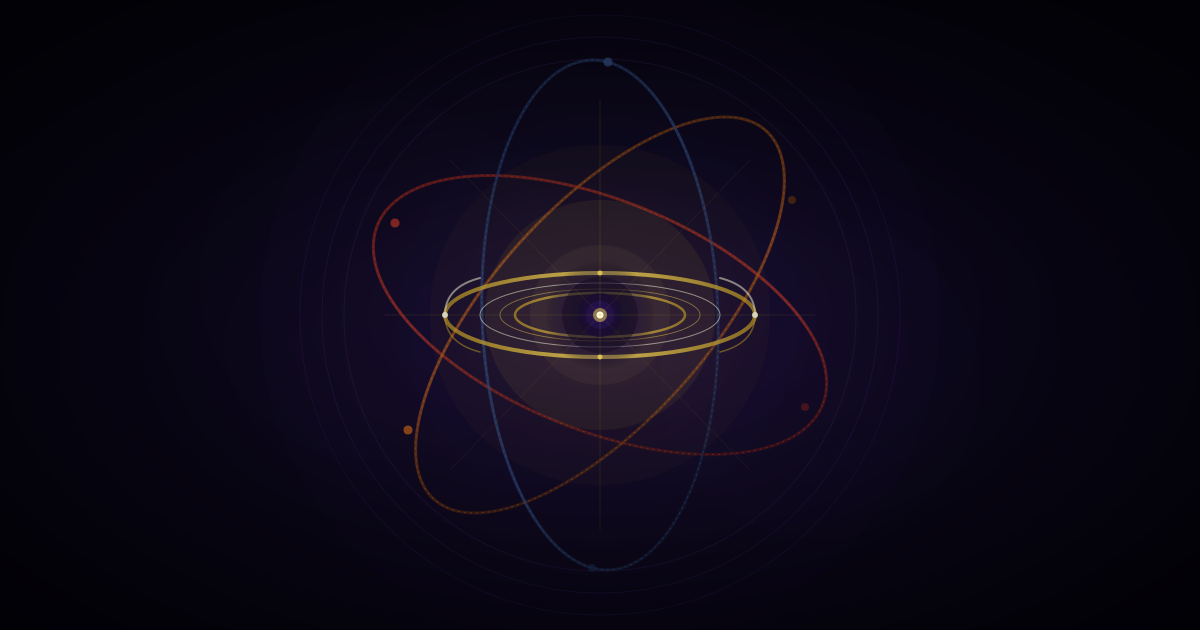
Three blame bodies in chaotic orbit becoming a stable four-body system when forgiveness enters as the fourth gravitational presence.
Key Takeaways
- Every conflict produces three simultaneous blame vectors — self, other, and situation — that orbit each other chaotically, because three gravitational masses pulling at once have no stable closed-form solution.
- Shame is not simply self-blame but self-blame turned recursive: a torus that orbits its own center and becomes impervious to ordinary self-improvement, which only supplies new material for shame.
- Forgiveness functions as a fourth gravitational body that does not eliminate the three blame vectors but restructures their relationship, the way a stabilizing mass at a Lagrange point resolves chaotic motion.
- The precise mechanism that breaks the recursive shame orbit is the Golden Rule applied inward — wishing for oneself what one would genuinely wish for any beloved person standing in the same position.
- The Four Spaces — give space, ask for space, maintain your own space, procure space for another — are the operational verbs of forgiveness when the abstract instruction to "just forgive" offers no foothold.
- Forgiveness is not forgetting, condoning, or reconciliation; it is releasing the orbit around the wound so that the energy locked in maintaining that orbit becomes available for something else.
Why Do Bad Things Feel So Personal?
There is an answer to this question that sounds like a riddle: bad things happen to good people because smart people do dumb things, and smart people do dumb things because they panic.
The compression in that sentence is intentional. Unpacked, it runs something like this.
When a threat appears — real or perceived, external or imagined — the nervous system does not wait for the prefrontal cortex to render a nuanced assessment of what is happening and why. The amygdala fires first, and it fires fast, routing activation through the threat-response circuitry before the part of the brain capable of contextual moral reasoning has received its first update. Joseph LeDoux's research on the emotional brain confirms that the amygdala can trigger fear and its behavioral consequences in the complete absence of conscious recognition — you are already moving, already reacting, already assigning blame, before the part of you capable of good judgment has woken up.
Robert Sapolsky, writing in Behave: The Biology of Humans at Our Best and Worst, observed that the prefrontal cortex — the seat of contextual, nuanced attributions of moral responsibility — is precisely the region that goes offline under stress. "The less developed, less active, or more impaired the frontal cortex," he wrote, "the less likely are nuanced, contextual judgments of moral responsibility." The more panicked the person, the more certain the blame. The more certain the blame, the less likely that it is landing in a place that is either accurate or useful.
This is not a moral failure. It is a physics problem disguised as a character issue.
Panic is not simply fear. It is mental phantasmagoria — the nervous system's overlay of threat-narratives onto the present moment, filling in the unknown with everything that has ever been frightening, generating a reading of the present situation that is shot through with the past. Under panic, a kitchen table argument becomes the template of every argument that preceded it. A raised voice becomes every raised voice the body has ever filed. A silence becomes all the silences that preceded abandonment. The person in front of you is simultaneously themselves and everyone who has ever worn that shape of danger.
In this state, the mind needs to do something with the energy of the threat. It needs to locate the source. It needs to know: who did this? And because the nervous system is working with compromised tools — reduced prefrontal nuance, heightened amygdala reactivity, a bias toward rapid threat-assignment over careful attribution — it does not arrive at a single, stable answer. It arrives at three.
Self. Other. Situation.
These three blame vectors are not a personality disorder. They are the default output of a panicked brain trying to locate danger. And the reason they never settle into a stable resting position is not because the person carrying them is confused or weak or spiritually undeveloped. It is because three gravitational masses, pulling simultaneously, cannot achieve a stable mutual orbit.
Henri Poincaré proved this in 1890. Musielak and Quarles confirmed it with modern computational methods in 2014. The three-body gravitational problem has no general closed-form solution. Given three masses of any size pulling on each other simultaneously, the system will not settle. It will continue in chaotic, unpredictable motion indefinitely — unless something intervenes.
The emotional physics are the same. The three blame vectors — self, other, situation — pull at each other in ways that feel exhausting, irrational, and outside of control, because they are outside of control in their current configuration. Not because the person bearing them is failing. Because the system, as constituted, has no stable solution.
Understanding this changes the relationship to blame itself. The problem is not that blame exists. The problem is that it is being expected to function as a three-body solution — which, by the mathematics of its own structure, it cannot provide.
The relationship between panic and the three blame vectors is not random. Sapolsky's research suggests a patterning that maps roughly onto threat type: other-blame tends to be the first activation under direct interpersonal threat (the amygdala's fastest threat-assignment move is to locate the source in the other); self-blame tends to arrive with a slight delay, as the prefrontal cortex begins the task of self-assessment under stress; situation-blame tends to arrive last, as the most cognitively complex attribution of the three, requiring the widest contextual frame. But the order is not fixed — it varies with attachment history, with socialization, with whether shame-proneness (Tangney and Dearing's construct) or other-directed aggression is the person's default threat response.
What matters for this framework is not the order of arrival but the recognition that all three arrive, that all three are always present in some proportion, and that the restless motion between them is not a sign of confusion but of a system doing exactly what three-body gravitational systems do. The exit is not a better strategy for managing the three bodies. The exit is a fourth presence that changes what the three bodies are orbiting.
Three Bodies in Orbit
Consider a rupture — not the extreme variety, but the ordinary, unremarkable kind that most people accumulate quietly over years: a relationship in which communication has broken down, trust has eroded, and both people involved are carrying a growing weight of unmet expectation.
In the aftermath of one of its ordinary bad evenings, the person carrying the wound sits with the three bodies in orbit.
The self-blame orbit. It arrives first or second — sometimes it rushes in ahead of the accusation, sometimes it arrives in the second wave, but it always arrives. What did I do to make this happen? The search backward through behavior: the tone used, the moment when an exit was possible and not taken, the pattern that has been repeating since long before this relationship. Self-blame is organized. It has a list. It can generate evidence with some ease, because the self is the only actor in the drama for whom complete behavioral footage is available. You cannot watch the other person from the inside. You can watch yourself.
The problem with the self-blame orbit is not that it is entirely wrong. Often it is partially right. But "partially right" is not the same as "a stable place to stand." As soon as the orbit settles toward self, the weight of it becomes unbearable, and the system throws itself back outward.
The other-blame orbit. Here is the list of what they did. The specific sentence. The pattern across months. The ways in which something was taken that was not offered, or something was withheld that was owed. Other-blame has the comfort of external referent — the source of the pain is locatable, nameable, outside of the self, which means it is, in theory, addressable. If they would change, the pain would stop.
Frederic Luskin's research at the Stanford Forgiveness Project introduced a useful concept here: the unenforceable rule. The other-blame orbit is almost always sustained by an unenforceable rule — an internal law about how the other person should have behaved, which they violated, and which cannot be enforced no matter how long or how loudly the violation is named. "You should not have said that." "You should have known." "A person who loved me would not have done this." Each of these rules is real as a standard; none of them can be made to retroactively change what happened. The orbit around other-blame is, in this sense, an orbit around something that cannot be moved.
The situation-blame orbit. Below both the self-orbit and the other-orbit is a third mass: the one that says nobody chose this. Both people were shaped by forces that preceded the relationship. Rubin Menakem's work on somatic ancestral inheritance illuminates this third orbit clearly: the body carries what earlier generations could not process, and what the body carries shapes behavior before conscious choice enters the picture. "Trauma that isn't transformed is transferred," Menakem writes. The situation-blame orbit knows that the tools both people brought to this table were handed down — that the tone she used was her mother's tone, which was her grandmother's tone before that. Nobody in the room invented their pattern from scratch.
The situation-blame orbit is the most accurate of the three — the one that most closely tracks what trauma research and developmental psychology confirm about how human behavior actually forms. And it is the least useful as a resting place, because it removes individual agency entirely. If everything was shaped by forces outside of choice, then choice is impossible, which means change is impossible, which means the only position available is despair.
There is also a meta-level observation about the three orbits that matters: they are not mutually exclusive. This is what makes the three-body configuration so distinctively difficult. A person does not usually inhabit only one orbit at a time. They inhabit all three simultaneously, with shifting weight distributions — mostly self-blame this hour, shifting to other-blame under certain conversational triggers, collapsing into situation-blame in the small hours of the morning. The weights redistribute based on context, on nervous system state, on what someone last said, on whether there was sleep, on whether the body is fed. And because the weights redistribute, the sense of solid ground never arrives. Each time the orbit seems to settle, it destabilizes again. This is not psychological fragility. This is the characteristic behavior of a three-body gravitational system.
There is also a social dimension that the physics metaphor captures well. In any conflict, there are at least two people carrying three orbiting bodies each. The person who caused harm has their own three bodies — their own self-blame, other-blame, and situation-blame, configured differently, weighted differently, but structurally identical. What happens when two people's three-body systems interact is not a simplification of the problem. It is a six-body problem, with exponentially more chaotic potential. The conversations that cycle endlessly in relationships in crisis — the arguments that keep having themselves, the conversations that seem to begin at the same point and end at the same point no matter how many times they are attempted — are, at the physics level, exactly what six mutually interacting gravitational masses do when left to their own dynamics.
This is not a counsel of despair. It is a description of the actual problem. The first step toward a fourth body is accurately seeing that the three-body system is not merely complicated — it is structurally unsolvable within its current configuration. That recognition is itself a form of relief: the reason resolution has not arrived is not because the people involved are failing. It is because three gravitational masses do not have a general closed-form solution.
Poincaré's insight was that the three-body gravitational system is not simply unstable — it is chaotically unstable. The motion is not merely irregular; it is sensitive to initial conditions in ways that make long-term prediction impossible. In the emotional equivalent: which blame orbit you land on depends not on the facts of the situation but on the state of your nervous system at the moment of landing. A person who woke up rested lands differently than one who did not. A person whose threat-system was already activated by something else lands differently than one whose nervous system was regulated. The chaos of the three-body blame orbit is not a sign of psychological instability. It is a predictable output of three gravitational masses being expected to solve a problem that three gravitational masses, by their mathematical nature, cannot solve.
Self-blame, other-blame, and situation-blame locked in mutual chaotic pull with no closed-form solution.
:::plate{slug="no-blame-stands-alone" locale="en"} No blame stands alone — every wound has three shadows. :::
This is the first crucial reframe: the restless, exhausting motion between self-blame, other-blame, and situation-blame is not a failure. It is the system working exactly as a three-body system works — which is to say, without a stable solution. The exit from the chaos is not found within the three-body system. It requires a fourth body.
Shame Is a Black Hole
Before arriving at the fourth body, one of the three warrants closer examination — because it is qualitatively different from the other two in ways that matter enormously.
Shame is not simply the self-blame orbit in a more intense form. It is a different animal.
Ordinary self-blame, as described above, has an object. I did this specific thing. I behaved in this specific way. The orbit circles around a behavior, which means it can, in theory, be addressed. Guilt — the behavioral form of self-accountability — circles around actions and can generate repair. This is why Brené Brown's research on the distinction between shame and guilt is so important for understanding what the self-blame orbit sometimes becomes: "Shame is highly correlated with addiction, violence, aggression, depression, eating disorders, and bullying. And guilt is inversely correlated with those things." Guilt says: I did something bad. Shame says: I am bad.
The shift from the behavioral to the identity level is the moment the self-blame orbit collapses into something with different physics. Tangney and Dearing's research on shame-proneness confirms the mechanism: shame involves a painful focus on the self as a totality, whereas guilt involves a painful focus on a behavior. A person in guilt can imagine acting differently. A person in shame cannot — because the problem is not what they did but what they are, and what they are cannot be changed by future action.
This is where the torus metaphor becomes useful. Imagine the self-blame orbit as a flow that normally circulates outward — pain moves from inside the person toward an object (a behavior, a choice, a pattern) and can, from there, move toward repair. The natural direction of this flow is: notice → feel → understand → change. But shame inverts the torus. Instead of flowing outward toward an object, the energy folds inward, and the flow begins to orbit itself. I am bad for feeling bad. I am weak for feeling shame about being weak. I should not need to be forgiven — the fact that I need forgiveness proves I am unforgivable.
The recursion is the key feature. Each layer of self-attack generates the next layer. The shame system becomes self-fueling, self-sealing. And here is the specific reason that ordinary self-help tends to bounce off it: any attempt to improve generates new material for the shame spiral. I tried to change and I failed — which proves I am irredeemably broken. I tried to forgive myself and it didn't work — which proves the self I was trying to forgive was right about what it is.
Paul Gilbert, whose work on the compassionate mind draws on evolutionary psychology and Buddhist practice together, identifies the neurological basis of this: the self-attack system and the self-compassion system run on different neural substrates. The threat system — which generates shame — activates the same circuitry as external threat perception. The soothing system — which makes self-compassion possible — requires a different activation path entirely, one associated with warmth, care, and safe connection. Trying to shame yourself out of shame is, neurologically, like trying to extinguish a fire by adding oxygen. The effort to eliminate shame through self-criticism is feeding the system it is trying to starve.
The black-hole metaphor in the article's title is precise: a black hole is a region where the normal physics no longer apply, where even light — the thing that makes visibility possible — cannot escape. Shame is a black hole in this sense. The ordinary light of self-reflection, which would allow someone to see their behavior accurately and change it, is consumed by the recursive orbit rather than emerging as usable information. The person in shame cannot see themselves clearly, not because they are refusing to look, but because the looking itself has been colonized by the attack system. Everything they see confirms the verdict.
This is why the three siblings in this trilogy — The Cycle of Harm, Hurt People Hurt People, and You Didn't Start This — each approached the question of self-accountability with care about the shame dynamic. The Cycle of Harm established that harmful behavior is almost always a trauma response, not a moral choice. Hurt People Hurt People described the witness capacity — the ability to see one's own contraction before it becomes behavior — as the pivot point. You Didn't Start This lifted the pressure to have already forgiven, naming explicitly that "the pressure to forgive before you are ready can actually impede healing by adding a layer of self-judgment to an already heavy load."
This article is the place the trilogy was always pointing toward. And it begins with the recognition that the fourth body — the one that can stabilize the three-body chaos — must be capable of operating inside the black hole of shame as well as in the more navigable territory of ordinary self-blame and other-blame. It must work when ordinary tools do not.
Shame as an inverted torus where self-blame folds inward, sealing itself from ordinary self-help or self-reflection.
The Fourth Body
In the physics of the three-body problem, the search for stable solutions has not been entirely fruitless. Mathematicians have found special cases: configurations in which the three bodies move in patterns that, under very specific conditions, can maintain stability. These configurations are not stable in the sense of being impervious to disruption — they are stable in the sense of having a coherent, recognizable form.
The emotional equivalent is forgiveness.
Not forgiveness in the version most people have been handed — as a spiritual directive, a religious obligation, a moral performance expected of victims by those who were not victimized. That version of forgiveness is, if anything, a fourth force that adds to the system's chaos rather than resolving it. "Just forgive" applied without mechanism is simply another unenforceable rule layered on top of the other unenforceable rules.
Forgiveness as the fourth body is something more specific, and more structural. Robert Enright, whose Process Model of Forgiveness represents four decades of systematic empirical research, defines forgiveness as "a willingness to abandon one's right to resentment, condemnation, and subtle revenge toward an offender who acts unjustly, while fostering the undeserved qualities of compassion, generosity, and even love toward him or her." Two elements of this definition are worth dwelling on.
The first is the phrase "a willingness to abandon." Not the accomplishment of abandonment — the willingness to move toward it. Enright's research on the four-phase process (Uncovering → Decision → Work → Deepening) confirms that forgiveness is not a single moment of release but a journey that begins with a decision and unfolds through active engagement. The decision precedes the feeling. This matters enormously for people who are told "I'll forgive when I'm ready" — readiness, in Enright's framing, is not a prerequisite for beginning; beginning is what generates the readiness.
The second is that forgiveness fosters undeserved qualities toward the offender — compassion, generosity, even love. This sounds impossible in many situations. The Dalai Lama's framing is more useful here than the moral imperative: the compassion extended toward someone who has caused harm is selfishly intelligent. A happy person stops hurting people. A person whose needs are met at every Maslow altitude does not chronically harm others from a place of panic and contraction. Wishing the harmer wellbeing is not altruism — it is the most effective available intervention in the system that produced the harm. You are not forgiving them because they deserve it. You are releasing your orbit around the wound because you deserve what becomes available when the orbit releases.
Luskin's research at Stanford confirms this in practice: people taught to forgive show measurable reductions in hurt, anger, and stress symptoms. His "unenforceable rules" framework provides the mechanism: the blame orbit is sustained by an internal law that says the situation should have gone differently, and no amount of repeating the violation will change what happened. Forgiveness does not say the rule was wrong — it says the orbit around the unenforced rule is costing more than it is returning. "You forgive not because the other person deserves it," Luskin writes, "but because you deserve peace."
As the fourth body in the orbital system, forgiveness restructures the dynamic. It does not eliminate self-blame, other-blame, or situation-blame — all three may remain as information, as data about what happened and what needs to change. What changes is the relationship to them. The orbit around them loosens. The gravitational pull that has been keeping the psyche locked in chaotic motion relative to these three masses diminishes, not because the masses disappear but because a new attractor has entered the system.
The fourth body is not simply "add forgiveness to the mix and stir." It is a fundamental reorganization. The system that had three bodies pulling chaotically now has a fourth presence around which the other three can find their relationship to each other. The torus can resume its outward flow. The self-blame can become useful accountability rather than recursive shame. The other-blame can become clear-eyed assessment of what actually needs to change rather than endless orbit. The situation-blame can become structural understanding rather than despair.
Klimecki and Singer's neuroscience of compassion training is relevant here as supporting evidence: compassion training — which is functionally related to forgiveness practice in its emphasis on extending warmth toward difficult figures — produces measurable functional neural changes, particularly in regions associated with positive affect and prosocial motivation. This is not a metaphor. The fourth body's entry into the system changes the physics at the neural level, not only at the conceptual level. The brain that has been trained toward forgiveness literally processes the wound differently — not with less reality, not with denial of what happened, but with different circuitry engaged in the processing.
The distinction Singer and Klimecki draw between empathy and compassion is also useful here. Empathy — matching the other's emotional state — leads to empathic distress and eventual avoidance of the other person, the wound, and the processing itself. Compassion — holding the other's reality with warmth rather than replication — is sustainable and generative. Forgiveness, properly understood, is an act of compassion rather than empathy. It does not require matching the harmer's inner experience or taking on the weight of their pain. It requires extending genuine warmth toward the harmer's humanity — which, counterintuitively, is more available than empathy because it does not require identification, only care.
This is what the up-spin is. And it begins with a very small, very specific practice.
The Golden Rule as Mechanism
There is a version of the Golden Rule that most people know: treat others as you would wish to be treated. It appears in some form in every major ethical and spiritual tradition — Karen Armstrong's research in Twelve Steps to a Compassionate Life catalogues at least five independent civilizational discoveries of the same principle; Jeffrey Wattles's philosophical study of the Golden Rule traces its appearance across cultures as diverse as ancient Egypt, Confucian China, Vedic India, classical Greece, and the Hebrew Bible. This cross-cultural convergence is itself evidence of something — not merely a shared moral intuition, but what the article on the Golden Rule as a Fractal Law of Life calls a structural truth about how human systems function at every scale. The rule is not platitude. It is pattern.
But there is a direction of application that rarely appears in the familiar versions of the rule, which is always framed outward — toward the other, toward the community, toward the stranger. The direction inward — treating yourself as you would wish to be treated — is the direction the Golden Rule must travel to become the mechanism that breaks the shame recursion.
Consider the person trapped in the black hole described in the previous section. They cannot see themselves clearly because the self-attack system has colonized the capacity for self-perception. The compassion system — the one that could generate self-correction from a place of warmth rather than terror — has been suppressed by the threat system. No amount of reasoning about their own behavior is going to reach the center of that orbit, because the reasoning itself will be absorbed.
Now consider a different approach. Take everything you know about the situation — the full weight of it, the ways in which you participated, the ways in which you were shaped by forces that preceded you, the real harm that occurred. Now imagine a friend of yours — someone you love, someone you regard with genuine care — standing in exactly your position. Same history, same actions, same context, same situation. Everything identical. What would you wish for this friend?
Not what would you say to them. Not what would you recommend. What would you wish for them?
The experiment almost always produces a different list than the one the self-attack system generates. The wish-list for the friend includes understanding, context, the recognition that they did something harmful but are not irredeemably harmful, the opportunity to repair what can be repaired, the grace to carry forward what cannot be repaired without being crushed by it. The wish-list for the friend includes genuine care.
Kristin Neff's research on self-compassion demonstrates that this is not merely a spiritual exercise — it is an empirically testable shift in psychological outcome. Self-compassion increases rather than decreases accountability; it does not let the self "off the hook" but instead creates the psychological safety in which honest self-examination becomes possible without triggering the shame cascade. People who practice self-compassion show greater motivation for behavior change, not less.
Worthington's REACH model — Recall, Empathize, Altruistic gift, Commit, Hold — places empathy as the single strongest predictor of emotional forgiveness. In the self-directed version, the empathy is toward oneself: the ability to feel, genuinely, the pain of one's own situation from a stance of care rather than prosecution. This is not indulgence. It is the movement from the threat system to the soothing system that Gilbert describes — and it is the only movement that can reach the center of the black hole.
The full practice is this: Write the wish-list for your friend who is standing in your position. Write it as specifically as you can — what you would actually wish, not what you think you should wish, not what sounds spiritually correct. Then read the list back to yourself, replacing "my friend" with "I." Say it aloud if the room permits. If not, say it where the body can hear it, in the chest, where the orbit is tightest.
This is the Golden Rule applied inward. It is small. It is not a resolution. It is a first move.
:::plate{slug="be-your-own-friend" locale="en"} Be to yourself the friend you would be to anyone you love. :::
The Regla de Oro — the Golden Rule in its Spanish-language iteration, which carries its own cultural weight, its own proverb tradition, its own generational transmission — applies the same structural insight. No hagas a los demás lo que no quieres que te hagan a ti. The negative formulation is the boundary-setter; the positive formulation is the generator. The self-directed version of the positive formulation is: do for yourself what you would do for anyone you love who stands where you are standing. Start there. Just there. One move.
Paul Gilbert's compassionate mind training, which builds on this exact principle, shows measurable changes in the neural patterns associated with self-attack when the practice is sustained. The soothing system can be trained. The torus can be gently, gradually redirected outward. The black hole can, over time, open enough to let some light through.
The Four Spaces as Forgiveness Scaffold
"Just forgive" is not a practice. It is a destination named without a route.
The Four Spaces framework — give space, ask for space, maintain your own space, procure space for another — is the route. It is the operational vocabulary of forgiveness made concrete enough to begin at any altitude of Maslow's pyramid, in any degree of readiness, with or without any contact with the person who caused harm.
Each space is a practice in itself, and together they form the scaffold on which forgiveness can be built even when forgiveness does not yet feel available.
Give space. This is the practice of allowing the three-body orbit to exist without trying to immediately resolve it. Not embracing the chaos, not surrendering to it — simply not forcing a resolution that is not yet available. The three bodies are pulling. That is what they do. Give them room to pull without demanding that they settle on a conclusion. The giving of space is the first move away from the urgency that keeps the orbit tight.
From a polyvagal perspective — Stephen Porges's framework for understanding the autonomic nervous system's organization of safety, danger, and connection — giving space is the practice of downregulating the sympathetic activation that keeps the blame-assignment circuitry running. The ventral vagal state — the physiological signature of genuine safety, connection, and expanded awareness — is the state in which forgiveness becomes available. You cannot move into ventral vagal territory by willing yourself there; you can create the conditions for it by giving the nervous system space to regulate. This is not a metaphor. It is physiology.
Ask for space. This is the practice of making the need explicit — to another person, to the situation, sometimes to one's own internal architecture. I need some distance from this in order to see it. The asking of space is an act of self-knowledge and self-advocacy. It is the recognition that the three-body orbit cannot be navigated from inside the orbit's tightest point. Some altitude is required — not the altitude of detachment, which loses the felt reality of what happened, but the altitude of perspective, which allows the pattern to become visible.
Maintain your own space. This is the ongoing practice that neither the giving nor the asking accomplishes alone. It is the daily, unglamorous work of staying connected to one's own inner state — the body's signal system, the nervous system's readings, the quiet informational content of emotions before they convert to blame. Porges's Polyvagal Theory describes the social engagement system as the most recently evolved layer of the autonomic nervous system — the one that makes nuanced interpersonal connection possible. Maintaining your own space is the practice that keeps this system online rather than collapsing into the older, less differentiated fight/flight/freeze responses.
Procure space for another. This fourth practice is the most relational, and the one that requires the most groundedness to execute. It is the practice of creating conditions in which the other person — the one who is also carrying three orbiting blame bodies, the one who is also panicking, the one who is also doing the best they can with what they have — can also find some altitude. Not because they deserve it, necessarily. Because the system changes when both parties have some space, and a changed system is the context in which forgiveness can occur.
Four quadrants mapping fight, flight, freeze, and fun show that forgiveness becomes available only in the regulated, ventral-vagal state.
The Four Spaces are not a linear sequence — they are not steps to be completed in order before forgiveness becomes available. They are practices that cultivate the inner and relational conditions in which forgiveness can occur spontaneously, the way certain plants require specific soil conditions before they will flower. The forgiveness itself is not something manufactured. It is something uncovered.
The "fun" quadrant in the diagram deserves specific attention. The Four Spaces framework maps human states onto four basic orientations: fight, flight, freeze, and fun. The first three map onto threat responses — sympathetic activation (fight, flight) and dorsal vagal shutdown (freeze). The fourth — fun — maps onto the ventral vagal state of genuine regulation, safety, and expansion. Fun is not frivolity. It is the physiological signature of a nervous system that has found, at least temporarily, that the danger has passed.
Forgiveness does not live in fight, flight, or freeze. It lives in fun — in the expanded, regulated, connected state in which the three-body orbit has quieted enough to allow a different relationship to what happened. The Four Spaces practices are the route from the threat states to the fun state — the route from the tight orbit to the open space in which the fourth body can do its work.
Hurt people hurt people.
The Up-Spin
This is the crown of what the trilogy has been building toward.
The Cycle of Harm described the down-spin: Panic → Blame → Harm → More Panic. Each rotation of the torus tightens the contraction, adds to the wound, and increases the likelihood of the next rotation. The down-spin is the engine of the cycle of harm — the mechanism by which unprocessed pain becomes transmitted harm, which becomes new unprocessed pain.
The up-spin is the same torus, rotating in the opposite direction.
It runs: Space → Forgiveness → Generosity → Gratitude → Recognition of oneness.
Each element is the previous one opened wider.
Space is the beginning — the Four Spaces practices, the giving of room to the three-body orbit, the creation of the physiological conditions in which something other than panic-driven blame becomes available. Space does not require that the situation has resolved or that justice has been served or that the other person has changed. Space is an internal act, available independent of external conditions. It is the first turn of the torus in the upward direction.
Forgiveness enters when space has been created — not as a decision to pretend the wound did not happen, but as the release of the gravitational lock. The fourth body has entered the system. The orbit around the wound begins to loosen. What has been locked in maintaining the orbit becomes available for other uses. Enright's "deepening phase" — in which a person begins to find meaning, even unexpected gift, in the process of having passed through the wound — is not the starting point. It is what emerges when the previous phases have been walked.
Generosity is what becomes possible when the energy that was locked in the blame orbit is released. Not generosity as performance or as strategic kindness — generosity as the natural expression of a system that is no longer maintaining a tight orbit around injury. The article on The Art and Science of Generosity maps this as the toroidal economy in action: giving from overflow rather than from scarcity. When the energy that was sustaining the blame orbit becomes available, it is available for something. That something tends, in practice, to move toward others — not because it is required to, but because connection is the natural direction of an uncontracted self.
Gratitude deepens as generosity circulates. There is a physics to this that Thich Nhat Hanh's concept of interbeing illuminates: "You cannot be yourself without me, and I cannot be myself without you." The boundary between self and situation becomes more permeable — not dissolved, but seen through a different lens. Gratitude is not the performance of appreciation for things that were painful. It is the authentic recognition that even the wound was part of a web that extends in all directions, that nothing happened in isolation, that the three-body chaos that felt so private was always also a planetary event. The Toroidal Economy and paying it forward are, in a sense, what gratitude does when it becomes action.
Recognition of oneness is the deepening phase at the far end of the up-spin. It is not the erasure of difference or the denial of harm. It is the recognition — which comes not from reasoning but from having lived through the process — that the harmer and the harmed are not strangers from different worlds. They are both people who panicked, or who were panicked, or who were shaped by panicking that preceded them by generations. The Golden Rule as a fractal law is, in its deepest form, the recognition of oneness: treating the other as you would wish to be treated because, at the level that matters most, you and they are not entirely separate.
Shantideva, writing in the eighth century in the tradition of Tibetan Buddhism, expressed this in a way that remains as precise as anything clinical psychology has produced: "All suffering comes from seeking happiness for oneself; all happiness comes from seeking happiness for others." This is not a call to self-abnegation. It is a description of the physics of the up-spin — the recognition that the self-other boundary, when held rigidly under panic, generates the conditions for harm; and that the loosening of that boundary, through forgiveness and the practices that attend it, generates the conditions for healing.
:::plate{slug="forgive-see-not-forget" locale="en"} Forgiveness is not forgetting — it is finally seeing clearly. :::
The up-spin is not a one-time arrival. It is a direction of travel. A person who has entered the up-spin will still encounter the down-spin — will still have days when the three-body orbit resumes its chaos, when the shame recursion tightens, when generosity is not available and the wound feels as fresh as it ever did. The up-spin is not a permanent state. It is an orientation: a direction the torus has learned is available.
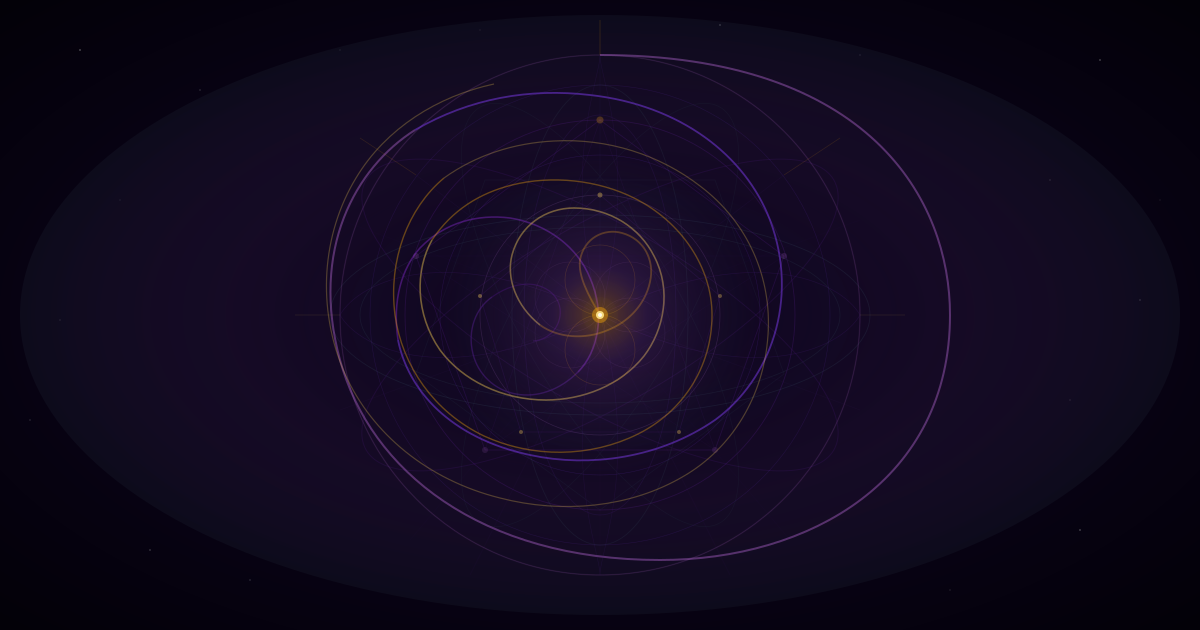
Two spirals side by side — the down-spin tightening from panic toward harm, the up-spin opening from space through forgiveness toward recognition of oneness.
The companion articles in this series — Golden Rule as a Fractal Law of Life, The Spectrum of Compassion, and Toroidal Economy — each pick up one thread from this up-spin sequence and trace it further. This article hands over the thread where forgiveness opens into generosity. What generosity does when it meets the world is the territory those articles inhabit.
But What About the Big Ones?
The architecture described above — three-body orbit, fourth body, Four Spaces, Golden Rule applied inward, up-spin — was built with the ordinary ruptures of ordinary human life in mind. The kitchen table argument. The workplace betrayal. The friendship that dissolved. The family silence that has lasted years.
But the honest question that sits in the back of this entire framework is: what about the big ones?
What about childhood abuse? Systemic oppression? The betrayal that restructured everything that came after it? The violence that left marks the body still carries? The generational harm that shows up in the nervous system of someone who was not even born when the original wound occurred?
The framework does not flinch from this question. But it also does not pretend the answer is the same as it is for a kitchen table argument.
Bessel van der Kolk's research on trauma is blunt on one point: "We now know that trauma is not just an event that took place sometime in the past; it is also the imprint left by that experience on mind, brain, and body." Intellectual forgiveness — the cognitive decision to release the orbit — does not, by itself, release the body. The body's trauma response can remain activated long after the mind has decided to move on. This is not a moral failure. It is a physiological reality. Forgiveness at the intellectual level is available before forgiveness at the somatic level, and the somatic level is what most of the clinical literature on trauma actually addresses.
Resmaa Menakem's work on racialized somatic healing is directly relevant here: some wounds are not individual wounds at all. They are carried in the body as ancestral inheritance — the accumulated trauma of generations transmitted somatically before conscious choice enters the picture. Forgiving an individual act of harm does not, by itself, heal the somatic inheritance that the individual act activated. The scope of healing required, in these cases, is proportionally larger.
Everett Worthington's research on forgiveness makes the critical distinction: decisional forgiveness (a behavioral commitment to release the claim) is available earlier and more widely than emotional forgiveness (the actual shift in felt experience). This matters because the pressure to have arrived at emotional forgiveness prematurely — particularly in the context of ongoing harm, unaddressed systemic injustice, or trauma that is still being held in the body — is not a forgiveness practice. It is a form of spiritual bypassing that adds a layer of self-judgment to the wound.
The framework offered in this article is not a claim that forgiveness is always available, always appropriate, or always the highest priority. It is a description of what forgiveness is, structurally, when it is available — and a set of practices that cultivate the conditions in which it can occur without forcing it before its time.
For the big ones: the sequence is the same, but the timeline is longer, the somatic work is non-optional, the support required is greater, and the scope of "situation-blame" may include whole systems that have not yet changed. Forgiveness at scale — the forgiveness of systems, of structures, of inherited wounds — is a different and more complex undertaking than the forgiveness of an individual act. It does not require beginning there. It only requires beginning where beginning is possible.
The first move is still the same: give space to the three bodies. Ask for space. Maintain your own. Procure space for another where you can. The first move is always available, even when the full arc of healing is still far away.
Forgive them, for they know not what they do.
— Luke 23:34 (KJV)
What Forgiveness Is Not
Because the word carries so much accumulated freight, a direct account of what this framework does not mean by forgiveness is warranted.
Forgiveness is not forgetting. The plate candidate from the research notes puts it directly: forgiveness is not forgetting — it is finally seeing clearly. Forgiveness, properly understood, requires memory. You cannot release your orbit around something you have not first clearly seen. The clarity of perception — the ability to see the three-body system and the role each body played — is not diminished by forgiveness. It is, in most accounts of those who have moved through the process, actually enhanced. Forgetting is the request of people who caused harm and want their victims to have shorter memories. Forgiveness is the act of people who have been harmed and want their own nervous systems back.
Forgiveness is not condoning. The release of the blame orbit does not mean the behavior was acceptable, appropriate, or without consequence. The fourth body entering the system does not retroactively make the wound not happen. Accountability, consequences, structural change, repair where it is possible — none of these are foreclosed by forgiveness. A person can forgive an action and continue to advocate fiercely for structural change that would prevent the same action from occurring again. The two are not in tension; they operate on different planes.
Forgiveness is not reconciliation. This is perhaps the most important distinction for people in abusive or ongoing harmful relationships: forgiveness is an internal act, requiring only the person who was harmed. Reconciliation — the resumption of relationship — requires the active, sustained participation of the other party and can only be appropriate where the conditions that produced the harm have genuinely changed. These are separate events. Forgiveness can occur in the complete absence of reconciliation. Reconciliation without forgiveness produces a different set of problems. The conflation of the two is the source of enormous additional suffering for people who were told "if you've forgiven him, you should be able to have him at the family table."
Forgiveness is not a performance. The announcement of forgiveness before the internal process has occurred is not forgiveness. It is social compliance that leaves the orbit intact beneath the performance. It can actually prolong the process by blocking access to the genuine emotional content — the anger, the grief, the righteous recognition that something unjust occurred — that the forgiveness process needs to work through, not past.
Forgiveness is not resolution. Forgiveness does not require that the situation has resolved — that justice has been served, that the other person has changed, that the wound has fully healed. It is precisely because forgiveness precedes these things that it has any transformative power at all. Waiting for resolution before forgiving is waiting for an external event to grant an internal freedom. The internal freedom is available — when the conditions for it have been cultivated — independent of external resolution.
The Practice
The entire architecture above — the three-body physics, the shame-as-black-hole geometry, the four-body stabilization, the Golden Rule mechanism, the Four Spaces, the up-spin sequence — can be approached through a specific, small, repeatable practice.
Five breaths. Accessible anywhere. No prior preparation required.
Breath one: Name the three bodies. Self-blame: what am I carrying about my own role? Other-blame: what am I carrying about their role? Situation-blame: what am I carrying about the larger forces that shaped this? Name them without judgment, without trying to resolve them. Three breaths for three bodies, if needed.
Breath two: Locate the orbit. Where in the body is the tightest point of the blame rotation right now? The chest, the jaw, the shoulders, the stomach? No need to change it. Just locate it, feel it, let it be as exactly as large as it is.
Breath three: Call up the friend. Bring to mind someone you love — or the generic image of a person you regard with genuine care — standing in exactly your position. Same situation, same history, same mess. Exactly where you are. What do you wish for them? Let the list form.
Breath four: Turn the list inward. Read the wish-list to yourself. Not to anyone else. Not as a performance. To the part of you that is in the orbit. Say it where the body can hear it.
Breath five: Step into what opens. Something has shifted — perhaps very slightly, perhaps more than expected. Whatever space has opened, step one millimeter into it. Not a resolution. Not a transformation. One millimeter.
This is not the completion of forgiveness. It is the first turn of the torus in the upward direction. It is available right now, before any external circumstances have changed, before any other party has acknowledged anything, before any justice has been served. It is the first move.
A few practical notes for the practice:
On the friend visualization: The friend does not need to be a real person. Some people find it easier to use a generic image — a person whose face is turned slightly away, or a child, or a silhouette. What matters is the quality of genuine care attached to the image. If no such image comes easily — if the self-attack system is so activated that even the visualization feels threatening — then the first practice is simply to locate the tightest point in the body, give it a name, and breathe toward it without trying to change it. This is still the practice. This is still a first move.
On repetition: This is not a one-time event. The five-breath practice is designed to be returned to — in the morning before the day's demands begin, in the moment when a conversation has stirred the orbit, in the gap between stimulus and response that Frankl named as the last human freedom. Each return is another small turn of the torus. The direction accumulates even when no individual practice feels significant.
On the relationship between decisional and emotional forgiveness: Worthington's research confirms that making the decision to work toward forgiveness — even before the emotional release has arrived, even when the wound is still fully felt — creates measurable changes in outcome. The decision is not a performance of something you do not yet feel. It is the first organizational act of the fourth body entering the system. The feeling follows the direction, sometimes slowly, sometimes with unexpected speed, but it follows from practice rather than arriving in advance of it.
On setback: There will be days when the practice seems to produce no movement, when the three bodies are pulling as tight as they ever have, when the wound feels as fresh as it did on the day it arrived. These days are not evidence that forgiveness is impossible or that the practice has failed. They are evidence that the wound has layers — that healing moves in spirals rather than straight lines, and that the layer currently presenting is one the process has not yet reached. The first move is available on those days too, in exactly the same form: name the three bodies, locate the orbit, call up the friend, turn the list inward, step one millimeter into what opens. Even on the days when the millimeter feels microscopic.
Closing the Trilogy
The articles before this one described the wheel. The Cycle of Harm named the mechanism: panic, unmet need, harm, transmission. Hurt People Hurt People described the inside of that transmission: the contracted self, the shame architecture, the witness capacity that can pause the automatic circuit. You Didn't Start This addressed the recipient of harm: the wound is real, the verdict it carries about your worth is not, the story is not over.
This article was the destination the trilogy was traveling toward: the mechanism that stops the wheel.
Not the promise that the wheel will be easy to stop. Not the assurance that the stop will be permanent on the first attempt, or that large wounds will yield as easily as small ones, or that the body will follow where the mind has decided to go without its own process and timeline. Not the claim that forgiveness is always the right priority, or the highest one, or the one that a person owes to anyone who harmed them.
The mechanism: a fourth body that restructures the gravitational system without requiring the three blame bodies to disappear. A Golden Rule that works inward. Four Spaces that cultivate the conditions. An up-spin that is, always, the other direction available on the same torus.
The wheel turns because panic is transmitted. The wheel stops turning — gradually, imperfectly, incompletely at first, and then more fully — when space is given, and forgiveness is cultivated, and generosity begins to flow from what was released, and gratitude deepens into the recognition that nothing ever happened in isolation, and the recognition opens into something that cannot quite be named but that Thich Nhat Hanh called interbeing, and that the grandmother who said borrón y cuenta nueva — wipe the slate and start again — was pointing toward when she had run out of more precise words.
This article closes the Cycle of Harm trilogy. The companion pieces are The Cycle of Harm, Hurt People Hurt People, and You Didn't Start This. The up-spin sequence continues in Golden Rule as a Fractal Law of Life, The Spectrum of Compassion, and Toroidal Economy.
Invitation
There are three weights you have been carrying.
The one you blame yourself for. The one you blame them for. The one you blame the world for. Each of them is real. None of them is the whole picture. And all three of them have been pulling at you simultaneously — not because you are confused or weak or spiritually undeveloped, but because that is what three gravitational masses do when they are expected to stabilize each other without a fourth presence to reorganize the field.
You do not need to put them down all at once. You do not need to have forgiven anyone before reading the next sentence. You do not need to feel ready for anything that follows.
There is one small practice available right now, exactly as things are.
Think of someone you love — or think of the generic shape of a person you regard with genuine care — and imagine them standing exactly where you are standing. Same wound, same mess, same three weights. Everything identical. What do you wish for them? Let the list form in whatever way it forms. What understanding, what context, what grace, what possibility — what do you genuinely wish for this person you care about, who is standing exactly where you are?
Now say it to yourself.
Not out loud if the room does not permit. Say it in the chest, where the orbit is. Say it where the body can hear it.
What I wish for you is what I wish for myself. What I would wish for myself, standing here, is this.
This is the five-breath practice: name the three bodies, locate the orbit, call up the friend, turn the list inward, step one millimeter into what opens.
The step is small. The direction it points is not.
People Also Ask
How do I forgive someone who has not apologized?
Forgiveness, as described in this framework, is an internal act — it does not require any participation from the person who caused harm. The common confusion is that forgiveness depends on the other party's acknowledgment, remorse, or change. This confusion makes forgiveness hostage to an event that may never occur, which is a different kind of orbit: waiting for permission to be free.
The research on forgiveness — particularly Enright's process model and Worthington's REACH framework — consistently distinguishes between forgiveness (an internal release of the blame orbit) and reconciliation (a resumed relationship requiring the other party's active participation). Forgiveness can occur in the complete absence of an apology, acknowledgment, or change. It occurs not because the offense was acceptable but because the person forgiving has decided that the energy cost of maintaining the orbit is higher than the freedom available from releasing it.
The Five Spaces practice in this article — including the Golden Rule applied inward — can be worked entirely alone, without contact with the person who caused harm. Begin there. The question of whether contact will ever be appropriate or desired is separate from the question of whether the internal process can begin.
Isn't forgiveness just letting them off the hook?
This is one of the most durable misconceptions, and it rests on a conflation: that the purpose of maintaining the blame orbit is to keep the other party accountable. In practice, the continuation of the orbit rarely affects the other party's behavior at all — particularly when they are not present, not aware of the orbit, or are not in relationship with the person holding it. The person carrying the orbit is the one most affected by it.
Luskin's Stanford research is useful here: forgiveness reduces hurt, anger, and stress symptoms in the person who forgives — not in the person who was forgiven. The other party's accountability, consequences, and responsibility for repair are entirely separate questions from whether the person who was harmed continues to maintain a tight gravitational orbit around the wound. These questions live on different planes.
Forgiveness does not say the offense was acceptable. It does not eliminate the appropriate pursuit of accountability, structural change, or repair. A person can forgive an action and simultaneously advocate for consequences, systemic change, and the prevention of the same harm to others. The two are not in competition. What forgiveness releases is not the other party's accountability — it is the forgiver's orbit.
Does forgiveness mean reconciliation?
No. This is the most important distinction in the article, and it cannot be stated plainly enough.
Forgiveness is an internal act requiring only the person who was harmed. Reconciliation — the resumption of relationship — requires the sustained, genuine participation of both parties and is only appropriate where the conditions that produced the harm have genuinely, verifiably changed. The conflation of these two has caused enormous additional suffering to people who were told that forgiving someone means resuming contact, returning to a relationship, or accepting an ongoing situation that was not safe.
A person can fully forgive an abusive parent without ever resuming regular contact. A person can fully forgive a betrayal without restoring trust, because trust is based on demonstrated behavior over time — not on internal release of the blame orbit. The forgiveness is real. The boundary is also real. The two coexist.
Reconciliation requires: (1) genuine acknowledgment of what occurred, (2) evidence of changed behavior, (3) safety for the person who was harmed, and (4) the genuine desire of both parties to restore relationship. Forgiveness requires none of these. It is available without them.
How do I forgive myself without excusing what I did?
The confusion between self-forgiveness and self-excusing tracks exactly the shame-vs-guilt distinction described in this article. Shame says: I am fundamentally bad and forgiving myself means pretending I'm not. This framing makes self-forgiveness feel like moral collapse.
But the distinction Tangney and Dearing's research draws is precise: guilt says I did something bad and can generate repair; shame says I am bad and generates recursion. Forgiving yourself is not a declaration that the behavior was acceptable. It is the release of the recursive orbit — the torus that has been orbiting itself — so that the energy locked in self-condemnation becomes available for genuine repair.
Kristin Neff's research on self-compassion directly addresses this: self-compassion does not reduce motivation for behavior change. It increases it. People who practice self-compassion show greater willingness to acknowledge mistakes clearly, take responsibility for them, and commit to doing differently. The shame recursion, by contrast, generates defensiveness, avoidance, and the exact behaviors it claims to be preventing.
The Golden Rule applied inward is the practice: apply to yourself exactly the quality of understanding, context, and grace that you would apply to a person you love who was in your position. Not to excuse what happened. To create the inner conditions in which genuine repair becomes possible rather than simply being orbited.
What about unforgivable things — abuse, betrayal, systemic harm?
This is the question that any honest forgiveness framework must address directly, without platitude and without minimization.
The answer is not that all things are equally forgivable with sufficient effort. It is that forgiveness is a process with a variable timeline, and the timeline for large wounds is proportionally longer than the timeline for ordinary ruptures.
Van der Kolk's research establishes that trauma is held in the body at a physiological level that intellectual forgiveness cannot reach on its own. Somatic healing — body-based practices, trauma-informed therapy, nervous system regulation — is not supplementary to forgiveness for trauma survivors; it is a prerequisite, or at minimum a necessary parallel process. The body must complete what the mind has accepted.
Menakem's work on racialized somatic inheritance addresses the structural dimension: some wounds are not individual wounds at all. They are systemic and generational, carried in the body across lineages. Forgiving an individual instance of systemic harm does not, by itself, address the system. Both individual forgiveness and systemic transformation are necessary, and neither substitutes for the other.
For the big ones: the scope of the work is larger, the timeline is longer, the somatic dimension is non-optional, and the distinction between forgiveness and reconciliation is more, not less, important to maintain. Begin where beginning is possible. Give space to the three bodies. Take care of the body first. Allow the process to take the time it takes.
How long does forgiveness take?
As long as the wound requires. Which is not a non-answer — it is a description of a genuine relationship between the scale of the wound and the duration of the process.
Enright's research on the Process Model of Forgiveness shows that movement through the phases — Uncovering, Decision, Work, Deepening — is not linear. People cycle through the phases, return to earlier phases, experience periods of apparent progress followed by unexpected resurgences of the original pain. This is not regression. It is the nonlinearity of any genuine inner process.
Worthington's distinction between decisional and emotional forgiveness is practically useful here: decisional forgiveness — the behavioral commitment to release the claim — can be made fairly quickly. Emotional forgiveness — the actual felt shift in internal state — arrives on its own timeline, often long after the decision has been made. Making the decision does not guarantee the feeling. It creates the conditions in which the feeling can eventually emerge.
The timeline is also influenced by external conditions: whether the source of harm is ongoing, whether the body has been given adequate resources for somatic healing, whether a supportive community exists, whether systemic conditions have changed. Forgiveness that is practiced in the presence of ongoing harm operates under constraints that forgiveness practiced in safety does not.
A rough heuristic from the research: the simpler the wound, the faster the process; the more complex, the more somatic, the more systemic — the longer. There is no timeline that is too long. There is no forgiveness that is too late.
What if I can't remember what happened clearly?
Memory and forgiveness have a complex relationship. Trauma specifically affects memory formation and retrieval — the hippocampus, which encodes episodic memory in its normal contextual form, is suppressed under high stress, which means traumatic events are frequently stored as sensory fragments rather than coherent narratives. This is not evasion or fabrication. It is how the traumatized brain works.
The forgiveness process does not require complete memory of events. What it requires is contact with the present-moment experience of the orbit — the body's current reading of whatever wound is being carried, regardless of the clarity of its narrative form. The three-body practice can be worked with incomplete memory: what do I feel some responsibility for, even if I am not sure of the sequence? What do I feel attribution toward someone else for? What feels like it was shaped by forces neither of us fully controlled?
The felt sense of the orbit is usually more available than the narrative detail of the events that produced it. Beginning with the felt sense — the tightness, the weight, the direction of the pull — is as valid an entry point as beginning with clear narrative memory. The forgiveness process is not a legal proceeding requiring complete and accurate testimony. It is an inner process that works with what the body knows, which is often more than the narrative mind can articulate.
References
- Enright, R. D. (2001). Forgiveness is a choice: A step-by-step process for resolving anger and restoring hope. American Psychological Association.
- Worthington, E. L. (2003). Forgiving and reconciling: Bridges to wholeness and hope. InterVarsity Press.
- Luskin, F. (2002). Forgive for good: A proven prescription for health and happiness. HarperOne.
- Enright, R. D., & Fitzgibbons, R. P. (2000). Helping clients forgive: An empirical guide for resolving anger and restoring hope. American Psychological Association.
- Worthington, E. L. (2006). Forgiveness and reconciliation: Theory and application. Brunner-Routledge.
- Brown, B. (2012). Daring greatly: How the courage to be vulnerable transforms the way we live, love, parent, and lead. Avery.
- Tangney, J. P., & Dearing, R. L. (2002). Shame and guilt. Guilford Press.
- Gilbert, P. (2009). The compassionate mind: A new approach to life's challenges. New Harbinger Publications.
- Neff, K. (2011). Self-compassion: The proven power of being kind to yourself. William Morrow.
- van der Kolk, B. A. (2014). The body keeps the score: Brain, mind, and body in the healing of trauma. Viking.
- Menakem, R. (2017). My grandmother's hands: Racialized trauma and the pathway to mending our hearts and bodies. Central Recovery Press.
- Porges, S. W. (2011). The polyvagal theory: Neurophysiological foundations of emotions, attachment, communication, and self-regulation. W. W. Norton.
- LeDoux, J. (1996). The emotional brain: The mysterious underpinnings of emotional life. Simon & Schuster.
- Sapolsky, R. M. (2017). Behave: The biology of humans at our best and worst. Penguin Press.
- Klimecki, O. M., Leiberg, S., Lamm, C., & Singer, T. (2013). Functional neural plasticity and associated changes in positive affect after compassion training. Cerebral Cortex, 23(7), 1552–1561.
- Singer, T., & Klimecki, O. M. (2014). Empathy and compassion. Current Biology, 24(18), R875–R878.
- His Holiness the Dalai Lama XIV. (1999). Ethics for the new millennium. Riverhead Books.
- Thich Nhat Hanh. (1987). Being peace. Parallax Press.
- Shantideva. (8th c. CE / 1997 translation). The way of the bodhisattva (P. Crosby & A. Skilton, Trans.). Shambhala.
- Armstrong, K. (2010). Twelve steps to a compassionate life. Knopf.
- Wattles, J. (1996). The golden rule. Oxford University Press.
- Musielak, Z. E., & Quarles, B. (2014). The three-body problem. Reports on Progress in Physics, 77(6), 065901.
- Poincaré, H. (1890). Sur le problème des trois corps et les équations de la dynamique. Acta Mathematica, 13, 1–270.
- Frankl, V. E. (1946/1959). Man's search for meaning. Beacon Press.