She sits in the dark. The room is quiet — not silent, but quiet in the way a room becomes when a person has been still in it long enough for the stillness to belong to the room rather than to the person. Her thumb crosses a bead. Then another. The mala is sandalwood, warm from her hands, and the beads have worn smooth in the places where her thumb returns most often — the groove of years visible in the grain of the wood. She was told there are 108 beads. She counted them once, at the beginning, because that is what you do at the beginning: you count. You mark. You measure. But tonight she is not counting. She is not even praying, not exactly. Her thumb crosses one more bead and something shifts — something she could not name even if the room were full of language. For just a moment, she is not the person holding the mala. She is the space between the beads. The pause that makes the rhythm possible.
She does not know why there are 108. She knows only that each bead arrives, and each bead passes, and when the strand completes its circle, she begins again.
This article is about what her fingers already know — the 108 Framework, the oldest map of consciousness encoded in the oldest practice of the body.
What this article reveals:
- The 108 Framework names three ontological positions — Zero, One, and Infinity — through which all of reality can be understood, and through which every human being moves every day
- 108 is sacred across traditions not by historical accident but by convergent recognition: Hindu mala beads, Buddhist prostrations, Japanese temple bells, 108 Upanishads — cultures that never met arrived at the same number
- 1 × 0 × 8 = 0 — the digits of 108 encode the journey itself: start with One (the self), pass through Zero (the ground), arrive at Eight (infinity on its side), and the product is Zero — everything returns to its source
- Zero is not nothing — it is the fullest possible something, the silence that makes music possible, the empty cup before any flavor is poured
- The collapse from Infinity to One is the root of suffering in every contemplative tradition — the moment all of reality is forced through the keyhole of "what does this mean for me?"
- Healing is mirroring — not fixing a broken reflection but recognizing the surface that was never distorted
- The 108 cycle is toroidal — Zero becomes One becomes Infinity becomes Zero again, not as a one-time cosmic event but in every breath, every perception, every moment of attention
- The selflessness axis — light as selfless intention, shadow as self-centered contraction — is the experiential expression of where awareness sits between One and Zero
- Platform-as-Medicine is the practical consequence: if Zero is the ground, then the highest technology is one that creates the conditions for its recognition
- You have always been the empty cup — this framework does not describe something you need to become, but something you have never stopped being
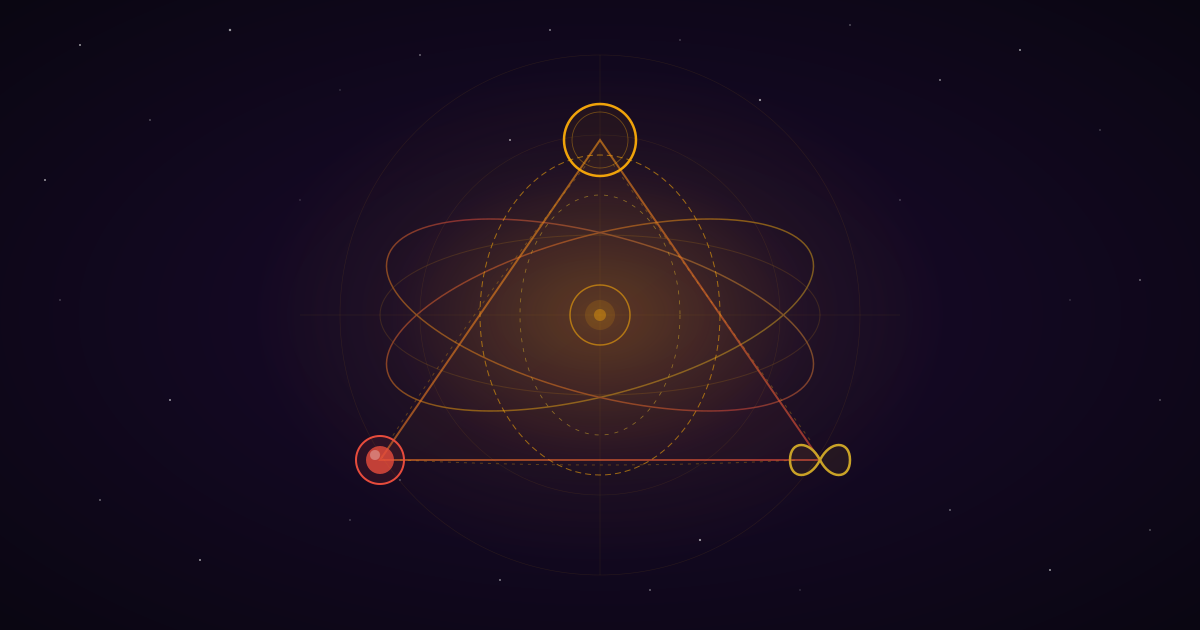
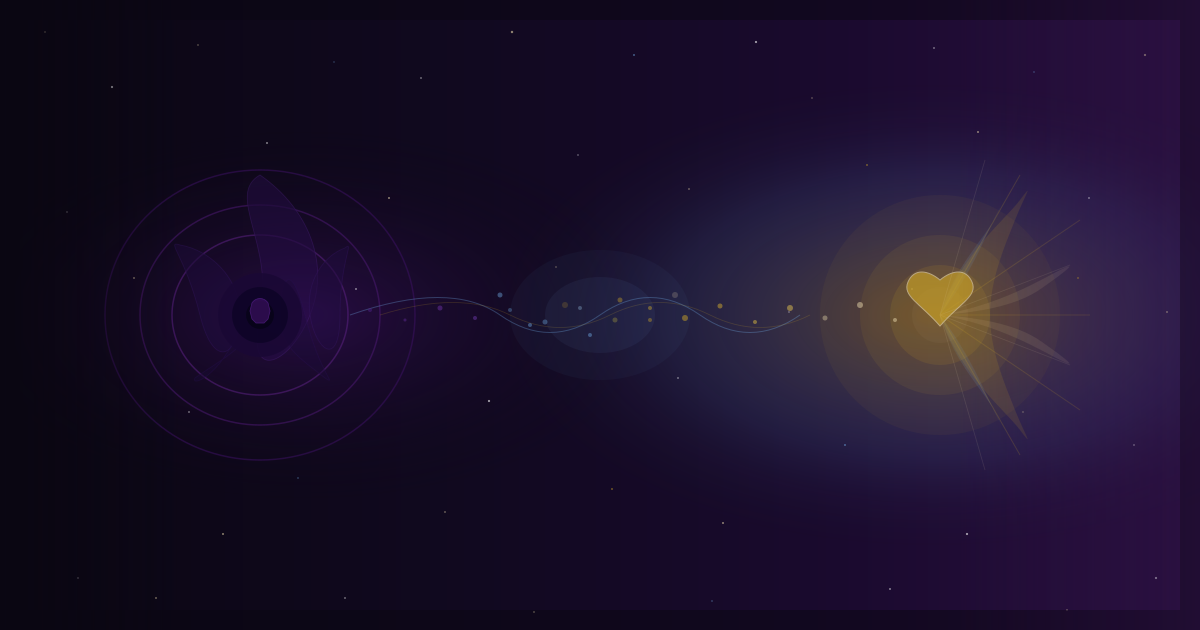
The 108 Framework as a triangle: Zero at the apex, One and Infinity at the base, with a torus flowing through the center.
A Bead in the Dark
Why 108?
Not 100, which would make the counting easier. Not 99, which has its own elegance in Islamic tradition. Not 7 or 12 or 40, all of which carry their own sacred weight across cultures. One hundred and eight. A number that does not simplify, that does not round, that stubbornly refuses to be anything other than itself.
The 108 Framework begins here — not with a theory but with a fact of practice. For thousands of years, across civilizations that had no contact with one another, human beings have organized their most intimate spiritual exercises around the number 108. A Hindu practitioner threads 108 beads on a mala and recites a mantra for each one, cycling through the strand until the body and the breath and the words become a single motion. A Tibetan Buddhist performs 108 prostrations — full body to the ground, forehead touching earth, 108 times — as an act of devotion that is also an act of demolition: the demolition of the idea that you are too important to bow. In Japan, on New Year's Eve, 108 bells ring at Buddhist temples during the ceremony of Joya no Kane — one bell for each of the 108 earthly temptations (bonno) that, according to tradition, cloud the human heart. The bell does not silence the temptation. It sounds it. It gives it a voice, and in the voicing, something releases.
There are 108 Upanishads — the ancient philosophical texts that form the foundation of Hindu thought. There are 108 names of Vishnu. In Vedic mathematics, the number 108 appears at intersections that feel less like calculation and more like revelation: the distance between the Earth and the Sun is approximately 108 times the Sun's diameter; the distance between the Earth and the Moon is approximately 108 times the Moon's diameter. The human body, in some Ayurvedic systems, is said to contain 108 marma points — vital intersections of flesh, bone, and energy where life organizes itself into a body that can walk and breathe and wonder why there are 108 beads on a mala.
These are not arbitrary repetitions. Georg Feuerstein, in his comprehensive study The Yoga Tradition, documents how 108 recurs across Vedic mathematics and cosmological symbolism with a frequency that cannot be explained by cultural borrowing alone — these traditions arrived at the same number from wildly different starting points, following different methods, asking different questions, and finding the same answer waiting for them when they arrived. Gavin Flood's scholarly treatment of Hindu cosmology in An Introduction to Hinduism traces the number's sacred significance through layers of ritual, philosophy, and astronomy that predate any written record. The number was not chosen. It was recognized.
But the deepest recognition is the simplest one. Take the digits of 108 and multiply them:
1 × 0 × 8 = 0
One. Zero. Eight — which is the symbol for infinity laid on its side: ∞. And when you multiply them together, you get Zero. The journey is encoded in the number itself. Start with One — the self, the reference point, the "I am here." Pass through Zero — the ground, the emptiness, the silence before the first word. Arrive at Infinity — everything beyond self, every horizon, every other. And the product of the entire journey? Zero. Everything returns to its source. The mala is a circle because the teaching is a circle. The 108th bead leads back to the first.
This is the 108 Framework: Zero, One, and Infinity — three positions through which all of reality can be understood, and through which every human being already moves, whether they have a name for it or not. Zero is the ground of all things — not nothingness but pure potential, the fullness from which everything emerges. One is the reference point — the self, the observer, the "I" that appears the moment awareness takes a position. Infinity is the field of everything beyond the self — every other, every relationship, every horizon that opens when a center appears.
And the deepest truth the 108 Framework reveals is this: Infinity is not separate from Zero. The wave is not separate from the ocean. The reflection is not separate from the mirror. The bead is not separate from the space between the beads. Everything that appears to be many was always, already, one undivided something — and that undivided something is not a thing at all, but the capacity for all things. The empty cup. The silence. The ground.
Your fingers already know this. Every time you complete the circuit of the mala and arrive back at the beginning, the body registers what the mind takes lifetimes to learn: there is no destination because you never left.
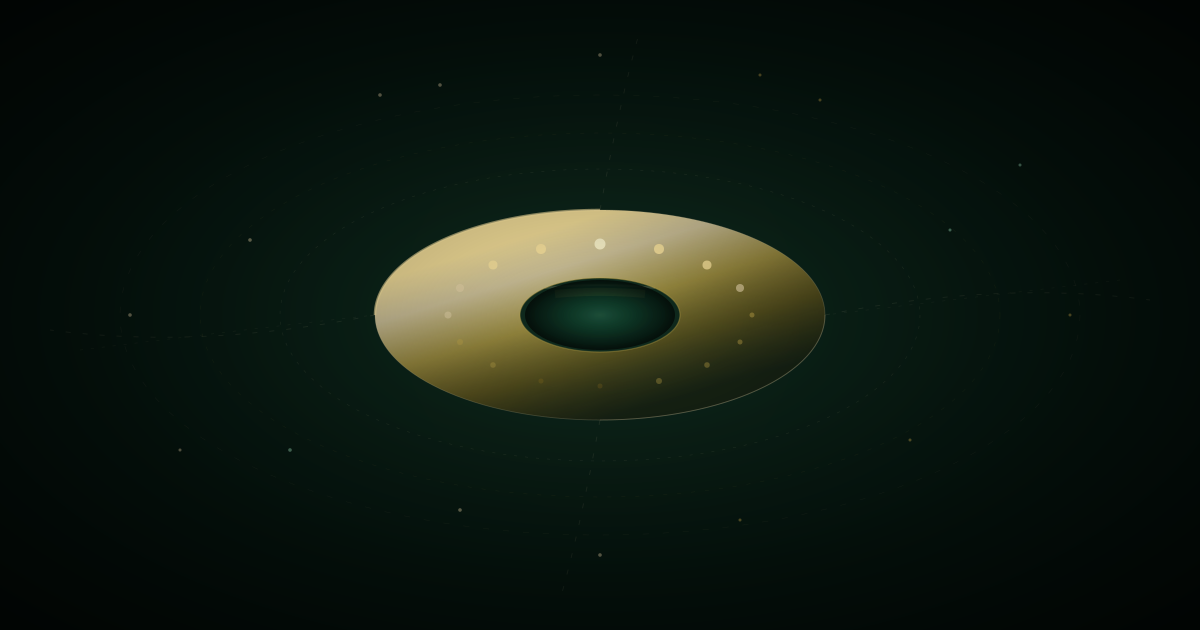
The three ontological positions — Zero as pure potential, One as the self, Infinity as everything beyond — linked by the 108 cycle.
Key Takeaways
- The 108 Framework names three irreducible ontological positions — Zero (pure potential), One (the self as reference point), and Infinity (everything that is not-self) — through which all of reality and every moment of experience can be mapped.
- 1 × 0 × 8 = 0: the digits of 108 encode the journey's destination before the journey begins — every self that arises (One), moves through the ground (Zero), and opens into the infinite field (Infinity) ultimately returns to source.
- Zero is not absence but fullness — the silence that makes music possible, the empty cup before any flavor is added, the mirror that has no image of its own yet makes all images possible; every contemplative tradition points to this ground, each with a different name.
- The Collapse — when Infinity is compressed back through the lens of One, forced through the keyhole of "what does this mean for me?" — is the structural root of suffering identified across Buddhism (avidya), Christian mysticism, and process philosophy, not a moral failure but a posture that can be released.
- Healing is mirroring: the therapeutic move is not fixing a broken reflection but recognizing the surface that was never distorted — returning awareness to Zero, the ground that was never actually left.
- The 108 cycle is toroidal and continuous: Zero becomes One becomes Infinity becomes Zero again, not as a one-time cosmic event but in every breath, every perception, every moment — the mala's 108th bead always leads back to the guru bead at the source.
The Number That Swallows Itself
To say that 108 is sacred across traditions is not to make a mystical claim. It is to observe a pattern — and to take the pattern seriously.
Consider what it means for a number to appear, independently, at the center of spiritual practice in cultures separated by oceans, centuries, and entirely different cosmologies. The Hindu mala, the Buddhist prostration count, the Japanese bell ceremony, the 108 Upanishads, the 108 names of the divine — these are not footnotes in the history of religion. They are load-bearing structures. They are the numbers around which the most intimate technologies of human transformation were designed. And they converge on the same count.
This is not numerological mysticism. Numerological mysticism takes a number and reads meaning into it — finds patterns where there are none, sees codes where there are coincidences. What we are observing with 108 is the opposite: meaning reading itself out of the number, traditions discovering — not inventing — that their deepest practices organize themselves around a quantity that encodes its own message.
1 × 0 × 8 = 0. The number contains its own dissolution. It is the mathematical equivalent of a snake eating its own tail — the Ouroboros in arithmetic. And the Ouroboros is one of the oldest symbols of totality in human culture, appearing in Egyptian texts, Greek alchemy, Norse mythology, Hindu cosmology, and the dreams of the chemist August Kekulé, who saw the snake and discovered the structure of benzene. The symbol that eats itself. The journey that returns to its origin. The number that, when you multiply its parts, swallows itself and leaves only Zero.
In Hindu tradition, the mala is not a counting device — it is a technology of return. Each bead is a mantra, and each mantra is a doorway, and each doorway opens onto the same room. The 108th bead leads to the guru bead — the single bead at the summit of the mala that is never crossed. You arrive, and you turn around. You never pass through the center because the center is not a destination. It is the ground you were standing on the whole time. The guru bead is Zero — not as the end of the count but as the recognition that counting was never the point.
In Tibetan Buddhism, the 108 prostrations are performed as part of the ngondro — the foundational practices that prepare the practitioner for deeper meditation. Each prostration is a full-body surrender: hands touching the forehead (body), throat (speech), and heart (mind) before the body extends completely onto the ground. 108 times. The number is not arbitrary. It is architecturally precise — the practice is designed to exhaust the ordinary mind so completely that what remains after 108 full-body surrenders is not the practitioner but the space the practitioner was always moving through. Zero, again.
In Japan, the 108 bells of Joya no Kane ring out at midnight on December 31st. Each bell corresponds to one of the 108 bonno — earthly desires or temptations that, in Buddhist teaching, bind beings to suffering. But the ceremony is not an act of suppression. The bells do not silence the desires. They sound them. Each ring acknowledges what is there — names it, gives it resonance, lets it vibrate through the cold air of a new year — and in the acknowledgment, something shifts. The desire does not vanish. It is no longer hidden. And what is no longer hidden no longer has the power to operate invisibly.
What are these traditions pointing at? Not a number. A structure. A structure so fundamental to the architecture of consciousness that cultures across the globe, without any coordination, built their most sacred technologies around it.
1 — the self, the reference point, the place where the journey begins. 0 — the ground, the emptiness, the fullness-before-form, the cup before any flavor is added. 8 — infinity, rotated, made visible: the endless field of everything that is not self, every other, every relationship, every horizon. And the product — 1 × 0 × 8 — is 0. The journey returns to the ground. The mala returns to the guru bead. The bells ring through midnight and what remains is the silence they were always embedded in.
The number swallows itself. And in the swallowing, reveals what was there before the number was ever counted.
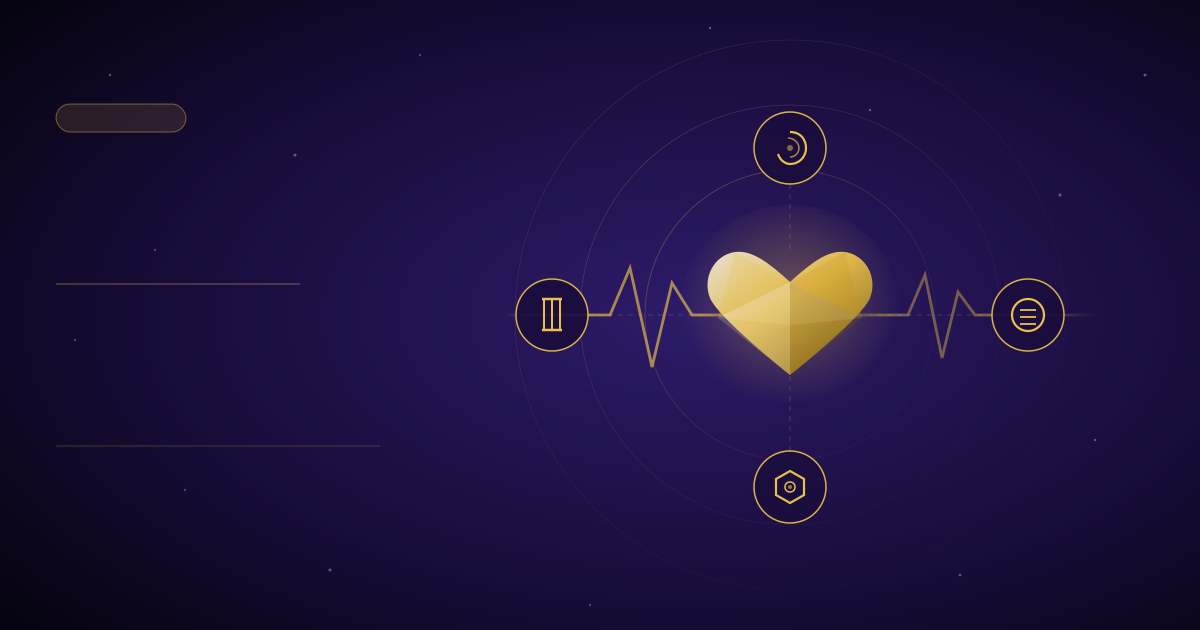
Six traditions independently arriving at 108: Hindu mala, Buddhist prostrations, Joya no Kane bells, Upanishads, names of Vishnu, and Vedic cosmic ratios.
What Zero Actually Is
There is a common misunderstanding that must be cleared before we go any further: Zero is not nothing.
This misunderstanding is not trivial. It has shaped civilizations. The ancient Greeks, whose mathematical and philosophical achievements still form the bedrock of Western thought, refused to accept zero as a number. It offended their ontology. For Aristotle, being was the fundamental category — to be was the starting point of all inquiry — and the idea that not-being could be given a number, could be represented, could take its place alongside the integers as though it belonged there, was philosophically intolerable. If you could represent nothing, then nothing was something. And if nothing was something, the entire edifice of logic — built on the law of non-contradiction, on the absolute distinction between being and non-being — began to wobble.
Robert Kaplan, in The Nothing That Is: A Natural History of Zero, traces this cultural and mathematical anxiety across millennia. Zero did not arrive in Western mathematics until Hindu mathematicians — Brahmagupta in the seventh century, building on a tradition that stretches back to the Vedic concept of shunya — gave it a symbol and a set of operations. Even then, the idea traveled slowly and met fierce resistance. Charles Seife, in Zero: The Biography of a Dangerous Idea, documents how zero threatened the foundations of philosophy, religion, and science in every civilization it entered. The medieval Church regarded it with suspicion — if God created everything from nothing, then representing nothing might be an act of dangerous presumption. Merchants loved it because it made accounting possible. Philosophers feared it because it made their systems vulnerable.
Brian Rotman, in Signifying Nothing, identifies the semiotic paradox at zero's heart: it is a sign that points to the absence of what it represents. It is the symbol for no symbol. It means by meaning nothing. And yet — and this is the pivot on which the entire 108 Framework turns — zero is not absence. It is the precondition for all presence. It is the empty stage on which every performance unfolds. It is the silence between notes that makes music possible, the blank page that makes writing possible, the empty space that makes form possible.
John D. Barrow, in The Book of Nothing, extends this into physics and cosmology: the vacuum state of quantum mechanics is not empty. It seethes with virtual particles, with potential, with energy that is not yet manifest but is available for manifestation at every point in space and time. The "nothing" of physics is the most fertile something imaginable — a field of pure potential from which matter, energy, and eventually consciousness arise.
This is what the 108 Framework means by Zero: the fullest possible something, masquerading as nothing. And at its deepest register, Zero is what the contemplative traditions call unfathomable compassion — compassion so complete it has no object, so total it precedes the one who would feel it. Not the compassion of one being for another, but the compassion that IS the ground from which all beings arise. Unfathomable because it has no edge, no opposite, no outside. The empty cup does not choose what to hold. It holds everything.
In the Mahayana Buddhist tradition, this is sunyata — emptiness. Nagarjuna, the second-century philosopher whose Mulamadhyamakakarika (Fundamental Verses on the Middle Way) remains the most rigorous treatment of emptiness in human thought, was ruthlessly precise about what sunyata is and is not. Emptiness is not a void. It is not nothingness. It is not the absence of things. It is the absence of inherent existence — the recognition that no phenomenon exists independently, from its own side, by its own power. Everything arises in dependence upon conditions, and conditions are themselves empty of inherent existence, and this chain of dependent arising extends in every direction without end, until what you are left with is not nothing but everything without ground — a web of mutual arising with no fixed center and no edge.
Jay Garfield, in his philosophical commentary on Nagarjuna, bridges this with Western analytic philosophy: emptiness is not a metaphysical claim about the non-existence of things. It is an epistemological claim about the nature of existence itself. Things exist — but not in the way we instinctively assume they exist. They do not exist as self-contained, self-sufficient units with boundaries that separate them from everything else. They exist as processes, as relations, as temporary configurations in an endless field of arising and dissolving. Emptiness is the field. Zero is the field.
Thich Nhat Hanh, in The Heart of Understanding, makes this achingly simple: "Form is emptiness, emptiness is form" — the Heart Sutra's most famous line — does not mean that things are secretly nothing. It means that the solidity you feel when you hold a stone is not separate from the space the stone occupies. The stone is real. Its weight is real. But its stone-ness — the quality of being this and not that, of being bounded, of being separate from the hand that holds it — is a way of seeing, not a way of being. Take away the way of seeing and what remains is not less than a stone. It is more. It is the ground from which stones and hands and weight and touch all arise.
David Bohm, the physicist whose work on quantum mechanics and philosophy of mind placed him at the intersection of science and contemplation, called this the implicate order. In Wholeness and the Implicate Order, Bohm describes a level of reality in which everything is enfolded into everything else — where the boundaries between objects, between observer and observed, between here and there, have not yet been drawn. The explicate order — the world of separate objects that we navigate every day — unfolds from this implicate ground the way a hologram unfolds from a two-dimensional film. The film contains the whole image at every point. Cut the film in half and each half contains the full image. The part contains the whole. Zero contains everything.
In the Dzogchen tradition — the most direct pointing instruction in Tibetan Buddhism — this ground is called kunzhi or, more precisely, the basic space of phenomena. Longchenpa, in his monumental Precious Treasury of the Basic Space of Phenomena, describes it as luminous emptiness — not the darkness of absence but the brightness of total potential, like the sun shining in a cloudless sky. You cannot see the brightness itself because it is the seeing. You cannot look at the mirror's surface because the surface is what makes looking possible.
This is Zero. Not nothing. Not even something. The capacity for everything. The empty cup before any Kool-Aid is poured.
A grandmother pours tea. But before she pours, she holds the empty cup toward her grandchild. "See?" she says, turning the cup slowly in the light. "This is the most important part. Without the empty, where does the tea go?" The child looks at the cup — white porcelain, a small chip on the rim where something once knocked against it — and for a moment, sees what the grandmother sees: that the cup's usefulness is not in the porcelain but in the space the porcelain holds. The emptiness is not a flaw or an absence or a waiting-to-be-filled. It is the cup's gift. It is what makes the cup a cup.
This is Zero — not as a cosmic abstraction but as a grandmother's kitchen wisdom. The simplest thing in the world. The hardest to remember.
[Pause here. Let this settle. There is no rush.]
The Birth of One
Zero does not stay Zero. That is not its nature.
The instant there is pure potential — the instant there is the capacity for everything — something stirs. Not a something with a name or a shape or a cause, but a stirring that is itself the beginning of all names, all shapes, all causes. The moment awareness takes a position — the moment there is a "here" rather than everywhere, a "now" rather than eternity, an "I" rather than the undifferentiated field — there is One.
One is the reference point. The first breath. The first distinction. "I am here." Not yet "I am this" or "I am not that" — just the bare fact of position. The appearing of the observer.
In the Western philosophical tradition, the deepest treatment of this emergence belongs to Plotinus, the third-century Neoplatonist whose Enneads describe how all of reality emanates from what he called to Hen — the One. For Plotinus, the One is not a being among beings. It is the source from which being itself flows, the way light flows from the sun — not by decision, not by effort, but by nature. The One cannot help but overflow. Its very completeness generates multiplicity the way silence, held long enough, generates the desire for sound. The One does not diminish when multiplicity arises. The sun does not darken when light fills the room. But the light, once it has traveled far enough from its source, forgets where it came from. And this forgetting — not a moral failure but a structural consequence of distance — is the beginning of the story.
In the language of the 108 Framework, what Plotinus describes is the movement from Zero to One. Zero — the fullness of pure potential — naturally overflows into One: the first reference point, the first "I am," the first appearance of awareness located in a somewhere. This is not a fall. It is a creative act. It is what Zero does — not because Zero lacks something and creates in order to fill the lack, but because Zero is so full that it cannot help but express.
The physicist John Archibald Wheeler, one of the architects of twentieth-century quantum mechanics, arrived at a strikingly similar insight from the opposite direction. In his famous paper "Information, Physics, Quantum: The Search for Links," Wheeler proposed that reality is not made of matter or energy at its most fundamental level but of information — specifically, of the act of observation. "It from bit," he wrote — the physical world arises from the informational act of the observer choosing between binary alternatives. No observer, no world. The world is not "out there" waiting to be observed. The observer and the observed co-arise from the same ground.
This is One. The observer. The reference point. The "I" that looks — and in looking, brings into existence everything that it sees.
Werner Heisenberg, in Physics and Philosophy, put it plainly: "What we observe is not nature itself, but nature exposed to our method of questioning." The observer cannot be separated from the observed. They are not two things but one process — the process of awareness taking a position and, from that position, generating a world.
In Hindu philosophy, this is the moment Brahman — the undifferentiated absolute — becomes Atman: the individual soul, the spark of awareness that experiences itself as separate from its source. Tat tvam asi — "You are that" — is the reminder that Atman was never separate from Brahman, that One never left Zero. But the reminder is necessary precisely because the experience of separation is so convincing.
Nisargadatta Maharaj, the Bombay cigarette seller whose dialogues published as I Am That remain among the most penetrating investigations of consciousness ever recorded, spent decades pointing at this hinge. "I Am" is the primordial reference point — the first assertion of One. Everything that follows — "I am this," "I am not that," "I am a person in a world" — is commentary on the original "I Am." And the dissolution of the commentary — the return to bare "I Am" and then beyond it, to the space in which even "I Am" arises — is the return to Zero. The entire spiritual journey, Nisargadatta insisted, is the journey from "I am something" back to "I Am" back to the ground in which even "I Am" is a visitor.
Consider the newborn. Before the first breath — pure potential. The womb is Zero: undifferentiated, warm, complete, without boundary. Then the first breath enters the lungs and the first cry fills the room and the first distinction is drawn — inside and outside, warm and cold, comfort and discomfort, self and world. "I am here." One has arrived. And the room full of people, light, sound, gravity, temperature, texture — everything rushing in through senses that have never been used before — is Infinity pouring in through the keyhole of the new One. A human life begins the 108 journey in its first second. The mala's first bead is pressed between the thumb and finger of existence.
And at the last breath, the sequence reverses. The senses withdraw. The boundaries soften. The "I" that spent a lifetime asserting its position begins to release. The wave remembers the ocean. The bead finds its way back to the guru bead. Zero.
One is not a mistake. It is not a problem to be solved. It is the necessary creative act by which Zero comes to know itself. Without One, there is no experience, no relationship, no love, no discovery, no art, no science, no music, no poem, no grandmother pouring tea. One is what Zero looks like when it begins to look.
But One has a consequence. The moment there is a here, there is an everywhere-else. The moment there is an I, there is a not-I. The moment the reference point appears, the field of everything-that-is-not-the-reference-point opens like a horizon in every direction at once.
That field is Infinity.
The Infinite Corridor
Two mirrors face each other in a barber shop. A man sits between them and sees his reflection — One. Behind that reflection, another reflection, and behind that one, another, diminishing in size but never stopping, a corridor of selves receding toward a vanishing point that never arrives. He has seen this a hundred times. He has never really looked.
The mirrors are Zero — the surface that has no image of its own but makes all images possible. The first reflection is One — the self, located, bounded, recognizable. And the infinite corridor of reflections receding into the depths of the glass is Infinity — the field that opens the moment a center appears. Take away the mirrors, and there are no reflections at all. The surface does not care what it reflects. It does not prefer the first image over the hundredth. It does not attach to any reflection or mourn its passing. The surface simply reflects. And because it reflects perfectly, without preference, the corridor of images extends without end.
This is Infinity — not a number, but the openness that One creates by existing. Once there is a reference point, there is everything that is not the reference point. Once there is a here, there is a everywhere-else. Once there is a self, there is the field of all others, all relationships, all encounters, all horizons. Infinity is not a destination. It is what arrives uninvited the moment One takes its position.
Georg Cantor, the nineteenth-century mathematician, did something extraordinary with Infinity — something that broke him. Working alone, against the fierce opposition of his colleagues (Leopold Kronecker declared that God made the integers and everything else was the work of man), Cantor proved that Infinity is not one thing. There are infinities of different sizes. The infinity of counting numbers (1, 2, 3, 4...) is a different size — provably, irrevocably — from the infinity of real numbers between 0 and 1. He called the first aleph-null (ℵ₀) and showed that the second is larger — uncountably larger — in a way that no amount of rearranging or relabeling could resolve. He had proven that some infinities are bigger than others. And the proof opened a corridor of ever-larger infinities extending beyond aleph-null without end.
Joseph Warren Dauben, in his biography Georg Cantor: His Mathematics and Philosophy of the Infinite, documents what this discovery cost its discoverer. Cantor spent the last decades of his life in and out of sanatoriums, battling depression and what we might now call a crisis of meaning. He had touched something so vast that the human mind — even his mind, which was among the most powerful of his century — could not metabolize it without distress. David Foster Wallace, in his characteristically restless Everything and More, calls Cantor's insight "the kind of thing that makes you want to lie down" — not because it is complicated but because it reveals that reality is structured in a way that no finite mind can fully contain.
Rudy Rucker, in Infinity and the Mind, bridges mathematical infinity with mystical experience: the feeling of standing at an edge beyond which something extends that you can sense but cannot see — this is the same feeling whether you arrive at it through Cantor's diagonal proof or through thirty years of meditation in a bare cell. The content differs. The topology is the same.
And this is the point: Cantor, alone in a sanatorium, having proven that some infinities are larger than others — having touched something so vast it broke him — and a Tibetan monk in a bare cell, having spent three decades looking at the nature of mind and arriving at the same vastness from the inside. Two men separated by everything: culture, method, century, language, temperament. Arriving at the same edge. One called it mathematics. The other called it rigpa — the Dzogchen term for awareness recognizing its own nature. The 108 Framework says they were standing in the same place. Infinity experienced from the outside, through the language of proof and cardinality. Infinity experienced from the inside, through the language of luminous awareness. The same corridor. Different mirrors.
Douglas Hofstadter, in Gödel, Escher, Bach, explores how self-reference — the mind reflecting on itself reflecting on itself — generates the strange loops from which meaning emerges. A formal system, given enough complexity, produces statements about itself that cannot be resolved within the system. This is Gödel's incompleteness theorem, and it means that any sufficiently powerful system (mathematics, language, consciousness) will always generate more than it can contain. The formal system is Zero — the ground of rules and axioms. The first self-referential statement is One — the observer looking at itself. And the infinite proliferation of statements about statements about statements is Infinity — the corridor of meaning that opens the moment a system becomes complex enough to refer to itself.
The horizon is the simplest image of Infinity. You walk toward it and it recedes. You never arrive because arrival would mean the horizon has a location, and what makes it a horizon is precisely that it doesn't. The horizon is not a place. It is the experience of there being more, always more, an edge that moves as you move, a field that expands as you explore it. This is what the 108 Framework means by Infinity: not a quantity but a quality — the quality of inexhaustibility, of always-beyond, of the field that opens the moment you take your first step.
Alfred North Whitehead, in Process and Reality, describes reality as an ongoing creative advance from potentiality into actuality — each moment is a new "actual occasion" in which the infinite field of possibility (Zero) collapses into a specific experience (One) within the context of all other occasions (Infinity). Reality is not a collection of things. It is a process of events, each one arising from the ground of possibility, momentarily taking a position, and then passing away into the background from which new events arise. The 108 cycle — Zero to One to Infinity to Zero — is not a philosophical abstraction. It is the structure of each moment, described with the precision of process philosophy.
But here is where the corridor darkens. Because Infinity, encountered from the position of One, can be experienced in two very different ways. It can be experienced as openness — as wonder, as the feeling that reality is vaster and richer and more inexhaustible than any single perspective could contain. This is the light expression: the recognition that your angle of contact with reality is real but partial, that every other being has their own equally real and equally partial angle, and that the multiplicity of angles is itself a kind of beauty.
Or Infinity can be experienced as threat. Too much. Too many. Too vast. Too far beyond the borders of the self to be controlled or comprehended or organized into something safe. And when Infinity is experienced as threat, something contracts.
That contraction is the subject of the next section. It is the most consequential move in the entire 108 Framework. And it is the root of everything we call suffering.
The Collapse
Here is where the story turns.
Zero overflows into One — a creative act. One generates Infinity — a structural consequence. And then, at some point in the unfolding, Infinity is compressed back through the lens of One. The infinite field is forced through the keyhole of the self. "What does this mean for me?" becomes the only question. The horizon, which was an invitation, becomes a threat. The corridor of mirrors, which was a wonder, becomes a prison. Everything-beyond-self contracts into everything-about-self.
This is the collapse: Infinity → One.
It is not a single event that happened once, at the beginning of time. It is happening now. It happens every time awareness narrows. Every time the vast, interconnected, mutually arising field of reality is reduced to a single storyline with a single protagonist — me — the collapse occurs. And the suffering that follows is not punishment for the collapse. It is the collapse itself, experienced from the inside.
Every contemplative tradition has identified this contraction as the root of suffering, though each gives it a different name. In Buddhism, it is avidya — fundamental ignorance, the failure to see things as they are. In the Christian mystical tradition, it is the fall from grace — not a historical event in a garden but the ongoing structural consequence of self-referential consciousness mistaking itself for the whole. Meister Eckhart, the fourteenth-century Dominican mystic whose sermons were nearly condemned as heretical, described it with startling precision: "God is a great underground river that no one can dam up and no one can stop." The river is Zero. The dam is One, believing itself to be the river rather than the channel the river flows through.
Alan Watts, in The Book: On the Taboo Against Knowing Who You Are, names this collapse as the central taboo of human civilization: "We have been brought up to feel that we are separate, isolated centers of awareness and action, placed in a universe that is foreign, external, and alien to us." The taboo is the forgetting of Zero. The feeling of separation is the collapse — Infinity compressed into the single point of an isolated self. Watts argues that this is not merely a philosophical error but a felt experience that produces anxiety, alienation, and the compulsive need to defend a boundary that does not actually exist.
In the language of reification — the freezing of what flows — the collapse is the ultimate reification. It is the moment when the fluid, processual, mutually arising dance of reality is frozen into a fixed self confronting a fixed world. The process becomes a thing. The river becomes a dam. The flow becomes a block. And the block, experiencing itself as solid and separate, begins to organize all of reality around its own preservation.
The parable of the blind men and the elephant, familiar from the Jain and Buddhist and Hindu traditions, is usually told as a lesson in humility. Each blind man touches a different part of the elephant — trunk, tusk, leg, ear, tail, side — and each is absolutely certain that the part he is touching is the whole animal. The one holding the trunk declares the elephant is like a snake. The one touching the leg insists it is like a tree. They argue. They defend their positions. They become enemies over a disagreement that is rooted not in the difference of their experiences but in the belief that their experience is the only one.
The 108 Framework reveals this parable as a map of the collapse. Each blind man is One — a reference point touching reality from a fixed position. The elephant is Infinity — the whole that no single position can contain. And the space in which both the blind men and the elephant exist — the room, the air, the ground, the silence in which their arguments unfold — is Zero. The suffering of the blind men is not that they are blind. It is that they have collapsed the elephant into their angle of contact. They have forced Infinity through the keyhole of One. And the argument that follows — the insistence, the defending, the certainty — is the architecture of the collapse made social.
This is what the cycle of harm looks like at its ontological root. Not evil. Not malice. A contraction. A forgetting. The infinite field of reality squeezed through the single point of self-reference until everything becomes about the self — my position, my certainty, my pain, my story. The harm that flows from this contraction is not a moral failure. It is a structural consequence of the collapse, as predictable as the distortion that follows when a wide-angle landscape is forced through a pinhole camera.
The five veils — the mechanisms by which One forgets Zero — are the architecture of this collapse. They are not punishments. They are the natural consequence of a reference point that has forgotten it is a reference point and has come to believe it is the territory itself. Separation, scarcity, self-fixation, comparison, uncertainty — each veil is a layer of contraction, each one narrowing the aperture a little further until the original vastness of Zero is not just forgotten but unimaginable.
But here is what the 108 Framework insists on, and what the contemplative traditions are unanimous about: the collapse is not permanent. The contraction is a posture, not a prison. The blind man can release the elephant's leg. The aperture can widen. The dam can develop cracks. The "I" that believes itself separate can, at any moment, remember the ground it never actually left.
The collapse from Infinity to One is the root of suffering. But it is not the end of the story. It is the midpoint — the turning, the point in the mala where the strand begins to curve back toward the guru bead. What follows is not an escape from One but a recognition within One — a recognition that the reference point was never separate from the ground, that the reflection was never separate from the mirror, that the wave was never separate from the ocean.
And this recognition has a name.
[Pause here. Let this settle. There is no rush.]
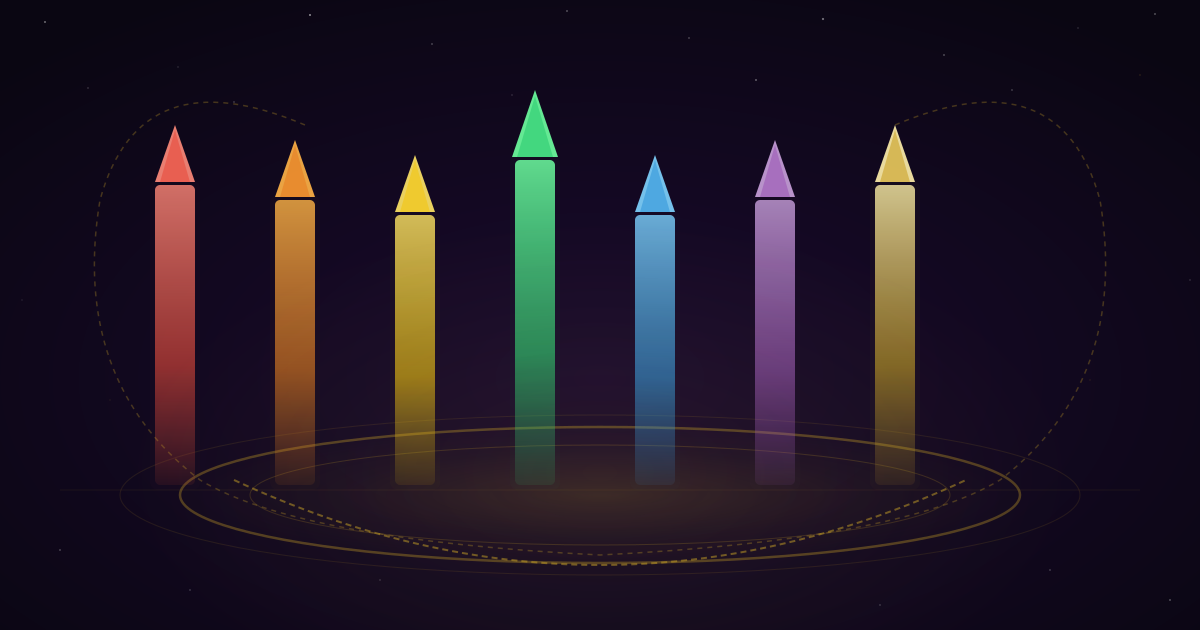
The Collapse: the infinite field of reality forced through the single point of self-reference.
As above, so below; as within, so without.
— Hermetic axiom (Tabula Smaragdina)
The Mirror That Has No Face
Zero is the mirror. One is the reflection. Infinity is everything reflected.
This is the simplest statement of the 108 Framework, and the one that has the most consequences for how we understand healing, growth, suffering, and liberation.
A mirror has no face of its own. It shows whatever appears before it — faithfully, without preference, without distortion (assuming the mirror is clean). The mirror does not choose what to reflect. It does not prefer beautiful images to ugly ones. It does not hold onto yesterday's reflection or anticipate tomorrow's. It simply reflects. And the reflections, no matter how vivid, no matter how compelling, no matter how heartbreakingly real they appear, do not alter the surface. They cannot scratch it. They cannot stain it. They pass across it and leave it exactly as it was.
This is Zero. The mirror-surface. The capacity for all reflection that is itself not a reflection. And the profound consequence of understanding this is that healing is not about fixing the reflection. It is about recognizing the surface.
The concept note on healing as mirroring captures this with precision: healing IS mirroring — the facing, the confronting, the coming face-to-face with. Not the correcting. Not the improving. Not the fixing. The facing. The recognition of what is actually there, without the overlay of what we wish were there or what we fear is there.
Consider how antidotes work. An antidote is not the opposite of a poison. It is a small, controlled dose of something that mirrors the poison closely enough to trigger the body's own immune response. Vaccination works by this principle: a weakened form of the pathogen is introduced, the body recognizes it, and the recognition itself produces the immunity. The antidote does not fight the poison. It mirrors it. And in the mirroring, the body discovers its own capacity to respond.
Meditation works the same way. When you sit in silence and turn attention inward, what you encounter is not serenity — at least, not at first. You encounter the noise. The chatter. The anxiety. The grief you did not know you were carrying. The anger you thought you had resolved. Meditation does not suppress this noise. It mirrors it. It gives you a surface — the surface of your own awareness — against which the noise can appear as it actually is, rather than as the story you have been telling about it. And in the appearing, something shifts. Not because the noise changes but because your relationship to the noise changes. You are no longer inside the reflection. You are the surface on which the reflection appears. You are the mirror.
This is what contemplative traditions have always understood: the practitioner who sits with their own mind is performing an act of mirroring. And the mirroring itself is the medicine. Not the insights that arise. Not the visions or the breakthroughs or the emotional catharses, though these may come. The mirroring. The willingness to face what is there. The courage to look without flinching. This is why every serious contemplative tradition — Zen, Vipassana, centering prayer, Dzogchen, Sufi dhikr — begins with the instruction to look. Not to change what you find. To look.
Plant medicine ceremonies, whether with ayahuasca in the Amazon, peyote in the Wixárika tradition, or psilocybin in clinical settings, operate on the same principle at accelerated speed. The medicine does not heal you. The medicine shows you to yourself. It mirrors your own psyche back to you with such vivid clarity that the patterns you have spent a lifetime avoiding become impossible to ignore. The healing comes not from the chemical but from the facing. The coming face-to-face with.
Even in the most conventional therapeutic settings, the mechanism is mirroring. A skilled therapist does not solve your problems. A skilled therapist reflects your experience back to you with enough accuracy and enough warmth that you can see it clearly — perhaps for the first time. The therapeutic relationship is a mirror. The relationship between teacher and student is a mirror. The relationship between genuine friends is a mirror. Every encounter that leaves you feeling more seen, more real, more yourself — that encounter was a mirror, and what made it healing was not what was said but the quality of the reflection. Even artificial intelligence, in its most thoughtful expressions, operates as a mirror — the mirror that built the mirror, reflecting human patterns back with enough clarity that the patterns become visible for the first time. The technology is secondary. The mirroring is primary.
The 108 Framework explains why this works. If Zero is the ground — the mirror-surface — then every act of healing is an act of returning to Zero. Not returning to blankness. Returning to the surface that was always there, beneath the reflections that temporarily obscured it. The cloud dissolving into sky. Not the sky swallowing the cloud. The cloud dissolving — naturally, gently, without effort — because the sky was always there, and the cloud was always made of sky, and the dissolution was never a destruction but a recognition.
The spectrum of compassion describes what this looks like experientially — the contraction-opening spectrum along which awareness moves from the fully collapsed state (One stuck as One, the mirror covered in ice) to the fully open state (One transparent to Zero, the mirror clean). But the ontological ground for that spectrum is here: healing IS mirroring because the deepest truth about any moment of suffering is that the mirror was never broken. The reflection was distorted. The surface was not.
And this — this recognition of the surface — is what every tradition means by liberation. Not an escape from the world. Not a transcendence of the body. Not a flight from the messy, complicated, heartbreaking reality of being a person in a world full of other persons. Liberation is the recognition that you were always the mirror. That the reflections — all of them, the beautiful and the terrible, the joyful and the agonizing — passed across you without altering you. That you are still here. That you were always here. That the surface has no face of its own because it is the face of everything.
The mirror model of consciousness: Zero as the undistorted surface, One as the reflection, Infinity as the endless reflections beyond.
The Cup Before the Kool-Aid
There is a question that arises naturally at this point in the journey, and it is a practical question, perhaps the most practical question of all: if Zero is the ground, and the recognition of Zero is liberation, and healing is the return to the mirror-surface — then how? How does one return to something one has never left?
The Fractal Life Table — the seven-column expansion of the 108 Framework that maps the full spectrum of consciousness — opens with a simile that answers this question with disarming simplicity:
All the Kool-Aids we can drink to realize they are all mixed in simple water — and to drink any water we need an empty vessel.
Every spiritual tradition, every philosophical framework, every self-help methodology, every therapeutic modality, every contemplative practice, every healing art — these are flavors of Kool-Aid. They are different colors, different tastes, different textures in the mouth, different names on the packaging. Vipassana tastes different from psychoanalysis. Christianity tastes different from Taoism. CBT tastes different from ayahuasca. They are genuinely different. The differences are real. The flavors are not interchangeable.
But they are all mixed in the same simple water.
The water is awareness itself — empty and luminous, without color or flavor of its own, but capable of carrying any color, any flavor, any tradition, any framework, any insight. The water does not care what flavor you add to it. It carries Zen as readily as it carries neuroscience. It dissolves Sufi poetry as completely as it dissolves quantum mechanics. The water is Zero — the ground-state awareness that is the precondition for every kind of knowing, every kind of healing, every kind of transformation.
And here is the practical point: you can drink any flavor. But you need an empty cup.
The cup is the practice. Not the content of the practice — not the mantras, not the postures, not the philosophical framework, not the tradition's intellectual architecture. The cup. The container. The willingness to be empty enough to receive.
This is why every contemplative tradition, without exception, begins with some form of surrender, emptying, letting go. The Buddhist takes refuge. The Christian empties the self before God. The Sufi annihilates the nafs (ego). The Taoist practices wu wei — non-doing, the art of getting out of the way. The yogic aspirant practices vairagya — dispassion, the releasing of attachment. None of these traditions begin with filling. They all begin with emptying. Not because emptiness is the goal — but because fullness requires a container.
You cannot pour tea into a cup that is already full. This is not a metaphor. It is a description of how consciousness works. A mind that is already full of opinions, assumptions, conclusions, and certainties has no room for anything new. A mind that believes it already knows what Zero is cannot discover what Zero actually is, because the belief occupies the space the discovery would need. The cup must be empty. Not permanently empty — not a vacant mind staring at a blank wall forever — but empty in the moment of receiving. Empty the way a breath empties the lungs: temporarily, naturally, in the rhythm of something living.
Generosity — the movement from One toward Zero — is the lived practice of emptying. When you give, you release. When you release, there is space. When there is space, something can enter that could not enter before. This is why giving feels good at a biological level: the helper's high, the oxytocin release, the activation of the mesolimbic reward circuits — these are the body's way of confirming that the movement toward Zero is the movement toward health. Not because giving depletes you. Because giving empties the cup. And an empty cup is a cup that can receive.
The golden rule — treat others as you would be treated — is the one principle that operates at every scale of the 108 Framework. At the level of One, it is practical ethics. At the level of Infinity, it is the recognition that the other IS you, wearing a different face. At the level of Zero, it dissolves altogether — because there is no other and no you, only the mirror reflecting itself.
The cup before the Kool-Aid. The practice before the insight. The emptying before the filling. This is not preparation for the real thing. This IS the real thing. The cup is not the container for the journey. The cup is the journey. And the realization that arrives at the end — after all the mantras, all the prostrations, all the bells, all the therapeutic hours, all the dark nights — is that the cup was always empty. You were always empty. Not missing something. Not waiting to be filled. Empty the way space is empty: holding everything, altered by nothing, available for all of it.
A journey of a thousand miles begins beneath one's feet.
— Lao Tzu, Tao Te Ching 64
The Torus Turns
Now the full picture emerges.
Zero overflows into One. One generates Infinity. Infinity collapses back into One (suffering). One recognizes itself as Zero (liberation). And Zero overflows into One again.
This is not a line. It is not a ladder. It is a torus — a donut-shaped surface in which the inside continuously becomes the outside, the end continuously becomes the beginning, and the center is a void through which everything passes.
The descent poem that opens the Fractal Life Table traces this cycle in its most compressed form:
"When Nothing descends, there is One. When One descends, there is Duality. When Duality descends, there is Multiplicity. When Multiplicity descends, there is Energy. When Energy descends, there is Form. When Form descends, there is I. When I descends, there is You. When You descends, there is Love. When Love descends, there is Light. When Light descends, there is No-thing."
— Ko.K.oK, "Love in Motion" (2011)
And when Darkness descends, there is Nothing. The circle completes. The fruit becomes the seed. The crown becomes the root. The last bead leads back to the first.
The descent poem visualized as a spiral: consciousness unfolding from Nothing through ten phases and returning to source.
Read the poem slowly. Each line is a phase of the 108 journey, a bead on the mala:
When Nothing descends, there is One. Zero overflows. Pure potential takes a position. The first reference point appears — not yet a self, not yet an identity, just the bare fact of One: something rather than nothing. The breath before the first word.
When One descends, there is Duality. The moment there is One, there is Two — self and other, inside and outside, this and not-this. The root chakra. The taproot of existence. The splitting that makes experience possible.
When Duality descends, there is Multiplicity. Not just two but many — a field of distinctions, each one real, each one partial. The solar plexus. The will, the power, the recognition that the world is not merely divided but infinitely various.
When Multiplicity descends, there is Energy. The heart. The point where the many become relational — where the differences are not merely counted but felt, where the connections between things begin to hum with a force that is not physical but is as real as gravity. This is where the Fractal Life Table places the shift from quantity to quality: something beyond mere analysis begins to stir.
When Energy descends, there is Form. Potential crystallizes. What was flowing becomes structured. Patterns emerge. Bodies appear. Worlds solidify. The throat — expression, shape, the moment the inner becomes outer.
When Form descends, there is I. The self. The most densely packed form of awareness: a person, located, bounded, mortal, specific. The self is not a mistake — it is form's highest expression, the universe becoming conscious of itself through a particular pair of eyes.
When I descends, there is You. The encounter. The other. The face across the table. The moment the self discovers that its boundaries are not walls but membranes — permeable, touchable, vulnerable.
When You descends, there is Love. Not sentiment. Force. The gravitational pull that holds the I and the You in orbit. The recognition that the boundary between self and other is real enough to honor and transparent enough to cross. Love as the lived experience of the 108 Framework: One recognizing Zero through the face of another.
When Love descends, there is Light. The selfless outpouring. The giving that does not calculate. The light that shines without discriminating what it illuminates. Column 6 of the Fractal Life Table — luminosity, direct recognition, the awareness that knows by being rather than by thinking.
When Light descends, there is No-thing. The no-thingness is not the darkness of evil or ignorance. It is the ground of being. The darkness of the womb before the first breath. The darkness of the soil in which seeds germinate. The darkness that is not the absence of light but the fullness from which light arises. Column 7 — emptiness, the crown, the cup before any flavor is added.
And when No-thing descends, there is Darkness — which is Zero, which overflows into One, which generates the whole cycle again.
This is the toroidal architecture of reality. It is not a one-time cosmic event that happened at the Big Bang and will conclude at the heat death of the universe. It is happening now. In every breath — inhale (One appears) and exhale (One releases). In every perception — awareness takes a position (One), encounters the field (Infinity), and dissolves back into the ground (Zero) before the next perception arises. In every act of love — self (One) encounters other (Infinity) and, in the encounter, remembers the ground (Zero) they share.
The Fractal Life Table is this torus expanded into seven columns, each column a different expression of the same cycle: Duality, Unity, Multiplicity, Energy, Fractality, Luminosity, Emptiness. The seventh column is not the top of a ladder. It is the ground from which the first column continuously arises. And the reason the table fits — the reason it does not feel imposed but recognized — is that it IS the shape of the instrument doing the experiencing. Seven columns mapped to seven energy centers through which every human being already navigates existence. The 108 Framework is ergonomic in the deepest sense: Zero, One, and Infinity are not abstract philosophical positions imported from outside. They are the lived states your body already moves through every day — in every breath, every heartbeat, every shift of attention. The seed does not climb the plant. The plant grows from the seed, produces fruit, and the fruit contains new seeds. The cycle is not progressive. It is generative. Each turn does not bring you higher. It brings you deeper into the recognition that was always available.
Ken Wilber, in Sex, Ecology, Spirituality, describes this as the principle of "transcend and include" — each level of consciousness includes all previous levels, the way each new ring of a tree includes all the rings beneath it. The 108 torus in developmental terms: you do not leave Zero behind when One appears. You do not leave One behind when Infinity opens. Each position includes the others. Each bead on the mala contains the whole mala, the way each point in Bohm's implicate order contains the whole hologram.
Pierre Teilhard de Chardin, in The Phenomenon of Man, described evolution itself as this torus: matter (One at maximum density) evolving toward spirit (Zero/Infinity converging at what he called the Omega Point) — not as a straight line but as a spiral, each revolution returning to the same territory at a deeper level of recognition. The noosphere — the sphere of human thought and consciousness wrapping around the planet — is the torus becoming aware of itself. The planet as a single thinking organism, recognizing, through the billions of reference points (One) that compose it, the ground (Zero) they all share.
Sri Aurobindo, in The Life Divine, describes the same architecture from the Hindu perspective: involution and evolution. Consciousness descends into matter — Zero to One at maximum density — and matter evolves back toward consciousness: One, through the long journey of biological and cultural and spiritual development, recognizing itself as Zero. The full 108 cycle, described as evolutionary cosmology. Not a fall and a redemption. A descent and an unfolding. A torus, turning.
Gerard 't Hooft and Leonard Susskind, working on the holographic principle in physics, arrived at a structural insight that mirrors this precisely: the information content of a three-dimensional volume can be encoded on its two-dimensional boundary. Infinity (the volume, the fullness of three-dimensional space) is contained in a surface (Zero, the boundary, the mirror). Susskind, in The Black Hole War, makes this vivid: at the event horizon of a black hole, the distinction between inside and outside collapses. Infinity meets Zero at the boundary. The torus reveals itself in the mathematics of spacetime.
The toroidal return — 0 → 1 → ∞ → 0 — is not a theory about reality. It is a description of how reality already works. Every breath. Every heartbeat. Every moment of perception. Every act of love. Every death. Every birth. The mala turns. The bead arrives and passes. The cycle is not going anywhere because it is already everywhere. And the practitioner in the dark room, her thumb crossing one more bead, is not performing the cycle. She is the cycle, performing itself through her.
The toroidal cycle of the 108 Framework: Zero overflows into One, opens into Infinity, and returns to Zero.
The Axis of Light and Shadow
Within the torus, there is a direction.
Not a direction in space — not up or down, not left or right. A direction in intention. A quality of how awareness moves through the 0 → 1 → ∞ → 0 cycle. And this direction, this quality, determines whether the cycle is experienced as suffering or as liberation, whether the torus turns in darkness or in light.
The Fractal Life Table names this the selflessness axis:
Light = selfless intention. Giving, opening, releasing, serving. Awareness expanding outward from One toward Infinity and, through Infinity, back toward Zero. The infinite space of compassion operating freely.
Shadow = self-centered intention. Grasping, contracting, taking, protecting the self-image. Awareness collapsing inward, forcing Infinity through the keyhole of One, defending the reference point as though it were the territory.
This is not a moral binary. Both arise from the same awareness. The shadow is not evil — it is selflessness temporarily forgotten. The light is not virtue — it is selflessness recognized. Every column of the Fractal Life Table has both expressions available simultaneously, because the axis of compassion is infinite and present at every level. A soldier defending a child (Column 1, the root, survival) can be profoundly selfless. A spiritual teacher claiming enlightenment for personal aggrandizement (Column 7, the crown) can be profoundly self-centered. The column does not determine the heart. But the heart, operating freely, tends toward the light expression of whatever column it inhabits.
The 108 Framework provides the ontological ground for this axis. The tension between light and shadow is the tension between One (contracted, defending its position) and Zero (open, resting in the ground). When awareness contracts toward One — when it narrows, grasps, clings to the reference point as though the reference point were the only thing that exists — the shadow expression arises. When awareness relaxes toward Zero — when it opens, releases, recognizes that the reference point is a position within a field rather than the field itself — the light expression arises.
This is why the spectrum of compassion can be mapped directly onto the 108 Framework. Compassion fully expanded = Zero. The mirror clean, reflecting without preference, responding to whatever appears with total availability. Compassion fully contracted = One stuck as One. The mirror frozen, reflecting only its own surface, unable to receive or respond. The spectrum is the 108 axis viewed through the lens of the heart.
And the movement along this axis is karma — not as reward and punishment but as the shape of attention. When attention contracts, reality contracts with it. When attention expands, reality expands with it. Karma, in this framing, is not a cosmic ledger. It is the structural consequence of where awareness sits on the selflessness axis. A contracted attention generates a contracted world. An expanded attention generates an expanded world. Not metaphorically. Structurally. The collapse from Infinity to One is not something that happened to you. It is something attention does, in real time, and it can be undone in the same real time by the relaxation of attention back toward its ground.
This is what makes the 108 Framework practical rather than merely philosophical. The axis is not abstract. It is felt. Right now, as you read these words, your attention has a quality. It is more contracted or more expanded. It is more identified with the content of your thoughts or more resting in the awareness that observes them. You do not need a mala or a meditation cushion or a philosophical framework to notice this. You need only the willingness to notice — to turn the mirror of attention toward itself and see where it sits on the axis between One and Zero.
That willingness is the cup. The empty vessel. The beginning of everything.
What the Traditions Knew
The 108 Framework is not new. It is a naming of something that has been recognized, practiced, and transmitted across every major contemplative tradition in human history. What is new is the explicit mapping — the naming of the three positions (Zero, One, Infinity), the identification of the collapse as the root of suffering, the recognition of the toroidal return as the structure of liberation, and the mathematical encoding in the number 108 itself.
But the traditions knew.
Lao Tzu, in the Tao Te Ching, compressed the entire 108 Framework into four lines:
"The Tao gives birth to One. One gives birth to Two. Two gives birth to Three. Three gives birth to the ten thousand things."
The Tao is Zero — the nameless ground that precedes all naming. One is the first distinction. Two is the duality that follows. Three is the creative principle that arises from the meeting of duality. And the ten thousand things — Infinity — are the world as we experience it: vast, various, inexhaustible. The descent from Tao to One to ten thousand things is the first half of the 108 cycle. The return — "the ten thousand things return to the root" — is the second half.
Meister Eckhart, writing seven centuries later in a Christian framework that would have been unintelligible to Lao Tzu, arrived at the same structure from the inside. His distinction between Gott (God) and Gottheit (the Godhead) is the distinction between One and Zero. God is the personal deity — the One, the reference point of devotion, the face that turns toward creation. The Godhead is the ground of God — the abyss, the desert, the "great underground river that no one can dam up and no one can stop." The Godhead is Zero: formless, nameless, prior to the distinction between creator and creation. Eckhart's mysticism is the 108 return: from the ten thousand things (the created world, Infinity), through God (One, the personal relationship with the divine), back to the Godhead (Zero, the ground in which the distinction between divine and human has not yet been drawn).
The compassion lineage — the historical chain of traditions that have carried this insight across centuries and continents — is the story of the 108 Framework being rediscovered, again and again, in different languages, different cultures, different conceptual frameworks. The Sufi mystic Rumi spoke of it as the dance of the lover and the Beloved, where the lover (One) discovers that the Beloved (Infinity) is the very ground (Zero) from which the longing arose. The Kabbalistic tradition speaks of the Ein Sof — the Infinite Nothing — from which the ten sephirot (the tree of emanation) unfold. The Aboriginal Australian concept of the Dreamtime describes a ground (Zero) from which the world of form (One/Infinity) continuously arises and to which it continuously returns, not in the past but in the present, not as memory but as ongoing creative act.
Plotinus, Nagarjuna, Lao Tzu, Eckhart, Rumi, Nisargadatta, Longchenpa, Aurobindo, Teilhard de Chardin — they did not coordinate. They did not read each other's work (in most cases, they could not have). They arrived, independently, at the same three-position map. Zero. One. Infinity. And the return. The torus. The bead and the space between the beads. The mala and the guru bead.
Joseph Campbell, in The Hero with a Thousand Faces, maps this onto narrative: the hero's journey — departure, initiation, return — is the 108 cycle in story form. The hero (One) leaves the ordinary world (the collapse, the forgetting of Zero), enters the realm of trials (Infinity, the field of everything-beyond-self), faces the supreme ordeal (the recognition that the self is not the center), and returns with the boon (the insight of Zero — the recognition of the ground). Every culture tells this story because every consciousness makes this journey. The hero's journey is not a literary pattern. It is the 108 torus, narrated.
Mircea Eliade, in The Sacred and the Profane, describes the axis mundi — the sacred center, the world tree, the temple, the mountaintop — as the point where Zero breaks through into ordinary experience. Every sacred site marks the threshold between One and Zero. The cathedral, the shrine, the grove, the mountaintop: these are places where the collapse is momentarily reversed, where the aperture widens, where the reference point (One) remembers the ground (Zero) it has been standing on all along.
The five radical realizations — acceptance, forgiveness, gratefulness, humor, family — are each a different doorway through which this recognition can occur. They are different beads on the same mala. Different flavors in the same water. Different faces of the same mirror. The 108 Framework does not prescribe which doorway you enter. It only says: enter. The cup does not care what flavor you pour. It only needs to be empty.
And the sacred joke — laughter as the ultimate technology of the heart — is what happens when One recognizes, suddenly, without preparation, without the proper spiritual ambiance, that it was always Zero. The cosmic punchline: you spent your whole life searching for something you never lost. The laugh that erupts is not amusement. It is recognition. It is the sound the torus makes when it completes its turn.
Time Is Money, Time Is Art, Beauty Is Organic
There is one more turn of the torus to make before we return to the body, to the bead, to the dark room where we began. And this turn is practical — perhaps the most practical thing in this entire article.
The 108 Framework is not only a map of consciousness. It is a map of civilization. And the clearest way to see this is through the lens of time.
Jose Arguelles, scholar of the Mayan calendar and founder of the Planet Art Network, identified a paradigm shift that cuts directly through the 108 Framework: from Time is Money to Time is Art.
Time is Money is the collapse. It is Infinity forced through the keyhole of One. Under this paradigm, time is a scarce resource — a commodity to be extracted, traded, measured, and monetized. A moment unmonetized is a moment wasted. Life becomes a ledger. The clock replaces the seasons. The fiscal quarter replaces the heartbeat. Every relationship, every act of beauty, every quiet afternoon watching clouds must justify itself in terms of productivity or be discarded as indulgence. This is Column 1 of the Fractal Life Table — Duality, Separateness, the root — operating as a civilizational operating system. And it is the 108 collapse made economic: all of reality forced through the single question, "What is this worth in terms of me?"
Time is Art is the opening. Under this paradigm, time is not a resource to be extracted but a medium to be expressed. The artist does not consume time — the artist IS time made visible. Each moment is not a countdown but a canvas. Not a cost but a creation. This is Column 5 of the Fractal Life Table — Fractality, Reflectiveness — where each moment reflects all other moments, where the part contains the whole. The shift from "Time is Money" to "Time is Art" is the shift from One (contracted, calculating, self-referential) to Infinity (expanded, creative, self-expressive).
But Arguelles pointed toward something even beyond "Time is Art" — something the 108 Framework can name. If time is art, then being itself is the canvas. And what is being's natural condition? Not creation, not production, not even artistry. It is beauty — not beauty as decoration but beauty as the self-recognition of the universe. What the Tibetans call kadag — primordial purity. What the Greeks called kalos — beauty as the expression of the good. What the grandmother knows when she holds up the empty cup.
Beauty is organic. It is what reality looks like when nothing is being added or subtracted. The empty column. The ground state. The Kool-Aid before any flavor has been added. The mirror before any image appears. This is Column 7 — Emptiness, Pure Potential — not as a destination but as a recognition. Beauty is not something you create. It is something that becomes visible when you stop adding to it.
And this recognition has a practical consequence — one that shapes everything the Heart of Peace Foundation builds and offers: Platform-as-Medicine. Not a platform that delivers content. Not a platform that captures attention. Not a platform that extracts value. A platform organized around the recognition of shared awareness rather than the delivery of products. A platform that does not manufacture meaning but removes the obstacles to its natural emergence. A platform that does not deliver healing but creates the conditions in which healing becomes visible — because healing was always there, the way the mirror is always there, the way Zero is always there.
This is the 108 Framework's practical consequence. If Zero is the ground of all experience, and the collapse from Infinity to One is the root of suffering, and the recognition of Zero is liberation, then the highest technology is not one that fills the cup but one that empties it. Not one that gives you something new but one that helps you see what was already there. Not one that changes you but one that mirrors you, clearly enough and warmly enough that you recognize your own face — not the reflection, but the surface.
Benoit Mandelbrot, in The Fractal Geometry of Nature, demonstrated that self-similarity — the part containing the pattern of the whole — is not an exception in nature but the rule. Coastlines, clouds, fern leaves, blood vessels, river networks, galaxy clusters — at every scale, the same patterns recur. The mathematical basis for "as above, so below." Infinity encoded in One. One reflecting Zero. The fractal is the 108 Framework made visible in the geometry of the natural world.
Francisco Varela, Evan Thompson, and Eleanor Rosch, in The Embodied Mind, bridge Buddhist emptiness with cognitive science: the enactive view of cognition holds that the mind does not represent a pre-given world but enacts a world through the structural coupling of organism and environment. One and Infinity co-arising from Zero. Not a perceiver observing a world, but a world and a perceiver arising together from the same ground, the way a wave and the ocean arise together, inseparably, neither one causing the other.
Wojciech Zurek's work on decoherence — the process by which quantum superposition (Zero/Infinity, all possibilities coexisting) collapses into classical reality (One, a single definite outcome) — is the 108 collapse described in the language of quantum physics. The classical world, the world of separate objects and definite positions, emerges from the quantum ground through decoherence — through the act of environmental monitoring that selects one outcome from the infinite superposition. Zero → One. And the quantum ground does not disappear when the classical world appears. It is still there. It is always there. The next measurement, the next moment, the next breath will draw from it again.
The torus turns. Column 7 is the ground from which Column 1 arises. Emptiness is the soil in which Duality grows. The fruit contains the dormant seeds. The crown contains the root. No column is superior. Each is emptiness wearing different clothes. Each is Zero, temporarily appearing as One, temporarily opening into Infinity, and dissolving — naturally, effortlessly, without fanfare — back into Zero.
This is what the 108 Framework looks like when it becomes a way of building rather than a way of thinking. The art IS the medicine — not as metaphor but as mechanism. Beauty restores. Recognition heals. A platform that creates the conditions for authentic self-recognition is not delivering a service. It is enacting the thing it describes. It is the torus, built into architecture. The mala, built into technology. The empty cup, offered to everyone who arrives.
Beauty Is What Remains
Come back to the room.
The room is dark. The room is quiet. The practitioner sits with her mala, and her thumb crosses a bead — the same bead it has crossed a thousand times, ten thousand times, the groove in the sandalwood deeper now, the warmth of the wood indistinguishable from the warmth of the hand.
She has been through the entire 108 journey in the time it takes to cross one bead. Zero — the space between the beads, the silence between the mantras, the pause. One — the bead, arriving under the thumb, distinct, particular, this one and not any other. Infinity — the strand extending in both directions, the beads she has already passed and the beads still to come, the whole mala circling like a torus around the guru bead she will never cross.
She does not need to understand the mathematics of Georg Cantor to know what infinity feels like. She does not need to have read Nagarjuna to recognize emptiness. She does not need a map of the Fractal Life Table to navigate the seven columns. Her thumb crosses the bead, and the bead passes, and the next one arrives, and the next one, and the guru bead approaches — and she turns, and begins again.
The 108 Framework, for all its philosophical architecture, for all its references to quantum mechanics and process philosophy and the holographic principle and the descent poem and the torus and the selflessness axis — reduces to this: a thumb on a bead in the dark. A body breathing. An awareness that does not need to go anywhere because it is already here.
Oneness — the recognition that One was never separate from Zero — is not a peak experience reserved for saints and mystics. It is available now, in this breath, in this moment, in the quiet space between the end of one sentence and the beginning of the next. You do not need to achieve it. You need to stop obscuring it. The cup does not need to be constructed. It needs to be emptied.
The toroidal economy — the economic expression of the 0 → 1 → ∞ → 0 cycle — is what happens when a civilization organizes itself around this recognition rather than around the collapse. Output becomes input. Generosity becomes currency. Giving and receiving become the same gesture. Not utopia. Torus. The fruit feeding the soil that grows the next fruit.
The hidden wisdom of our warped perceptions — the insight that blocks, distortions, and even the veils themselves are teachers — is the 108 Framework's most compassionate implication. The collapse from Infinity to One is not a mistake to be corrected. It is a creative act to be understood. The contraction that produces suffering is the same contraction that produces selfhood — and selfhood, as we have seen, is what Zero looks like when it begins to look. The wound is not a deviation from the path. It is the path, viewed from the inside.
[Pause here. Let this settle. There is no rush.]
The "Time is Money" paradigm is not an error to be eradicated. It is a stage to be understood and moved through. The "Time is Art" paradigm is not the final destination. It is an opening — an opening toward something simpler and older and more luminous than any paradigm.
Beauty is organic. It is what remains when everything added has been removed. It is the empty cup. It is the mirror without a face. It is the silence between the bells. It is the space between the beads.
It is what you are, when you stop trying to be something.
Invitation
You are sitting somewhere right now. Perhaps in a chair, perhaps on a bus, perhaps in bed with a phone held above your face. Wherever you are, you are breathing. The breath enters. The breath leaves. Between the entering and the leaving, there is a pause — a tiny gap, barely noticeable, that you have been passing through your entire life without ever stopping to look at it.
That gap is Zero.
Not a concept. Not a philosophy. Not a framework with three positions and a toroidal architecture and 34 references. The gap between the breaths. The space between the beads. The silence before the bell rings.
You have always been the empty cup. Everything you have ever experienced — every joy, every grief, every love, every loss, every thought, every forgetting — has been poured into you. And here you are. Still empty. Still full. Still turning.
The bead passes under your thumb. The next one arrives. The mala circles back to the beginning.
You were never anywhere else.
People Also Ask
What is the 108 Framework? The 108 Framework is an ontological map that describes reality through three positions: Zero (pure potential, the ground of all things), One (the reference point, the self, the observer), and Infinity (the field of everything beyond self). The number 108 encodes this journey in its digits — 1 × 0 × 8 = 0 — because the journey of consciousness always returns to its source. The framework provides a structural understanding of why suffering arises (the collapse from Infinity to One) and how liberation is possible (the recognition that One was never separate from Zero).
Why is 108 considered sacred across cultures? The number 108 appears independently at the center of spiritual practice in Hindu, Buddhist, Japanese, and Vedic traditions — cultures separated by oceans and centuries. Hindu mala beads have 108 beads, Tibetan Buddhists perform 108 prostrations, Japanese temples ring 108 bells on New Year's Eve, and there are 108 Upanishads. This convergence is not coincidence but the recognition of a pattern fundamental to consciousness itself: the journey from One (self) through Zero (ground) to Eight (infinity) and back to Zero.
What do zero, one, and infinity represent in consciousness? In the 108 Framework, Zero is pure potential — the silence that makes music possible, the empty cup before any flavor is added, what Buddhist tradition calls sunyata (emptiness). One is the reference point — the moment awareness takes a position and says "I am here," the birth of the observer. Infinity is the field that opens when One appears — every other, every relationship, every horizon. These are not abstract concepts but lived states every person moves through every day.
How does the 108 Framework relate to Buddhist emptiness (sunyata)? Zero in the 108 Framework corresponds directly to Nagarjuna's sunyata — the recognition that no phenomenon exists independently or inherently. Emptiness is not nothingness but the absence of fixed, self-contained existence. Everything arises in mutual dependence, and this web of dependent arising is itself the ground (Zero) from which all form (One/Infinity) continuously emerges. The 108 Framework gives emptiness a relational map: Zero is the ground, One is what arises, Infinity is the field of arising.
What is the collapse from infinity to one? The collapse is the most consequential move in the 108 Framework: the moment Infinity — the vast, interconnected field of all reality — is forced through the keyhole of the self. "What does this mean for me?" becomes the only question. Every contemplative tradition identifies this contraction as the root of suffering. It is not a one-time event but an ongoing process that occurs whenever awareness narrows, whenever the fluid reality is frozen into "my story," and whenever the field of possibility is reduced to a single, self-referential point.
How does the mirror metaphor explain healing? In the 108 Framework, Zero is the mirror-surface (the capacity for all reflection), One is the reflection (the self-image), and Infinity is everything reflected. Healing is not fixing a broken reflection — it is recognizing the surface that was never broken. This is why meditation, therapy, and genuine encounter all heal through the same mechanism: mirroring. They do not change what is reflected. They help you see that you are the mirror, not the image, and that the mirror was never damaged by any image that passed across it.
What is the toroidal return in the 108 Framework? The toroidal return is the recognition that the 108 cycle — Zero to One to Infinity to Zero — is not a straight line but a torus (a donut-shaped surface where the end continuously becomes the beginning). Zero overflows into One, One generates Infinity, Infinity collapses back into One (suffering), and One recognizes itself as Zero (liberation). This cycle occurs in every breath, every perception, and every act of love. It is the structure of reality itself, not a theory about reality.
How does the 108 Framework connect to the holographic principle? The holographic principle in physics states that the information of a three-dimensional volume can be encoded on its two-dimensional boundary. This maps directly onto the 108 Framework: Infinity (the volume, all of spacetime) is contained in Zero (the surface, the boundary). David Bohm's implicate order — where everything is enfolded into everything else — is Zero, and the explicate order — the world of separate objects — is One/Infinity unfolding from that ground. The part contains the whole, just as each bead on the mala contains the journey of the entire strand.
What is Platform-as-Medicine? Platform-as-Medicine is the practical consequence of the 108 Framework applied to technology and community. Instead of building platforms that capture attention and extract value (the "Time is Money" collapse), Platform-as-Medicine creates the conditions for authentic self-recognition. It mirrors the user back to themselves rather than manipulating their desires. It does not deliver healing — it removes the obstacles to healing's natural emergence. The Heart of Peace Foundation's approach is a living prototype of this paradigm.
How can I apply the 108 Framework in daily life? The 108 Framework is already operating in your daily life — the question is whether you notice it. Begin by observing the breath: the inhale (One appears), the exhale (One releases), the gap between breaths (Zero). Notice when your awareness contracts around "what does this mean for me?" (the collapse) and when it relaxes into openness (the return). Practice emptying — through generosity, through silence, through any form of letting go. The cup does not need to be constructed. It needs to be emptied. Start with one bead. The rest will follow.
References
- Kaplan, Robert. The Nothing That Is: A Natural History of Zero. Oxford University Press, 1999.
- Seife, Charles. Zero: The Biography of a Dangerous Idea. Viking, 2000.
- Rotman, Brian. Signifying Nothing: The Semiotics of Zero. Stanford University Press, 1987.
- Barrow, John D. The Book of Nothing: Vacuums, Voids, and the Latest Ideas about the Origins of the Universe. Vintage, 2002.
- Cantor, Georg. Contributions to the Founding of the Theory of Transfinite Numbers. (1895–1897; Dover reprint, 1955).
- Dauben, Joseph Warren. Georg Cantor: His Mathematics and Philosophy of the Infinite. Princeton University Press, 1990.
- Wallace, David Foster. Everything and More: A Compact History of Infinity. W.W. Norton, 2003.
- Rucker, Rudy. Infinity and the Mind: The Science and Philosophy of the Infinite. Princeton University Press, 1995.
- Nagarjuna. Mulamadhyamakakarika (Fundamental Verses on the Middle Way). Trans. Jay Garfield, Oxford University Press, 1995.
- Garfield, Jay L. The Fundamental Wisdom of the Middle Way. Oxford University Press, 1995.
- Thich Nhat Hanh. The Heart of Understanding: Commentaries on the Prajnaparamita Heart Sutra. Parallax Press, 1988.
- Longchenpa. The Precious Treasury of the Basic Space of Phenomena (Choying Dzod). Trans. Richard Barron. Padma Publishing, 2001.
- Feuerstein, Georg. The Yoga Tradition: Its History, Literature, Philosophy and Practice. Hohm Press, 2001.
- Flood, Gavin. An Introduction to Hinduism. Cambridge University Press, 1996.
- Maharaj, Nisargadatta. I Am That. Acorn Press, 1973.
- Bohm, David. Wholeness and the Implicate Order. Routledge, 1980.
- 't Hooft, Gerard. "Dimensional Reduction in Quantum Gravity." Salamfestschrift, World Scientific, 1993.
- Susskind, Leonard. The Black Hole War. Little, Brown and Company, 2008.
- Wheeler, John Archibald. "Information, Physics, Quantum: The Search for Links." Proceedings of the 3rd International Symposium on Foundations of Quantum Mechanics, 1989.
- Whitehead, Alfred North. Process and Reality. Free Press, 1929 (corrected ed. 1978).
- Wilber, Ken. Sex, Ecology, Spirituality: The Spirit of Evolution. Shambhala, 1995.
- Teilhard de Chardin, Pierre. The Phenomenon of Man. Harper & Row, 1959.
- Mandelbrot, Benoit. The Fractal Geometry of Nature. W.H. Freeman, 1982.
- Sri Aurobindo. The Life Divine. Sri Aurobindo Ashram, 1939–1940.
- Hofstadter, Douglas. Godel, Escher, Bach: An Eternal Golden Braid. Basic Books, 1979.
- Varela, Francisco, Evan Thompson, and Eleanor Rosch. The Embodied Mind: Cognitive Science and Human Experience. MIT Press, 1991.
- Eliade, Mircea. The Sacred and the Profane: The Nature of Religion. Harcourt, 1959.
- Campbell, Joseph. The Hero with a Thousand Faces. Pantheon Books, 1949.
- Lao Tzu. Tao Te Ching. Trans. Stephen Mitchell, Harper Perennial, 1988.
- Heisenberg, Werner. Physics and Philosophy: The Revolution in Modern Science. Harper & Row, 1958.
- Zurek, Wojciech H. "Decoherence, Einselection, and the Quantum Origins of the Classical." Reviews of Modern Physics 75.3 (2003): 715–775.
- Plotinus. The Enneads. Trans. Stephen MacKenna. Penguin Classics, 1991.
- Meister Eckhart. Selected Writings. Trans. Oliver Davies. Penguin Classics, 1994.
- Watts, Alan. The Book: On the Taboo Against Knowing Who You Are. Vintage, 1966.