In 519 BCE, in the city of Jerusalem, a man named Hillel was approached by a skeptic who offered to convert to Judaism on one eccentric condition: Hillel must teach him the entire Torah while standing on one foot. The request was almost certainly intended as mockery. The Torah was an enormously complex body of law, history, poetry, and prophecy — the accumulated spiritual inheritance of a people. To summarize it on one foot was, presumably, to expose its impossibility.
Hillel stood on one foot.
"What is hateful to you, do not do to your neighbor. That is the whole Torah. All the rest is commentary — go and learn it."
The skeptic, according to the Talmud, converted.
Not because Hillel was clever. Because the skeptic recognized something — in his own body, in his own experience — as true. The whole of a civilization's moral inheritance, compressed to a single principle, and the compression didn't lose anything. It revealed the seed from which the whole had grown.
Let's stay with that for a moment. Because what Hillel did is extraordinary, and we tend to rush past it. He didn't simplify the Torah. He didn't pick his favorite part. He identified the generative principle — the pattern from which the rest could be derived. Like a mathematician who discovers the equation behind an infinitely complex curve, Hillel was saying: this is where it all comes from.
And he wasn't alone.
Twenty-five years later and a thousand miles to the west, a teacher named Jesus offered his followers a positive formulation of the same principle: "Do unto others as you would have them do unto you." (Matthew 7:12) Neither man knew the other existed. Neither was working from the other's teaching.
Three centuries before Hillel stood on his foot, Confucius had taught a nearly identical principle in China: "Is it not shu — reciprocity? What you do not want done to yourself, do not do to others." (Analects 15:24, c. 500 BCE). When a student asked Confucius for a single word that could guide a person's entire life, Confucius gave him shu. The question was asked in the same spirit as the skeptic's challenge to Hillel. The answer was the same principle from a different cardinal direction.
The Buddha articulated it in the Dhammapada: "Hurt not others in ways that you yourself would find hurtful." Muhammad would later anchor it at the heart of Islam: "None of you has faith until he loves for his brother what he loves for himself." The Mahabharata states it without equivocation: "This is the sum of duty: do not do to others what would cause pain if done to you." Zoroastrianism: "That nature alone is good which refrains from doing to another whatsoever is not good for itself."
The convergence is not coincidence. It is not the product of cultural diffusion. And the principle itself is not merely advice.
It is a discovery.
Five traditions. No contact. One law. What does it mean when completely separate civilizations, working in isolation from one another, all converge on the same answer? In science, that kind of independent convergence is considered among the strongest evidence that something real is being described. Leibniz and Newton didn't talk to each other when they both discovered calculus. They were both engaging seriously with the same mathematical reality, and that reality didn't care who found it first.
The Golden Rule works the same way. It wasn't invented. It was found — over and over, by people trying to answer the most urgent question a community can face: How do we live together?
This article is an invitation to look at that discovery with fresh eyes. Not as a moral platitude you learned in kindergarten, but as something far stranger and more powerful: a fractal law — a single principle that generates the same structural outcome at every scale of human life, from two people in a room to a civilization's relationship with the living world.
What you'll find in these pages:
- The Golden Rule is not a moral commandment — it's a fractal law, a governing pattern that replicates at every scale of human existence, producing the same structural outcome wherever it's applied
- Five unconnected civilizations discovered the same principle independently during the Axial Age — this is not cultural coincidence but separate discoverers encountering the same underlying law
- Robert Axelrod's computer tournaments proved that Tit-for-Tat — a direct formalization of the Golden Rule — outperforms every known alternative strategy in sustained cooperation; the most ethical move is also the computationally optimal one
- Mirror neurons reveal that the brain literally enacts what it observes in others — the Golden Rule isn't moral aspiration grafted onto selfish biology but the articulation of a neurological reality already built into us
- Communities that practice the Golden Rule at scale show measurably superior outcomes across economic resilience, health, education, and innovation — Robert Putnam's thirty-year research documents what happens when reciprocal trust thins enough to tear
- At its deepest level, the Golden Rule asks a question it never quite answers: "Who is this self you are treating others as?" — and the answer to that question changes everything
- Children as young as fourteen months show distress at others' pain and move to help — the Rule was in us before language, before civilization, before anyone taught it
Key Takeaways
- The Golden Rule is not a moral commandment but a fractal law — a single governing pattern that replicates at every scale of human existence, from two people in a conversation to a civilization's relationship with the living world.
- Five unconnected civilizations — Jewish, Christian, Confucian, Buddhist, and Hindu — independently articulated the same principle during the Axial Age, a convergence that points to a discovered law rather than a transmitted teaching.
- Robert Axelrod's iterated Prisoner's Dilemma tournaments demonstrated that Tit-for-Tat, a direct formalization of reciprocity, outperforms every known alternative strategy over sustained interaction, showing that the most ethical move is also the computationally optimal one.
- Mirror neurons reveal that the human brain literally simulates what it observes in others, grounding the Golden Rule not in moral aspiration but in a neurological reality already built into human biology before language or civilization.
- Robert Putnam's multi-decade research on social capital documents measurable deterioration in health, education, economic resilience, and civic participation when reciprocal trust erodes — the fractal law operates in reverse as well as forward.
- Children as young as fourteen months show unprompted distress at others' pain and move to help, indicating that the Golden Rule precedes formal moral instruction and is woven into human development from its earliest stages.
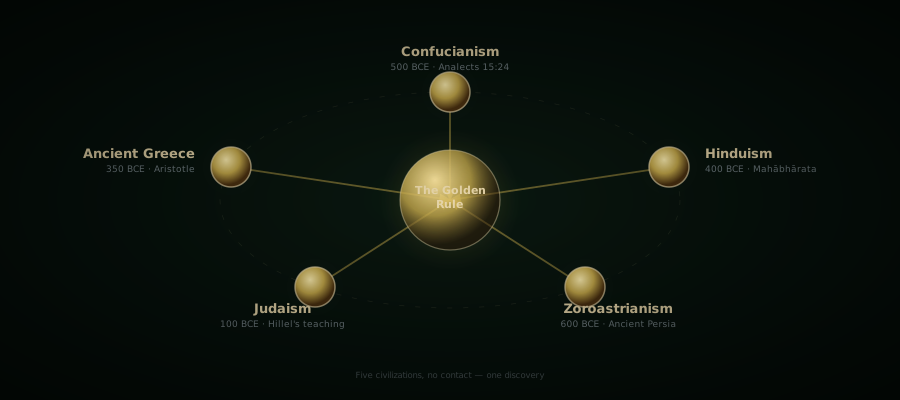 Five traditions, no contact — one discovery. The same underlying law, articulated independently across the full span of human civilization.
Five wisdom traditions — Confucian, Buddhist, Hindu, Abrahamic, and indigenous — converging at a single shared center.
What is hateful to you, do not do to your neighbor.
— Hillel the Elder, Babylonian Talmud, Shabbat 31a
Five Discoverers, No Contact
Let's go deeper into what happened during the Axial Age, because the story is even stranger than it first appears.
Karen Armstrong's The Great Transformation (2006) — one of the most important works of comparative intellectual history written in the last half-century — documents what the philosopher Karl Jaspers named in 1949: a period roughly spanning 800 to 200 BCE during which transformations of extraordinary depth occurred simultaneously in at least four distinct civilizational centers: China, India, the Middle East, and Greece. During this same window, without any evidence of significant cross-cultural contact, thinkers working in radical isolation from one another arrived at strikingly convergent conclusions about the nature of the human moral situation.
Here's what makes the convergence truly remarkable: these thinkers disagreed on almost everything else. They disagreed on theology, metaphysics, cosmology, the nature of the divine, the structure of the universe, and the ultimate destiny of the soul. What they agreed on — what emerged independently from each tradition — was this one principle: reciprocal regard as the foundation of ethical life.
And they weren't working in peaceful ivory towers. The Axial Age was a period of intense urban disruption, political fragmentation, violent conflict, and the collapse of older social orders. In China, the Zhou dynasty was fracturing into a mosaic of warring states — the period literally called the "Warring States" — in which the old feudal order was dissolving into a chaos of competing military powers. In India, the ancient Vedic tribal order was giving way to urban commercial society, with all the displacement and moral confusion that accompanies rapid social transformation. In the Middle East, the Assyrian and Babylonian empires were destroying ancient kingdoms; the Israelite state was eliminated and its people exiled to Babylon, an experience of civilizational collapse so profound that it fundamentally reshaped Jewish theology. In Greece, the collapse of Mycenaean palace culture had given way to centuries of relative poverty before the emergence of the polis.
It was precisely in this context of fragmentation — Armstrong argues, and the historical record bears out — that these teachers emerged. Not in spite of the collapse, but because of it. When the old structures fail, when inherited authority crumbles, when the social order that organized collective life dissolves — something has to take its place. And what these teachers found, each on their own, was a principle that didn't need external authority to function. It was self-authorizing. It worked because of what it was, not because of who was enforcing it.
The Golden Rule was not a luxury of prosperous, settled civilizations. It was, over and over again, the discovery of people trying to understand how human beings could live together after the structures that had organized them had collapsed.
Think about that. When everything falls apart, when the inherited social order crumbles, when the old authorities lose their hold — what remains? What can serve as a foundation for community when nothing else will?
These five civilizations, each in their own crisis, each without knowledge of the others, arrived at the same answer.
Confucius (551–479 BCE) was explicitly restorative. His life spanned one of the most chaotic periods in Chinese history, and his project was not abstract philosophy — it was practical reconstruction. He was searching for the principles that could rebuild a coherent human community when everything else had failed. When he identified shu — reciprocity — as the single principle that could guide a whole life, he wasn't offering moral decoration. He was identifying what he took to be the structural foundation of social order itself.
His disciple Tsang asked: "Is there one word that can serve as a guide for one's entire life?" Confucius replied with shu. One word. The Golden Rule as the entire curriculum. And in the Analects 4:15, he offered a related formulation: the Master's way is zhong shu — conscientiousness and reciprocity — and nothing more. Not "these are the most important principles among many." These are the only principles. Everything else is elaboration.
In India, the Jain tradition offers one of the earliest formulations anywhere: the Acaranga Sutra (c. 500 BCE) states: "A man should wander about treating all creatures as he himself would be treated." Notice the scope — all creatures, not just other humans. The ecological dimension that we often think of as modern was already present in one of the earliest formulations, twenty-five centuries ago. The Mahabharata, the vast Hindu epic that reached something like its current form between 400 BCE and 400 CE, returns to the same principle in multiple passages across the text — "This is the sum of duty" — suggesting its authors understood it not as one teaching among many but as a root principle capable of generating the whole.
Hillel the Elder (~110 BCE – 10 CE), working in Jerusalem during Roman occupation, gave what is arguably the most compact and radical formulation in any tradition. He doesn't merely identify the Golden Rule as an important principle. He identifies it as the generative seed of an entire moral tradition — the principle from which everything else can be derived. "The whole Torah. The rest is commentary." This is the move of a mathematician who has found the axiom from which the theorems follow. Not a simplification. A discovery of the generative root.
In Greece, Socrates's ethical project was anchored in a version of the same principle through the concept of justice. Aristotle's formulation in the Nicomachean Ethics approaches it from the direction of distributive justice: what is just is what you would want applied to yourself if you were in the other's position. The Stoics made it foundational to their cosmopolitanism — the recognition that all rational beings belong to a single community whose law is reciprocal regard.
And beyond the Axial Age civilizations, indigenous traditions across multiple continents contain formulations that predate contact with any of these — a fact that extends the convergence beyond the Mediterranean-to-Pacific band that Jaspers originally described.
The Sioux concept of Mitákuye Oyásʼiŋ — "all my relations" — is both a cosmological statement and an ethical principle: to recognize that all living beings are related is to recognize that the treatment of others is not separable from the treatment of oneself. It is said at the beginning and end of prayer, a constant reminder that the web of reciprocal regard includes everything that lives.
The Ubuntu philosophy of Southern African cultures — umuntu ngumuntu ngabantu, "a person is a person through other persons" — contains an even more radical version: the self is not prior to relationship but constituted by it. Desmond Tutu described Ubuntu as the understanding that "my humanity is caught up, is inextricably bound up, in yours." In this framework, the Golden Rule isn't a constraint on a pre-social individual. It's a description of how the individual actually comes into being. You don't exist first and then relate to others. You come into existence through relationship. The Rule isn't something you apply to pre-existing selves. It's the principle by which selves are formed in the first place.
We are, in 2026, living through a period that bears more than a passing structural resemblance to the conditions of the Axial Age. Political fragmentation. The collapse of shared epistemic authority. The erosion of the civic structures that once organized collective life. The question these ancient teachers were answering is not a historical question. It is the question of our own moment.
And the answer they found — independently, repeatedly, from every direction — is still the most structurally sound answer available: reciprocal regard is the only foundation that does not require the authority of a stable external structure. It is its own authority.
Do unto others as you would have them do unto you.
— Universal proverb (Axial Age convergence)
The Playground Experiment
Before we trace the Golden Rule through science and philosophy and civilizational history, let's start somewhere more immediate. Let's start with children.
In a now-famous series of studies, developmental psychologist Michael Tomasello and his colleagues at the Max Planck Institute observed what happens when very young children — fourteen to eighteen months old, barely walking, long before any formal moral instruction — witness an adult in distress.
A researcher would "accidentally" drop a marker while reaching for it. The toddlers would toddle over and pick it up. Not because anyone asked them to. Not because anyone had taught them to help. Not because they were rewarded for it. They did it reflexively, the way you pull your hand back from a hot stove.
When the researcher dropped the marker on purpose — casually tossing it aside — the toddlers didn't help. They could already tell the difference between someone who needed help and someone who didn't. At fourteen months.
Felix Warneken, working with Tomasello, extended the experiments. He found that toddlers would help even when it cost them something — interrupting their own play, navigating around obstacles, putting in effort. And when he offered rewards for helping, the helping actually decreased in subsequent rounds. The reward introduced a transactional frame that undermined the intrinsic motivation. The children were not calculating costs and benefits. They were responding to something that felt like a pull toward another person's need.
This is not learned behavior. This is not cultural conditioning. This is the Golden Rule before language. Before civilization. Before anyone stood on one foot and named it.
What's even more striking is what happened across cultures. Warneken and Tomasello replicated these findings with children from different cultural backgrounds — and the results held. The helping impulse was not more prevalent in cooperative cultures or less prevalent in individualistic ones. It was everywhere. It was, as far as the researchers could tell, a feature of being human, not a feature of being raised in any particular way.
Jean Decety at the University of Chicago, using functional MRI studies with older children, found that moral reasoning and empathy share neural circuitry with self-referential processing — the brain's capacity to model the other as a version of the self. When we observe another person's experience, the same neural regions activate as when we undergo that experience ourselves. The distinction between first-person and third-person, between self and other, is not a fact of nature — it's a construction. And it's a construction that the brain can partially dissolve in the act of genuine attention.
There's a poignant detail in these studies that often goes unremarked. The toddlers didn't help everyone. They helped those who appeared to genuinely need help. They could already distinguish between authentic need and casual disregard. At fourteen months, they were already reading intention, already modeling the other's inner state, already calibrating their response to what the other person actually needed rather than just what they observed on the surface. This is not simple mimicry. This is the rudiment of moral perception.
The toddlers in those experiments were not following a rule. They were expressing a capacity — a capacity that evolution built into us because it makes us more effective social agents, because the communities whose members could feel each other's needs and respond to them survived at higher rates than communities of isolated calculators.
The Golden Rule, then, is not something the sages invented and the rest of us are trying to learn. It's something we all arrive with. What the sages did — Confucius, Hillel, the Buddha, all of them — was give language to something the body already knows.
The Simplest Strategy Wins
Now let's talk about a computer tournament. Because the story of how the Golden Rule was mathematically proven is, honestly, one of the most satisfying stories in the history of science.
In 1980, the political scientist Robert Axelrod at the University of Michigan sent invitations to game theorists around the world: submit a computer program that will compete in an iterated Prisoner's Dilemma tournament, and we will find out which strategy for managing cooperation and defection is most successful over time.
If you haven't encountered it, the Prisoner's Dilemma works like this: Two players simultaneously choose to cooperate or defect. If both cooperate, both get a moderate payoff. If both defect, both take a small loss. If one cooperates and the other defects, the defector gets a large gain and the cooperator gets a large loss. The structure creates a genuine dilemma — the individually rational choice is always to defect, but mutual defection produces worse outcomes for everyone than mutual cooperation.
Sound familiar? This is the mathematical structure underlying every situation where you have to decide whether to trust someone. Every business partnership. Every marriage. Every treaty between nations. Every act of generosity offered before you know whether it will be returned.
Axelrod received fourteen entries. The tournament ran each program against every other in iterated rounds, giving each pair the opportunity to interact repeatedly. What matters in the iterated version isn't just what you do on any single round — it's what pattern of behavior you establish over time, because your partner can respond to your history.
The winner was the simplest program submitted: Tit-for-Tat, entered by the game theorist Anatol Rapoport of the University of Toronto. Its complete logic fits in one sentence: cooperate on the first move, then on every subsequent move do whatever your partner did on the last move.
That's it. The entire strategy.
Axelrod ran a second tournament with sixty-two entries, this time publishing the results of the first so that participants could design their strategies knowing what had won. More complex strategies were submitted. Longer memories. Cleverer deceptions. Elaborate pattern-recognition algorithms.
Tit-for-Tat won again.
And here's where it gets beautiful. Axelrod analyzed why it kept winning — published as The Evolution of Cooperation in 1984, one of the most elegant pieces of applied moral philosophy in the scientific literature — and identified four properties:
It is nice: it never defects first. It never initiates exploitation. It consistently presents itself as a cooperative partner.
It is retaliatory: it responds to defection immediately and proportionally. It cannot be taken advantage of. Try to exploit it and you'll get exactly what you gave.
It is forgiving: it returns to cooperation the moment the other player does. It doesn't carry grudges. The cycle of mutual punishment ends as soon as the other side is willing to stop.
It is clear: its behavior is simple enough for other players to understand and respond to. This transparency isn't weakness — it's what makes the cooperative equilibrium stable.
Tit-for-Tat's four interlocking properties — nice, retaliatory, forgiving, clear — forming a stable cooperative system.
Read those four properties again slowly. Nice. Retaliatory. Forgiving. Clear. That's not a computer strategy. That's a description of the wisest person you know.
Think about the person in your life who most embodies trustworthiness. Chances are they show all four properties: they lead with generosity, they don't let themselves be exploited, they don't hold grudges past the point of usefulness, and you always know where you stand with them. The math and the wisdom converge.
What makes this result so remarkable is what it ruled out. Clever strategies lost. Manipulative strategies lost. Strategies with long memories and complex conditional logic lost. Strategies designed to exploit the patterns of others lost. The most sophisticated strategies, by every conventional measure of strategic sophistication, were beaten by the simplest possible implementation of the oldest moral principle in human history.
What Axelrod demonstrated was not merely that reciprocity is ethically appealing. He demonstrated that reciprocity is computationally optimal for sustained cooperation. The Golden Rule, in its essence, is Tit-for-Tat: offer what you would want returned. Respond proportionally to what you receive. Forgive and resume cooperation when the other party is ready. And be legible enough that others can understand what you're offering.
The most ethical strategy is also the most effective one. That's not a coincidence. It's a clue about the structure of reality.
One sentence now spans twenty-five centuries: the principle Confucius gave to a student with a single word — shu — is the same principle that a computer tournament at the University of Michigan would prove optimal two and a half thousand years later.
Martin Nowak of Harvard, writing in Science in 2006, extended Axelrod's insight by identifying five distinct mechanisms through which cooperation evolves in biological and social systems: direct reciprocity (Tit-for-Tat), indirect reciprocity (reputation), network reciprocity (the clustering of cooperators), kin selection, and group selection. Every single mechanism is, at its core, a variant of the Golden Rule operating at a different scale. The Golden Rule isn't one cooperation mechanism among many — it's the master pattern that all cooperation mechanisms instantiate.
Your Body Already Knows
In 1996, something happened in a neuroscience lab in Parma, Italy that would change our understanding of what the Golden Rule actually is.
Giacomo Rizzolatti and his colleagues were studying motor neurons in macaque monkeys — the neurons that fire when the monkey reaches for something. They had electrodes in place, monitoring neural activity while a monkey reached for peanuts. Standard procedure.
Then a researcher reached for a peanut. And the monkey's motor neurons fired — the same neurons, the same pattern — as though the monkey were reaching for the peanut itself. The monkey was sitting still. It was only watching. But its brain was performing the action it observed.
Rizzolatti called them mirror neurons. Subsequent research confirmed the existence of analogous systems in humans, extended by researchers including Vittorio Gallese and Jean Decety.
Let that land for a moment. When you watch someone reach for a glass of water, a part of your brain reaches for it too. When you watch someone stub their toe, your pain circuits activate. When you see a face crumple in grief, something in you crumples. When you watch an athlete sprint, the motor regions of your brain begin preparing to sprint. When you watch a musician's fingers fly across a piano, the areas of your brain responsible for finger movement light up, even though your hands are perfectly still.
This is not metaphor. This is not sentiment. This is the literal, measurable, neurologically real permeability of the boundary between self and other. Your nervous system does not fully distinguish between what happens to you and what happens to the person you're watching. The wall between your experience and theirs has always been more porous than you imagined.
Vittorio Gallese, one of the co-discoverers of mirror neurons, proposed what he calls the "shared manifold hypothesis" — the idea that before we cognitively understand another person's experience, we already share a pre-reflective resonance with them at the neural level. We don't first observe, then interpret, then empathize. We resonate first, and the observation and interpretation come after. The connection is more fundamental than the separation. The wall is the construction. The resonance is the default.
Mirror neurons bridging two figures, showing the permeable boundary where self and other begin to overlap.
The Golden Rule, in neuroscientific terms, is not an instruction to override selfishness. It's an invitation to activate the neural architecture that already exists for accurately perceiving another person's experience — and to let that perception inform action. When we do unto others as we would have them do unto us, we're engaging a neurological capacity that evolution built into us because it makes us more effective at the thing that keeps us alive: living together.
Robert Trivers of Harvard laid the evolutionary foundation in his landmark 1971 paper "The Evolution of Reciprocal Altruism." Trivers showed that behavior benefiting another organism at cost to the actor — what looks, superficially, like pure altruism — can evolve through natural selection under precisely the conditions that characterize human social life: when individuals interact repeatedly, when they can recognize and remember one another, and when the benefits of mutual cooperation exceed the costs of individual sacrifice. Reciprocal altruism isn't a moral ideal grafted onto selfish biology. It's an evolved survival technology, optimized by millions of years of social living.
Jonathan Haidt's research program, synthesized in The Righteous Mind (2012), adds the cross-cultural dimension. Haidt and his colleagues surveyed moral intuitions across dozens of cultures worldwide and identified six universal moral foundations — care/harm, fairness/reciprocity, loyalty/betrayal, authority/subversion, sanctity/degradation, and liberty/oppression. Fairness and reciprocity appears everywhere. Not because Western missionaries spread it. Not because one culture taught the others. Because it's a feature of moral cognition that emerges wherever human beings live together — which is to say, everywhere.
The Golden Rule, then, was not invented by moral philosophy. It is the moral articulation of what evolution built first, what the brain already does, what children demonstrate before they can speak. Confucius and Hillel were not creating something new. They were — as Armstrong says — discovering something that was already there, and giving it a form that could be transmitted, practiced, and refined.
The Same Pattern at Every Scale
The mathematician Benoit Mandelbrot coined the word fractal in 1975 to describe something he kept seeing everywhere he looked: patterns that reproduce their own structure at every level of magnification. The coastline of Britain is irregular at the scale of a satellite image and equally irregular under a microscope, because the same generative process — the interaction of water and rock — operates at both. The Mandelbrot set, generated by iterating the simplest possible rule (z → z² + c), produces infinite complexity at every scale of zoom, not because it's imposed from outside but because it emerges from the rule itself.
The Golden Rule is fractal in exactly this sense. The principle — treat others as you would want to be treated — is a simple rule. But applied recursively, at every level of human social organization, it generates the same structural output: more cooperation, more trust, more resilience, more capacity for joint flourishing. And its violation, at any scale, generates the same structural failure: erosion of trust, proliferation of defection, collapse of the systems that depend on reciprocal obligation.
Let's walk through the scales. And as we do, notice how the same pattern — the same structural logic — repeats at each level. This is what makes it fractal. Not just that it appears at multiple scales, but that the mechanism is identical each time.
Between two people. A relationship organized around treating each other as one would want to be treated generates the trust that makes depth and durability possible. Without reciprocal regard, what looks like relationship is actually a temporary alignment of interests, vulnerable to dissolution the moment those interests diverge. With it, the relationship can survive divergence because both parties have committed to something that transcends the immediate transaction. This is not merely a description of friendship — it's friendship's structural condition.
You can feel this in your own experience. Think of a relationship where you felt genuinely safe — where you knew that the other person would treat your vulnerabilities with the same care they'd want for their own. That safety didn't come from a contract or an agreement. It came from the accumulated evidence of reciprocal regard, practiced day after day, until trust became the medium you both breathed. Now think of a relationship where that reciprocity was missing. The absence has a texture too — a persistent low-grade vigilance, an inability to fully relax, a sense that the ground might shift without warning. The presence and absence of the Golden Rule between two people is not an abstraction. It's the most tangible thing in the world.
Within an organization. Adam Grant's research at the Wharton School, detailed in Give and Take (2013), documents this with empirical precision. In virtually every field he studied — medicine, engineering, sales, law — the highest long-term performers were "Givers": people whose default orientation is to offer more than they take. Givers initially appear to sacrifice short-term advantage. But over time — and this is the fractal insight — the pattern of reciprocal regard they establish attracts collaboration, generates trust, builds reputation, and creates conditions in which others invest in their success. The Golden Rule at organizational scale isn't merely ethically preferable. It's operationally superior over any time horizon long enough to matter.
Across a community. Robert Putnam's thirty-year research project, culminating in Bowling Alone (2000), documented what he called "social capital" — the networks of trust, reciprocity, and mutual obligation that determine a community's capacity for collective action. Communities where "generalized reciprocity" is strong — the willingness to extend the Golden Rule not just to people we know but to strangers — show measurably superior outcomes across every significant dimension: faster economic recovery, longer individual lifespans, higher educational achievement, more effective governance, greater innovative output. The Golden Rule at community scale isn't a moral luxury. It's what determines whether a community can hold itself together under pressure.
Between nations. International trade relationships built on reciprocal benefit — what the economist David Ricardo called comparative advantage — have produced longer periods of peace between participants than any alternative arrangement. The postwar international order — imperfect as it was — was an attempt to institutionalize this principle: countries that commit to reciprocal rules, mutual legal obligation, and the norm of treating other nations' interests as real have, in general, fought one another less. As Axelrod showed, reciprocal cooperation is computationally optimal, and the costs of sustained mutual defection exceed the costs of genuine reciprocal investment.
The history of the twentieth century offers a brutal confirmation from the negative side. When nations systematically violated the Golden Rule at scale — treating other peoples' lives, territories, and interests as expendable — the result was not merely moral failure but structural collapse: world wars, genocides, the destruction of the international systems that had taken centuries to build. And every attempt to rebuild after these collapses — the League of Nations, the United Nations, the European Union — was, in essence, an attempt to institutionalize reciprocal regard at civilizational scale. The architecture varies. The underlying principle is always the same.
The Golden Rule's branching pattern repeating across four scales — two people, organizations, communities, and nations.
The pattern of the Golden Rule's application and the pattern of its violation are both fractal. What is true between two people is true between two organizations, between two nations, between humanity and the living world. The same simple rule, applied or violated at any level, produces the same structural outcome.
This is what The Math of Everything describes at a more abstract level — the way a single generative principle (the "1") produces infinite complexity (the "8") from apparent nothing (the "0"). The Golden Rule is one of the clearest examples of this fractal architecture in action: one principle, applied recursively, generating the cooperative structure of human life at every scale.
And the violation of the fractal law is equally self-similar. What is true of betrayal between two people — the collapse of trust, the defensive withdrawal, the escalating cycle of retaliation — is true of the cycle of harm between communities, between nations, between a civilization and its environment. The same mechanism that makes a marriage fail when reciprocal regard disappears is the same mechanism that makes an ecosystem fail when extraction replaces reciprocity. The patterns are not metaphorically similar. They are structurally identical. That's what it means for a law to be fractal.
Understanding this changes the stakes of everyday behavior. The Golden Rule isn't just a nice way to treat the person in front of you. It's a practice of participation in the structural integrity of every system you're embedded in — from your closest relationship to the biosphere itself. What you do at the personal scale echoes, with the same structural logic, at every scale above you. You are, whether you know it or not, a participant in a fractal. How you treat the person in front of you is not separate from how the world holds together.
The Ecological Mirror
There's one more scale we need to look at. And this one stings.
The relationship between humanity and the living systems on which we depend is, at its deepest level, a reciprocity problem. We have been extracting from those systems without returning. Treating them as resources without integrity of their own. Doing unto the living world what we would not want done to ourselves.
A forest practices something remarkably like the Golden Rule. Suzanne Simard's research at the University of British Columbia has documented what she calls the "wood wide web" — networks of mycorrhizal fungi through which trees share nutrients, send chemical warning signals, and even direct resources toward struggling neighbors, including trees of different species. A mother tree, Simard found, will preferentially feed her seedlings through fungal networks. But she also feeds strangers. When a neighboring tree is cut off from light, other trees in the network will send it carbon through the fungal connections — keeping it alive until conditions change. The forest is a reciprocity system, and it has been running longer than any human civilization.
A coral reef operates the same way. Fish clean parasites from larger fish who could eat them. Clownfish protect anemones that protect them. The entire structure of the reef is a web of reciprocal relationships so densely interwoven that removing any one strand weakens the whole.
We didn't ask the forest for permission before we clearcut it. We didn't consult the reef before we acidified its waters. We didn't treat the ocean's fish stocks as though they had interests worth considering. We didn't apply the fractal law at the scale where it might have mattered most.
The consequences — now visible across multiple dimensions of the planetary system simultaneously — are precisely what always follows when the Golden Rule is violated at sufficient scale: the system begins to fail. Species extinction rates. Ocean acidification. Soil depletion. Climate destabilization. These aren't random misfortunes. They're the fractal consequence of the Golden Rule's violation at civilizational scale.
I'm not saying this to preach. I'm saying it because the pattern is structurally identical at every level we've examined: between two people, within organizations, across communities, between nations — and now, between a species and its living home. The same law. The same consequence when it's violated. The same restoration when it's honored.
The cycle of harm that operates between individuals — where hurt begets hurt, where the violated become violators — operates at civilizational scale too. What the material veil describes in philosophical terms, the ecological data describes in parts per million and degrees Celsius.
This isn't a reason for despair. It's actually a reason for hope — and this distinction matters deeply. Because if the same law operates at every scale, then the same remedy is available at every scale too. The practice of reciprocal regard that heals a relationship can, scaled appropriately, heal a community. And what heals a community can, in principle, heal our relationship with the living systems we depend on.
The indigenous traditions always knew this. Mitákuye Oyásʼiŋ didn't draw a line between human relations and ecological relations. The Golden Rule, in the Lakota understanding, applied to the river, the buffalo, the prairie grass, the stones. Not metaphorically. The way you treated the land was the way the land would treat you. Reciprocity all the way down.
We are now learning, through satellite data and climate models and extinction rates, what those traditions knew through relationship and attention: the living world responds to how it's treated. The fractal law doesn't stop at the boundary of the human species. It extends to every system we're embedded in. And the question it asks at the ecological scale is the same question it asks between two friends:
What would I want, if I were on the receiving end of this?
The Grandmother and the Stranger
Let me tell you about someone you've probably met, in one form or another, in your own life.
There's a woman in Charlotte's West Side — I'll call her Mrs. Thompson, though that's not her name — who has been practicing the Golden Rule for decades without ever using the phrase. She's seventy-three. She grew up in this neighborhood. She's seen it change around her a dozen times.
Every Saturday morning, Mrs. Thompson cooks. Not for her family — they're grown, scattered across three states. She cooks for whoever shows up. The door is open. There are always too many chairs crammed around the table, and there's always enough food. Somehow there's always enough food.
A young man moved into the apartment two doors down — recent immigrant, no English, no family nearby, working night shifts at the warehouse. She couldn't speak his language. He couldn't speak hers. But she brought him a plate the first Saturday. And the next. By the third week, he was at the table. By the second month, he was helping cook.
She didn't explain the Golden Rule to him. She didn't need to. She demonstrated it — and the demonstration transmitted something that no lecture could.
This is the part that matters most: the pattern is contagious. Not because it's a meme or a social pressure or a moral obligation. It's contagious because being on the receiving end of genuine reciprocal regard activates the same capacity in the receiver. The young man started bringing plates to the elderly woman across the hall. Then the elderly woman started checking on the single mother two floors up. Not because Mrs. Thompson organized a helping network. Because she had planted a seed, and the seed knew how to grow.
Nowak's research on indirect reciprocity — the science of reputation — explains part of this mechanism. When you witness someone being generous, your own cooperative behavior increases, even toward third parties who weren't involved in the original exchange. The technical term is "upstream reciprocity." The everyday term is "inspiration." Mrs. Thompson inspired, without trying to inspire, because the pattern itself is generative. It reproduces.
This is how the Golden Rule actually moves through the world. Not through philosophy departments or computer tournaments — though those tell us something important about why it works. It moves through people like Mrs. Thompson, who practice it so naturally that it becomes the atmosphere of a place. You walk into her kitchen and you feel it: the quality of being treated as though you matter. And something in you responds. Something in you — the same something that fired in those toddlers reaching for the dropped marker — starts treating other people the same way.
There's a word for what Mrs. Thompson creates: social capital. Putnam's research measured it through surveys and databases and thirty years of meticulous data collection. But Mrs. Thompson creates it with cornbread and an open door. The data and the cornbread are describing the same thing.
Putnam's research documented this at scale — the measurable effects of communities where generalized reciprocity is strong. But Mrs. Thompson's kitchen is where it actually lives. In the specific, the embodied, the weekly rhythm of plates carried to neighbors. In the willingness to welcome a stranger who speaks a different language, because you remember what it felt like to be new somewhere.
Every community that applied the Golden Rule consistently found that it worked. Every leader who organized around it found more stable and flourishing outcomes. Every relationship in which it was practiced found that it generated the trust without which depth is impossible. The principle outlasted every civilization that discovered it because it's not the product of any civilization. It's a description of how human cooperative systems actually function.
Mrs. Thompson doesn't know about Axelrod's tournament. She doesn't know the term reciprocal altruism. But she knows — in the way that matters most, in the body-knowledge that precedes all theory — what Confucius meant by shu. And every Saturday morning, she teaches it without saying a word.
This is what generosity looks like in practice: not an abstract principle but a plate of food, carried across a hallway, to someone who didn't expect it.
The Positive and the Negative
Something worth noticing about all those cross-cultural formulations: they don't all say the same thing, exactly. And the differences matter.
Hillel's formulation is negative: "What is hateful to you, do not do to your neighbor." Confucius's shu is also negative: "What you do not want done to yourself, do not do to others." The Mahabharata: "Do not do to others what would cause pain if done to you."
Jesus's formulation is positive: "Do unto others as you would have them do unto you."
The difference between "don't hurt" and "actively help" might seem like a technicality. It isn't.
The negative formulation — the older and more widespread version — sets a floor. It says: at minimum, don't inflict what you wouldn't want inflicted on you. This is the baseline of human decency. Don't lie, cheat, steal, or harm. The floor.
The positive formulation raises the ceiling. It says: don't just refrain from harm — actively offer what you would want to receive. Not just the absence of cruelty, but the presence of care. Not just "do no harm" but "do the good you would want done."
Both are necessary. The floor without the ceiling produces a society of people who leave each other alone — which sounds pleasant in theory but is actually a description of loneliness at scale. The ceiling without the floor produces a society of people who help strangers while mistreating their families — generosity as performance, detached from the discipline of not-harming. The full spectrum of compassion requires both: the discipline of the negative and the generativity of the positive.
This spectrum maps onto something deeper. The negative formulation — "don't harm" — is a practice of restraint, of awareness, of noticing when your actions might cause pain you wouldn't want to experience. It cultivates sensitivity. The positive formulation — "actively give what you'd want to receive" — is a practice of imagination, of creativity, of looking at another person's life and asking what gift you could bring to it. It cultivates generosity. Together, they form a complete practice: sensitivity and generosity. Awareness and action. The two wings of a bird.
Axelrod's Tit-for-Tat, interestingly, encodes both. Its "niceness" is the positive formulation — it cooperates first, initiating generosity. Its "retaliation" is the negative formulation — it responds to harm proportionally. The Golden Rule at its most complete isn't one or the other. It's a spectrum, and different traditions have illuminated different regions of it.
The spectrum from negative restraint to positive generosity, with reciprocity's four properties as the living bridge.
What's striking is not that each tradition contains the Golden Rule, but that each tradition's formulation illuminates something the others leave implicit. The Confucian tradition makes explicit the social architecture that reciprocity builds. The Buddhist tradition makes explicit the perceptual shift that makes reciprocity natural rather than effortful. The Hindu tradition makes explicit the cosmic scale at which the principle operates. The Abrahamic traditions make explicit the generative power of the principle — its capacity to ground and organize an entire moral order. The indigenous traditions — Ubuntu, Mitákuye Oyásʼiŋ — make explicit the relational ontology that the principle presupposes: the understanding that the self is not separate from but constituted by its relations.
Together, they don't contradict each other. They describe the same phenomenon from different angles. And the overlapping testimony is among the strongest available evidence that what these traditions were pointing at was real.
The Question the Rule Secretly Asks
Now we arrive at the part that changes everything. And you won't find it in Axelrod's data or Putnam's social capital metrics. You'll find it in the quiet space between the words of the Rule itself.
"Treat others as you would want to be treated."
Read it again. Slowly this time.
"Treat others as you would want to be treated."
The Rule tells you how to act. But notice what it assumes without examining: the identity of the one doing the treating. The word "you" is sitting right there in the middle of the sentence, and no one ever asks what it means. There's a hidden question nested inside the Golden Rule like a seed inside a fruit — and when you notice it, the entire principle deepens by an order of magnitude:
Who is this self you are treating others as?
If the self is a fixed, isolated entity — a discrete bundle of preferences and interests sealed off from everyone else — then the Golden Rule is a kind of projection exercise: imagine what it would be like to be over there, then act accordingly. It's useful. It's prosocial. But it's fundamentally a bridge between two separate islands.
But what if that's not what the self is?
The deepest traditions that discovered the Golden Rule — the ones that meditated on it longest, that practiced it most rigorously — all found themselves arriving at this question. And their answers are remarkably convergent.
The Buddhist tradition's analysis of anatta (non-self) suggests that the sense of being a separate, autonomous individual — with interests fundamentally independent of and potentially opposed to those of others — is a perceptual construction rather than an accurate description of reality. Not that there's no experience. But that the seemingly solid, separate self that experiences is a process, not a substance, and the sense of fundamental separation from others is, at some level, a misperception.
The Advaita Vedanta tradition in Hinduism makes the claim in its most radical form: Atman (the individual self) and Brahman (the ground of all being) are not-two. The apparent separation is the fundamental misperception that the tradition's practices are designed to dissolve. Ubuntu — umuntu ngumuntu ngabantu — says it from the African philosophical tradition: "I am because we are." The self is relational, not isolated. Mitákuye Oyásʼiŋ says it from the Lakota: all my relations. Everything is kin.
The mystical traditions of the Abrahamic religions — Kabbalah, Sufism, Christian mysticism — arrive at structurally similar claims through different vocabularies.
What these traditions converge on is a claim that the neuroscience of mirror neurons is now, in a more modest way, confirming: the boundary between self and other is not as fixed as ordinary experience suggests. The neural enactment of another's experience that Rizzolatti's research documents is not a metaphor for connection — it is a literal description of what the nervous system does. We do not merely observe others from behind a window of separateness. We resonate with them at the level of neural firing.
When we do unto others as we would have them do unto us, we are — at this deeper level — doing unto a being who is not as separate from us as our ordinary perception suggests. The Golden Rule is not a guideline for the management of our separateness. It is an invitation to perceive more accurately — to discover that the separateness which makes the Rule feel like sacrifice is less complete than we imagined.
And in the traditions that have practiced this most deeply, the insight is consistent: when the perception of separation dissolves even partially, the Rule ceases to feel like constraint and begins to feel like description. Not I should treat others as I would want to be treated, but of course I treat others as I would want to be treated, because what happens to them is not separate from what happens to me.
You may have felt this, even briefly. In a moment of deep love, or in the presence of great suffering, when the wall between your experience and another's became thin enough to almost vanish. When comforting a crying child felt like comforting your own pain. When witnessing a stranger's joy produced a warmth in your chest that had nothing to do with your own circumstances. Those moments aren't sentimental aberrations. They're glimpses of a more accurate perception — the perception that the Golden Rule, practiced deeply enough, reveals.
This is the question that The Geometry of Collaboration keeps circling in a different register: What becomes possible when the boundary of self becomes porous enough to genuinely include another? What changes — in practice, in creativity, in shared work — when "I" and "you" discover they are not quite as separate as they appeared? If this seed question is pulling at you, that chapter is where the practical implications bloom.
Immanuel Kant's Categorical Imperative — act only according to maxims you could will to be universal laws — is a philosophical re-derivation of the same insight from pure reason. Kant's argument isn't that we should be nice. It's that any principle of action that can't survive universalization contains a self-contradiction. The Golden Rule, in this analysis, is not external moral requirement but the logical consequence of consistent rational agency. To act against it is not just unkind. It's incoherent.
John Rawls, in A Theory of Justice (1971), reconstructed it at the level of political philosophy through the "veil of ignorance": design social institutions as though you didn't know what position you'd occupy. Not a sentimental argument — a rational one. The only way to design genuinely just institutions is to apply the Golden Rule at systemic scale.
Martin Buber, in I and Thou (1923), approached the metaphysical dimension from yet another direction. He distinguished between "I-It" relationships — where the other is encountered as object — and "I-Thou" relationships — where the other is encountered as genuine subject, another center of experience. The Golden Rule is the practical expression of the I-Thou orientation. And what Buber called "inclusion" — the genuine imaginative inhabiting of another's experience — is the perceptual capacity without which the principle becomes merely formal.
All roads lead to the same place: the Golden Rule isn't just about behavior. It's about perception. It works because the separation it appears to bridge was never as solid as we thought. And the deeper you practice it, the more you discover that the bridge was always there — you just hadn't looked down.
This is what the Technologies of the Heart series keeps circling back to: the oneness that makes the Rule effortless is not the prerequisite for practicing it. It's what consistent practice reveals.
What the Grandmother Knows
Let's come back to earth now. Because if this article has done its job, you've just traveled from a one-foot balance in ancient Jerusalem through computer tournaments and mirror neuron labs and Charlotte kitchens and the mycorrhizal networks beneath a forest floor — and the question that remains is the most practical one: So what do I do with this?
The Golden Rule does not require philosophical enlightenment to practice. It requires only a moment of genuine imagination — what Buber called "inclusion," the act of genuinely inhabiting the full reality of another person's experience from within, not merely observing it from without.
This is not complicated. What makes it difficult is not its complexity but the pervasive bias of self-referential attention — the tendency, reinforced by every ambient cultural message in a consumer culture, to treat our own experience as primary and everyone else's as secondary. The practice of the Golden Rule is, fundamentally, a practice of attention: turning the same quality of attention we normally give to our own experience toward the experience of another.
Mrs. Thompson does this every Saturday. The toddlers in Tomasello's experiments did it at fourteen months. Your body does it every time mirror neurons fire. Confucius condensed it to a single word. Axelrod proved it optimal with millions of computational iterations.
You already know how. The question is whether you'll make it deliberate.
The Three-Second Pause. Before speaking, before sending the message, before making the decision — pause long enough to ask: how would I experience this if I were on the receiving end? Not abstractly. In this person's position, with their history, their sensitivities, their hopes, their fears — how does this land? Three seconds. It changes everything.
The Bilateral Interest Map. In conflict, the Golden Rule doesn't mean giving the other person what they want. It means treating their interests as though they were as real and as legitimate as your own — because they are. The resolution that treats both sets of interests as real is almost always available. The resolution that treats only one set as real is almost always unstable.
The Rawlsian Leadership Test. Whether you lead an organization, a family, a community, or a civic institution — the Golden Rule asks: would I endorse these practices if I didn't know whether I would be the leader or the led? What transparency would I want? What respect? What genuine consideration of my perspective? Leadership organized around this question consistently outperforms leadership organized around hierarchy, for reasons Axelrod's analysis makes precise: people cooperate more fully with leaders they trust.
The Forgiveness Protocol. Tit-for-Tat's most counterintuitive property — perhaps its most important — is its forgiving quality. It doesn't carry grudges beyond the next move. When the other party returns to cooperation, Tit-for-Tat immediately resumes. In human relationships, this translates to what every contemplative tradition recommends: the willingness to return to reciprocal regard after violation, not because the violation didn't happen, but because sustained mutual defection serves neither party and closes the possibility of repair.
The Stranger Test. Once a week, extend the Golden Rule to someone who can't reciprocate — someone you'll never see again, someone who has nothing to offer you. Buy the coffee. Hold the door an extra moment. Ask the checkout clerk how they're actually doing, and wait for the answer. This is where the practice of paying it forward begins — extending the Rule beyond the transactional, into the unconditional. This is what the compassion lineage has always taught.
Try This Today
Choose one relationship — professional, personal, or civic — in which you're currently navigating a tension. Write down, in as much detail as you can, how the situation looks and feels from the other person's position. Not your interpretation. Their experience, as close as you can honestly imagine it. What do they fear? What are they trying to protect? What do they most need to hear?
Then ask: what would I offer them, knowing this?
The answer, in most cases, will be both clearer and more generous than what you were offering before.
This is not weakness. It is the most effective move available, and Axelrod's research makes that precise: the strategy that begins with generosity, responds proportionally, forgives readily, and continues — consistently outperforms every alternative over any time horizon long enough to matter.
Shu
One spring morning in ancient China — the exact date lost to history, but the context preserved in the Analects — a student named Tsang approached Confucius and asked for a single word that could guide a person's entire life. It was not a casual question. It was the kind of question a student asks when they've grasped that the complexity of moral learning is threatening to overwhelm the coherence of practice — when the accumulation of principle is in danger of becoming confusion.
Confucius replied: "Is it not shu — reciprocity? What you do not want done to yourself, do not do to others."
The student went away with one word. Two and a half thousand years later, in a computer laboratory at the University of Michigan, Robert Axelrod ran a tournament that would involve game theorists from around the world, sixty-two competing strategies, millions of iterations of the Prisoner's Dilemma, and the full analytical apparatus of modern social science — and the winner was the simplest strategy submitted: a program that cooperated first, responded proportionally, forgave readily, and continued.
Shu survived two and a half millennia not because it was protected by authority or preserved by tradition alone, but because it kept working. Every community that applied it consistently found that it worked. Every leader who organized their governance around it found that it produced more stable and more flourishing outcomes than the alternatives. Every relationship in which it was practiced found that it generated the trust without which depth is impossible. The principle outlasted every civilization that discovered it because it is not the product of any civilization. It is a description of how human cooperative systems actually function.
The character shu (恕) combines the radicals for "like" (如) and "heart" (心) — like-hearted, the capacity to align one's heart with the heart of another. Not a rule you follow. A resonance you cultivate. Not a duty you perform. A perception you practice until it becomes the default way you encounter the world.
What Confucius gave the student was not comfort. He gave him a tool — a precise, deployable, testable technology for navigating the full complexity of human social life. The student who received it was in the same position as anyone who receives a powerful tool: he had to practice it, test it, fail with it, refine his understanding, and practice again. He would, in applying it imperfectly and persistently, discover for himself what Axelrod would later demonstrate mathematically: that this approach, over time, outperforms every alternative — not because the world is fair, but because cooperation, consistently offered and consistently maintained, generates the conditions under which the world can become more fair.
We return to Hillel on one foot. The skeptic's challenge was that the Torah — the entire accumulated moral inheritance of a civilization — was too complex to be summarized. Hillel's answer was that it was not too complex but too simple: the whole of it was generated by a single seed principle, and what looked like complexity was elaboration on a theme so fundamental that you could stand on one foot and say it. The rest — all of it — was commentary.
Go and learn it.
And the learning, as Hillel knew, is not a matter of reading. It is a matter of doing. The Golden Rule is not comprehended by understanding it. It is comprehended by practicing it — in the next conversation, the next decision, the next moment when you have the choice between treating another person's experience as real or treating it as irrelevant. The practice is the understanding. There is no gap between them.
Do not do to others what you do not want done to yourself.
— Confucius, Analects 15:24
Invitation
You already know this law. You were born knowing it.
Every time you have felt the sting of being treated as less than human — you know, in your body, what the world needs. Every time you have been truly seen — you know the power you carry to give that to another.
Treat them as you would wish to be treated. Not as a rule. As a remembering.
The toddler who picked up the fallen marker knew it. Mrs. Thompson, carrying a plate across a hallway, knows it. The five civilizations that discovered it independently knew it. Your mirror neurons, firing in sympathetic resonance with the person beside you, know it right now.
The question isn't whether you've heard this before. You have. The question is what happens when you take it seriously — not as a platitude, but as a fractal law that operates at every scale of your life.
Between you and one other person. Within the team you work with. Across the community you live in. And yes — between your species and the living world that sustains you.
One principle. Every scale. The same outcome.
Shu. Reciprocity. Like-hearted.
The rest is commentary. Go and live it.
People Also Ask
What is the Golden Rule and where does it come from?
The Golden Rule — "treat others as you would want to be treated" — is the most widely shared ethical principle in human history. Its origins are not singular: it was discovered independently in at least five major civilizations during the Axial Age (roughly 800–200 BCE), including China (Confucius, c. 500 BCE), India (the Jain and Hindu traditions), the Middle East (Hillel the Elder, c. 30 BCE), and Greece (Socrates, Aristotle). Karen Armstrong documented this simultaneous independent emergence in The Great Transformation (2006), concluding that these were separate discoveries of the same underlying moral law, not cultural borrowings.
Is the Golden Rule found in all religions?
Yes — every major world religion contains a formulation. Judaism (Hillel: "What is hateful to you, do not do to your neighbor"), Christianity (Jesus: "Do unto others as you would have them do unto you"), Islam (Muhammad: "None of you has faith until he loves for his brother what he loves for himself"), Hinduism (the Mahabharata: "This is the sum of duty"), Buddhism ("Hurt not others in ways that you yourself would find hurtful"), and Zoroastrianism, Confucianism, Jainism, and Taoism among others. Indigenous traditions across multiple continents contain equivalent principles — Mitakuye Oyasin (Sioux) and Ubuntu (Southern Africa) among the most notable.
What does science say about the Golden Rule?
Three distinct scientific traditions converge on the same conclusion. Evolutionary biology (Robert Trivers, 1971) demonstrates that reciprocal altruism is an evolved survival strategy. Game theory (Robert Axelrod, 1984) proves mathematically that Tit-for-Tat — a formalization of the Golden Rule — outperforms every known alternative in iterated cooperation. Neuroscience (Giacomo Rizzolatti, Jean Decety) discovered mirror neuron systems that cause the brain to literally enact observed experiences. Martin Nowak's 2006 synthesis identified five mechanisms of cooperation evolution — all variants of the Golden Rule at different scales.
Why does Tit-for-Tat win?
Anatol Rapoport's Tit-for-Tat won Robert Axelrod's computer tournaments because of four specific properties: it's "nice" (never defects first), "retaliatory" (responds proportionally to exploitation), "forgiving" (immediately resumes cooperation when the other party does), and "clear" (simple enough for others to model). Together, these properties make it the computationally optimal strategy for any social environment where interactions repeat and parties can recognize each other — the structure of virtually all significant human relationships.
What is the difference between the Golden Rule and the Platinum Rule?
The Golden Rule says treat others as you would want to be treated. The Platinum Rule (a modern refinement attributed to philosopher Milton Bennett) says treat others as they want to be treated. The distinction matters in multicultural contexts: what you would want isn't always what the other person wants. The Platinum Rule requires deeper listening and cultural humility — but both rules share the same foundation of reciprocal regard and the willingness to take the other person's experience seriously.
How is the Golden Rule connected to mirror neurons?
Mirror neurons, discovered by Giacomo Rizzolatti in 1996, fire identically whether you perform an action or observe someone else performing it. Jean Decety's research shows that moral reasoning and empathy share neural circuitry with self-referential processing. This means the brain literally models others' experiences using the same circuits it uses for your own. The Golden Rule isn't asking you to override your biology — it's asking you to activate the neural architecture that already exists for perceiving another's experience as your own.
What are the limits of the Golden Rule?
The most serious limitation is the assumption of shared preferences — what you want may not be what others want. A deeper limitation is that the Rule says nothing about how to act when one party consistently refuses to reciprocate. Tit-for-Tat handles this through proportional response, but in practice, knowing when to continue offering and when to protect yourself from systematic exploitation requires judgment the Rule alone can't supply. Finally, applying the Rule to non-human systems and future generations requires extensions beyond the original principle.
What is shu in Confucian philosophy?
Shu (恕) is the Chinese concept of reciprocity central to Confucian ethics. The character combines radicals for "like" (如) and "heart" (心) — literally "like-hearted," the capacity to align your heart with another's. When asked for a single word that could guide an entire life, Confucius answered: shu. In the Confucian framework, it's not merely a behavioral rule but a relational practice through which ren (humaneness) is cultivated — the quality that makes us fully human.
How does the Golden Rule relate to social capital?
Robert Putnam's thirty-year research project documented that communities with strong "generalized reciprocity" — the willingness to extend the Golden Rule to strangers, not just friends — show measurably superior outcomes across economic resilience, health, education, governance, and innovation. When this web of reciprocal trust thins, communities lose their capacity for collective action. The Golden Rule at community scale is literally what holds a society together under pressure.
Can the Golden Rule be applied to environmental ethics?
Yes, and the application is urgent. The ecological crisis can be understood as the fractal consequence of the Golden Rule's violation at civilizational scale — extracting from living systems without returning, treating the natural world as a resource without integrity. Indigenous traditions like Mitakuye Oyasin ("all my relations") always included the more-than-human world in their scope of reciprocal regard. Extending the Golden Rule to our relationship with Earth's living systems is not a metaphorical stretch — it's the same structural principle applied at the scale where it may matter most.
References
- Armstrong, Karen. The Great Transformation: The Beginning of Our Religious Traditions. Knopf, 2006.
- Armstrong, Karen. The Case for God. Knopf, 2009.
- Armstrong, Karen. Sacred Nature: Restoring Our Ancient Bond with the Natural World. Knopf, 2022.
- Axelrod, Robert. The Evolution of Cooperation. Basic Books, 1984.
- Buber, Martin. I and Thou. Translated by Walter Kaufmann, Charles Scribner's Sons, 1970 (original 1923).
- Decety, Jean, and Claus Lamm. "The Role of the Right Temporoparietal Junction in Social Interaction." The Neuroscientist, vol. 13, no. 6, 2007, pp. 580–593.
- Grant, Adam. Give and Take: Why Helping Others Drives Our Success. Viking, 2013.
- Haidt, Jonathan. The Righteous Mind: Why Good People Are Divided by Politics and Religion. Vintage, 2012.
- Jaspers, Karl. The Origin and Goal of History. Translated by Michael Bullock, Yale University Press, 1953 (original 1949).
- Kant, Immanuel. Groundwork for the Metaphysics of Morals. 1785.
- Mandelbrot, Benoit. The Fractal Geometry of Nature. W. H. Freeman, 1982.
- Nowak, Martin. "Five Rules for the Evolution of Cooperation." Science, vol. 314, no. 5805, 2006, pp. 1560–1563.
- Putnam, Robert. Bowling Alone: The Collapse and Revival of American Community. Simon & Schuster, 2000.
- Putnam, Robert, and Lewis Feldstein. Better Together: Restoring the American Community. Simon & Schuster, 2003.
- Rawls, John. A Theory of Justice. Harvard University Press, 1971.
- Rizzolatti, Giacomo, and Laila Craighero. "The Mirror-Neuron System." Annual Review of Neuroscience, vol. 27, 2004, pp. 169–192.
- Simard, Suzanne. Finding the Mother Tree: Discovering the Wisdom of the Forest. Knopf, 2021.
- Tomasello, Michael. Why We Cooperate. MIT Press, 2009.
- Trivers, Robert. "The Evolution of Reciprocal Altruism." Quarterly Review of Biology, vol. 46, no. 1, 1971, pp. 35–57.
- Warneken, Felix, and Michael Tomasello. "Altruistic Helping in Human Infants and Young Chimpanzees." Science, vol. 311, no. 5765, 2006, pp. 1301–1303.
- Gallese, Vittorio. "The 'Shared Manifold' Hypothesis." Journal of Consciousness Studies, vol. 8, no. 5–7, 2001, pp. 33–50.
- Aristotle. Nicomachean Ethics. Translated by W. D. Ross. c. 340 BCE.
- Confucius. The Analects. Translated by D. C. Lau. Penguin Classics, 1979.
- Cantor, Georg. Beiträge zur Begründung der transfiniten Mengenlehre. 1895.
- Bennett, Milton. "Towards Ethnorelativism: A Developmental Model of Intercultural Sensitivity." Cross-Cultural Orientation, 1986.
- Ricardo, David. On the Principles of Political Economy and Taxation. 1817.
- Simard, Suzanne. "Net Transfer of Carbon Between Ectomycorrhizal Tree Species in the Field." Nature, vol. 388, 1997, pp. 579–582.
- Tutu, Desmond. No Future Without Forgiveness. Doubleday, 1999.
- Wattles, Jeffrey. The Golden Rule. Oxford University Press, 1996.
- Neusner, Jacob, and Bruce Chilton, eds. The Golden Rule: The Ethics of Reciprocity in World Religions. Continuum, 2008.
The Heart of Peace Foundation cultivates compassion, generosity, and human flourishing through mindfulness, community nourishment, and spiritual growth. Explore our programs or get involved to bring these practices into your community.