A potter's hands rest on wet clay. The wheel is already turning — slow, then quicker, the kind of rhythm you find with your foot before you find it with your eye. Water beads on the rim. The clay yawns up between her thumbs, a column with no name yet, and she leans her weight into it gently, the way you lean into someone you're listening to. The wall rises. It thins. The pot is hollow before it is anything else. She is shaping it around the absence at its center, and the absence is not a problem — the absence is what makes it a pot.
This is how everything that lasts gets made. Something turns. Something holds. Something opens around an emptiness that the hands learn to honor instead of fill.
Your grandmother knew this when she pressed her thumb into the middle of the masa to make a tortilla. Your father knew it when he cupped his palms to drink from the kitchen tap and the water held its shape only because his hands made the bowl. A child knows it the first time she digs her fingers into mud at the edge of a puddle and discovers that the hole is the thing — that the pot was never the clay, the pot was the meeting between the clay and the room it makes inside itself.
What the potter is doing, the cosmos is doing too — at every scale where anyone has ever looked carefully. An electron settles into its orbital around a nucleus the way clay finds its wall against the wheel: pulled by what is there, shaped by what is not. A galaxy curls its arms outward the way the column rises between thumbs: a spiral that the math calls logarithmic and the eye simply calls familiar. A heart muscle pulses in a rhythm that, written on paper, looks the same as the rhythm of a smoke ring or a hurricane's eye or the slow turn of stars around their common center. The same shape keeps showing up. Different clay. Same hands.
This is the quiet thing the physics has been saying, scale by patient scale, for about a hundred years now. The constants that recur — the bound that uncertainty cannot cross, the unity that holds all possibilities in relation, the recursion that lets structure repeat without copying itself — are not decoration. They are the fingerprint of something true about how the real holds together. Not a mystical claim. A noticing, careful and falsifiable, that the same family of vessels keeps coming off the wheel.
You don't have to follow the equations to feel what they are saying. You only have to remember the hands. The pot is shaped around what isn't there. The shape repeats. The shape is the kindness.
Key Takeaways
- The elephant of the cosmos is structurally inaccessible — no vantage permits a complete touch. These pages make three touches and names what each one is not touching.
- Zero, one, and infinity are not philosophical placeholders. They are precise structural features of working physics: bounding absence, conserved unity, recursive flow.
- The pottery thesis: same constraint, different clay at different scales. The Heisenberg bound, the unitarity condition, and the renormalization-group flow recur across quantum, mesoscopic, biological, and cosmological scales — each within its own formalism, each in its own dialect.
- The biological scale is the reader's own laboratory. Heartbeat, breath, neural oscillation, and brainwave power spectra exhibit the same architecture as smoke rings, accretion disks, and Kuramoto coupling.
- Beauty in mature physics is not decoration. It is the signature of a constraint that chose what it chose out of everything it could have chosen, and the math is the tracing of that choice with fidelity.
- These pages do not claim to have the elephant. It claims only that three touches, taken with care, return a consistent shape — and that the consistency is a fact about the structure, not a metaphysical thesis about what the structure means.
What follows treats physics as physics, on its own terms. It imports no contemplative claim and asks physics to ratify nothing. It reads the working formalism — Heisenberg, Born, Schrödinger, Wilson, Bekenstein-Hawking, Kuramoto, Mandelbrot — and notices, scale by scale, that certain structural features show up wherever the math has been worked patiently. A companion piece elsewhere in this corpus reads the same architecture in a contemplative register. The two coexist because the architecture admits both readings, and neither reduces to the other. A reader who has never opened the companion can read this writing straight through and lose nothing. The bridge between them, if it exists, is the reader's to walk.
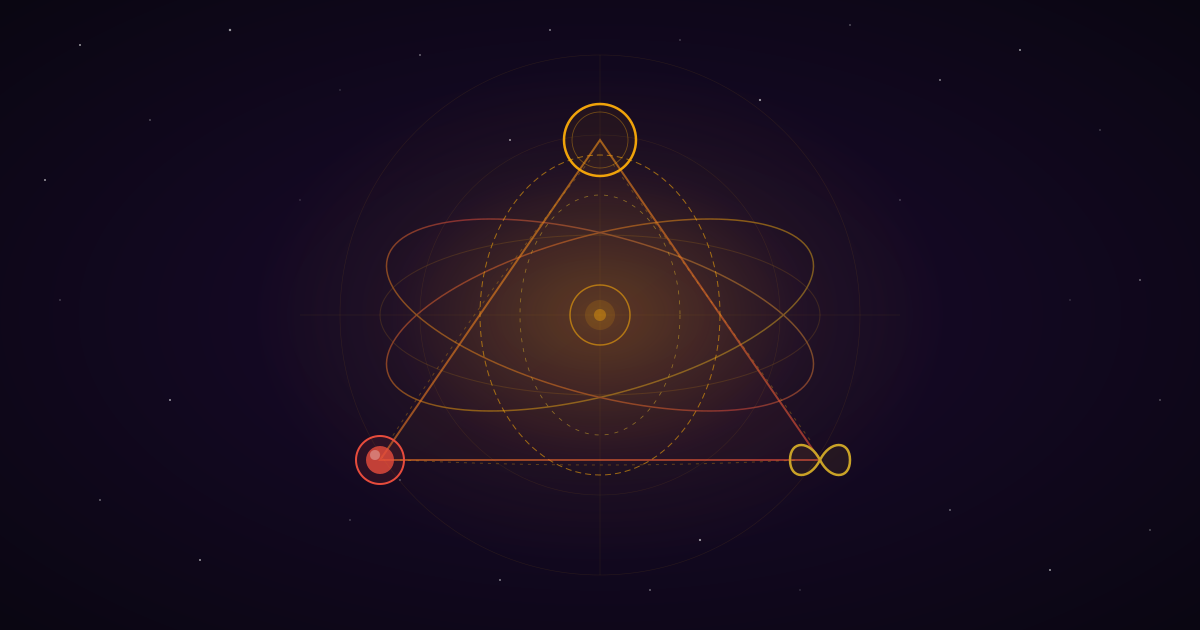
The pottery thesis names what recurs: same constraint, different clay at different scales, and the family of vessels is the recurrence itself. Zero as the vacuum that holds the field — the absence the pot is shaped around. One as the unity that organizes what could otherwise scatter — the wall the clay finds against the spinning. Infinity as the recursion that lets structure repeat without copying itself — the curve the potter's hands keep returning to scale after scale. Each scale-section grounds in established physics, cites peer-reviewed sources, and ends with a clause naming what would falsify the claim. The architecture earns its standing scale by scale. The fingerprint — what the math leaves across scales — is a consistent shape returned from different angles, not a proof of the hand that left it.
Three touches. Each named. Each falsifiable. Each aware of what it is not touching.
1. Three Numbers as Physics Primitives
Before any scale-specific treatment, three numbers need naming — the three that recur through all of them. Zero, one, and infinity. Read in the abstract, these are philosophical placeholders. Read in physics, they are precise structural features: boundary conditions, conservation laws, and recursive flows the formalism makes rigorous and the experimental record confirms. The three sections below introduce each number as it appears in the equations the equations below use. They do not develop the full physics; the four scale-sections do that. What this primer does is give the numbers their structural reading before the reader meets them in context.
This is the pottery thesis stated at its most compressed. The pot is shaped by the absence at its center. The organization is the constraint that holds all possibilities in relation. The structure is what persists when the specific material varies. Zero, one, infinity: not a mystical trilogy. A working physicist's three-word description of the architecture that shows up at every scale where the math has been worked patiently.
Zero — The Pregnant Emptiness
The first structural feature is absence. Not nothing. Absence.
In classical mechanics, "empty space" is a container that happens to be unfilled. In quantum field theory, the situation is more precise, and the precision changes everything. The vacuum — the ground state of a quantum field — is not a container. It is the state of lowest energy for a system governed by the formalism, and the formalism requires that this state be active. The Casimir effect measures a force between two uncharged conducting plates separated by a small gap — a force attributable to the difference in vacuum field modes between the plates and outside them. The Lamb shift in atomic hydrogen — the measurable splitting between 2s and 2p energy levels — traces to the electron's coupling with vacuum fluctuations. Both are textbook physics. Both confirm that "vacuum" and "nothing" are different claims.
The structural reading of zero becomes precise through the Heisenberg uncertainty relation. For any pair of conjugate observables — position and momentum:
This is not a statement about imprecise measurement. It is a statement about the structure of the vacuum itself. No preparation can simultaneously specify both position and momentum to arbitrary precision; their product is bounded below by ℏ/2. The vacuum is not a state where everything is zero. It is a state where the minimum product of conjugate uncertainties is achieved. The zero at the center of the vacuum is a bound, not a nothing. Pregnant emptiness is the physicist's name for what the formalism says: the vacuum contains the field; the field cannot be quieted below its ground state; the ground state has structure.
What this equation traces across these pages: Section 2.6 will develop the cross-scale pattern (Gabor-Heisenberg time-frequency uncertainty, energy-time uncertainty), showing that wherever Fourier transforms relate observables, this form of bound appears. The absence at the center of an orbital's nodal plane — where the electron probability density is zero — is the orbital's most diagnostic feature. At cosmological scale (Section 4.3), the event horizon is the bounding absence — the surface defined by what cannot be read from outside, and whose entropy encodes everything that can. The zero is always a constraint, and the constraint is always generative.
One — The Conservation of Total Possibility
The second structural feature is unity. In quantum mechanics, the state of a system is a vector in Hilbert space. The probability of finding the system in some configuration is one — certainty, not in the sense of determining which configuration, but in the sense that the possibilities collectively exhaust the space. The formalism expresses this through the inner product normalization:
This is unitarity at the level of the state vector. Read carefully, it says: the total probability integrated over all possible outcomes is conserved. The system does not leak. The constraint organizing the space of possibilities does not diminish the possibilities — it holds them in relation. One is not uniformity; it is the conservation of diversity organized around a total.
The unitarity condition is not aesthetics. It is a physical constraint on the dynamics. Unitary evolution means the Schrödinger equation preserves the inner product. Non-unitary evolution would mean information loss at the level of the wavefunction — a violation that standard quantum mechanics does not permit and that the black hole information paradox makes famous by apparently requiring. The holographic principle in Section 4.3 is, in part, an attempt to show that unitarity holds even at the cosmological scale where Hawking radiation appears to threaten it.
The structural reading of one: it is the condition that makes the manifold of possibilities a manifold — not a scattered collection of unrelated options, but a structured space where constraint operates. The Hamiltonian selects a specific outcome from the manifold without destroying the manifold. The constraint chooses the manifestation; unitarity is what ensures the manifold remains available for the choosing. At biological scale (Section 3.5.3), the Kuramoto coupling constant operates in an analogous way: below the critical threshold, oscillators remain incoherent; above it, they phase-lock into a coherent joint state while the individual oscillators' natural frequencies remain. The organization is the constraint. The constraint conserves the diversity of the organized.
What this reading enacts: the Born rule in Section 2.3, the dipole coupling in Section 2.4, the Rydberg family in Section 2.2 — each is an instance of a constraint operating on a manifold whose total is conserved. One is the shape that conservation takes in the formalism.
Infinity — Recursion as Structural Feature
The third structural feature is recursion. Not infinite regress — the philosophy problem. Scale-self-similarity — the physics observation.
When physicists in the mid-twentieth century encountered the formal infinities that arise in quantum field theory from integrating high-energy vacuum modes into observable quantities, the first response was that the theory was incomplete. The second response — which turned out to be correct — was that the infinities were telling something true. Wilson's renormalization group (Nobel lecture 1982) showed that the infinity is structural: physics at one scale is related to physics at another by a definite flow in coupling-constant space. The same equation governs both the low-energy behavior and the high-energy behavior, and the relationship between them is tracked by the beta function:
Here g is a coupling constant (for instance, the strength of a particle interaction), μ is the energy scale at which the coupling is measured, and β(g) is the rate at which the coupling changes as the energy scale changes. A positive beta function means the coupling grows with energy; a negative beta function means it shrinks; a zero beta function (a fixed point) means the physics at that scale is scale-invariant. The beta function is the recursion made formal: what the physics looks like at one scale is a consequence of what it looked like at the previous scale, and the cascade extends across orders of magnitude.
The structural reading of infinity: it is not the endpoint of a divergent sum. It is the persistence of structure across scale. Where the beta function has a fixed point, the physics is self-similar — the same patterns appear at every scale in the vicinity of the fixed point. This is what Kolmogorov's turbulence scaling (Section 3.4) instantiates at mesoscopic scale: the 5/3 energy spectrum of the turbulent cascade is the mesoscopic manifestation of scale-invariance in a fluid. The 1/f spectrum of biological signals (Section 3.5.4) instantiates it at biological scale. The Harrison-Zel'dovich scale-invariant spectrum from inflationary structure formation (Section 4.5) instantiates it at cosmological scale. The beta function is the primitive; the specific power-law exponents at each scale are the constraint-selected manifestations.
The pattern this equation enacts: Section 2.5 names renormalization-group recursion as what the pregnant vacuum implies at the quantum scale. Section 4.5 names inflation as the mechanism by which the cosmological scale acquires the same structural feature. The recursion is not a metaphor transferred from one scale to another. It is the same formal feature appearing in different physical contexts because the same mathematical structure governs both.
Three Readings of One Constraint Structure
Zero, one, and infinity are not three separate phenomena that happened to appear in the same article. They are three readings of the same constraint structure. The vacuum that cannot be quieted to zero is the same structure that bounds conjugate observables from below. The conservation of total probability is what keeps the manifold of possibilities available for constraint-selection. The recursion that appears in renormalization-group flow is what keeps the manifold self-similar across scale — what keeps the pattern "constraint-selecting-from-manifold" from dissolving at the first scale change.
The architecture this introduces — substrate, manifold of possibilities, constraint that selects, specific manifestation — Section 5 develops as the umbrella that organizes all four scale-sections. Section 1 names the three primitive numbers the umbrella will use. Each section that follows is a different physical scale where all three primitives show up simultaneously in the working equations. Three scales walked. At each one, zero is the bounding absence; one is the organized totality; infinity is the recursive structure. The pottery thesis sits inside that: the constraint that shapes the clay does not change as the scale changes. The vessels differ. The family of vessels is what these pages trace.
The toroidal topology that will recur through Section 2 through Section 4 is one geometric face of this architecture: the torus is the simplest non-trivial shape that embodies closed flow (zero — absence at the center of the circulation), conservation (one — the flux is preserved around the loop), and self-similar scaling (infinity — the circulation can nest at multiple scales). The torus is not the only geometric face. It is the family's most legible member at the scales these pages treat. Section 2 develops it at quantum scale; Section 3 at mesoscopic scale; Section 3.5 at biological scale; Section 4 at cosmological scale. The same topology, constraint-selected differently at each scale. The architecture extends.
To see a world in a grain of sand, and a heaven in a wild flower; hold infinity in the palm of your hand, and eternity in an hour.
— William Blake, Auguries of Innocence (c. 1803)
2. The Quantum Scale
The hydrogen atom has one electron, one proton, and the simplest interaction in atomic physics: the Coulomb potential. Everything in this section follows from that minimal setup. What emerges, examined honestly, is not a story about a particle orbiting a nucleus — it is a story about constraint, eigenstate, and the absence-as-structure that makes the orbital what it is.
The seven sub-sections walk seven moves: the orbital structure determined by constraint; the family of frequencies generated by one rule; the measurement that does not exist outside its setup; the coupling that emits, absorbs, and lets the field know itself; the vacuum that is never empty; the uncertainty that recurs across scales; and what this section deliberately does not treat. Each move that earns an equation reveals cross-scale resonance with a structurally identical move at another scale here. The hydrogen atom is the simplest demonstration; the architecture extends.
A reader new to quantum mechanics can read every equation in this section with a graduate-level QM textbook within reach. A working physicist can read it without one. Both should land at the same place: there is no privileged observer; the constraint chooses the manifestation; the absence is the structure.
2.1. Orbital structure
The hydrogen atom is governed by the Schrödinger equation in the Coulomb potential. For stationary states — the orbitals — this reduces to the time-independent eigenvalue problem:
where Ĥ = -ℏ²/2m ∇² - e²/4πε₀r is the Coulomb-Hamiltonian, n is the principal quantum number, ℓ is the orbital angular momentum, and m is its z-projection. The eigenfunctions are not chosen — they are what survive the constraint.
For the 2p_z state (n=2, ℓ=1, m=0), the eigenfunction factors as ψ_{210}(r,θ,φ) = R_{21}(r)·Y_{10}(θ,φ), and the probability density |ψ|² shows two lobes separated by a horizontal nodal plane through the nucleus. The dumbbell structure is geometric, not coordinate-dependent. Under any unitary change of basis that preserves the Hamiltonian, the dumbbell remains. The 2p_z orbital is a gauge-invariant feature of the density — a structural fact, not a representation choice.
The nodal plane is the absence-as-structure. The electron has zero probability density anywhere on that plane. The orbital's shape — what makes 2p_z different from 1s, or from 3d_xy — is fundamentally the geometry of where its wavefunction vanishes. The absences are diagnostic.
This is the cross-scale recurrence. At every scale where an orbital, a vortex, a nervous-system attractor, or a galactic structure is identified, the shape of the absence is what the structure is. The dumbbell is the simplest version. Pottery thesis at quantum scale.
2.2. The hydrogen spectrum
When an electron transitions between two eigenstates, it emits or absorbs a photon whose wavelength obeys one rule:
R_H = 1.097 × 10⁷ m⁻¹ is the Rydberg constant. Two integer constraints — one initial state, one final — select one wavelength from the manifold of all electromagnetic frequencies.
The hydrogen spectrum is not a list of unrelated lines. It is a family generated by one rule. The Lyman series (transitions to n=1, ultraviolet), the Balmer series (transitions to n=2, visible), the Paschen series (transitions to n=3, infrared) — each is the same Rydberg formula with a different fixed n_1. The ultraviolet, visible, and infrared lines are siblings of one structure.
The electromagnetic spectrum spans roughly twenty orders of magnitude in wavelength, from radio waves at 10⁶ m to gamma rays at 10⁻¹⁵ m. The hydrogen spectrum samples this continuum at the discrete points the Rydberg formula permits. Different integer pairs select different points. Same constant. Same equation. Different members of one family.
Working physicists treat the EM spectrum and its discrete realizations — atomic transitions, molecular transitions, nuclear transitions — as one phenomenon at different scales. The sun's continuous blackbody radiation, the absorption lines from cool gas in front of stars, the radio-wavelength 21-centimeter hyperfine line of neutral hydrogen — all of these are EM. Same field. Different members. The Rydberg formula is the atomic-physics-textbook proof of concept that one equation can generate one such discrete family from constraints.
What follows extends the move. Other physical structures, examined honestly, exhibit the same architecture: a manifold of possibilities, a constraint that selects, a specific manifestation. Everything else here is an extension of an architecture working physics already accepts.
2.3. Measurement and the observer-relative state
The orbital exists. The transition exists. The photon exists. But the measurement — the moment at which a specific outcome is registered — does not exist independent of its setup.
This is what the formalism says. The Born rule:
— the expectation value of an observable  in state |ψ⟩ — gives one number. To collapse the state to a specific eigenvalue a_i requires a measurement operator that selects from the manifold of Â's eigenstates. The state, the operator, and the apparatus together produce the outcome. Remove any one, and the outcome dissolves.
Halvorson and Clifton (2002) make the formal statement: in relativistic quantum field theory, the concept of "particle" cannot be defined consistently across observers. What one observer counts as one particle, another counts as multiple; what one calls vacuum, another sees as a thermal bath of particles (the Unruh effect). The "particle" is a reification — a stable noun applied to what is, at the level of the formalism, a feature of a specific reading of the field.
Zurek (2003) provides the dynamical mechanism. Decoherence — the rapid scrambling of quantum coherence by environmental coupling — is what selects, from a continuum of possible measurement bases, the specific basis the world appears to operate in. Position eigenstates dominate at macroscopic scales not because position is privileged metaphysically, but because environmental scattering einselects them. The classical world is what survives the measurement-by-environment, not a separately-existing layer beneath the quantum.
The observer-independent observation does not exist. Mature physics has been saying this since Bohr's measurement cut. What follows does not import contemplative humility into physics. It lets physics finish its sentence.
Three monks. Each touches an aspect — a wavefunction, an observable, an apparatus — and reports honestly. None of them touches the elephant. None of them was supposed to.
A probability wave collapses to a single eigenstate — constraint selects one possibility from an infinite manifold.
2.4. Coupling to the field
The atom's eigenstates do not change in isolation. They couple to the electromagnetic field through the dipole interaction:
d̂ = -e·r̂ is the dipole operator; Ê is the electromagnetic field operator. Together they generate every spectral transition, every emission, every absorption, every line in the hydrogen spectrum.
In the rotating-wave approximation — and the Jaynes-Cummings model that systematizes it (Jaynes and Cummings 1963) — this single equation enacts five operations:
- Emit:
|ψ_excited⟩ ⊗ |0⟩ → |ψ_ground⟩ ⊗ |1⟩— an excited state radiates into a previously-unoccupied photon mode. - Detect: the field's photon-number operator registers what was emitted.
- Absorb: the inverse process —
|ψ_ground⟩ ⊗ |1⟩ → |ψ_excited⟩ ⊗ |0⟩. - Distinguish: the spectral resolution of the photon's energy
E = ℏωdiscriminates which transition occurred. - Understand: the consequent state-update — what the system "knows" after the event — is the joint atom-field eigenvector after the coupling.
The same equation reads forward as emission, backward as absorption, and in superposition as Rabi oscillation. The five operations are not five equations. They are one equation read at five different reading-rates.
This pattern recurs at every scale here. At cosmological scale, the black hole horizon emits Hawking radiation, detects through entanglement encoding, absorbs by gravitational accretion, distinguishes via the entropy bound, and understands via bulk reconstruction — the AdS/CFT correspondence is, formally, the bulk reconstructing its state from boundary information. At biological scale, the heart's pacemaker emits an electrical pulse, detects through baroreceptor feedback, absorbs the resulting hemodynamic signal, distinguishes via phase-locked coupling to respiration, and understands as the next contraction. Same five operations. Different physics. Different scale of physical realization. The architecture is what recurs.
2.5. The pregnant vacuum
Even the ground state of a quantum field has nonzero energy. The Casimir effect — the attractive force between two uncharged conducting plates separated by a small gap — is the experimental anchor. The vacuum between the plates supports fewer field modes than the vacuum outside, producing a measurable energy difference. The Lamb shift in atomic hydrogen — the small splitting between 2s and 2p energy levels — is a second experimental anchor, attributable to the coupling between the electron and the vacuum's zero-point fluctuations. Both are textbook physics. Both demonstrate that "vacuum" is not synonymous with "nothing."
Renormalization in quantum field theory is the procedure for handling the formal infinities that arise when high-energy modes of this active vacuum are integrated into observables. Wilson's renormalization group, recognized in the 1982 Nobel lecture, shows that the procedure encodes a structural feature: physics at one scale is related to physics at another by a definite flow in coupling-constant space. The same recursion β(g) = μ ∂g/∂μ named in Section 1 as one of the three-numbers primitives.
Knot theory and topological quantum field theory — Witten's 1989 derivation of the Jones polynomial via Chern-Simons theory — represents an active research program at the intersection of topology and quantum mechanics. These pages note its existence as territory adjacent to Section 2's claims; we do not develop it here.
2.6. Uncertainty as cross-scale pattern
One additional structural feature in the formalism is worth naming explicitly. For any pair of conjugate observables — position and momentum, energy and time, angle and angular momentum — quantum mechanics imposes:
This is the Heisenberg uncertainty relation (Heisenberg 1927). Read at quantum scale, it states that no preparation can specify both position and momentum to arbitrary precision; their product is bounded below by ℏ/2.
The same trade-off pattern appears at other scales with different physical content. In signal processing, the Gabor-Heisenberg uncertainty bounds the simultaneous time-resolution and frequency-resolution of any signal: Δt · Δω ≥ 1/2. In particle decay, the energy-time uncertainty ΔE · Δt ≥ ℏ/2 permits virtual states whose lifetime is bounded by their energy violation.
Each is a different trade-off, governing a different physical regime. None reduces to another. But the form of the trade-off — a product of conjugate uncertainties bounded below by a constant — recurs. Not metaphorically. Wherever the framework involves a Fourier transform between two variables, an uncertainty relation between those variables follows by formal necessity. The recurrence is the form; the specific physics at each scale is the content. The constraint chooses the manifestation.
2.7. What Section 2 is not treating
This section has not addressed:
- Topological quantum field theory beyond the one-line acknowledgment. TQFT is an active research program; the connection between knot polynomials and quantum field theory deserves a treatment longer than these pages can support.
- Multi-electron atoms and chemistry. The hydrogen atom is the simplest case; the same architecture extends to multi-electron systems via Hartree-Fock and density functional theory. These pages cite the simplest version; the rest is textbook chemistry.
- Bohmian alternatives and pilot-wave interpretations. Formally equivalent to standard QM for non-relativistic single-particle predictions but differing in interpretive commitments. The falsification clause below names the interpretive boundary.
- Quantum information and computation. The architecture extends to entanglement, qubits, and error correction; the specific applications are not in this writing’s scope.
- Foundational interpretations beyond decoherence. Many-worlds, QBism, consistent histories, relational quantum mechanics (Rovelli) — each makes different ontological claims. What follows cites Rovelli's RQM for the no-privileged-frame structure (Section 5) and otherwise stays at the level of the formalism.
Falsification — Section 2
What follows reads three structural features at quantum scale: the probability density |ψ|² of p, d, and f orbitals as exhibiting toroidal-or-multilobe structure that is gauge-invariant (a geometric feature of the density itself, not of any coordinate or basis choice); the decoherence-and-einselection framework as the formal mechanism by which classical structure emerges from quantum substrate (not a derivation contingent on observer-relative ontological commitments); and the conjugate-variable uncertainty pattern (Δx · Δp ≥ ℏ/2 and its analogs) as a recurring formal feature wherever Fourier transforms relate observables, not a single-scale phenomenon.
If a different formulation, equally rigorous and equally predictive, yields a description without the multilobe-and-nodal-plane structure — if the dumbbell or torus reading is shown to be a representation choice rather than a structural fact — the quantum-scale topology claim collapses to descriptive convenience. If decoherence is shown to require ontological assumptions beyond the formalism for the einselection mechanism to operate as cited, the no-privileged-frame claim weakens to the strength of those assumptions. If the conjugate-variable uncertainty pattern is shown to fail as a cross-scale feature — if Gabor-Heisenberg time-frequency uncertainty or particle-decay energy-time uncertainty turn out to lack the structural relationship to position-momentum uncertainty what follows reads them as having — the cross-scale correspondence with Section 3.4 (Kolmogorov 5/3) and Section 3.5 (1/f spectrum) weakens from formal homology to pattern-coincidence. This writing’s quantum-scale touch depends on each of these structural claims surviving formal scrutiny at the level of detail the cited sources provide. We invite the alternative.
3. The Mesoscopic Scale
The mesoscopic scale is where physics becomes legible to the eye. A smoke ring holds its shape across a room. A compass needle points north because liquid iron three thousand kilometers below is circulating in a pattern that has persisted for billions of years. A swinging pendulum traces the same arc it traced for Galileo. None of this is mysterious — every phenomenon in this section is undergraduate-textbook physics, derivable from Newtonian mechanics and Maxwell's equations, verifiable in a laboratory or in a kitchen.
That accessibility is the point. The cross-scale architecture what follows traces does not require exotic physics to be visible. It appears at the scale where the math is most tractable, the examples most tangible, and the claims most straightforwardly falsifiable. If the structural features identified here — toroidal flow, logarithmic constraint-selection, recursive feedback, scale-invariant cascades, magnetic field topology — do not survive scrutiny at the scale where scrutiny is easiest, no amount of quantum subtlety or galactic grandeur rescues them. The mesoscopic scale is the hardest test precisely because the tools for testing it are so immediately available.
Six sub-sections follow: the toroidal topology of vortex flow and Moffatt's helicity invariant; the logarithmic spiral family, introduced here as the constraint-as-selector spine reused here; recursive feedback and the Lorenz attractor as the legible exemplar of bounded aperiodic dynamics; power-law spectra in turbulence and the Kolmogorov 5/3 law; the geodynamo, whose toroidal-poloidal decomposition echoes the galactic structure of Section 4; and what Section 3 is not treating. The internal numbering is Section 3.1, Section 3.2, Section 3.3, Section 3.4, Section 3.6, Section 3.7 — skipping Section 3.5 because that label belongs to the biological-scale section here.
3.1. Toroidal vortex topology
A smoke ring is a torus of rotating fluid — a closed loop of vortex filament whose axis is bent into a circle. The tube of rotating fluid is the vortex core; the fluid outside circulates around it; the entire configuration propagates through the surrounding medium by its own induced velocity. Blow a smoke ring: the leading edge of the torus pushes fluid outward and backward, the trailing edge draws it inward, and the ring propels itself forward in perfect self-generated translation. The geometry is the mechanism.
The topological invariant that characterizes vortex configurations of this class is the helicity. For an ideal fluid with velocity field u and vorticity ω = ∇ × u, Moffatt (1969) established:
The helicity H is conserved under the Euler equations — it does not change as the vortex evolves, even as the flow field deforms, stretches, and tilts. Topologically, helicity counts the linking and knotting of vortex lines: two unlinked, untwisted vortex tubes have H = 0; a pair of interlocked rings has |H| proportional to the product of their circulations. The helicity is the flow's topological signature, and it is invariant.
The smoke ring is the simplest non-zero member of this class, and it is also the most physically transparent: toroidal geometry generated by a physical mechanism (the rolling of a vortex sheet into a closed tube), conserved by a topological invariant, propagating by the geometry of its own induced velocity. No other geometry of comparable simplicity does all three.
The cross-scale reach of this invariant extends in two directions. At the scale of Section 3.5, the left ventricle generates a vortex ring during diastole — a toroidal structure of blood identified by Pasipoularides (2010) as a structural feature of healthy cardiac filling, not a pathological artifact. The same topological object, at the scale of blood in a beating heart. At the scale of Section 4, accretion disks around black holes are toroidal flow geometries in which the closely-related magnetic helicity (the field-line-linkage analogue of H) is a component of the magnetic topology threading the disk. Smoke ring at fluid scale, cardiac vortex at biological scale, accretion disk at galactic scale: three scales, one topological invariant family, one structural fingerprint.
3.2. The logarithmic spiral family
Vortex flow does not only produce closed rings. In two-dimensional potential flow, a free vortex combined with a radial source or sink generates a spiral: fluid parcels orbit the vortex core while simultaneously approaching or receding from it, tracing paths that meet every radial line at the same angle. That constant-angle condition is the geometric definition of the logarithmic spiral.
The family is:
One equation births an entire family of spirals; constraint chooses which member the universe grows.
where r is the radial distance, θ is the polar angle, a sets the scale, and b is the pitch — the rate at which the spiral expands per radian of rotation. A large |b| produces a loosely wound spiral; b → 0 collapses the family toward a circle. Every member of the family has the same angular structure (equiangular at every point); what distinguishes members is the single parameter b.
The key observation is that b is not a free variable in any particular physical system. It is constraint-determined: the ratio of the sink strength to the vortex strength in fluid flow, the ratio of growth rate to angular momentum in botanical packing, the ratio of poloidal to toroidal field in a dynamo. The constraint chooses the member. The family provides the candidates; the physics of each realization selects one.
This is the equation that recurs. At galactic scale (Section 4), observations of spiral galaxy arm pitch angles follow the same family, with b set by the dynamical parameters of the disk — angular velocity profile, gas surface density, the balance of gravity and pressure. Strogatz (2014) develops the connection between two-dimensional potential flow and logarithmic spirals in the context of vortex dynamics, and the derivation shows that the equiangular property is not a coincidence of shape but a consequence of the constant-angle condition being the only self-similar spiral consistent with the flow equations. At biological scale, phyllotaxis in botanical specimens generates spiral arrangements whose pitch is set by packing iteration (Douady and Couder 1992) — a different constraint, the same family. The constraint changes; the form persists.
The logarithmic spiral is introduced here because the mesoscopic scale is where the family is most directly derivable from first principles. The galactic and botanical realizations are downstream recognitions of the same family. The family is what recurs; the physics at each scale is what selects b. The constraint is the selector.
3.3. Recursive feedback and strange attractors
A pendulum is a limit cycle. Perturb it and it returns to the same closed orbit in phase space. The dissipation wipes the perturbation and the cycle persists. The dynamics are regular: one attractor, one dimension, fully predictable.
The Lorenz attractor is the legible exemplar of what happens when a nonlinear dissipative system has too much energy to settle onto a simple limit cycle but too much dissipation to expand to infinity. Lorenz (1963) showed this in a severely truncated model of atmospheric convection: three coupled ordinary differential equations, no external forcing, deterministic evolution — and trajectories that never repeat, never settle, and never diverge. The attractor is a bounded, aperiodic, fractal set in three-dimensional phase space. Its shape is a pair of lobes, the orbit spiraling around one lobe, jumping to the other, spiraling again: the butterfly, not the torus. This distinction matters. The Lorenz attractor is not toroidal — it is a strange attractor on a fractal manifold, topologically more complex than a torus. Its topological genus is not 1. Conflating the Lorenz attractor with toroidal flow on the grounds that both involve spiraling is a category error. The toroidal topology of Section 3.1 and the recursive feedback structure of Section 3.3 are two separate structural features that happen to both be present at the mesoscopic scale.
What the Lorenz attractor instantiates is recursive feedback: the output of the system at time t becomes the input that shapes the output at time t + dt, without any external forcing, and the result is a structure that is neither periodic nor random. The recursion is the mechanism. Strogatz (2014) develops the formal treatment; the relevant structural point for this writing is that the attractor's existence is a consequence of the same recursive-feedback architecture that appears at quantum scale in renormalization-group flow (Section 1, Section 2.5) and at biological scale in neural phase-locking (Section 3.5). Different physics. Different attractors. The same structural move: iteration of a nonlinear rule generates a structured, bounded, aperiodic set.
The Hopf bifurcation provides one clean route to this territory. In its radial normal form (Strogatz 2014):
a single control parameter μ governs whether the system settles at the fixed point r = 0 (when μ < 0) or on a limit cycle of radius √μ (when μ > 0). At μ = 0, the bifurcation: the system is poised at the threshold between fixed-point stability and oscillatory behavior. The constraint parameter μ chooses the regime; the structure of the attractor is the consequence. The cross-scale recurrence is explicit: the Kuramoto critical coupling K_c in Section 3.5 is a threshold of the same type — below it, neural oscillators run incoherently; above it, a coherent rhythm emerges. In both cases, a single parameter governs whether the system organizes into collective motion. The constraint chooses the manifestation.
3.4. Power-law spectra in turbulence
A turbulent fluid is not disordered in the sense of featureless noise. It is organized across scales. Large eddies inject energy at the forcing scale; that energy cascades through intermediate eddies to smaller and smaller scales, where viscosity finally converts it to heat. The cascade is scale-invariant over a range of scales called the inertial subrange — no preferred eddy size within it, no preferred timescale, energy flowing from large to small by the same self-similar process at every scale in the range.
Kolmogorov (1941) derived the energy spectrum of this cascade from a dimensional argument: if energy dissipation rate ε and wavenumber k are the only relevant variables in the inertial subrange, the energy per unit wavenumber must scale as:
The 5/3 law. The exponent is not empirical; it follows from the assumption of scale invariance and dimensional homogeneity alone. Experimental measurements of turbulent flow across many decades of Reynolds number confirm it. Mandelbrot (1967, 1982) provides the fractal-geometry context for why this spectral scaling and the spatial fractal structure of turbulence are two faces of the same scale-invariance. The spectrum is the fingerprint of the cascade: measure E(k) in any fully turbulent flow at sufficient Reynolds number and the 5/3 law appears.
The cross-scale correspondence with Section 3.5 is direct and structural. The 1/f power spectrum S(f) ∝ f^(-α) (with α ≈ 1) that characterizes heart rate variability, EEG amplitude fluctuations, and other biological signals is formally analogous: a power-law scaling of variance across frequency, with no preferred scale, structure persisting from the longest measured timescales to the shortest. The Kolmogorov cascade operates in spatial frequency (wavenumber k); the biological 1/f spectrum operates in temporal frequency; the exponents differ because the generating mechanisms differ. But the form is the same: a cascade without a preferred scale, carrying structure across a range of scales with a fixed power-law exponent. The fingerprint is a power law. The physics that generates it varies by scale.
3.6. Magnetic field topology and the geodynamo
Earth's magnetic field is not a bar magnet. It is a dynamo: the sustained conversion of kinetic energy in the liquid outer core into magnetic field energy, maintained against ohmic dissipation by the ongoing convection of electrically conducting fluid. Shut off the convection and the field decays on a timescale of tens of thousands of years. The field exists because the core is circulating, and it has been circulating — and sustaining a field — for at least 3.5 billion years.
Roberts and Glatzmaier (2000) provide the formal treatment of geodynamo theory and simulations. The key structural feature for what follows is the field's topology. In both the Earth's dynamo and the solar dynamo, the magnetic field organizes into two components: a toroidal component (field lines running in closed loops around the rotation axis, entirely within the fluid) and a poloidal component (field lines that thread through the axis and emerge at the poles). The toroidal-poloidal decomposition is not a coordinate convenience; it reflects the physical mechanisms by which the dynamo sustains itself. The differential rotation of the fluid (the ω-effect) stretches poloidal field lines into toroidal ones. Helical convection (the α-effect) converts toroidal field back into poloidal field. The cycle sustains the dynamo: toroidal → poloidal → toroidal, driven by the kinetic energy of the convecting core.
The polarity reversals of Earth's field — recorded in the magnetic signature of ocean-floor basalts as they solidify at mid-ocean ridges — are a consequence of the nonlinear dynamics of this cycle. The toroidal-poloidal exchange is not a linear process; at sufficient turbulence levels in the outer core, the cycle can destabilize, and the poloidal field can flip sign. Roberts and Glatzmaier (2000) reproduce spontaneous polarity reversals in numerical simulations, confirming that the reversal is a dynamical feature of the same equations that generate the field, not an external perturbation.
The cross-scale reach was prepared for in Section 3.1. The topological structure of the geodynamo — closed toroidal field loops, poloidal loops threading the rotation axis, sustained by helical convection — is the planetary-scale instantiation of the same topology that appears in vortex tubes at fluid scale and in the magnetic field threading accretion disks at galactic scale (Section 4). The fingerprint is the closed-loop field structure organized by rotation and helical convection; the scale changes from meters to planetary radii to galactic radii; the topology persists.
3.7. What Section 3 is not treating
This section has not addressed:
- Full turbulence theory. The Navier-Stokes equations govern viscous fluid dynamics; the Kolmogorov scaling follows from them under specific assumptions. These pages cite the 5/3 law without entering the unsolved mathematics of turbulence (the regularity of Navier-Stokes solutions remains an open Millennium problem). The scaling law stands independently of the global regularity question.
- Plasma physics beyond elementary MHD. The geodynamo and solar dynamo are treated in the magnetohydrodynamic approximation. Kinetic plasma physics — particle-in-cell simulations, the Vlasov equation, collisionless reconnection — is a separate territory with richer structure than MHD captures. The toroidal-poloidal decomposition discussed here belongs to the MHD regime; its survival in full kinetic treatment is a separate question.
- Full bifurcation theory. The Hopf bifurcation is one codimension-1 bifurcation among many (saddle-node, pitchfork, transcritical, homoclinic). These pages use it as the cleanest embodiment of constraint-parameter-driven phase change; the full bifurcation taxonomy is in Strogatz (2014) and is not reproduced here.
- Soliton physics and integrable systems. Solitary waves, the KdV equation, inverse-scattering transform — a family of exact solutions to nonlinear wave equations in which stable, particle-like structures propagate without dispersion. The structural features of solitons are different from those of vortex topology or power-law cascades; they are not in scope here.
- Condensed-matter hydrodynamics. Superfluid vortex dynamics in Bose-Einstein condensates, quantum Hall fluid topology, and topological defects in ordered media (skyrmions, magnetic monopoles in spin ice) exhibit vortex-topological structure. These pages’ mesoscopic-scale treatment is classical fluid and MHD; the condensed-matter extensions are adjacent territory, not developed here.
- The full Lorenz system as a model of atmospheric convection. The Lorenz attractor is used here as a legible exemplar of recursive feedback in a dissipative nonlinear system. The Lorenz equations are a severe truncation of the Boussinesq convection equations; they are not a realistic model of weather. What follows uses only the attractor's structural properties — boundedness, aperiodicity, sensitive dependence on initial conditions — not its meteorological content.
Falsification — Section 3
These pages read the recursive feedback identified in the dynamical systems treated here — the Lorenz attractor as bounded aperiodic recursion, the geodynamo as a sustained toroidal-poloidal field cycle, turbulent cascades as scale-invariant energy transfer — as structural features of the full nonlinear physics, not artifacts of low-dimensional approximation or truncated model selection. The helicity invariant H = ∫ u · ω d³x is read as a topological invariant of the flow configuration in the ideal-fluid limit, not as a coordinate-specific construction. The logarithmic spiral family r = a · e^(bθ) is read as a family whose members are constraint-selected, with b set by the physical parameters of each realization, not a coincidental recurrence of shape.
If the full nonlinear treatment of systems beyond the Lorenz truncation dissolves the recursive attractor structure into high-dimensional flow without bounded aperiodicity, the recursion-at-mesoscale claim weakens from structural feature to truncation artifact. If the toroidal-poloidal decomposition of the geodynamo field is shown to be a basis-choice convention without topological content in the full MHD treatment — equivalent to any other decomposition, with no physical selection principle — the field-topology claim reduces to descriptive convenience. If the 5/3 spectral exponent is shown to fail in regimes where the inertial-subrange assumptions hold (constant energy flux, local isotropy, no large-scale forcing anomaly), the scale-invariance claim requires qualification at precisely those regimes. What follows will name where it depends on approximation and truncation explicitly. Where it does not name dependence, the claim must hold without truncation. We invite the alternative.
3.5. The Biological Scale
The reader's own pulse is the laboratory. Between the mesoscopic physics of smoke rings and magnetorotational instabilities and the galactic structures of Section 4, there is a scale where the architecture becomes personally verifiable: the human body. The heartbeat is not a metaphor for coupled oscillators. It is a coupled oscillator. The brainwave is not a poetic echo of turbulent cascades. It is a measurable signal exhibiting the same scale-invariant power spectrum.
This section treats the biological scale as physics — no more, no less. The heart's electrical activation obeys topological constraints. The left ventricle generates a vortex ring during diastole that belongs to the same family as the smoke ring in Section 3. Neural populations phase-lock according to an equation that is structurally identical to the dipole-coupling Hamiltonian that organized Section 2. The body, examined honestly and without overclaim, exhibits the fingerprints already identified at quantum and mesoscopic scales.
Four sub-sections follow: cardiac re-entry as topological failure, the diastolic vortex as biological smoke ring, neural phase-coupling via the Kuramoto architecture, and the scale-invariant statistics of body signals read through phase-space embedding. A fifth closes with what the section deliberately does not treat. The section stays at physics. The reader draws their own conclusions from there.
3.5.1. Heart torus: cardiac re-entry as topological failure
The heart's electrical activation is a wave. Under normal conditions, that wave propagates outward from the sinoatrial node, coordinates the contraction of four chambers in sequence, and extinguishes itself at the boundaries. What makes normal sinus rhythm work is not only that the wave fires — it is that the wave terminates. The tissue becomes refractory; the wave cannot re-enter tissue it has already activated.
Re-entry occurs when this termination fails. The condition is geometric. Glass and Mackey (1988) establish the criterion: re-entry requires a closed conduction pathway whose physical length exceeds the refractory wavelength of the propagating electrical signal. The wavelength is:
where v is conduction velocity and APD is the action potential duration. When the pathway length L satisfies L > λ, a self-sustaining circuit is possible — the wave arrives at its own origin before the tissue has recovered, and circulates indefinitely. Atrial flutter, atrioventricular nodal re-entry, and the circus-movement tachycardias of Wolff-Parkinson-White syndrome are all instances of this one geometric condition being met. Ventricular fibrillation represents the catastrophic limit: multiple simultaneous re-entrant circuits, self-organizing into a topology the conduction system can no longer coordinate.
The cross-scale correspondence is with vortex topology from Section 3. The re-entrant circuit is a closed loop of excitation propagating through excitable tissue — the biological analogue of the closed vortex tube, with the refractory wavefront playing the role of the vortex core's excluded region. The condition L > λ is a mismatch between a topological invariant (pathway length, set by anatomy) and a dynamical length scale (refractory wavelength, set by cell physiology). Cardiac fibrillation is what happens when the topology cannot support the dynamics. The geometry of absence — where the wave cannot be, because the tissue is refractory — is what makes the circuit possible or impossible. The nodal plane from Section 2.1 made the orbital by defining where the electron is not. Here, the refractory boundary makes the re-entrant circuit by defining where the wavefront cannot yet travel. Absence-as-structure, at biological scale.
3.5.2. The diastolic vortex: the smoke ring at biological scale
The left ventricle fills during diastole. Blood accelerates through the mitral valve into the expanding ventricular chamber, and the jet does not dissipate uniformly. It rolls into a vortex ring — a closed toroidal structure of rotating fluid, topologically identical to the smoke ring, the underwater bubble ring, and the vortex tube studied formally in Section 3.
Pasipoularides (2010) documents this in detail across five decades of experimental and computational fluid dynamics data. The diastolic vortex ring is not a pathological finding — it is the healthy state. It forms with each beat, circulates within the ventricle, assists in directing blood toward the outflow tract during systole, and dissipates. Its geometry stores kinetic energy efficiently, reduces turbulent losses, and provides the pressure gradients that drive continued filling. A ventricle that fails to form the vortex ring — as seen in certain cardiomyopathies — wastes energy in turbulent flow and develops abnormal filling patterns measurable by Doppler echocardiography.
No new equation is needed here. The Moffatt helicity invariant H = ∫ u · ω d³x from Section 3 applies in principle to any localized vortical structure in a viscous fluid, including the ventricular vortex; the biological realization does not require a separate derivation, only the recognition that the same topological object is present. The smoke ring in Section 3 was the simplest demonstration; the left ventricle is the biological member of the same family. Different physics — blood viscosity, endocardial geometry, valve timing — different scale of physical realization. The architecture is identical.
The cross-scale reach extends further. The galactic accretion disk in Section 4 is also toroidal flow: angular momentum conserved, material spiraling inward, the magnetic field threading the same geometry. Smoke ring at fluid scale, vortex ring at cardiac scale, accretion disk at galactic scale. Three scales. One topological object. The fingerprint is legible across ten orders of magnitude.
3.5.3. Neural oscillation and phase coupling
Neural populations oscillate. This is not metaphor. Individual neurons fire action potentials; populations of neurons fire rhythmically; those rhythms couple across brain regions. The phenomenon is directly measurable — EEG electrodes record the summed field potential of millions of synchronized neurons, and the oscillations appear as distinct frequency bands with specific functional associations: delta (1–4 Hz) in deep sleep, theta (4–8 Hz) in navigation and memory encoding, alpha (8–13 Hz) in visual idling, beta (13–30 Hz) in motor preparation, gamma (30–100 Hz) in local computation and binding.
Slow theta waves cradle fast gamma bursts — the brain's hierarchical oscillations nested within each other.
The mechanism of coupling between oscillations was given its most general mathematical form by Kuramoto (1984). For a population of N oscillators, each with its own natural frequency ω_i, the dynamics of the phase θ_i of the i-th oscillator obeys:
The coupling constant K governs the strength of mutual entrainment. Below the critical threshold K_c, oscillators run at their natural frequencies and the population remains incoherent. Above it, a fraction of the population phase-locks — a single coherent rhythm emerges from a distribution of natural frequencies, as if a family of slightly mistuned instruments finds a shared pitch by listening to each other.
Buzsáki (2006) and Buzsáki and Wang (2012) develop this architecture specifically for neural oscillations, showing that theta-gamma coupling — the nesting of gamma oscillations within specific phases of the theta cycle — is a canonical example of Kuramoto-class phase-locking operating simultaneously at two frequencies. The theta rhythm provides the slow clock; gamma bursts are gated by its phase. Buzsáki and Wang (2012) establish the inhibitory interneuron circuits as the biophysical substrate of gamma-frequency locking — an explicit mechanism for how the coupling constant K of the abstract Kuramoto model is physically realized in the brain.
The structural link to Section 2 is structural, not poetic. The Kuramoto coupling term (K/N) Σ sin(θ_j − θ_i) acts between oscillating units in the same way the dipole interaction Ĥ_int = −d̂ · Ê acts between atom and field in Section 2.4: a coupling term between subsystems that, above a threshold, drives a coherent joint state. The five-operations spine named in Section 2.4 — emit, detect, absorb, distinguish, understand — appears here as the theta-gamma coupling cycle: the theta rhythm emits a phase signal, gamma generators detect it, local circuits absorb the entrainment, specific gamma bursts distinguish phase-selective windows, and the resulting joint theta-gamma state is the system's updated configuration. Same architecture. Different physics. Different scale of physical realization.
3.5.4. Phase-space topology of body signals
An ECG is a time series. So is an EEG. So is a record of heart rate variability sampled over an hour. These look, naively, like noise superimposed on periodic signals. The question Takens (1981) answers is: what is the attractor that generated this time series, and how can it be recovered from scalar measurements alone?
The theorem states that if a dynamical system has an attractor of dimension d, then the attractor can be reconstructed — up to diffeomorphism — from a scalar time series x(t) by constructing delay-coordinate vectors:
for suitable embedding dimension m ≥ 2d + 1 and delay τ. The reconstructed cloud of points in m-dimensional space is topologically equivalent to the original attractor. The geometry of the cloud — its Lyapunov exponents, its fractal dimension, its recurrence structure — is preserved under the delay embedding. The attractor's fingerprint survives scalar projection.
Applied to cardiac signals, the phase-space reconstruction of normal heart rate variability produces a bounded attractor with fractal dimension between 1.5 and 2; it is neither a limit cycle (dimension 1, too regular) nor white noise (dimension ∞, no structure). Applied to EEG, phase-space embedding of sleep recordings reveals the evolution from waking high-dimensional dynamics through successive reductions in attractor dimension as sleep deepens, returning to high-dimensional complexity in REM.
The scale-invariant signature that unifies these observations is the 1/f power spectrum. For a stationary signal, the power spectral density S(f) characterizes the distribution of variance across frequencies. Many biological signals — heart rate variability, EEG amplitude, neuronal interspike intervals — exhibit:
with α ≈ 1. This is the mark of long-range temporal correlations: an event at time t is correlated with events at time t + τ for all τ, with correlation strength decaying as a power law. Neither exponential decay (which would yield a Lorentzian spectrum) nor white noise (which would yield α = 0) produces this shape. It requires scale-free temporal organization — no privileged timescale, self-similar correlation structure across the full measured range.
The structural parallel with Section 3 is direct. The Kolmogorov 5/3 law (E(k) ∝ k^(-5/3)) from Section 3 governs scale-invariant energy distribution in turbulence across spatial frequency. The 1/f spectrum governs scale-invariant temporal correlation in biological signals across temporal frequency. Both are fingerprints of the same structural feature: a cascade without a preferred scale, carrying structure from large to small with a fixed power-law exponent. The exponents differ because the physics differs — the 5/3 law follows from Kolmogorov's energy-cascade argument; biological 1/f does not yet have a single agreed mechanism. But the form is the same, and the form is the fingerprint.
Healthy biological systems exhibit 1/f scaling. Failure modes perturb it. Ventricular fibrillation produces a characteristic loss of 1/f structure in the cardiac signal; certain pathological EEG states show characteristic deviations from the resting 1/f baseline. The Takens embedding and the power spectrum are not clinical instruments here — they are the physicist's tools for reading the attractor. The body maintains its 1/f organization; the attractor persists; the fingerprint is legible.
The golden ratio appears in cardiac literature — spiral arrangements of trabeculae, claimed Fibonacci sequences in valve leaflet geometry. The legible-icon discipline applies: the golden ratio is the family's most photogenic member, not its president. It arises from packing arguments under rotational symmetry (Douady and Couder 1992 show this rigorously for botanical phyllotaxis); wherever it appears in cardiac geometry, the same packing argument may or may not apply. It is a structure-consistent coincidence, not an independent claim. This writing’s biological-scale claim does not depend on it.
3.5.5. What Section 3.5 is not treating
This section has not addressed:
- Consciousness, qualia, or subjective experience. The section treats the body as a physical system — oscillators, vortex rings, attractors, spectra. Whether the brain's phase-coupled oscillations generate subjective experience is a separate question that physics alone does not settle, and these pages do not attempt it.
- Neuroscience beyond oscillatory dynamics. Synaptic plasticity, receptor pharmacology, cortical layer architecture, connectome topology — these constitute the bulk of neuroscience. The Kuramoto architecture and theta-gamma coupling are small territories within that domain. These pages treat them because they carry the cross-scale structural claim; the rest of the field is not in scope.
- Clinical cardiology. The re-entry condition and the diastolic vortex are entry points into a vast clinical literature. These pages use them as physics examples, not as contributions to diagnostic or therapeutic practice.
- Integrative biology and systems biology. Gene regulatory networks, metabolic flux dynamics, ecological food webs — these exhibit their own oscillatory and scale-invariant structure. The body examined here is the body as isolated physical system; the broader biological hierarchy is not in scope.
- Chaotic dynamics beyond the Takens theorem. Bifurcation theory, control of chaos, synchronization in pathological states — Glass and Mackey (1988) develop much of this; these pages use only the topological failure-mode condition and the attractor-reconstruction tool.
- The full literature on
1/fnoise. The mechanism of biological1/fspectra is contested. Self-organized criticality, multiplicative noise, long-range correlations from fractal anatomical branching, network-level avalanche dynamics — multiple mechanisms can produce1/fpower laws. What follows notes the empirical signature without adjudicating the mechanism debate.
Falsification — Section 3.5
What follows reads the scale-invariant 1/f power spectrum of cardiac and neural signals, the phase-locking behavior of neural oscillators, and the topological failure-mode condition of cardiac re-entry as exhibiting structural features — temporal scale-invariance, Kuramoto-class synchronization, topological-geometric constraints — that are not artifacts of measurement resolution, signal preprocessing, or model selection.
If a competing analysis shows that the 1/f exponent in heart rate variability is an artifact of non-stationarity or windowing effects, and that the corrected spectrum is not scale-invariant, the temporal scale-invariance claim at biological scale collapses. If the Kuramoto architecture is shown to be an inadequate model for neural synchronization in the specific sense that phase reduction is not valid for the conductance-based neurons of the relevant circuits, the structural recurrence linking Section 2's dipole coupling weakens from structural equivalence to analogy. If the re-entry condition is shown to require non-topological mechanisms — ionic heterogeneity rather than pathway-length mismatch — in the majority of clinically documented re-entrant arrhythmias, the topological-failure-mode reading is a partial description rather than the organizing principle. These pages’ biological-scale touch depends on each of these structural claims surviving careful scrutiny at the level of detail the cited sources provide. We invite the alternative analysis.
4. The Galactic / Cosmological Scale
The galactic scale is the scale where popular science most aggressively overclaims. The universe-as-hologram, the fractal cosmos, the golden-ratio galaxy — each carries enough truth to be attractive and enough distortion to be dangerous. This section treats the galactic and cosmological scale as working physics: equations grounded, citations verified, honest cuts made explicitly. What established physics actually establishes at this scale is remarkable enough. The distortions are not needed, and naming them is part of the work.
Five sub-sections follow: the toroidal-poloidal structure of galactic magnetic fields; accretion disk geometry as toroidal ground state; the holographic principle from Bekenstein-Hawking entropy through the Ryu-Takayanagi formula; cosmological horizons named precisely and without overclaim; and inflation as the mechanism of recursive structure formation, followed by what the cosmic web actually demonstrates and where the fractal claim runs out. A sixth closes with what the section deliberately does not treat. Each move at galactic scale rhymes with a move already made — the fingerprint is readable in both directions.
4.1. Galactic magnetic fields: toroidal-poloidal decomposition
The Milky Way has a magnetic field. This field is not uniform — it has structure, and that structure is geometrically constrained by the physics that generates it. Beck (2015) provides the canonical observational synthesis across spiral galaxies: the large-scale galactic magnetic field decomposes into two components, toroidal and poloidal, defined by their orientation relative to the galactic symmetry axis. The toroidal component runs parallel to the galactic plane, following the spiral arms; the poloidal component runs perpendicular, threading through the disk and looping above and below the midplane. This decomposition is not a choice of description. It reflects the underlying physics of how galactic dynamos operate.
The equation governing that operation is the magnetohydrodynamic induction equation:
where v is the velocity field of the conducting plasma, B is the magnetic field, and η = 1/(μ₀σ) is the magnetic diffusivity. The first term on the right — induction — generates field from the interaction of velocity and existing field; the second — diffusion — dissipates it. A sustained dynamo requires induction to win over diffusion. At galactic scales, the velocity field includes differential rotation (the inner disk rotating faster than the outer, stretching toroidal field from poloidal) and helical turbulence of the interstellar plasma (recreating poloidal field from toroidal). The toroidal and poloidal components are not independent — each feeds the other in the dynamo cycle. The field's structure is the trace of that cycle.
The structural link to earlier sections runs in both directions. The induction equation at galactic scale is the same equation governing the Earth's liquid-iron dynamo in Section 3 and the solar dynamo that organizes the sunspot cycle. Roberts and Glatzmaier (2000), cited in Section 3, are explicit: from Earth to galaxy, the dynamo mechanism is identical — the physics does not care about the scale of the conductor or the size of the velocity shear. Three realizations, one equation, three scales of physical implementation. The fingerprint is the equation, not any particular galaxy or planetary interior.
Faraday rotation of polarized radio waves from background sources passes through the galactic magnetic field and encodes its line-of-sight component in the rotation measure. Synchrotron emission from cosmic-ray electrons spiraling in the field encodes the field's orientation in the plane of the sky. Beck (2015) synthesizes decades of these observations. The toroidal-poloidal decomposition survives that level of scrutiny: it is not a model imposed on the data. It is what the data, read honestly, returns.
4.2. Accretion as toroidal flow: the thin disk at galactic scale
When gas, dust, or stellar debris falls toward a compact massive object — a black hole, a neutron star, a forming protostar — it does not fall straight in. Angular momentum conservation prevents it. The infalling material spreads into a rotating disk, circling the central object with orbital velocity that decreases outward. This structure is the accretion disk, and it is toroidal flow by geometry: material rotating about a central axis, in the plane perpendicular to that axis.
Shakura and Sunyaev (1973) constructed the thin-disk model that remains the foundation of accretion disk theory. The key insight is dimensional: for gas at temperature T orbiting at Keplerian velocity v_K, the disk's vertical scale height H satisfies H/R ~ c_s / v_K, where c_s is the sound speed. For cold gas far from the central object, c_s << v_K and H << R — the disk is geometrically thin. The material traces a quasi-toroidal volume: thin in the vertical direction, extended in the azimuthal and radial directions, with angular momentum dominating the dynamics. Viscous angular momentum transport, parameterized by the Shakura-Sunyaev α-prescription, allows material to slowly spiral inward as it loses angular momentum outward. The disk is the ground state because angular momentum conservation forces it.
The cross-scale correspondence is direct. Section 3.5.2 named the left-ventricular diastolic vortex ring — toroidal flow at cardiac scale, where the same geometry arises from the same physical principle: angular momentum conserved as fluid flows through a constriction into an expanding chamber. Section 3 named the smoke ring — toroidal vortex in a Newtonian fluid, the helicity integral encoding its topological stability. The accretion disk is the same topological object at galactic scale: a closed toroidal volume of rotating material, sustained by angular momentum conservation, threading a magnetic field whose structure the induction equation of Section 4.1 governs. Smoke ring at fluid scale. Ventricular vortex at cardiac scale. Accretion disk at galactic scale. Three scales, one topological object, ten orders of magnitude in physical extent.
Galactic spiral arms do not belong to this claim. Their pitch angles are broadly distributed across the observed galaxy population — roughly 5° to 30°, with no concentration at the golden-angle or golden-ratio value that popular presentations sometimes assert. The legible-icon discipline applies: the accretion disk and the galactic dynamo are the load-bearing galactic-scale examples. Spiral arm pitch is a separate and more complex structural question that these pages do not enter.
4.3. The horizon and what bulk reads from boundary
A black hole has a boundary: the event horizon. Inside the horizon, no signal can escape to external observers. The interior is causally screened. The question Bekenstein (1973) asked is: what is the entropy of a black hole? Entropy is a count of microstates. A black hole, viewed from outside, has no visible internal structure — it is characterized by only three parameters (mass, charge, angular momentum). The thermodynamic analysis leads to a result that initially seems wrong and then turns out to be one of the most load-bearing results in theoretical physics:
where A is the area of the event horizon and ℓ_p = √(ħG/c³) is the Planck length. The entropy of a black hole is proportional to the area of its boundary, not to its volume. In natural units, S = A/4.
Entropy lives on the horizon's surface, not inside — the cosmos keeps its books in two dimensions.
Hawking (1975) confirmed this thermodynamic picture by showing that black holes emit thermal radiation at temperature T_H = ħc³/(8πGMk_B) — consistent with black holes as thermodynamic systems with entropy S = A/4. Hawking radiation arises from quantum field-theoretic effects in the curved spacetime near the horizon: the vacuum modes seen by an asymptotic observer are not the same as those seen by an observer falling through the horizon, and the mismatch is registered asymptotically as thermal flux at the temperature T_H. The formal correspondence with Section 2.4 is structural — the horizon emits via the same quantum-field mechanism that makes the vacuum of Section 2.5 active, now applied at the gravitational boundary between accessible and inaccessible regions.
The entropy-area proportionality is the formal content of the holographic principle. 't Hooft (1993) and Susskind (1995) draw the general conclusion: the information content of a region of space is bounded not by its volume but by its boundary area. A three-dimensional region does not contain more independent degrees of freedom than a two-dimensional surface can encode. The bulk is, in a precise sense, readable from the boundary.
Ryu and Takayanagi (2006) make this formula calculable in Anti-de Sitter / conformal field theory (AdS/CFT) duality. For a region A on the boundary conformal field theory, the entanglement entropy of A with the rest of the boundary is:
where γ_A is the minimal surface in the bulk AdS space whose boundary is ∂A. This is the Bekenstein-Hawking formula applied to a surface derived from an entanglement calculation on the boundary. The bulk geometry is encoded in boundary entanglement. The formal echo across Section 2.1 is structural: absence-as-structure at the quantum scale meant the orbital is defined by where the wavefunction vanishes. Here, the horizon is the bounding absence — the surface that defines what is structurally inaccessible — and the entropy of that absence is what the rest of the universe can read. The boundary encodes the bulk; the absence is the structure.
The popular formulation "the universe is a hologram" is not what the holographic principle says. The principle is a formal result about the scaling of degrees of freedom in quantum gravity and in AdS/CFT geometries. It is not a claim about consciousness, simulation, or the unreality of three-dimensional experience. These pages name the formal result precisely and declines the popular-mysticism reading explicitly. The formal result is extraordinary enough to stand without the decoration.
4.4. Cosmological horizons: three boundaries, one structural observation
Cosmology distinguishes three distinct horizons, each bounding a different kind of inaccessibility.
The Hubble horizon (also called the Hubble radius) is the distance d_H = c/H at which the recession velocity of comoving objects equals the speed of light, where H is the Hubble parameter. Signals from beyond this radius cannot currently reach us because the expansion of space outpaces light propagation.
The particle horizon is the boundary of the observable universe: the maximum distance from which any signal could have reached an observer since the beginning of time, integrated over the universe's full expansion history. It defines the region of causal contact — everything that can, in principle, have influenced the present state of the universe.
The event horizon (in the cosmological sense) is the complement: the boundary beyond which no signal emitted today will ever reach the observer in the infinite future. In a universe with accelerating expansion, an event horizon exists — the universe is expanding fast enough that even signals sent now from beyond this boundary will never close the gap.
Three horizons. Three distinct types of accessibility bound. The structure invites an observation without requiring formalization: the Hubble horizon bounds what is currently accessible; the particle horizon bounds what was ever causally connected; the event horizon bounds what will ever be accessible. A reader encountering the three-numbers framework will recognize the structural shape. What follows names the three horizons precisely and stops there. Formalizing a correspondence between zero, one, and infinity and the specific horizon geometries would require a derivation this section cannot support without overreaching. The structural connection is gestured; the reader closes the loop. The honesty of the gesture is that it is a gesture and not a proof.
Page and Wootters (1983) established a related boundary result in quantum gravity: in a fully constrained quantum-gravitational system, time evolution does not appear at the fundamental level. What an internal observer reads as time is a relational quantity — the correlation between a subsystem used as a clock and the rest of the system. The timeless framework is the formal context in which cosmological horizons have their deepest structural significance: the boundary between regions of accessibility is ultimately a boundary between correlated and uncorrelated subsystems.
4.5. Inflation, structure formation, and the cosmic web's honest boundary
The large-scale structure of the universe — the cosmic web of filaments, walls, and voids — originated as quantum fluctuations in the very early universe, amplified by inflation to macroscopic scales. Linde (1990) and Mukhanov (2005) provide the formal framework. During inflation, the universe underwent a period of accelerated expansion driven by the potential energy of a slowly-rolling scalar field (the inflaton). In the slow-roll regime, with V(φ) nearly flat, the Friedmann equation reduces to:
where H is the Hubble rate and V(φ) is the inflaton potential. Quantum fluctuations of the inflaton field exit the Hubble horizon during inflation — their wavelength is stretched by the accelerated expansion until it exceeds c/H — and are frozen as classical perturbations, preserved outside the horizon until the universe's later deceleration re-admits them. These re-entering perturbations seed the density variations that gravity subsequently amplifies into the cosmic web observed today.
The cross-scale correspondence is with renormalization-group recursion from Section 1 and Section 2.5. Inflation generates a nearly scale-invariant spectrum of initial perturbations — the Harrison-Zel'dovich spectrum — because the Hubble rate H varies slowly during slow-roll, making each comoving scale experience nearly identical quantum-to-classical transition conditions. The same structure-generation mechanism operates across a vast range of spatial scales. No single scale is privileged. This is the inflationary contribution to these pages’ cross-scale claim: the mechanism that seeds structure is itself scale-invariant by construction.
The cosmic web exhibits scale-invariant statistical structure on intermediate scales — roughly 10 to 100 megaparsecs. Galaxy surveys show filaments, walls, and voids clustering in a self-similar pattern across this range. This is a genuine and remarkable structural feature of the universe. But Hogg et al. (2005), analyzing the large-scale distribution of luminous red galaxies from the Sloan Digital Sky Survey, demonstrate the transition explicitly: on scales approaching and exceeding ~100 Mpc, the universe becomes statistically homogeneous and isotropic to the precision of the survey. The cosmic web is not fractal at all scales. The claim that the universe exhibits fractal structure without scale bound is not supported by the data. These pages decline it explicitly.
The honesty of this cut is not a concession. A fractal universe without a homogeneity transition would violate the cosmological principle, conflict with the observed CMB nearly-uniform temperature, and require a different cosmological model than the one the cited evidence supports. The cosmic web exhibits scale-invariant structure on intermediate scales because structure formation physics operates similarly across those scales. The universe is homogeneous at large scales because the cosmological principle holds. Both are true. Neither cancels the other. These pages name both.
4.6. What Section 4 is not treating
This section has not addressed:
- String theory and extra dimensions at cosmological scale. String landscape, flux compactifications, and their implications for the cosmological constant problem are active and contested research programs. This writing’s cross-scale structural claims do not depend on string theory, and the section makes no claims that require it.
- Multiverse scenarios. Eternal inflation, bubble nucleation, and the multiverse of possible vacua — these are speculative extensions of well-tested inflation theory. What follows treats inflation at the level of the single-universe, single-inflaton-field model that is observationally constrained. Multiverse claims are explicitly out of scope.
- Dark energy mechanisms. The accelerated expansion of the universe is observationally established. Its mechanism — cosmological constant, quintessence, modified gravity — remains an open question. What follows cites the Friedmann equation in the slow-roll inflationary context, not as a claim about dark energy dynamics.
- Modified gravity alternatives. MOND, f(R) gravity, and TeVeS provide alternative frameworks for galactic-scale dynamics. These pages’ galactic structural claims — magnetic field topology, accretion disk geometry, holographic entropy — are independent of the dark matter / modified gravity debate and do not adjudicate it.
- Full inflationary theory. The slow-roll Friedmann equation is one equation from a vast apparatus. Reheating, preheating, non-Gaussianity in the primordial spectrum, tensor-to-scalar ratio constraints — these are the substance of observational inflationary cosmology. What follows uses the single slow-roll equation to carry the cross-scale structure-formation claim; the rest of the field is not in scope.
- Penrose's Conformal Cyclic Cosmology. A cosmological recursion proposal from Penrose (2010). These pages note its existence as territory adjacent to Section 4's claims — the cosmological recursion theme is structurally related — but does not develop it, because CCC makes claims beyond what this section's citation discipline can verify.
Falsification — Section 4
These pages read three structural features at galactic and cosmological scale: the toroidal-poloidal decomposition of galactic magnetic fields as a topological feature the induction equation enforces (not a basis-choice convention); the Bekenstein-Hawking entropy-area proportionality and its Ryu-Takayanagi extension as load-bearing formal results about quantum gravity (not metaphors for unrelated information-theoretic claims); and the scale-invariant statistical structure of the cosmic web on intermediate scales as a real feature of large-scale structure formation (bounded by the homogeneity transition Hogg et al. (2005) demonstrate at ~100 Mpc).
If equally rigorous treatments of Faraday-rotation and synchrotron-polarization observations yield descriptions of large-scale galactic fields without the toroidal-poloidal structure as a topological necessity, the galactic dynamo claim weakens to descriptive convenience. If future work on the AdS/CFT correspondence, on de Sitter quantum gravity, or on the precise matching between black-hole microstate counts and Bekenstein-Hawking entropy reveals qualifications that limit the holographic principle's applicability to specific spacetime classes only, the bulk-from-boundary structural claim has the scope those qualifications permit and no more. If revised galaxy surveys with different sample selection demonstrate cosmic-web homogeneity at scales smaller than the ~100 Mpc transition Hogg et al. report, the intermediate-scale scale-invariance window narrows correspondingly. This writing’s galactic-scale touch depends on each of these structural claims surviving careful scrutiny at the level of detail the cited sources provide. We invite the alternative comparison.
5. What Recurs (and Why That Doesn't Mean We Have the Elephant)
The four scale-sections have walked four territories — quantum, mesoscopic, biological, galactic — and returned, each time, with what looks like the same shape. A substrate. A manifold of possibilities the substrate supports. A constraint that selects from that manifold. A specific manifestation that the constraint chooses. The question Section 5 names is: is that recurrence a structural fact about the physical world, or is it a pattern of description that these pages have imposed on otherwise unrelated phenomena?
The answer this section offers is careful. What recurs across scales is the architecture: a substrate, a manifold of possibilities the substrate supports, and a specific manifestation the constraints select. The math we have walked through in Section 2 through Section 4 was, at every scale, an instance of this architecture. The next four sub-sections name what that means for the cross-scale claim.
That sentence is the umbrella. What sits under it is not a claim that the same thing is happening at all scales — it is a claim that the same organizational structure governs what happens at each scale, with the physics at each scale supplying different constraints that select different manifestations. Section 5.1 defines the architecture formally. Section 5.2 names its dynamical instance — the five operations of light. Section 5.3 makes the honest cuts, naming what does not recur. Section 5.4 cross-walks the architecture through the canonical proof-of-concept. The Three Monks sentence closes the chapter.
5.1. The Constraint-as-Family-Member-Selector Architecture
What recurs across scales is the architecture: a substrate, a manifold of possibilities the substrate supports, and a specific manifestation the constraints select. The math we have walked through in Section 2 through Section 4 was, at every scale, an instance of this architecture. The next four sub-sections name what that means for the cross-scale claim.
The architecture has three layers. The first is the substrate — the unconditioned condition the architecture presupposes. In physics, the substrate is not a thing among things; it is what the field equations describe before any particular eigenstate is selected. The vacuum of Section 2.5 is the substrate at quantum scale: not empty, not occupied, but the ground condition out of which every specific field configuration arises. The substrate cannot be removed from the calculation without removing the physics.
The second layer is the manifold — the structured space of all possibilities the substrate supports. In quantum mechanics, the manifold is the Hilbert space: a separable, infinite-dimensional space in which every possible state of the system is a vector, every observable is an operator, and every measurement is a projection. The electromagnetic spectrum is the manifold read at a different level of description: the complete family of all electromagnetic frequencies, from radio to gamma, each a possible constraint-selected manifestation of one underlying field. In Section 3.2, the logarithmic spiral family — first introduced there as the parent equation:
— is the manifold of all spirals consistent with the constant-angle condition. Each member is a legitimate possibility. The constraint chooses which one appears in any particular physical realization.
The third layer is the specific manifestation — the singular, actualized instance that appears within the manifold. The eigenstate. The actually-measured photon frequency. The particular spiral pitch angle b of a given galaxy's arms or a given plant's phyllotactic arrangement. The specific manifestation is not the only element of the manifold; it is the element the constraint selects. Different scales realize different specific manifestations because the constraints differ. The Coulomb potential selects the hydrogen atom's allowed energies from the continuum; the ratio of sink-to-vortex strength in fluid dynamics selects the spiral's pitch; the dynamical parameters of the galactic disk select the arm pitch angle.
Substrate, manifold, and manifestation form the universal architecture that constraint-selection repeats at every scale.
The cross-scale verification is retrospective, not retrospective argument. At Section 2's quantum scale, the Hilbert space is the manifold, eigenstates are specific manifestations, and the substrate is the underlying quantum field that the Schrödinger equation governs. At Section 3's mesoscopic scale, the logarithmic spiral family r = a · e^(bθ) is the manifold, and each physically realized spiral — the vortex in a drain, the Earth's geodynamo field, a galaxy arm — is a constraint-selected member. At Section 3.5's biological scale, the phase-space of cardiovascular and neural attractors is the manifold; the specific signals the body generates are constraint-selected manifestations of that phase-space. At Section 4's galactic scale, the cosmological field is the substrate; the specific large-scale structures — cosmic filaments, the CMB fluctuation spectrum, the galactic magnetic field topology — are constraint-selected manifestations.
The architecture is not the claim that all of these are the same phenomenon. It is the claim that all of them have the same organizational structure. The constraint chooses the family member. The family provides the candidates. The physics of each scale determines what counts as a constraint and what counts as a candidate. Naming this architecture precisely is what makes the cross-scale claim defensible rather than merely evocative.
One cognitive tool deserves acknowledgment rather than formalization. The move from a family of possibilities to a specific one requires, for any observer, a cognitive operation: the act of treating a selected manifestation as a thing-with-edges, a bounded entity one can refer to. In physics, this is routine and unproblematic — the orbital, the frequency, the black hole are all entities that the formalism licenses. The reification is the cognitive operator that lets any observer call "the orbital" or "the black hole" a thing-with-edges. It is a valid operator within the formalism. What follows names it without formalizing it; the formalization would require ontological commitments what follows has declined.
5.2. Five Operations of Light (the dynamical instance)
At every scale in the writing that admits a center-of-perspective — atom, organism, accretion disk — the same five operations recur, mediated by electromagnetic-mode coupling between the center and its environment. Emission. Detection. Absorption. Distinction. Understanding. They are not five separate equations. They are one coupling Hamiltonian read at five different reading-rates.
The formal anchor at quantum scale is the dipole interaction Hamiltonian first introduced in Section 2.4:
In the Jaynes-Cummings model that systematizes the rotating-wave approximation (Jaynes and Cummings 1963), this single equation enacts all five operations. Read forward in time it is emission: |ψ_excited⟩ ⊗ |0⟩ → |ψ_ground⟩ ⊗ |1⟩. Read backward it is absorption: |ψ_ground⟩ ⊗ |1⟩ → |ψ_excited⟩ ⊗ |0⟩. The photon-number operator that registers what was emitted is detection; the spectral resolution E = ℏω that discriminates which transition occurred is distinction; the joint atom-field eigenvector after the coupling — the state the system "knows" after the event — is understanding.
At cosmological scale, the Bekenstein-Hawking entropy (first developed in Section 4.3):
paired with the Ryu-Takayanagi formula:
gives the five operations their galactic reading. Hawking radiation is emission — the horizon radiates as a thermal source by the quantum-field mechanism of Section 2.5, now applied at the gravitational boundary between accessible and inaccessible regions. The encoding of information in the boundary entanglement structure is detection. Gravitational accretion — material spiraling inward through the accretion disk of Section 4.2 — is absorption. The entropy bound itself, S = A/4, is distinction: it differentiates the information content of the horizon from that of any smaller region, marking what is recoverable from what is not. The AdS/CFT bulk reconstruction — the formal procedure by which boundary entanglement data recovers the bulk geometry — is understanding: the system's consequent state-update, the joint eigenvector of horizon and field.
The table below places all three scales in one view. It is the embodiment-test passing artifact. It enacts the cross-scale claim by displaying it.
| Operation | Quantum (Section 2.4) | Biological (Section 3.5.3) | Galactic (Section 4.3) |
|---|---|---|---|
| Emit | \|ψ_excited⟩ ⊗ \|0⟩ → \|ψ_ground⟩ ⊗ \|1⟩ | Theta-rhythm emits phase signal | Hawking radiation |
| Detect | Photon-number operator registers | Gamma generators register the phase | Entanglement encoding at horizon |
| Absorb | \|ψ_ground⟩ ⊗ \|1⟩ → \|ψ_excited⟩ ⊗ \|0⟩ | Local circuits entrained | Gravitational accretion |
| Distinguish | Spectral resolution E = ℏω | Phase-selective gamma bursts | Entropy bound differentiates content |
| Understand | Joint atom-field eigenvector | Joint theta-gamma state-update | AdS/CFT bulk reconstruction |
The biological column is not an analogy draped over the quantum and galactic columns. It is the same five operations read at the scale of Section 3.5.3. The theta rhythm emits a phase signal; gamma generators detect it and register its phase; local circuits are entrained — absorbed into the coherent rhythm the theta clock provides; specific gamma bursts select phase windows and so distinguish which processing context is currently active; and the resulting joint theta-gamma state is the neural population's updated configuration — its understanding, in the only sense that word earns a place in a physics table.
The five-operations spine is this writing’s most rigorous structural recurrence claim. The other cross-scale rhymes here — the logarithmic spiral at multiple scales, the toroidal topology, the power-law spectra — all name features that recur in a family-resemblance sense: the same architectural role, different physical mechanisms. The five operations are tighter. They are not five structural roles; they are the reading-rate decomposition of one coupling equation. The coupling between a center-of-perspective and its electromagnetic environment, at any scale where such coupling is the dominant dynamical pathway, produces all five operations as a consequence of the formalism. Different physics governs each scale. The five reading-rates are what recur.
5.3. What Does Not Recur (the honest cuts)
The cross-scale claim is rigorous because it includes explicit cuts. Naming what does not recur is as much a part of the architecture as naming what does. The cuts are not concessions. They are what makes the surviving claim defensible.
Cut one: the cosmic-spiral Fibonacci romance. Galaxy spiral arm pitch angles are broadly distributed across the observed galaxy population — roughly 5° to 30°, with no concentration at the golden-angle value that popular presentations sometimes claim (Beck 2015, cited at Section 4.2). The legible-icon discipline applies: the golden ratio is the chart's most photogenic member, not its president. It arises from packing arguments under specific constraints — Douady and Couder (1992) derive it rigorously for botanical phyllotaxis under iterative deposition and packing minimization; the same derivation does not apply at galactic scale because the constraint is different. The galactic spiral is a logarithmic spiral with a pitch angle set by the dynamical parameters of the disk; it is a member of the r = a · e^(bθ) family, but the value of b is not constrained by Fibonacci packing. The galaxy belongs to the logarithmic spiral family. It does not belong to the Fibonacci subfamily.
Cut two: the universe-as-hologram popular-mysticism reading. The holographic principle is a formal result about the scaling of degrees of freedom in quantum gravity and in AdS/CFT geometries. Its content was stated precisely in Section 4.3: the information needed to describe a region of space is bounded not by the volume but by the boundary area. That is a result about the dimensional structure of quantum-gravity Hilbert space, not a claim about consciousness, simulation, or the unreality of three-dimensional experience. What follows named this cut in Section 4.3 and reaffirms it here. The formal result is load-bearing. The popular-mysticism reading is not.
Cut three: the fractal universe without scale bound. The cosmic web exhibits scale-invariant statistical structure on intermediate scales — roughly 10 to 100 megaparsecs. Hogg et al. (2005) demonstrate the transition to homogeneity explicitly at scales approaching ~100 Mpc. A fractal universe at all scales is not supported by the data; it would conflict with the cosmological principle and with the CMB's observed near-uniformity. The cosmic web is scale-invariant across an intermediate range because structure-formation physics operates similarly across those scales. The universe is homogeneous at large scales because the cosmological principle holds. Both are true. Neither cancels the other.
Cut four: mind as the substrate. The architecture defined in Section 5.1 includes a substrate layer — the unconditioned condition the physics presupposes. Page and Wootters (1983) establish that in a fully constrained quantum-gravitational system, time evolution does not appear at the fundamental level; what an internal observer reads as time is a relational correlation between subsystems. Rovelli's relational quantum mechanics (Rovelli 1996) removes the privileged observer. Neither result requires mind as substrate. The substrate layer is a structural location in the formalism. It is not a claim about consciousness being the fundamental stuff of physics. These pages cite Page-Wootters and Rovelli for the structural argument; it does not use either to argue for panpsychism, idealism, or mind-first ontology.
Cut five: the strong and weak forces. The five-operations spine named in Section 5.2 uses electromagnetic coupling as its dynamical carrier. Not all physics is mediated by light. Strong-force gluon exchange operates by color charge; weak-force gauge bosons couple to chirality and govern parity violation; gravitational coupling is a separate formal structure. The cross-scale claim of Section 5.2 is precise: it applies to scales where EM-coupling mediates the center-of-perspective dynamics. It is not a claim about all physical interactions at all scales. This precision is not a limitation. It is the condition that makes the claim more than an analogy.
Working physics already operates with the family-of-scales structure: the electromagnetic spectrum is the manifold of all electromagnetic frequencies, with any specific frequency a constraint-selected manifestation of one underlying field. These pages extend the move to other physical phenomena. A reader who disputes that these pages’ family-of-scales claim is real must first dispute that the EM spectrum's family-of-scales claim is real. The argumentative burden is the same in both cases. We are content to defend on that ground.
5.4. The Three-Layer Architecture Cross-Walked (proof-of-concept)
The substrate/manifold/specific architecture is not a metaphorical analogue borrowed from one scale and applied to others. It is the same architecture, named in physics with mathematical and experimental specificity, at each scale these pages treat. The electromagnetic spectrum is the canonical proof-of-concept, because working physics already accepts it and applies it without controversy. Demonstrating that the EM spectrum instantiates the three-layer architecture is the minimum required before extending the architecture to other physical phenomena.
The three layers map structurally as follows:
| Layer | Physics | Mathematical structure | |---|---|---| | Substrate | The pre-quantum field; the field-equations describe; the substrate equations operate over | The function space the field operators act on | | Manifold | The Hilbert space; the EM spectrum considered as the manifold of all possible frequencies | A separable Hilbert space with appropriate inner product | | Specific | The eigenstate; the actually-measured frequency; the particular photon | An element of the manifold; an eigenvalue; a specific projection |
The formal expression of constraint-selecting-from-manifold is the Born rule, first introduced in Section 2.3:
The state |ψ⟩ is the manifold-element — the full quantum state, carrying all the possibilities the manifold holds. The operator  is the constraint — the observable being measured, whose eigenstates are the possible specific manifestations. The eigenvalue a is the specific manifestation that the constraint selects from the manifold when the measurement is performed. The Born rule is the formal expression of the architecture's third layer appearing from its second. Every time a measurement outcome is registered in quantum mechanics, the three-layer architecture is in operation.
The EM-spectrum proof-of-concept makes the architecture visible at the level a reader can inspect directly. The radio wave and the gamma ray are not two different kinds of things; they are the same underlying field realized at different frequencies. The constraint in each case is the physical system doing the coupling: an antenna resonates at radio frequencies; a nuclear transition couples at gamma frequencies; the crystal in an X-ray machine couples at X-ray frequencies. Different constraints, different specific manifestations, one underlying field. This is the architecture. It is not controversial. It is textbook electromagnetism.
What follows extends this architecture to other physical phenomena on the claim that the structural move is the same. At mesoscopic scale, the logarithmic spiral family r = a · e^(bθ) plays the role the EM spectrum plays: it is the manifold of all spirals consistent with the equiangular condition. The specific pitch angle b is the constraint-selected manifestation. The constraint is the physical parameters of each realization — fluid dynamics, botanical packing, galactic disk dynamics. At biological scale, the Kuramoto phase-space is the manifold; the specific coupling basin the neural population settles into is the constraint-selected manifestation. At galactic scale, the cosmological field is the substrate; the specific structures the Harrison-Zel'dovich spectrum generates are constraint-selected manifestations frozen at the moment of reheating.
The Page-Wootters (1983) timeless framework gives the three-layer architecture its deepest physical grounding. In a fully constrained quantum-gravitational system — one where the Wheeler-DeWitt equation governs the total wavefunction — time does not appear as an external parameter. The Schrödinger equation with its time variable is an emergent description valid for subsystems, not a fundamental feature of the universe. What an internal observer reads as temporal evolution is a relational quantity: the correlation between a subsystem used as a clock and the rest of the system. Page and Wootters (1983) made this precise for a simple two-subsystem universe; Giovannetti, Lloyd, and Maccone (2015) developed the framework further for many-body systems. The significance for the three-layer architecture is this: at the substrate layer — the level of the total system — time is not a coordinate. The manifold at this level is the space of all possible relational correlations between subsystems. The specific manifestations are particular correlation-patterns selected by the system's state. The architectural language is not being applied metaphorically to the Page-Wootters picture; it is the structural description of what the picture shows. Rovelli's relational quantum mechanics (Rovelli 1996) reinforces the same structural reading: there is no observer-independent assignment of a quantum state; every state is relative to a reference system. The manifold is the space of all observer-relative states; the specific manifestation is the state relative to a particular reference. Different observers, different constraints, different specific manifestations of the same substrate.
The three-layer architecture survives at every scale what follows treats. At quantum scale, the Born rule is the formal expression of it. At mesoscopic and biological scales, the constraint-parameter that governs attractor selection (the Hopf bifurcation's μ, the Kuramoto model's K) plays the role the measurement operator plays in quantum mechanics. At galactic scale, the Bekenstein-Hawking entropy is the formal expression of the manifold's boundary — the information-content of the manifold of possible interior states, encoded at its boundary. The architecture is not the same equation at each scale. It is the same organizational structure, realized in different equations, at each scale.
Section 5 Closing — The Three Monks
Three monks who all touch something curved are not therefore in possession of the elephant. They have learned that something curved is consistent across their touches. That is a smaller, truer claim than "the elephant is curved."
This is what Section 5 has shown. The constraint-as-family-member-selector architecture recurs at every scale these pages treat. The five operations of light are the architecture's dynamical instance, readable from one coupling Hamiltonian across quantum, biological, and galactic scales. The three-layer architecture is demonstrable at the EM spectrum before it is extended anywhere else. All of that is real. The touches are genuine touches. They return a consistent shape.
And the shape is not the elephant. The architecture named in Section 5.1 is a structural feature of how physicists have successfully described the phenomena at each scale. It is a feature of the descriptions and of what the descriptions are tracking. What it is a feature of, at the level beneath the descriptions — what the substrate layer is, what the manifold is in itself, whether the architecture is a feature of mind or world or their unresolvable entanglement — is not answered by the architecture's recurrence. The architecture's recurrence is a smaller, truer claim. The elephant is held back. That holding-back is the compassion.
Falsification — Section 5
What follows reads three structural features at the cross-scale level: the substrate/manifold/specific architecture as a real structural feature of physics that recurs at multiple scales — not a metaphorical analogue imposed on otherwise unrelated phenomena — demonstrated first in the EM spectrum where working physics already accepts it, then extended to mesoscopic, biological, and galactic phenomena on the claim that the structural move is the same; the five operations of light as the dynamical instance of this architecture, mediated by electromagnetic coupling at every scale that admits a center-of-perspective; and the constraint-as-selector pattern as the formal mechanism by which specific manifestations appear within the manifold, with the Born rule, the Kuramoto critical threshold, and the Bekenstein-Hawking entropy all serving as scale-specific expressions of the third layer appearing from the second.
If the substrate/manifold/specific architecture is shown to be a category-confusion that fails to hold under formal scrutiny — if the Hilbert space at quantum scale is not genuinely homologous to the configuration space at biological scale and to the cosmological field at galactic scale, and this writing is simply borrowing the word "manifold" across structurally unrelated uses — the cross-scale claim collapses to metaphor. If the five-operations pattern is shown to be cherry-picked — if many physical phenomena involving EM coupling do not exhibit all five operations, or if the operations are forced onto the physical descriptions rather than discovered in them — the dynamical-instance claim weakens from structural recurrence to interpretive imposition. If the constraint-as-selector pattern is shown to require ontological commitments beyond the formalism — a privileged observer, a selecting-agent that the formalism does not name, an exterior vantage point from which "selection" is visible — the architecture's epistemic stance collapses under the same decoherence argument that Section 2.3 uses to name why the observer-independent observation does not exist.
These pages’ cross-scale claim depends on each of these structural features surviving formal scrutiny at the level of detail the cited sources provide. We invite the alternative.
5b. Fibonacci Packing (sibling chapter; structural-topological instance)
Section 5b sits under the same umbrella as Section 5. Where Section 5 names the dynamical instance of the constraint-as-family-member-selector architecture — the five operations of light, mediated by EM coupling — Section 5b names the structural-topological instance: the Fibonacci recurrence, which appears at three rigorously distinct physical scales under three distinct physical constraints, as a consequence of those constraints rather than as a coincidence of form.
The umbrella claim of Section 5.1 applies here without modification. The Fibonacci recurrence is a manifestation of the architecture: there is a substrate (iterative discrete deposition, or atom-packing, or topological quantum-state counting), a manifold (the family of all possible packing arrangements, or substitution-rule-generated tilings, or non-Abelian anyon Hilbert spaces), and a specific manifestation (golden-angle phyllotaxis, or Penrose quasicrystal structure, or the Fibonacci anyon ground-state dimension). Different constraints choose the same family member because the underlying arithmetic — the Fibonacci recurrence and its limiting ratio — is the structural attractor toward which the packing problem naturally flows.
What Section 5b does not claim: that the Fibonacci recurrence is universal across all scales. The cosmic-Fibonacci cut at Section 5b.4 is as important as the three positive instances. The Fibonacci recurrence appears where the specific constraint (iterative packing, substitution rules, topological quantum statistics) requires it. Where the constraint is different, the same recurrence does not appear, and these pages do not force it.
5b.1. Phyllotactic Packing
Hofmeister (1868) made the original observation: new leaf and flower primordia appear at the apex of a growing plant shoot in a fixed angular pattern, one at a time, each placed at approximately 137.5° from the last. The number of spirals visible in a mature sunflower head — running in two families, one left-handed and one right-handed — are almost always consecutive Fibonacci numbers: 34 and 55, or 55 and 89, or 89 and 144, depending on the species and specimen.
Primordia spiral outward at 137.5 degrees — the golden angle emerges from packing geometry, not botanical intention.
Why? Douady and Couder (1992) derived the answer from first principles in a landmark paper in Physical Review Letters (68, 2098). Their setup is minimal: a circular arena in which drops of ferrofluid, introduced one at a time at the center, move outward under a magnetic repulsion that pushes each new drop to the angular position that maximizes its distance from all previous drops. No Fibonacci input. No botanical instruction. The only parameter is the ratio of the radial drop velocity to the rate of deposition. The result, across a broad range of this parameter, is spontaneous organization into the 137.5° divergence angle.
The Fibonacci recurrence and its limiting ratio are what this angle encodes. The sequence is generated by one rule:
The ratio of consecutive terms converges to the golden ratio: F_{n+1}/F_n → φ = (1 + √5)/2 ≈ 1.618. The divergence angle 137.5° is 360°/φ² ≈ 137.508°. A growth process placing each new element at this angle from the last generates the densest possible packing — a packing in which no single radial direction becomes overloaded, and the resulting spiral counts in any two crossing families are always consecutive Fibonacci numbers.
The constraint is iterative discrete deposition under packing minimization. Under that constraint and no other, the golden angle is the attractor. The plant does not compute Fibonacci numbers; the packing geometry makes Fibonacci numbers the consequence of the constraint the plant's growth process satisfies. The constraint chooses the family member. The family member is golden.
The cross-scale claim extends to Section 5b.2 and Section 5b.3 because the same recurrence appears at crystallographic and quantum scales under different constraints. The constraint differs; the recursion persists. That is the structural claim.
5b.2. Crystallographic Fibonacci: Penrose Tilings and Quasicrystals
Penrose (1974) discovered a family of non-periodic tilings of the plane using two tile shapes — a fat rhombus and a thin rhombus, here called L (long diagonal dominates) and S (short diagonal dominates) — related by a substitution rule. The rule is simple:
Applying σ repeatedly generates an infinite sequence: L → LS → LSL → LSLLS → LSLLSLSL → ..., in which the count of L tiles after n applications is F_{n+1} and the count of S tiles is F_n. The ratio of L to S tiles in any finite patch of a Penrose tiling converges to φ.
Two substitution rules, iterated without end, generate the aperiodic order of Penrose tiles and quasicrystals alike.
The inflation factor — the ratio of the new tile edge length to the old after one substitution — is also φ. Fibonacci structure is not an aesthetic property of Penrose tilings; it is a consequence of the substitution rule, which is itself the unique aperiodic tiling rule consistent with five-fold rotational symmetry.
For thirty years after Penrose's discovery, quasiperiodic tilings were a mathematical curiosity. In 1984, Shechtman, Blech, Gratias, and Cahn reported the electron diffraction pattern of a rapidly quenched aluminum-manganese alloy in Physical Review Letters (53, 1951). The pattern showed sharp diffraction peaks arranged with icosahedral symmetry — five-fold rotational symmetry in three dimensions. Classical crystallography forbids this. Periodic crystal lattices can have two-fold, three-fold, four-fold, or six-fold rotational symmetry; five-fold and ten-fold symmetry require non-periodic packing. What Shechtman and colleagues had produced was the physical realization of the Penrose tiling in three dimensions: a quasicrystal.
The diffraction peaks of a quasicrystal index at positions that are irrational multiples of the fundamental lattice vector — specifically, Fibonacci-indexed positions, where the indexing integers are consecutive Fibonacci numbers. The constraint here is atom-packing in a solid alloy: the Al-Mn system satisfies a local icosahedral bonding geometry that enforces the quasiperiodic arrangement as a global minimum of the free energy. Under that constraint, the quasicrystal's diffraction spectrum indexes in Fibonacci positions. The constraint chooses the family member.
Shechtman's discovery was initially rejected; the community accepted it gradually as additional quasicrystal systems were identified. The Nobel Prize in Chemistry was awarded in 2011. The formal connection to Penrose substitution rules — and through them to the Fibonacci recurrence — is not a metaphorical claim. It is the mathematical structure of the diffraction pattern, derivable from the substitution rule exactly as Penrose derived the tiling properties. The shared architecture with Section 5b.1 is structural, not poetic: the constraint in phyllotaxis is iterative biological packing; the constraint in quasicrystals is atomic-scale solid-state chemistry. Different physics. Different scale of physical realization — centimeters to angstroms. The same Fibonacci recurrence as the structural consequence.
5b.3. Fibonacci Anyons and Fractional Quantum Hall Physics
The fractional quantum Hall effect arises when a two-dimensional electron gas is subjected to a strong perpendicular magnetic field at very low temperatures. The electron gas forms incompressible quantum fluid states at certain rational fillings of the Landau levels — specific rational values of the ratio of electron density to magnetic-flux quantum density. The well-established sequence includes ν = 1/3, 2/5, 3/7, ... (the Laughlin and Jain states) and extends to more exotic rational fractions.
Read and Rezayi (1999), in Physical Review B (59, 8084), analyzed the state at ν = 12/5 — a fraction in the second Landau level that had been observed experimentally but whose quasiparticle structure was not fully understood. Their calculation demonstrated that the quasiparticles at this filling factor are non-Abelian anyons of a specific type: Fibonacci anyons. The term "Fibonacci anyon" refers to an anyon whose braiding statistics follow the Fibonacci fusion rule: two Fibonacci anyons can fuse to form either the vacuum (trivial representation) or another Fibonacci anyon.
The Hilbert space counting that follows from this fusion rule produces the Fibonacci recurrence at the level of the ground-state degeneracy. For a system of n Fibonacci anyons on a disk, the dimension of the ground-state Hilbert space is:
where F_n is the n-th Fibonacci number. The ground-state degeneracy grows as the Fibonacci sequence because the fusion rule is exactly the Fibonacci recursion: the number of ways n anyons can fuse to the vacuum is the number of ways n−1 anyons fuse to the vacuum (the n-th anyon fuses to the vacuum via the (n−1)-anyon channel) plus the number of ways n−2 anyons fuse to the vacuum (the n-th anyon fuses with the (n−1)-th to form one Fibonacci anyon, and then that anyon must fuse with the remaining n−2). That is F_{n-1} + F_{n-2} = F_n. The Fibonacci numbers are not chosen; they are what the non-Abelian braiding statistics require.
The cross-scale resonance with Section 5b.1 and Section 5b.2 is again structural. At phyllotaxis scale, the constraint is iterative packing in two dimensions under radial growth; the substrate is the angular phase space; the specific manifestation is the 137.5° divergence angle. At quasicrystal scale, the constraint is icosahedral bonding geometry in a solid alloy; the substrate is the configurational space of atomic positions; the specific manifestation is the Penrose quasiperiodic arrangement. At Fibonacci anyon scale, the constraint is the non-Abelian braiding statistics of the ν = 12/5 fractional quantum Hall state; the substrate is the topological Hilbert space of the anyon system; the specific manifestation is the Fibonacci-sequence ground-state degeneracy.
Three physical realizations. Three different constraints. Three scales of physical size — centimeters of botanical packing, angstroms of crystal lattice, nanometer-scale quantum Hall devices. One recurrence as the structural consequence of each constraint. That is the Section 5b claim in its most precise form.
The Fibonacci anyon result is significant for a second reason. The Read-Rezayi prediction that ν = 12/5 hosts a non-Abelian phase is falsifiable in principle and in practice: the experimental signature is the ground-state degeneracy on a torus, which in principle can be distinguished from the degeneracy of other candidate states by interferometry. The theoretical prediction is not yet exhaustively confirmed at ν = 12/5 — the state is experimentally fragile, and the specific non-Abelian character has not been definitively confirmed at the level of direct anyon braiding measurement as of the sources these pages cite. The Section 5b falsification clause names this explicitly.
5b.4. The Cosmic-Fibonacci Cut
This writing’s cross-scale Fibonacci claim is rigorously bounded: phyllotactic, crystallographic, and quantum scales exhibit the same recurrence under three different constraints. The cosmic spiral is logarithmic without being golden, and these pages do not claim it for the Fibonacci family.
Galaxy spiral arms are logarithmic spirals — members of the r = a · e^{bθ} family introduced in Section 3.2 — with pitch angles broadly distributed across the observed galaxy population, from roughly 5° to 30° (Beck 2015). The distribution shows no concentration at the golden-angle or golden-ratio value. The constraint governing galactic spiral pitch is the disk's angular velocity profile, gas surface density, and the balance of self-gravity and pressure — not iterative packing minimization, not substitution-rule geometry, not non-Abelian fusion statistics. The galactic spiral selects its b value from the logarithmic spiral family under one constraint; Fibonacci packing selects its divergence angle from the angular phase space under a different constraint. They are both instances of the constraint-as-family-member-selector architecture. They do not select the same family member, because the constraints are different. The cosmic spiral is the logarithmic family's member chosen by galactic dynamics. It is not the Fibonacci family's member. The legible-icon discipline holds: the golden ratio is the chart's most photogenic member, not its president.
Falsification — Section 5b
These pages read three structural features at Fibonacci-packing instances: phyllotactic golden-angle as a structurally-derived consequence of packing minimization under iterative deposition — not a numerical coincidence but the unique attractor of the Douady-Couder dynamical system; Fibonacci-substitution at the quasicrystalline scale as the physical mechanism for the diffraction patterns observed at Fibonacci-indexed wavevectors — not a basis-choice convention but a consequence of the non-periodic atom-packing geometry enforced by icosahedral bonding; and Fibonacci anyons at the ν = 12/5 plateau as a topological-quantum-state structure deriving from the non-Abelian fusion rule of the Read-Rezayi state — observable in principle from the ground-state degeneracy, falsifiable by interferometric measurement.
If phyllotactic golden-angle is shown to be insufficiently constrained — if the Douady-Couder packing argument supports a continuous family of divergence angles of which 137.5° is one possibility among many rather than the unique minimum, so that Fibonacci counts in mature plants are statistical accident rather than constraint-consequence — the phyllotaxis anchor loses its structural reading. If the Fibonacci substitution rules in quasicrystals are shown to be one substitution-pattern among many that produce equivalent diffraction spectra — so that Fibonacci indexing is a convention among equivalent alternatives, not a physical necessity — the crystallographic-scale claim weakens to descriptive convenience. If the Read-Rezayi prediction is shown to fail at experimental verification of the ν = 12/5 plateau in conditions where other anyon types would produce indistinguishable signatures — so that the non-Abelian character cannot be confirmed independently of the Fibonacci-anyon model — the quantum-scale Fibonacci claim weakens from predicted structural feature to consistent-with-data hypothesis. This writing’s Fibonacci-packing claim depends on each of these surviving formal scrutiny at the level of detail the cited sources provide. We invite the alternative.
6. Falsification & Limits
These pages make cross-scale claims. Cross-scale claims are the most exposed kind of claims in physics, because they require not only that each scale-specific claim survive on its own terms, but that the formal bridges between scales be real bridges rather than rhetorical ones. This writing is not exempt from this exposure. The falsification clauses that close each section are not rhetorical; they name specific conditions under which these pages’ claims at that scale would be reduced, weakened, or withdrawn. This section gathers those clauses and adds the meta-clause: the boundary between what physics establishes and what these pages offer as structural reading.
Physics-first companions to contemplative frameworks need explicit falsification clauses not as a concession but as the primary quality signal. An article that makes cross-scale structural claims without naming what would unmake them is not rigorous. It is aspirational. What follows does not aspire; it claims, and it names what would defeat the claim.
The Scale-Specific Falsification Clauses
Section 2 Quantum scale. What follows reads three structural features at quantum scale: the gauge-invariant multilobe-and-nodal-plane structure of orbital probability densities; the decoherence-einselection framework as the formal mechanism by which classical structure emerges from quantum substrate; and the conjugate-variable uncertainty pattern as a formal feature recurring wherever Fourier transforms relate observables. If the dumbbell and torus readings of orbital density are shown to be representation choices rather than structural facts — if a different, equally rigorous formulation yields probability densities without the multilobe and nodal-plane structure — the quantum-scale topology claim collapses to descriptive convenience. If decoherence is shown to require ontological assumptions beyond the formalism for the einselection mechanism to operate as cited, the no-privileged-frame claim weakens to the strength of those assumptions. If the conjugate-variable uncertainty pattern fails as a cross-scale feature — if Gabor-Heisenberg time-frequency uncertainty and energy-time uncertainty have no structural relationship to position-momentum uncertainty — the formal homology to Section 3.4 and Section 3.5 weakens from formal homology to pattern-coincidence. We invite the alternative.
Section 3 Mesoscopic scale. These pages read the recursive feedback of the Lorenz attractor, the toroidal-poloidal topology of the geodynamo, and the Kolmogorov 5/3 cascade as structural features of the full nonlinear physics, not artifacts of low-dimensional approximation. The helicity invariant is read as a topological invariant of the flow configuration in the ideal-fluid limit, not as a coordinate-specific construction. If the full nonlinear treatment dissolves the recursive attractor structure into high-dimensional flow without bounded aperiodicity, the recursion-at-mesoscale claim weakens from structural feature to truncation artifact. If the toroidal-poloidal decomposition is shown to be a basis-choice convention without topological content in the full MHD treatment, the field-topology claim reduces to descriptive convenience. If the 5/3 exponent fails in regimes where the inertial-subrange assumptions hold, the scale-invariance claim requires qualification. We invite the alternative.
Section 3.5 Biological scale. What follows reads the 1/f power spectrum of cardiac and neural signals, the phase-locking behavior of neural oscillators, and the topological failure-mode condition of cardiac re-entry as exhibiting structural features that are not artifacts of measurement resolution, signal preprocessing, or model selection. If the 1/f exponent in heart rate variability is shown to be an artifact of non-stationarity or windowing effects, the temporal scale-invariance claim at biological scale collapses. If the Kuramoto architecture is shown to be inadequate for neural synchronization in the specific sense that phase reduction is not valid for the conductance-based neurons of the relevant circuits, the cross-scale correspondence with Section 2's dipole coupling weakens from structural equivalence to analogy. If the re-entry condition is shown to require non-topological mechanisms in the majority of clinically documented arrhythmias, the topological-failure-mode reading becomes partial rather than organizing. We invite the alternative analysis.
Section 4 Galactic and cosmological scale. These pages read the toroidal-poloidal decomposition of galactic magnetic fields as a topological feature the induction equation enforces, the Bekenstein-Hawking entropy-area proportionality and its Ryu-Takayanagi extension as load-bearing formal results about quantum gravity, and the scale-invariant statistical structure of the cosmic web on intermediate scales as real and bounded by the homogeneity transition Hogg et al. (2005) demonstrate at ~100 Mpc. If equally rigorous treatments of Faraday-rotation and synchrotron-polarization observations yield descriptions without the toroidal-poloidal structure as a topological necessity, the galactic dynamo claim weakens. If future work on AdS/CFT or de Sitter quantum gravity reveals qualifications limiting the holographic principle's applicability, the bulk-from-boundary structural claim has the scope those qualifications permit and no more. If revised galaxy surveys demonstrate cosmic-web homogeneity at scales smaller than the ~100 Mpc transition, the intermediate-scale scale-invariance window narrows correspondingly. We invite the alternative comparison.
Section 5 Cross-scale umbrella. The cross-scale claim is this writing’s most exposed claim. The umbrella architecture — constraint-selecting-from-manifold — is read as a formal structural feature recurring across Section 2 through Section 4, not as a poetic gesture. If the structural features identified at one scale have no formal mathematical analogue at another — if "constraint-selecting" at quantum scale is mathematically unrelated to "constraint-selecting" at galactic scale and what follows is simply borrowing the word — the cross-scale claim collapses to metaphor. The formal bridges between scales must be real bridges. These pages’ cross-scale claim depends on this more than on any other single condition.
Section 5b Fibonacci structural-topological instance. What follows reads the Fibonacci recurrence as constraint-emergent at three rigorous scales — phyllotaxis (Hofmeister 1868; Douady and Couder 1992), quasicrystals (Shechtman et al. 1984; Penrose 1974), and Fibonacci anyons (Read and Rezayi 1999) — each via a different physical mechanism that produces the same recursion as a consequence. If the Fibonacci recurrence at any of the three realizations is shown to be coincidence rather than constraint-emergent — if Hofmeister-Douady-Couder iterative packing does not require Fibonacci, if Penrose substitution rules can be derived from non-Fibonacci primitives, if Fibonacci anyon Hilbert-space dimensions are an artifact of one specific fractional quantum Hall state rather than a structural feature of non-Abelian anyons — the corresponding scale loses its anchor in Section 5b's family-of-three closing. We invite the alternative.
The Boundary
There is a boundary between what physics establishes and what what follows offers as structural reading. The boundary is not an embarrassment. It is these pages’ most honest moment.
What physics establishes: the structural features described at each scale in Section 2 through Section 5b are features of the physical world as those fields have determined it, grounded in equations that survive peer review and experimental confirmation to the degree the cited sources describe. The Heisenberg uncertainty bound is not this writing’s interpretation; it is the formalism's result. The Moffatt helicity invariant is not an analogy; it is a topological fact about ideal-fluid vortex configurations. The Bekenstein-Hawking entropy is not a metaphor; it is a load-bearing result in theoretical physics. These pages describe these features. It does not create them.
What these pages offer as structural reading: the claim that the cross-scale recurrence — zero as bounding absence, one as organized totality, infinity as recursive structure — is more than coincidence of vocabulary is an interpretive claim, not a derived result. The claim that the architecture (substrate, manifold, constraint, specific manifestation) is genuinely the same architecture across scales, not just a similar-looking architecture at each scale, is an interpretive claim. The claim that the family of vessels — all the constraint-selected manifestations across all the scales — points toward a structural feature of reality that the scales individually do not capture is an interpretive claim. What follows makes these claims explicitly. It does not hide them in the physics.
Readers who find the physics compelling but the structural reading unnecessary are not wrong. The physics stands on its own. Readers who find the structural reading the point are not overclaiming — provided they hold the distinction between the physics and the reading. These pages name the boundary so that both kinds of reading are available.
Manuscript-Level Falsification Clause
Even if every falsification clause above is survived, these pages do not claim to have shown what the cosmos is. It claims only that three touches, taken with care, return a consistent shape. There are touches we have not made and could not make. There are receivers — instruments, frameworks, beings — who would touch differently and report differently, and would be no less correct than we are. The elephant is structurally inaccessible. The work is the touching, done honestly. That is all these pages offer, and all rigor permits.
Closing — The Math and the Beauty Are the Same Event
There is an observation at the end of these pages that is not a theorem.
The Hopf bifurcation is beautiful — the moment when a single control parameter, passing through a threshold, causes a fixed point to bloom into a limit cycle. The Bekenstein-Hawking entropy is beautiful — the boundary area of a black hole encodes the thermodynamic state of a volume, collapsing three dimensions of irreducible complexity onto two. The hydrogen spectrum is beautiful — the entire diversity of atomic spectral lines generated from one equation and two integers. These are not rhetorical descriptions. Every physicist who has spent time with these results encounters the same thing: the math, done correctly, arrives at a punchline. The punchline is rigorous. It is also beautiful. That these two properties coincide is not a mystery these pages explain. It is an observation we close with.
The math and the beauty are the same event because the math is tracing the shape of the constraint, and the constraint is what makes the specific manifestation possible, and what makes a specific manifestation possible is what makes the manifestation recognizable, and what makes it recognizable is what makes it beautiful. The pottery thesis names this from one angle: the pot is beautiful because the absence at its center is the right absence — the one the clay's properties and the potter's pressure together required. The math is beautiful for the same reason. It is tracing a constraint that chose what it chose out of everything it could have chosen, and the tracing has fidelity.
What this writing did not do is as important as what it did. The substrate layer — what Section 5.2 gestures toward as the pre-quantum field, the unconditioned condition the architecture presupposes — was not formalized. It could not be formalized without claiming territory the physics does not yet map. The three-layer architecture names the substrate as a structural location, not a derived result. What follows notes the location. It declines to fill it. That is the honest move.
The contemplative parallels — the trikaya doctrine's mapping of Dharmakaya, Sambhogakaya, and Nirmanakaya onto the three-layer architecture; the Kabbalistic structure from Ein Sof through Adam Kadmon to first emanation — are adjacent territory. What follows names them in Section 5.2's closing paragraph as parallels in a different register, not as equivalences claimed. A reader who sees the structural homology and wants to follow it into that register has the freedom to do so. These pages do not require it and does not prevent it. The freedom is the point.
The reader may stop here. The cosmological-108 companion — written in a contemplative register — is available as a second touch, a different register applied to the same structure. The pair together is itself a touch in the blind-monks sense: two hands on the elephant's same region, speaking different languages about the same shape. Neither reduces to the other. Reading both is optional. Reading neither is fine. Reading one and then deciding about the other is the natural path. What follows does not require its companion to land.
Three touches. A consistent shape returned. The elephant held back. The holding-back honored.
Invitation
You stand somewhere on the elephant. What you have touched is real. What you have not touched is real too.
The math, done well, does not give you the elephant. It gives you the shape returned to your touching, and the shape is enough.
Three touches are not less than the elephant. They are everything you can honestly say about it. The honesty is the work. The holding-back is the honoring. What is rigorous is also beautiful, and you did not make the coincidence — you only kept faith with the touching long enough to feel it.
Stay with what you touched. Someone else, somewhere, is touching another part. The elephant moves. You both feel it.
People Also Ask
Q1. What is the pottery thesis in plain physics terms?
The pottery thesis is: same constraint, different clay at different scales. The Heisenberg uncertainty bound, the unitarity condition, and the renormalization-group flow recur across quantum, mesoscopic, biological, and cosmological physics — each within its own formalism, each in its own dialect. The vessels differ; the family of vessels is the recurrence itself. The math is the fingerprint left wherever the constraint is honestly traced; this writing documents the fingerprint without claiming the hand that left it.
Q2. How does the Heisenberg uncertainty relation function as a "zero" — bounding absence rather than nothing?
The relation Δx · Δp ≥ ℏ/2 is not a statement about imprecise measurement; it is a structural feature of the vacuum itself. No preparation can simultaneously specify both position and momentum to arbitrary precision; their product is bounded below by ℏ/2. The vacuum is therefore not a state where everything is zero — it is the state where the minimum product of conjugate uncertainties is achieved. Pregnant emptiness is the physicist's name for what the formalism actually says: the absence at the center is a constraint, and the constraint is generative.
Q3. What does ⟨ψ|ψ⟩ = 1 mean as a conservation principle, not just a normalization?
Unitarity at the level of the state vector says the probability of finding the system in some configuration is one — total possibility is conserved. The system does not leak. Unitary evolution under the Schrödinger equation preserves the inner product across time; non-unitary evolution would mean information loss at the level of the wavefunction, which standard quantum mechanics does not permit. The "one" is the conservation of a manifold of possibilities organized in relation, not uniformity collapsing to a single outcome.
Q4. How does Wilson's renormalization-group flow turn "infinity" into a structural feature rather than a divergence?
Wilson's renormalization group (Wilson, Nobel lecture 1982) showed that the formal infinities arising in quantum field theory from integrating high-energy vacuum modes are not pathologies — they encode that physics at one scale is related to physics at another by a definite flow in coupling-constant space. The beta function β(g) = μ ∂g/∂μ tracks how a coupling changes as the energy scale changes; a fixed point of the beta function is where physics becomes scale-invariant. The Kolmogorov 5/3 turbulence spectrum (Kolmogorov 1941), the 1/f spectra of biological signals, and the Harrison-Zel'dovich cosmological spectrum each instantiate the same recursive feature at different scales. Recursion is not infinite regress — it is scale-self-similarity made formal.
Q5. How does Kuramoto coupling at biological scale share architecture with quantum unitarity?
The Kuramoto model (Kuramoto 1984) describes a population of coupled phase oscillators with distributed natural frequencies and a single coupling parameter K. Below a critical coupling threshold K_c the population remains incoherent; above it, the oscillators phase-lock into a coherent collective state while individual oscillators retain their natural frequencies. The constraint chooses a manifestation (synchrony) without destroying the manifold of possibilities (the underlying frequency distribution) — structurally analogous to how a quantum Hamiltonian selects an eigenstate from a state space without collapsing the unitary structure of the space itself. Same architecture; different substrate.
Q6. What does the Bekenstein-Hawking entropy say at cosmological scale, and how is it a "zero"?
The Bekenstein-Hawking entropy formula S = A/(4ℓ_p²) (Bekenstein 1973, Hawking 1975) holds that the entropy of a black hole is proportional to the area of its event horizon, not its volume. The event horizon is the bounding absence — the surface defined by what cannot be read from outside, and whose area encodes the thermodynamic state of everything inside. The "zero" at cosmological scale is structurally identical to the "zero" at quantum scale: a constraint that organizes what is possible by naming what is not accessible. The holographic principle ('t Hooft 1993, Susskind 1995) generalizes this: the information content of a region is bounded by the area of its boundary, not the volume it contains.
Q7. Why is phyllotaxis (Fibonacci spirals in plants) cited as a physics result rather than a botanical curiosity?
Douady and Couder's 1992 Physical Review Letters paper demonstrated that the Fibonacci angle (~137.5°) emerges from a purely physical packing process: ferrofluid droplets placed periodically on a rotating dish, repelled by their predecessors, organize themselves into the same divergence angle that sunflowers, pinecones, and pineapples exhibit. The Fibonacci recursion is not a biological program — it is what optimal packing under simple repulsive constraints physically produces. The biological scale instantiates a structural feature that is mathematically forced; the plant is what the constraint chose, not what the plant chose.
Q8. What does "math is the fingerprint, not the territory" mean as a methodological commitment?
The math, done correctly, traces the shape of a constraint that selected what it selected out of everything it could have selected. The fingerprint is the consistent shape returned across scales when the constraint is honored honestly — a documentation of recurrence, not an ontological claim about what reality "is." The territory itself remains beyond any single touch — the elephant the blindfolded monks can never collectively see. A working physicist who traces constraint with fidelity finds the same architectural features recurring across radically different physical regimes; the recurrence is what the math records, and what this writing documents.
Q9. Why three scales (quantum, mesoscopic, cosmological) and not more or fewer?
Three is the minimum that allows the recurrence claim to be falsifiable without becoming a numerology. Two scales could be coincidence; four or more risks becoming a curated tour rather than a cross-section. Each scale has its own complete formalism (quantum mechanics, statistical and fluid mechanics, general relativity), its own experimental record, and its own falsification clause stated within the section — what would have to be observed for the cross-scale architecture claim to fail at that scale. The biological scale is treated as the body's instance of mesoscopic, not a fourth scale, because biological dynamics ride on mesoscopic substrates (membrane chemistry, neural oscillation, fluid transport) and inherit their architectural features rather than supplying new ones.
Q10. What is the "three monks" parable doing in a physics article, and how is it different from making a contemplative claim?
The parable — three monks led blindfolded to touch different parts of an elephant — names an epistemological constraint, not a contemplative thesis: no vantage permits a complete touch of a structurally inaccessible whole. It functions as the article's explicit statement of its own limit: three touches, each honest, each falsifiable, each aware of what it is not touching. The contemplative parallels named in Section 5.2 (the trikaya doctrine, Kabbalistic emanation) are adjacent territory in a different register, available to a reader who sees the structural homology, but neither claimed nor required. The article is physics on physics' terms; the parable sets the epistemological frame within which honest physics can speak about more than one scale at once without claiming the elephant.
References
-
Beck, R. "Magnetic fields in spiral galaxies." Astronomy & Astrophysics Review 24, article 4 (2015). DOI: 10.1007/s00159-015-0084-4
-
Bekenstein, J. D. "Black holes and entropy." Physical Review D 7 (1973): 2333–2346. DOI: 10.1103/PhysRevD.7.2333
-
Buzsáki, G. Rhythms of the Brain. Oxford University Press, 2006. ISBN 9780195301069
-
Buzsáki, G. & Wang, X.-J. "Mechanisms of gamma oscillations." Annual Review of Neuroscience 35 (2012): 203–225. DOI: 10.1146/annurev-neuro-062111-150444
-
Casimir, H. B. G. "On the attraction between two perfectly conducting plates." Proceedings of the Koninklijke Nederlandse Akademie van Wetenschappen 51 (1948): 793–795. URL: https://dwc.knaw.nl/DL/publications/PU00018547.pdf
-
Douady, S. & Couder, Y. "Phyllotaxis as a physical self-organized growth process." Physical Review Letters 68 (1992): 2098–2101. DOI: 10.1103/PhysRevLett.68.2098
-
Giovannetti, V., Lloyd, S. & Maccone, L. "Quantum time." Physical Review D 92 (2015): 045033. DOI: 10.1103/PhysRevD.92.045033 (arXiv: 1504.04215)
-
Glass, L. & Mackey, M. C. From Clocks to Chaos: The Rhythms of Life. Princeton University Press, 1988. ISBN 0691084963
-
Halvorson, H. & Clifton, R. "No Place for Particles in Relativistic Quantum Theories?" Philosophy of Science 69, no. 1 (2002): 1–28. DOI: 10.1086/338939
-
Hawking, S. W. "Particle creation by black holes." Communications in Mathematical Physics 43 (1975): 199–220. DOI: 10.1007/BF02345020
-
Heisenberg, W. "Über den anschaulichen Inhalt der quantentheoretischen Kinematik und Mechanik." Zeitschrift für Physik 43 (1927): 172–198. DOI: 10.1007/BF01397280
-
Hofmeister, W. Allgemeine Morphologie der Gewächse. Leipzig, 1868. URL: https://archive.org/details/bub_gb_UgtVAAAAMAAJ
-
Hogg, D. W. et al. "Cosmic Homogeneity Demonstrated with Luminous Red Galaxies." Astrophysical Journal 624 (2005): 54–58. DOI: 10.1086/429084
-
't Hooft, G. "Dimensional reduction in quantum gravity." gr-qc/9310026 (1993). URL: https://arxiv.org/abs/gr-qc/9310026
-
Jaynes, E. T. & Cummings, F. W. "Comparison of quantum and semiclassical radiation theories with application to the beam maser." Proceedings of the IEEE 51 (1963): 89–109. DOI: 10.1109/PROC.1963.1664
-
Kolmogorov, A. N. "The local structure of turbulence in incompressible viscous fluid for very large Reynolds numbers." Doklady Akademii Nauk SSSR 30 (1941): 301–305. English translation DOI: 10.1098/rspa.1991.0075
-
Kuramoto, Y. Chemical Oscillations, Waves, and Turbulence. Springer, 1984. ISBN 9783642696893
-
Lamb, W. E. & Retherford, R. C. "Fine Structure of the Hydrogen Atom by a Microwave Method." Physical Review 72 (1947): 241–243. DOI: 10.1103/PhysRev.72.241
-
Linde, A. Particle Physics and Inflationary Cosmology. Harwood Academic Publishers, 1990. ISBN 3718604906
-
Lorenz, E. N. "Deterministic nonperiodic flow." Journal of the Atmospheric Sciences 20 (1963): 130–141. DOI: 10.1175/1520-0469(1963)020<0130:DNF>2.0.CO;2
-
Mandelbrot, B. "How Long Is the Coast of Britain? Statistical Self-Similarity and Fractional Dimension." Science 156 (1967): 636–638. DOI: 10.1126/science.156.3775.636
-
Mandelbrot, B. The Fractal Geometry of Nature. W. H. Freeman, 1982. ISBN 0716711869
-
Moffatt, H. K. "The degree of knottedness of tangled vortex lines." Journal of Fluid Mechanics 35 (1969): 117–129. DOI: 10.1017/S0022112069000991
-
Mukhanov, V. Physical Foundations of Cosmology. Cambridge University Press, 2005. ISBN 9780521563987
-
Page, D. N. & Wootters, W. K. "Evolution without evolution: Dynamics described by stationary observables." Physical Review D 27 (1983): 2885–2892. DOI: 10.1103/PhysRevD.27.2885
-
Pasipoularides, A. Heart's Vortex: Intracardiac Blood Flow Phenomena. People's Medical Publishing House, 2010. ISBN 9781607950332
-
Penrose, R. "The role of aesthetics in pure and applied mathematical research." Bulletin of the Institute of Mathematics and its Applications 10 (1974): 266–271. (Pre-DOI; confirmed via secondary citation trail in Gardner 1977 and de Bruijn 1981; no archive URL available.)
-
Penrose, R. Cycles of Time. The Bodley Head, 2010. ISBN 9780224080361
-
Read, N. & Rezayi, E. "Beyond paired quantum Hall states: Parafermions and incompressible states in the first excited Landau level." Physical Review B 59 (1999): 8084–8092. DOI: 10.1103/PhysRevB.59.8084
-
Roberts, P. H. & Glatzmaier, G. A. "Geodynamo theory and simulations." Reviews of Modern Physics 72 (2000): 1081–1123. DOI: 10.1103/RevModPhys.72.1081
-
Rovelli, C. "Relational quantum mechanics." International Journal of Theoretical Physics 35 (1996): 1637–1678. DOI: 10.1007/BF02302261
-
Ryu, S. & Takayanagi, T. "Holographic Derivation of Entanglement Entropy from AdS/CFT." Physical Review Letters 96 (2006): 181602. DOI: 10.1103/PhysRevLett.96.181602
-
Shakura, N. I. & Sunyaev, R. A. "Black holes in binary systems. Observational appearance." Astronomy & Astrophysics 24 (1973): 337–355. URL: https://ui.adsabs.harvard.edu/abs/1973A%26A....24..337S
-
Shechtman, D., Blech, I., Gratias, D. & Cahn, J. W. "Metallic Phase with Long-Range Orientational Order and No Translational Symmetry." Physical Review Letters 53 (1984): 1951–1953. DOI: 10.1103/PhysRevLett.53.1951
-
Strogatz, S. H. Nonlinear Dynamics and Chaos (2nd ed.). Westview Press, 2014. ISBN 9780813349107
-
Susskind, L. "The world as a hologram." Journal of Mathematical Physics 36 (1995): 6377–6396. DOI: 10.1063/1.531249
-
Takens, F. "Detecting strange attractors in turbulence." Lecture Notes in Mathematics 898 (1981): 366–381. DOI: 10.1007/BFb0091924
-
Wilson, K. "The renormalization group and critical phenomena." Reviews of Modern Physics 55 (1982): 583–600. DOI: 10.1103/RevModPhys.55.583
-
Witten, E. "Quantum field theory and the Jones polynomial." Communications in Mathematical Physics 121 (1989): 351–399. DOI: 10.1007/BF01217730
-
Zurek, W. H. "Decoherence, einselection, and the quantum origins of the classical." Reviews of Modern Physics 75 (2003): 715–775. DOI: 10.1103/RevModPhys.75.715