There is a river you have probably stood beside. Maybe it was the thin, windy one that ran behind your grandmother's house, or the bright cold one you found at the end of a long hike, or just the one that runs along the road you drive home on most evenings. The water you saw that day is not there anymore. The water that is there now will not be there in another second. No man steps in the same river twice — Heraclitus said this twenty-six centuries ago, and most of us learned it once and filed it under philosophy. But stand beside an actual river for an actual minute and the line stops being philosophy. It becomes an immediately lived experience.
What is more interesting than the line itself, though, is what it depends on to be true. The river of Heraclitus's afternoon is gone — the actual water, the actual ripples, the actual fish. The river of yesterday's afternoon is gone too. The river of two minutes ago is gone. None of those rivers are the same. But the looking at a river — that has been the same looking for as long as there have been eyes and rivers. A person standing beside the dancing ripples, watching the surface go and go and go, being silently taught about impermanence by water that is too patient to argue. The water never repeats. The looking never stops. The awareness behind the looking has been getting the same lesson for thousands of years, quietly, the river telling it to anyone who happens to be standing there with eyes.
That is the asymmetry. The river goes. The looking stays. And reification — the name for what happens when the mind forgets which is which — is the most ordinary trick we play on ourselves, hundreds of times a day, almost always without noticing we are doing it.
This — the mind's habit of forgetting which is which, of mistaking the going for the staying — is reification. The most ordinary act in the world, and the most extraordinary. The mind takes the river and pulls a rock out of it. Takes the current and pulls a category out of it. Takes a moment of feeling and pulls a permanent self out of it. None of those things were there before the mind did the pulling. They are not there now, either, except in the way the pulling holds them. The thaw, when it comes, is not magic. The thaw is mostly noticing — and the noticing is something you already know how to do. Your body has been doing it underneath the freeze, all along.
The looking that stays is not neutral, and it is not only a matter of eyes. The awareness behind every pair of eyes that has ever watched a river is the same awareness that is listening, right now, to the small sounds of the room you are in — the same awareness feeling the weight of your hands wherever they rest, tasting whatever is in your mouth, smelling whatever is in the air, sensing your own breath without your having asked it to. Looking happens through every sense, in every direction, all the time, without your having to make it do so. You are not someone who has awareness. You are awareness — looking with the eyes of body and mind, listening with the ears of body and mind, tasting and smelling and sensing with every doorway your body and mind have ever opened.
And the looking is itself love. When nothing is being added to it, when nothing is being grasped, when nothing is being defended — that awareness is unfathomable compassion. This is why noticing thaws. Not because noticing is a clever technique you have to master. Because to perceive something without grasping is already to hold it in love. The looking is the containing space inside which the freeze can dissolve — the way a body held in someone's gentle attention begins to soften before any words are spoken. It is why therapy works, why prayer works, why sitting in silence at five in the morning at the kitchen table works. The looking is not advice; it is the field. And from the field, the right feeling and the right action arise on their own — not always in perfect execution, but with perfect intention: the intention for all to heal, for all to be whole. And the field is not somewhere you have to go to find. It is what you already are. The looking has been here, looking, the whole time you have been looking for it. You have never been outside of it for a single moment. Right here. Right now.
Key Takeaways
- Reification literally means "thing-making" — the mind's habit of freezing flowing processes into fixed things, then forgetting the freeze ever happened.
- The fallacy of misplaced concreteness (Whitehead) names the error at the heart of Western thought: treating abstractions such as "the self," "the economy," or "time" as solid objects rather than ongoing processes.
- Buddhist emptiness (sunyata) is not nihilism — it is the recognition that nothing has fixed, independent existence, which means everything is alive with relationship and flow.
- Cognitive science reveals that reification is the brain's default mode: System 1 thinking (Kahneman) and prototype categorization (Rosch) convert the continuous stream of experience into frozen snapshots for survival, but survival hardware mistaken for truth becomes a prison.
- Social reification is how constructed categories — race, nation, gender, class — are forgotten as constructions and experienced as nature, becoming the invisible architecture of oppression.
- The self is the ultimate reification: a flowing process that has frozen into the belief that it is fixed and enduring — and de-reification is not the destruction of the self but the recognition that it was always the river, never the ice.
The Thing-Making Machine
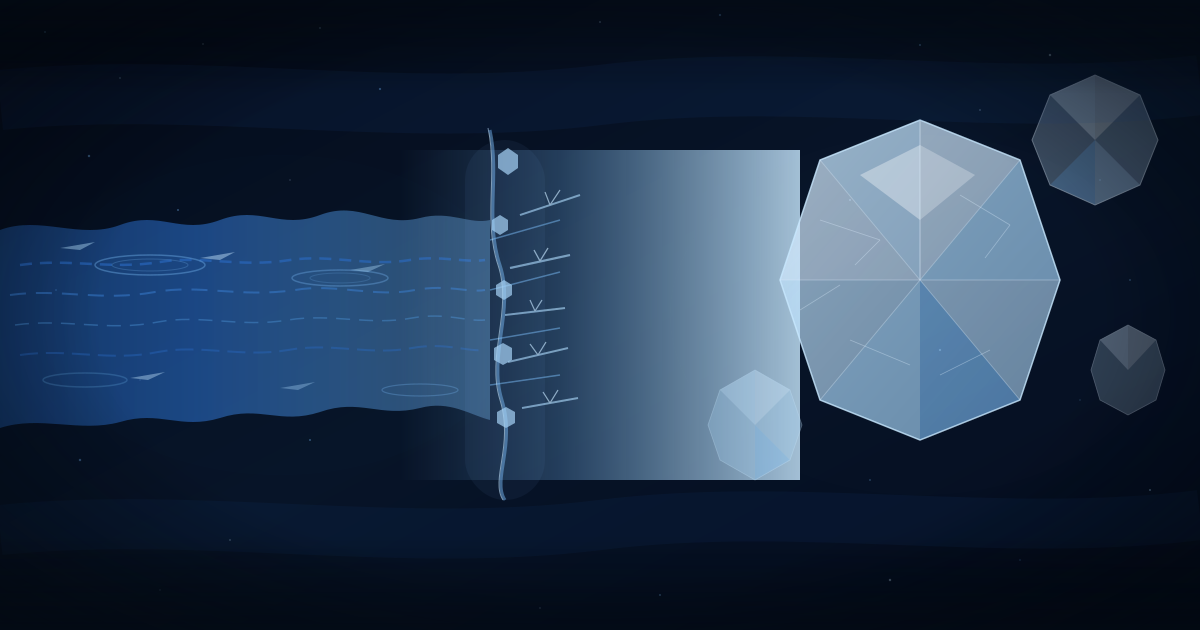
Reification comes from the Latin res — thing — and facere — to make. Thing-making. The mind treating a process as a substance, a flow as an object, a relationship as a commodity. Not exotic. Not confined to philosophy departments. Something the mind does so often that the words for it have worn smooth — the kind of phrase a friend says when they can see you slipping. Don't make a thing out of it. Quiet folk wisdom that names the same act in any tongue. Making a thing out of it is what the back porch calls it. Reification is what the philosophy departments call the same move. The friend at the kitchen table and Nāgārjuna — the second-century teacher who spent a lifetime naming exactly this mistake the mind keeps making — are pointing at the same hand. And what they are pointing at is something that is happening to you, every day, right now. You already have everything you need to see it — the friend and the sage are not telling you something new; they are reminding you of something your body already knows — the way the breath comes back when you finally stop holding it.
You do not need a textbook to recognize the act. You need a moment — a real one, recent enough that you can still feel it. Here is one of mine. Not because mine matters more than yours — just because it is recent enough that I can hand you the texture of the freeze and the texture of the thaw, the way a friend would hand you a nice warm cup of rich hot chocolate on a chilly day.
The wonderful flow of our conversation, like a river of streaming and swirling currents, came to a sudden freeze the moment I snapped at someone I love, because I myself had froze. I froze the expectations of how the flow needed to be, and at that moment was when I stopped hearing her and was only listening for my own expectations. Before I even knew it, my own heart had become its own block of ice, unwilling to melt unless the temperature is just right. And that is precisely what she was so skillfully able to do — thaw the frozen expectations that allowed conversation to flow naturally again. Not by forcing flow, but by allowing the warmth of the heart to surface naturally by directly asking what those sudden expectations were. The words themselves aren't important, because the conversation could've been with anyone, anywhere, at any moment. But it was like a soft yet mindful pivot: wait, what do you mean by.. whatever it was I was starting to get flustered about. Followed by a, oh I hear you, tell me about it. Interesting. Where do you think that comes from? How does it relate to now? Crack. The ice that had taken over the heart started to allow the flow of authentic conversation once again. Not by protecting the vulnerable riverbed under the currents, but by dipping the toes in, until eventually taking a full dive into the flow of the moment.
Linguists who studied moments like that one — most famously George Lakoff and Mark Johnson, in Metaphors We Live By (1980) — found that the freezing happens not on the surface of language but underneath it; the metaphors that turned a lived moment into a frozen position were never ours alone, we inherited them. Alfred North Whitehead called this kind of freeze the fallacy of misplaced concreteness a hundred years ago — the academic name for the same move the kitchen-table phrases were already naming.
You may feel a little caught — gently, warmly. Not caught doing something wrong. Caught doing something invisible. There is no shame in this. We are all here together, all running on the same inheritance, all freezing the moments we are living inside of into opinions, every minute of every day, the way breath turns to fog on a winter morning — automatic, ordinary, mostly invisible. That is not a flaw. That is the territory. And the territory is where the healing happens — not somewhere else, not when you are different, not when the freeze is gone. Here. Right here. Right now.
None of this is a mistake. The freeze is older than your mind: the simplest act of seeing already does it. Light strikes the eye in a continuous spectrum, a flow of wavelengths with no edges in it; what arrives in your awareness is yellow. The continuous has been carved into discrete categories before any thought arrives. The cognitive scientist Eleanor Rosch demonstrated, in a series of studies beginning in 1973, that this carving is the brain's foundational operation — the first thing it does with any sensory input — and that the categories your mind produces are not the neat logical boxes a textbook would draw. They are clustered around prototypes, fuzzy at the edges, shaped by the body and the culture as much as by the world. Without the carving, you could not pour water from one vessel into another, because vessel and water would not yet have separated from each other. Reification gave you the cup. Reification gave you the bridge over the river. Reification gave you language. The mechanism that has frozen so much of your life is the same mechanism that has built every word you have ever used to name your pain. It is not the enemy. It is the equipment. We do not want to drain the river. We want to see it — because seeing it is, all by itself, the beginning of the thaw. The thaw has already started.
Pause here. Notice what just happened as you read the last paragraph. Did you feel a flicker of recognition — a sense that something familiar was being described, something you do but have never quite named? That flicker is itself a process, arising right now, in this body, in this moment. Notice how quickly the mind wants to freeze it: "I understand this." "This is interesting." "I already knew this." Each of those is a tiny reification — a snapshot of the flowing experience of reading. You do not have to stop doing it. Just notice. The noticing is enough.
The map is not the territory.
— Alfred Korzybski, Science and Sanity (1933)
The Name Tag That Stuck
Here is a small story, and it may be your story.
A seven-year-old goes to a birthday party. There are balloons, a magician, too many children in too small a room. The seven-year-old does what a perfectly healthy nervous system sometimes does in a novel, overstimulating environment: she hangs back. She watches from the edge. She speaks quietly, or not at all. An adult — well-meaning, observant, trying to be helpful — writes a name tag and sticks it on her chest. The name tag says: SHY.
She is not shy. She is experiencing shyness in this moment, in this room, with these strangers. Shyness is arising — a process, a temporary pattern of nervous system activation, no more permanent than the taste of birthday cake. But the name tag does not say "currently experiencing a passing state of social caution." It says SHY. And the child, who trusts adults the way rivers trust gravity, accepts the label.
By twelve, "I am shy" has replaced "shyness is arising." By eighteen, she has organized her life around the label: no theater class, no debate team, no study abroad. By thirty, entire domains of experience — public speaking, leadership, intimacy, creative risk — have been walled off by a single label someone wrote on a sticker twenty-three years ago.
This is reification at the scale of identity. A verb — being shy in this moment — has been frozen into a noun — a shy person. A process has become a thing. And the thing, once installed, generates its own evidence: every moment of social discomfort confirms the label, while every moment of social ease is dismissed as an exception. The name tag has become a self-fulfilling prophecy, and the prophecy has become a prison.
Every reader carries name tags they did not write.
"The smart one." "The difficult child." "The one who doesn't try." "The sensitive one." "The strong one" — which, reified, means "the one who is not allowed to be weak." Each tag began as an observation of a passing state: someone saw you doing something once, in one context, and froze that observation into a permanent category. And you — because you were young, because you trusted the tagger, because the human brain is built to accept the categories it is given — wore the tag until it felt like skin.
The cycle of harm operates through exactly this mechanism. A child who is told "you are bad" — not "you did something hurtful," but you are bad — has been handed a name tag. The behavior, which was a process (something that happened, something that could change), has been reified into an identity (something the child is, something that cannot change). And the identity, once installed, produces its own logic: if I am bad, then bad behavior is simply me being myself. The exit from the cycle — which is always the recognition that behavior is not identity, that what was done is not who you are — is blocked by the very reification that set the cycle in motion.
De-reification, at this scale, is not the removal of the name tag. It is the recognition that it is a name tag — something stuck on, not something grown from within. You are not shy. Shyness arose in you once and the label stayed. You are not broken. Something broke, and the breaking was frozen into a definition. You are not your worst moment. You are the river, not the ice.
The Map That Ate the Landscape
Imagine you are hiking through unfamiliar mountains. You have a topographic map — a good one, with contour lines and elevation markings and the comforting precision of cartographic science. The map tells you where the ridges are, where the water flows, where the trail bends. You consult it, and it helps. You navigate a tricky descent by following the contour lines, and you arrive safely at the river crossing the map promised would be there.
Then something happens.
You stop looking at the mountains. You look only at the map. When the trail bends in a direction the map does not show, you follow the map. When you hear a waterfall the map does not indicate, you assume you must be in the wrong place. When the terrain surprises you — a meadow where the map shows forest, a cliff where the map shows gentle slope — you feel that the terrain is wrong.
You are now navigating a piece of paper through a world you no longer see.
The philosopher Alfred North Whitehead had a name for this. He called it the fallacy of misplaced concreteness — the error of treating an abstraction as if it were a concrete, independently existing entity. The map is an abstraction of the landscape. It is useful, necessary, and — in itself — harmless. The fallacy occurs the moment the map is treated as more real than the landscape it represents. The moment the abstraction replaces the reality.
Whitehead, writing in Process and Reality (1929), saw this fallacy at the heart of Western metaphysics — and, through metaphysics, at the heart of Western civilization. The entire tradition from Plato through Descartes to modern science had committed the same error: it had taken the abstractions it created to understand reality (atoms, minds, selves, nations, economies) and then treated those abstractions as the fundamental furniture of the universe. The map had eaten the landscape.
"The economy" is a map. A useful one — it helps us talk about patterns of production, exchange, and distribution. But the moment we say "the economy demands" or "the economy won't allow" or "we can't afford to" — as though the economy were an independent agent with its own desires, rather than a name for the sum of our collective choices — we have committed the fallacy. The abstraction has been mistaken for a concrete entity. The map is giving orders. This is the cognitive mechanism that the material veil depends on to stay invisible.
"Race" is a map. The continuous variation of human phenotypes — skin tone, hair texture, facial structure — has been carved into a handful of discrete categories that have no basis in genetics and every basis in power. The categories were drawn. They were drawn by specific people, in specific centuries, for specific purposes. And then the drawing was forgotten, and the categories were treated as nature — as real as oxygen, as inevitable as gravity. The map did not just eat the landscape; it replaced it. The constructed categories became the only landscape most people could see.
"The self" is a map. A convenient, useful, perhaps necessary abstraction of the flowing process of experience. But the moment the self is treated as a fixed entity — something that has experiences rather than being the experiencing — the map has consumed the territory. And this, as we will see, is the deepest reification of all.
The fallacy of misplaced concreteness is not an intellectual error confined to philosophy. It is the operating system of everyday life. Every time you say "I should" (as though there were a fixed self with fixed obligations), every time you say "that's just how things are" (as though the current arrangement of society were a geological fact), every time you say "I know who I am" (as though identity were a destination and not a journey) — you are following the map through the mountains with your eyes closed.
The landscape is still there. It has always been there. The mountains do not need your map to exist. The question is whether you are willing, even for a moment, to look up from the paper and see what is actually in front of you.
The Philosophers Who Saw the River
Long before anyone used the word "reification," there were people who saw the river.
Henri Bergson was one of them. In the early 1900s, this French philosopher — who would later win the Nobel Prize in Literature for the quality of his prose — noticed something that troubled him about the way Western thought handled time. Scientists measured time. Philosophers analyzed time. Everyone treated time as a line — a series of discrete, equal moments arranged like beads on a string, each one measurable, each one interchangeable. But when Bergson sat still and actually attended to his own experience of time, what he found was nothing like a string of beads.
What he found was duree — duration. Continuous, indivisible, creative flow. A melody, not a sequence of notes. The experience of watching a sugar cube dissolve in water revealed it: you cannot speed up the dissolving. You must wait. And in the waiting, you encounter time not as a quantity to be measured but as a quality to be lived. Bergson realized that the scientific treatment of time — breaking it into measurable instants — was itself a reification. It spatialized what was temporal, froze what was flowing, killed what was alive. "The intellect," Bergson wrote in Creative Evolution (1907), "is characterized by a natural inability to comprehend life." Not because the intellect is stupid, but because the intellect's native operation — analysis, division, measurement — is inherently reificatory. It can only understand the river by stopping it. And a stopped river is no longer a river.
Across the Atlantic, at almost exactly the same time, William James was discovering the same truth from a different direction. James, the American psychologist and philosopher, was trying to describe consciousness. The received view — inherited from the British empiricists — treated consciousness as a chain of discrete ideas: one thought, then another, then another, like links in a chain. But when James actually observed his own experience (a radical act in an era of brass-instrument psychology), what he found was not a chain at all.
It was a stream.
"Consciousness," James wrote in The Principles of Psychology (1890), "does not appear to itself chopped up in bits. Such words as 'chain' or 'train' do not describe it fitly. It is nothing jointed; it flows. A 'river' or a 'stream' are the metaphors by which it is most naturally described." The stream of consciousness — the phrase James gave to the English language — was not just a literary device. It was a philosophical protest against reification. You do not "have" thoughts. Thinking happens, the way flowing happens. And the substantive parts of the stream — the clear, stable perceptions that psychology studied — were surrounded by what James called the transitive parts: the fringes, the feelings-of-relation, the vague but vital sense of between-ness that connects one moment to the next. Western psychology had systematically ignored the transitive parts because they resisted reification. They could not be pinned down, measured, or categorized. They were the water between the ice floes — and science, in its fixation on the solid, had overlooked them entirely.
Then came Whitehead, who took Bergson's duree and James's stream and forged them into a complete metaphysical system. If reality is fundamentally process — if "actual occasions" (Whitehead's term for the basic units of reality) are not things but events, not substances but happenings — then the entire Western philosophical tradition, from its Greek foundations onward, had committed the fallacy of misplaced concreteness at the deepest possible level. It had reified reality itself. It had taken the flowing, creative, relational character of the real and frozen it into a world of static substances with fixed properties.
Here were three Western minds — a Frenchman, an American, a Briton — arriving independently at the same recognition: reality flows, and the mind freezes. Bergson's duree, James's stream, Whitehead's process — three names for the same river. Each philosopher, in his own way, was trying to de-reify Western thought, to melt the ice that centuries of substance-thinking had formed.
What none of them knew — or at least, what none of them fully appreciated — was that a tradition on the other side of the world had been saying this for two and a half thousand years.
The Oldest Insight in the World
In the second century CE, a Buddhist philosopher named Nagarjuna sat down to write what would become one of the most important philosophical texts in human history. The Mulamadhyamakakarika — the Fundamental Verses of the Middle Way — is not easy reading. It is terse, rigorous, relentlessly logical. But its central claim, once grasped, is devastatingly simple:
Nothing has svabhava.
Svabhava — "own-being," "inherent existence," "self-nature" — is the Buddhist term for exactly what this article has been calling reification. It is the assumption that things exist from their own side, independently, with a fixed essence that makes them what they are. The chair is a chair because of something inherent in the chair. The self is a self because of something inherent in the self. This assumption feels so obvious, so self-evident, that questioning it feels like questioning gravity.
Nagarjuna questioned it. Systematically, chapter by chapter, he examined every category of experience — causation, motion, time, the self, suffering, liberation — and demonstrated that none of them possess svabhava. Nothing exists independently. Everything arises in dependence on conditions. Everything is, in the technical Buddhist term, empty — not empty of existence, but empty of inherent existence. Empty of the fixed, independent, self-contained nature that reification attributes to it.
This is sunyata — emptiness. And it is not what it sounds like.
Emptiness is not a void. It is not nihilism. It is not the claim that nothing exists. It is the recognition that everything exists relationally — that the apparently solid, independent things of the world are actually flowing processes sustained by a web of conditions so vast that no single thread can be isolated without falsifying the whole. The chair exists — but not as an inherent chair-thing. It exists as a temporary configuration of wood, design, labor, intention, and use, each of which exists as a temporary configuration of further conditions. Pull any thread, and the whole tapestry shifts.
The Heart Sutra, Buddhism's most compressed expression of this insight, states it as a koan: "Form is emptiness, emptiness is form." This is not a riddle. It is a precise description of what happens when reification dissolves. Form — the solid, the shaped, the seemingly independent — is emptiness, because none of it possesses inherent existence. And emptiness — the flowing, the relational, the open — is form, because the flow itself is what produces every shape the world takes. Form and emptiness are not two things. They are ice and water — the same substance in different modes.
Thich Nhat Hanh, the Vietnamese Zen master, offered the most accessible expression of this truth in his concept of inter-being: "This is, because that is." Look at a piece of paper. In it you can see the cloud that rained on the tree, the tree that became pulp, the sun that fed the tree, the logger who felled it, the logger's parents, the road the truck traveled, the people who built the road. The paper is not an independent thing. It inter-is with everything. To see this — truly see it, not just intellectually acknowledge it — is to de-reify the paper. And once you de-reify the paper, you begin to notice that you have never encountered a single thing in your life that, on close inspection, does not dissolve into relationship.
The Buddhist tradition had been mapping this territory for two millennia before Bergson noticed duree. The Abhidharma — the Buddhist psychology — had already deconstructed experience into a stream of momentary mental events (dharmas) arising and passing so rapidly that no stable "thing" survives the analysis. The 108 Framework recognizes this as the movement from Infinity (the endless play of forms) to One (the contracted self that reification produces) — a collapse that is not a catastrophe but a forgetting. A river that has temporarily lost touch with its own nature as water.
What is extraordinary is not that East and West arrived at the same insight — it is that they arrived at it independently, through completely different methods, separated by two thousand years and ten thousand miles. Bergson watched a sugar cube dissolve. Nagarjuna sat in meditation and followed the logic of dependence to its conclusion. James observed his own stream of consciousness. The Abhidharma masters counted the momentary arisings of mental events. And they all saw the same river. This is the hidden wisdom that every tradition keeps rediscovering: nothing is as fixed as it appears.
Tsongkhapa, the great Tibetan Buddhist philosopher of the fifteenth century, mapped this with particular precision in his Lam rim chen mo (The Great Treatise on the Stages of the Path to Enlightenment). The mind, Tsongkhapa wrote, does not merely perceive things as having inherent existence — it actively attributes inherent existence to them. It paints svabhava onto the world the way a projector paints images onto a screen. And the painting is so seamless, so automatic, so below the threshold of ordinary awareness, that the mind genuinely believes it is seeing what is there rather than projecting what it expects. The path to liberation, in Tsongkhapa's analysis, is the gradual training of the mind to catch itself in the act of painting — to see the attribution happening in real time, and to recognize, in that seeing, that the apparently solid world is a process of construction, not a collection of discoveries.
This is not a metaphysical claim available only to meditators who have spent decades in retreat. It is a description of something you can verify in the next ten seconds. Look at any object near you. A cup, a pen, a shoe. Notice how it appears: solid, independent, existing from its own side. Now ask: where does the cup end and the air begin? Where does the pen end and the hand holding it begin? Where, exactly, is the boundary between "shoe" and "not-shoe"? The more precisely you look, the more the boundaries dissolve. The apparently solid object becomes a web of relationships — material, spatial, perceptual, conceptual — held together not by inherent existence but by the mind's habit of drawing lines and then treating the lines as real.
Rupert Gethin, in The Foundations of Buddhism (1998), describes this as the central insight of the Abhidharma tradition: the doctrine of ksanikavada, the momentariness of phenomena. Nothing persists. Nothing endures as the same entity from one moment to the next. What appears to be a stable object is actually a rapid succession of momentary events — like a film that appears to show continuous motion but is actually composed of discrete still frames projected at a speed that creates the illusion of continuity. The self, the object, the world — all are this illusion. Not "illusion" in the sense of being unreal, but "illusion" in the sense of being misperceived. The river is real. The ice is real. The mistake is believing the ice is what the river really is.
This convergence between traditions is itself a kind of de-reification. The borders between "Eastern philosophy" and "Western philosophy" — which academic departments have reified into separate disciplines with separate faculties and separate budgets — dissolve the moment you notice what they share. There are not two rivers. There is one river with many names.
When the Left Hand Forgets the Right
In 2009, a Scottish psychiatrist named Iain McGilchrist published a book that changed the way many people understood their own minds — and, through their minds, the culture they lived in.
The Master and His Emissary was not another pop-psychology book about "left brain vs. right brain." McGilchrist was a former literary scholar turned neuroscientist, and his argument was far more subtle and far more disturbing than the crude hemisphere mythology of the 1970s. His claim was not that the two hemispheres do different things — one logic, the other creativity. His claim was that they do the same things in fundamentally different ways. They attend to the same world through radically different modes of attention. And the mode that has come to dominate Western civilization is, in the language of this article, the reificatory one.
The left hemisphere's mode of attention is narrowly focused, detail-oriented, and concerned with what is already known. It grasps — literally and figuratively. It picks things up, categorizes them, re-presents them as internal models. It is the hemisphere of tools, language, and manipulation. It deals in fixed categories, clear boundaries, and explicit representations. It sees parts, not wholes. Pieces, not processes. Things, not flows.
The right hemisphere's mode of attention is broad, open, and concerned with what is new, what is alive, what is present. It attends to the whole — the context, the relationships, the living reality in which the parts are embedded. It does not grasp; it receives. It does not categorize; it encounters. It sees the forest, not just the trees. The river, not just the ice.
McGilchrist's argument — extended in his monumental 2021 work The Matter with Things — is that Western civilization has progressively organized itself around the left hemisphere's mode of attention. Not because the left hemisphere "took over" in some neurological coup, but because the products of left-hemisphere attention — categories, models, representations, systems — are easier to share, communicate, and build on than the products of right-hemisphere attention, which are always contextual, always embodied, always more than words can capture. Science works in left-hemisphere mode. Bureaucracy works in left-hemisphere mode. Capitalism works in left-hemisphere mode. And each of these systems, once established, reinforces the mode that created it.
The result is a culture that reifies by default.
The title of McGilchrist's 2021 work — The Matter with Things — is a triple pun. The problem (the "matter") is that we have turned everything into matter (substance). We have turned everything into things. The matter with things is that we see only things, and in seeing only things, we miss the living, flowing, relational reality that things were abstracted from.
This is not brain-determinism. McGilchrist is not claiming that reification is inevitable because of neurology. He is explaining why reification feels so natural — why de-reification feels so counterintuitive. The left hemisphere's reificatory mode is not a flaw; it is one half of a partnership. The right hemisphere is supposed to be the master — the broad, contextual awareness that sets the agenda — and the left hemisphere is supposed to be the emissary — the focused, analytical attention that carries out specific tasks within the context the master provides. But the emissary, McGilchrist argues, has usurped the master. The tool-handler has come to believe that tools are all there is.
The spectrum of compassion maps this at the emotional level: contraction — the narrowing of awareness to the radius of one — is left-hemisphere dominance applied to care. Opening — the expansion of awareness to include the whole — is the right hemisphere reclaiming its role. What The Spectrum of Compassion maps as a spectrum of feeling, this article names as a spectrum of attention. And what moves a person from contraction to opening is, at its root, a shift from reification to flow — from grasping to receiving, from seeing things to seeing processes, from the ice to the water.
Pause. Take a breath. If you are reading this with your left hemisphere — categorizing, evaluating, comparing to what you already know — notice that. Not to judge it. Just to feel, for a moment, the difference between analyzing these words and actually being here, in your body, in this room, with whatever light is falling on this page. That difference — between the re-presentation and the presence — is the difference McGilchrist spent a thousand pages describing. You do not need a thousand pages. You just need one breath.
The Commodity That Was Once a Relationship
Let us stay briefly in territory that The Material Veil has already mapped, because it is the territory where reification becomes visible at civilizational scale.
In 1867, Karl Marx described something he called commodity fetishism — a phenomenon so strange that it sounds like anthropology until you recognize it in your own life. What Marx observed was this: in a market economy, the social relationships between people — the labor, the care, the cooperation, the exploitation, the shared history that goes into making anything — take on "the fantastic form of a relation between things."
A shirt arrives at the store. It has a price tag. The price tag is all you see. Behind the price tag is a person who sewed the shirt — their hours, their fatigue, their children waiting at home. Behind that person is a factory, and behind the factory is a supply chain, and behind the supply chain is a web of political, economic, and ecological relationships spanning continents. But the commodity — the shirt-as-thing — has absorbed all of that. The relationships have been reified into a price. The process has been frozen into a product.
Georg Lukacs, writing in 1923, extended Marx's insight into a comprehensive diagnosis: under capitalism, reification becomes the dominant form of consciousness. Everything — not just commodities but human beings, relationships, experiences, even time itself — is experienced as a thing. The worker becomes a thing (a "human resource"). The patient becomes a thing (a "case"). The student becomes a thing (a "grade point average"). And the consciousness that does this — the consciousness that relates to the world primarily through reification — does not experience itself as doing anything unusual. It experiences itself as simply seeing the world as it is.
This is the mechanism that weaves the material veil. The veil is not the economy. The veil is the belief that the economy — this particular arrangement of extraction, commodification, and accumulation — is natural, inevitable, and the only option available. That belief is a reification: a constructed system, made by human beings in historical time, treated as a fact of nature. The Material Veil mapped the veil in detail. What this article adds is the name for the cognitive operation that holds the veil in place.
Here is the vignette that brings it home.
You are watching a sunset. For a moment — one unguarded, unreified moment — there is just the watching. Light changing. Sky moving. Something in you opening, the way things open when they are not trying to be anything. Then a thought arrives: "I should photograph this." Then another: "This would make a great post." Then another: "This resort was worth the price."
The sunset — which was a process, a flowing relationship between light and eye and atmosphere and the part of you that knows how to be still — has been reified into a product. A commodity. A thing to be captured, shared, rated, and monetized. You did not choose to do this. The operating system — what The Material Veil called "Time is Money" — did it for you. The price tag appeared on the sunset the way price tags appear on everything in a culture that has reified experience itself into a series of transactions.
Erich Fromm, in To Have or to Be? (1976), named the two modes precisely. The having mode relates to the world through possession, accumulation, and control — everything is a thing to be acquired. The being mode relates to the world through presence, participation, and aliveness — everything is a process to be experienced. The having mode is reification applied to the whole of life. The being mode is de-reification lived as daily practice. And generosity — which is the subject of an article still ahead on this path — is what happens when the having mode softens and the being mode flows through.
The Borders We Die For
Two children live in a village that straddles a line.
The line was drawn by diplomats in a distant capital — men in suits who had never visited the village, never walked its roads, never tasted the water from its well. On one side of the line, one language is spoken in schools. On the other side, another. The children play together in a language neither school teaches — the language of the field behind their houses, of shared games and whispered secrets, of children who do not yet know they are supposed to be different.
One day, the line becomes real. Soldiers appear. A fence goes up. Papers are required. The children, who used to cross the line without noticing it, now need permission to visit each other. One of them gets permission. The other does not.
The line has not changed. It is the same ink on the same paper, agreed upon by the same people who never visited. But it has been reified. It has crossed the threshold from construction to fact. From "a line we drew" to "the border." And the border — which is a name tag stuck on the landscape by people with power — now determines who can move, who can work, who is a citizen and who is a criminal, who belongs and who is alien, who lives and who is turned back into danger.
This is social reification, and it is the most consequential form of the mechanism this article describes.
The sociologists Peter Berger and Thomas Luckmann, in The Social Construction of Reality (1966), mapped the three-step process by which human constructions become unquestionable facts:
- Externalization — humans create social worlds. We draw lines, invent categories, establish institutions.
- Objectivation — those worlds become "objective." The institutions take on a life of their own. The categories begin to feel real.
- Reification — the human authorship is forgotten. The line was drawn becomes the border has always been there. The category was created becomes the race is natural. The institution was designed becomes the system is inevitable.
Step three is where the damage happens. Not because social categories are "unreal" — they have real consequences, real power, real effects on real bodies — but because their constructed nature has been erased. Race is not a genetic category; it is a social construction that was reified into a hierarchy, and the hierarchy has shaped centuries of lived experience. Gender is not a binary; it is a spectrum of expression that was reified into two boxes, and the boxes have shaped billions of lives. Nationality is not an essence; it is a legal fiction that was reified into an identity, and the identity has sent millions to war.
The philosopher Ian Hacking, in The Social Construction of What? (1999), sharpened the analysis: not all constructions are constructed in the same way, and not all carry the same stakes. The social construction of quarks is very different from the social construction of race. What matters is not whether something is "socially constructed" — nearly everything is — but whether the construction has been reified, and what happens to the people who are trapped inside the reification.
What happens, when reification is applied to social categories without check — when constructed distinctions are not just mistaken for nature but enforced through violence — is the subject of the next article on this path: When Frozen Thinking Turns Cruel. This article describes the mechanism. The next will describe what happens when the mechanism is weaponized.
For now, notice this: the de-reification of social categories is not the denial that they exist. It is the remembering that they were made. The border is real — real soldiers, real fences, real consequences. But it was drawn. By humans. In historical time. For reasons that can be named. And what was drawn by humans can be redrawn.
This is the place where reification becomes not just a philosophical curiosity but a matter of life and death. The relational geometry that makes communities thrive depends on fluid categories — on the capacity to see the person behind the label, the process behind the category, the fellow human behind the border. Every time a category is de-reified — every time "illegal immigrant" becomes "a person who crossed a line drawn by diplomats," every time "enemy" becomes "a person whose pain I do not yet understand" — the conditions for compassion are restored. Not because compassion requires ignoring difference, but because compassion requires seeing the construction for what it is: a construction. Something made. Something that can be made differently.
The golden rule — "do unto others as you would have done unto yourself" — is, at its deepest level, an instruction in de-reification. It asks you to see through the reified boundary between self and other, to recognize that the "other" is not a different kind of being but the same process of experiencing, suffering, hoping, and fearing that you call "yourself." The golden rule does not work on the level of things — it only works on the level of processes. Two things are always separate. Two processes can flow into each other.
The two children still speak the same language in the field behind their houses.
The Buddhist Monk and the Neuroscientist
In 1986, a Chilean-born neuroscientist named Francisco Varela sat down to meditate with Tibetan Buddhist monks at a retreat in the French Alps. He was already one of the most important figures in cognitive science — co-author, with Humberto Maturana, of the theory of autopoiesis (self-making), which demonstrated that living organisms are not things but self-generating processes. But Varela had a dual life. He was also a serious practitioner of Tibetan Buddhism, trained in the same contemplative traditions that had been mapping the processual nature of mind for two and a half millennia.
What Varela saw — and what he spent the rest of his career trying to articulate — was that these were not two separate projects. The Abhidharma, the Buddhist psychology, had mapped the momentary arising and passing of mental events with a precision that Western psychology was only beginning to approach with its most sophisticated instruments. Two thousand years before the invention of the fMRI, Buddhist meditators had already deconstructed the self into a stream of rapidly changing processes — sensation, perception, mental formation, consciousness — each one arising in dependence on conditions, each one lasting only a moment before dissolving into the next.
And cognitive science, arriving at the same territory from the opposite direction, was discovering the same thing. The self that psychology had long treated as a unified entity — the executive function, the decision-maker, the "homunculus" in the brain — was dissolving under the weight of its own evidence. There was no single place in the brain where "the self" lived. There was no unified command center. There was a dynamic, distributed, constantly shifting pattern of neural activity that gave rise to the experience of a unified self — the way a flock of starlings gives rise to the appearance of a single moving shape without any single bird being in charge.
Varela's insight — expressed in his foundational 1991 work The Embodied Mind, co-authored with Evan Thompson and Eleanor Rosch — was that both traditions were describing de-reification. The Buddhist meditator, sitting in awareness and watching the self dissolve into process, was doing empirically what the cognitive scientist was doing theoretically: demonstrating that the self is not a thing but a pattern — a flowing, self-organizing, processual pattern that persists not because of some inner essence but because of the conditions that sustain it. Remove the conditions, and the pattern shifts. Change the conditions, and the self changes. The ice melts. The river resumes.
Varela's work with the Dalai Lama — the Mind and Life dialogues, which brought contemplatives and scientists together for decades of sustained conversation — was not "East meets West" in the tourist sense. It belonged to the same compassion lineage that has always passed insight across centuries through different vessels. It was two maps recognizing the same landscape. The landscape was process. The maps differed in method, language, and cultural context. But the territory they described was identical: a world in which nothing has fixed, independent existence. A world of flow, not things. A world in which the self is not the river's author but the river itself, temporarily shaped into a pattern that can say "I."
Evan Thompson, Varela's student and philosophical heir, would carry this forward in Waking, Dreaming, Being (2014) — a book that traces the processual nature of the self through waking life, dreaming, deep sleep, and meditative states. In every state, Thompson demonstrates, the self is a construction — a useful, necessary, even beautiful construction, but a construction nonetheless. And the recognition of this construction — the de-reification of the self — is not its destruction. It is its liberation.
The Master Freeze
We arrive, now, at the deepest place this article can take us. And it is, paradoxically, the place closest to home.
If reification is the mind's habit of treating processes as things, then there is one process above all others that the mind has reified with total commitment, absolute conviction, and centuries of philosophical and religious reinforcement:
Yourself.
The sense of being a fixed, enduring, independent "I" — the feeling that there is someone in here, behind the eyes, authoring the thoughts, choosing the choices, persisting through time as the same essential being from childhood to old age — is the master reification. It is not one freeze among many. It is the freeze from which all others flow.
Think about it. Every other reification this article has described depends on a reifier. Someone to freeze the feeling into an identity, the relationship into a commodity, the construction into a fact. And who is that someone? The self. The apparently solid, apparently permanent, apparently independent entity that does the freezing. But if the self is itself a reification — a flowing process that has been frozen into the appearance of a thing — then the entire architecture of human suffering rests on a single, foundational illusion.
The Buddhist tradition calls this anatta — not-self. And the name is misleading, because it sounds like a denial. "You do not have a self." "You do not exist." This is not what anatta means. Anatta does not deny that experience happens, that awareness is present, that there is a pattern of life that responds to the name you were given. What it denies is that this pattern has svabhava — inherent, independent, fixed existence. What it asserts is that the self is a process, not a substance. A river, not a rock. A verb pretending to be a noun.
The Dalai Lama, in conversation with Howard Cutler, offered the most accessible formulation: the self is "a convenient designation." Not an illusion — a designation. A useful label applied to a flowing process for practical purposes. You need a name for the tax forms. You need a sense of continuity to make plans. You need a feeling of agency to cross the street. The self, as a designation, is perfectly functional. The suffering begins when the designation is mistaken for the designated — when the label "I" is treated as pointing to a fixed entity rather than a flowing process.
This is the collapse that the 108 Framework maps at the ontological level. In that framework, Zero is unfathomable compassion — the mirror in which everything is reflected. Infinity is the endless play of forms — the reflections themselves, flowing, dancing, never still. And One is the contraction — the moment the flowing field of process freezes into a single point of reference that calls itself "I" and experiences itself as separate from everything else. Reification is the mechanism of the collapse from Infinity to One. The boundless river of process contracts into a single drop that believes it is self-contained.
The five veils — which a later article will map in full — are specific reifications at different layers of experience. The Material Veil reifies value. The Emotional Veil reifies feeling. The Intellectual Veil reifies thought. The Self-Fixation Veil reifies identity. The Bliss Veil reifies spiritual experience. Each veil is a freeze. Each freeze is a variation on the master freeze: the self, pretending to be solid, relating to each layer of experience as though both it and the experience were things.
But here is the part that requires extraordinary warmth, because the reader's sense of self is the most intimate thing they possess. The invitation is not to destroy the self. It is not to achieve some heroic state of egolessness. It is something much simpler and much more tender:
See the self as it is.
See that the "I" is not a rock but a river — flowing, changing, composed of conditions that are themselves flowing and changing. See that the solidity you defend is made of the same substance as the flow you fear. See that the ice is water. Not was water. Not will become water. Is water. Right now. In this moment. The self you are protecting is already the process you are protecting it from.
David Bohm, the physicist, saw this from the side of physics. In Wholeness and the Implicate Order (1980), he described what he called the implicate order — "unbroken wholeness in flowing movement" — and the explicate order — the reified world of separate things that thought carves from the seamless whole. "Thought," Bohm wrote, "creates the world and then says 'I didn't do it.'" The self that thought creates is its masterpiece — so convincing that even the thinker believes the self was there before the thinking began.
Bohm went further. He proposed what he called the rheomode — a verb-based language designed to counter reification at its linguistic root. In English, nouns dominate: "the observer observes the observation." Three things, all derived from a single process. In the rheomode, the process comes first: "observing is happening." No observer separate from the observing. No observation separate from the observer. Just the flowing act itself, undivided. Bohm knew the rheomode would never replace English. But he also knew that the experiment itself — the attempt to speak without reifying — revealed how deeply language encodes the freeze. Try it now: describe what is happening to you in this moment without using the word "I." Without any nouns at all. Just verbs. Just processes. "Reading is happening. Breathing is continuing. Questioning is arising." Notice how strange it feels — and how, beneath the strangeness, something loosens.
Mark Johnson, in The Meaning of the Body (2007), traces this even deeper. Abstract concepts — including "self," "time," and "value" — are not pure mental abstractions. They are built from image schemas that originate in bodily experience: containment (the body as a container), balance, force, path, center-periphery. The self feels like a "thing inside a container" because the body is a container, and the mind maps the abstract concept of selfhood onto this bodily schema. The reification of the self is not just a cognitive habit — it is an embodied one. The body itself participates in the freeze. Which means that de-reification, too, must move through the body: not just thinking differently about the self, but feeling the self differently. Feeling the boundaries soften. Feeling the containment loosen. Feeling the process where the product used to be.
The de-reification of the self is not an achievement. It is not something you do once and then live in blissful egolessness forever. It is something that happens in moments — small, quiet, ordinary moments. The moment you notice that "I am angry" is a reification and that what is actually happening is "anger is arising." The moment you notice that the boundary between yourself and the person across the table is not a wall but a wave. The moment you notice that the "I" who is noticing is itself arising and passing, arising and passing, like breath.
In those moments, the ice does not break. It softens. The river does not start; it is noticed. And the self — the beautiful, useful, unnecessary master reification — relaxes its grip by one degree. Just one degree. And one degree, held with warmth and patience, is enough for the first crack to appear.
The Thaw
Spring does not arrive as an event. It arrives as a process.
The ice does not shatter. It does not break apart in dramatic, cinematic fashion. It softens. Slowly. From the edges first — the same edges where the freeze began. The sun returns, not as a force that fights the ice, but as a warmth that reminds the ice what it is. And the ice, without struggle, without decision, without heroic effort, begins to remember.
It is water.
It has always been water.
De-reification feels like this. Not an achievement but a recognition. Not the addition of something new but the subtraction of something unnecessary. Not the breaking of the ice but the warming of the conditions that sustain it.
Humberto Maturana and Francisco Varela called it autopoiesis — self-making. Every living system, from a single cell to a human being, is not a thing but a self-creating process. The cell does not have life; it is living. The organism does not have a self; it is self-organizing. The moment you see yourself this way — not as a fixed entity that has experiences but as a living process that generates itself moment to moment — something fundamental shifts. The question changes from "who am I?" (which presupposes a fixed answer) to "what am I becoming?" (which presupposes flow). And the second question, unlike the first, cannot freeze. It is always open, always moving, always alive.
The generosity standard operates through this same unfreezing. When a gift moves through a community without being captured — without being converted from a relationship into a transaction — it demonstrates de-reification in action. The gift is not a thing; it is a movement. The receiver is not an endpoint; they are a passage. And the act of passing it on, rather than holding on, is the simplest possible practice of letting the frozen flow.
You have been doing this, without knowing it, your entire life. Every time a grudge softens — not because you decided to forgive, but because the holding simply became too heavy and something in you let go. Every time a certainty becomes a question — not because someone argued you out of it, but because the freeze could not hold against the warmth of new experience. Every time a name tag falls off — not because you peeled it away, but because you grew beyond its edges and it simply no longer fit.
These are moments of de-reification. Moments when the frozen begins to flow. They are not rare. They are not spiritual achievements reserved for monks and masters. They are the most ordinary thing in the world — as ordinary as ice melting in sunlight, which is to say: as miraculous as anything that has ever happened.
The path ahead from here opens in several directions, each one a different form of thaw:
What happens when reification is not just a personal cognitive habit but a civilizational weapon — when constructed categories are not just mistaken for nature but enforced through violence, when the ice is defended as sacred and the water is declared heretical? That is the territory of the next article on this path, and it is the territory where the wonder of this article sharpens into reckoning.
What is the simplest act of de-reification you can perform right now? Give something away. Not because you should, but because generosity is what happens when the freeze around "mine" begins to soften — when the boundary between what you hold and what you release becomes as fluid as the boundary between ice and water.
If the self is the master freeze, what are the specific layers of ice? The five veils map them — material, emotional, intellectual, self-fixation, bliss — each one a reification at a different scale of experience, each one a freeze waiting to be warmed.
And beneath all of these: if reification is the collapse from Infinity to One — the moment the boundless field of process contracts into a single point that calls itself "I" — what does it look like to remember Infinity? The 108 Framework holds that question. Not as an answer but as an invitation to stand at the edge of what can be said and feel what lies beyond it.
Invitation
You do not have to break the ice.
You never did. The river has not stopped. It has only slowed, thickened, grown quiet under the surface you have been walking on your whole life. And the part of you that has been walking — so carefully, so cautiously, so afraid of falling through — is itself the water, pretending to be solid, pretending it needs solid ground.
Stop pretending. Not dramatically. Not heroically. Just — for this one breath — let the pretense soften by one degree.
Feel the temperature rise.
The grudge you have been holding is not a thing. It is a process, still in motion, still available to change direction. The identity you have been defending is not a fortress. It is a pattern, still forming, still free to re-form. The self you have been protecting is not a rock. It is the river itself — flowing, alive, and far too large to be contained by any name tag anyone ever stuck on it.
The thaw has already begun. You can feel it. Right now. In the slight loosening between one breath and the next. In the space between what you thought you knew and what you are beginning to see.
Let it flow.
People Also Ask
What is reification in simple terms?
Reification is the mind's habit of treating a process as if it were a thing. The word comes from Latin — res (thing) + facere (to make) — and it describes something you do hundreds of times daily without noticing. When you say "I have depression" instead of "depressive feelings are arising," you have reified a flowing process into a fixed object. Reification is not a mistake — it is how brains navigate complexity. It becomes a source of suffering when the snapshot is mistaken for the reality, when the map replaces the landscape.
What is the fallacy of misplaced concreteness?
The philosopher Alfred North Whitehead coined this term in 1929 to name the error of treating an abstraction as if it were a concrete, independently existing entity. "The economy," "the self," "time" — these are all abstractions, useful mental shorthand for complex processes. The fallacy occurs when we forget they are shorthand and start treating them as real things with real powers. When we say "the economy demands" or "time is running out," we are committing the fallacy — and building our lives around a map while ignoring the landscape.
How does reification relate to Buddhist emptiness?
Buddhist emptiness (sunyata) is the direct antidote to reification. Emptiness does not mean nothingness — it means the absence of inherent, independent, fixed existence (svabhava). Everything that appears to be a solid, permanent thing is actually a flowing process arising from conditions. The Buddhist philosopher Nagarjuna demonstrated this systematically in the second century CE, showing that nothing — not even emptiness itself — possesses inherent existence. To see emptiness is to de-reify: to recognize that what seemed solid is actually flowing, and always has been.
What is the connection between reification and the cycle of harm?
The cycle of harm described in Hurt People, Hurt People depends on reification at every stage. When a child is told "you are bad" rather than "you did something hurtful," a process (behavior) is reified into a thing (identity). The identity then becomes self-fulfilling: if I am bad, bad behavior is just me being myself. Reification also freezes the roles of victim and harm-doer into permanent categories, making it harder for anyone involved to change. De-reification — recognizing that behavior is not identity, that roles are not essences — is one of the key mechanisms by which the cycle can be interrupted.
What does Bergson mean by duree?
Henri Bergson used the French word duree (duration) to describe the actual lived experience of time — as opposed to the "spatialized time" that clocks and calendars measure. Duree is continuous, indivisible, qualitative, and creative. It cannot be broken into discrete equal units without destroying what makes it time. Bergson argued that Western thought commits a fundamental error by treating time like space — as something you can divide into measurable chunks. This spatialization of time is itself a reification: it freezes what flows, making lived experience into a measurable commodity.
Is the self really a reification?
Yes — but not in the way that sounds. Saying the self is a reification does not mean you do not exist. It means that what you call "yourself" is a flowing process — a dynamic pattern of experience, memory, anticipation, and relationship — that the mind treats as a fixed, independent, enduring entity. Buddhist philosophy calls this recognition anatta (not-self). Cognitive science confirms it: there is no single location in the brain where "the self" resides. The self is more like a river than a rock — real, powerful, shaping the landscape, but always moving, always composed of water that is also the world's water.
How does language reify our experience?
George Lakoff and Mark Johnson showed that abstract thought is fundamentally structured by conceptual metaphor — and metaphor is inherently reificatory. "Time is money" does not just describe a similarity; it installs a substitution, making us experience time as something we spend, waste, save, and invest. "Argument is war" makes us attack positions and defend claims. Every conceptual metaphor freezes one domain of experience into the shape of another. Because we think in metaphor, we reify constantly through language — and rarely notice we are doing it.
What is social reification?
Social reification is the process by which human-made categories — race, gender, nationality, class — are forgotten as human-made and experienced as natural, inevitable facts. The sociologists Berger and Luckmann mapped the three-step sequence: humans create social worlds (externalization), those worlds become objective (objectivation), and the human authorship is forgotten (reification). A border, once reified, is no longer seen as a line that was drawn but as a fact that has always existed. Social reification is the mechanism of systemic oppression — it makes constructed hierarchies invisible as constructions.
What is de-reification and how do you practice it?
De-reification is the recognition that what was taken for a thing is actually a process — that what was frozen is still flowing. It is not a technique so much as a shift in attention. You practice it every time you notice that "I am anxious" is a reification and that what is actually happening is "anxious sensations are arising and will pass." You practice it when you question a category you have been treating as natural, or when you hold your sense of self lightly enough to feel the process beneath the label. Meditation, contemplative inquiry, and honest self-observation are all traditional paths to de-reification.
How does McGilchrist's divided brain relate to reification?
Iain McGilchrist argues that the brain's two hemispheres attend to the world in fundamentally different ways. The left hemisphere's mode is narrowly focused, grasping, and categorical — it sees things, parts, and representations. The right hemisphere's mode is broad, open, and contextual — it sees processes, wholes, and living reality. Reification is the left hemisphere's native operation. Western civilization, McGilchrist argues, has progressively organized itself around left-hemisphere attention, producing a culture that reifies by default. De-reification involves restoring the balance — allowing the right hemisphere's broader, more processual mode of attention to take the lead.
References
-
Berger, Peter L. & Thomas Luckmann (1966). The Social Construction of Reality: A Treatise in the Sociology of Knowledge. Anchor Books.
-
Bergson, Henri (1907/1911). Creative Evolution. Trans. Arthur Mitchell. Henry Holt.
-
Bergson, Henri (1889/1910). Time and Free Will: An Essay on the Immediate Data of Consciousness. Trans. F.L. Pogson. Sonnenschein.
-
Bohm, David (1980). Wholeness and the Implicate Order. Routledge.
-
Dalai Lama XIV & Howard C. Cutler (1998). The Art of Happiness. Riverhead Books.
-
Fromm, Erich (1976). To Have or to Be? Harper & Row.
-
Gethin, Rupert (1998). The Foundations of Buddhism. Oxford University Press.
-
Hacking, Ian (1999). The Social Construction of What? Harvard University Press.
-
James, William (1890). The Principles of Psychology. Henry Holt.
-
Johnson, Mark (2007). The Meaning of the Body: Aesthetics of Human Understanding. University of Chicago Press.
-
Kahneman, Daniel (2011). Thinking, Fast and Slow. Farrar, Straus and Giroux.
-
Lakoff, George (1987). Women, Fire, and Dangerous Things: What Categories Reveal About the Mind. University of Chicago Press.
-
Lakoff, George & Mark Johnson (1980). Metaphors We Live By. University of Chicago Press.
-
Lukacs, Georg (1923/1971). "Reification and the Consciousness of the Proletariat." In History and Class Consciousness. Trans. Rodney Livingstone. Merlin Press.
-
Marx, Karl (1867/1976). Capital: A Critique of Political Economy, Volume 1. Trans. Ben Fowkes. Penguin.
-
Maturana, Humberto R. & Francisco J. Varela (1987). The Tree of Knowledge: The Biological Roots of Human Understanding. Shambhala.
-
McGilchrist, Iain (2009). The Master and His Emissary: The Divided Brain and the Making of the Western World. Yale University Press.
-
McGilchrist, Iain (2021). The Matter with Things: Our Brains, Our Delusions, and the Unmaking of the World. Perspectiva.
-
Nagarjuna (c. 150 CE/1995). The Fundamental Wisdom of the Middle Way (Mulamadhyamakakarika). Trans. Jay L. Garfield. Oxford University Press.
-
Nhat Hanh, Thich (1988). The Heart of Understanding: Commentaries on the Prajnaparamita Heart Sutra. Parallax Press.
-
Rosch, Eleanor (1973). "Natural Categories." Cognitive Psychology 4(3): 328-350.
-
Siderits, Mark & Shoryu Katsura (2013). Nagarjuna's Middle Way: Mulamadhyamakakarika. Wisdom Publications.
-
Thompson, Evan (2007). Mind in Life: Biology, Phenomenology, and the Sciences of Mind. Harvard University Press.
-
Thompson, Evan (2014). Waking, Dreaming, Being: Self and Consciousness in Neuroscience, Meditation, and Philosophy. Columbia University Press.
-
Tsongkhapa (15th c./2002). The Great Treatise on the Stages of the Path to Enlightenment (Lam rim chen mo), Vol. 3. Trans. The Lamrim Chenmo Translation Committee. Snow Lion.
-
Varela, Francisco J., Evan Thompson & Eleanor Rosch (1991). The Embodied Mind: Cognitive Science and Human Experience. MIT Press.
-
Whitehead, Alfred North (1929). Process and Reality: An Essay in Cosmology. Macmillan.