There is a door. You have been pushing against it for years.
Not a metaphorical door — or not only a metaphorical one. There is a real sensation in the body, a bracing in the chest, a set of the jaw, a forward lean of will that you bring to the things that block you. You push against your tendency to feel separate. You push against the whisper that there is never enough. You push against the hardened image of yourself that you carry around like identification papers. You push against the compulsion to measure yourself against everyone in the room. You push against the nameless dread that something, somewhere, is about to go wrong.
You push. You read books about pushing more effectively. You attend workshops on advanced pushing techniques. You meditate on the nature of pushing. You try pushing softer, pushing harder, pushing with your whole body, pushing with just your fingertips, pushing with the breath, pushing with intention, pushing with surrender.
The door does not open.
One day, exhausted — not enlightened, just tired — you stop pushing. You lean against the door the way you lean against a friend's shoulder when you have run out of words. Your weight shifts. The door moves. It swings inward, gently, on well-oiled hinges, into a room that has been lit the entire time.
You were pushing. The door opens by pulling.
This is not a story about effort versus effortlessness, or about trying too hard, or about letting go. Those framings are themselves forms of pushing — they are more instructions about what to do with the door. This is a story about something much more disorienting and much more liberating: the discovery that the door was never locked. The obstacle was not the door. The obstacle was your assumption about which direction to apply force. You did not need more strength, more technique, more spiritual maturity. You needed to stop and feel which way the door wanted to move.
If you have read The Five Veils, you have spent time with the five habitual patterns that prevent oneness from being recognized — Separation, Scarcity, Self-Fixation, Comparison, and Uncertainty. You have felt them named. You may have felt the strange relief of recognition: Oh. That is what has been running. You have learned to see the programs. You have learned the micro-practices that begin to thin each veil.
This article is the moment the door swings open.
Not because you have finally pushed hard enough. Not because you have mastered the micro-practices. Not because you have transcended the veils through superior spiritual effort. The door opens because of a single discovery — one that has been hiding in plain sight since the beginning, one that the Vajrayana Buddhist tradition has been teaching for thirteen hundred years, one that changes everything:
The veils are not just obstacles. They are wisdoms — in disguise.
The very mechanism that blocks your recognition IS the recognition, warped by the habit of dualistic perception. The poison IS the medicine, taken at the wrong dose. The locked door was never locked. You were just pushing in the wrong direction.
Welcome to the twist.
Two states at the same door: force strains against the inward-opening, while a quiet lean lets it swing wide.
Key Takeaways
- The five habitual veils — Separation, Scarcity, Self-Fixation, Comparison, and Uncertainty — are not obstacles to be eliminated but contracted forms of five corresponding wisdoms that can be liberated.
- Vajrayana Buddhism has taught for thirteen hundred years that the five poisons of the mind and the five wisdoms of awakened awareness are the same energy in different states, one frozen and one flowing.
- Transmutation differs fundamentally from transcendence: rather than escaping or suppressing a difficult pattern, transmutation works with its energy directly, warming the ice until it becomes water again.
- Contemplative practices such as tonglen, RAIN, and Chöd each provide embodied methods for turning toward painful states rather than pushing against them, allowing the contracted energy to release into its wisdom form.
- Western psychology's cognitive reappraisal research, particularly James Gross's process model of emotion regulation, offers parallel evidence that how one relates to an emotional state shapes its trajectory more than the state itself.
- Recognizing the wisdoms hidden inside the veils does not require advanced spiritual attainment — it requires a shift in direction, leaning into the door rather than pushing against it, and finding that it was never locked.
An Ancient Map Found in Your Own Pocket
Somewhere around the eighth century, in the monasteries and mountain caves of what is now Tibet, Nepal, and northern India, a radical teaching took hold — one that distinguished the Vajrayana path from every other approach to human suffering that had come before it.
The teaching was this: the five poisons of the mind — the kleshas that cause suffering — are not separate from the five wisdoms of awakened awareness. They are the same energy. The only difference is whether that energy is contracted or liberated, frozen or flowing, seen through the lens of a self that feels separate or recognized as the natural radiance of awareness itself.
This was not a consolation prize. It was not the spiritual equivalent of "every cloud has a silver lining." It was a precise, structural, experiential claim: ignorance is not the absence of wisdom. Ignorance IS wisdom — Dharmadhatu Wisdom, the wisdom of all-encompassing space — that has forgotten it is a mirror and now stares at its own reflections as if they were the only things that exist. Attachment is not the corruption of love. Attachment IS Discriminating Wisdom — the exquisite ability to perceive the unique qualities of each thing — that has lost its balance and begun to grasp. Aversion is not the opposite of clarity. Aversion IS Mirror-like Wisdom — the ability to reflect reality exactly as it is — that pushes away what it reflects because it does not like the image. Pride is not the enemy of equality. Pride IS the Wisdom of Equanimity — the deep recognition that all beings are fundamentally equal — inflated into hierarchy. Jealousy is not the failure of generosity. Jealousy IS All-Accomplishing Wisdom — the ability to celebrate effective action wherever it occurs — collapsed into resentment because the action happened in someone else's life.
Read that paragraph again. Slowly. Let the structure settle.
Each wisdom and its corresponding poison are not opposites. They are not even on different ends of a spectrum, the way hot and cold are expressions of temperature. They are the same energy — one open, one contracted. The same river, one flowing freely and one frozen into ice. The ice is not a different substance from the water. It is water, held in a different state. And the transition from ice to water is not destruction — it is liberation. You do not kill the ice. You warm it. What emerges is what was always there.
This is the Vajrayana map. And the astonishing thing — the thing that should make the hair on your arms stand up — is that it is not a map of some exotic spiritual territory accessible only to advanced meditators sitting in Himalayan caves. It is a map of your own mind, right now, in this moment, as you read these words. The five poisons are running. The five wisdoms are also running. They are the same programs. The only variable is whether you are looking at them from inside the contraction or from the space that holds the contraction.
Before we apply this map to the Five Veils, a word of reverence is necessary. The five wisdoms teaching comes from a living lineage — a chain of teacher-to-student transmission stretching back over a millennium. It is not a theory invented by a single author but a discovery refined by thousands of practitioners who tested it in the laboratory of their own experience. This article offers one contemporary application of that teaching, synthesized with Western psychology and the framework of this series. It is not a replacement for the tradition, any more than a photograph of a mountain replaces the climb. The depth of the lineage exceeds what any article can convey. What follows is an invitation to recognize something in yourself — and, if the recognition resonates, to seek out the living tradition that holds this wisdom in its fullness.
The First Turning: Separation Becomes Discernment
Let us return to the first veil. Separation — the habitual experience of being over here while everything else is over there. The hard edge between self and world. The subway commuter with her body-as-fortress, her elbows-as-boundaries, her skin-as-border-wall.
In The Five Veils, we named this veil and understood its origin: 200,000 years of evolution wired the brain to construct a self-other boundary because distinguishing self from not-self was essential for survival. The brain's posterior parietal cortex — the orientation association area — builds this boundary in real time, every moment, from sensory data. The veil is not a moral failure. It is neurological hardware running an outdated program.
But here is what The Five Veils did not say — what it could not say, because the ground had not yet been prepared:
The ability to distinguish self from other is not a bug. It is a genuine wisdom.
Discernment — the capacity to perceive differences, to recognize where one thing ends and another begins, to see clearly what is what — is one of the most precious faculties of the awakened mind. Without discernment, you cannot set a boundary with someone who is harming you. Without discernment, you cannot tell the difference between what nourishes you and what depletes you. Without discernment, you cannot recognize that another person is suffering and that their suffering is not the same as yours. Discernment is not separation. Discernment is clarity.
The Veil of Separation is the Wisdom of Discernment — contracted.
Feel the difference. Discernment says: "I can perceive where I end and you begin, and that perception is useful — it helps me relate to you as a distinct being worthy of respect." Separation says: "I am over here and you are over there, and the gap between us is the most real thing in the universe, and I must defend my side of it." Same energy. Same perceptual capacity. One is fluid and relational. The other is frozen and defensive.
The reification is precise: the mind takes the flowing, contextual, moment-to-moment act of distinguishing self from other — which is a verb, a living process — and freezes it into a noun, a fixed boundary, a permanent wall. The verb "discerning" becomes the noun "separation." The wisdom becomes the veil.
And here is the liberating implication — the part that should make something in your chest unknot: you do not need to destroy the Veil of Separation. You do not need to stop perceiving differences. You do not need to dissolve into some undifferentiated cosmic soup where nothing has edges and everything is the same. That is not oneness. That is another form of reification — freezing the fluid recognition of unity into a rigid idea of no-boundaries.
What you need is to let the frozen boundary melt back into the flowing perception it was before it hardened. You need to let separation relax into discernment. The ice does not need to be destroyed. It needs to be warmed.
The wisdom was always there. It was just frozen.
Pause here. Close your eyes for a moment. Think of someone from whom you feel separate — a colleague, a family member, a stranger you passed on the street. Feel the boundary between you. Now ask: is this boundary a wall, or is it a lens? Can you feel the difference? The wall blocks. The lens focuses. The same boundary, held differently, becomes a different instrument entirely. The wall says: stay away. The lens says: I see you clearly.
The Second Turning: Scarcity Becomes Care
The second veil — Scarcity. The pervasive sense that there is not enough. Not enough money, not enough time, not enough love, not enough safety. The woman on the subway calculating rent increases and dental bills, running the algorithm of insufficiency that never produces a comforting answer.
We named its evolutionary origin: in the ancestral environment, resources genuinely were scarce. Caloric scarcity, shelter scarcity, mate scarcity — these were not cognitive distortions but descriptions of reality. The brain learned to scan for deficit because deficit could kill you. Kahneman's prospect theory showed that losses are felt roughly twice as intensely as equivalent gains. The negativity bias is not paranoia. It is survival hardware.
But what is the brain actually doing when it scans for deficit? What is the underlying capacity that the Veil of Scarcity distorts?
It is paying attention to what matters.
Care — the ability to recognize what needs tending, what is important, what deserves your resources and your energy — is a wisdom. Without care, you would not notice that your child needs feeding, that your relationship needs attention, that your body needs rest. The person who genuinely does not care about anything is not liberated — they are dissociated. Care is the heartbeat of a life fully lived.
The Veil of Scarcity is the Wisdom of Care — contracted.
Care says: "This matters. I will tend to it." Scarcity says: "This matters, and there is not enough of me to tend to it, and there will never be enough, and everything I love is in danger of running out." Same attentiveness. Same capacity to recognize what needs attention. One is spacious and responsive. The other is contracted and panicked.
The contraction happens when care forgets the difference between tending and hoarding. Tending is fluid — you give attention where it is needed, and when the need shifts, your attention shifts with it. Hoarding is frozen — you grip what you have because you believe that what you have is all there will ever be. The Material Veil operates at the systemic level, creating economic architectures of scarcity. But the inner veil operates in the same way: your attention to what matters becomes a death grip on what you fear losing.
The liberating implication: you do not need to stop caring. You do not need to adopt an "abundance mindset" by forcing yourself to believe that everything is fine when your rent just went up and your savings are thin. The spectrum of compassion does not ask you to pretend that real challenges are not real. What it asks — and what the wisdom within the veil is already trying to do — is to hold your care without contracting around it. To notice what matters without deciding that what matters is about to be taken from you. To tend the garden without gripping each flower so tightly that you crush it.
The wisdom of care was there the whole time. It was just panicking.
The Third Turning: Self-Fixation Becomes Self-Awareness
The third veil — Self-Fixation. The continuous construction of a self-image that must be maintained, defended, promoted, and presented. The woman on the subway rehearsing her presentation, curating her competence, preparing to perform herself for an audience that may or may not be paying attention.
This is the veil that reification knows best. The self — that flowing, processual, moment-to-moment arising of identity — is the mind's masterpiece of freezing. The verb "selfing" becomes the noun "self." The process becomes a product. The river becomes a statue, and then you spend the rest of your life defending the statue against weather.
But what is the mind actually doing when it constructs self-awareness? What is the genuine capacity that self-fixation distorts?
It is knowing itself.
Self-awareness — reflexive consciousness, the ability of awareness to turn back on itself and recognize that it is aware — is one of the most extraordinary capacities in the known universe. Without self-awareness, there is no learning, no growth, no moral development, no capacity to change. The ability to say "I notice that I am angry" is the beginning of every form of emotional alchemy this article will describe. Self-awareness is not the problem. Self-awareness is the miracle.
The Veil of Self-Fixation is the Wisdom of Self-Awareness — contracted.
Self-awareness says: "I can observe myself — my thoughts, my patterns, my reactions — and that observation gives me the freedom to choose how I respond." Self-fixation says: "I am this. I must continue to be this. Any threat to this image of myself is an existential emergency." Same reflexive capacity. Same mirror turned inward. One is fluid — it watches the self arise and change without clinging to any particular configuration. The other is frozen — it takes a snapshot of the self at some moment and then spends decades defending the photograph against the living, changing, unphotographable person it was supposed to represent.
The connection to The Math of Everything is direct: in that framework, One is the reference point — the self, the observer, the collapse of infinite potential into a single perspective. Self-fixation is One forgetting that it emerged from Zero and believing that it IS the beginning, the center, the most important thing. Self-awareness is One recognizing that it emerged from Zero — recognizing that the capacity to be a self is a gift of awareness, not a fortress to be defended.
And here is a subtlety that matters: the wisdom of self-awareness includes the awareness that the self is constructed. The very capacity that creates the self is the same capacity that can see through the self. The mirror that makes the image is the same mirror that reveals the image as an image. You do not need to shatter the mirror. You need to notice that you are looking at a reflection, not at a solid object.
The wisdom of self-awareness was there the whole time. It was just staring at its own reflection and mistaking it for a prison wall.
The Fourth Turning: Comparison Becomes Appreciation
The fourth veil — Comparison. The relentless algorithm of ranking. The woman on the subway evaluating the beautiful coat, the calm reader, the unburdened teenager. Where do I rank? How am I doing? Am I enough?
Social comparison theory (Festinger, 1954) documented the mechanism. The brain's default mode network runs the algorithm on autopilot. Upward comparison (they have more) produces envy. Downward comparison (they have less) produces fragile superiority. Lateral comparison (we are equal) produces temporary peace that lasts only until the next data point arrives. The algorithm never rests because it was designed for an ancestral environment where rank genuinely determined access to food, mates, and protection. In a band of 150 humans on the savanna, knowing your position in the hierarchy was not vanity — it was survival intelligence.
But what is the brain actually doing when it perceives quality in others? What is the genuine wisdom that comparison distorts?
It is appreciating.
Appreciation — the ability to perceive beauty, excellence, skill, goodness, grace in another being — is a wisdom. It is the aesthetic capacity that makes art possible, that makes mentorship meaningful, that allows you to be moved by the brilliance of someone you have never met. When you see a musician perform with such mastery that it takes your breath away, the initial perception — "that is extraordinary" — is pure appreciation. The suffering begins only when the mind appends a second thought: "...and I could never do that" or "...and why can't I be like that?" The appreciation is clean. The comparison is the contraction.
The Veil of Comparison is the Wisdom of Appreciation — contracted.
Appreciation says: "I perceive the remarkable in you, and that perception is itself a form of connection — my ability to recognize your excellence is a faculty we share." Comparison says: "I perceive the remarkable in you, and it means I am less." Same perceptual capacity. Same sensitivity to quality. One celebrates. The other collapses into measurement.
Notice how this connects to the Fractal Life Table: each column of the table has both shadow and wisdom expressions. The shadow of a column is not a different energy from the wisdom — it is the same energy, contracted. When you see someone's generosity and feel diminished by it, the shadow and the wisdom are both present in the same moment. The appreciation of their generosity IS the wisdom. The contraction into "I am not generous enough" IS the shadow. They occupy the same instant. They use the same perceptual hardware. The only variable is whether the mind holds the perception openly or contracts around it into ranking.
And here is the liberation: you do not need to stop noticing excellence in others. You do not need to train yourself into a bland egalitarianism where nothing is remarkable and no one is extraordinary. That is not freedom from comparison — that is blindness. The wisdom asks you to do something both simpler and harder: notice the excellence, feel the appreciation, and then — the critical moment — decline the invitation to rank yourself against it. Let the perception land without the metric. Let the beauty in without the scoreboard.
The wisdom of appreciation was there the whole time. It was just keeping score.
Pause. Think of someone you admire — perhaps someone whose qualities you have envied. Feel the admiration. Now notice: the admiration itself, before the comparison kicks in, is pure. It is your capacity for appreciation, doing exactly what it is designed to do. The envy is what happens when appreciation contracts. Can you feel the difference? The appreciation wants to celebrate. The comparison wants to measure. They coexist in the same moment. You can choose which one to feed.
The Fifth Turning: Uncertainty Becomes Openness
The fifth veil — Uncertainty. The nameless dread. The fog of the future. The woman on the subway sensing, without evidence, that something is about to go wrong. Not any particular thing. Just... something. The intolerance of not-knowing that makes the unknown feel threatening simply because it is unknown.
The evolutionary logic is clear: in the ancestral environment, the unknown genuinely could kill you. The rustle in the grass might be a predator. The unfamiliar face might be an enemy. The brain's threat-detection system — the amygdala, the anterior insula, the hypothalamic-pituitary-adrenal axis — learned to code uncertainty as danger because in a world of genuine physical threats, the cost of treating a neutral stimulus as dangerous (a false alarm) was trivial compared to the cost of treating a dangerous stimulus as neutral (death). The asymmetry is profound: a thousand false alarms cost you nothing but cortisol. One missed threat costs you everything. So the brain evolved a permanent bias toward treating the unknown as threat.
But what is the mind actually doing when it holds an unresolved space? What is the genuine capacity that the Veil of Uncertainty distorts?
It is remaining open.
Openness — the ability to hold not-knowing without collapsing into premature certainty — is the ground of all creativity, all genuine learning, all wonder, all discovery. Every insight you have ever had arrived in a moment of not-knowing. Every real conversation — the kind that changes you — required that you not know in advance what the other person was going to say. Every act of love involves the uncertainty of vulnerability: you do not know whether you will be received, and you open yourself anyway. The capacity to stand in the space before answers arrive is not weakness. It is the precondition for everything that matters.
The Veil of Uncertainty is the Wisdom of Openness — contracted.
Openness says: "I do not know what comes next, and that not-knowing is alive with possibility — it is the creative void from which all newness emerges." Uncertainty says: "I do not know what comes next, and that not-knowing is a threat — it is a darkness full of dangers, and I must fill it with certainty as quickly as possible, even if the certainty is false." Same capacity to stand at the edge of the unknown. Same encounter with what has not yet arrived. One leans into the space with curiosity. The other recoils from it in fear.
Shunryu Suzuki Roshi said it plainly: "In the beginner's mind there are many possibilities, but in the expert's mind there are few." The beginner's mind IS the Wisdom of Openness. The expert's mind — the mind that has filled every space with certainty, that has mapped every territory, that has no room left for surprise — is the Veil of Uncertainty in its most sophisticated disguise. Because the expert's certainty is not the absence of uncertainty. It is uncertainty denied. It is the unknown papered over with conclusions. And the papering-over takes enormous energy — energy that, liberated, becomes the very openness it was suppressing.
The connection to the five radical realizations that await in the next stage of this journey is direct: when the Wisdom of Openness is fully liberated, not-knowing becomes not a state to endure but a home to inhabit. The great mystics and scientists alike describe this: the deepest discoveries come not from having the right answers but from being willing to stay in the question long enough for the question to transform you.
Irvin Yalom, the existential psychotherapist, identified four "ultimate concerns" that every human being must face: death, freedom, isolation, and meaninglessness. Each of these is, at root, an encounter with the unknown — with what cannot be resolved, controlled, or made safe. Yalom discovered that the patients who faced these ultimate concerns directly — who sat in the uncertainty without demanding resolution — were the ones who arrived at authentic living. Those who fled the uncertainty into premature certainty (religious dogma, career obsession, compulsive control) remained, in his clinical observation, anxious and unfree. The Veil of Uncertainty is the avoidance of the ultimate concerns. The Wisdom of Openness is the willingness to meet them. And the meeting, as both Yalom and the contemplative traditions agree, is not the destruction of the self but its deepening.
Pema Chödrön puts it in the language of practice: "Letting there be room for not knowing is the most important thing of all. We try to do what we think is going to help. But we don't know. We never know if we're going to fall flat or fly." In When Things Fall Apart, she describes groundlessness as the ground — the open, unresolved space from which all genuine transformation arises. The Veil of Uncertainty recoils from groundlessness. The Wisdom of Openness recognizes it as home.
The wisdom of openness was there the whole time. It was just flinching.
Pause. Bring to mind something you do not know — some unresolved question in your life, some decision that has no clear answer, some territory you have not yet mapped. Feel the discomfort. Now ask: is the discomfort coming from the not-knowing, or from my relationship to the not-knowing? Can you feel that the space itself — the open, unresolved space — is not threatening? That the threat is generated by the mind's insistence that the space must be filled? The space is fine. The space is actually alive. The insistence is the contraction. The space is the wisdom.
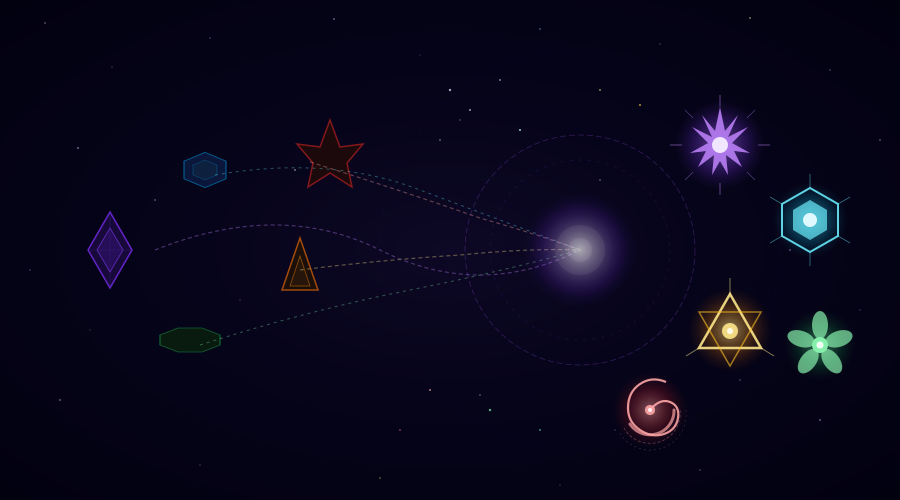
Five veils and their radiant counterparts — the same energy contracted into shadow or opened into light.
This too shall pass.
— Persian Sufi proverb
The Alchemist's Secret: Transformation, Not Elimination
Now that the five turnings are visible — Separation into Discernment, Scarcity into Care, Self-Fixation into Self-Awareness, Comparison into Appreciation, Uncertainty into Openness — we can name the method that makes the turning possible.
It is not transcendence. Transcendence says: rise above the veils. Leave them behind. Become a person who no longer experiences separation, scarcity, self-fixation, comparison, or uncertainty. Ascend to a higher plane where these petty human patterns no longer apply.
The problem with transcendence is that it is the veils wearing spiritual clothing. "I am above comparison" IS comparison — you are comparing yourself favorably to people who still compare. "I have transcended self-fixation" IS self-fixation — you are now fixated on the self-image of being someone who has transcended. Chögyam Trungpa called this spiritual materialism — the ego's co-optation of the spiritual path, using wisdom teachings as fuel for the very patterns they were meant to dissolve.
The method is transmutation. Not rising above but going through. Not eliminating the veil but entering it so completely that its nature becomes apparent. Not fighting the poison but — as in the old Tibetan story — tasting it, understanding its composition, and adding precisely the right compound to transmute it into medicine.
This is emotional alchemy.
The alchemical metaphor is precise, and Carl Jung was perhaps the first Western psychologist to see its precision. In his commentary on "The Secret of the Golden Flower," Jung recognized that psychological transformation mirrors the alchemical process: the base material — lead, shadow, symptom, poison — is not discarded in favor of gold. The base material IS transmuted into gold. The lead contains the gold in latent form. The nigredo (the blackening, the darkest stage) is not an error or a failure — it is the necessary first stage of transformation. The darkness of the veils is the nigredo from which the gold of wisdom emerges.
James Hillman radicalized this insight: the psyche's symptoms are not errors to be corrected but messages to be heard. Depression is not a malfunction — it is the psyche's way of deepening. Anxiety is not a chemical imbalance to be medicated away — it is the psyche's signal that something demands attention. Hillman was not dismissing the real suffering these states cause. He was insisting that the suffering contains information — and that the information, properly received, becomes the wisdom the symptom was trying to deliver all along.
Applied to the Five Veils: the goal is not to become a person without separation, scarcity, self-fixation, comparison, or uncertainty. It is to become a person who meets these states with enough awareness that the wisdom within them is liberated. Not a person above the weather. A person who can feel the rain without drowning. A person who can hear what the storm is saying.
The spectrum of compassion taught that the opening end of the spectrum is not a different territory from the contraction end. It is the same territory, seen without distortion. That article gave us the cloud metaphor: "Health dissolves illness — like a cloud dissolves into sky." Here, the metaphor completes itself. The cloud does not go somewhere else when it dissolves. It does not fight the sky. The sky does not fight the cloud. The cloud was always sky — water vapor and air, the same substance as the atmosphere around it, temporarily appearing as something different. When conditions change, the cloud does not die — it relaxes into what it always was.
The Veil of Scarcity does not die when it is transmuted into the Wisdom of Care. It relaxes into what it always was. The only thing that changes is the contraction. The energy remains. The substance was never different.
This is what Trungpa meant by "crazy wisdom" — not wisdom that is crazy in the colloquial sense, but wisdom that appears crazy to the ego because it refuses the ego's demand for orderly, comfortable, step-by-step transcendence. Crazy wisdom says: go into the mess. Go into the fear. Go into the shame and the greed and the jealousy and the terror. Not to wallow in them but to discover what they are made of. What they are made of, invariably, is wisdom in drag. The poison is wearing a costume. Your job is not to defeat the costume but to recognize the face underneath it.
Lead and storm dissolve through inner fire — transmutation reveals the gold that was always present.
The Funhouse Mirror: Why Your Distortions Are Diagnostic
There is a metaphor that makes the entire article concrete — one that connects the Vajrayana's ancient wisdom to the specificity of your own experience.
Imagine walking into a funhouse. You step in front of a warped mirror. Your reflection is distorted — stretched tall, squashed wide, rippled, bent. You laugh, because you know the mirror is curved. You know that the image is not you but a warped version of you.
Now notice something no one ever points out: the distortion is information.
The specific way the mirror is warped — the precise curvature, the exact locations where it bends — tells you the exact shape of the mirror. If you could trace the distortion with your fingertips, you would have a perfect map of the mirror's geometry. And from that geometry, you could calculate exactly what an undistorted reflection would look like. The distortion does not hide reality. The distortion reveals the precise nature of the distorting surface.
Your veils work identically.
The specific way your Veil of Scarcity warps your perception — what exactly feels scarce, in what domain, with what intensity, triggered by what circumstances — is not random. It is a perfect map of where your Wisdom of Care is contracted. The precise contours of your scarcity reveal the precise contours of your care. What you most fear losing is what you most deeply tend. What feels most insufficient is what matters most to you. The distortion IS the diagnosis. The diagnosis IS the treatment plan, written in mirror-script.
This is what makes emotional alchemy precise rather than vague. It is not a general instruction to "transform negative emotions into positive ones." It is a specific invitation to look at the exact shape of your suffering and read it as a map of your exact wisdom. The person whose Veil of Separation manifests as chronic loneliness has a Wisdom of Discernment that knows, with aching precision, the texture of genuine connection. The person whose Veil of Comparison manifests as envy of artists has a Wisdom of Appreciation that is tuned, with exquisite sensitivity, to creative beauty. The person whose Veil of Uncertainty manifests as obsessive planning has a Wisdom of Openness that knows — though it has forgotten it knows — how to inhabit the creative void.
In the language of The Math of Everything, Zero is the mirror surface — pure awareness reflecting everything without distortion. The veils are not coverings placed over the mirror. They are the ways the mirror is warped. But a warped mirror still reflects. And the warp itself is Zero's way of showing you where One has contracted — where the self has gripped too tightly, where the flowing awareness has frozen into a fixed position.
When you see the distortion clearly enough — really clearly, without flinching, without trying to fix it — you can feel the mirror straighten. Not through effort. Through seeing. The seeing IS the straightening. This is emotional alchemy in a single image.
The distortion traced as a glowing map — every contraction reveals the clear seeing hidden within it.
The Healer and the Five Wells
There is a Tibetan teaching story — one of those stories that sounds simple the first time you hear it and then unfolds in your mind for years.
A great healer arrives in a village where five wells have been poisoned. The villagers are sick. They have stopped drinking. They are dying not of the poison but of thirst — afraid to drink from the only water sources they have.
The villagers expect the healer to drain the five wells and fill them with clean water. Instead, the healer does something that terrifies them: she drinks from each well.
She tastes each poison. She identifies its composition. She sits with each one, letting its nature reveal itself. And then, understanding precisely what the poison is, she adds a single compound to each well — not an antidote that neutralizes the poison, but a catalyst that transforms the poison into medicine.
The villagers drink from the same five wells. The water now heals. It heals precisely the illnesses the poisons had caused — because the healed water contains the intelligence of what had harmed it.
The healer says: "I did not replace the water. I helped the water remember what it was before it was poisoned."
Each veil is a poisoned well. Each wisdom is what the water was before the poison. And the healer's method — tasting the poison, understanding its composition, adding awareness as the catalyst — is the method of emotional alchemy.
The five wells are your five veils. The five medicines are your five wisdoms. And the healer — the one who tastes the poison without being destroyed by it — is you, learning to meet your own contracted states with enough presence that the contraction relaxes and the wisdom flows again.
This is what generosity as gratitude in action looks like turned inward: the willingness to give your own suffering the gift of your attention. Not to fix it. Not to transcend it. To taste it. To understand what it is made of. To discover that it was always trying to tell you something — and that what it was trying to tell you was the wisdom you have been searching for everywhere else.
Tonglen: Breathing the Alchemy
If emotional alchemy is the method, tonglen is the method in motion — the practice that enacts the entire teaching in a single breath cycle.
Tonglen — Tibetan for "sending and taking" — is one of the most radical practices in the contemplative world. Pema Chödrön, who has done more than perhaps anyone to bring this practice to Western audiences, describes it simply: breathe in suffering. Breathe out compassion.
That is it. That is the entire instruction.
Breathe in the suffering — your own, someone else's, the world's. Not metaphorically. Actually breathe it in. Feel it enter your body on the inhale — the darkness, the heat, the weight of it. Then, on the exhale, send out whatever you can: relief, spaciousness, freshness, kindness. Let the exhale carry compassion to the person, the situation, the world you are holding in your awareness.
The practice sounds counterintuitive to the point of absurdity. Every survival instinct says: push suffering away. Hoard comfort. Protect yourself. Tonglen says: reverse the flow. Take in what you flee. Send out what you cling to.
And in that reversal, every veil is simultaneously addressed.
Instead of separating from pain — the Veil of Separation — you take it in. The boundary between your pain and others' pain becomes permeable. Discernment remains (you know whose suffering you are breathing in), but separation dissolves.
Instead of hoarding comfort — the Veil of Scarcity — you send it out. Your comfort is not a finite resource to be guarded but a flow to be shared. Care remains (you are tending to suffering), but scarcity dissolves.
Instead of protecting the self from discomfort — the Veil of Self-Fixation — you open the self to the full spectrum of experience. Self-awareness remains (you are consciously choosing to open), but fixation dissolves.
Instead of comparing your pain to others' pain — the Veil of Comparison — you recognize the shared texture of suffering. Appreciation remains (you perceive the specificity of each person's experience), but ranking dissolves.
Instead of fleeing the unknown territory of another's pain — the Veil of Uncertainty — you enter it willingly. Openness remains (you are holding a space you cannot fully understand), but fear dissolves.
Tonglen is all five micro-practices from the Five Veils fused into a single breath cycle. It is emotional alchemy in real time, available anywhere, requiring nothing but a willingness to breathe.
Pema Chödrön writes in The Places That Scare You: "Tonglen reverses the usual logic of avoiding suffering and seeking pleasure. In the process, we become liberated from very ancient patterns of selfishness. We begin to feel love for both ourselves and others; we begin to take care of ourselves and others."
Begin small. Breathe in your own suffering first — the specific texture of whatever veil is most active in you right now. Feel its weight on the inhale. Then breathe out spaciousness, kindness, warmth toward yourself. When this becomes stable, extend the practice to someone you know who suffers similarly. Then to strangers. Then to the world. The breath is the vehicle. The alchemy is the destination.
RAIN: The Four Steps of Western Alchemy
If tonglen is the Vajrayana's practice of emotional alchemy, then RAIN is its Western therapeutic cousin — the framework developed by Tara Brach that translates the same essential insight into four repeatable steps that any reader can begin today.
RAIN stands for:
Recognize. Name the veil. "Oh, there's the Veil of Scarcity running." "There's Self-Fixation rehearsing the performance." "There's Comparison doing its ranking algorithm." The naming itself is the first act of alchemy. Daniel Siegel's research on interpersonal neurobiology gives us the neural mechanism: when you name an emotional state — "name it to tame it" — the prefrontal cortex activates and modulates the amygdala's reactivity. The naming does not suppress the emotion. It creates a space between the emotion and your identification with it. You are no longer inside the veil. You are looking at it. And looking at it IS the beginning of seeing the wisdom within it.
Allow. Let the veil be present without fighting it. This is where most spiritual practice goes wrong — the moment of recognition is immediately followed by the impulse to fix, to push away, to transcend. Allow says: stop. Let it be here. The Veil of Uncertainty is present? Let it be present. Do not try to replace it with confidence. Do not try to reframe it as excitement. Just let the uncertainty sit in the room like Rumi's unexpected guest. Allowing is not passive — it is the most active form of courage. It is choosing not to run from what is here.
Investigate. Now explore the veil with curiosity. Where do you feel it in the body? What is its texture — tight, hot, cold, heavy, buzzing? What does it need? Not what does your ego want to do about it — what does the veil itself need? This is the step where the funhouse mirror becomes diagnostic. You are tracing the distortion with your fingertips. You are feeling the precise curvature of the contraction. And in that investigation, the contraction begins to speak. It says: "I need to know that what I care about will not be taken from me" (Scarcity, speaking its wisdom of Care). It says: "I need to know that I will not be annihilated if my self-image changes" (Self-Fixation, speaking its wisdom of Self-Awareness). The investigation does not impose meaning. It receives it.
Nurture. Offer the veil what it needs. Not what will fix it — what will tend to it. A hand on the chest. A breath of warmth toward the contracted place. The words: "I see you. You have been trying to protect me. Thank you. You can rest." This is not self-help affirmation. This is the practice of meeting the veil with the same compassion you would offer a frightened child — because the veil IS a frightened child. It is a survival program, installed millennia ago, still running because no one ever told it that the danger has passed.
The progression from the micro-practices in The Five Veils to RAIN mirrors the progression from that article's framework to this one. The micro-practices interrupt the veil — they create a gap, a moment of "oh, I see what is happening." RAIN transforms the veil — it enters the gap and discovers what the veil is made of. The micro-practices are the first turning of the key. RAIN is the door swinging open.
James Gross's research on emotion regulation gives us the scientific frame: suppression — pushing the emotion down — increases physiological arousal, reduces wellbeing, and ironically makes the emotion stronger. Reappraisal — changing the cognitive frame through which the emotion is perceived — reduces arousal, increases wellbeing, and liberates the energy the emotion was consuming. But emotional alchemy is something more specific than generic reappraisal. It is not changing the story about the emotion. It is changing the relationship to the emotion. It is not telling yourself "this anxiety is actually excitement." It is meeting the anxiety with enough presence that the anxiety reveals what it is made of — and what it is made of is the Wisdom of Openness, contracted.
The neuroscience validates the contemplative insight: you do not need to eliminate the emotion. You need to see it clearly. Seeing IS the transformation. The prefrontal cortex does not overpower the amygdala. It integrates with it. The higher brain does not defeat the lower brain. It befriends it. The same neural architecture that generates the veil is the neural architecture that, properly integrated, generates the wisdom.
Feeding Your Demons: The Charnel Ground Practice
There is a practice more radical than tonglen, more demanding than RAIN, and more ancient than either. It comes from an eleventh-century Tibetan woman named Machig Labdrön, and it involves going to the place that frightens you most and offering your body to whatever demons arise.
This is the Chöd practice. And its modern adaptation — Tsultrim Allione's "Feeding Your Demons" — is the most complete expression of emotional alchemy in the contemplative world.
The historical Chöd was not metaphorical. Practitioners literally went to charnel grounds — the cremation sites and bone yards of medieval Tibet — at midnight. They went alone. They sat among the remains of the dead. And they invited whatever demons arose — terror, revulsion, grief, madness — to come forward. Not to be fought. Not to be exorcised. To be fed.
The practitioner would visualize offering their own body — dissolving it into nectar and pouring it into the mouths of the demons until the demons were fully satisfied. And when a demon is fully fed — when it has received everything it wanted — it does not become more powerful. It transforms. In its place stands an ally — a source of clarity, compassion, and power that was trapped inside the demonic form.
The insight is the same insight that runs through this entire article, taken to its most extreme expression: what appears as a demon is your own rejected wisdom, projected outward as threat. When reclaimed through offering rather than combat, the demon's energy becomes available for life rather than defense.
Tsultrim Allione's modern adaptation makes this accessible. You do not need a charnel ground. You need a quiet room, a willingness to face what frightens you, and the following steps:
First, identify the demon — the emotional state that is active. The Veil of Self-Fixation, say, in the form of shame about a failure.
Second, give it a form. What does it look like? How big is it? What color, what texture, what expression on its face? The visualization externalizes the internal, making it possible to relate to the state rather than being consumed by it.
Third, ask it three questions: What do you want? What do you need? How will you feel when you get what you need?
Fourth — and this is the radical step — dissolve your own body into nectar and feed the demon exactly what it said it needs. Not what you think it should need. What it said. If the demon of shame says "I need to know that I am not a fraud," you feed it the nectar of genuineness. If the demon of scarcity says "I need to know that I will not be abandoned," you feed it the nectar of belonging.
Fifth, when the demon is fully fed, it transforms. What stands in its place? An ally. A wisdom. A protector. The shame-demon, fed the nectar of genuineness, becomes the Wisdom of Self-Awareness — the capacity to know yourself without being destroyed by what you see. The scarcity-demon, fed the nectar of belonging, becomes the Wisdom of Care — the capacity to tend to what matters without panicking.
This is not a technique for the faint of heart. It requires the audacity to face what you have been fleeing — to sit with the very states that the cycle of harm perpetuates when they go unmet. But it is also, in Allione's words, "the fastest way I know to transform inner conflict into inner peace."
The demons are not foreign invaders. They are your own wisdom, disguised by fear. Feed them, and they take off their costumes.
The Twin Truth: Real Pain and Real Wisdom
Here is where honesty requires us to stop and hold something carefully.
Everything in this article so far could be misused. It could become another form of spiritual bypassing — the term John Welwood coined for using spiritual ideas to avoid facing emotional pain. "My depression is just the Wisdom of Discernment!" "My crippling anxiety is really the Wisdom of Openness!" "My shame is secretly a teacher, so I don't need to do the hard work of healing!"
No.
The veils cause real pain. The Veil of Separation causes real loneliness — the kind that makes you feel like you are the only person alive at 3 AM. The Veil of Scarcity causes real panic — the kind that wakes you at 4 AM calculating bills. The Veil of Self-Fixation causes real shame — the kind that makes you avoid mirrors. The Veil of Comparison causes real despair — the kind that makes other people's happiness feel like a personal insult. The Veil of Uncertainty causes real terror — the kind that makes the future feel like a sentence rather than an invitation.
The wisdom framing does not erase this pain. It does not bypass it, minimize it, or spiritualize it into irrelevance. The pain is real. The suffering is real. The contraction is real.
AND.
The wisdom is also real. The discernment within the separation is real. The care within the scarcity is real. The self-awareness within the self-fixation is real. The appreciation within the comparison is real. The openness within the uncertainty is real.
Both are true. Both must be held. This is the twin truth of emotional alchemy, and it is the hardest thing in the article to hold without tilting to one side or the other.
If you tilt toward the pain and forget the wisdom, you are back to pushing against the door — fighting the veils, trying to eliminate them, applying more force in the wrong direction.
If you tilt toward the wisdom and forget the pain, you are spiritually bypassing — using the reframe as an anesthetic, thinking your way around the hurt instead of feeling your way through it.
The Vipassana tradition — the insight meditation lineage of Southeast Asia — has a parallel teaching. Joseph Goldstein and Jack Kornfield, in Seeking the Heart of Wisdom, describe how the five hindrances (nivarana) that arise in meditation — sensory desire, ill will, sloth, restlessness, and doubt — are traditionally treated not as obstacles to practice but as objects of practice. The meditator who encounters restlessness does not try to suppress it. The meditator turns toward it, investigates its texture, explores its energy, and discovers that restlessness, fully met, reveals its nature as alertness — the mind's capacity for wakeful attention, temporarily misdirected. The meditator's version of "the blocks are the teachers" is this: every hindrance, when met with full mindfulness, becomes a doorway to deeper understanding. The hindrance is not separate from the practice. The hindrance IS the practice, wearing a mask.
This holds for the veils too. Your loneliness is not separate from your capacity for connection. Your panic about money is not separate from your capacity for care. Your shame is not separate from your capacity for honest self-reflection. They are the same things. And the path is not to choose the wisdom over the pain but to discover the wisdom within the pain — which requires being willing to feel the pain fully.
The path is the middle. Hold both. Feel the pain of the contraction AND feel the wisdom that the contraction is made of. They coexist. They are the same energy, simultaneously contracted and reaching toward liberation. You do not have to choose between acknowledging your suffering and recognizing your wisdom. They are the same thing, seen from two sides.
Mark Epstein, the psychiatrist who has spent a career integrating Buddhist insight and psychoanalysis, puts it beautifully in Going to Pieces Without Falling Apart: "The ego's fragmentation is not pathology but the natural precondition for a wider identity." The veils "going to pieces" IS the wisdom emerging. The falling apart IS the coming together. But the falling apart is real, and it hurts, and anyone who tells you otherwise is selling a bypass.
Welwood himself — the man who named the problem — also named the solution: "We are not just humans learning to become Buddhas, but also Buddhas learning to become fully human." The wisdom descends into the human experience. The human experience rises toward the wisdom. They meet in the middle, which is the only place where transformation actually happens — not above the mess, not below it, but in it.
Pain and wisdom coil around one axis — two spirals inseparable, both real, meeting at the still center.
The Ouroboros: Using Veils to Dissolve Veils
There is one more paradox to hold — and this one should make you smile.
If the veils ARE the wisdoms in distorted form, then every spiritual practice that works with the veils is itself using distorted wisdom to liberate undistorted wisdom. The snake is eating its own tail. The path is consuming itself.
Consider: meditation is, structurally, the Veil of Self-Fixation's energy turned back on itself. Self-referential attention — the ability to watch your own mind — is exactly what self-fixation does. Meditation takes that energy and redirects it: instead of watching a frozen self-image and defending it, you watch the flowing process of selfing and let it be. Self-fixation provides the fuel. Awareness redirects it. The veil powers its own dissolution.
Tonglen is the Veil of Separation's energy reversed. The self-other distinction — the very capacity that creates the experience of being separate — is used to deliberately take in another's suffering and send out one's own comfort. Separation provides the structure. Compassion redirects it. The veil is the vehicle of its own transformation.
The "just like me" practice — the micro-practice from The Five Veils for the Veil of Comparison — uses the Veil of Comparison's energy redirected. The capacity to compare self with other, to evaluate one against another, is turned from ranking into recognition: "This person, just like me, wants to be happy. Just like me, wants to be free from suffering." Comparison provides the engine. Wisdom redirects it.
Even Suzuki Roshi's "beginner's mind" — the antidote to the Veil of Uncertainty — uses uncertainty's own energy. The willingness to not-know, to stand at the edge of what has not yet been determined, is exactly what uncertainty IS. The only difference is the relationship: beginner's mind holds not-knowing with curiosity. Uncertainty holds not-knowing with dread. Same position. Same edge. Different orientation.
The veils provide the fuel for their own transmutation. The path eats itself. And what remains — what is left when the snake finishes swallowing its own tail — is wisdom.
But here is Trungpa's necessary warning, the guardrail on this entire article: even the understanding that "veils are wisdoms" can become a veil if it is grasped rather than lived. "I understand that my veils are wisdoms" is an intellectual position, and intellectual positions are — you guessed it — reifications. The understanding must be felt, practiced, breathed, lived in the body. It must be discovered fresh each time the veil arises, not carried around like a shield against experience.
The sacred joke at the heart of all this — and it is a joke, one that should produce genuine laughter if you feel it rather than just think it — is that the effort to "get" this teaching is itself the last veil. The trying to understand is the door being pushed from the wrong side. And the moment you stop trying — the moment you lean against the door, exhausted and honest — is the moment the door swings open and you realize it was never locked, the room was always lit, and you were already inside.
The Resting Place: Your Veils as Curriculum
Let us gather what we have found.
You came to this article from The Five Veils, where you learned to name the five habitual patterns that reconstruct the experience of separation. You learned that they are not moral failures but neurological defaults, and that each one has a micro-practice that begins to thin it.
Now you know more. You know that each veil is not just an obstacle but a wisdom in disguise — that the very mechanism that blocks recognition IS the recognition, seen through the lens of contraction:
- Separation is Discernment — the ability to perceive boundaries — contracted into a prison.
- Scarcity is Care — the ability to recognize what matters — contracted into panic.
- Self-Fixation is Self-Awareness — the ability to know yourself — contracted into a fortress.
- Comparison is Appreciation — the ability to perceive excellence — contracted into ranking.
- Uncertainty is Openness — the ability to hold not-knowing — contracted into fear.
You know that the method is not transcendence but transmutation — not rising above the veils but entering them so completely that their nature as wisdom becomes apparent. You have met the practices: tonglen, which reverses all five veils in a single breath; RAIN, which walks you through recognition, allowing, investigation, and nurture in four steps; and Chöd, which feeds the demon until it reveals the ally it always was.
And you know the twin truth: the pain is real, and the wisdom is real. Both. At the same time. In the same breath.
What does this mean for your life — not your spiritual life or your philosophical life, but the life you are living right now, the one with the commute and the bills and the difficult conversations and the 3 AM awakenings?
It means your veils are your curriculum. They are not obstacles on the path. They are the path. Each contraction you feel — each moment of loneliness, each pang of not-enough, each grip of self-defense, each stab of comparison, each wave of dread — is a lesson plan, customized to your exact life, pointing toward the exact wisdom you most need to liberate.
The Fractal Life Table maps this precisely: each column has both a shadow and a light expression, and the shadow is not a different energy from the light. It is the same energy, contracted. Your specific shadows are not random. They are the precise inverse of your specific gifts. The person with the deepest capacity for connection feels the sharpest edge of separation. The person with the most exquisite taste feels the most painful comparisons. The person with the greatest capacity for care feels the most acute scarcity. Your pain is the shadow cast by your own wisdom. And the shadow, when you learn to read it, is a map of the light.
Rumi knew this. In the poem that has become the emotional alchemy tradition's anthem, he wrote:
This being human is a guest house. Every morning a new arrival. A joy, a depression, a meanness, some momentary awareness comes as an unexpected visitor. Welcome and entertain them all! Even if they're a crowd of sorrows, who violently sweep your house empty of its furniture, still, treat each guest honorably. He may be clearing you out for some new delight. The dark thought, the shame, the malice, meet them at the door laughing, and invite them in. Be grateful for whoever comes, because each has been sent as a guide from beyond.
Each guest — the depression, the shame, the malice — is not an invader but a guide. Each is a wisdom in distorted form. Welcome the guest, and the guide appears. Meet the demon at the door laughing, and it removes its mask to reveal your own face — your own wisdom, your own discernment, your own care, your own self-awareness, your own appreciation, your own openness — looking back at you, wondering why you ran for so long.
The door was never locked. It opens inward. It always has.
The meditator from the end of The Five Veils — the one who discovered she could see in the dark? This is what she saw. Not the absence of the veils but the presence of the wisdoms within them. Not a room emptied of obstacles but a room where every obstacle had turned out to be a lantern, a teacher, a map. The darkness was not the enemy of sight. The darkness was what her eyes needed to learn to read. And the veils — those ancient, habitual, neurological programs that reconstruct separation every morning before breakfast — were the alphabet.
The woman on the subway — the one from The Five Veils, the one with five programs running below the threshold of awareness — has not gone anywhere. She is still on the train. The elbows are still too close. The rent is still going up. The presentation is still at 10 AM. The woman in the beautiful coat is still sitting across the aisle. The reorganization rumor is still circulating.
But something has shifted. Not in the world — in her relationship to it.
The boundary between her and the passengers is still there. But it no longer feels like a siege wall. It feels like a membrane — permeable, alive, capable of protecting her AND connecting her. The discernment is present. The prison is gone.
The calculation about rent is still running. But it no longer has the quality of panic. It has the quality of attention — her mind tending to what matters, noticing what needs care, organizing its resources around what it loves. The care is present. The scarcity is dissolving.
The presentation rehearsal is still happening. But it is no longer a performance of a self that must be perfect. It is a person, preparing to share what she knows, aware that she is nervous and choosing to bring the nervousness with her rather than pretending it does not exist. The self-awareness is present. The fortress has softened.
The woman in the beautiful coat is still beautiful. But the beauty no longer stings. It delights. The ability to perceive excellence in another person — to be moved by someone else's grace — is a gift, not a wound. The appreciation is present. The scoreboard is gone.
The future is still uncertain. The reorganization may happen. The text from her mother may contain bad news. But the uncertainty no longer feels like a fog of threat. It feels like a space — an opening, an invitation, the same open space from which every good thing in her life has arrived unannounced.
Nothing has been removed. Everything has been transmuted.
The golden rule that began this series — "treat others as you would wish to be treated" — turns out to have an inward face: treat your own suffering as you would wish someone to treat theirs. With presence. With compassion. With the willingness to taste the poison and discover the medicine. With the trust that the door opens inward, that the cloud was always sky, and that the guest who arrives as shame, as fear, as loneliness, was sent — every time — as a guide.
You have been in the room the whole time. The light was always on.
Now you can see.
Invitation
You have been pushing against doors that open inward. The separation you feared — look at it. The scarcity you braced against — look at it. The self you tried to fix — look at it.
Not to dissolve them. Not to transcend them. To see what they were protecting: the raw, unbearable openness that needed a frame before it could be felt.
The frame was never the problem. The forgetting that you built it — that was the only suffering. Now you remember. And the poisons are already doing what they always wanted to do — healing you.
People Also Ask
What are the five Buddhist wisdoms?
In the Vajrayana Buddhist tradition, the five wisdoms (pañca-jñāna) are: Dharmadhatu Wisdom (the wisdom of all-encompassing space), Mirror-like Wisdom (the ability to reflect reality exactly as it is), the Wisdom of Equanimity (recognizing the fundamental equality of all beings), Discriminating Wisdom (perceiving the unique qualities of each thing), and All-Accomplishing Wisdom (the ability to act effectively and celebrate all accomplishment). Each corresponds to one of the five poisons or kleshas, and the Vajrayana teaching holds that the poison and the wisdom are the same energy in different states — one contracted, one liberated.
How do the five poisons become five wisdoms?
The Vajrayana tradition teaches that the five poisons — ignorance, attachment, aversion, pride, and jealousy — are not separate from the five wisdoms. They are the wisdoms in distorted form, seen through the lens of dualistic perception. Transmutation occurs not by eliminating the poison but by recognizing the wisdom already present within it. When the contraction relaxes through practices like tonglen, RAIN, or Chöd, the poison reveals its nature as wisdom. The ice melts back into the water it always was.
What is emotional alchemy in Buddhism?
Emotional alchemy refers to the process of transmuting difficult emotional states — anger, craving, fear, jealousy, confusion — into their corresponding wisdoms, rather than trying to suppress or eliminate them. This is the core method of the Vajrayana Buddhist tradition, where the practitioner enters the difficult state so completely that its nature as wisdom becomes apparent. Carl Jung independently discovered a parallel principle in his work with alchemical symbolism: the base material contains the gold in latent form.
What is the difference between transcendence and transmutation?
Transcendence means rising above difficult states — leaving them behind in favor of a "higher" consciousness. Transmutation means entering the difficult states so completely that their nature transforms from within. The Vajrayana tradition favors transmutation because transcendence, paradoxically, can become another form of spiritual materialism — the ego using spiritual practice to avoid facing what is difficult. Transmutation uses the energy of the difficult state itself as the fuel for transformation.
How does tonglen practice work?
Tonglen ("sending and taking") is a Tibetan compassion practice in which you breathe in suffering and breathe out compassion. On the inhale, you take in the pain — your own or another's — feeling its weight and darkness enter your body. On the exhale, you send out relief, spaciousness, and kindness. The practice reverses the habitual pattern of avoiding pain and hoarding comfort, simultaneously addressing multiple veils. Pema Chödrön's The Places That Scare You offers a comprehensive introduction to the practice.
What is the RAIN meditation technique?
RAIN is a four-step framework developed by Tara Brach for working with difficult emotional states: Recognize (name the state), Allow (let it be present without fighting it), Investigate (explore its felt sense in the body), and Nurture (offer it care rather than combat). RAIN translates the contemplative insight of emotional alchemy into four repeatable, accessible steps that bridge Buddhist practice and Western therapeutic approaches.
What is Chöd practice and feeding your demons?
Chöd is an eleventh-century Tibetan practice developed by Machig Labdrön in which the practitioner goes to a frightening place and offers their body to whatever demons arise. Tsultrim Allione's modern adaptation, "Feeding Your Demons," makes this accessible: you give the demon a form, ask it what it needs, dissolve yourself into nectar, and feed it until it transforms into an ally. The insight is that what appears as a demon is your own rejected wisdom projected outward as threat.
Can negative emotions be transformed into wisdom?
Yes — and not through suppression or positive thinking. Neuroscience research by James Gross and colleagues demonstrates that cognitive reappraisal (changing one's relationship to an emotion) is more effective than suppression (pushing it down). Dan Siegel's "name it to tame it" research shows that simply labeling an emotional state activates prefrontal regulation of the amygdala. The contemplative traditions go further: the specific quality of each difficult emotion reveals the specific wisdom it is hiding.
What is spiritual materialism?
Spiritual materialism is a concept introduced by Chögyam Trungpa in Cutting Through Spiritual Materialism (1973). It describes the ego's tendency to co-opt the spiritual path — using meditation, wisdom teachings, and even compassion as fuel for self-fixation and spiritual superiority. "I am a meditator" becomes another form of self-fixation. "I have transcended comparison" becomes another form of comparison. The antidote is not more practice but more honesty — recognizing when the path has been co-opted and starting again with beginner's mind.
How do you practice radical acceptance?
Radical acceptance, as taught by Tara Brach, does not mean approving of everything or being passive in the face of injustice. It means recognizing what is actually present in your experience — the pain, the fear, the contraction — without adding a layer of resistance on top of it. The RAIN framework is the practical method: Recognize what is here, Allow it to be present, Investigate its felt sense, and Nurture it with care. Acceptance is not the end of change — it is the beginning. You cannot transform what you refuse to acknowledge.
References
-
Trungpa, Chögyam. Cutting Through Spiritual Materialism. Shambhala, 1973.
-
Trungpa, Chögyam. Crazy Wisdom. Shambhala, 1991.
-
Allione, Tsultrim. Feeding Your Demons: Ancient Wisdom for Resolving Inner Conflict. Little, Brown, 2008.
-
Chödrön, Pema. The Places That Scare You: A Guide to Fearlessness in Difficult Times. Shambhala, 2001.
-
Chödrön, Pema. When Things Fall Apart: Heart Advice for Difficult Times. Shambhala, 1997.
-
Shantideva. The Way of the Bodhisattva (Bodhicaryavatara). Trans. Padmakara Translation Group. Shambhala, 2006 (orig. 8th century).
-
Kongtrul, Jamgön. The Treasury of Knowledge, Book Six: Frameworks of Buddhist Philosophy. Snow Lion, 2007.
-
Gross, James. "The Emerging Field of Emotion Regulation: An Integrative Review." Review of General Psychology 2.3 (1998): 271–299.
-
Ochsner, Kevin, and James Gross. "The Cognitive Control of Emotion." Trends in Cognitive Sciences 9.5 (2005): 242–249.
-
Siegel, Daniel. Mindsight: The New Science of Personal Transformation. Bantam, 2010.
-
Siegel, Daniel. The Developing Mind: How Relationships and the Brain Interact to Shape Who We Are. 2nd ed. Guilford Press, 2012.
-
Jung, Carl. "Commentary on 'The Secret of the Golden Flower.'" In Alchemical Studies, CW 13. Princeton University Press, 1929/1967.
-
Hillman, James. Re-Visioning Psychology. Harper, 1975.
-
von Franz, Marie-Louise. Alchemy: An Introduction to the Symbolism and the Psychology. Inner City Books, 1980.
-
Brach, Tara. Radical Acceptance: Embracing Your Life with the Heart of a Buddha. Bantam, 2003.
-
Brach, Tara. Radical Compassion: Learning to Love Yourself and Your World with the Practice of RAIN. Viking, 2019.
-
Suzuki, Shunryu. Zen Mind, Beginner's Mind. Weatherhill, 1970.
-
Rumi, Jalal ad-Din. The Essential Rumi. Trans. Coleman Barks. HarperOne, 2004.
-
Welwood, John. Toward a Psychology of Awakening: Buddhism, Psychotherapy, and the Path of Personal and Spiritual Transformation. Shambhala, 2000.
-
Epstein, Mark. Going to Pieces Without Falling Apart: A Buddhist Perspective on Wholeness. Broadway Books, 1998.
-
Goldstein, Joseph, and Jack Kornfield. Seeking the Heart of Wisdom: The Path of Insight Meditation. Shambhala, 1987.
-
Yalom, Irvin. Existential Psychotherapy. Basic Books, 1980.