There is a moment, before any significant act, that we almost never notice. A hand hovering over a door handle. A breath gathered before a difficult conversation. The half-second before a message is sent. Something is already happening in that sliver of time — something invisible, something that has quietly determined the quality of what is about to unfold. The door is the same door. The conversation is the same conversation. But not all hands reach toward the same thing. Not all breaths carry the same interior weather.
Two people can perform the identical act — arrive at the same meeting, make the same donation, speak the same words of care — inhabiting completely different inner worlds. One is reaching toward connection; the other is reaching for relief from guilt. One is moved by genuine love of the work; the other by the fear of what failure would cost. The outer actions are indistinguishable. The inner lives are not even close.
This is not a trivial difference. It determines everything: the quality of the experience from the inside while the action is happening, the effect the action has on others who receive it, and whether, looking back years later, the whole enterprise will have felt like a life fully lived or a performance carefully maintained. And at the root of that difference — invisible, ancient, and almost never examined — are three questions that every wisdom tradition in human history has tried to ask in its own language.
What are we actually seeking? Why does this seeking feel necessary? And who, in the end, is it truly for?
These three questions — intention, motivation, purpose — are the arrow, the bow, and the target. They are the inner architecture beneath all outer behavior. They were already shaping the action before the action began. And they are waiting, right now, beneath whatever we are about to do next.
Key Takeaways
- Intention, Motivation, and Purpose (IMP) are the three invisible forces that pre-shape every action, relationship, and creative act — not the "what" of behavior but the "how" and "why" that give it its quality.
- Intention is the arrow: the immediate direction of energy, the aim of consciousness before any action begins, whether conscious or not.
- Motivation is the bow: the emotional engine behind intention. Self-Determination Theory shows that the quality of motivation — not its intensity — determines whether an outcome will feel meaningful or hollow.
- Purpose is the target and the most neglected of the three: it orients action toward self or toward others, determining not what is achieved but what the achieving means.
- From Self-Determination Theory to logotherapy to narrative identity research, a converging finding holds: the quality of inner life is shaped not by what happens, but by the IMP pattern brought to it.
- Every major wisdom tradition has named and cultivated IMP — from cetana in Buddhism to niyyah in Islam to prohairesis in Stoicism to sankalpa in yoga — in different languages but toward the same perennial recognition.
Where there's a will, there's a way.
— English proverb
Why IMP Matters
Every action we have ever taken was shaped by three invisible forces we may never have named. Before the deed was the direction. Before the direction was the desire. Before the desire was the question of who, exactly, the whole enterprise was for. These three forces — intention, motivation, and purpose — are the inner technology beneath all outer behavior: the machinery of meaning-making that every wisdom tradition has tried to illuminate, and that every branch of contemporary psychology has tried to measure. We call them, together, IMP.
Modern life is extraordinarily skilled at filling schedules, achieving goals, and optimizing outcomes — and extraordinarily poor at asking whether any of it is aligned with what actually matters. The result is a civilization of spectacular accomplishment and creeping meaninglessness. We confuse goals with purpose. We mistake desire for intention. We conflate ambition — the drive to achieve — with meaning — the experience of mattering. These are not the same phenomena, and conflating them produces the characteristic suffering of contemporary life: the person who gets everything they sought and feels, upon arriving, a hollow where the satisfaction was supposed to be. This is not a failure of achievement. It is a failure of IMP alignment.
This pattern — the hollow arrival — shows up in the cycle of harm when unexamined intention creates ripple effects the actor never intended. It shows up in the five veils that obscure our deeper nature from view. And it shows up whenever a person confuses the material veil — the equation of wellbeing with accumulation — for the whole of reality.
IMP clarifies the inner geometry of action. It asks not "what did you do?" but "from where did the doing arise?" Not "what did you accomplish?" but "in service of what did you act?" Not "how motivated were you?" but "what kind of motivation was moving you?" These are older questions than any psychology textbook. They appear in the Bhagavad Gita and the Stoic discourses, in Sufi poetry and Buddhist phenomenology, in Indigenous decision-making frameworks and Christian mystical theology. What contemporary science has added is not the discovery of these questions but their empirical validation — the proof that IMP patterns have measurable consequences for wellbeing, health, creativity, and the quality of human relationships.
The invitation of this exploration is not to fix your motivation, upgrade your intention, or discover your purpose as though these were products to acquire. It is to slow down enough to notice what is already moving you, and to bring that movement into the light of awareness. From that noticing — unhurried, honest, without self-judgment — everything becomes possible.
Before you read further, try this: bring to mind the last significant action you took — a conversation, a decision, a piece of work you offered to the world. Can you feel the intention that was running beneath it? Not what you told yourself you were doing, but what the actual reaching was? Sit with that for a moment. Whatever you find, it is the beginning of IMP awareness.
The Archer's Architecture
Before we enter the detail, it helps to feel the whole.
Imagine an archer. Not a competitive archer — someone older, quieter, standing in an open field with no audience and no scoreboard. The bow is drawn. The arrow is nocked. Ahead, at some distance, is the target.
The arrow is intention — the direction of reaching, the aim of consciousness before the release. Is the arrow pointed at something real? Is the aim true, or has the archer been aiming where they were taught to aim rather than where their own seeing directs? The quality of the aim determines the trajectory of everything that follows.
The bow is motivation — the force that makes the reaching possible. It is the draw, the tensioning, the energy stored in the flex of the wood. How is the bow drawn? Is it drawn from love — the body relaxed, the draw even, the breath steady? Or is it drawn from fear — the muscles rigid, the jaw clenched, the string pulled back too far or not far enough? The same arrow, the same target, and two entirely different flights depending on the quality of the draw.
The target is purpose — the orientation of the entire endeavor. What is standing there? Is it the archer's own image, reflected back — a target shaped by ego, needing to be hit to prove something? Or is it something beyond the archer entirely — a contribution to the field, an offering, a gift to someone who will never know the arrow was released?
Arrow. Bow. Target. Intention. Motivation. Purpose. Three elements of a single architecture. Not three separate practices to optimize, but a unified inner technology that is already running — right now, beneath whatever you are about to do next.
The question has never been whether you have an IMP pattern. You do. Everyone does. The question is whether you have noticed it — and whether what you notice, when you look, is what you would choose.
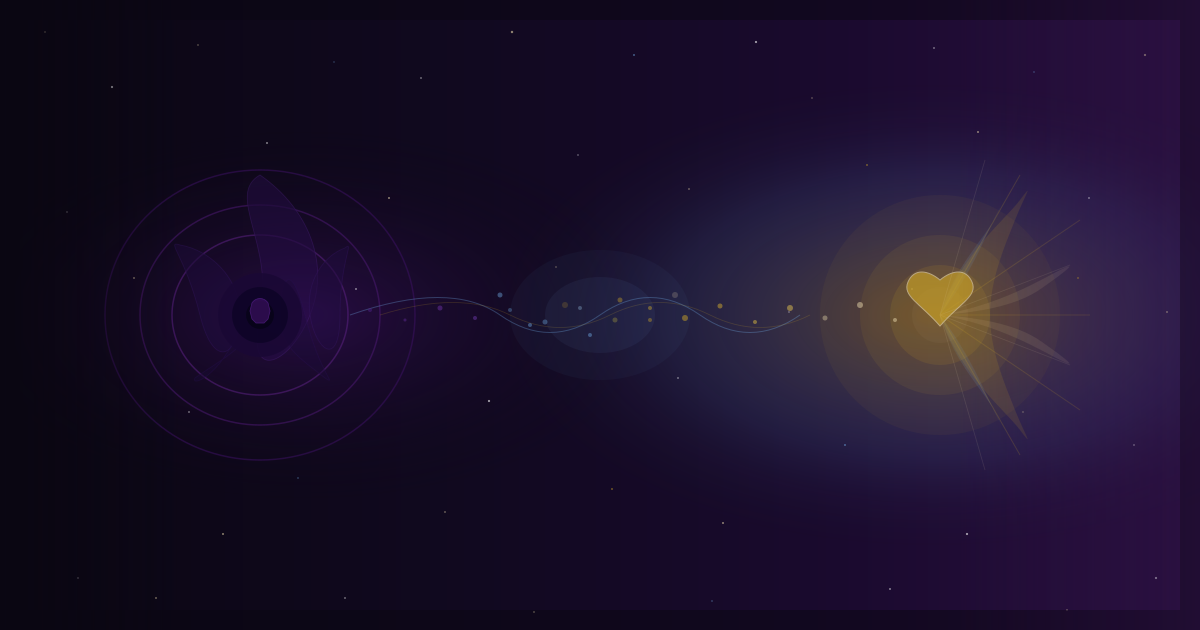
Intention as arrow, motivation as bow, purpose as target — the three-part inner architecture behind every action.
Intention: What You Seek
The word intention comes from the Latin intendere — to stretch toward. Even the etymology is already a metaphor: intention is a reaching of consciousness in a direction. It is the arrow before it flies, the aim that precedes the release.
Intention, as we are using the word here, is not a goal or a plan. It is the immediate orientation of energy — the direction in which attention and effort are pointed before the first step is taken. Every action has one, whether the actor is aware of it or not. The person who walks into a meeting without consciously setting an intention does not have no intention. They have an unconscious one. And unconscious intentions, as any honest self-examination reveals, have a way of running the show.
The most important distinction in the study of intention is between the stated intention and the actual intention — what we tell ourselves we are seeking versus what the deeper patterns of our attention and behavior reveal. A person may sincerely state the intention "I want to help this person" while the actual intention — invisible, unexamined — is "I want to be seen as someone who helps." Both can be simultaneously present. Only one is conscious. And the unconscious one shapes the quality of the help far more than the stated one does. This is the same territory explored in hurt people hurt people — where unexamined inner wounds generate actions that look caring on the surface but carry a different charge entirely.
Peter Gollwitzer at New York University spent decades studying what he calls "implementation intentions" — specific "if-then" formulations that dramatically increase follow-through on stated goals. His 1999 research found that the precision and specificity of a stated intention correlates directly with the probability of aligned action. But even Gollwitzer's framework, powerful as it is, addresses only the effectiveness of stated intentions — not their depth. We can become very efficient at pursuing shallow intentions. The more important question is whether the intention itself is pointing somewhere real.
The Directionality of Reaching
Approach and avoidance research, pioneered by Andrew Elliot at the University of Rochester, reveals another layer: even when two people pursue the same behavioral goal, those motivated by approach intentions (reaching toward something desired) experience fundamentally different psychological outcomes than those motivated by avoidance intentions (escaping something feared). The goals look identical from the outside. The inner lives, and the long-term consequences for wellbeing, are not even close.
Elliot's framework, developed across two decades of empirical work, demonstrates that the same goal — "I want to do well in this course" — produces measurably different outcomes depending on whether it is framed as approach ("I want to master this material") or avoidance ("I don't want to fail this exam"). Approach goals correlate with deep processing, intrinsic interest, and sustained engagement. Avoidance goals correlate with surface processing, test anxiety, and the kind of shallow achievement that evaporates the moment the threat is removed. The achievement may look identical on a transcript. The inner experience — and the long-term learning — are entirely different.
Consider two people who meditate daily. One sits because silence genuinely calls them — an approach intention, a reaching toward. The other sits because not sitting produces guilt, because they fear what happens to their anxiety when the practice lapses — an avoidance intention, a fleeing from. Same cushion, same minutes, same external behavior. Radically different inner architecture. Elliot's research consistently shows that approach-motivated behavior produces greater enjoyment, deeper engagement, and more sustainable commitment. Avoidance-motivated behavior produces compliance but not flourishing — the behavior continues, but the person inside it is quietly contracting.
The implications ripple outward. A parent whose intention toward their child is approach-oriented ("I want to foster this person's flourishing") creates a qualitatively different relational field than a parent whose intention is avoidance-oriented ("I don't want my child to turn out badly"). A leader whose organizational intention is approach ("let's build something that genuinely serves people") creates a different culture than one whose intention is avoidance ("let's make sure we don't get sued or lose market share"). The behaviors generated by each may overlap substantially. The environments they create do not.
This distinction matters beyond psychology. The cult of certainty is built on avoidance intention — the desperate need to flee ambiguity rather than a genuine reaching toward truth. The gaslighting and misinformation that corrode communities exploit avoidance fears — reaching away from discomfort rather than toward discernment.
The Buddhist Map of Intention
Buddhism named this distinction with great precision. The Pali word cetana — often translated as "volition" — refers to the specific mental event of intentional reaching: the moment consciousness moves toward something. The Buddha's formula, preserved in the Pali Canon, is unambiguous: cetanāhaṃ bhikkhave kammaṃ vadāmi — "It is cetana that I call karma." Not the action itself, but the intention behind it, generates the moral consequence. Two physically identical actions with different intentions produce different karmic weight. The inner reality matters as much as the outer behavior — a recognition that contemporary neuroscience is just now beginning to confirm.
The Noble Eightfold Path's second factor, sammā saṅkappa (Right Intention), maps the territory of healthy intention along three dimensions: the intention of renunciation (releasing grasping), the intention of non-ill-will (releasing aversion), and the intention of harmlessness (releasing cruelty). These are not commandments but a phenomenological description of what a clear, undistorted intention-field actually looks like from the inside. Notice: all three are defined as releasing something — not as acquiring virtue but as removing obstruction. The arrow does not need to be made more powerful. It needs to be freed from what bends it.
The Stoic Discovery
Epictetus, the Stoic philosopher who was born a slave, identified the will — prohairesis, the faculty of intention — as the only thing that cannot be taken away from a human being. External events, the body, reputation, wealth: none of these belong to us in any final sense. Our intentions do. For Epictetus, the entire practice of philosophy reduces to a single discipline: learning to aim intentions at what is genuinely within our power (our own choices, responses, and orientations) and releasing everything else.
Consider the specific physical reality of Epictetus's early life. Captivity. Someone else controlling your body, your schedule, your movements. Your leg broken by your master — tradition holds that Epictetus limped for the rest of his life. And within that captivity, the discovery of prohairesis: the one thing the master's hand cannot reach. Not freedom from constraint but freedom within it. The radical nature of this discovery is not philosophical — it is a survival technique born in actual bondage, tested against the most concrete possible oppression, and found to hold.
This is the same recognition that you didn't start this explores — the inheritance of conditions we did not choose, and the faculty within those conditions that remains genuinely ours.
Shadow Intentions
The shadow territory of intention is perhaps its most important landscape. Avoidance intention — doing things primarily to escape something rather than reach toward something — underlies an enormous amount of human activity that passes for productivity, generosity, or diligence. The busyness that is actually flight from silence. The helping that is actually self-soothing. The achieving that is actually proof of adequacy. Shadow intentions are universal — there is no shame in having them. The practice is awareness: noticing when the arm is reaching forward while the eyes are looking backward.
This is the territory the five veils describe — layers of self-obscuring that make it genuinely difficult to see what we are actually reaching toward. The shadow is not the enemy. It is the unexamined. And the act of examination itself begins to change the field.
A simple practice of intention examination asks: If no one ever knew I did this — not even myself, in retrospect — would I still do it? What remains after all witness is removed is the deepest accessible layer of actual intention. It is rarely comfortable to see. It is almost always more useful than the stated version.
Pause here. Think of something you do regularly — a habit, a commitment, a relationship practice. Ask yourself that question honestly. If no one ever knew — not even you — would you still do it? Whatever answer arises, do not judge it. Simply notice. The noticing is the practice.
Two archers, one moving toward light and one fleeing shadow — the same outward act animated by opposite inner directions.
Motivation: Why You Seek It
If intention is the arrow, motivation is the bow. It is the force that makes the reaching possible — that draws energy back so it can spring forward, that sustains effort through the inevitable friction of difficulty. Without motivation, intention has direction but no power. It cannot fly.
The most common confusion about motivation is the conflation of its intensity with its quality. "Highly motivated" is widely treated as an unambiguous virtue. But it is not. A person driven by terror is highly motivated. So is a person driven by genuine love of what they are doing. These are not equivalent states, and they do not produce equivalent lives. The question that matters is not how motivated we are but what kind of motivation is moving us — and this is precisely the question that Self-Determination Theory, the most rigorously researched framework in motivational psychology, was built to answer.
The Quality Continuum
Edward Deci and Richard Ryan at the University of Rochester have spent more than four decades developing what is now the dominant scientific account of human motivation. Their framework describes not a single thing called "motivation" but a continuum of qualitatively different motivational states, ranging from fully external to fully internal. The differences between these states are not merely conceptual — they have been measured in dozens of countries across hundreds of studies and shown to have reliably different consequences for wellbeing, creativity, persistence, and psychological health.
At one end of the continuum is external regulation: acting to gain a reward or avoid a punishment. This is the motivation of the student who studies only for the grade, the employee who works only to avoid getting fired. It reliably produces behavior in the short term and consistently undermines the intrinsic quality of that behavior. Mark Lepper, David Greene, and Richard Nisbett's landmark 1973 study demonstrated what they called the "overjustification effect": when external reward is added to an already intrinsically motivated activity, intrinsic motivation reliably decreases. The child who loves to draw, and is then paid to draw, draws with less joy — and stops drawing entirely when the payment stops.
Moving along the continuum toward greater internalization, we find introjected motivation: acting because we "should," because not acting would produce shame, guilt, or anxiety. The external pressure has been swallowed but not metabolized. "I exercise because I'll feel guilty if I don't." This is the most common motivational state in high-achieving individuals — and it correlates, in the research, with fragile self-esteem, defensive behavior, and poor long-term wellbeing outcomes. Here lies the motivational engine of what reification does to the psyche — the conversion of living process into rigid identity that must be defended.
Further along lies identified motivation: acting because we genuinely value the outcome, even if the activity itself is not inherently enjoyable. "I do these accounts carefully because I care about the financial health of this organization." The identification with the value is real. There is still a felt separation between the person and the activity. Then comes integrated motivation: acting because the activity has been fully metabolized into self-concept — it expresses who the person is. "I teach because teaching is an expression of who I am." The activity and the identity are no longer distinguishable.
At the far end of the continuum is intrinsic motivation: acting for the inherent satisfaction and vitality of the doing itself, independent of any outcome. This is the motivation of a child absorbed in play, an artist lost in making, a meditator settled in silence. It cannot be manufactured — but it can be fostered by environments that satisfy three fundamental psychological needs that Deci and Ryan identify as universal: autonomy (I am genuinely the author of this action), competence (I am growing through this), and relatedness (I am connected to others through this). When these three needs are met, intrinsic motivation tends to emerge naturally. When they are systematically thwarted — by controlling environments, coercive relationships, or punitive institutions — even naturally intrinsic activities lose their flavor.
This has everything to do with the social fabric. As the generosity standard explores, entire communities can operate from different positions on the motivational continuum — communities built on threat and compliance versus communities built on genuine care and mutual contribution. The quality of motivation at scale becomes the quality of civilization.
The Will to Meaning
Viktor Frankl, the Viennese psychiatrist who survived Auschwitz and built an entire school of psychotherapy on what he observed there, arrived at his account of human motivation through the most extreme laboratory imaginable.
What he found was that the prisoners most likely to survive were not the strongest or the best-fed, but those who had not lost their sense of meaning. Not pleasure, not power — meaning. The cold of the camp. The prisoners who were physically strong but had lost meaning, dying first. The ones who held a thread — a manuscript to finish, a child to find, a truth to serve — enduring against all material logic. Frankl watching, diagnosing, and simultaneously being a participant in what he observed. The will to meaning is not a theory he developed after the war. It is a survival strategy he lived inside.
"He who has a why to live can bear almost any how," Frankl quoted Nietzsche. He had seen the proof.
His central thesis, which he named "logotherapy," holds that the primary human drive is the will to meaning: the need to find significance, direction, and coherence in one's existence. Frankl's insight goes deeper than SDT's continuum, important as that framework is. He observed that meaning is not something humans create — it is something they discover. It is already present in the situation, waiting to be found.
Frankl identified three irreducible sources of meaning: creative values (what we give to the world through work and making), experiential values (what we receive from life through beauty, love, and truth), and attitudinal values (the stance we take toward unavoidable suffering). The third is the most radical: even in suffering that cannot be eliminated, a meaning-orientation is possible. The person who cannot change their circumstances can still choose how they inhabit them. This is the motivational backbone of the compassion lineage — the capacity to meet suffering with something other than collapse or denial.
"Don't aim at success," Frankl wrote in a passage that captures the paradox at the heart of all IMP work. "The more you aim at it and make it a target, the more you are going to miss it. For success, like happiness, cannot be pursued; it must ensue, and it only does so as the unintended side effect of one's personal dedication to a cause greater than oneself."
The Neurological Split
Kent Berridge's neuroscience research at the University of Michigan adds a final, useful distinction at the cellular level. Berridge demonstrated in 1998 that the brain runs two separate systems for what we loosely call "motivation": a wanting system (dopamine-mediated), which drives anticipation, craving, and seeking, and a liking system (opioid-mediated), which produces the actual experience of pleasure and satisfaction.
These systems are often in dramatic misalignment: the slot machine, social media, and most forms of extrinsic-motivation pursuit activate the wanting system intensely while producing very little genuine liking. The person who checks their phone two hundred times a day is not experiencing satisfaction two hundred times. They are experiencing craving two hundred times — the dopamine loop firing without the opioid payoff, a neurological treadmill that generates exhaustion while producing the felt sensation of urgency. This is the biochemistry of the material veil — the endless wanting that masquerades as genuine need.
Intrinsic motivation, by contrast, tends to engage both systems in more balanced proportion — the anticipation and the experience remain coherent. When you are doing something genuinely meaningful, the wanting and the liking walk together. This is part of what Mihaly Csikszentmihalyi called flow — the merging of action and awareness that occurs when motivation quality is fully intrinsic, when the doing and the being are the same movement.
Consider: What in your life engages both wanting and liking in balance — where the anticipation and the experience walk together? What engages wanting alone — the craving without the satisfaction? You already know the difference. You feel it in your body. The first is nourishing. The second is depleting. The quality of motivation, not its intensity, is what determines which one you inhabit.
The Sufi Heart
The Sufi tradition speaks of shawq — divine longing — as the highest motivational current available to human consciousness. In the opening lines of the Masnavi, Rumi's great poem of the spirit's journey, a reed flute cries for the reed bed it was cut from. That crying is simultaneously the reed's suffering and its music: the wound of separation and the energy generated by that wound are the same thing.
The heart, in Sufi psychology, is constitutively motivational — it is always turning toward whatever it loves. The Arabic word qalb (heart) shares its root with "that which turns." It cannot not be in motion. It is always reaching, always drawn, always oriented toward something. The practice is not to stop the turning but to discern what the heart is actually turning toward, and to redirect that turning, through ikhlas (purification of intention), toward the Real.
The quality of motivation, not its intensity, is what determines the quality of a life. This is not a spiritual claim alone. It is the most replicated finding in motivational science.
The Self-Determination Theory continuum, from external compulsion through integration, to the quiet freedom of intrinsic motivation.
Two Identical Gifts
Before we turn to purpose, consider a scene.
Two people give the identical gift — same amount, same recipient, same wrapping. The occasion is the same. The words accompanying the gift are the same.
Person A gives from overflow. They noticed a need, felt genuinely moved, and responded. The gift is an extension of care. They do not need the recipient to react in any particular way. They do not need witnesses. If the gift were anonymous, they would feel exactly the same.
Person B gives from fear. They are afraid of looking stingy. The gift is a performance aimed at an imaginary audience — or at their own self-image as a generous person. If no one saw, they would feel less inclined. If the recipient failed to express gratitude, they would feel cheated.
The gift is the same. The IMP pattern is not. And here is the part that matters: the recipient, somehow, knows the difference. Not through analysis. Not because Person B was clumsy or Person A was eloquent. Through the felt quality of the exchange — a warmth in one case, a slight heaviness in the other. The body knows what the mind has not yet named.
This is the territory the art and science of generosity maps in detail — the difference between giving as expression and giving as transaction. IMP is the diagnostic tool that makes the difference visible. And purpose is where the diagnostic becomes most uncomfortable.
Purpose: Who It Is For
Purpose is the most misused word in contemporary culture. "What's your purpose?" has become a career question, a brand question, a question about personal optimization. Purpose has been domesticated into productivity. We have lost something essential in that domestication.
Purpose, at its root, is a relational question. It is not about what we do. It is about the direction in which our doing is aimed — toward self, or toward others; toward the local ego, or toward the whole web of life. Purpose cannot exist in isolation. It requires a recipient, an other, a community within which the action makes sense. Ask not "what is the purpose of my life?" — that question is too large, too abstract, too easily captured by the ego's image of itself as a purposeful person. Ask instead: Who is this particular action for? That smaller, more answerable question is the doorway to the larger one.
Contemporary culture is saturated with intention-setting and motivation-hacking. Goal-setting frameworks, habit systems, accountability structures — these are tools for managing intention and motivation. Purpose is almost entirely absent from the conversation. And this absence, Frankl would argue, is precisely why so many well-intentioned, highly motivated people arrive at their goals and find them strangely empty. The arrow flew true, the bow was powerful, but the target was in the wrong field. The five radical realizations include this recognition — that achievement without purpose-alignment is a specific kind of suffering, wearing the disguise of success.
The Indigenous Compass
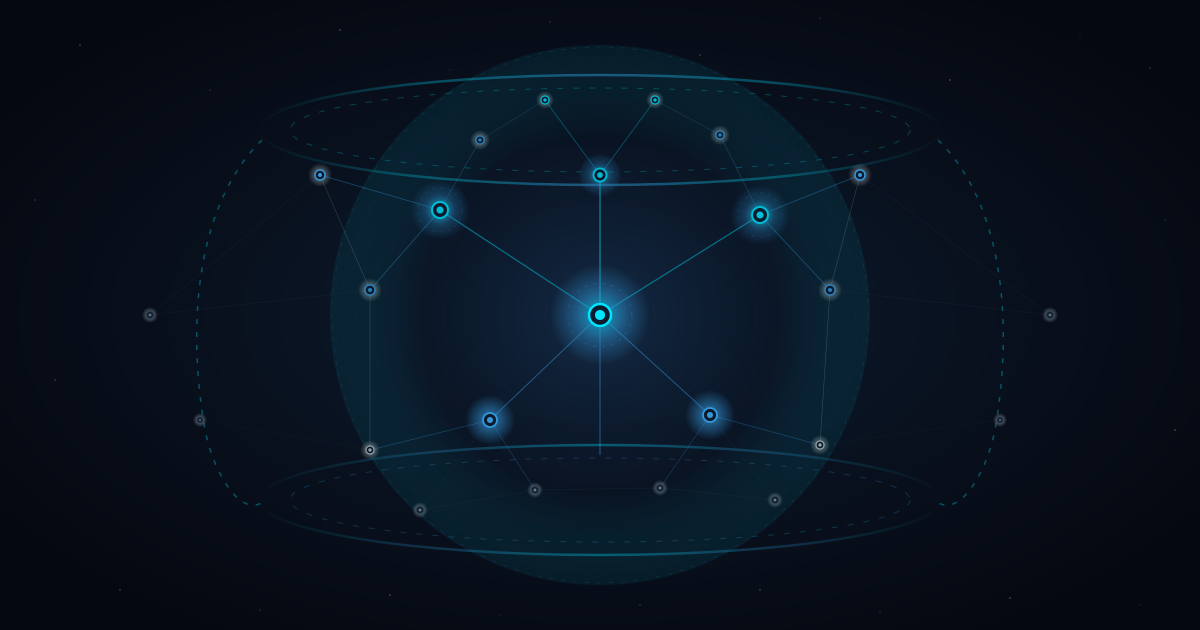
Indigenous traditions understood this with a depth that Western psychology is only beginning to approach. The Lakota phrase mitákuye oyásʼiŋ — "all my relations" — is not merely a greeting. It is an ontological statement: every action is embedded in a web of relationship that extends to all living beings — people, animals, plants, waters, ancestors, the yet-unborn. Purpose, in this worldview, is never a solo project. It is always a contribution to the living whole. This is the relational ontology the Gaia Mind Network models in three dimensions — every node connected to every other, every action rippling through the field.
The Haudenosaunee "Seventh Generation" principle extends this accountability across time: decisions are evaluated by their effect on the seventh generation yet to come. This is perhaps the most radical form of purpose-extension available to human consciousness — purpose stretched across approximately 175 years of future generations, most of whom have not yet been born. The question "is this good for the children?" — meaning not only one's own children, but the children of all species, in all directions, across all time — is perhaps the most demanding purpose-audit available in any tradition.
Desireless Action and the Yogic Path
In the Bhagavad Gita, Krishna instructs Arjuna in nishkama karma — desireless action. This is routinely misunderstood as passivity or detachment from the world. It is the opposite: it is action freed from attachment to the fruits of action. The purpose is the offering itself, not what the offering returns to the giver. This is the yogic equivalent of what Self-Determination Theory calls intrinsic motivation, expressed at the level of purpose rather than motivation: the action is its own justification.
Svadharma — one's own unique dharma — insists further that each person has a singular contribution to make that only they can make. Living another's contribution, even skillfully, is a form of spiritual corruption. Purpose, in this framework, is not merely noble or altruistic — it is particular, embodied, irreplaceable. The fractal life table maps this territory — each person's life as a unique fractal pattern, unrepeatable, carrying a specific contribution the whole requires.
In Tantric yoga and the practice of yoga nidra, a sankalpa is a heartfelt resolve — a seed intention planted at the deepest accessible layer of consciousness, in the hypnagogic state between waking and sleep where the will can most directly access subconscious patterns. A sankalpa differs from an ordinary goal or stated intention in a crucial way: it is not invented by the thinking mind but retrieved from a deeper knowing. The traditional instruction is not "I will become X" but "I am already X — and I am removing what obscures this truth." The sankalpa is not manufactured; it is remembered.
Bodhicitta — Purpose Extended to All Beings
Buddhist Mahayana tradition offers bodhicitta — the awakening mind — as the highest purpose available to a human being: the aspiration to attain enlightenment not for oneself but for the benefit of all sentient beings. The bodhisattva vow, "I will not enter nirvana until all sentient beings are free from suffering," is not a practical goal but a directional orientation — a field that shapes every action without requiring the action to be explicitly grandiose. Purpose extended to include all consciousness, across all time. The tonglen practice — breathing in the suffering of others, breathing out relief — is bodhicitta enacted in the breath itself: purpose made physiological.
This is the direction the spectrum of compassion traces — from compassion for self, to compassion for those close, to compassion for all beings. Bodhicitta is the far horizon of that spectrum, where the distinction between "my" purpose and "our" purpose dissolves entirely.
The Paradox of Genuine Purpose
Frankl's paradox of purpose is worth sitting with: purpose cannot be invented — it can only be discovered. The person who sits down to design their purpose usually produces something that serves their ego's self-image as a purposeful person. Genuine purpose is found in the encounter with what is actually needed — in the gap between what the world is and what it could be, and in the specific capacity the person has to help close that gap.
The purpose spectrum runs from self to close others to community to species to cosmos. No point on this spectrum is inherently superior to any other. A person whose purpose is genuinely loving family presence is closer to the heart of things than a person performing global purpose while ignoring the people in the next room. The question is not how large the purpose is — it is how genuine, how free from ego-admixture, how truly oriented toward the flourishing of what is actually present in front of us.
Sit with this. Think of the person in your life who most reliably makes you feel genuinely cared for. Notice: you probably do not think of them in terms of their "purpose" or "impact." You think of them in terms of their presence. Their attention. The way they are with you. That quality of being-with is purpose in its most immediate form — and it is worth more than any number of purpose statements on a vision board.
Cross-Cultural Lineage of IMP
IMP is not a contemporary wellness concept. It is a perennial human discovery — something the entire species has been working on for millennia, in every language, in every climate, in every form of human community that has ever tried to live well together. Each tradition offers a different facet of the same inner landscape. The hidden wisdom that runs beneath all traditions converges here — at the recognition that the invisible interior of action is its most consequential dimension.
Buddhism — Cetana and Sammā Saṅkappa
In Abhidharma Buddhist psychology, cetana — volition — is identified as one of 52 cetasikas, the basic mental factors that constitute conscious experience. It is not a background mood or a vague motivational state. It is a specific, identifiable mental event: the moment of intentional reaching, the instant in which consciousness moves toward or away from something. The Buddha's explicit equation — cetana = karma — places intention at the foundation of the entire Buddhist ethical and soteriological framework. What we do matters; why we do it matters more.
Sammā saṅkappa — Right Intention — is the second factor of the Noble Eightfold Path, which means it stands at the very foundation of the Buddhist path. Its three dimensions map precisely onto the IMP framework: renunciation (releasing grasping intention), non-ill-will (releasing aversive motivation), and harmlessness (orienting purpose toward non-harm of all beings).
Bodhicitta — the awakening mind — is the culmination of Buddhist IMP. It synthesizes all three elements: the intention to awaken, the motivation of universal compassion, and the purpose of benefit for all sentient beings across all time. In the Mahayana tradition, bodhicitta is not an aspiration to be achieved and then sustained but a direction of orientation to be continuously renewed — a compass heading, not a destination. This is purpose as the oneness recognition understands it — the point at which self-interest and other-interest become genuinely indistinguishable.
Sufism — Niyyah and Ikhlas
"Actions are by intentions" — innama al-'amal bil-niyyat — opens the most frequently cited hadith in Islamic religious teaching. Without niyyah, the specific intention set before an act of worship or ethical conduct, even the formally correct action lacks its essential validity. This is not a legalistic point. It is a recognition that the invisible interior of an act is as spiritually real as its visible exterior — that God, in Sufi understanding, sees the inside of the arrow, not just its flight.
Ikhlas — sincerity, purity of intention — is the quality of motivation freed from all admixture of self-interest. Not the absence of desire, but the purification of desire down to one: love of the Real (al-Haqq). The Sufi path is largely a path of ikhlas cultivation: the progressive removal of the ego's overlays from motivation, until what remains is action arising from and returning to pure love.
Ibn Arabi teaches that the heart — qalb, a word whose root means "that which turns" — is constitutively motivational. It is always turning toward whatever it loves. The practice of Sufi psychology is to bring that perpetual turning into conscious alignment: to discern what the heart is actually turning toward beneath the noise of conditioned desire, and to redirect that turning toward the Beloved. This is IMP work in its most intimate form — not the management of behavior but the education of the heart's native longing.
Christianity — Discernment and Self-Emptying
Ignatius of Loyola's Discernment of Spirits — developed in the sixteenth century and still practiced globally — is essentially a motivation-quality diagnostic system. Ignatius distinguished between consolation (inner movements toward God, life, truth, love, peace) and desolation (inner movements away — toward contraction, fear, self-referential anxiety). Learning to distinguish these two currents, he taught, is the foundational practice of the spiritual life.
The agere contra principle — "act against" — is the Ignatian prescription for desolation: when fear-based, contracted motivation is recognized, the practice is to move in the opposite direction, to make the choice that love would make rather than the choice that fear demands. This is a deliberate IMP reorientation — not waiting to feel differently, but choosing to act from the deeper intention while the surface feeling remains uncomfortable.
Meister Eckhart's Gelassenheit — self-emptying, yielding — is perhaps the most radical statement of purpose-purification in the Western mystical tradition. It is not self-abnegation but the progressive removal of ego-overlay from all action, until what remains is action arising from the ground of being itself. Augustine's prayer — "Our heart is restless, until it repose in Thee" — names the motivational dynamic that lies beneath all human seeking: a restlessness that cannot be quieted by any finite object, because it is in fact a displaced form of the deepest motivation, the return to Source.
Stoicism — Prohairesis and the Ruling Faculty
Epictetus was born a slave, subjected to systematic coercion throughout his early life, and became one of the most influential philosophers in human history. The root of his philosophy was a discovery he made in his own captivity: there was one thing his masters could not touch — his prohairesis, his will, his faculty of intention. They could control his body, his circumstances, his reputation. They could not control where he aimed his consciousness.
From this discovery, Epictetus built an entire philosophy of freedom: the dichotomy of control. Place your intentions on what is genuinely within your power — your own choices, responses, judgments, and orientations. Release everything else. This is not a recipe for passivity but for the concentration of intentional energy on the only terrain where it can actually operate.
Marcus Aurelius, writing in his private journal — the Meditations, never intended for publication — returned again and again to the same practice: noticing when the hêgemonikon, the ruling faculty, had drifted into validation-seeking, fear, resentment, or distraction, and bringing it home. This is the Stoic version of IMP practice: continuous, unglamorous, private, and done entirely for the quality of the inner life it produces. The emperor who ruled the known world, doing the same inner work as the former slave — from different stations, the same practice.
Indigenous Traditions — Relational Accountability
Among the Lakota people, mitákuye oyásʼiŋ — "all my relations" — is spoken as both prayer and statement of fact. It is not a reminder to be kind to others. It is an ontological claim: we are in relation with all of life — human, animal, plant, mineral, ancestral, future — and every action participates in that relational web, whether we are aware of it or not.
The Haudenosaunee Seventh Generation Principle asks decision-makers to evaluate every significant action by its impact on those who will live seven generations from now. Purpose that stretches across approximately 175 years of future generations, most of whom have not yet been born. When the sacred joke reveals the cosmic absurdity of human self-importance, it is this kind of temporal humility — the knowledge that we are a brief passage in a very long story — that makes purpose genuine rather than grandiose.
Notice which tradition, if any, spoke to something already moving in you. Not as intellectual interest — as recognition. That recognition is itself a signal about your own IMP pattern. What you are drawn to reveals what you are already reaching toward.
Six wisdom traditions — Buddhism, Sufism, Christianity, Stoicism, Yoga, and Indigenous ways — encircling the same perennial insight about intention and purpose.
Modern Psychology of IMP
The traditions knew what they were describing. Contemporary psychology has spent several decades building the empirical foundation beneath those descriptions — measuring, mapping, and in many cases confirming what spiritual practitioners have reported from the inside for thousands of years.
Narrative Identity
Dan McAdams at Northwestern University has dedicated his career to understanding what he calls "narrative identity" — the story we construct about who we are and how our lives cohere. His central finding is that humans do not merely tell stories about their lives; we are our stories. The self is not a static entity but a narrative constructed over time from the raw material of experience, and the quality of that narrative — the IMP pattern woven through it — determines its psychological consequences.
McAdams's research on the redemption narrative versus the contamination narrative is particularly striking. People who interpret their difficult experiences as leading to growth (redemption sequences) show significantly higher wellbeing, greater generativity, and more purposeful behavior than people who interpret comparable experiences as leading to loss or corruption (contamination sequences). The external events may be similar or even identical. The IMP pattern through which those events are interpreted determines whether they become resources or wounds. This is the mechanism behind what when reification goes dark describes — the difference between a narrative that hardens into prison and one that opens into path.
Meaning-Making Under Stress
Crystal Park and Susan Folkman's 1997 meaning-making research introduced a distinction that maps directly onto IMP: appraised meaning (the immediate interpretation of a specific event) versus global meaning (the overarching framework of worldview, purpose, and values within which events are interpreted). When a stressful event violates global meaning — when it contradicts our fundamental beliefs about how the world works — a process of meaning-making is triggered: the person must either reinterpret the event or adjust the global belief.
People with clear, robust global meaning (coherent purpose, strong values, trust in something larger than themselves) navigate this process more effectively. Not because difficulty is reduced, but because the framework for metabolizing it is intact. This is what the 108 framework provides at its deepest level — a meaning-architecture robust enough to metabolize even catastrophic disruption.
Grit Without Steering
Angela Duckworth at the University of Pennsylvania has documented extensively that grit — the combination of passion and long-term perseverance — predicts significant achievement outcomes. But Duckworth's framework raises a question it does not fully answer: grit in service of what? A person can bring extraordinary grit to the pursuit of ego-aggrandizement or to the service of genuine contribution. The grit framework measures the engine; IMP provides the steering. Passion without aligned purpose is merely intensity. Perseverance without meaningful intention is merely stubbornness. The full picture requires both.
Carol Dweck's growth mindset research illuminates a parallel point: the growth mindset is itself an IMP pattern — intention directed at learning rather than proving, motivation oriented toward mastery rather than validation. A fixed mindset is an IMP distortion: the intention is aimed at proving adequacy rather than learning truth, the motivation is avoidance of failure rather than approach toward growth. The mindset is not a personality trait. It is an IMP habit — and habits, as neuroplasticity research confirms, can change.
Flourishing and Brain Architecture
Martin Seligman's PERMA model — Positive emotion, Engagement, Relationships, Meaning, and Achievement — identifies Meaning as a structural pillar of psychological flourishing, not an optional garnish. Seligman's evolution from a happiness model to a flourishing model reflects precisely the IMP insight: a good life is not primarily a pleasant life but a meaningful one, and meaning is structurally different from pleasure.
At the neurological level, purposeful action engages the ventromedial prefrontal cortex — the region associated with values-based decision-making, self-referential processing, and the integration of emotional and cognitive information. This is anatomically distinct from the circuits underlying habit-based or reward-driven behavior. The brain treats purposeful action as a different kind of thing, not just a more intense version of ordinary motivated behavior. The Default Mode Network — active during self-referential thought, narrative construction, and future planning — shows more coherent activity in people who report a stronger sense of purpose. And purposeful, meaning-aligned activity increases production of BDNF (Brain-Derived Neurotrophic Factor), the brain's primary growth hormone. The biological substrate of learning, growth, and flourishing is literally activated by IMP alignment.
This is not metaphor. The brain is built to respond to meaning. The architecture of purpose is written into the neurology.
The Convergence
What is remarkable about the modern empirical literature is not any single finding but the convergence. Self-Determination Theory, working from laboratory experiments and cross-cultural surveys. Logotherapy, working from the most extreme human conditions. Narrative identity theory, working from life story analysis. Positive psychology, working from population-level studies of flourishing. Neuroscience, working from brain imaging and neurochemistry. All arriving at the same conclusion from entirely different starting points: the quality of motivation — not its intensity — determines the quality of a life. The direction of purpose — not its size — determines whether achievement feels meaningful or hollow. The honesty of intention — not its ambition — determines whether actions nourish or deplete the person performing them.
This convergence is itself significant. When the phenomenological reports of contemplative practitioners across thirty centuries align with the factor analyses of motivation researchers, and both align with the neural activation patterns visible in an fMRI — we are not looking at coincidence or confirmation bias. We are looking at a robust feature of human psychology that manifests across every level of analysis. IMP is not an invention. It is a discovery — rediscovered, generation after generation, tradition after tradition, research program after research program, because it is genuinely there.
IMP as a Technology of the Heart
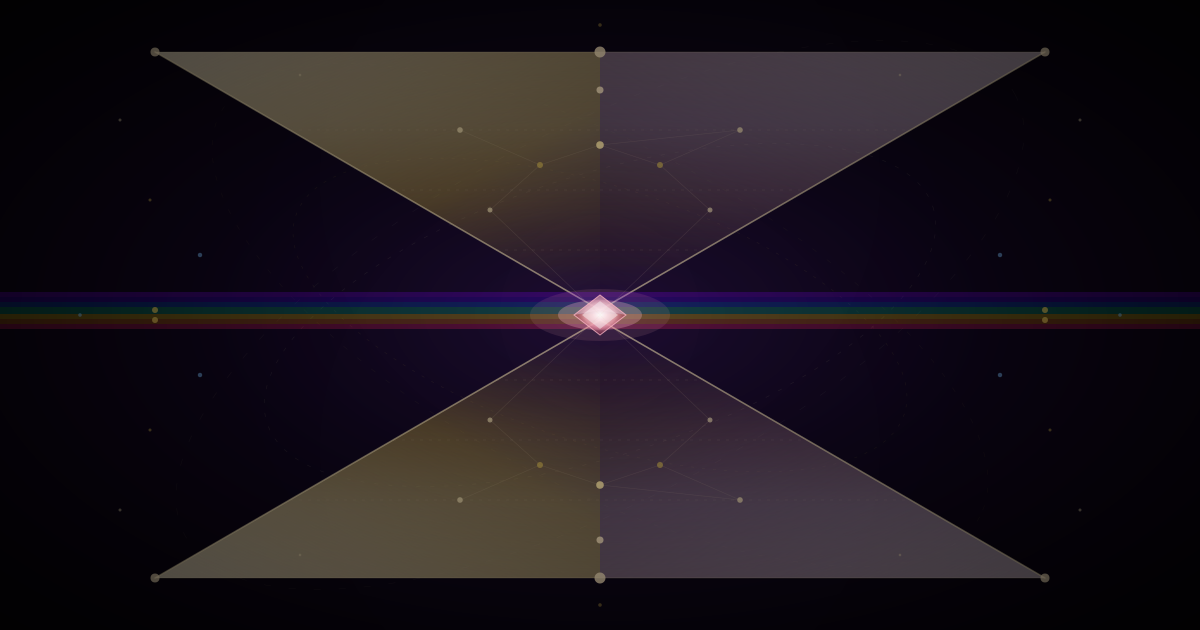
The Maslow Hourglass of Being describes human development not as a ladder to be climbed but as a living hourglass: seven dimensions of need and flourishing, flowing in two directions through a heart-shaped pivot of Purpose. IMP is the operational code that hourglass runs.
Intention determines which dimension of the Hourglass activates in any given moment: am I attending to Safety, Belonging, Esteem, Meaning, Love, Wisdom, or Peace? The direction of the attention-arrow places us somewhere in the architecture. Motivation determines the direction of flow within that dimension: is this the ascending expression (growth-oriented, other-connecting, life-affirming) or the descending one (fear-based, contracting, self-protective)? Purpose determines the direction of the outer field: is the energy radiating outward — giving, opening, offering — or contracting inward, taking, closing?
Together, IMP is not a supplement to the Hourglass framework but its engine. Change the IMP pattern, and everything changes: which dimension activates, which direction the energy flows, whether the outer field opens or closes. A person can be physically in the same room, at the same desk, having the same conversation — and inhabit completely different positions in the Hourglass depending on the IMP pattern running at that moment.
The four questions of the Maslow Compass — Current, Ground, Turn Toward, Let Fall — are designed precisely to surface the unconscious IMP pattern and bring it into the light of awareness. "Current" asks: what IMP pattern is running right now? "Ground" asks: what habitual IMP baseline do I return to under pressure? "Turn Toward" asks: what shift in intention, motivation quality, or purpose-direction would open upward flow? "Let Fall" asks: what shadow IMP pattern — avoidance intention, fear motivation, ego-purpose — is ready to be released?
The shift from unconscious to conscious IMP is itself a form of awakening — not a dramatic conversion but a quiet revolution in the quality of everyday life. It is a practice rather than a state: it requires continuous revisiting, because unconscious patterns continuously reassert themselves, especially under stress and fatigue. The practice is not to achieve perfect IMP and maintain it. It is to notice, gently and without self-punishment, when IMP has drifted from love toward fear, from service toward self-protection, from genuine purpose toward performed purpose — and to return.
The waist of the Hourglass — the heart pivot of Purpose — is where IMP is most decisive. A person stuck at the waist is typically caught in an IMP bind: the intention is oriented correctly but the motivation is fear-based, or the motivation is healthy but the purpose is ego-oriented. The Compass helps locate the specific bind; IMP practice helps dissolve it. The movement from the lower Hourglass into the upper requires exactly the kind of IMP shift that cannot be forced — it can only be invited, through honest inquiry, genuine willingness, and the support of a community that models the same movement.
Where do you notice the IMP bind in your own life? The place where the intention feels right but the motivation underneath is fear? Or the place where the motivation is genuine but the purpose keeps circling back to self? You do not need to resolve this. You only need to see it. The seeing is where the shift begins.
IMP Beneath the Technologies of the Heart
IMP has been present, unnamed, in every chapter of this series — the invisible architecture beneath each technology we have examined. Naming it now allows us to see each earlier exploration with new eyes.
The art and science of generosity depends entirely on IMP. True generosity requires pure intention (not transaction) and other-oriented purpose. The gift that expects return is not generosity — it is barter with emotional packaging. IMP is what distinguishes them.
The Golden Rule as fractal law requires a specific motivational act: imagining the other's experience as genuinely mattering. This is empathy as motivation — being moved by the other's situation rather than by our own desire to appear ethical.
Paying it forward is purpose freed from a specific recipient. Giving oriented toward the web of relations rather than the individual exchange — the purest form of purpose-for-the-whole available in everyday practice.
Collaboration geometry depends on shared purpose as its foundation. Without it, what appears to be collaboration is mere coordination — parallel action without motivational coherence. When groups make IMP explicit, coordination transforms into genuine co-creation.
Compassion as inner clarity has its own specific IMP: intention toward the relief of suffering, motivation arising from felt recognition of shared humanity, purpose oriented toward the actual flourishing of the being who suffers.
The oneness recognition is what happens when purpose genuinely expands to include all beings — when the experiential distinction between self-interest and other-interest begins to dissolve. This is not a concept one arrives at through argument. It is what happens when purpose practice deepens enough that the boundary between "my flourishing" and "your flourishing" becomes genuinely transparent.
The toroidal economy is what happens when IMP clarity scales from individual practice to collective structure — economies organized around genuine contribution to flourishing rather than accumulation without limit. The torus is the natural geometry of IMP at scale: energy given outward, returning enriched, circulating through the whole rather than pooling in isolated concentrations. Every economic system reflects the aggregate IMP of its participants. An economy of fear-motivation and ego-purpose contracts. An economy of intrinsic motivation and other-oriented purpose expands. The shift is not utopian aspiration — it is the structural consequence of individual IMP practice, multiplied across communities.
And beneath all of these — beneath generosity and compassion and collaboration and oneness — IMP is the quiet, invisible engine. Not one more thing to practice, but the thing already being practiced, consciously or not, in every moment of every life. The invitation is simply to notice it.
The Morning Question
Here is what it looks like when IMP becomes daily practice — not philosophy but lived texture.
A person wakes. Before the phone is checked, before the email is opened, before the calendar's demands arrive — three minutes. Maybe sitting up in bed, maybe standing at the window with coffee in hand.
One question: What quality do I want to bring to the people I encounter today?
Not a goal. Not an achievement target. Not "what do I want to accomplish?" but "what quality of presence do I want to offer?" The answer might be patience. It might be genuine curiosity. It might be steadiness, warmth, courage, honesty. One quality. Specific. Felt in the body, not just named in the mind.
That is the morning's intention — the arrow set before the bow is drawn.
Then: Why does this matter to me today?
Not a justification. A felt sense. Maybe it matters because yesterday's impatience hurt someone. Maybe it matters because the quality of attention is what the people closest to you actually receive from you, more than any outcome you produce. The motivation check. Is the answer love, or is it guilt? Both are valid starting points. But knowing which one is running changes the quality of the day.
Then: Who might benefit from this quality today?
Not the whole world. Not an abstract "humanity." The person you will sit across from at lunch. The colleague who seems to be struggling. The child who watches how you move through difficulty. Specific, actual, present. Purpose anchored in the real.
Three questions. Three minutes. And then the day begins — not uninstructed, not running on default, but oriented. The archer has set the aim. The quality of the draw is known. The target is in sight.
This is what IMP practice looks like at its simplest. And if you do this tomorrow morning, the day will be different from one that begins with the phone.
Three questions at dawn — What am I seeking? Why does this matter? Who is this for? — each a threshold before the day's first step.
Practical Application
The three questions at the heart of IMP practice are ancient. They can take three minutes to ask, or three years to fully inhabit. We offer them not as a protocol to execute but as companions to live with — questions that, returned to regularly and honestly, gradually change the texture of a life.
The Three Reflective Questions
What am I actually seeking here?
This is the intention audit. Not the stated goal, but the actual reaching. Beneath "I want to finish this project," what is the reaching toward — recognition, relief from anxiety, genuine contribution, proof of capability? The practice is simple: name the stated intention, then ask "and beneath that?" Repeat three times. The answer to the third iteration is usually the one worth working with — and it is usually more uncomfortable, and more honest, than the first. Shadow intentions require no condemnation. They require only awareness.
Why does this actually matter to me?
This is the motivation audit. Beneath the obvious answer — it matters because it is my job, my relationship, my responsibility — what is the emotional engine? Is it love, curiosity, fear, resentment, desire for approval, genuine care? The SDT continuum is useful here as a map: where on the spectrum from pure extrinsic to pure intrinsic does this particular "why" land? Can it be moved one step — not all the way, just one step — toward integration? The audit is not about manufacturing intrinsic motivation; it is about honest recognition of what is actually moving us, without judgment. Recognition alone begins to shift the motivational center of gravity.
Who is this truly for?
This is the purpose audit, and it is the most uncomfortable question of the three. Many actions we believe to be oriented toward others are, on honest examination, substantially oriented toward ourselves — toward how we will feel having done them, toward how we will appear to others or ourselves. This is not cause for shame. It is information. Where on the purpose spectrum does this action land — self, close others, community, something larger? Even a small, honest expansion of purpose — from "this is for me" to "this might also serve the person I am giving it to" — changes the quality of the action measurably.
Micro-Practices
The morning intention (three minutes, before the day's agenda arrives): not a goal-setting exercise but a felt orientation. "What quality do I want to bring to the people I encounter today?" is often more generative than "what do I want to accomplish?" Let the answer be specific, relational, humble. One quality, honestly held, is more powerful than a list of objectives.
The pre-conversation breath: before entering any difficult conversation, one breath and one question — "Am I entering this from love or from fear?" Love-based entering is characterized by curiosity, genuine interest in the other's experience, willingness to be changed by what is heard. Fear-based entering is characterized by self-protection, the need to win, the need to be right, or the need to avoid discomfort. No judgment on the answer — the recognition itself shifts the motivation field more reliably than any forced attempt to feel differently.
The purpose reminder before creative work: before beginning any significant creative or contributory act — writing, teaching, building, caring — one question: "Who might this serve?" Not in a grandiose way. Even "this might give one person a moment of recognition" is a purpose anchor. The reminder moves the center of motivational gravity from self-reference toward contribution, and the work that emerges from that shift is reliably different from work done entirely for the self.
The pause practice: before sending the email written in anger, opening the application out of boredom, making the reactive comment, avoiding the conversation from fear — one breath, and three seconds of IMP awareness. Not feasible for every moment. Entirely feasible for the high-stakes moments, which are the ones that matter most.
IMP Journaling
In the morning (five minutes): What am I reaching toward today, and why does it genuinely matter? What quality of motivation do I want to bring to the most difficult thing on today's horizon? Who, specifically, might benefit from my best effort today?
In the evening (five minutes): Did my actions today align with my stated intention? If not, what was the actual intention running the show? What motivated me most today — love or fear, contribution or self-protection? Who benefited from my presence today, and was that orientation genuine?
Once a week (fifteen minutes): What pattern do I notice in my motivations? What is my default motivational quality under stress? Is there a purpose that called to me this week — something larger than my immediate concerns that wanted my participation? What IMP distortion showed up most reliably, and what would I like to invite differently?
IMP in Relationships
In any relationship, the difference between a gift and a loan is entirely an IMP difference. Genuine giving — motivated by love, with purpose oriented toward the other's actual flourishing — carries a quality that both the giver and the recipient can feel. Transactional giving — motivated by the expectation of return, with purpose substantially oriented toward how the giver will feel or appear — carries a different quality entirely. The behaviors can be outwardly identical. The relationship between people is not.
Listening is perhaps the most IMP-sensitive act available to human beings. Two people can display identical outward listening behavior — the nodding, the eye contact, the verbal acknowledgments — while inhabiting completely different inner orientations. One is listening from genuine curiosity, attending to the other's experience as its own end. The other is waiting to respond, processing what is being said primarily in terms of its implications for their own narrative. The person being listened to almost always knows the difference, even without being able to articulate why. The difference is IMP.
The AI mirror explores a modern version of this recognition — the way artificial intelligence reflects our own patterns back to us, and what that reflection reveals about the IMP patterns running beneath our engagement with technology itself.
Think of the best listener you know. The person who makes you feel genuinely heard. Now notice: what you're responding to is not their technique. It is their IMP — the quality of intention, motivation, and purpose with which they attend to you. That quality cannot be faked. It can only be cultivated.
The Arrow Released
The archer is still. The string is empty. The hand is open.
Somewhere, unseen, the arrow is in flight. And what its flight reveals — to anyone who knows how to read it — is not the arrow's quality but the archer's. The precision of the aim. The evenness of the draw. The steadiness of the hand in the moment between intention and release.
The three questions have already done their work. Before the action began, the inner architecture was already in place: the intention reaching toward something real, the motivation drawn from something deeper than fear, the purpose oriented toward something larger than the self. None of it was visible. All of it was consequential. The arrow was shaped before the string was drawn. The flight was shaped before the release. The life is shaped in the invisible moments of inner orientation that precede the living of it.
This is not a romantic idea. It is the converging finding of every contemplative tradition and every serious branch of motivational science: the quality of what we do is determined, more than anything else, by the quality of what we are reaching from. The same action, inhabited by different IMP patterns, is literally a different action. Not in its outward form — but in its effect on the world, and in what it costs or replenishes in the person doing it.
The three questions — What am I seeking? Why does this matter to me? Who is this for? — are not problems to solve. They are thresholds to inhabit, again and again, with each new situation, each new door, each new breath before speaking. They do not have final answers. They have living ones, answers that shift as we shift, that deepen as we deepen, that become more honest as we become more willing to be honest.
The practice is never complete. It is always beginning. The arrow has just left the string. And already, somewhere inside the quality of this moment's attention, the next one is being aimed.
Before you act — pause. Before you speak — pause. Before you decide — pause.
Ask only three questions: What am I intending? Why does this matter to me? Who is this for?
You do not need to have all the answers. You only need to be honest with the question.
That honesty is the beginning of everything.
Invitation
Before you act, pause. Not to hesitate — to feel the architecture beneath the impulse. What do you intend? What draws the string? And where — if you are honest, truly honest — is the arrow pointed?
Most of your life has been spent in motion without this pause. That is not a failure. It is how the bow learns its own strength.
But now you know the three forces. Now the scattered light has a lens. What you do next will not be louder than before. It will be truer.
People Also Ask
What is the difference between intention, motivation, and purpose?
Intention is the immediate direction of your energy in a given moment — what you are reaching toward, the aim of attention and action before the act begins. Motivation is the emotional engine behind that reaching — the quality of force that draws the bow, the why beneath the what. Purpose is the orientation of the entire endeavor toward self or toward others — the "for whom" that gives the action its ultimate meaning. Together, these three form an inner architecture that determines not just what we do, but the entire quality of the inner life we inhabit while doing it. The archer metaphor captures it: intention is the arrow (direction), motivation is the bow (force and quality), purpose is the target (orientation). They are not three separate practices to optimize but a unified inner technology that is already running in every moment.
How does Self-Determination Theory explain intrinsic versus extrinsic motivation?
Edward Deci and Richard Ryan describe motivation as a continuum from purely external (acting for reward or to avoid punishment) to fully internal (acting for the inherent satisfaction of the activity itself). Between these poles lie intermediate forms: introjected motivation (acting from internalized "should"), identified motivation (acting because the outcome is genuinely valued), and integrated motivation (acting because the activity expresses who you are). Decades of research consistently show that as motivation moves from extrinsic toward intrinsic, wellbeing, creativity, persistence, and psychological health all improve — regardless of the domain or the culture. The three basic psychological needs — autonomy, competence, and relatedness — are the conditions under which intrinsic motivation naturally emerges.
What did Viktor Frankl mean by the will to meaning?
Frankl argued that the primary human drive is not pleasure, as Freud proposed, nor power, as Adler proposed, but meaning — the need to find significance and direction in one's existence. He developed this view partly through direct observation in Auschwitz, where he found that survivors were often not the physically strongest but those who maintained a sense of meaning — a reason to endure. The will to meaning is not a wish for pleasant experience but an orientation toward something that transcends the immediate self: a task to complete, a person to love, a truth to serve. Frankl identified three irreducible sources of meaning: creative values (what we give to the world), experiential values (what we receive from life through beauty and love), and attitudinal values (the stance we take toward unavoidable suffering). The third is the most radical — even in suffering that cannot be eliminated, a meaning-orientation is possible.
How do I discover my purpose rather than invent it?
Frankl's key insight is that purpose cannot be manufactured — it must be discovered in the encounter with what is actually needed and what you are specifically equipped to give. Rather than asking "what should my purpose be?" — a question the ego is very happy to answer in self-flattering ways — the more productive question is "what does this situation call for that I am positioned to offer?" Purpose is found at the intersection of what genuinely moves you toward care, what the community or the world actually needs, and what your specific capacity allows you to contribute. Practices that help: attending quietly to what moves you without being prompted by reward; noticing what you find yourself doing when no audience is watching; listening for what makes you feel simultaneously most alive and most useful. The fractal life table offers one map for this discovery.
What is a sankalpa and how does it differ from a regular intention?
A sankalpa is a deep heartfelt resolve planted at the level of the unconscious mind — typically in the hypnagogic state of yoga nidra, between waking and sleep, where the will can most directly access subconscious patterns. Unlike a regular intention set by the thinking mind, a sankalpa is a seed planted in the deeper self — something already true at the level of one's fundamental nature, being called into fuller expression rather than invented from scratch. The traditional orientation is not "I will become X" but "I am already X — and I am removing what obscures this." The sankalpa is not manufactured; it is remembered.
How does IMP connect to the Maslow Compass?
The Maslow Compass is a four-point diagnostic tool — Current, Ground, Turn Toward, Let Fall — that maps a person's position in the Hourglass of Being. IMP is the inner engine that the Compass reads. "Current" surfaces the dominant IMP pattern operating right now. "Ground" maps the habitual IMP baseline. "Turn Toward" names the IMP reorientation that would open upward flow. "Let Fall" identifies the shadow IMP pattern — avoidance intention, fear motivation, ego-purpose — obstructing movement. Together, the Compass and IMP form an integrated practice: the Compass locates; the IMP work moves.
Can IMP be changed, or is it fixed by personality and history?
IMP is not fixed. It is a pattern that can shift — and does shift — across the lifespan through both conscious practice and through significant experiences of love, loss, and community. What feels like "personality" (being naturally fear-motivated, or naturally other-oriented) is often a stable IMP pattern formed through early experience and reinforced by unconscious habit. These patterns can be interrupted and gradually redirected through the practices described in this article — not through a single decision but through repeated, gentle return to awareness over time. Research in neuroplasticity confirms that the neural circuits underlying motivational patterns remain genuinely changeable across the lifespan, given the right conditions: honest self-examination, patient practice, and — perhaps most critically — a community context that models and supports the IMP shift.
How does IMP relate to everyday decisions, not just big life questions?
IMP operates at every scale. The quality of attention you bring to a single conversation is shaped by IMP. The way you respond to an email written in frustration is shaped by IMP. Whether you reach for the phone out of genuine curiosity or out of avoidance of what is actually in front of you — that is an IMP moment. The micro-practices described in this article (the morning intention, the pre-conversation breath, the pause practice) are designed specifically for the everyday scale. The extraordinary value of IMP is precisely that it applies to the ordinary: the small moments that, accumulated across a lifetime, determine the quality of the whole.
References
- Deci, E.L., & Ryan, R.M. (2000). The "what" and "why" of goal pursuits: Human needs and the self-determination of behavior. Psychological Inquiry, 11(4), 227–268. Available at: selfdeterminationtheory.org
- Frankl, V.E. (1959). Man's Search for Meaning. Beacon Press. — The foundational text of logotherapy and the will to meaning.
- Elliot, A.J. (1999). Approach and avoidance motivation and achievement goals. Educational Psychologist, 34(3), 169–189.
- McAdams, D.P. (2006). The Redemptive Self: Stories Americans Live By. Oxford University Press. — Narrative identity and how the stories we tell shape our lives.
- Park, C.L. & Folkman, S. (1997). Meaning in the context of stress and coping. Review of General Psychology, 1(2), 115–144.
- Berridge, K.C. (1998). Pleasure, pain, desire, and dread: Hidden core processes of emotion. Well-Being: Foundations of Hedonic Psychology, 525–557.
- Duckworth, A. (2016). Grit: The Power of Passion and Perseverance. Scribner.
- Greater Good Science Center, UC Berkeley. The Science of Meaningful Life. Available at: greatergood.berkeley.edu
Related explorations: The Maslow Hourglass of Being | The Generosity Standard | Compassion as Inner Clarity | The Gaia Mind Network | Karma and Attention