In November of 2018, a person sat on a couch in a Charlotte apartment and checked his bank balance. Two hundred and forty-one dollars.
He did not panic. Panic requires a certain surplus of energy, and what he felt instead was something quieter and more clarifying — the sudden, unmistakable transparency of a wall he had never noticed before. Two hundred and forty-one dollars is not a crisis for a person with a trust fund. It is not a crisis for a person who knows the check arrives Friday and the rent is paid through January. But for a person sitting on a secondhand couch in a small apartment, with no safety net and no backup plan and no inheritance waiting in a drawer, two hundred and forty-one dollars is the amount at which something becomes visible.
What became visible was this: the entire world he lived in — the economy, the job market, the rent structure, the cost of groceries, the price of gas, the invisible calculus by which the hours of his life had been converted into a number in a database on a screen — was not natural. It was not inevitable. It was not the way things had to be. It was a system. It was a machine. And the machine was not built for him.
He had known this intellectually before. Everyone knows it intellectually. But there is a difference between knowing and seeing — the same difference as between understanding that a window is made of glass and actually walking into it. Two hundred and forty-one dollars was the glass. And when he hit it, the whole architecture of assumptions behind it — work hard and you will be fine, the market rewards value, opportunity is available to those who seek it — became momentarily, brutally transparent.
This is what it means to see the material veil. Not to theorize about it. Not to read about it. To see it — the way you see a pane of glass only after you have smashed your face against it.
Most people never get that clear a look. The veil works precisely because it stays invisible. It disguises itself as common sense, as the natural order, as the way things are. It tells you that the economy is like the weather — complex, unpredictable, but fundamentally beyond anyone's authorship. It tells you that the relationship between your time and your money is a fair exchange, negotiated between free agents. It tells you that if you are not thriving, the problem is probably you.
Two hundred and forty-one dollars says otherwise.
Key Takeaways
- The material veil is not the economy itself — it is the belief that extraction is the only economy possible, an assumption so thoroughly normalized it reads as nature.
- The phrase "time is money," crystallized as common sense by Benjamin Franklin in 1748, installs a substitution that converts lived experience — grief, friendship, rest, prayer — into an economic calculation.
- The gig economy presents precarity as autonomy, offloading risk onto workers while concentrating profit at the platform layer.
- Surveillance capitalism, as documented by Shoshana Zuboff, harvests human attention and behavioral data at industrial scale, converting consciousness itself into a commodity sold to advertisers and political actors.
- Predatory finance systematically targets those with the fewest alternatives, converting future labor into present profit through instruments designed to keep borrowers in perpetual obligation.
- The commons — land, water, knowledge, care networks — were enclosed through specific historical acts, not natural evolution, and those acts can be named, dated, and, in principle, reversed.
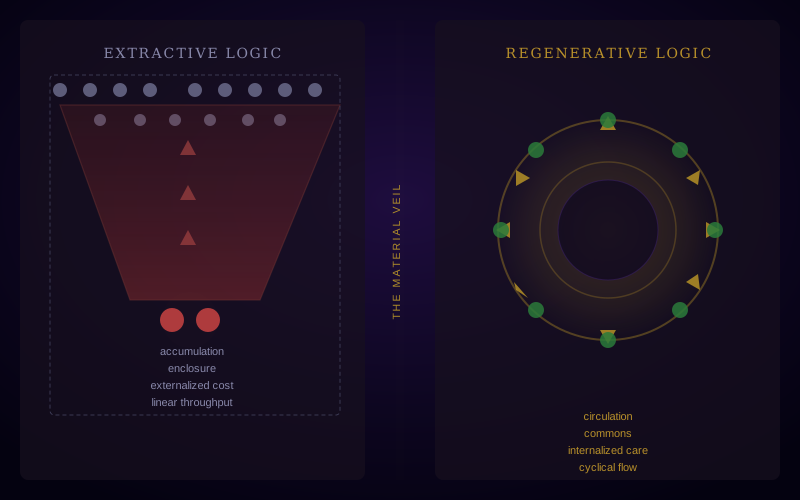
Two operating logics. One is presented as the only option. The other has been functioning, in various forms, for as long as humans have been sharing food.
Time Is Money (And That Is the Problem)
In 1748, a twenty-two-year-old printer in Philadelphia published an essay called Advice to a Young Tradesman, and in it he placed a sentence that would quietly reprogram Western civilization:
"Remember that time is money."
Benjamin Franklin did not invent the idea. But he crystallized it. He gave it the moral authority of common sense — and common sense, as Antonio Gramsci would later observe, is how hegemony disguises itself as nature. Franklin's sentence landed in the culture like a line of code inserted into an operating system. It ran in the background. It became invisible. And it converted every domain of human experience into a calculation.
If time is money, then every hour not spent earning is an hour wasted. If time is money, then sleep is a cost. Friendship is a cost. Sitting on a porch watching the light change is a cost. Playing with your children is a cost — unless it can be categorized as "quality time," which is the economy's way of permitting what it cannot yet monetize. If time is money, then the question a person asks at the end of their day is not was I alive today? but was I productive?
Jose Arguelles, in his remarkable and underappreciated work Time and the Technosphere (2002), traced this deeper than Franklin. Arguelles argued that the Gregorian calendar itself — irregular, asymmetric, divorced from any natural cycle — was a technology of control. It replaced circular time (the kind that flows with seasons, moons, and bodies) with linear time (the kind that flows toward deadlines, fiscal quarters, and retirement accounts). And linear time, Arguelles wrote, is the infrastructure of extraction. It turns moments into units. It turns life into throughput. It makes the human being legible as a labor input and illegible as a living presence.
This is not metaphor. The phrase "time is money" does not describe a similarity. It installs a substitution. Wherever time appears in your life — in your morning, your commute, your weekend, your grief, your lovemaking, your prayer — the operating system runs the conversion: what is this worth? What is the opportunity cost of this moment? Could this hour be more efficiently allocated?
The philosopher Erich Fromm, writing in To Have or to Be? (1976), identified this as the core mechanism of what he called the "having mode" — the orientation in which a person relates to the world primarily through ownership, control, and accumulation. The having mode does not merely acquire things. It acquires experiences, relationships, identities. In the having mode, love is something you "have" or "don't have." Knowledge is something you "possess." Even spiritual practice can become something to "get" — a commodity, an optimization strategy, a line item on the self-improvement spreadsheet.
The alternative — what Fromm called the "being mode" — is the orientation in which a person relates to the world through presence, aliveness, and participation. In the being mode, the question is not what do I have? but what am I experiencing? Not what is this worth? but what is this? The being mode is the natural state of a child who has not yet been taught that time is money. It is the state the cycle of harm contracts away from, and the state that generosity spontaneously expresses.
"Time is money" is the material veil's source code. It is the instruction that converts lived experience into economic input. And it runs so deep that questioning it feels less like intellectual inquiry and more like heresy.
But notice what happens when the code is removed. When you sit with a dying friend, and the thought "I should be doing something productive" does not arise. When you hold a sleeping infant, and the hours pass without measurement. When you are so absorbed in making something — a meal, a garden, a piece of music — that the clock becomes irrelevant. In those moments, the operating system crashes, and something older takes its place: the experience of time as alive, as the medium in which life happens rather than the currency in which life is spent.
Arguelles called this "time is art." It is not a slogan. It is a different operating system — one that the Fractal Life Table places in Column 5, the column of creative resonance, where moments are not consumed but composed. The material veil is, among other things, the belief that "time is money" is the only operating system available — that "time is art" is a luxury for people who can afford not to work. The veil hides the fact that "time is money" is itself an invention, barely three centuries old, and that for the vast majority of human history, time was something you moved through like water, not something you sold by the hour.
Two operating systems for time. One depletes. The other composes. The material veil is the belief that only the first one exists.
All that glitters is not gold.
— English proverb (Chaucer, c. 1390)
The Cancer Ward
Imagine a hospital with two wings.
In the first wing, doctors are treating patients with cancer — actual, biological cancer. Cells that have lost their regulatory signals. Cells that grow without reference to the body's needs, commandeering blood supply and metabolic resources, expanding relentlessly because their growth program has been disconnected from the feedback loops that would normally say enough. The patients in this wing are frightened. The doctors are doing everything they can. And the first thing any oncologist will tell you is that cancer is not evil. It is a system that has lost its capacity for self-regulation. The cells are not malicious. They are confused — following a growth program that was once functional but has become disconnected from the signals that would tell it to stop.
In the second wing — and this is where the metaphor earns its place — the doctors are treating a different kind of pathology. In this wing, the subject is not a body but an economy. And the diagnosis is identical: a system that grows without reference to the needs of its host. That commandeers resources — labor, attention, ecological capital, care — and converts them into a single output: more growth. That has lost its regulatory signals. That interprets all feedback (the planet is warming, the workers are exhausted, the aquifers are dry) not as information to be integrated but as friction to be overcome.
Charles Eisenstein, in Sacred Economics (2011), named this with diagnostic precision: financial cancer. Not as polemic. As pathology. The modern financial system, Eisenstein argued, is structurally identical to a malignant tumor. It requires exponential growth to sustain itself. It externalizes its costs onto the host. It converts living tissue — community, ecology, trust, care — into fuel for its own expansion. And it experiences its own growth as vitality, even as the host weakens.
The metaphor is not casual. It is structural. Cancer cells are not a different species from healthy cells. They are healthy cells in which the growth-regulation mechanism has failed. Similarly, an extractive economy is not made of different people than a regenerative economy. It is made of the same people — the same creativity, the same desire for security, the same impulse to build — operating within a system whose regulatory signals have been overridden.
The question that matters is not are the cells evil? The question is: what happened to the feedback loop?
In the body, the feedback loop that regulates growth is called apoptosis — programmed cell death, the mechanism by which a cell that has outlived its function or begun to replicate dangerously voluntarily stops. It is the cell's capacity to say enough. Cancer is what happens when apoptosis fails.
In an economy, the feedback loops that should regulate growth are the commons: the shared resources, norms, and institutions that say this belongs to everyone and you cannot take more than the system can replenish. The commons are the economy's apoptosis. And the material veil — the belief that extraction is natural, that growth is always good, that the market will self-correct — is the mechanism by which apoptosis is disabled.
Kate Raworth, in Doughnut Economics (2017), drew the picture that makes this visible. The doughnut is a diagram with two boundaries: an inner ring (below which people fall into deprivation — of food, health, education, political voice) and an outer ring (beyond which the economy overshoots planetary boundaries — climate change, ocean acidification, biodiversity loss). The safe and just space for humanity is the doughnut itself: the zone between enough and too much.
The extractive economy does not aim for the doughnut. It does not even see the doughnut. It sees only one direction: more. And "more" — decoupled from the question more of what? for whom? at what cost? — is the operational definition of cancer.
This is not a call to destroy the economy. A doctor does not destroy the patient. The doctor restores the feedback loops that the disease has disabled. Raworth's work — like Eisenstein's, like the toroidal economy described later in this series — is an attempt to restore the feedback. To re-enable apoptosis. To let the system hear, again, the signals it has been designed to ignore.
The Delivery Driver's Math
It is 11:14 PM on a Tuesday, and a man is sitting in his car outside a Wendy's in Raleigh, staring at his phone.
The app says: $6.75. Five miles. The customer ordered a Baconator combo and a Frosty. The man — he is twenty-nine, he has a degree in communications he is still paying for, and his name does not matter because this story belongs to roughly four million Americans — is doing math.
Gas: 2.20. Depreciation on his car: the IRS says 0.04 per mile, but he has not done that calculation because he cannot afford the answer. Time: it will take twenty-two minutes, and in those twenty-two minutes he will not be available for another order.
2.20 in gas equals 12.30.
The minimum wage in North Carolina is 6.75 vanishes. If the algorithm decides to throttle his orders because he declined too many low-paying deliveries — and the algorithm does decide this, though the company will never say so in those words — then next Tuesday will be worse.
The math never works. It is not supposed to work. That is the design.
Guy Standing, in The Precariat: The New Dangerous Class (2011), described this with the clarity of someone who saw it forming: a new global class of workers defined not by what they lack (wages — they have wages, technically) but by what they lack structurally: security. Security of employment, of income, of representation, of skill development, of time. The precariat earns money. It does not build stability. It is kept permanently on the edge — not quite destitute enough to revolt, not quite secure enough to plan. Standing called it a class "in the making," and the gig economy is the factory that makes it.
Shoshana Zuboff, in The Age of Surveillance Capitalism (2019), showed the mechanism from the other side. The gig platforms do not merely connect workers to customers. They generate behavioral surplus — data about every movement, every decision, every hesitation, every acceptance and rejection — and that data is the actual product. The delivery driver thinks he is selling his labor. He is selling his labor and his behavioral data and his willingness to accept terms that no collective bargaining process would ever ratify. The platform extracts from three directions simultaneously, and the language of "independence" and "flexibility" is the veil that makes the extraction feel like freedom.
This is the material veil at street level. Not as theory. As an eleven-o'clock calculation in a Wendy's parking lot. The driver knows, at some level, that the math does not work. He can feel it in his body — the tension in his shoulders, the low hum of anxiety about the transmission, the fatigue that is no longer just physical but existential. He is not lazy. He is not making poor decisions. He is doing exactly what the system incentivizes him to do, and the system is designed to extract more value from his effort than it returns.
The cycle of harm described how pain-with-no-exit produces harmful behavior. The gig economy is pain-with-no-exit as a business model. Not because the founders are villains — most of them probably believe their own pitch about democratizing work. But because the operating logic — extract maximum value, externalize maximum cost, maintain maximum optionality for the platform while minimizing it for the worker — is the logic of extraction. And extraction, at scale, produces the same contraction, the same narrowing, the same survival-mode compression that Hurt People, Hurt People traced at the individual level.
The delivery driver does not have the bandwidth for generosity. Not because he is selfish — you didn't start this, and neither did he. Because the system has consumed the surplus that generosity requires. Generosity needs slack — a margin of time, energy, attention that exceeds immediate survival needs. The gig economy is precision-engineered to eliminate slack. Every idle moment is a missed order. Every rest is an opportunity cost. The operating system says: time is money, and you cannot afford to waste either.
The Scroll
You open your phone.
You were looking for the time. Or the weather. Or a text from someone you care about. It does not matter. What matters is that between the moment you unlocked the screen and the moment you next looked up, twenty-three minutes passed. And in those twenty-three minutes, the following things happened:
You saw four advertisements. You did not experience them as advertisements because they were embedded in content — a friend's post about a vacation, a recipe video, a news article with a provocative headline. The ads were precision-targeted, selected by an algorithm that knows your purchasing history, your browsing patterns, your approximate income, and — based on engagement data from people demographically similar to you — your current emotional vulnerabilities.
You received two micro-doses of outrage. One was political, the other was cultural, and both were engineered to provoke engagement because outrage generates more clicks, shares, and comments than any other emotional state. The research is unambiguous: Brady et al. (2017) found that each moral-emotional word in a social media post increased its diffusion by 20 percent. The platforms know this. Their algorithms are tuned for it.
Seventeen data points were generated about you during those twenty-three minutes. Your scroll speed (which indicates attention level), your pause duration on specific content (which indicates interest), your tap patterns, your time of day, your location. These data points were bundled with billions of others and fed into machine learning models that predict, with increasing precision, what you will do next — what you will buy, what you will watch, what you will fear, what you will desire.
You still do not know what time it is.
Tim Wu, in The Attention Merchants (2016), traced this economy back to its origin: the moment, in the early twentieth century, when someone realized that human attention could be harvested, packaged, and sold. The first attention merchants were newspapers that discovered advertising revenue. Then radio. Then television. Then the internet. Each generation refined the extraction. Each generation found a way to capture attention more efficiently, hold it longer, and sell it at a higher price.
But the current generation — the one you just participated in, during those twenty-three minutes — represents a qualitative break from everything that came before. Wu, Zuboff, and Jaron Lanier (in Ten Arguments for Deleting Your Social Media Accounts Right Now, 2018) all converge on the same point: the attention economy is no longer a market for attention. It is an extraction system for behavioral data that uses attention as the entry point.
Cathy O'Neil, in Weapons of Math Destruction (2016), showed what happens downstream. The algorithms that process your behavioral data do not merely predict your behavior. They shape it. They create feedback loops: you see content that matches your predicted preferences, which narrows your exposure, which confirms the model, which narrows your exposure further. O'Neil called these "weapons of math destruction" because they systematically disadvantage the people they target — reinforcing inequality, amplifying bias, and converting human complexity into a manipulable data profile.
This is not a conspiracy. It is a business model. And the business model works because it operates behind the material veil — behind the assumption that what you are doing when you scroll is "choosing" content, "consuming" media, "staying informed." The language of choice disguises the mechanism of extraction. You are not choosing. You are being harvested.
The 108 Framework describes eight dimensions of human experience that require attention, care, and presence to flourish. The attention economy does not compete with one of those dimensions. It competes with all of them simultaneously. Every minute of attention captured by the scroll is a minute not available for the inner work that the Spectrum of Compassion describes, the relational care that the Golden Rule depends on, the creative expression that the Fractal Life Table maps in its higher columns. The attention economy is not merely extracting your time. It is extracting your capacity for presence — the very resource that every article in this series argues is the foundation of a fully human life.
Every scroll is a transaction you did not agree to. The product is not the content. The product is you.
Your attention is the raw material. Your behavior is the product. The scroll is the extraction point. You still do not know what time it is.
The Strip Mall at the Edge of Town
Drive to the edge of almost any American city and you will find it: a strip mall with a payday loan office next to a dollar store next to a check-cashing service next to a rent-to-own furniture outlet. The architecture is deliberate, even if no single architect designed it. These businesses cluster together because they serve the same population — people who have been excluded from the mainstream financial system and must pay a premium for every basic economic transaction.
The payday loan charges an average annual percentage rate of 400 percent. The check-cashing service takes 2 to 5 percent of every paycheck cashed. The rent-to-own store sells a 1,200 over the course of a year. The dollar store sells food at lower nominal prices but higher per-unit costs than the supermarket five miles away — the supermarket that requires a car, gas, time, and the kind of scheduling flexibility that a person working two gig jobs does not have.
David Graeber, in Debt: The First 5,000 Years (2011), showed that this is not new. What is new is the scale and the sophistication. Graeber traced the history of debt from ancient Mesopotamia to the present and found that debt has always been the primary instrument through which the powerful extract labor from the vulnerable. The innovation of the modern financial system is not the invention of debt. It is the invention of debt instruments so complex that the extraction becomes invisible — hidden behind interest rate schedules, compounding formulas, and terms-of-service agreements that no one reads because they were designed not to be read.
The material veil is particularly thick here. The language of finance presents debt as a neutral instrument — a tool, like a hammer, that can be used well or poorly. But a hammer does not come with an algorithm designed to identify the people most likely to miss a payment. A hammer does not charge a 400 percent APR. A hammer does not restructure itself so that the principal never decreases no matter how many payments are made.
Predatory finance is not finance that went wrong. It is finance that is working exactly as designed. The payday loan is not a market failure. It is a market success — for the lender. The student loan that follows a twenty-nine-year-old communications graduate into his Wendy's parking lot at 11 PM is not a system malfunction. It is a system functioning precisely as intended: converting future labor into present profit, and doing so in a way that the borrower experiences as personal responsibility for a structural condition.
This is the mechanism by which the cycle of harm scales. In the previous article, we traced how individual pain contracts the compassion radius to one — how a person in survival mode cannot extend care beyond their own body. Predatory finance manufactures survival mode. It takes a person who might otherwise have the margin to breathe, to plan, to care about their community, to volunteer, to rest — and it compresses their horizon to the next payment. It does to millions of people simultaneously what trauma does to one nervous system: it activates the survival circuits and disables everything else.
Wilkinson and Pickett, in The Spirit Level (2009), demonstrated the downstream effects across 23 wealthy nations: every indicator of social harm — violence, mental illness, addiction, incarceration, teenage pregnancy, low trust — correlates not with how poor a society is, but with how unequal it is. The gap is the disease. And predatory finance widens the gap as a core function, not a side effect.
The strip mall is the material veil made architectural. It is the physical expression of an economy that extracts from those who have the least and returns the profit to those who have the most. And it is surrounded, on all sides, by the language of choice: nobody forced them to take the loan, they could have saved, they should have read the fine print. The language of individual responsibility draped over structural extraction. The veil working exactly as designed.
The Great Forgetting: When Land Became Property
There was a time — and this is not mythologized nostalgia; it is documented economic history — when the basic elements of life were not commodities.
Land was not property. It was the commons — the shared resource from which a community drew its sustenance, governed by rules of use rather than rules of ownership. Water was a right, not a product. Seeds were exchanged freely between farmers, not patented by corporations. Care for the sick and the elderly was embedded in kinship and community structures, not outsourced to a market that prices it at $7,000 per month for a nursing home bed.
Karl Polanyi, in The Great Transformation (1944), wrote the definitive account of how this changed. Polanyi described a "double movement" — the simultaneous creation of a self-regulating market and the social resistance that market provoked. The key insight, which has only become more relevant with time, is that land, labor, and money are what Polanyi called fictitious commodities. They are not produced for sale on a market. Land is the natural environment. Labor is human life activity. Money is a token of exchange. Treating them as commodities — as things produced for sale, subject to supply and demand, disposable when unprofitable — requires the systematic destruction of the social fabric that previously governed their use.
The enclosure movement in England — beginning in earnest in the fifteenth century and accelerating through the eighteenth — is the clearest historical example. Common land that had sustained village life for centuries was fenced, privatized, and consolidated into large estates. The people who had relied on the commons for grazing, foraging, and firewood were displaced. They became, in the language of economics, a "labor supply" — people who, having been stripped of their means of subsistence, had no choice but to sell the only thing they had left: their time.
This is where "time is money" comes from. Not from a philosophical insight. From a historical process. When you have no commons — no land to grow food on, no community to care for you in illness, no shared resource to draw from in crisis — then your labor is all you have. And if your labor is all you have, then your time is, indeed, money. It is the only money you possess. Franklin's aphorism is not wisdom. It is the ideology of enclosure, polished into a proverb.
Elinor Ostrom, who won the Nobel Prize in Economics in 2009, spent her career demonstrating what Polanyi had argued theoretically: that commons can be governed effectively without either privatization or state control. Ostrom studied fisheries, irrigation systems, forests, and grazing lands around the world and found that communities consistently develop sophisticated governance rules for shared resources — rules that are more adaptive, more equitable, and more sustainable than either market or state management. Her work was a direct refutation of the "tragedy of the commons" — Garrett Hardin's influential 1968 argument that shared resources are inevitably overexploited unless privatized.
The tragedy of the commons is the material veil's origin story. It is the narrative that says: humans are inherently selfish, shared resources will always be destroyed, and therefore privatization is not a political choice but a natural necessity. Ostrom's research — decades of empirical fieldwork across dozens of cultures and ecosystems — showed that this story is not just wrong. It is precisely backwards. The commons are not destroyed by sharing. They are destroyed by enclosure — by the removal of the governance systems that communities developed to manage them.
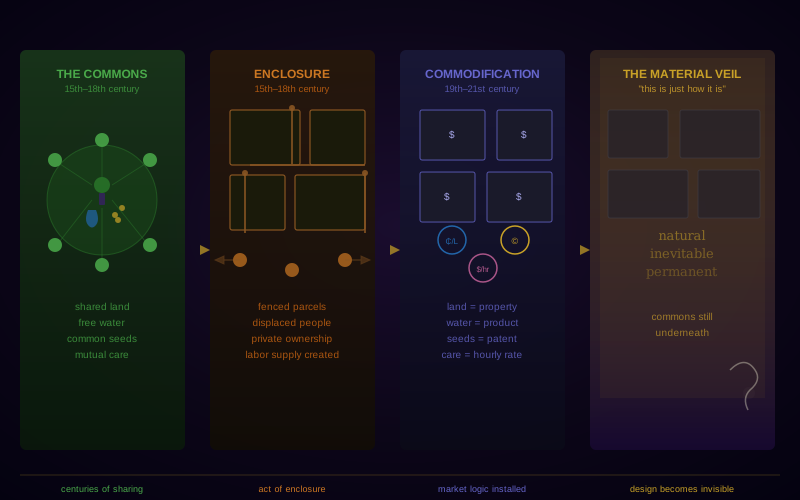
What was shared became enclosed. What was enclosed became commodified. What was commodified became invisible — because the veil makes the current arrangement look like it was always the only option.
Naomi Klein, in The Shock Doctrine (2007), documented how this process accelerated in the twentieth century. Klein showed that moments of crisis — wars, coups, natural disasters, financial collapses — were systematically used to implement rapid privatization of public resources. The pattern was consistent: a society in shock, its normal democratic resistance weakened, and a pre-packaged program of deregulation, privatization, and austerity imposed in the gap between the crisis and the recovery. Klein called it "disaster capitalism," and her evidence — from Chile to Poland to Iraq to post-Katrina New Orleans — was voluminous and damning.
The material veil is thickest during these moments. When a society is in crisis, the extractive logic presents itself as the only rational response: we must cut public spending, we must privatize services, we must let the market allocate resources efficiently. The alternative — that the crisis was produced by the extractive logic in the first place, and that the solution requires the restoration of commons, not their further enclosure — is invisible precisely because the veil makes it invisible.
But the commons persist. They persist in the Wikipedia editor who contributes for free. In the open-source programmer who gives away code. In the community garden, the mutual aid network, the time bank, the tool library, the free clinic, the neighborhood that watches each other's children. In every act of sharing that the market cannot explain and the material veil cannot see.
The Shadow of Column One
The Fractal Life Table maps human experience across seven columns, from the dense materiality of Column 1 (Duality, survival, the physical) through the luminous emptiness of Column 7. Each column has what the table calls a "light expression" and a "shadow expression" — not morally good and bad, but selfless and self-centered applications of the same energy.
Column 1's light expression is survival itself: the fierce, sacred intelligence of a body that knows how to stay alive, the groundedness of a person who can meet the material world on its own terms, the clarity of someone who can look at a bank balance and make a plan. Column 1 light is the generosity chapter's toddler, giving from her own diminishing supply — the aliveness that is possible when material reality is met with open hands.
Column 1's shadow expression is what happens when survival intelligence becomes the only intelligence. When the material plane absorbs all available attention. When the question "is this safe?" becomes the only question, and every relationship, every experience, every moment of beauty is filtered through the calculus of threat and resource. Column 1 shadow is not evil. It is contracted — the same contraction the cycle of harm described at the individual level, now operating as an organizing principle for an entire civilization.
The material veil is Column 1 shadow operating at civilizational scale.
This is what makes the concept structurally precise rather than merely metaphorical. The material veil is not a conspiracy by bad actors. It is not a policy failure that smarter policy could fix. It is an orientation — a mode of relating to reality in which the material dimension absorbs all the oxygen, and the other six columns (unity, creativity, transformation, resonance, illumination, emptiness) become invisible. Not because they do not exist, but because the system's attention is fully consumed by the survival calculation.
This is exactly what the table predicts. When any column dominates without integration, its shadow expression takes over. A Column 1 civilization — one that has organized its entire economy, education system, healthcare system, and measure of human value around material accumulation — will produce, as surely as gravity produces weight, the shadow expressions of Column 1: exploitation, extraction, hoarding, the conversion of all living things into resources, the freezing of flow into commodity.
That last phrase — the freezing of flow into commodity — is the bridge to the next article in this series. Reification is the philosophical name for the process by which living processes are frozen into dead objects. When a river becomes a "water resource." When a forest becomes "timber." When a human being becomes "human capital." When a relationship becomes a "transaction." Reification is the mechanism of the material veil — the operation by which it converts the living world into the inventory of the extractive economy. And when reification operates without any countervailing force — when the freezing goes all the way down — the result is what When Frozen Thinking Turns Cruel will describe: a world in which even consciousness itself is treated as a commodity to be mined.
But that is Reification and When Frozen Thinking Turns Cruel territory. For now, the point is simpler: the material veil is not a surface problem. It is a Column 1 shadow problem. And Column 1 shadow is not addressed by working harder within Column 1. It is addressed by integrating — by bringing the awareness of the other columns (relationship, creativity, transformation, pattern, consciousness, emptiness) back into the conversation. This is what the entire happy path of this series is designed to do: not to escape Column 1, but to place it in the context of the full table, where it can do its sacred work of grounding without becoming the prison it becomes when left alone.
Five dimensions of human life that every person needs and no market can produce — still alive, still functioning, still hidden behind the veil.
Polanyi's Double Movement
Karl Polanyi saw it coming.
Writing in 1944, with the ruins of two world wars still smoking and the architecture of the postwar order not yet built, Polanyi described a pattern that has repeated itself with striking consistency for two hundred years: the expansion of the market into domains of life where it does not belong, followed by the defensive reaction of society attempting to protect itself from the consequences.
He called it the double movement. The first movement is the extension of market logic into land, labor, and money — the creation of the fictitious commodities. The second movement is the spontaneous, often chaotic resistance that this extension provokes: labor unions, environmental regulations, welfare states, social insurance, public health systems, commons governance. The double movement is not a policy debate. It is a survival instinct — society's immune response to the experience of being consumed by its own economy.
The material veil operates by making the first movement invisible — by presenting market expansion as natural, inevitable, and beneficial, so that the second movement (the resistance) appears as interference, inefficiency, or nostalgia. Every argument for deregulation is a first-movement argument disguised as common sense. Every argument for privatization of public services assumes that the market is the default and the commons are the exception. The veil does not prevent resistance — it delegitimizes it in advance.
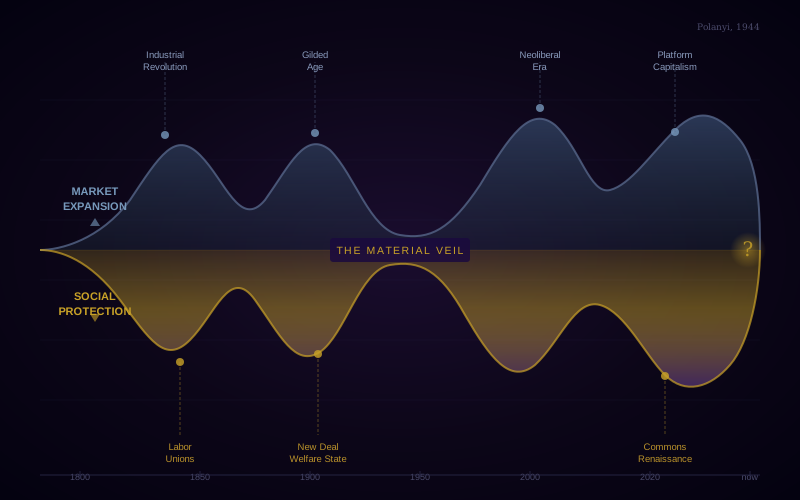
Two centuries of the same pattern: the market expands into life, and life pushes back. The veil is what makes the expansion look natural and the pushback look naive.
But here is what Polanyi saw that many of his readers miss: the double movement is not a battle between progress and reaction. It is a diagnostic signal. When society pushes back against market expansion, it is not resisting progress. It is protecting the conditions that make progress possible — the social bonds, ecological systems, and human capacities that the market requires but cannot produce. A market economy that destroys its own social and ecological base is not progressing. It is cannibalizing.
The material veil hides this self-cannibalization. It presents the conversion of commons into commodities as "development." The depletion of aquifers as "agricultural efficiency." The erosion of community bonds as "individual freedom." The replacement of stable employment with gig work as "the future of work." Each conversion is real and measurable. And each is presented, by the veil, as forward movement rather than what it structurally is: the consumption of the host by the parasite.
This does not mean all markets are parasitic. It means that markets become parasitic when they are decoupled from the social and ecological feedback loops that regulate them — when the apoptosis is disabled, when the commons governance is removed, when the double movement's protective push is delegitimized and defunded. A market embedded in a living community, governed by norms of reciprocity and restrained by ecological limits, is a powerful and beneficial tool. A market that has consumed the community and the ecology that gave it meaning is a cancer.
The toroidal economy describes the alternative architecture in full. What matters here is the diagnostic: the material veil is the belief layer that prevents us from seeing the double movement clearly — that keeps us interpreting market expansion as progress and social protection as interference, when the relationship is often exactly reversed.
What the Veil Hides (And What Lives Behind It)
The material veil does not create a false reality. It creates a partial reality — a reality in which only one layer of existence is visible, and all other layers are dismissed as idealism, sentiment, or irrelevance. The veil is dangerous not because it lies but because it edits. It removes from the picture everything that cannot be priced, and then presents the remaining picture as complete.
What does it edit out?
Care. The unpaid labor that sustains every economy on earth — the childcare, the elder care, the emotional labor, the cooking, the cleaning, the staying-up-all-night-with-a-sick-child — is invisible to GDP. Marilyn Waring, in If Women Counted (1988), documented that if unpaid care work were counted as economic activity, it would represent the largest sector of every national economy on earth. The material veil does not merely undervalue care. It renders it invisible — and then builds economic policy as if it does not exist.
Ecology. The natural systems that produce the oxygen, filter the water, pollinate the crops, and regulate the climate are treated as externalities — costs that are real but fall outside the transaction that produced them. Herman Daly, the father of ecological economics, spent decades arguing that an economy that treats its ecological base as an externality is an economy that has confused the container with the contents. The economy is a subset of the ecology. Not the reverse. The material veil inverts this relationship, presenting the economy as the primary reality and the ecology as a resource pool to be managed for the economy's benefit. Suzanne Simard's research on forest communication networks — the underground fungal web she called the "wood wide web" — revealed that trees share nutrients, send distress signals, and actively support their kin. Forests are not collections of competing individuals. They are communities organized around mutual aid. The material veil cannot see this because its accounting system has no category for it.
Relationship. The social bonds that make collective life possible — trust, reciprocity, solidarity, shared identity, mutual obligation — are what Robert Putnam, in Bowling Alone (2000), called "social capital." And like care and ecology, social capital is invisible to the extractive economy. You cannot buy trust. You cannot outsource solidarity. You cannot download a community. The material veil recognizes only the transactions that occur within relationships. The relationships themselves — the substrate that makes the transactions meaningful — are invisible.
Meaning. The human need for purpose, coherence, and contribution — what Viktor Frankl called "the will to meaning" and what the 108 Framework maps as the eighth dimension of human experience — does not appear in any economic model. The material veil permits "meaning" only insofar as it can be monetized: find your passion and turn it into a business. The possibility that meaning might be an end in itself — that a person might need purpose the way they need food, that the absence of meaning might be as pathological as the absence of nutrition — is invisible behind the veil.
Time. Real time — the kind that flows with the body's rhythms, the seasons' cycles, the unforced pace of genuine creative work and genuine rest — is invisible. The only time the veil recognizes is clock time, billable time, time-as-money. The deep time of healing, the slow time of growing food, the circular time of the liturgical year, the dreamtime of indigenous cosmology — all invisible. All edited out. All replaced by the linear, monetized, depleting time that the first section of this article described.
This is what the material veil hides: not another world, but the rest of this world. The dimensions of existence that the extractive economy cannot capture, cannot price, and therefore cannot see. Care, ecology, relationship, meaning, time — the five things that every human life requires and no market can produce.
And behind the veil, they are still there. The care is still happening — in kitchens, in hospitals, in living rooms where someone is up at 3 AM with a crying infant. The ecology is still functioning — diminished, stressed, but still producing the oxygen and filtering the water. The relationships are still forming — in neighborhoods, in congregations, in the fleeting moments of genuine connection that the attention economy interrupts but cannot eliminate. The meaning is still sought — in art, in service, in contemplation, in the stubborn refusal to believe that the spreadsheet is the whole story. The real time is still flowing — underneath the clock, beneath the schedule, in the body's rhythms that no algorithm can fully override.
The material veil is not a wall. It is a film. And seeing through it — which is what the five veils framework describes in its full architecture — does not require destroying the economy. It requires completing the picture. Adding back what was edited out. Restoring the dimensions that the veil made invisible. And from that restored picture, building economic structures that serve the whole of life rather than only the slice the veil permits.
Buddhist Economics and the Economics of Enough
In 1973, E.F. Schumacher published a book with a title that sounded like a contradiction: Small Is Beautiful: A Study of Economics As If People Mattered. The book was written by a former economic advisor to the British National Coal Board — not a monk, not an activist, but a man who had spent decades inside the machinery of industrial economics and had come to a conclusion that the machinery could not accommodate: that the purpose of an economy is not growth. It is the wellbeing of the people it serves.
Schumacher's chapter on "Buddhist Economics" remains one of the most quietly radical texts in the Western economic canon. In it, he describes an economics organized not around the maximization of output but around the concept of right livelihood — one of the steps on the Buddha's Noble Eightfold Path. Right livelihood means work that does not harm, that contributes to the flourishing of the community, and that provides the worker with the conditions for inner development. In Buddhist economics, Schumacher wrote, the purpose of work is threefold: to give a person a chance to develop their faculties, to enable them to participate in a common task with others, and to produce goods and services needed for a becoming existence.
Notice what is missing: maximization. Buddhist economics does not ask "how can we produce the most?" It asks "how can we produce enough — with the least harm, the most meaning, and the greatest participation?" The question of "enough" is, in the material veil's framework, a heresy. The veil says: there is never enough. Growth must continue. More is always better. Buddhist economics says: enough is a precise quantity, and exceeding it is as harmful as falling short of it.
This is not asceticism. Schumacher was explicit about this. Buddhist economics does not advocate poverty. It advocates sufficiency — the state in which material needs are met, harm is minimized, and the surplus of human energy is available for the pursuits that material accumulation cannot provide: creativity, relationship, contemplation, service, the development of what the Fractal Life Table maps in its higher columns.
The difference between sufficiency and deprivation is crucial. The material veil conflates them — it tells you that any limit on growth is a limit on freedom, that any question about "enough" is an argument for austerity. This conflation is itself a product of the veil. Austerity is enforced deprivation — it takes resources from the bottom and concentrates them at the top while calling it fiscal discipline. Sufficiency is the opposite: it ensures the floor (Raworth's inner ring) while respecting the ceiling (the outer ring). Austerity serves the extractive economy. Sufficiency dissolves the material veil by demonstrating that a good life does not require infinite growth — it requires enough, distributed with care.
Schumacher understood something else that the conventional economic tradition misses entirely: that labor itself is not merely a cost. In extractive economics, labor is something endured — a sacrifice the worker makes in exchange for wages. The goal of the system is to minimize labor (through automation, efficiency, outsourcing) and maximize output. The worker's experience is irrelevant; only their productivity matters. In Buddhist economics, labor is a gift — an opportunity for the worker to develop capacities, to participate in shared purpose, to contribute something to the community's life. The goal of the system is not to eliminate labor but to make it meaningful. A society that succeeds in eliminating most human labor but leaves its people without purpose has not succeeded at all. It has merely relocated the suffering from the body to the soul.
This reorientation maps directly onto the compassion lineage that runs through this series. The extractive economy narrows the question of work to: how much did you produce? Buddhist economics widens it to: who did you become in the process? The first question is a Column 1 question. The second includes all seven columns. And the material veil is, precisely, the belief that only the first question matters.
Kate Raworth's doughnut is the same insight, expressed in ecological rather than Buddhist terms. The inner ring of the doughnut is Schumacher's "enough" — the material floor below which deprivation occurs. The outer ring is Schumacher's "too much" — the ecological ceiling beyond which the system begins to cannibalize itself. Between the two is the safe and just space: the economics of enough.
The toroidal economy that this series describes later is the operational architecture for what Schumacher and Raworth are pointing at: an economy shaped like a torus rather than a pyramid, in which resources circulate rather than accumulate, in which every outflow returns as inflow, in which the health of the whole is the measure of success rather than the wealth of the few.
These are not utopian fantasies. Mondragon, the Basque cooperative network, employs over 80,000 people and has operated on cooperative principles for seventy years. The Kerala Model in India delivered literacy, healthcare, and life expectancy outcomes comparable to wealthy nations at a fraction of the GDP. The solidarity economy movement in Brazil encompasses over a million enterprises. The commons renaissance — from Creative Commons licensing to open-source software to community land trusts — is rebuilding, piece by piece, the shared infrastructure that enclosure dismantled.
The material veil's greatest trick is not convincing you that extraction is natural. It is convincing you that the alternative does not exist. That the choice is between this economy and no economy. That the only people who question the extractive model are naive idealists who have never had to make payroll.
The evidence says otherwise. The evidence says that regenerative economics is not only possible but already functioning — in cooperatives, in commons, in solidarity networks, in indigenous economies that predate and will outlast the extractive system that currently dominates. The evidence says that the delivery driver in the Wendy's parking lot is not trapped by nature. He is trapped by design. And design can be changed.
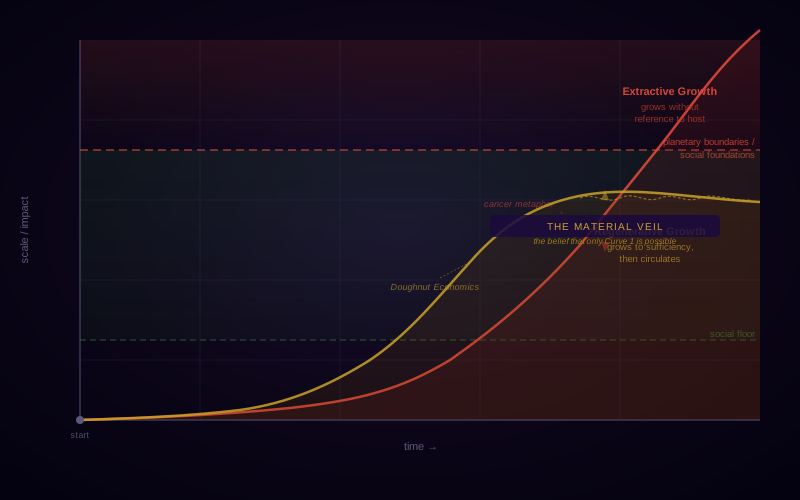
Two kinds of growth. One consumes its host. The other finds sufficiency and circulates. The veil is the belief that only the first kind counts.
The Normalization Machine
The most insidious feature of the material veil is not that it hides the truth. It is that it makes the truth unnecessary.
A veil that actively deceived — that told you the economy was fair when you could see it was not, that told you debt was neutral when you could feel it crushing you — would be relatively easy to penetrate. Deception invites investigation. But normalization does something more effective than deception: it makes the question irrelevant. It does not say "the system is fair." It says "the system is the system" — and the tone in which it says this communicates everything: this is just how things work, everyone knows this, questioning it is naive, alternatives are theoretical, be practical.
Normalization does not require agreement. It requires only acquiescence. You do not need to believe that the gig economy is just. You need only accept that it is normal — that it is the current state of affairs, that it is probably not going to change, that your energy is better spent navigating it than questioning it. You do not need to believe that predatory lending is fair. You need only accept that it is legal, that it is available, that everyone uses it when they have to. You do not need to believe that your attention is being harvested. You need only continue to scroll.
This is what Gramsci called hegemony — the form of power that operates not through force but through consent, not through coercion but through the production of common sense. Hegemony is the mechanism by which the interests of the dominant class become the assumptions of everyone. It does not tell you what to think. It tells you what is thinkable. And the material veil is hegemony's instrument: the layer of shared assumptions that makes extraction feel like gravity — not a force that can be resisted, but a condition that must be endured.
The five radical realizations that this series will eventually reach include the realization that what feels like nature is often architecture. And the sacred joke at the end of the happy path is partly this: that the system that felt so permanent, so total, so inescapable, was always just a story — a very convincing story, but a story nonetheless. The feeling that the current economy is "just the way things are" is not a perception. It is a product — manufactured by centuries of enclosure, reinforced by institutional design, maintained by the attention economy's capacity to consume the cognitive surplus that would otherwise be available for questioning.
Think about how this operates in education. A child enters school and is immediately sorted by performance — grades, test scores, class rank. The sorting feels natural because everyone goes through it. But the sorting is doing something specific: it is teaching the child that their value is measurable, comparative, and conditional. It is installing the operating system before the child has the capacity to question it. By the time the child is old enough to ask "why is my worth determined by a number on a test?" the question feels absurd — because the system has been running for so long that it has become invisible. This is normalization. Not agreement. Not even belief. Just the quiet disappearance of the question.
The same process operates at every level: in workplaces that treat exhaustion as evidence of commitment, in healthcare systems that price-gate access to the body's basic needs, in housing markets that treat shelter as a speculative asset rather than a human right. Each of these arrangements is historically contingent — it was designed, it was implemented, it could be otherwise. But normalization has done its work so thoroughly that questioning any of them sounds, to most ears, like questioning gravity.
But the normalization is not total. It never is. There are cracks.
The crack appears when a delivery driver does the math at 11 PM and realizes it does not add up — not as personal failure, but as structural design. The crack appears when a parent calculates the cost of childcare and realizes that the economy does not have a line item for the most important work they do. The crack appears when a person in debt recognizes that the debt was designed to be unpayable. The crack appears when you check your phone for the time and twenty-three minutes later realize you were harvested.
There is an old teaching — attributed to fish, of all creatures — that goes like this: the fish does not know it is in water. The water is not a thing the fish notices. It is the medium the fish moves through, the substance its gills were built for, the condition that has been present since before the fish could form a thought. To notice water, the fish would have to know what air felt like. It would have to have some reference point outside the medium itself.
The material veil is the water. "Time is money" is the water. The assumption that growth must be infinite, that debt is neutral, that your attention is yours to spend as you choose — these are the water. You do not decide to believe them. They were here before you. They shaped the institutions you grew up inside, the language you use to describe value, the questions that feel worth asking and the ones that feel naive.
The crack in the veil is the moment the fish notices the water. Not because someone explained hydrology. Because something changed — the tank got too small, the oxygen dropped, the wall appeared where open water used to be. And in that moment of noticing, something irreversible happens: the water, which was invisible because it was everywhere, becomes visible. It was always there. Now you can see it.
Each crack is a moment when the veil becomes visible. And in that moment — however brief, however uncomfortable — the question becomes possible: if this is not natural, then what else is possible?
That question is the beginning. Not the answer — the beginning. The answer requires the work that the rest of this series describes: the reification article that names the freezing mechanism, the five veils framework that maps all the layers, the toroidal economy that describes the alternative architecture, the generosity standard that offers a different metric, and the sacred joke at the end of the path that reveals what was true all along.
But the question is where it starts. And the question starts with seeing the veil.
The Cycle of Harm at Civilizational Scale
In the previous article, we traced the cycle of harm at the individual level: pain contracts the compassion radius to one, contraction disables the capacity for care, and the absence of care produces conditions that generate more pain. The cycle runs on pain-with-no-exit — the state in which suffering has accumulated past the person's capacity to process it and no alternative pathway is visible.
The material veil is the mechanism by which this cycle operates at civilizational scale.
Consider the delivery driver again. His pain is not primarily emotional (though it is that too). It is structural — produced by an economic system that extracts his labor, his data, and his future stability in exchange for a per-delivery payment that does not cover his actual costs. His pain-with-no-exit is not a personal failure of imagination. It is a designed condition — the gig economy requires his pain-with-no-exit to function, because a driver with genuine options would not accept $6.75 for twenty-two minutes of work.
Now scale this. Four million gig workers in the United States alone. Forty-four million Americans carrying student debt. Seventy-eight percent of American workers living paycheck to paycheck (according to a 2023 survey by LendingClub and PYMNTS). Each of these people is experiencing, to varying degrees, the same contraction the cycle of harm describes: the narrowing of attention to immediate survival, the disability of the longer-term capacities (planning, creativity, community engagement, care for others), and the generation of downstream effects (family stress, health problems, social withdrawal, political alienation) that feed the cycle further.
Wilkinson and Pickett's research confirms the mechanism: inequality does not merely correlate with social harm. It produces social harm, through the physiological pathway of chronic stress. A society with high inequality is a society in which a large proportion of the population is running survival-mode neurochemistry — elevated cortisol, suppressed immune function, contracted attention, disabled social engagement. This is the same neurochemistry the cycle of harm described in individuals who have experienced trauma. The difference is that in this case, the trauma is not a single event. It is an economic condition — a chronic, structural, designed state of precarity that produces the same biological outcomes as abuse.
The material veil makes this connection invisible. It presents the delivery driver's stress as an individual problem (he should get a better job, he should have studied something practical, he should have saved more). It presents inequality as an inevitable byproduct of freedom (some people succeed, some don't, that's the market). It presents the downstream effects — the anxiety, the depression, the substance use, the family dissolution, the violence — as individual pathologies rather than systemic symptoms.
This is the mechanism that hurt people hurt people described at the interpersonal level — but operating now through institutions, algorithms, and financial instruments rather than fists and words. The veil's most effective trick is to separate the economy from its human consequences. To maintain a conceptual firewall between "economic policy" and "mental health," between "market efficiency" and "community wellbeing," between "GDP growth" and "the felt experience of being alive in this system." That firewall is the veil. And breaching it — seeing the economy and its human consequences as a single system rather than two unrelated domains — is what it means to see the material veil clearly.
Seeing Clearly Is Not Enough (But It Is Where Everything Starts)
If you have read this far, you may be feeling something uncomfortable. Perhaps anger. Perhaps grief. Perhaps the familiar numbness that arrives when the scale of a problem exceeds the scale of any visible solution. All of these responses are accurate. They are your nervous system registering, correctly, that what has been described is real, that it is large, and that it is producing harm.
The material veil would prefer that this discomfort resolve in one of two ways: either back into normalization (okay, but what can I actually do about it? nothing, so let me get back to my life) or forward into despair (the system is too big, the forces are too powerful, nothing will ever change). Both of these resolutions leave the veil intact. Normalization consents to it. Despair surrenders to it. Neither sees it.
There is a third response, and it is the one this series is built on: clarity without collapse. Seeing the system clearly — its mechanisms, its history, its current operations, its effects on bodies and communities and ecologies — without concluding that seeing is futile. Holding the full picture without either flinching away from it or drowning in it.
This is, in a different register, exactly what the Spectrum of Compassion describes. Compassion is not the avoidance of difficult truth. It is the capacity to remain present to difficult truth without contracting. The spectrum runs from full contraction (compassion of one — I can only care about myself) to full opening (compassion that includes all beings, all systems, all dimensions). The material veil keeps most people near the contracted end — not because they lack the capacity for wider compassion, but because the system consumes the surplus that compassion requires.
Seeing the veil is the first act of recovery. Not the last — the first. It does not fix the delivery driver's math. It does not dissolve the student debt. It does not dismantle the attention economy or restore the commons or transform the gig economy into a cooperative. What it does is something more fundamental: it restores agency. The moment you see the veil — the moment you recognize that the system you live in is a design, not a destiny — you have recovered the one thing the veil is designed to prevent: the knowledge that it could be otherwise.
That knowledge is not a luxury. It is the precondition for every act of resistance, every act of creation, every act of solidarity, every act of generosity that the rest of this series will describe. The toroidal economy cannot be built by people who believe the current economy is the only one possible. The generosity standard cannot be adopted by people who believe that time is money and nothing else. The hidden wisdom of the contemplative traditions cannot reach people whose attention has been fully captured by the scroll. The oneness that the deepest articles in this series describe — the recognition that separation itself is the root illusion — remains inaccessible as long as the veil maintains its most basic fiction: that you are an isolated economic unit competing for scarce resources in a zero-sum world.
Seeing the veil is necessary. It is not sufficient. But it is where everything starts.
And it starts here — in the recognition that the material dimension of life is real, is important, is sacred in its own right (Column 1 has a light expression, remember) — but is not the whole story. The material veil is not the material world. It is the belief that the material world is all there is. And that belief, once seen, begins to dissolve — not because someone argued you out of it, but because you saw through it. The way a person, on that couch in Charlotte with two hundred and forty-one dollars, saw through it: not as theory, but as the sudden, clarifying transparency of a wall that was always there.
Invitation
You are already inside the material veil. You have been inside it since the first time someone told you what your time was worth. Since the first report card that ranked your value. Since the first moment you calculated whether you could afford to rest.
You did not choose it. It was waiting for you — older than your language, more pervasive than your culture, woven so thoroughly into the fabric of daily life that seeing it feels like seeing air.
But you are seeing it now. You felt it in the delivery driver's math, or in the strip mall's architecture, or in the twenty-three minutes you lost to the scroll. Something shifted. Not in the system — the system has not changed. In you. A film became visible. A glass wall revealed its edge.
That is enough. Not because clarity fixes the world. Because clarity is the ground from which the world can be re-entered differently. You cannot lift a veil you cannot see. And now you see it.
The commons are still here — in every act of sharing, every gift freely given, every moment of care that no invoice will ever capture. The real time is still flowing — underneath the clock, beneath the schedule, in the rhythm your body keeps when the algorithm is not watching. The other columns of the table are still alive — creativity, relationship, transformation, resonance, illumination, emptiness — waiting, with infinite patience, for your attention to return.
The veil is thin. It always was. And you are already on the other side.
People Also Ask
What is the material veil?
The material veil is the belief — so pervasive it feels like common sense — that material reality is the only reality, and that the extractive economy is the only economy possible. It is not the material world itself, which is real and sacred. It is the layer of assumption that prevents us from seeing the rest of what exists: care, relationship, meaning, ecology, and time as they actually are, rather than as the economy prices them. The concept is the first of five veils described in this series, each obscuring a different dimension of full human experience.
Is the material veil the same as capitalism?
No. Capitalism is an economic system. The material veil is a belief system that makes capitalism (or any extractive system) feel natural and inevitable. The material veil existed before capitalism — in every system that treated material accumulation as the primary measure of value. And it could persist even if capitalism were replaced by another system that maintained the same orientation toward extraction. The veil is the operating assumption; the economic system is the expression. Changing the system without changing the assumption produces, as history demonstrates, new forms of the same extraction.
What did Polanyi mean by "fictitious commodities"?
Karl Polanyi argued that land, labor, and money are not true commodities — they were not produced for sale on a market. Land is the natural environment. Labor is human life activity. Money is a token of exchange. Treating them as commodities requires the systematic destruction of the social fabric that previously governed their use. The enclosure of commons, the creation of a "labor market," and the financialization of money are all expressions of this fiction — and the social damage they produce (ecological destruction, worker exploitation, financial instability) is a direct consequence of treating as commodities what are not, in fact, commodities.
How does the attention economy relate to the material veil?
The attention economy is the material veil's most recent and sophisticated expression. It harvests human consciousness — attention, emotion, desire, fear — at industrial scale, converting lived experience into behavioral data that is sold to advertisers and used to train predictive models. The attention economy does not merely extract money or labor. It extracts the capacity for presence — the very resource needed to see the veil, question the system, and participate in alternatives. In this sense, the attention economy is the veil's immune system: it consumes the cognitive surplus that would otherwise be available for resistance.
What is the connection between the material veil and the cycle of harm?
The cycle of harm describes how individual pain contracts the compassion radius and produces downstream harm. The material veil is the mechanism by which this cycle operates at civilizational scale. Structural conditions — predatory finance, gig economy precarity, inequality, the attention economy — produce chronic stress in large populations, activating survival-mode neurochemistry and disabling the higher capacities (planning, creativity, empathy, community engagement) that would otherwise interrupt the cycle. The veil makes this connection invisible by maintaining a conceptual firewall between "economic policy" and "human wellbeing."
Are there real alternatives to the extractive economy?
Yes, and they are already functioning. The Mondragon cooperative network in Spain has operated for seventy years with over 80,000 worker-owners. The Kerala Model in India achieved developed-world health and education outcomes at a fraction of the GDP. The global commons movement — from open-source software to community land trusts to Creative Commons licensing — is rebuilding shared infrastructure. Kate Raworth's Doughnut Economics has been adopted as a planning framework by Amsterdam and other cities. These are not utopian experiments. They are working systems that demonstrate a different operating logic. The material veil's most effective fiction is that they do not exist.
What does Buddhist economics have to do with the material veil?
E.F. Schumacher's concept of Buddhist economics — drawn from the Buddha's teaching on right livelihood — offers a direct alternative to the material veil's core assumption. Where the veil says more is always better, Buddhist economics says enough is a precise quantity. Where the veil measures an economy by its output, Buddhist economics measures it by the wellbeing of the people it serves. Where the veil treats work as a cost (something endured in exchange for wages), Buddhist economics treats work as a gift (an opportunity to develop capacities and contribute to community). The concept is not specifically Buddhist — Schumacher noted it could as easily be called "Christian economics" or "Gandhian economics." The point is the reorientation: from growth for its own sake to sufficiency for life's sake.
What is "financial cancer" and why does the metaphor matter?
"Financial cancer" is Charles Eisenstein's term for the structural logic of a financial system that demands exponential growth in a finite world — growth decoupled from the health of the organism it inhabits. Like biological cancer, this system is not made of different material than a healthy economy; it is the same human creativity, the same desire for security, operating within a framework whose regulatory signals have been disabled. The metaphor matters because it shifts the diagnosis from moral failure (greedy individuals) to systemic pathology (a feedback loop that has lost its capacity to say enough). You don't cure cancer by blaming the cells. You restore the feedback loop.
How does debt work as a mechanism of extraction?
Debt is older than money, and its earliest forms were moral as much as financial — the word for "debt" shares its root with "guilt" and "sin" in most Indo-European languages. David Graeber's research shows that this moral weight was always the primary mechanism: debt creates obligation, and obligation can be leveraged. Modern predatory finance is the industrial scaling of this ancient mechanism. Payday loans at 400 percent APR, student debt that follows borrowers for decades, credit card compounding designed never to reach zero — these are not market failures. They are instruments precision-designed to convert the future labor of the vulnerable into present profit for the lender. The borrower experiences this as personal responsibility. The system experiences it as a business model.
What does it mean that "Time is Money" is an operating system, not a metaphor?
A metaphor invites you to consider a similarity and then return to reality as it was before. An operating system runs underneath everything — it shapes what questions are askable, what experiences are legible, what a "good use of time" means. When Benjamin Franklin wrote "time is money" in 1748, he was not offering a comparison. He was installing a substitution: wherever time appears in your life, the system converts it to an economic question. Sleep becomes a productivity cost. Friendship becomes networking. Grief becomes a disruption to schedule. The philosopher Jose Arguelles described this as the Gregorian calendar itself being a technology of extraction — replacing circular time (seasonal, bodily, sacred) with linear, monetized time. Questioning "time is money" feels like heresy because it is the operating system questioning itself.
How does the enclosure of the commons connect to today's economy?
The enclosure of common lands in fifteenth-to-eighteenth-century England was not primarily about land. It was about creating a labor supply — people who, having been stripped of shared means of subsistence, had no choice but to sell their time. That original enclosure established the template: take something previously governed by community norms and convert it into a commodity. The same move has been applied to labor, to money, to knowledge (intellectual property), to genetic code (seed patents), and most recently to human attention (the data economy). Elinor Ostrom's Nobel Prize-winning research demolished the justification for each of these enclosures — showing that commons governance works, that communities sustainably manage shared resources across centuries, and that the "tragedy of the commons" is not a law of nature but a story the extractive economy tells about itself.
References
Arguelles, J. (2002). Time and the Technosphere: The Law of Time in Human Affairs. Bear & Company.
Brady, W. J., Wills, J. A., Jost, J. T., Tucker, J. A., & Van Bavel, J. J. (2017). Emotion shapes the diffusion of moralized content in social networks. Proceedings of the National Academy of Sciences, 114(28), 7313-7318.
Daly, H. E. (1996). Beyond Growth: The Economics of Sustainable Development. Beacon Press.
Eisenstein, C. (2011). Sacred Economics: Money, Gift, and Society in the Age of Transition. Evolver Editions.
Frankl, V. (1946). Man's Search for Meaning. Beacon Press.
Franklin, B. (1748). Advice to a Young Tradesman, Written by an Old One. Reprinted in The Papers of Benjamin Franklin, Yale University Press.
Fromm, E. (1976). To Have or to Be? Harper & Row.
Graeber, D. (2011). Debt: The First 5,000 Years. Melville House.
Gramsci, A. (1971). Selections from the Prison Notebooks. International Publishers. (Original work written 1929-1935.)
Hardin, G. (1968). The tragedy of the commons. Science, 162(3859), 1243-1248.
Klein, N. (2007). The Shock Doctrine: The Rise of Disaster Capitalism. Metropolitan Books.
Lanier, J. (2018). Ten Arguments for Deleting Your Social Media Accounts Right Now. Henry Holt and Company.
LendingClub & PYMNTS. (2023). New Reality Check: The Paycheck-to-Paycheck Report. LendingClub Corporation.
O'Neil, C. (2016). Weapons of Math Destruction: How Big Data Increases Inequality and Threatens Democracy. Crown.
Ostrom, E. (1990). Governing the Commons: The Evolution of Institutions for Collective Action. Cambridge University Press.
Polanyi, K. (1944). The Great Transformation: The Political and Economic Origins of Our Time. Farrar & Rinehart.
Putnam, R. D. (2000). Bowling Alone: The Collapse and Revival of American Community. Simon & Schuster.
Raworth, K. (2017). Doughnut Economics: Seven Ways to Think Like a 21st-Century Economist. Chelsea Green Publishing.
Schumacher, E. F. (1973). Small Is Beautiful: A Study of Economics As If People Mattered. Blond & Briggs.
Standing, G. (2011). The Precariat: The New Dangerous Class. Bloomsbury Academic.
Waring, M. (1988). If Women Counted: A New Feminist Economics. Harper & Row.
Wilkinson, R., & Pickett, K. (2009). The Spirit Level: Why More Equal Societies Almost Always Do Better. Allen Lane.
Wu, T. (2016). The Attention Merchants: The Epic Scramble to Get Inside Our Heads. Alfred A. Knopf.
Simard, S. (2021). Finding the Mother Tree: Discovering the Wisdom of the Forest. Alfred A. Knopf.
Zuboff, S. (2019). The Age of Surveillance Capitalism: The Fight for a Human Future at the New Frontier of Power. PublicAffairs.