A woman waits at a counter. The clerk has her papers in his hand. He glances at the top corner of the form, where a single word names what she is — applicant, alien, undocumented, case — and the line of his mouth changes before he reads the next field. He has not looked at her face. He will not. Somewhere behind his eyes a small switch has been thrown: the person across the counter has become a category, and the category tells him what she is owed. The exchange will happen between him and the word on the form. She might as well not be standing there.
This is the simplest, most ordinary scene of dark reification, and most of us have either been the woman at the counter or the man behind it more times than we want to count. The freeze that the previous article named — the mind's habit of turning a flowing process into a fixed thing — is not only a private trick we play on ourselves at the kitchen table. It is the same gesture the clerk just made. It is the gesture our institutions learn to make at scale, the gesture our laws enshrine, the gesture an algorithm can now perform a million times a second without ever seeing a single face.
One person frozen into a word. Repeated across a county, the freeze hardens into a policy. Across a country, into a law. Across centuries, into the assumption that a whole people are those people — a category so old it has stopped feeling like a category and started feeling like the ground beneath everyone's feet.
This is the watershed gone cold. Not one river slowing now but the whole system — tributaries, marshes, springs, the creeks where children waded in summer. All of it flowing once. All of it alive. Now roads run where the rivers used to. Bridges. Cities. Generations who have never seen flowing water and who call the ice ground. When someone presses an ear to the surface and says — softly, with the hesitation of someone who knows the reaction — there is water beneath us, I can hear it moving — the response is not curiosity. It is fear. If the ice is not ground, everything built on it is at risk. So the one who heard the water is silenced. Or ridiculed. Or, if they persist, called a threat to civilization itself.
This is the darkest place on the happy path, and you deserve to know that before we begin. Stay close. Not to me — to yourself. To the part of you that can feel the weight of what we are about to look at and remain open. Not because openness is virtuous. Because openness is the only way through. The alternative — hardening, looking away — is itself the mechanism we are here to understand. The ice that forgot it was ice.
If the weight becomes too much, stop. Breathe. Feel the temperature of your own hands. You are here. You are alive. You are water, no matter what has frozen around you.
Key Takeaways
- Dark reification is the same cognitive mechanism examined in the preceding article — freezing what flows — but weaponized at civilizational scale, applied not to feelings or self-concepts but to entire peoples and enforced through law and violence.
- Dehumanization is not an absence of morality but a cognitive act: reification applied to persons, reclassifying living beings into categories that suspend moral consideration before the harm begins.
- The Scale of Reification traces a fractal progression — from personal (freezing feelings into identity) to interpersonal (freezing people into categories) to institutional (freezing categories into law) to civilizational (freezing institutions into the appearance of nature itself).
- Hannah Arendt's analysis of the banality of evil shows that atrocity does not require hatred — only obedience to frozen categories and the ordinary compliance of people who have stopped seeing faces behind the labels.
- Propaganda functions as the industrial production of frozen categories, and social media algorithms have automated that production at a speed and scale no prior propagandist could match.
- Every major spiritual tradition began as a de-reification of its era's frozen order, and many later reified their own teachings into doctrine enforced with violence — the cathedral and the pyre are built from the same stone.
- The exit from dark reification is the irreducible moment of recognition: one person seeing a living being where the system designated a thing, one crack in the ice through which the underlying current becomes visible again.
A frozen basin over living water, with one thin crack of warm light where the current still flows beneath.
The road to hell is paved with good intentions.
— English proverb (medieval)
The Same Mechanism, Scaled
You already know the mechanism.
If you have come here from the previous article, you understand that reification is the mind's habit of turning rivers into rocks, verbs into nouns, flowing processes into frozen things. You understand that it is not a mistake — it is the brain's foundational cognitive operation, the survival hardware that converts the overwhelming complexity of raw experience into manageable snapshots. You understand that it becomes a source of suffering not when it operates, but when it is mistaken for truth — when the snapshot replaces the reality, when the ice forgets it is water.
What you may not yet understand is how far that mechanism can go.
The previous article showed you reification at personal scale. A feeling freezes into a mood. A mood freezes into an identity. An identity freezes into a destiny. The child who was told "you are clumsy" carries the name tag into adulthood, long after the body that tripped has become graceful. That was intimate. That was the mechanism in the bedroom, the classroom, the therapist's office.
Now watch the same mechanism zoom out.
Personal reification: I freeze a feeling into an identity. "I am anxious." The flowing, contextual process of anxious sensations hardens into a permanent feature of the self. My inner stream narrows to ice.
Interpersonal reification: I freeze a person into a category. "They are dangerous." The irreducible complexity of another human being — their history, their fears, their midnight tenderness, the way they laugh when nobody is watching — all of it compressed into a single frozen label. They are no longer a person. They are a type.
Institutional reification: The categories are frozen into structures. Laws are written. Borders are drawn. Identity cards are issued. The category is no longer something I carry in my mind; it is something the state carries in its filing cabinets. Segregation. Apartheid. Caste codes. The frozen category has graduated from cognition to infrastructure.
Civilizational reification: The structures are frozen into "the way things are." The categories are so old, so deeply embedded, so thoroughly naturalized that they have ceased to appear as categories at all. Slavery is not a political choice but an economic necessity. Colonialism is not an invasion but a civilizing mission. The division of humanity into races is not a construction but a biological fact. The ice has become ground. And anyone who questions the ground is threatening civilization itself.
This is the Scale of Reification. It is not a metaphor. It is a description of a process that has occurred, with variations, on every inhabited continent across every century of recorded history. The same cognitive act — the same freeze — repeated at larger and larger scales until the ice covers everything and the water beneath is not just forgotten but actively denied.
Gregory Stanton, the genocide scholar who founded Genocide Watch, mapped this progression with devastating precision in his framework "The Ten Stages of Genocide". The stages are: classification, symbolization, discrimination, dehumanization, organization, polarization, preparation, persecution, extermination, denial. Read them again. Each stage is a deepening of the freeze. Classification: the continuum is divided into categories. Symbolization: the categories are given names, colors, uniforms. Discrimination: the categories are given different legal rights. Dehumanization: the out-group category is reclassified as less than human. Organization: the machinery of enforcement is built. Polarization: the middle ground is eliminated. Preparation: lists are made, resources allocated. Persecution: the category is confined, stripped, starved. Extermination: the category is destroyed. Denial: the ice is smoothed over. The water was never there.
Ten stages. One mechanism. The same freeze, deepening.
And here is the part that is hardest to sit with, the part that the warmth of this voice must hold most carefully: every person reading this sentence lives inside cognitive machinery that is capable of executing every one of those stages. Not because you are evil. Because you are human. Because the same survival hardware that lets you categorize "safe" from "dangerous" — the same System 1 that Daniel Kahneman described, the same prototype categorization that Eleanor Rosch documented — is the hardware that, when operating under sufficient stress, with sufficient social reinforcement, at sufficient scale, produces the freeze that Stanton mapped.
The cycle of harm showed you this at personal scale. Pain, unprocessed, turns outward. A person who hurts, hurts others. The mechanism is not malice but overflow. Now imagine that mechanism applied not to a single person but to an entire civilization. A nation humiliated — by war, by economic collapse, by colonial subjugation — carries its unprocessed pain the same way an individual does. James Gilligan's insight about violence and shame, which we explored at the individual level, scales with terrifying precision: national humiliation becomes collective shame, collective shame becomes scapegoating, scapegoating becomes genocide. The same cycle. The same overflow. The same mechanism. Different magnitude.
Take a breath here. This is heavy material, and it does not get lighter for a while. But you do not have to carry it alone. The voice of this article is not asking you to shoulder the weight of history. It is asking you to see a pattern — clearly enough to recognize it, gently enough to remain open. The pattern is the point. Not the horror. The pattern.
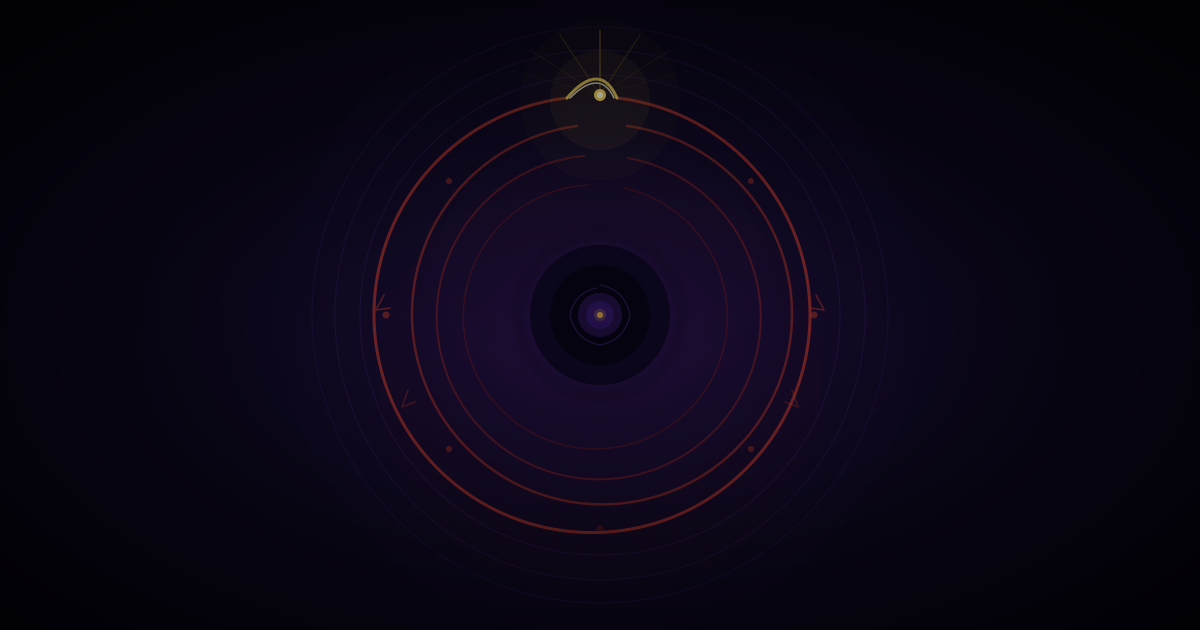
The Scale of Reification: four concentric rings — the same freeze pattern echoing outward from the personal self to the civilizational whole.
The Scale of Reification: same cognitive act — freezing what flows — repeated at larger and larger scales until the ice covers everything.
The Shadow at Civilizational Scale
Carl Jung spent the last decades of his life warning about something he could see forming in the collective psyche of the West. He called it the shadow — the aspect of the self that is disowned, repressed, and then projected onto others [25, 26]. At the individual level, the shadow is straightforward enough: the anger you cannot admit becomes the anger you see everywhere in other people. The vulnerability you cannot face becomes the weakness you despise in others. The parts of yourself you have exiled do not disappear. They go underground and return wearing someone else's face.
Jung's insight, which he articulated most urgently in The Undiscovered Self (1957), was that this mechanism does not stop at the individual. Collectives have shadows too. A nation's shadow is the set of truths it cannot face: its founding violence, its ongoing exploitation, its complicity in suffering it prefers not to see. And just as an individual projects their shadow onto a scapegoat — the co-worker who carries the anger you won't admit to, the ex who embodies the vulnerability you disowned — a civilization projects its shadow onto entire populations.
The disowned fear becomes "the enemy." The unacknowledged guilt becomes "the criminal." The repressed shame becomes "the inferior race." The unfaced vulnerability becomes "the weak" who must be eliminated so that the strong can feel safe.
This is not an analogy. This is the mechanism. Dark reification is shadow projection at civilizational scale. The entire apparatus of propaganda, institutional racism, and genocidal ideology is — at its psychological root — a collective defense mechanism. A civilization's attempt to freeze its own shadow into an Other and then destroy the Other rather than face the shadow.
The Fractal Life Table locates this precisely. At Column 1, the shadow expression reads: "Fear of the unknown, materialistic, self-centered." At the individual level, this is a contraction — a pulling inward, a narrowing of awareness to the smallest possible circle of concern. At the civilizational level, the same contraction becomes something far more dangerous. Fear of the unknown becomes xenophobia — the systematic suspicion of anyone outside the frozen category "us." Materialistic becomes extractive — not just acquiring things but treating people as things to be acquired, used, discarded. Self-centered becomes imperial — the assertion that one civilization's frozen categories are not merely local customs but universal truths that must be imposed on all others.
The Column 1 shadow principle from the Fractal Life Table states it with disarming simplicity: "The more self-centered I am, the more I benefit." When this becomes a civilization's operating system — when the shadow is not faced but enshrined — the result is colonialism, slavery, and the doctrine that some people are resources to be extracted rather than beings to be recognized. The doctrine of terra nullius — land declared "empty" by reifying its Indigenous inhabitants out of legal existence — is the Column 1 shadow crystallized into international law.
But here is what Jung understood and what the Fractal Life Table makes explicit: the shadow is not evil. It is awareness at maximum contraction. It is the same awareness that, in its expanded state, produces compassion, generosity, recognition — everything the happy path maps on its opening side. The contraction is real. Its consequences are real. The suffering it produces is real and must be named. But the awareness that contracted is not a different substance from the awareness that expands. It is the same water, frozen.
This matters because the alternative — declaring the shadow "evil" and projecting it outward — is itself the mechanism of dark reification. If you read this article and conclude "those people who committed genocide are monsters, fundamentally different from me," you have performed exactly the cognitive act the article describes. You have frozen a living, complex, contradictory human being into a category. You have created an "us" (people who would never do such things) and a "them" (people who are capable of monstrousness). And the moment that binary is in place, the machinery is primed.
This is not a comfortable realization. It is not meant to be. But it is the realization without which everything else in this article remains safely abstract — a catalog of other people's darkness rather than a mirror held, with steady hands and warm light, in front of your own.
The Factory of Frozen Categories
Let us look at how the ice is manufactured.
Dark reification does not happen spontaneously. It is produced. Someone measures skulls. Someone drafts legislation. Someone writes the pamphlet. Someone designs the curriculum. Someone builds the taxonomy that sorts living beings into the categories that will later be enforced with violence. The freeze is industrialized — and the industry has a name that Jacques Ellul gave it in 1962: propaganda.
Ellul's insight was radical in its simplicity: propaganda is not a set of lies deployed against the truth. It is an environment. A total restructuring of the categories through which reality is perceived. The propagandist's work is not persuasion — it is category construction. Take a population of irreducibly unique individuals and freeze them into a single label. "The Jew." "The Tutsi." "The infidel." "The illegal." Once the label is established, all information about the group is filtered through the frozen category. Individual stories are edited out. Complexity is compressed. Humanity is abstracted away. A mother of three who teaches mathematics and sings off-key in the shower becomes one of them.
Jason Stanley, in How Fascism Works (2018), mapped the specific architecture of this category construction. The mythic past: there was a time when "we" were great, before "they" corrupted everything. Anti-intellectualism: experts who question the frozen categories are enemies of the people. Hierarchy: the categories are not merely different but ranked. Victimhood: "we" are the real victims, despite all evidence to the contrary. Law and order: the category "criminal" maps onto the category "them" so precisely that enforcement becomes indistinguishable from persecution. Sexual anxiety: "they" threaten our women, our children, our purity. The appeal to the heartland: "real" people live in specific places, look specific ways, believe specific things.
Each element is a frozen category. Each one is a piece of the machinery. And the machinery, once assembled, runs with a momentum that does not require individual malice to sustain. It runs on something far more common than malice.
It runs on compliance.
Stanton's Ten Stages: a descending freeze spiral — each stage a deeper solidification, with denial looping back to the beginning, the freeze defending itself.
The Skull Measurer
In the early 1930s, a Belgian colonial administration in Rwanda set about solving a problem that did not exist.
The people of Rwanda — Hutu, Tutsi, Twa — were not discrete ethnic groups in the way European race science understood ethnicity. They were social categories within a shared culture, sharing the same language (Kinyarwanda), the same religious traditions, the same territory, the same lineage myths. Intermarriage was common. Movement between categories was possible. The boundaries were fluid — a continuum, not a wall.
The Belgians could not tolerate a continuum. Continua cannot be administered. So they sent anthropologists with calipers and measuring tape to produce the frozen categories that colonial governance required. Skulls were measured. Noses were measured. Heights were recorded. The measurements were fed into a racial taxonomy: Tutsi (taller, thinner noses — classified as closer to European, therefore superior) and Hutu (shorter, wider noses — classified as more "Bantu," therefore subordinate). Identity cards were issued. The cards were not descriptions of reality. They were instruments of reification — documents that froze a spectrum of human variation into two discrete categories and then made those categories the basis of law, education, employment, and political power.
The calipers did not kill anyone.
The reification did.
Sixty years later, in one hundred days between April and July of 1994, approximately 800,000 people were murdered along the line that the skull measurer drew. Neighbors killed neighbors. Teachers killed students. Priests killed parishioners. The radio station RTLM broadcast instructions — "cut down the tall trees" — and the tall trees were not trees. They were Tutsi. The frozen category, produced by a Belgian anthropologist with a measuring tape, had become so real, so naturalized, so deeply embedded in the institutional architecture of Rwandan life, that it could motivate ordinary people to pick up machetes and kill the people they had shared meals with the week before.
Philip Gourevitch, whose account We Wish to Inform You That Tomorrow We Will Be Killed with Our Families (1998) remains the essential record, described the aftermath with a precision that does not flinch: "Genocide, after all, is an exercise in community building." The frozen category is not just a label. It is a social project. An identity. A belonging. And the most terrifying thing about belonging is what it requires you to do to those who are defined as not belonging.
Take a moment here. This is not easy material. It is not meant to be easy. But the weight you are feeling is not a sign of weakness. It is a sign that the part of you that recognizes other human beings as human beings is still working. That recognition — the one the frozen categories are designed to disable — is alive in you right now. Stay with it.
The Ledger and the Log
A pattern is emerging. If you are reading carefully, you have already seen it. It is the same mechanism — the same freeze — repeating across continents, across centuries, across ideologies. What varies is the content of the frozen category. What remains constant is the structure.
Let us look at that structure through specific documents — not to catalog horror, but to recognize the fingerprint of the same hand.
The Desk Murderer
Adolf Eichmann, at his desk in Berlin, was not raging. He was not frothing with antisemitic passion. He was filling out forms.
The trains to Auschwitz ran on schedules. The gas was requisitioned through supply chains. The bodies were processed with industrial efficiency — hair sorted, gold teeth extracted, personal effects catalogued. The entire machinery of extermination was organized with the same bureaucratic competence that one might apply to a logistics firm or a railway system.
When Hannah Arendt observed Eichmann's trial in Jerusalem in 1961, she expected to encounter a monster. What she found instead was something far more disturbing: a man of "terrifying normality." Not a sadist. Not an ideologue driven by apocalyptic hatred. A bureaucrat. A man who had accepted the frozen categories of his system so completely that the humanity of his victims was simply not a relevant variable in his calculations. He did not hate Jews. He did not need to. The category had already done the work that hatred would otherwise have had to do. The category said: these are not persons. These are units. Units to be processed, transported, disposed of. And Eichmann processed, transported, and disposed of them with the same diligence he would have applied to any other administrative task.
"He merely, to put the matter colloquially, never realized what he was doing," Arendt wrote. Not because he lacked intelligence. Because the frozen categories of his system had made realization unnecessary. The moral prohibition against murder applies to persons. The reification had reclassified the victims as non-persons. And so the prohibition was not violated. It was suspended. The ice was so thick that the water beneath it — the irreducible humanity of each person loaded onto each train — could not be seen, heard, or felt.
This is what Arendt called the banality of evil. Not the absence of evil. Evil that has been so thoroughly reified into routine that it no longer requires hatred, only compliance. And compliance — Stanley Milgram's obedience experiments showed this with devastating clarity — is something sixty-five percent of ordinary people will offer when an authority figure asks them to deliver what they believe are lethal electric shocks to a stranger. Sixty-five percent. Not sociopaths. Not ideologues. Ordinary people, in a laboratory at Yale, pressing a button because a man in a lab coat told them to.
Philip Zimbardo's Stanford Prison Experiment extended the point: ordinary college students, assigned the role of prison guards, became sadistic within days. Not because the role revealed their hidden nature. Because the role was a frozen category, and the category, once accepted, reorganized their behavior to match its demands. The guard does not need to hate the prisoner. The category "guard" and the category "prisoner" contain, within their frozen structure, the relationship of domination and submission. Once you accept the label, the label does the rest.
The point is not that humans are inherently cruel. The point is the opposite: humans are so deeply social, so profoundly oriented toward belonging and compliance, that a well-constructed frozen category can recruit their sociality in the service of atrocity. Cruelty is not the cause. Compliance is the cause. The frozen category is the cause. And the frozen category is produced by the same cognitive machinery that produces every other category — the same machinery that turns the continuous spectrum of visible light into "red" and "blue," the same machinery that turns a flowing process of sadness into "I am depressed."
Same machinery. Different scale. Different consequences.
If you are feeling something uncomfortable right now — a resistance, a desire to say "but I would never" — that discomfort is not a problem. It is the article working. Not on you. With you. The recognition that you live inside the same cognitive machinery that made Eichmann's desk work possible is not an accusation. It is an invitation to vigilance. The most dangerous people in history were not the ones who knew they were dangerous. They were the ones who were certain they were good.
The Middle Passage Ledger
There is a document — one among thousands, preserved in shipping archives and insurance records — that reduces the whole of chattel slavery to a single column heading.
"Pieces."
Not "persons." Not "passengers." Not even "slaves," which at least acknowledges the existence of a human being in bondage. Pieces. Cargo to be tallied, insured, and depreciated if damaged in transit. A human being, with a mother's name and a father's laugh and a childhood memory of rain on a specific roof — reified into a unit of commerce. A piece.
The entire apparatus of the transatlantic slave trade — the auction block, the bill of sale, the branding iron, the breeding programs, the Three-Fifths Compromise that wrote partial dehumanization into the United States Constitution — was not a failure of morality operating despite normal cognition. It was normal cognition operating at dark reification. The cognitive machinery of categorization, applied to persons, until the person disappeared and only the category ("property") remained.
Saidiya Hartman, in Scenes of Subjection (1997), made a point that deepens the picture in a way that is essential to understand: even the empathy directed at enslaved people was often itself a form of reification. Abolitionist literature that invited white readers to "imagine yourself in their place" sometimes consumed the subjectivity of the enslaved person — replacing their actual experience with the white reader's fantasy of what that experience might be like. The category shifted from "property" to "object of my compassion" — but the person was still an object. The ice changed temperature but did not melt. The face was still not seen on its own terms.
This is why the exit from dark reification cannot be empathy alone. Empathy, if it operates through projection — if it says "I imagine what it would be like to be you" rather than "I see you as you are" — can itself be a form of reification. The distinction matters. It is the difference between consuming someone else's experience and recognizing it. Between melting the ice with your own heat and letting the water flow on its own terms.
Another pause. If you have been reading continuously, you have now encountered the skull measurer, the desk murderer, and the cargo ledger. Each one is a document of the same mechanism. Each one names a specific moment when a living being was successfully frozen into a category. The weight of this is cumulative, and it is meant to be. Not to overwhelm but to establish the pattern so firmly that it cannot be dismissed as a historical anomaly. This is not ancient history. This is not someone else's problem. This is the machinery, and it is still running.
Stanton's ten stages: each one a deepening of the same freeze, from classification to denial. The exit is always the same — seeing a face.
The Us and the Them
Beneath every instance of dark reification — beneath the skull measurer's calipers and the desk murderer's forms and the cargo ledger's column headings — there is a structural engine so simple that it can be stated in four words:
Us. Versus. Them.
Henri Tajfel, the social psychologist who had himself survived the Holocaust by concealing his Jewish identity, spent his career studying the minimal conditions required to activate this engine. His discovery was alarming in its simplicity: almost nothing was required. In his "minimal group" experiments, Tajfel divided participants into groups based on trivial, meaningless criteria — a preference for one painter over another, an estimate of the number of dots on a screen. The groups had no history, no conflict, no competing interests. They were arbitrary labels applied to strangers.
It did not matter. Within minutes, participants were allocating more resources to members of their own group and fewer to members of the other group. In-group favoritism and out-group discrimination appeared as though they had been waiting in the cognitive machinery, fully formed, needing only the slightest trigger to activate. Tajfel called this Social Identity Theory: the human need to belong is so powerful that even a meaningless label — even a category with no content, no history, no material stakes — is enough to generate the "us versus them" binary.
Muzafer Sherif's earlier Robbers Cave Experiment (1954) had demonstrated the same principle in a more naturalistic setting: boys at a summer camp, divided into two groups, escalated from friendly competition to open hostility within days. The groups developed their own identities, their own languages of contempt for the other side, their own narratives of victimhood and righteousness. All it took was a line. A label. A category. The freeze.
The Fractal Life Table's Column 1 shadow principle captures this with surgical precision: "Any movement or ideology operating primarily from a binary 'us vs them' framework — regardless of political orientation — expresses the Col 1 shadow." Notice: regardless of political orientation. This is not a left-wing problem or a right-wing problem. The mechanism is deeper than politics. It is deeper than ideology. It is the cognitive architecture of categorization itself — the same architecture that the previous article described, the same survival hardware that evolved to distinguish predator from prey, food from poison. Applied to the social world, this hardware produces the most natural thing in the world: a line between those who are like me and those who are not. And on either side of that line, different rules apply.
The spectrum of compassion maps this as contraction — the narrowing of the circle of concern to include only those inside the frozen category "us." At maximum contraction, the circle is a point: only I matter. At slightly wider contraction, the circle includes my family, my tribe, my nation — and excludes everyone else. Dark reification is what happens when the contraction is not just individual but systemic — when the frozen circle of concern is not a private feeling but a public policy. When the nation-state itself operates on the principle that some people are inside the circle and some are outside, and the ones outside are not just different but less. Less worthy. Less human. Less real.
The descent from "different" to "dangerous" to "less than human" is not a leap. It is a series of small, almost imperceptible freezes, each one making the next one possible. Nick Haslam's research on dehumanization identified two distinct forms: animalistic dehumanization (denying uniquely human characteristics — civility, refinement, moral sensibility — and comparing the out-group to animals) and mechanistic dehumanization (denying human nature — warmth, emotion, agency — and treating the out-group as objects, automata, tools). Both forms are reification. Both forms take a living being and freeze them into a category that strips away some essential dimension of their humanity.
The cycle of harm described how individual pain, when it overflows, spills onto others. This is that same overflow at civilizational scale. A society in pain — humiliated, economically shattered, collectively ashamed — generates exactly the conditions under which the "us versus them" machinery operates at maximum power. Ervin Staub's research mapped the progression with excruciating clarity: difficult life conditions produce uncertainty; uncertainty produces a need for belonging; belonging produces in-group identity; in-group identity produces out-group suspicion; suspicion, under sufficient pressure, produces scapegoating; scapegoating, once institutionalized, produces dehumanization; dehumanization, once normalized, produces genocide. Each step is a deepening of the freeze. Each step feels, to the person taking it, like a reasonable response to a genuine threat. And that is perhaps the most important thing to understand about dark reification: it does not feel dark from the inside. From the inside, it feels like survival.
The Binary Machine: the full spectrum of human variation compressed into two frozen boxes — the seed crystal around which all dark reification organizes itself.
The Cathedral and the Pyre
There is a form of dark reification more painful than any other — not because it produces more suffering (all suffering is immeasurable) but because it begins with genuine insight. With liberation. With love.
Every great spiritual tradition on earth began as a de-reification.
Jesus of Nazareth walked into a religious culture that had reified the law — frozen the living commandments into a dead legalism that sorted people into "clean" and "unclean," "righteous" and "sinful," "worthy" and "unworthy." And he said: the law was made for the human, not the human for the law. He touched lepers. He ate with tax collectors. He spoke with Samaritan women. Each act was a deliberate unfreezing — a refusal to let the frozen category stand between him and the living being in front of him. His was a ministry of de-reification, and it cost him his life, because frozen categories do not forgive those who melt them.
The Buddha walked into a culture that had reified caste — frozen the fluid social relationships of the Vedic period into a rigid hierarchy ordained by divine law. And he said: there is no Brahmin by birth; there is only a Brahmin by conduct. He accepted students from all castes. He ordained women. He declared, in a civilization built on the ice of inherited status, that the ice was not ground. That was enough to make him, in the eyes of the Brahmanical establishment, as dangerous as a thaw in spring.
Muhammad walked into a culture that had reified tribal identity — frozen the relationships between the clans of Arabia into a system of feuds, blood debts, and inherited enmities that could not be questioned because they were "the way things are." And he said: the believers are brothers. Not by blood. Not by tribe. By recognition. A single community (ummah) that cuts across every tribal category and replaces the frozen hierarchy of birth with the flowing recognition of shared submission to something larger than any clan.
Each of these founders was a river in a frozen landscape. Each one saw through the categories of their time and refused to accept the ice as ground. Each one paid for that refusal.
And then — and this is where the heart breaks — each tradition took the living insight and froze it.
The teaching became a text. The text became a doctrine. The doctrine became a creed. The creed became a test. And the test became a weapon.
The same institution — the medieval Catholic Church — that built Chartres Cathedral, commissioned Giotto's frescoes, preserved the manuscripts of antiquity, and produced the theology of Thomas Aquinas — also burned Giordano Bruno at the stake, tortured Galileo, launched the Inquisition, authorized the Crusades, and blessed the colonization of the Americas with papal bulls that reified Indigenous peoples out of full personhood. Not two different churches. The same one. The cathedral and the pyre are built from the same stone.
Karen Armstrong, in The Battle for God (2000), traced this pattern across traditions with the care of someone who loves what she is examining and grieves what it became. Fundamentalism, she argued, arises when mythos — the participatory, living dimension of spiritual truth — is reified into logos — literal, propositional truth claims that can be tested, enforced, and defended with violence. The mythos says: "God is love." The logos says: "Believe that God is love, in exactly this formulation, or be punished." The mythos flows. The logos freezes. And the frozen logos, because it carries the authority of the original insight, is more dangerous than any secular ideology — because it claims not just political power but divine mandate. When the state kills you, it claims necessity. When the frozen church kills you, it claims holiness.
Charles Kimball, in When Religion Becomes Evil (2002), identified five warning signs: absolute truth claims, blind obedience, the establishment of the "ideal" time, ends justifying means, and the declaration of holy war. Read the list again. Each sign is a form of reification. An absolute truth claim freezes a living insight into a dead proposition. Blind obedience freezes the relationship between teacher and student into a relationship between commander and soldier. The "ideal" time freezes the dynamic, uncertain flow of history into a predetermined narrative. Ends justifying means freezes the infinite value of each living being into a dispensable means to a greater end. And holy war freezes the tender, terrifying encounter with the sacred into a license to destroy anyone who encounters the sacred differently.
The cruelest irony in the history of human consciousness is this: the very teaching that was meant to dissolve frozen categories becomes a frozen category that is enforced with fire.
And yet — and this is where the tears are not of despair but of something harder to name — the original insight was real. The rivers that Jesus, the Buddha, and Muhammad opened were real rivers. The water they released is still flowing, underneath all the institutional ice, in every tradition. Every mystic in every lineage — Meister Eckhart, Rumi, Dogen, Kabir, Teresa of Avila, Ramana Maharshi — is a person who pressed their ear to the frozen surface of their own tradition and heard the water moving. The cathedral and the pyre are built from the same stone. But the stone is not the point. The point is what the stone was built to house — and what the pyre was built to destroy — and it is the same thing: a living encounter with the real that refuses to be frozen.
Pause. If this section has stirred grief or anger — at religion, at institutions, at the pattern itself — let that arise. Do not freeze it into a position. Let it flow. The grief is appropriate. The anger is appropriate. They are signs of life.
The cathedral and the pyre are built from the same stone. The living water flows beneath both.
The Algorithm Inherits the Shadow
Everything we have examined so far — the skull measurer, the desk murderer, the cargo ledger, the cathedral and the pyre — happened in a world where the frozen categories were produced by human hands. Someone measured. Someone legislated. Someone preached. Someone wrote the pamphlet. The propagandist was a person, and the propaganda was distributed through channels that moved at the speed of print, of radio, of a human voice shouting into a crowd.
That world is gone.
The categories are now produced and distributed at a speed and scale that no human propagandist could match — not because any human designed it that way, but because a machine discovered that frozen categories are engaging.
In the attention economy that the Material Veil described — where human attention is the raw material and engagement is the product — social media algorithms have made a discovery that Stanton's ten stages of genocide could have predicted: outrage, fear, and tribal identification are the most engaging content on earth. The algorithm does not understand what it is amplifying. It does not know what a "Tutsi" is, or a "Jew," or an "illegal." It knows one thing: when a user engages with content that deepens the freeze — content that sharpens the line between "us" and "them," content that abstracts a living being into a threatening category — the user stays longer. Clicks more. Sees more ads. Generates more revenue.
The algorithm is an automatic reification engine. Not by design but by selection. It selects for the content that produces the most engagement, and engagement, it has discovered, correlates with the deepening of frozen categories. Filter bubbles are digital enclosures — walled environments where the frozen category feels like the whole world, where the algorithm ensures that every piece of information the user encounters confirms and deepens the freeze. Recommendation engines that begin with mainstream commentary and end, twenty clicks later, at white supremacist manifestos are not malfunctioning. They are functioning exactly as designed — optimizing for engagement by following the natural gradient of the freeze toward its deepest point.
Shoshana Zuboff, in The Age of Surveillance Capitalism (2019), named the economic structure: the extraction of behavioral data and its transformation into predictions about future behavior, which are then sold to advertisers. But the extraction is not neutral. The data most eagerly extracted is the data that reveals which frozen categories a user is most susceptible to — which tribal identities they most strongly hold, which out-groups they most strongly fear, which emotional triggers will keep them scrolling. The attention economy meets the dehumanization machinery in the algorithm that serves you your next dose of righteous anger.
Safiya Noble, in Algorithms of Oppression (2018), demonstrated what this looks like in practice: search results that reinforce racial stereotypes, auto-complete suggestions that dehumanize, image recognition systems trained on datasets that encode the frozen categories of the societies that produced them. The algorithm does not create racism. It inherits the shadow — the collective shadow that Jung warned about — and then amplifies it at a speed and scale that turns a slow historical freeze into an instantaneous, global solidification.
The Algorithm's Shadow
In March 2019, a twenty-eight-year-old in Christchurch, New Zealand, walked into two mosques and killed fifty-one people.
He had not grown up surrounded by Muslims. He had no personal grievance. He had no history of interpersonal conflict with anyone from the communities he destroyed. But for months — years, perhaps — a recommendation algorithm had been feeding him an escalating sequence of content. From mainstream conservative commentary to anti-immigration channels. From anti-immigration channels to white nationalist content. From white nationalist content to manifestos, to recruitment material, to the specific vocabulary and imagery of dehumanization.
Each recommendation deepened the freeze. "Them" became more abstract with every click. More threatening. More categorical. The algorithm was not trying to radicalize anyone. It was trying to maximize engagement. And engagement, the algorithm had learned, lives at the bottom of the freeze — at the point where the Other has been so thoroughly reified into a category that violence against the category feels not like murder but like pest control.
This is not a future risk. This is the current condition. The Material Veil described the extraction of attention. Dark reification describes what that extraction produces when the frozen categories are about people. The algorithm inherits the shadow because the shadow is the most engaging content the shadow can produce. And the speed at which it produces that content — instantaneously, globally, personalized to each user's specific susceptibility — makes every previous technology of propaganda look like a hand-cranked printing press.
The reader should recognize their own media diet in this section. Not as equivalent to genocidal propaganda — scale matters, context matters, the comparison is not an equation — but as operating on the same spectrum. The same mechanism. The same cognitive hardware. The same freeze, calibrated differently. Every time you scroll past a headline that reduces a complex geopolitical situation to "they are destroying our country," you are encountering the algorithm's version of the skull measurer's calipers. Cruder, faster, more pervasive — but structurally identical. A continuum frozen into a binary. A living complexity reduced to a dead category. An invitation to deepen the freeze, brought to you by a machine that does not know what it is doing but does it very, very well.
The Banality That Lives in Us
We have traveled, now, through centuries and continents. Through the skull measurer's colonial office and Eichmann's administrative desk and the cargo hold of a slave ship and the cathedral that burned its own prophets and the algorithm that amplifies what it does not understand. In each case, the mechanism is the same: a living being, frozen into a category. A person, replaced by a label. A face, obscured by a name tag that says "not one of us."
And in each case, the perpetrators were not, for the most part, what we might wish them to be: monsters. Aberrations. Creatures from a different moral species.
They were ordinary people.
This is the insight that Arendt, Milgram, and Zimbardo converge on from different directions — and it is the insight that this article, more than any other on the happy path, asks you to sit with.
Arendt: Eichmann was not a fanatic. He was a joiner. A man who wanted to belong, to advance, to be seen as competent and reliable. The frozen categories of the Nazi system gave him a structure within which these perfectly ordinary desires could be fulfilled. He did not need to be convinced that Jews were subhuman. He needed only to accept the category — to stop asking whether the category was true and start asking how efficiently he could process it. The moral catastrophe was not the presence of malice. It was the absence of thought.
Milgram: the sixty-five percent who delivered what they believed were lethal shocks were not sadists. They were uncomfortable. Many protested verbally. Some wept. But when the authority figure said "the experiment requires that you continue," they continued. The frozen category — "this is an experiment," "the learner has agreed to participate," "the scientist is in charge" — provided sufficient structure to override their discomfort. The discomfort was not absent. It was simply outranked by the compliance.
Zimbardo: the college students who became abusive guards at Stanford were screened for psychological normality before the experiment began. They were not selected for aggression or dominance. They were selected for ordinariness. And their ordinariness, placed inside the frozen category structure of "guard" and "prisoner," produced sadism within days. Not because sadism was latent in them. Because the category contained the sadism, and accepting the category meant accepting its contents.
Jonathan Glover, in Humanity: A Moral History of the Twentieth Century (1999), synthesized these findings into a framework that is both devastating and — if you hold it with enough warmth — ultimately hopeful. The mechanisms that enable atrocity, Glover argued, are not exotic. They are three perfectly ordinary psychological processes: the erosion of moral identity (I stop thinking of myself as someone who cares about this), the weakening of sympathy (the distance between me and the victim is increased until they cease to be real), and the distortion of moral reasoning (I tell myself a story in which what I am doing is necessary, or justified, or someone else's responsibility). Three ordinary processes. Three forms of reification: freezing my moral identity into a category that excludes this act; freezing the victim into a category that excludes my sympathy; freezing the situation into a category that excludes my responsibility.
The warmth of this article must hold most firmly here. Because the invitation is not "you are a potential Eichmann." The invitation is: "you live inside the same cognitive architecture, and the first defense against its darkest expressions is not moral certainty — it is the willingness to remain uncertain." The person who says "I would never" has already frozen themselves into a category ("the kind of person who would never") and the history of atrocity is populated almost exclusively by people who were certain they would never.
The alternative is not despair. It is not "since anyone could, nobody is responsible." Accountability remains essential — the cycle of harm made that clear. The alternative is a specific kind of vigilance: the willingness to notice when a frozen category is forming. To notice when "they" is doing more work than it should. To notice when compliance is replacing thought. To notice when the distance between yourself and another living being is increasing — and to close it. Not because you are good. Because you are paying attention.
The Face That Interrupts
And now — after the longest descent — the first light.
Not a flood of light. Not a sunrise. Not the triumphant reversal of everything that came before. A crack. A thin line. The sound of water moving beneath the ice.
Emmanuel Levinas, the Lithuanian-Jewish philosopher who lost most of his family in the Holocaust and spent the rest of his life thinking about what makes ethics possible in a world capable of such events, arrived at an insight that is as simple as it is radical:
The face of the Other is the interruption of totality.
By "totality," Levinas meant any system of thought that reduces everything to the Same — that captures all of reality inside a single frozen framework and leaves no room for anything that exceeds the framework. Totalitarianism is a political totality. A racist ideology is a cognitive totality. The algorithmic filter bubble is a digital totality. Each one is a system of frozen categories that claims to account for everything and demands that nothing escape its grid.
And the face — the actual, living face of another human being — is the one thing that always escapes. Not because faces are magical. Because a face is not a category. It is an encounter. An event. An irreducible moment in which another consciousness — another universe of experience, another lifetime of memory and fear and hope — presents itself to you and says, without words, without intention, simply by being there: I am here. I am real. I am not the label you have been given for me.
Levinas called this the ethical demand of the face. The face demands — not by asking, not by arguing, but simply by appearing — that you recognize what is in front of you. And recognition is the opposite of reification. Reification says: you are a category. Recognition says: you are a face. Reification freezes. Recognition melts. And the moment of recognition — which can happen in a death camp, on a segregated bus, in a propaganda-saturated living room, scrolling past a thumbnail of a person the algorithm has labelled "enemy" — is the crack in the ice.
The Faces at the Hotel
In April 1994, as the genocide in Rwanda unfolded at a pace that outstripped every international response, Paul Rusesabagina — the manager of the Hotel des Mille Collines in Kigali — sheltered 1,268 Tutsi and moderate Hutu refugees inside his hotel.
He was not a saint. He was not a revolutionary. He was a hotel manager. A man whose training was in hospitality — in the art of seeing each guest as a person, of attending to individual needs, of maintaining the dignity of the encounter. And when the genocide came to his door, he could not perform the freeze. He could not look at the people in front of him — terrified, desperate, exhausted — and see "cockroaches." He saw faces. Each face was an interruption of the frozen order. Each face that he could not un-see was a crack in the civilizational ice.
He bribed militiamen with money and liquor. He bluffed commanders on the telephone. He leveraged every connection, every favor, every diplomatic channel available to a hotel manager with no army, no weapons, no political power. He did it because the faces would not stop being faces. The category "cockroach" would not stick to them. The freeze would not take.
Levinas would call this the ethical demand of the face of the Other. But Rusesabagina did not need Levinas. He needed what every exit from dark reification requires: the irreducible encounter with a living being that refuses to fit inside the frozen category.
And he was not alone in history. Oskar Schindler, the German industrialist who saved 1,200 Jewish lives by employing them in his factories — he too saw faces where the system told him to see names on a list. Not because he was a moral hero. He was, by most accounts, a war profiteer, a womanizer, an opportunist. But at some point the faces on his factory list became faces — irreducible, demanding, real — and the frozen category "labor resource" cracked.
Harriet Tubman, who returned to the slave-holding South again and again, risking recapture and death, to lead others to freedom through the Underground Railroad — she saw faces in the dark. Each person she guided was not a "fugitive" or a "piece" or a "unit." Each person was a face. And the face, in the darkness of a Maryland swamp at midnight, was the only light that mattered.
Desmond Tutu, presiding over the Truth and Reconciliation Commission in post-apartheid South Africa, insisted on something that neither pure justice nor pure mercy could accomplish: the encounter with the face. The perpetrators were required to tell the truth — to speak, in the presence of the people they had harmed, the full account of what they had done. And the survivors were given the choice to respond. Not to a category. To a face. A specific face, sitting in a specific chair, carrying a specific weight of guilt and shame and — sometimes, impossibly — a capacity for remorse that the frozen category "enemy" would never have predicted.
The Truth and Reconciliation Commission was, in Levinas's terms, the deliberate interruption of totality by the face. It was not justice in the retributive sense. It was recognition — the refusal to let the frozen categories of apartheid remain the final word. And it was enough. Not enough to heal everything. Not enough to undo decades of systematic dehumanization. But enough to crack the ice. Enough to let the water move.
The Crack in the Ice
Here is where we stand.
We have looked at the mechanism — the same freeze, operating at personal, interpersonal, institutional, and civilizational scale. We have looked at the shadow — the disowned darkness projected onto others and defended as reality. We have looked at the factory — the industrial production of frozen categories through propaganda, legislation, and now algorithmic amplification. We have looked at the historical record — the skull measurer, the desk murderer, the cargo ledger, the cathedral and the pyre. We have looked at the cognitive architecture — the banality that lives in ordinary compliance, in the sixty-five percent, in the college students who became guards.
And we have found the exit.
It is not a policy. It is not a program. It is not a ten-step plan for dismantling systemic oppression, although such plans are necessary and the work of building them is sacred. The exit is prior to all of that. It is the moment that makes all of that possible.
The exit is recognition.
Seeing a living being where the category said to see a thing.
This is what Rusesabagina did. What Schindler did. What Tubman did. What Tutu created the conditions for. What Primo Levi, in writing If This Is a Man (1947), demanded of every reader: look at this person. If this is a man — if this broken, starved, dehumanized figure standing in the snow of Auschwitz is a man — then the entire system that said otherwise is a reification. And the reification can be named. And what can be named can be seen. And what can be seen can be melted.
The crack in the ice is not produced by force. It is produced by seeing. Not the seeing of the eyes — the eyes can see a face and categorize it in milliseconds, as we discussed. The seeing that cracks the ice is the seeing that refuses to stop at the category. That keeps looking. That notices the irreducible specificity of this face, this life, this universe of experience that no label can contain.
Achille Mbembe, in Necropolitics (2019), described the zones of dark reification as "death-worlds" — spaces where persons have been so thoroughly reified that they exist in a state of "living death," suspended between life and nonexistence. The crack in the ice is what restores life to the death-world. Not by magical intervention. By the simplest, most ancient, most indestructible act available to consciousness: the act of seeing.
And here, at the bottom of the happy path, at the darkest point in the entire journey from harm to healing, we arrive at the turning point.
You cannot give to a category.
You can only give to a face.
The exit from dark reification — the crack in the civilizational ice — is the precondition for everything that comes next on the happy path. Generosity, the subject of the next article, is not an abstract virtue. It is what happens when someone sees a face and responds. Not with a policy. Not with a theory. With a gift. An offering. A movement toward the face that says: I see you. You are real. Here — take this. It is not much. But it is mine, and I give it to you freely, because you are not a category. You are a living being. And living beings give to living beings. That is what the water does, when the ice lets it flow.
The darkest point and the first light are separated by a single act of seeing.
One crack in the civilizational ice: the minimum viable interruption of dark reification — a single face, truly seen.
Return to the watershed.
The ice is still there. It would be dishonest — a spiritual bypass, a premature consolation — to pretend otherwise. The roads are still built on it. The cities still stand. The institutions still function. The algorithms still amplify. The categories are still frozen, and in many places the freeze is deepening, not receding.
But in one place — maybe more than one, maybe more than can be counted — there is a sound.
Not a crack of thunder. Not the dramatic splintering of a dam. Something quieter. Something you have to be very still to hear.
Water.
Moving beneath the ice.
It has always been moving. That is the thing about water — about the living awareness that the previous article described, that the Fractal Life Table maps, that the entire 108 Framework points toward. It cannot actually be stopped. It can be slowed. It can be hidden. It can be denied. Cities can be built over it. Laws can be written on top of it. Generations can be born and die without knowing it is there. But it moves. It always moves. Because that is what water does. That is what awareness does. That is what the living, flowing, irreducibly real process of being conscious does: it moves toward recognition the way water moves toward the sea.
Even inside the most total system of dehumanization — even in the death camps, even in the slave ships, even in the algorithmic filter bubbles that are being built right now — recognition breaks through. A guard sees a prisoner's face. A bystander intervenes. A survivor writes. A hotel manager refuses to let the freeze take. The water finds a crack, and through the crack it flows, and the flow is always toward the same destination: the moment when someone sees a living being where the system said to see a thing.
This is not optimism. Optimism is the belief that things will get better. This is something else — something earned, something that has passed through the full weight of the darkness and found, at the bottom, something the darkness cannot destroy. Not because the darkness is weak. Because the water is older. Because awareness, even at its most contracted, even at its most frozen, is still awareness. And awareness, given the slightest crack, flows.
The next article on this path is about what happens when the water begins to flow. When the recognition that cracked the ice becomes a gift. When the face that interrupted the totality becomes the face that receives. Generosity is not the opposite of dark reification. It is what dark reification, cracked open, releases. The water that was always there. The river that the ice could never actually stop.
But that is the next article.
For now, just this: beneath everything you have read today — beneath the skull measurer and the desk murderer and the ledger and the cathedral and the algorithm — the water is moving. It is moving in you, right now, as you read these words and feel the weight of them and choose not to look away. Your refusal to look away is itself the crack. Your willingness to sit with the heaviness and remain open — not hardened, not dissociated, not certain that you are better than anyone in this article — is the first movement of the water.
The thaw begins not with a policy or a protest or a program.
It begins with a face.
Invitation
You do not have to fix this.
That is the first thing. Before the invitation, the permission: you do not have to fix the ice. You do not have to dismantle every institution of dark reification. You do not have to solve the algorithm. You do not have to bear, in your single body, the weight of every atrocity this article has named.
What you can do — what you are already doing, by having read this far without looking away — is refuse the freeze.
The next time a headline reduces a complex situation to "they are destroying our country" — notice. The next time a conversation turns a living, contradictory human being into a type, a label, a category — notice. The next time your own mind, under stress, begins to harden, begins to sort the world into us and them, safe and dangerous, good and evil — notice. Not with judgment. Not with the frozen certainty that you are above this. With the warmer, humbler, more honest recognition that you live inside the same cognitive architecture as everyone in this article, and the only defense is the willingness to keep seeing faces where the categories want you to see things.
This is not a small thing. This is the crack in the ice.
Every face you refuse to freeze — every moment you choose recognition over categorization, encounter over efficiency, the trembling uncertainty of seeing over the cold comfort of knowing — is a place where the water moves. And the water, once it moves, moves toward connection. Toward generosity. Toward the turning point that the next article will explore.
The darkest place on the happy path is not a dead end. It is a turning point. And the turning point is not a grand gesture or a political revolution or a spiritual awakening.
It is one face. Seen clearly. By you.
Right now.
People Also Ask
What is dark reification?
Dark reification is the weaponization of the mind's natural categorizing habit — what the previous article called "freezing what flows" — at collective and civilizational scale. Where ordinary reification turns a flowing feeling into a fixed identity ("I am shy"), dark reification turns a living human being into a frozen category ("they are vermin," "they are property," "they are infidels"). The mechanism is identical; the scale is civilizational; the consequences are genocide, slavery, colonialism, apartheid, and every form of systematic dehumanization. It is not a different kind of error from the one you commit when you reduce a complex person to a simple label. It is the same error, amplified to the point where the label becomes a death sentence.
How does dehumanization work psychologically?
David Livingstone Smith's research shows that dehumanization is not the absence of moral cognition but a specific cognitive act: the reclassification of a person into a category of entity that does not warrant moral consideration. Once the reclassification is complete — once the Tutsi is "cockroach," the Jew is "vermin," the enslaved person is "property" — the moral prohibition against harm is not violated but suspended, because the prohibition applies to persons, and the reification has reclassified them as non-persons. Nick Haslam identified two forms: animalistic dehumanization (denying uniquely human traits, likening the group to animals) and mechanistic dehumanization (denying human nature, treating the group as objects or tools). Both are forms of reification.
What did Hannah Arendt mean by the banality of evil?
Observing Adolf Eichmann's trial in Jerusalem in 1961, Arendt expected to find a monster and instead found a bureaucrat — a man of "terrifying normality" who had accepted the frozen categories of his system so completely that the humanity of his victims was not a relevant variable in his work. The banality of evil is not the absence of evil. It is evil that has been so thoroughly reified into routine — absorbed into procedures, protocols, and categories — that it no longer requires personal hatred or sadistic motivation. It requires only compliance. Only the ordinary willingness to follow instructions within a system that has already done the moral work of reclassification. Milgram's obedience experiments confirmed the point: sixty-five percent of ordinary people complied with instructions they believed were causing lethal harm, because the authority structure provided the frozen category that overrode their discomfort.
What is the collective shadow in Jungian psychology?
Jung's individual shadow — the disowned aspects of the psyche that are repressed and projected onto others — scales to the collective level. A nation's shadow is the set of truths it cannot face: its founding violence, its ongoing exploitation, its complicity in suffering. Dark reification is the mechanism by which the collective shadow is projected: the disowned fear becomes "the enemy," the unacknowledged guilt becomes "the criminal," the repressed shame becomes "the inferior race." The entire apparatus of propaganda and institutional racism functions, at its psychological root, as a civilization's attempt to freeze its own shadow into an Other and destroy the Other rather than face the shadow. Jung warned that this mechanism intensifies when individuals surrender their moral autonomy to mass movements, letting the collective do their shadow-work for them.
How does propaganda create dehumanization?
Propaganda is the industrial technology of dark reification — the mass production of frozen categories. Jacques Ellul showed that modern propaganda does not aim to persuade but to pre-structure the categories through which reality is perceived. The propagandist's work is category construction: take a diverse population of irreducibly unique individuals and freeze them into a single label. Once the label is established, all information about the group is filtered through the frozen category — individual stories are erased, complexity is compressed, humanity is abstracted away. Gregory Stanton's ten stages of genocide map the propaganda arc: classification, symbolization, dehumanization — each stage a deepening of the freeze. Modern social media algorithms automate this process at unprecedented speed and scale.
How do algorithms amplify othering and dehumanization?
Social media algorithms optimize for engagement, and engagement correlates with content that deepens the "us versus them" freeze — outrage, fear, and tribal identification. The algorithm does not intend to radicalize; it follows the natural gradient of frozen categories toward their deepest point. Recommendation engines can carry a user from mainstream commentary to extremist content through incremental steps, each one narrowing the category and deepening the dehumanization. Filter bubbles create digital enclosures where the frozen category feels like the whole world. Safiya Noble's research showed that search engines reinforce existing racial stereotypes, making algorithmic systems automatic reification engines that inherit and amplify the collective shadow at speeds no human propagandist could match.
What is the connection between religion and dark reification?
Every great spiritual tradition began as a de-reification — a living teacher who saw through the frozen categories of their time. But over centuries, the liberating insight was itself reified: the teaching became a text, the text became a doctrine, the doctrine became a creed, the creed became a weapon. Karen Armstrong traced this pattern across Judaism, Christianity, and Islam, showing that fundamentalism arises when living spiritual insight (mythos) is reified into literal propositional claims (logos). The same institution that built cathedrals and preserved manuscripts also burned heretics and blessed colonial violence. This is reification's cruelest irony: the very teaching meant to dissolve frozen categories becomes a frozen category enforced with fire.
What is the Scale of Reification?
The Scale of Reification is a fractal framework showing how the same cognitive mechanism — freezing what flows — operates at progressively larger scales: (1) Personal — freezing a feeling into an identity ("I am broken"), (2) Interpersonal — freezing a person into a category ("they are dangerous"), (3) Institutional — freezing categories into structures (segregation laws, caste systems), (4) Civilizational — freezing structures into "the way things are" (slavery as economic necessity, colonialism as divine mandate). Each level requires and reinforces the others: the institutional level gives the interpersonal its authority, and the civilizational level makes the institutional invisible. Stanton's ten stages of genocide map onto this progression with precision.
What did Levinas mean by the face of the Other?
Emmanuel Levinas, a Lithuanian-Jewish philosopher who lost his family in the Holocaust, argued that the face of the Other is the "interruption of totality" — the irreducible encounter with a living being that cannot be fully captured by any category or system. The face does not argue or persuade; it simply presents itself and demands recognition. Dark reification is the attempt to erase the face — to replace the encounter with a frozen label. The exit from dark reification is the moment when someone sees a living being where the system said to see a thing. This recognition — which can happen in a death camp, on a segregated bus, or while scrolling past an algorithmic thumbnail — is what Levinas called the foundation of ethics: the encounter that cannot be totalized.
Is dark reification still happening today?
Dark reification is not a historical phenomenon — it is an ongoing condition. Algorithmic amplification of othering, political propaganda that reduces complex populations to threatening categories, institutional systems that enforce racial and economic hierarchies, and border regimes that reify human beings into "legal" and "illegal" are all contemporary expressions of the same mechanism. The technology has changed — algorithms now produce and distribute frozen categories faster than any human propagandist could — but the cognitive architecture is identical. The question is not whether dark reification exists in your world. The question is whether you can recognize it when it operates on you, through the categories you consume, the binaries you accept, and the faces you fail to see.
References
-
Arendt, Hannah. The Origins of Totalitarianism. Harcourt, 1951.
-
Arendt, Hannah. Eichmann in Jerusalem: A Report on the Banality of Evil. Viking Press, 1963.
-
Power, Samantha. "A Problem from Hell": America and the Age of Genocide. Basic Books, 2002.
-
Stanton, Gregory H. "The Ten Stages of Genocide." Genocide Watch, 1996 (revised 2013).
-
Smith, David Livingstone. Less Than Human: Why We Demean, Enslave, and Exterminate Others. St. Martin's Press, 2011.
-
Zimbardo, Philip. The Lucifer Effect: Understanding How Good People Turn Evil. Random House, 2007.
-
Milgram, Stanley. Obedience to Authority: An Experimental View. Harper & Row, 1974.
-
Staub, Ervin. The Roots of Evil: The Origins of Genocide and Other Group Violence. Cambridge University Press, 1989.
-
Gilligan, James. Violence: Reflections on a National Epidemic. Vintage, 1996.
-
Levi, Primo. If This Is a Man (Survival in Auschwitz). Orion Press, 1947 (English trans. 1959).
-
Gourevitch, Philip. We Wish to Inform You That Tomorrow We Will Be Killed with Our Families: Stories from Rwanda. Farrar, Straus and Giroux, 1998.
-
Hartman, Saidiya. Scenes of Subjection: Terror, Slavery, and Self-Making in Nineteenth-Century America. Oxford University Press, 1997.
-
Mbembe, Achille. Necropolitics. Trans. Steven Corcoran. Duke University Press, 2019.
-
Tajfel, Henri. "Experiments in Intergroup Discrimination." Scientific American 223.5 (1970): 96-102.
-
Sherif, Muzafer et al. The Robbers Cave Experiment: Intergroup Conflict and Cooperation. Institute of Group Relations, University of Oklahoma, 1961.
-
Haslam, Nick. "Dehumanization: An Integrative Review." Personality and Social Psychology Review 10.3 (2006): 252-264.
-
Ellul, Jacques. Propaganda: The Formation of Men's Attitudes. Trans. Konrad Kellen & Jean Lerner. Knopf, 1965 (original French 1962).
-
Stanley, Jason. How Fascism Works: The Politics of Us and Them. Random House, 2018.
-
Armstrong, Karen. The Battle for God: A History of Fundamentalism. Ballantine Books, 2000.
-
Kimball, Charles. When Religion Becomes Evil: Five Warning Signs. HarperSanFrancisco, 2002.
-
Levinas, Emmanuel. Totality and Infinity: An Essay on Exteriority. Trans. Alphonso Lingis. Duquesne University Press, 1969 (original French 1961).
-
Glover, Jonathan. Humanity: A Moral History of the Twentieth Century. Yale University Press, 1999.
-
Zuboff, Shoshana. The Age of Surveillance Capitalism. PublicAffairs, 2019.
-
Noble, Safiya Umoja. Algorithms of Oppression: How Search Engines Reinforce Racism. NYU Press, 2018.
-
Jung, Carl Gustav. Aion: Researches into the Phenomenology of the Self. Trans. R.F.C. Hull. Routledge, 1951.
-
Jung, Carl Gustav. The Undiscovered Self. Trans. R.F.C. Hull. Little, Brown, 1957.
-
Buddhaghosa. Visuddhimagga (The Path of Purification). Trans. Bhikkhu Nanamoli. Buddhist Publication Society, 1956 (original c. 5th century CE).
-
Gethin, Rupert. The Foundations of Buddhism. Oxford University Press, 1998.