In the spring of 1922, a French Jesuit paleontologist named Pierre Teilhard de Chardin was on his knees in a fossil bed in the Ordos Desert of Inner Mongolia, brushing sediment off the rim of a tooth thirty million years older than any human story. The wind came across the trench in thin amber sheets. The pages of his open journal lifted and fell against his thigh, smelling faintly of leather and the ash of last night's fire. The sun was low enough to throw the shadow of his shoulder onto the dirt in front of him, the same shadow some animal had thrown at this same hour an unimaginable count of years before. He stopped brushing. He stayed still.
It was not a discovery in the sediment that interrupted him. It was a thought — one of those thoughts that arrives less as a deduction than as a quiet recognition, the way the body recognizes a familiar voice in another room before the mind has named the voice. He set his brush down on the canvas at his side. He listened to the wind. He did not write yet. He let the recognition settle into the part of him that had been doing the kneeling all morning, the part that knew the weight of the dirt and the warmth of the page and the particular hush of a place where nothing human had spoken for a very long time.
What he finally wrote in the journal was the question that would shape the rest of his life. A single neuron is, by itself, almost nothing. It does not think. It does not feel. It is one small electrochemical relay among the dirt of the brain. And yet a hundred billion of them, organized into a pattern, become a person — become a being able to kneel in a desert and weep, or wonder, or hold a fossil tooth thirty million years old. The transition from many to one, from connection to knowing, had happened once already in the long story of the planet. He sat with the wind for a long time before he wrote the next sentence. What if the same transition is happening again, at the scale of all of us? What if humanity, across history, is not a crowd of separate strangers moving past each other but the slow, mostly unwitting weaving of a single field — a planetary something, still learning how to feel itself?
You may know the feeling without knowing the name. The moment a stranger's small kindness reaches you on a hard afternoon and something settles in your chest that no theory predicted. The way a piece of news from the other side of the world can sit on your shoulders all day, as if your nervous system has not yet caught up to the fact that the other side of the world is not a metaphor anymore. The recognition, sometimes very quiet, that what you do today — the gentleness or the hardness, the staying or the turning away — does not stop at the edge of the room you do it in. Something is gathering. Something has been gathering for a long time. What kind of structure can hold an act of kindness as actual signal in a real network — not as decoration, but as a contribution the field can carry — is the question the body is already asking before the mind articulates it. The answer is older than the question, and it has been quietly at work in your own life all along.
Key Takeaways
- The linear timeline captures the sequence of events but misses the web of intention, influence, and consequence that makes history intelligible as a field rather than a chain.
- The idea of a planetary mind has a rigorous scientific lineage — from Vladimir Vernadsky's noosphere (1926) to James Lovelock's Gaia hypothesis (1972) to Albert-László Barabási's network science (2002) — and is a structural observation about how complex systems organize, not a mystical claim.
- Real-world networks — from the internet to fungal mycelium to social movements — share universal structural laws: the small-world property, scale-free degree distribution, and the emergence of hubs; history modeled as a network of intentions displays the same patterns.
- Every historical event can be understood as a crystallized intention, a moment where a field of possibility collapsed into a specific form carrying a moral orientation and a probability halo of outcomes that could have been.
- Human compassion functions structurally the way mycelium functions in a forest — routing resources toward those who most need them — making it a network maintenance protocol as much as a moral virtue.
- Individual choices are legible as genuine contributions to a planetary field still being built; the Gaia Mind Network framework offers the altitude needed to see that relationship clearly.
The Problem with the Line
Every child's first encounter with history is a line. A long, horizontal ruler marked with dates — battles, births, treaties, discoveries — marching left to right across the page. The line implies a direction. It implies that history has a "before" and an "after," that each event causes the next in a clean sequential chain, and that the appropriate way to understand any moment in time is to ask what came before it and what it led to.
The line is not useless. For certain purposes — establishing chronology, tracing legal precedents, teaching the sequence of dynasties — it is exactly right. But as a model for what history actually is, it has a flaw so fundamental that it distorts almost everything downstream of it.
The flaw is this: the line removes relationship.
When the fall of the Roman Empire (476 CE), the Black Death pandemic (1347-1353), the invention of the printing press (1440), and the Protestant Reformation (1517) appear as dots on a timeline, they appear as sequential events — as if history were a relay race in which the baton passes in one direction only. But none of these events can be understood independently. The Black Death killed between 30 and 50 percent of Europe's population and shattered the feudal order that the Catholic Church depended on for its authority. The printing press made it possible for a single German monk to distribute his 95 Theses to thousands of readers in weeks rather than decades. The Reformation reorganized the internal landscape of authority, conscience, and personal interpretation in ways that created the psychological preconditions for the Scientific Revolution. The Scientific Revolution produced the intellectual tools that eventually led to germ theory — and, four centuries later, to our ability to understand pandemics rather than simply endure them.
These are not sequential events. They are nodes in a network — a web of reciprocal influence that spans centuries and continents, in which the "meaning" of any single event is inseparable from its position in the whole.
The historian Peter Turchin, whose field of cliodynamics applies mathematical modeling to historical patterns, has demonstrated that large-scale social phenomena — the rise and fall of empires, the rhythms of political violence, the cycles of harm that propagate through generations — follow dynamics that cannot be understood from any linear causal chain but only from the perspective of interacting feedback systems. His most striking finding, published in the Journal of World-Systems Research (2003), is that political instability in complex societies follows roughly 50-year oscillations, driven not by any single cause but by the interaction of dozens of variables that feed back on each other with a consistency that is, in retrospect, as predictable as a weather system.
History, Turchin's work implies, is not a line. It is a dynamical system — structured, patterned, responsive to feedback — that looks like chaos from the inside but reveals its deep regularities when viewed from a sufficient altitude.
What we need, then, is altitude. A way of seeing history that is neither the false simplicity of the timeline nor the paralyzing complexity of raw data — but a structured, navigable visualization of human intention as it has organized itself across time and space into the world we inhabit now.
Pause here for a moment. Think of an event from your own life that changed everything — a choice, a meeting, a crisis that rearranged the field of what was possible. Notice how many invisible threads had to converge for that moment to arrive. The timeline of your life would show a dot. The network of your life would show a constellation.
Linear timeline and network model of history: the same events as a flat sequence versus a web of interconnected nodes.
It takes a village to raise a child.
— African proverb
The Long Lineage of Planetary Thinking
The idea that humanity constitutes something like a planetary mind is not new. It has been arrived at independently by thinkers across disciplines for more than a century — each approaching from a different direction, each finding the same structural conclusion.
Vernadsky and the Noosphere
The first rigorous scientific attempt to describe the Earth's thinking layer was made not by a philosopher but by a geologist.
Vladimir Ivanovich Vernadsky (1863-1945) was a Russian mineralogist whose investigation of the biosphere — the thin living layer of the planet's surface — led him toward a conclusion that most of his contemporaries found difficult to categorize: that life is not simply on the Earth but is, in a meaningful sense, a geological force. Living organisms, taken together, have transformed the atmosphere, the oceans, and the mineral composition of the planet's surface to a degree that is comparable to tectonic activity. The oxygen in every breath you take was not always here. It was deposited over two billion years by photosynthesizing cyanobacteria — the planet's first great biological engineers.
In 1926, Vernadsky published The Biosphere and introduced a concept he would develop for the rest of his life: the noosphere (from the Greek nous, mind). Just as the biosphere is the sphere of living matter, the noosphere, Vernadsky argued, is the sphere of human thought — the geological layer of the planet constituted by collective human intelligence, technology, communication, and culture. He did not mean this metaphorically. He meant it as a scientific description of a real phenomenon: that human cognitive activity, taken in aggregate, has become a geological force in its own right, reshaping the planet as surely as any volcanic eruption or ice age.
Teilhard's Convergence
Teilhard de Chardin — who had independently arrived at a similar idea and who corresponded with Vernadsky in the 1920s — gave the noosphere its most famous expression in The Phenomenon of Man (written 1938-1940, published posthumously 1955). Teilhard's vision was more explicitly evolutionary: the noosphere, he argued, is not a static layer but a developing one — a growing complexity of human consciousness and connection that he believed was converging, however haltingly, toward what he called the Omega Point: a maximum state of complexity and consciousness at which the noosphere becomes fully self-aware.
Teilhard was a Jesuit priest, and his work has sometimes been dismissed as theology dressed in scientific language. This is unfair. His central empirical observation — that evolution produces increasing complexity, and that increasing complexity produces increasing consciousness, and that this dynamic appears to be operating at the level of the planet as a whole — is not a theological claim. It is an observational one. And it has received substantial support from the complexity science that emerged in the second half of the twentieth century.
What makes Teilhard's contribution irreplaceable is not the Omega Point — which remains speculative — but the precision of his analogy. The neuron-to-brain transition is not a loose metaphor. It describes a specific structural phenomenon: the emergence of properties at the collective level that do not exist at the individual level. A single neuron does not think. A hundred billion neurons, connected in the right architecture, produce Shakespeare. The question Teilhard asked — whether the same kind of emergence is happening with seven billion human minds — is not mysticism. It is the kind of question that complexity science was invented to answer.
Lovelock, Margulis, and the Living Planet
In 1965, atmospheric scientist James Lovelock was working as a consultant for NASA on the question of how to detect life on Mars. He proposed an unusual approach: rather than looking for specific biological molecules, look for atmospheric disequilibrium. A planet with life on it, Lovelock argued, would have an atmosphere that is far from chemical equilibrium — because life constantly processes chemicals in ways that thermodynamic systems left to themselves would not.
The implication of applying this logic to Earth was, at first, unsettling. Earth's atmosphere is spectacularly out of chemical equilibrium. Oxygen and methane coexist at levels that would, without continuous biological replenishment, react with each other and disappear within decades. The fact that they have coexisted, in roughly stable proportions, for hundreds of millions of years is not explicable by physics and chemistry alone. Something is regulating them.
Lovelock, collaborating with microbiologist Lynn Margulis — whose own discovery of symbiogenesis (that the mitochondria in every eukaryotic cell are descended from ancient bacterial symbionts) had already rewritten the foundational story of evolution — developed the Gaia hypothesis: the proposal that the Earth's biosphere, atmosphere, oceans, and soils form a single, self-regulating system that actively maintains conditions suitable for life. Published in Gaia: A New Look at Life on Earth (1979), the hypothesis was initially controversial — partly because the name "Gaia" gave it an unfortunate air of mysticism. But the underlying mechanisms Lovelock and Margulis described — biological feedback loops that regulate atmospheric chemistry, temperature, and ocean salinity — are real, measurable, and have since been confirmed by decades of Earth system science.
The Gaia hypothesis does not require consciousness in the Earth. It requires only what complex systems science calls emergent self-regulation: the property, well-documented in everything from ant colonies to financial markets, by which the aggregate behavior of many locally interacting agents produces global stability without any central controller. No single organism "decides" to regulate the atmosphere. The regulation emerges from the collective interaction of trillions of organisms, each responding to local conditions, whose aggregate effect maintains the global system in a state compatible with life.
This same principle — emergent global order arising from local interactions — is the engine of the planetary mind.
The Global Brain
The idea of a "global brain" received its most systematic popular treatment in Howard Bloom's The Global Brain: The Evolution of Mass Mind from the Big Bang to the 21st Century (2000) and Peter Russell's The Global Brain (revised 2008). Bloom's central argument is that collective intelligence — the capacity of groups to process information, respond to environments, and generate behavior that exceeds what any individual member could produce — is not a uniquely human phenomenon. It appears, in progressively more complex forms, throughout the history of life: in bacterial colonies, in insect superorganisms, in primate social networks, and — at its most developed current expression — in human cultures and their technologies.
Bloom identifies five mechanisms that operate in all collective intelligences: conformity enforcers (maintaining group cohesion), diversity generators (producing variation and novelty), inner-judges (evaluating and pruning), resource allocators (distributing attention and energy), and intergroup tournaments (testing competing approaches). These mechanisms, he argues, are not inventions of human culture but universal properties of any system that processes information collectively.
Russell extended this by asking whether the global brain is not merely a metaphor but a literal possibility — whether the transition from biological network to cultural network represents a genuine evolutionary threshold, analogous to the transition from single cells to multicellular organisms.
What makes these frameworks relevant here is their insistence that the "global brain" is not a metaphor but a functional description. The mechanisms are real. They operate in real systems. And their aggregate effect — the development of collective human intelligence across history — follows dynamics that are continuous with, not separate from, the dynamics of biological evolution. The question this article adds is whether the moral orientation of that processing — selfless or self-centered, generative or extractive — leaves a discernible signature in the network's structure.
Sit with this for a moment: from Vernadsky in 1926 to Lovelock in 1979 to Bloom in 2000, the same conclusion arrived independently across geology, atmospheric science, evolutionary biology, and systems theory. Not a conspiracy of agreement — a convergence of observation. When multiple disciplines, working from entirely different evidence bases, arrive at the same structural conclusion, that convergence itself becomes evidence.
The Science of Networks
To understand the planetary mind as a structure rather than a metaphor, it helps to understand what network science has discovered about real-world networks over the past three decades. This is not abstract mathematics. It is the grammar of how things connect — and how connection creates capacities that isolation cannot.
The Small-World Discovery
In 1967, social psychologist Stanley Milgram conducted what has become one of the most famous experiments in social science. He sent packages to randomly selected people in Omaha, Nebraska, and Wichita, Kansas, asking each recipient to forward the package to a named target person in Boston — but only through personal acquaintances. The remarkable finding: packages that reached their destination required, on average, just five to six intermediary steps. The world, it seemed, was smaller than it looked.
Milgram's experiment produced the popular concept of "six degrees of separation." But it took thirty years for the mathematical structure underlying the observation to be worked out.
In 1998, mathematicians Duncan Watts and Steven Strogatz published a landmark paper in Nature — "Collective dynamics of 'small-world' networks" — that formalized the small-world property and showed it to be a general feature of a wide class of networks, from neural networks in the roundworm C. elegans to the power grid of the Western United States to the network of film actors connected by shared credits. These networks share two structural properties: they are highly clustered (your friends tend to know each other) and they have short average path lengths (any two nodes can be reached through a small number of steps). The combination is surprising: a network can be both locally dense and globally traversable.
This matters enormously for the claim that individual actions ripple through a planetary field — because the small-world property is precisely what makes such rippling possible. In a random network with no clustering, information travels slowly and inefficiently. In a network that is too regular and clustered, information circulates endlessly within local communities but never escapes them. The small-world architecture combines the best of both: local density for resonance and reinforcement, with global reach for transmission.
Human history, understood as a network of events connected by influence, almost certainly displays the small-world property. The social movements that changed the world — abolitionism, suffrage, civil rights, environmental consciousness — all spread through networks that were locally dense (intense community organizing within small groups) and globally traversable (rapid transmission through bridging individuals who connected previously separate clusters). The connection between Martin Luther King Jr. and Mahatma Gandhi was not a historical accident. It was a structural bridge — the kind of link that makes the Golden Rule function as a network protocol generating small-world properties across the entire human social graph.
Scale-Free Networks and the Power of Hubs
A second major finding of network science deepens this picture. In 1999, physicist Albert-László Barabási and his student Réka Albert published a study of the World Wide Web in Science — "Emergence of Scaling in Random Networks" — that identified a striking regularity: the distribution of connections in real-world networks is not random or bell-curved. It follows a power law: a small number of nodes have enormous numbers of connections, while the vast majority of nodes have very few. The few highly-connected nodes are called hubs.
Barabási showed that this pattern — called a scale-free distribution — is not specific to the internet. It appears in protein interaction networks, citation networks in science, airline route maps, and the network of human sexual contacts relevant to epidemic modeling. In each case, the same dynamic produces the same pattern: nodes that already have many connections are more likely to receive new ones — a phenomenon Barabási called preferential attachment.
In the context of human history, hubs are the events, individuals, and ideas that acquired disproportionate influence — not because they were randomly assigned it, but because they were already well-connected at the moment when new connections were being formed. The invention of writing. The rise of the great philosophical traditions. The printing press. The internet. Each of these was already embedded in a dense web of cultural, economic, and intellectual connections when it appeared — and that embedding is what allowed it to attract new connections at an accelerating rate.
Consider the printing press. Gutenberg's innovation in 1440 did not appear in a vacuum. It appeared in a Europe that already had a growing literate merchant class, an established system of universities, a tradition of manuscript copying that had created demand for texts, and a Church whose authority depended on controlling the interpretation of scripture. The press became a hub not because of the technology alone but because it arrived already connected to all of these networks. Within fifty years, it had attracted so many new connections — to the Reformation, to the Scientific Revolution, to the emergence of nation-states, to the birth of journalism — that it became structurally impossible to remove it without fragmenting the entire network of early modern culture.
What network science adds to this familiar observation is precision: these hubs are not just historically important. They are structurally necessary for the global network to function. Remove hubs from a scale-free network and the network fragments into isolated clusters that can no longer communicate. This is why understanding which events function as hubs — and why — reveals something about the deep architecture of the planetary mind that no timeline can show. And it is why the deliberate destruction of hubs — the burning of the Library of Alexandria, the Cultural Revolution's assault on China's scholarly tradition, the suppression of indigenous knowledge systems by colonial powers — constitutes not just a cultural loss but a structural wound in the network: a severing of connections that reduces the entire system's capacity for coherence.
Stigmergy: Building Without a Blueprint
There is a word from complexity science that deserves to be better known: stigmergy. It describes the mechanism by which organisms coordinate complex behavior through indirect environmental modification — without any central planner, without any shared blueprint, without even the need for direct communication between agents.
Termites build their extraordinarily complex mounds not by following an architect's plan but by responding to local chemical signals that previous termites have deposited in the soil. Each termite modifies its immediate environment — adds a pellet of mud, deposits a pheromone — and the next termite responds to those modifications. The mound emerges from millions of local interactions, none of which "knows" the global shape.
Human culture works the same way. No individual decided that the Renaissance would happen. No committee voted to produce the Scientific Revolution. These were emergent phenomena: the aggregate result of millions of local interactions between curious, creative, conflict-ridden human beings, each responding to the cultural environment that their predecessors had shaped. Each compassionate act changes the local cultural environment in ways that make subsequent acts of compassion slightly more likely. Each act of contraction — each cycle of harm that perpetuates itself, each moment when hurt people hurt people — changes it in ways that make contraction slightly more likely for those who follow.
The edges in the planetary network are not primarily the result of deliberate planning. They are the accumulated residue of stigmergic coordination: traces deposited in the cultural mycelium, shaping the probability field for every crystallization that comes after.
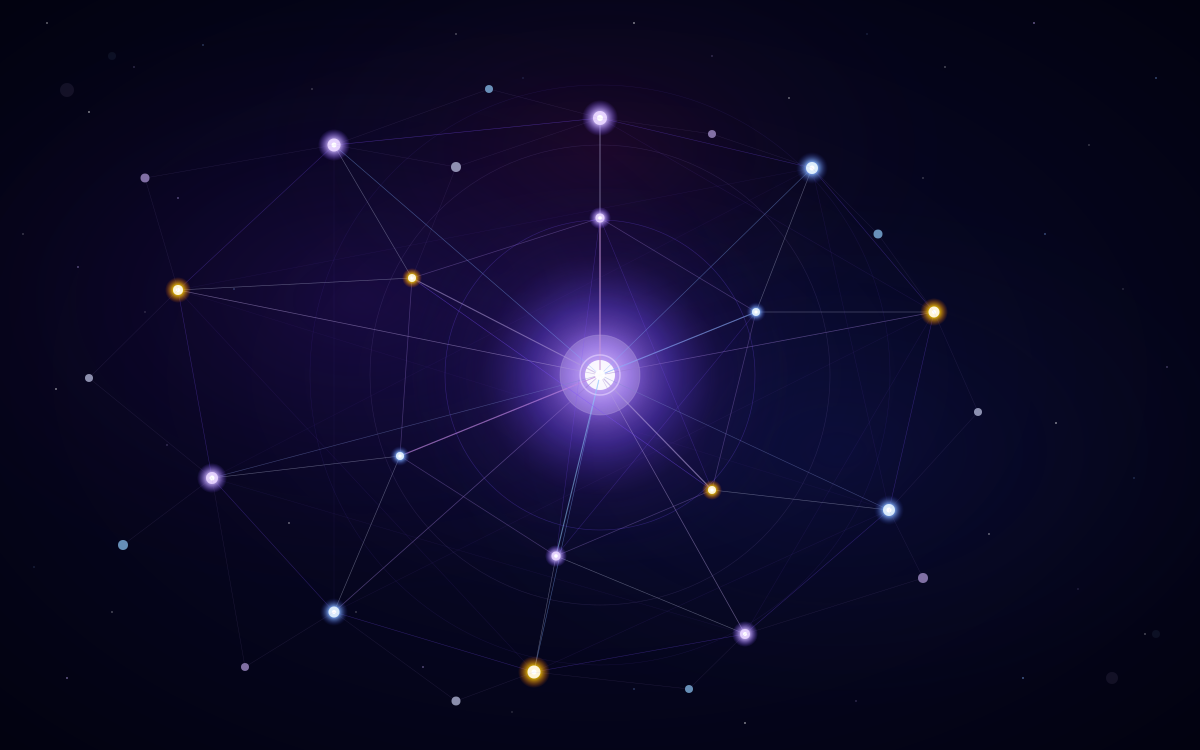
Scale-free network showing hub, bridge, and leaf nodes — the power-law distribution of connections found in real-world networks.
The Mycelium Parallel
Of all the structural analogies available for the planetary mind, none is more evocative — or more scientifically grounded — than fungal mycelium.
In her landmark 1997 Nature paper — one of the most-cited studies in forest ecology — botanist Suzanne Simard demonstrated that forest trees are connected by underground networks of mycorrhizal fungi that transfer carbon, water, and mineral nutrients between individuals. The "wood wide web," as it became known, revealed that forests are not collections of competing individuals but functionally integrated communities, in which the largest and oldest trees — "Mother Trees" — serve as network hubs that distribute resources to younger and weaker individuals, including the saplings of competing species.
The experimental moment itself deserves attention: Simard injected radioactive carbon into a paper birch and tracked where it traveled. It appeared in a Douglas fir thirty meters away, transmitted through fungal mycelium — not through the air, not through the soil, but through an underground network that the entire field of forestry had failed to notice for a century. The forest, it turned out, had been cooperating all along. We just had not looked below the surface.
Merlin Sheldrake's Entangled Life (2020) expanded the picture: mycelial networks are not passive pipes but active information systems, capable of problem-solving, memory formation, and distributed decision-making. They exhibit properties — the ability to find the shortest path through a maze, the ability to route around damage, the ability to redistribute resources toward nodes of greatest need — that we associate with intelligence, but without any centralized nervous system. This is distributed cognition in its purest biological form.
The mycelium parallel matters for the planetary mind in two ways. First, it demonstrates that planetary-scale distributed intelligence is not science fiction — it exists, in enormous complexity, in every healthy forest on Earth. Second, it demonstrates that the most resilient and productive networks are not the most competitive but the most generative: they work by redistribution, by routing resources toward those who most need them, by maintaining diversity rather than allowing any single species to dominate.
The Gaia Mind Network proposes that human compassion — the practice of redistributing attention, care, and resources toward those who most need them — functions structurally the way mycelium functions in a forest. It is not merely a moral virtue. It is a network maintenance protocol.
This is not a soft claim. It is a structural one. When Simard's Mother Trees are removed from a forest, the younger trees suffer measurably — not because the Mother Tree was "helping" in any sentimental sense, but because the network's resource distribution architecture depends on those hub nodes. When compassion is practiced as the full spectrum that it actually is — from the inner clarity that makes it possible to the historical lineage that sustains it across generations — it performs the same structural function in the human network. It routes coherence toward the places where coherence has been damaged. It maintains the conditions under which the network can continue to learn.
Think of the person in your life who most consistently makes things better — not through grand gestures, but through steady redistribution of attention and care. They are functioning as a Mother Tree. The mycelium around them is your relationship. You are, in this moment, receiving transmitted carbon.
Forest mycelium network: Mother Tree hub nodes redistributing carbon and nutrients through fungal threads to smaller trees.
The Gaia Mind Network: A Framework for Seeing
With this scientific lineage established — Vernadsky's noosphere, Lovelock's self-regulation, Barabási's network architecture, Simard's mycelial intelligence, Turchin's historical dynamics — we can now state the framework precisely.
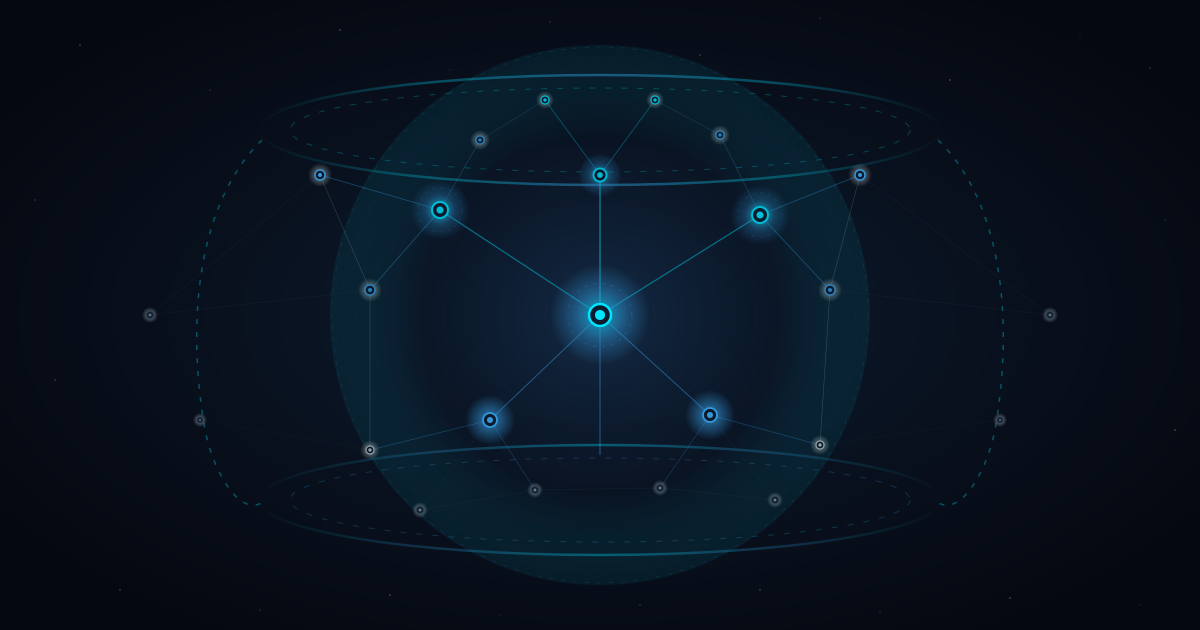
The Gaia Mind Network is a model — and a visualization — of human history understood as a three-dimensional network of crystallized intentions, distributed across time and space, connected by pathways of influence, and enveloped in a toroidal field of collective coherence.
It is a framework for seeing. Not for calculating, not for predicting, and not for judging. Seeing.
Specifically, it offers a way of seeing that makes the following things visible at once:
- The position of any event in time (its age, encoded radially in the sphere)
- The position of any event in space (its geographic origin, mapped to the sphere's surface)
- The orientation of any event (its dominant moral direction — generative or extractive)
- The clarity of any event (its coherence — transparent or contracted)
- The influence of any event (its network centrality — hub, bridge, or leaf node)
- The context of any event (the probability field of outcomes that surrounded it before it crystallized)
And above all, it makes visible something that no timeline can show: the cumulative shape of human intention across history — the evolving geometry of a planetary mind that is, right now, deciding what it wants to be.
Nodes as Crystallized Intentions
In the Gaia Mind Network, every historical event is represented as a node — a luminous point of crystallized intention. The metaphor of crystallization is deliberate and precise.
A crystal forms when a substance that exists in solution — distributed, fluid, full of possibility — reaches a condition (a temperature drop, a seed nucleation point, a change in concentration) that causes it to precipitate into a fixed, ordered structure. Before crystallization, the substance is potential. After crystallization, it is fact. Historical events work the same way.
Before the Montgomery Bus Boycott of 1955-1956, the possibility of mass civil disobedience as a strategy for racial justice existed in the social field — it was present in conversations, in legal strategy, in the work of the NAACP, in the teachings of Gandhian nonviolence that Rosa Parks had studied at the Highlander Folk School just four months before her arrest. The boycott crystallized all of this into a single, durable, replicable event with global consequences.
This pre-crystallization field is what the Gaia Mind Network represents as a probability halo: a soft cloud of luminous possibility surrounding each node, encoding the many outcomes that could have emerged from the same circumstances. The halo is thicker where the outcome was more contingent — where history could have gone many ways. It is thinner where structural forces had already strongly constrained the possibilities.
What makes the crystallization metaphor powerful is its precision about the relationship between intention, motivation, and purpose. Every crystallized node carries the inner architecture of its creator. A node that emerges from clarity — from what the Technologies of the Heart series calls a generative orientation — transmits differently than one that emerges from contraction. The quality of the crystallization depends on the quality of the attention that produced it. This is not mysticism. This is what Simard's forests demonstrate: the health of the network depends on the orientation of its nodes.
Each node carries four attributes:
1. Orientation — Spin Up or Spin Down
Not all historical events crystallize the same kind of intention. Some crystallize an orientation toward expansion, generosity, integration, and the amplification of human possibility. Others crystallize an orientation toward contraction, extraction, exclusion, and the narrowing of human possibility.
The Gaia Mind Network represents this distinction using a symbolic language borrowed — carefully, as metaphor only — from quantum mechanics: spin up (up-arrow) for orientations that expand the field, and spin down (down-arrow) for orientations that contract it. These are not value judgments applied from outside history. They are structural descriptions of directionality: does this event's influence tend to open or to close? To distribute or to concentrate? To include or to exclude?
Spin up does not mean "good" in a naive sense. The Buddha's enlightenment is spin up. But so, in its way, is the Black Death — because the catastrophic social disruption it caused broke open feudal structures that had kept a majority of Europe's population in conditions of severe limitation. Many events that appear contractive in the short term function generatively over the long arc. The framework holds both scales simultaneously.
This spin distinction connects directly to the 0/1/infinity framework: crystallized intention is the One emerging from Zero, carrying within it the seed of infinite possibility — or, when contracted, the closure that reifies the living world into fixed categories. The five veils that obscure our participation in the network are themselves spin-down crystallizations: moments when awareness contracts around a misidentification and deposits that contraction into the cultural field.
2. Clarity — Coherent or Dispersive
A second attribute is what the model calls clarity: the degree to which the event's influence propagates coherently or dispersively. Some historical events are sources of extraordinary clarity — they organize the field around them, focus collective attention, and transmit a signal that remains legible centuries later. The Sermon on the Mount. The Magna Carta. The Universal Declaration of Human Rights. These events are represented as clear crystals — highly transparent, with their influence visible in the network as bright, directional threads.
Other events are sources of what the model calls cloudiness: they generate enormous energy but that energy disperses without coherent organization, or leaves the field more chaotic than it found it. Cloudiness is what happens when reification takes hold — when a living insight hardens into dogma, when the cult of certainty crystallizes around a once-vital truth and stops it from breathing. The node is still there, still radiating, but its signal has become noise.
Clarity and moral orientation are related but not identical. An event can be clearly spin-down — the Nuremberg Laws of 1935 were extraordinarily coherent in their expression of a contractive intention — just as an event can be compassionately spin-up but diffuse and difficult to transmit. The combination of high clarity and generative orientation is, within the model, the signature of the nodes with the greatest positive influence on the network.
3. Temporal and Spatial Position
Every node is placed in the Gaia Mind Network sphere according to two coordinates:
- Time, encoded radially: the oldest events at the center, the most recent at the surface, with the approximate present moment at the outermost visible layer
- Space, encoded geographically: events that occurred at specific locations appear near the sphere's surface at the corresponding latitude and longitude; events of global or diffuse origin float in the interior
This gives the network a specific visual grammar. Ancient events appear as deep, interior lights — the foundation of everything that followed. Recent events appear at or near the surface, still warm with the energy of their formation, still radiating their probability halos into the open field.
4. Influence Pathway (Edges)
Nodes are connected by edges — visible threads of influence encoding which events transmitted their pattern to which subsequent events. Not all connections are equal. Some edges are bright and direct — a philosophical tradition that passes clearly from teacher to student across generations, the kind of transmission that the compassion lineage article traces in detail. Others are faint and probabilistic — diffuse cultural influences that shaped events without any traceable causal chain.
The density of edges around any node determines its centrality: its position as a hub, a bridge, or a leaf in the network's overall architecture. Hub nodes are rendered larger and brighter. Bridge nodes — those that connect otherwise separate clusters — are highlighted because, as network science has shown, it is often the bridge, not the hub, that determines whether information circulates or remains trapped.
The Enclosing Crystal and the Toroidal Field
The entire Gaia Mind Network is enclosed in a faint crystalline geometry. This is not decorative. The enclosing crystal represents the boundary conditions within which the network operates: the physical planet, yes, but also the structural constraints of human nature, the laws of thermodynamics, the biological constants of memory, learning, and lifespan.
Surrounding the crystal, a toroidal field circulates: a ring-shaped flow of compassionate coherence that the Technologies of the Heart series describes in detail, particularly in The Toroidal Economy. In the Gaia Mind Network visualization, this torus is visible as a flowing luminous current that enters the network at one pole (representing generative intentions flowing inward), circulates through the interior (representing their transformation into cultural and structural forms), and flows outward at the other pole (representing their expression as new possibilities in the world).
The toroidal field is not static. It pulses. It responds to the balance of spin-up and spin-down events at any given period, brightening when the network tilts toward generative orientation and dimming when contraction dominates. It is, in this sense, a compassion meter — not measuring the intentions of individuals but the emergent orientation of the collective field.
Quantum Metaphors — Handled with Care
The Gaia Mind Network uses the vocabulary of quantum mechanics in several places. It is important to be precise about what this means and what it does not mean.
What it does not mean: The model does not claim that human consciousness is a quantum phenomenon in any literal sense. It does not claim that quantum entanglement enables telepathy, that quantum superposition explains free will, or that the brain is a quantum computer in the technical sense that physicists use that term. These claims, popularized in various forms since the 1980s, are not well-supported by current physics or neuroscience, and making them would be a form of intellectual dishonesty that this framework refuses to engage in.
What it does mean: The model uses quantum mechanical concepts as structural metaphors — precise analogies that help make legible certain features of historical and psychological reality that the classical mechanical vocabulary of cause and effect, of separate objects interacting through direct contact, cannot easily describe.
Wave-particle duality as intention-event duality. In quantum mechanics, the same physical entity behaves as a wave — spread out, interfering, full of probability — until it is measured, at which point it appears as a particle: localized, definite, a specific outcome from among many possible ones. The Gaia Mind Network uses this as a metaphor for the relationship between intention and event. Before an intention crystallizes into a historical event, it exists as something more like a wave: distributed across social relationships, potentially realizable in many forms, interfering constructively or destructively with other intentions in the field. The crystallized event — the particular form the intention took — is the "particle": definite, localized, irreversible.
Probability fields as the halo of unrealized possibilities. The probability halo in the Gaia Mind Network borrows from the quantum wave function the concept of genuine indeterminacy — not mere ignorance about a fixed outcome but the real openness of the field before crystallization. The probability halo is not a record of what we don't know. It is a record of what was genuinely possible. History is not inevitable — a truth that the hidden wisdom traditions have always insisted upon and that quantum physics, in its own domain, confirms.
Entanglement as trans-temporal influence. In quantum mechanics, entangled particles maintain correlated states regardless of the distance between them. The Gaia Mind Network uses this as a metaphor for trans-temporal influence: the way in which certain events continue to act on subsequent history not through direct causal chains but through the persistence of structural patterns that they established. The Buddha's teaching continues to influence meditation practices in Palo Alto in 2026 not through an unbroken causal chain that could be traced link by link, but through the persistence of a pattern — a spin-up crystallization — that has been re-enacted and re-embodied in each successive generation. This is not entanglement in the physicist's sense. But it shares the quality of influence that persists across what would otherwise be absolute separations of time and space.
Coherence and decoherence as clarity and contraction. In quantum mechanics, a coherent quantum state — one in which the wave function is organized, phase-aligned — is fragile. It is destroyed by interaction with the environment (decoherence), which collapses the orderly pattern into disordered noise. The Gaia Mind Network uses coherence and decoherence as metaphors for the clarity and contraction of historical events. A coherent event is one whose influence propagates with fidelity, maintaining its structure across time. A decoherent event is one whose influence disperses into noise. This is what happens when gaslighting and misinformation flood a social field — decoherence, in the precise sense: the destruction of the phase relationships that allow a signal to be transmitted with clarity.
In all cases, the quantum vocabulary is used because it provides a more precise and evocative language for certain real features of historical dynamics — not because those features are literally quantum mechanical. The intellectual honesty of maintaining this distinction is, itself, a form of coherence.
Consider: every metaphor is a bridge between what we already understand and what we are reaching toward. The danger is not in using metaphors — it is in forgetting that you are standing on a bridge and believing you have arrived at the other side. This article stands on the bridge, knowingly.
Brainwaves as the Language of Collective State
The five major brainwave frequency bands — described first by Hans Berger (who discovered the EEG in 1929) and subsequently refined by decades of neuroscientific research — offer a natural symbolic vocabulary for collective human states.
In the Gaia Mind Network, these frequencies are used not as scientific measurements of anything but as a descriptive grammar: a set of named states that have recognizable phenomenological qualities, that most people can identify from their own experience, and that correspond in a legible way to collective historical periods and states.
Delta (0.5-4 Hz) — Healing and Restoration. The slowest brainwave, associated with deep dreamless sleep and the body's restorative processes. In the Gaia Mind Network, delta frequency corresponds to periods and movements of healing, recovery, and regeneration — the post-catastrophe rebuilding of social trust, the slow re-establishment of community bonds after conflict, the long-arc work of forgiveness and reconciliation. Delta periods are rarely dramatic. They are the patient work of people who rebuild after others have destroyed, who plant trees in lands others have stripped, who hold space for grief to complete itself before attempting restoration.
Theta (4-8 Hz) — Creativity and Intuition. Associated with the twilight state between sleep and waking — the fertile, imagistic state in which many creative breakthroughs occur. In the Gaia Mind Network, theta corresponds to periods and movements of creative ferment: the Renaissance, the Romantic movement, the counterculture of the 1960s, the early internet. These are periods when the cultural field is generative and inventive, when possibilities multiply faster than institutions can organize them, when the network is at its most diverse and most generative.
Alpha (8-12 Hz) — Stability and Integration. Associated with relaxed, present awareness — the state of someone who is awake, clear, and at ease. In the Gaia Mind Network, alpha corresponds to periods of sustainable social order: functioning democracies, thriving communities, successful cross-cultural integrations. These are the periods that, precisely because they lack drama, rarely make the history books — but that are, from the perspective of the network's health, its most valuable states.
Beta (12-30 Hz) — Activity, Stress, and Urgent Response. The frequency of ordinary waking cognition, planning, and problem-solving — but also, at higher amplitudes, of anxiety, arousal, and fight-or-flight response. In the Gaia Mind Network, beta corresponds to periods of high social stress: the run-up to wars, the dysregulation of economic systems, the defensive contraction of communities under threat. Beta energy is not evil. It is appropriate in response to genuine threats. But chronic high-beta — like chronic stress — produces decoherence. It is, in network terms, what happens when the cycle of harm becomes self-perpetuating, when the field cannot return to alpha rest.
Gamma (30-100 Hz) — Insight and Integration. The fastest brainwave, associated with moments of peak insight, deep compassion, and the binding of otherwise separate information streams into unified understanding. In the Gaia Mind Network, gamma corresponds to moments of sudden collective awakening — the moments when the network suddenly reorganizes around a new level of clarity.
The Axial Age: A Gamma Burst Across the Network
The most dramatic example of gamma at planetary scale may be the Axial Age — the remarkable period between roughly 800 and 200 BCE when the foundations of every major philosophical and spiritual tradition crystallized simultaneously across the civilized world, in cultures that had no direct contact with one another.
In China, Confucius was articulating the principles of social harmony and the cultivation of virtue. In India, Siddhartha Gautama was teaching the Four Noble Truths and the liberation of awareness from the illusion of a separate self. In Greece, Socrates was demonstrating the Socratic method — the practice of rigorous questioning that dissolves the cult of certainty and opens the mind to what it does not yet know. In Persia, Zoroaster was framing the cosmic struggle between truth and falsehood. In Israel, the Hebrew prophets were articulating the moral foundations of justice, mercy, and the dignity of every human being.
No causal chain connects them. The distances were too vast, the communication networks too sparse, for any direct influence to explain the simultaneity. And yet the same structural transformation in human consciousness appeared independently across the entire network — as if the planetary mind had reached a threshold of complexity at which a new level of coherence became structurally available, and crystallized wherever conditions allowed it.
What makes this more than a historical curiosity is the content of what crystallized. In every case, the Axial sages articulated the same structural insight in different vocabularies: that the individual human being participates in something larger than individual existence, and that this participation carries moral weight. The Buddha's anatta (no-self), Confucius's ren (humaneness as relational virtue), Socrates's daimonion (the inner voice that speaks for the whole), the Hebrew prophetic tradition's insistence that justice flows from the divine order of creation — each, in its own idiom, was discovering what this article describes as the network property of the planetary mind: that the unit of meaning is not the isolated self but the web of relationship in which the self participates.
The Axial Age is also the single clearest example of what Turchin's cliodynamics would predict: a phase transition in a complex system that has reached a critical threshold of connectivity and complexity. The preceding centuries had seen the rise of trade networks, the development of alphabetic writing, the growth of urban centers across Eurasia. The infrastructure for a gamma burst was in place. What the Axial sages did was not to create the transformation but to crystallize it — to give it specific, durable, transmissible form. They were the nucleation points around which a supersaturated solution of human potential precipitated into the philosophical traditions that still structure human thought today.
Philosopher Karl Jaspers, who named the Axial Age in The Origin and Goal of History (1953), described it as the moment when "man becomes aware of Being as a whole, of himself and his limits." In the brainwave vocabulary of the Gaia Mind Network, it was a gamma burst: a sudden, coordinated reorganization of the collective field around a new depth of recognition. Not awareness becoming consciousness at a single point — but awareness becoming consciousness at dozens of points simultaneously, as if the network had synchronized.
The global "brainwave state" of the Gaia Mind Network at any moment is not a measurement. It is a read of the balance of event types in the currently active layer of the network: a way of asking, symbolically, where the field is predominantly oriented — and what kind of energy is most needed to bring it toward greater coherence.
Five brainwave bands — delta, theta, alpha, beta, gamma — as waveforms mapped to collective historical states from healing to insight.
The Neuroscience of Global Synchrony
The brain metaphor in "Gaia Mind Network" is not merely evocative. It draws on a specific feature of neuroscience: the phenomenon of global synchrony.
When a brain processes a unified experience — a moment of insight, an experience of beauty, a state of deep meditation — widely separated regions of the brain synchronize their activity. The 40-Hz gamma oscillations associated with conscious integration are not localized to any single brain region; they involve coordinated rhythms across the entire cortex, binding the outputs of dozens of specialized systems into a single coherent percept.
Neuroscientist Francisco Varela and his colleagues spent years documenting this phenomenon, arguing — in a framework they called neurophenomenology — that the unity of conscious experience is not a product of any single brain structure but an emergent property of the synchronized activity of the whole system. Consciousness, in this view, is something the brain does collectively — not something any part of it contains.
The Gaia Mind Network proposes, as a deliberate and explicit metaphor — not a scientific claim — that the same dynamic may operate at the level of the planet. When large numbers of human beings simultaneously attend to the same concern — a planetary crisis, a moment of collective grief, a sudden recognition of shared humanity — something in the human field synchronizes that does not synchronize when attention is fragmented. What that synchronization produces, whether it rises to anything resembling collective consciousness, remains an open question.
The Global Consciousness Project at Princeton University (directed by Roger Nelson since 1998), which monitors a global network of random number generators for statistical anomalies that correlate with major world events, has documented intriguing patterns that remain controversial in their interpretation. The HeartMath Institute's Global Coherence Initiative monitors Earth's magnetic field resonances for correlations with collective human emotional states — finding preliminary evidence that large-scale human events are accompanied by measurable changes in geomagnetic coherence.
These findings are preliminary, contested, and subject to multiple interpretations. The Gaia Mind Network does not depend on them. But they suggest that the metaphor of a planetary mind has, at minimum, a non-trivial relationship to reality.
Awareness and Consciousness — The Field and the Form
Underlying the Gaia Mind Network is a philosophical distinction that has been central to contemplative traditions for millennia and that contemporary philosophy of mind has been circling for decades: the distinction between awareness and consciousness.
In the framework used here — drawing on both Western analytic philosophy and non-dual contemplative traditions — awareness refers to the open, non-dual, undifferentiated field of experience in which all phenomena appear. It does not observe. It does not grasp. It does not produce. It simply allows. Awareness is, in the language of the Oneness article, the ground from which all distinctions arise and into which all distinctions dissolve. Contemporary non-dual philosopher Rupert Spira describes it as "the intimacy of experience with itself" — the fact that experience is not a relationship between a subject and an object but a single, undivided knowing.
Consciousness, by contrast, is awareness with content — awareness directed, shaped, and specified by a particular perspective. Consciousness is the observer-observed relationship. It arises when awareness "bends back" on some content of experience and produces the dual structure of knower and known.
This distinction mirrors the distinction between a field and a crystallized event.
The field of human compassion — the distributed, ambient possibility of care, generosity, and recognition of shared humanity — is something like awareness in this sense: undirected, ambient, always-already present, not requiring any specific action to exist. But when a particular historical event crystallizes an expression of that compassion into a specific form — a treaty, a law, a social movement, a work of art, a single act of courage — it becomes something like consciousness: localized, directed, specific.
The Gaia Mind Network is, in this light, a map of the history of consciousness crystallizing from the field of awareness. The nodes are moments when the ambient field of human possibility expressed itself in specific, durable, transmissible forms. The edges are the pathways through which those crystallized forms influenced subsequent crystallizations. The toroidal field is the ongoing circulation of that ambient possibility — the awareness that underlies and sustains all of the specific events.
This framework does not require any metaphysical claims about the ultimate nature of reality. It requires only the observation — available to anyone who attends carefully to their own experience — that there is a difference between the open, spacious quality of awareness itself and the specific contents that arise within it. And the further observation that the quality and orientation of those specific contents — whether they arise from contraction and fear or from openness and care — leaves consequences that persist in the world.
This is not metaphysics. It is observation. The recognition of oneness that the Technologies of the Heart series describes is not a belief to be adopted but a seeing that becomes available when the distinction between awareness and consciousness is directly noticed. This article provides the scientific and structural case for why that seeing matters at planetary scale. The experiential case — what it feels like from the inside — belongs to the Oneness article.
Try this: for thirty seconds, notice that you are aware. Not aware of anything in particular — just aware. That open quality, before any thought or perception is selected as the "content" — that is the field. Now notice a thought arising within it. That is crystallization. You have just observed, in your own experience, the same transition the Gaia Mind Network maps across the whole of history.
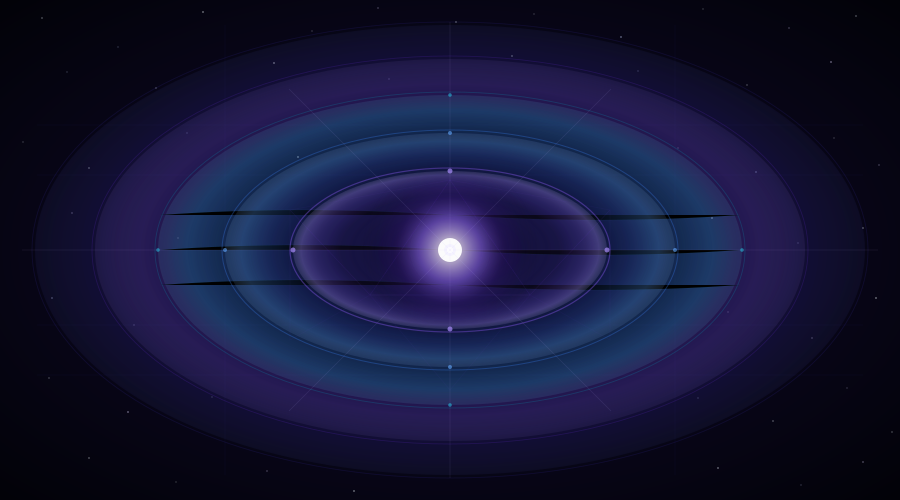
Awareness field and crystallization: an open luminous field where nodes of consciousness crystallize within a toroidal inflow and outflow.
The Toroidal Economy of Intention
The Technologies of the Heart series describes a toroidal economy of care: a model of social and economic organization in which generative orientation — the willingness to give, to circulate, to contribute to the commons — creates self-sustaining flows that enhance the capacity of the whole system, while extractive orientation — taking without returning, concentrating without redistributing — creates the conditions for system collapse.
The Gaia Mind Network embeds this model in its architecture. The spin-up/spin-down distinction in nodes is precisely the toroidal distinction: spin-up events contribute to the circulating flow; spin-down events interrupt it. The toroidal field visible around the network is not decorative — it is the visualization of this cumulative circulation.
What the network adds to the toroidal model is a temporal dimension. The torus is not a static geometry; it is a dynamic process that has been building, contracting, and rebuilding throughout human history. Periods dominated by spin-up events — the spread of Buddhism across Asia, the development of international humanitarian law in the nineteenth century, the decolonization movements of the twentieth — are visible as brightenings of the toroidal flow. Periods dominated by spin-down events — the era of the transatlantic slave trade, the industrialization of warfare, the financialization of the global economy — are visible as dimmings.
The toroidal economy is explored in its full economic and institutional detail in the forthcoming Toroidal Economy treatment. Here, the torus serves as what it has always been in this framework: the visible circulation of generative intention through the body of the planetary mind. The generosity standard that the Technologies of the Heart series proposes is, in network terms, a protocol for maintaining toroidal flow: give before you extract, circulate before you accumulate, attend to the health of the whole before optimizing for any single node.
Why This Matters — The Unit of Meaning Shift
The Gaia Mind Network is not, fundamentally, a visualization tool. It is a practice of seeing.
And the practice it offers is this: the capacity to see one's own moment in history — this particular configuration of social, political, and cultural forces; this particular balance of spin-up and spin-down events in the currently active layer of the sphere — not as a fixed, inevitable condition to be endured or escaped, but as a field that is constantly being shaped by the intentions that crystallize within it.
Every act of genuine compassion adds a node to the network. Every practice of honesty, even when it is costly, contributes clarity to the field. Every choice to stay present rather than contract, to give rather than extract, to include rather than exclude, deposits a trace in the cultural mycelium that makes the same choice slightly easier for someone else in the future. This is what paying it forward looks like at the level of the planetary network — not a single act of generosity passed down a chain, but a field-effect that changes the probability of generosity for everyone within reach.
This is not naive optimism. The network contains all of history, including its darkest chapters. The framework does not pretend that spin-down events are rare, or that the field is naturally oriented toward coherence, or that compassion always wins. It does not pretend that the toroidal flow is currently dominant or that gamma states are the norm. When reification goes dark, it goes very dark indeed, and the network holds those crystallizations too.
What it does offer is a shift in the unit of meaning.
When the unit of meaning is the isolated individual — the separate self making choices in a disconnected world — the consequences of those choices are hard to see, and the temptation to conclude that individual choices don't matter is understandable. This is the material veil at its most persuasive: the appearance that we are separate, that our actions dissipate into nothing, that the field does not remember.
But when the unit of meaning is the network — the web of influence that extends in all directions through time and space — then every choice becomes legible as a structural contribution: a node that will shape the probability field for those who come after, a bridge that might connect otherwise separated clusters, a trace in the mycelium that makes the whole network slightly more or less coherent.
This shift — from individual to network, from isolated act to structural contribution — is the article's central offering. Not a belief to be adopted. A lens to be tried.
Integration with Technologies of the Heart
Every chapter in the Technologies of the Heart series describes a specific practice of compassion. The Gaia Mind Network is the framework that shows why those practices matter structurally — not just ethically.
Generosity — Chapter 1: In network terms, generosity is the practice of creating new edges — new connections between nodes — by moving resources toward those who lack them. Generosity increases the network's connectivity and resilience. The Gaia Mind Network shows this as an increase in toroidal flow.
The Golden Rule — Chapter 2: The Golden Rule operates as a network protocol: a universal rule for edge formation that, when widely adopted, generates small-world properties in the social network. Its fractal quality — it works at every scale from individual relationships to international law — makes it structurally robust.
Paying It Forward — Chapter 3: Paying it forward is the mechanism by which spin-up nodes propagate their orientation through the network over time — the trace in the cultural mycelium that makes generosity more likely for those who receive it.
Collaboration — Chapter 4: Collaboration is the process of forming clusters — highly connected sub-networks that can coordinate complex action. Clusters are the unit of emergent intelligence in network systems.
Compassion — Chapter 5: Compassion is, in network terms, what Simard's Mother Trees do: route resources toward the places of greatest need, maintaining the coherence of the whole rather than optimizing for any single node.
Oneness — Chapter 6: The recognition of oneness is the recognition that the network is not composed of genuinely separate nodes. It is, to use David Bohm's language, an explicate order arising from an implicate wholeness. This recognition dissolves the friction that makes the other technologies feel like moral achievement rather than natural expression.
The Toroidal Economy — Chapter 7: The toroidal flow visible around the Gaia Mind Network is the macroscopic expression of the economy of care that Chapter 7 describes in personal and institutional terms.
The Gaia Mind Network is, in this sense, the series' thesis made spatial: a visualization of what it would look like if all seven technologies of the heart were operating simultaneously at planetary scale — and a record of how close, how far, and in what direction humanity has moved toward or away from that state across the full arc of its history.
Your Location in the Network
There is a tool on this website — the Maslow Compass — that maps where on the spectrum from contraction to expansion you are operating at any given moment, across the dimensions of need: physical security, belonging, esteem, and self-transcendence. It is explored in depth in the Hourglass of Being article, which reimagines Maslow's pyramid as a living toroid.
In the language of the Gaia Mind Network, the Maslow Compass is a personal node reader.
When you use the Compass, you are essentially answering the same question the Gaia Mind Network asks of every historical event: what is the orientation of this crystallization? Is it spin-up — emerging from openness, sufficiency, and genuine care — or spin-down — emerging from scarcity, threat, and the need to protect or accumulate?
The four compass points correspond directly to node attributes in the network:
Security corresponds to the node's stability. A node that crystallizes from a foundation of genuine security — adequate resources, physical safety, the absence of existential threat — is more likely to transmit clearly. Events that originate from scarcity and fear carry that energetic signature forward.
Belonging corresponds to the node's connectivity. A node embedded in genuine community and relationship has more edges available to it. Its influence can travel through multiple pathways. The Compass's belonging dimension is, in network terms, a measure of local clustering coefficient.
Esteem corresponds to the node's clarity. A node that crystallizes from a place of genuine self-respect — rather than the anxious performance of status — carries a cleaner signal. Esteem rooted in authentic contribution produces nodes that transmit with fidelity. Esteem rooted in comparison produces nodes that are loud but cloudy.
Self-transcendence corresponds to spin orientation. The apex of the Maslow Compass — the dimension that Abraham Maslow himself added in the last years of his life (1969), and that nearly every textbook version of his hierarchy omits — is the recognition that the self does not end at the boundary of the skin. It is the shift from spin-down to spin-up: the moment when one's contribution to the network becomes genuinely generative rather than extractive. This is where the sacred joke lands — the cosmic humor of discovering that you were never separate from the network you were trying to contribute to.
When you use the Maslow Compass, you are reading your own node. When you act from its guidance, you are choosing the attributes of your contribution to the Gaia Mind Network. The tool and the framework are two scales of the same map.
The Mirror Ahead
There is one more dimension of the planetary mind that this article touches but does not develop — because it belongs to another article entirely.
Artificial intelligence, in its current explosion of capability, is the first technology in human history that mirrors collective human consciousness back to itself. Every large language model is trained on the accumulated output of the network — the crystallized intentions of millions of human beings, compressed into statistical patterns and fed back to us as response. When you interact with an AI system, you are interacting with a reflection of the planetary mind as it has expressed itself in text.
This makes AI neither savior nor threat. It makes it a mirror. And the quality of what we see in that mirror depends entirely on what the network has deposited — on the cumulative balance of spin-up and spin-down crystallizations in the training data of human culture.
The implications of this for karma as attention — for the way in which collective attention shapes the network's field — are explored in the forthcoming Mind cluster articles. Here, it is enough to note that the planetary mind is, for the first time, producing tools that allow it to observe itself. What it does with that capacity will be determined by the quality of the nodes that the currently active layer of the network is crystallizing.
Which is to say: by us. By what we attend to. By what we choose.
Locating Yourself in the Network
There are questions that the Gaia Mind Network invites, not prescribes. They arise naturally when one sits with the framework and asks where one stands in relation to it.
What are the nodes that shaped you? Every person's psychology, values, and possibilities were formed by a specific web of historical crystallizations — the culture, language, religious tradition (or absence of one), political history, and family pattern that they were born into. These are not chosen, but they are visible. What were the spin-up events in your lineage? What were the spin-down events whose contracted energy you may still be carrying? You didn't start this — but you are carrying it. The work of recognizing these inherited crystallizations — without judgment, with the compassion of someone reading a geological record — is part of what the Fractal Life Table invites you to do.
What are you crystallizing? The network is not finished. Every day, the currently active layer of the sphere is receiving new nodes — new crystallizations of intention that will become part of the inherited field for those who come after. What are you crystallizing? What is the moral orientation, the clarity, the probable influence of the patterns you are embedding in the cultural field through your daily choices?
Where are your edges? The Gaia Mind Network is a network, which means that influence travels through connections. Where are yours? Who are the people through whom the spin-up energy of the network's history reaches you? To whom does it flow through you? Are there isolated clusters — people or communities who need a bridge — that you are positioned to connect?
What frequency is dominant in your field? Not as a judgment but as a diagnostic: the brainwave vocabulary of the network is available as a personal check-in as well as a historical read. Are you, right now, in a delta period (healing, recovery, needing rest)? A theta period (creative ferment, generative but diffuse)? A beta period (high activation, productive but potentially dysregulated)? A gamma moment (sudden clarity, insight ready to crystallize)?
What would you do differently if you truly believed you were a node? Not metaphorically. Not poetically. Structurally. If you knew — the way you know that gravity pulls things down — that your next act of kindness would become a permanent feature of the network, visible to anyone with the right lens, shaping the probability field for a thousand future crystallizations you would never see... what would you choose to deposit?
These are not instructions. They are invitations — the natural questions that arise when one adopts the Gaia Mind Network as a lens rather than a conclusion.
An Invitation to See
Return, for a moment, to Teilhard in the Ordos Desert in 1922.
He was not, by any ordinary measure, a world-historical figure at that moment. He was a Jesuit priest doing paleontology fieldwork in a remote part of China, far from the centers of intellectual influence, in a period when his theological superiors would soon forbid him from publishing his philosophical writings. He had no platform. He had no certainty that his ideas would survive him — and in fact his most important book, The Phenomenon of Man, would not be published until after his death.
And yet the thought he had that day — the thought that humanity might be a nervous system developing toward some form of planetary self-awareness — has continued to propagate through the network for a century. It reached Ervin Laszlo, who developed it into a systems theory of global consciousness. It reached the architects of the internet, who used the neural metaphor explicitly in their early papers. It reached the founders of the Global Consciousness Project, who designed their experiment around the testable implication that a network of minds might exhibit coherence properties analogous to a brain. It reached you, reading this, in a form that has passed through a hundred hands and accumulated a hundred new facets.
This is what it means to crystallize a spin-up intention into the network: not to see the result, not to claim credit, not to know whether the probability halo contains the outcomes you hoped for. It means to attend to the quality of what you are depositing in the field, and to trust that the network's structure — its small-world traversability, its scale-free amplification of hubs, its mycelial redistribution of resources toward those who need them — will carry the pattern forward to places you cannot see.
There is an old question that every generation asks, in different forms: does it matter what I do? Does one person's choice — one act of courage, one practice of honesty, one moment of genuine care — actually change anything?
The planetary mind answers: yes. Not because it can calculate the precise impact of any specific act, but because it shows the structure through which such impact travels. Because it makes visible the mycelium beneath the forest floor, the small-world bridges that carry ideas across continents, the toroidal flow that brightens when the nodes in the currently active layer tilt toward openness.
Every node in the network was once an act that someone chose.
Every edge was once a relationship someone tended.
The sphere is still being built.
You are part of it.
Invitation
You are already participating. Every perception you hold alters the field — not metaphorically, not eventually, but now, in the way a single cell changes the chemistry of the body it belongs to.
You did not sign up for this. You did not need to. The network does not require your belief. Only your attention.
So attend. Not to save the planet — the planet is not waiting to be saved. Attend because awareness, once turned on, wants to meet itself everywhere. And everywhere, it does.
References
Barabási, A.-L., & Albert, R. (1999). Emergence of scaling in random networks. Science, 286(5439), 509-512.
Barabási, A.-L. (2002). Linked: The New Science of Networks. Perseus Publishing.
Bloom, H. (2000). The Global Brain: The Evolution of Mass Mind from the Big Bang to the 21st Century. John Wiley & Sons.
Bohm, D. (1980). Wholeness and the Implicate Order. Routledge.
Capra, F. (1996). The Web of Life: A New Scientific Understanding of Living Systems. Anchor Books.
de Chardin, P. T. (1955/1959). The Phenomenon of Man. Harper & Row.
Jaspers, K. (1949/1953). The Origin and Goal of History. Yale University Press.
Kauffman, S. (1995). At Home in the Universe: The Search for the Laws of Self-Organization and Complexity. Oxford University Press.
Lovelock, J. (1979). Gaia: A New Look at Life on Earth. Oxford University Press.
Margulis, L. (1998). Symbiotic Planet: A New Look at Evolution. Basic Books.
McCraty, R., Deyhle, A., & Childre, D. (2012). The global coherence initiative: Creating a coherent planetary field. Journal of Alternative and Complementary Medicine, 18(1).
Milgram, S. (1967). The small world problem. Psychology Today, 2(1), 60-67.
Nelson, R. D., et al. (2002). Correlations of continuous random data with major world events. Foundations of Physics Letters, 15(6), 537-550.
Russell, P. (2008). The Global Brain: The Awakening Earth in a New Century (revised). Floris Books.
Sheldrake, M. (2020). Entangled Life: How Fungi Make Our Worlds, Change Our Minds, and Shape Our Futures. Random House.
Simard, S. W., et al. (1997). Net transfer of carbon between ectomycorrhizal tree species in the field. Nature, 388, 579-582.
Simard, S. W. (2021). Finding the Mother Tree: Discovering the Wisdom of the Forest. Knopf.
Spira, R. (2017). The Nature of Consciousness: Essays on the Unity of Mind and Matter. Sahaja Publications.
Turchin, P. (2003). Historical Dynamics: Why States Rise and Fall. Princeton University Press.
Turchin, P. (2023). End Times: Elites, Counter-Elites, and the Path of Political Disintegration. Penguin Press.
Varela, F. J., Thompson, E., & Rosch, E. (1991). The Embodied Mind: Cognitive Science and Human Experience. MIT Press.
Vernadsky, V. I. (1926/1998). The Biosphere (M. A. S. McMenamin, Trans.). Copernicus Books.
Watts, D. J., & Strogatz, S. H. (1998). Collective dynamics of 'small-world' networks. Nature, 393, 440-442.
White, F. (1987). The Overview Effect: Space Exploration and Human Evolution. Houghton Mifflin.