She had checked every box the pyramid promised. Safety — yes. Belonging — mostly. Even a kind of purpose, worn like a well-tailored coat that fit everywhere except across the shoulders. And yet, at 3 a.m., she found herself in the kitchen watching an old hourglass her grandmother had left her — not watching the sand, exactly, but watching the narrow waist where all motion paused before choosing direction. The grains hung there for just a fraction of a second, suspended between worlds, luminous in the lamplight, as if gravity itself had to think. Something in her recognized that waist. She lived there — between what she had gathered and what she had yet to give, between who she had become and who she was still becoming. The sand resumed. And the question formed the way questions do at 3 a.m.: not with words first, but with a felt shape. What if the map they gave us was never the full map? What if the geometry of a human life is not a ladder pointing toward some distant summit, but something that breathes — something that, like the hourglass, moves in both directions at once, always, without stopping?
Key Takeaways
- Maslow's pyramid is not a ladder but an hourglass — two pyramids joined at the heart pivot of Purpose, both always active simultaneously, the pyramid Maslow never drew having erased his own corrections.
- The seven Dimensions of Being (Safety, Financial Ground, Belonging, Purpose, Emotional Resilience, Growth, Inner Peace) each carry two orientations — upward (generative) and downward (depleting) — so the relevant question is never which level one occupies but which direction energy is moving.
- The Four Toroidal Flows — Inner Upward, Inner Downward, Outer Upward, Outer Downward — describe the full circulation of a human life, and the hourglass is the visible cross-section of that living torus.
- "Catching falling knives" names the universal pattern of inner downward flow: the suffering is not in the falling but in the grasping, a dynamic every major contemplative tradition has identified and named.
- The heart pivot at the center of the hourglass is not a level to be reached but a constant presence — the membrane between the developmental arc of becoming and the expressive arc of giving.
- The Maslow Compass does not rank or score; it mirrors how energy moves across all seven dimensions at once, because honest seeing is itself the first movement toward change.
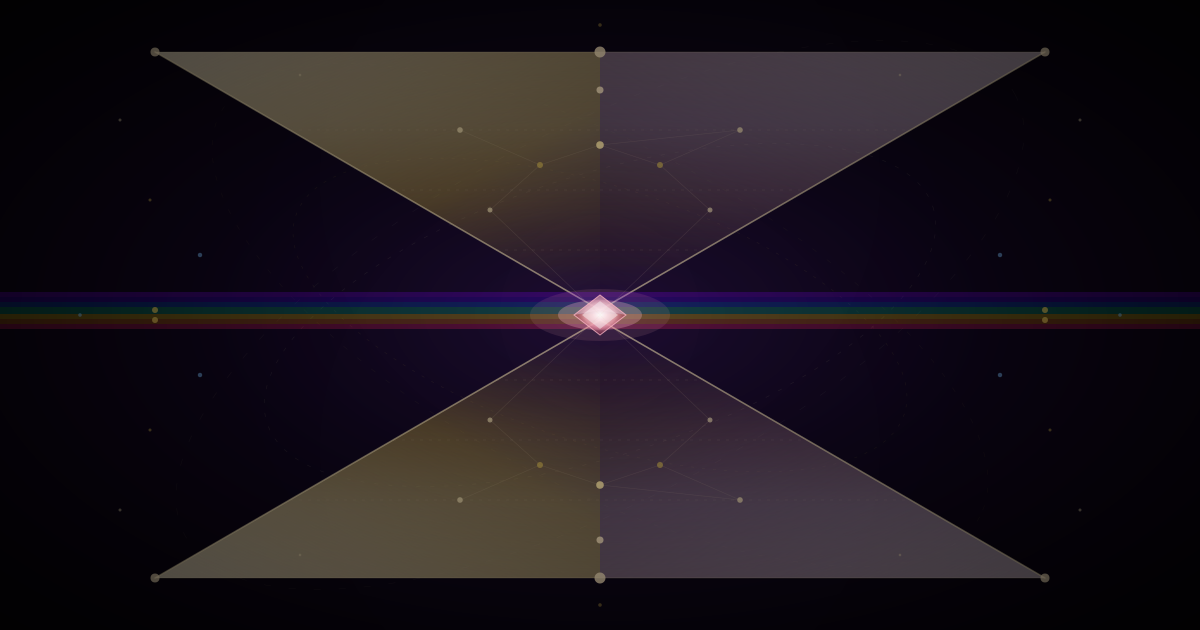
The Hourglass of Being. Two pyramids joined at the heart pivot of Purpose. Inner and outer flows circulating simultaneously — not as a sequence, but as a living field. Each color represents one of the seven Dimensions of Being: Red (Safety), Orange (Financial Ground), Yellow (Belonging), Green (Purpose), Blue (Emotional Resilience), Indigo (Growth), Violet (Inner Peace).
First the belly, then the dance.
— Spanish proverb (translated)
The Problem with the Pyramid
For eighty years, we have been reading one of psychology's most powerful maps — and reading it upside down. Not because Abraham Maslow was wrong. Because the pyramid we drew in his name was never the full picture.
The correction is geometric. Replace the pyramid with the hourglass — two pyramids joined at the heart, both always active simultaneously, energy moving in four directions at once.
Maslow's hierarchy of needs is one of the most recognized frameworks in the history of human psychology, reproduced in textbooks and corporate training decks and motivational posters on every continent. Yet the iconic pyramid diagram that carries his name was not drawn by Maslow himself. It was a visual simplification popularized decades after his 1943 paper in Psychological Review, and it flattened a dynamic, living theory into a static, hierarchical icon.
The pyramid implies three distortions that Maslow himself spent his final decades quietly correcting.
The first is linearity — the suggestion that human development moves in a single direction, upward, one rung at a time. The second is sequentiality — the implication that higher needs cannot stir until lower ones are fully satisfied. The third is finality — the assumption that reaching self-actualization is an arrival, a summit, the end of the journey.
None of these are accurate, and Maslow said so, repeatedly, in his later work. What the pyramid diagram silenced was the most revolutionary insight of his career: that human beings do not climb toward flourishing. They circulate through it.
This matters beyond the history of psychology. These three distortions — linearity, sequentiality, finality — have quietly shaped how entire cultures think about human development. They show up in corporate ladder metaphors, in the notion that you must "get your life together" before you can serve others, in the guilt people feel when they experience deep inner peace while their finances are in ruin or their relationships are torn. The pyramid taught us that such experiences are impossible. The hourglass reveals they are inevitable — because all dimensions are always active, always simultaneously in motion.
The hourglass does not simply describe human needs more accurately. It reveals the hidden geometry of what it means to be fully alive: not a summit to be reached, but a living circulation to be inhabited. And this geometric correction — from triangle to hourglass, from ladder to breath — turns out to carry implications not just for individual psychology but for how we understand generosity, compassion, collaboration, and the entire architecture of human flourishing that the Fractal Life Table maps across seven columns.
Maslow's Own Evolution: From Pyramid to Living System
Abraham Maslow was a Brooklyn-born psychologist who spent the first half of his career doing something quietly radical: instead of studying what made people sick, he studied what made them extraordinary.
His 1943 paper, "A Theory of Human Motivation," published in Psychological Review, introduced the five-level hierarchy of needs that would eventually make his name a household word. Physiological needs. Safety. Love and belonging. Esteem. Self-actualization. The paper was careful, nuanced, and full of qualifications — Maslow explicitly noted that needs do not operate in strict sequence, that a person can be partially active at multiple levels simultaneously. He wrote: "We have spoken so far as if this hierarchy were a fixed order, but actually it is not nearly so rigid as we may have implied." That crucial qualification was the first thing erased when someone, decades later, drew the pyramid.
But Maslow did not stop there.
Through the 1950s and 60s, he introduced a distinction that quietly transformed the entire framework: the difference between D-motivation and B-motivation.
D-motivation — deficiency motivation — is driven by lack. We seek safety because we feel unsafe. We seek belonging because we feel alone. We seek esteem because we feel diminished. Every movement is a correction, a filling of what is empty, an attempt to reach ground that should already be beneath us. The cycle of harm that operates in depleted communities is D-motivation at collective scale — entire populations moving from lack, feeding lack, reproducing lack.
B-motivation — Being-motivation — is something altogether different. It is not driven by what is missing but by what is intrinsically alive: the pull toward truth, beauty, goodness, wholeness, justice. B-motivation does not arise from an empty vessel seeking to be filled. It arises from a vessel that has found, however partially, what fills it — and now moves outward from that fullness. The distinction between D-motivation and B-motivation is the embryo of the hourglass: one current ascending from lack, the other descending from abundance. Two directions. One system.
The connection to the 108 Framework is direct: D-motivation is the One — the bounded self operating from separation and insufficiency. B-motivation is the Zero — the unbounded awareness operating from fullness and recognition. Every act, every moment of perception, carries the signature of one or the other. And the shift between them is not about climbing higher. It is about which direction the energy is moving.
By 1962, in Toward a Psychology of Being, Maslow was describing peak experiences — moments of transcendence, unity, and effortless rightness — as natural expressions of a fully functioning human being, not rare mystical events. These were not rewards for reaching the top of the pyramid. They were recognitions available at any point in the developmental arc, whenever the mode of perception shifted from D-seeing to B-seeing.
Then, in 1969, in the final years of his life, he added a sixth level above self-actualization that the standard pyramid almost universally omits: self-transcendence. The motivation, as Maslow described it, to serve something greater than oneself — to identify with the whole rather than the individual self. This is not a footnote. It is the keystone of the arch. The apex of the pyramid was never self-actualization. It was the recognition that the self actualizes itself only to the extent that it transcends itself.
There is something poignant in the historical record that deserves attention. In 1964, Maslow published Religions, Values, and Peak Experiences, in which he argued that peak experiences — moments of profound unity, awe, and ego-transcendence — are not the exclusive property of religious mystics. They are natural expressions of the fully functioning human being, available to anyone whose perceptual apparatus is not chronically contracted by deficiency-needs. He was, in effect, secularizing mysticism — not by stripping it of depth but by insisting that depth is not the property of any institution. This is a radical position, and the academy largely ignored it.
This was the man who spent his final years writing about transcendence, about Being-values, about the profound ordinariness of what he called plateau experiences — the sustained, low-key awareness that the sacred is woven into the fabric of everyday life. The plateau experience, he insisted, was even more important than the peak. Peaks are dramatic and temporary. Plateaus are quiet and sustainable — a way of being rather than a momentary event. The person who lives on the plateau does not have transcendent experiences. They have a transcendent orientation: ordinary life perceived through the lens of Being rather than deficiency.
Meanwhile, his academic colleagues kept drawing pyramids. He died in 1970, before completing the synthesis his thinking demanded. The hourglass completes the arc his own hand was already tracing.
What Came After: The Thinkers Who Added the Missing Dimensions
The thinkers who came after Maslow each added one missing dimension to the incomplete model.
Ken Wilber, in Integral Psychology (2000), placed the hierarchy within a four-quadrant map of individual and collective, interior and exterior development — adding the crucial insight that human beings can be advanced in cognitive development while underdeveloped in emotional or relational domains. Linearity, Wilber showed, was the wrong frame from the start. A person can be a brilliant physicist and an emotional child. A community can achieve material prosperity and spiritual impoverishment simultaneously. The pyramid's single axis could never capture this.
Clare Graves, whose Spiral Dynamics model emerged in the same decade as Maslow's later work, proposed that human values spiral upward in a double-helix of increasing complexity — each new level including and transcending the previous, never discarding the ground beneath it. Graves saw what the pyramid denied: you do not leave Red behind when you arrive at Green. You carry every color with you.
Manfred Max-Neef, the Chilean economist who published Human Scale Development in 1991, argued that human needs are not hierarchical but simultaneous — any need can be an entry point for flourishing, and the matrix of human needs is a living field, not a ladder. His work directly challenged the sequentiality that the pyramid imposed and that Maslow himself had already questioned.
And Viktor Frankl, whose Man's Search for Meaning emerged from the evidence of Nazi concentration camps, provided perhaps the most empirical challenge to the pyramid: human beings can access meaning, purpose, and even transcendence when safety, shelter, and every material condition of the lower levels have been stripped away. In the most extreme conditions imaginable, Frankl observed that the survivors who maintained access to purpose — to some sense that their suffering was not entirely senseless — showed measurably less psychological disintegration than those who lost it. The pyramid's strict sequentiality is not just philosophically inadequate. It is demonstrably false.
What these thinkers reveal, together, is not a contradiction of Maslow but a completion. The model was always reaching beyond its own edges. The hourglass is where it arrives.
The Hourglass Thesis: Two Pyramids, One Breath
Here is the thesis in its simplest form: human development is not a climb. It is a circulation. The pyramid shows only half the map — the ascending half. But every inhale requires an exhale. Every development requires expression. Every gathering requires offering. The hourglass shows both: one pyramid rising toward the heart, one descending from it, joined at the moment of Purpose — that luminous waist where what we have gathered meets what we have yet to give.
The Two Arcs
The lower pyramid is the developmental arc. Energy rises from the ground of physical safety through financial stability, relational belonging, purposeful contribution, emotional resilience, intellectual growth, and into the luminous recognition of shared nature. This is Maslow's hierarchy — but understood as a living current rather than a fixed staircase. It is the inward breath of the self — what is gathered, nourished, developed, made strong.
The upper pyramid is the expressive arc. Energy descends from that same summit of recognition — from the violet of self-transcendence downward through the blue of emotional depth, the green of purposeful offering, the yellow of relational gift, the orange of material generosity, and the red of embodied presence in the world. This is the arc Maslow's pyramid forgot to draw. It is the outward breath of the self made available to the world — what is offered, shared, expressed, given.
The connection to paying it forward becomes visible here: the descending expressive arc is the mechanism through which inner development cascades into the world as gift. Not because we should give — but because fullness, by its nature, overflows.
The Move That Changes Everything
Both pyramids are always simultaneously active. This is the move that changes everything. We are not on the lower pyramid waiting to graduate to the upper one. A grieving person accessing deep inner peace while struggling with financial fear, a flourishing artist navigating a difficult relationship — both are experiencing simultaneous activation across all seven dimensions, all the time.
The question is never which level are you on. The question is always which direction is your energy moving — upward through nourishment and development, or downward through depletion and contraction?
Consider a physicist whose partner died six months ago. She is in profound grief — the Safety and Belonging dimensions in deep downward flow, the nervous system unmoored, the world no longer holding the shape it used to hold. Yet her research has never been more alive. The Indigo dimension is in full upward flow — ideas arriving with a clarity that feels almost transgressive given the surrounding pain. She cannot explain the coexistence. The pyramid would say she cannot access Growth until Belonging is restored. The hourglass says: both are happening at once, because they always are. The question is not "how is this possible?" but "which direction is each dimension moving?" The grief and the brilliance are not contradictions. They are simultaneous currents in the same living system.
This is what makes the hourglass different from every other developmental model — and what connects it to the simultaneity that the Fractal Life Table maps across all seven columns. The Fractal Life Table takes this same insight and extends it across multiple domains — psychological, economic, relational, spiritual — showing how each column operates simultaneously in every human life. The hourglass gives you the experiential map. The Fractal Life Table gives you the structural architecture. They are companion pieces of the same recognition.
The Heart Pivot
The hourglass waist — the heart pivot — is not a level to be reached. It is always present. It is the point of intersection where the inner life meets outer expression, where becoming meets giving, where the self's development encounters the world's need.
Purpose is not a destination. It is the membrane between self and world. And the mode of perception operating at that membrane — whether we are seeing through the lens of deficiency or through the lens of Being — is the single variable that determines which direction the energy flows.
Plotinus understood this dynamic seventeen centuries before modern psychology had language for it. He called the outward movement proodos — the going forth of the One into multiplicity — and the inward movement epistrophe — the return of multiplicity to its source. The hourglass is Plotinus's cosmology rendered as a map of the human heart.
The Lighthouse
A lighthouse does not climb to its position. It was built there. Its function is not to ascend but to emit — to send light outward from its fixed position. The keeper's job is not to move the lighthouse but to keep the light burning.
Purpose works the same way. It is not a summit you reach after years of ascending. It is the membrane between what has been gathered (the fuel) and what is being offered (the light). The lighthouse keeper who understands this does not spend her life climbing higher. She spends it tending the flame — and the flame, by its nature, reaches outward across the dark water.
This is the image the hourglass holds: not a ladder with a view at the top, but a lamp at the center, burning in both directions at once.
The seven Dimensions of Being. Each color carries two orientations: upward (generative, nourishing, alive) and downward (depleting, reactive, contracted). All seven are simultaneously active. The hourglass contains the full spectrum at all times.
The Seven Dimensions of Being: A Rainbow Spectrum
A note on the rainbow: Each dimension is assigned a color from the visible spectrum — not as arbitrary decoration, but as a mnemonic. Red grounds us in the body; violet opens us to what lies beyond the individual self. The spectrum is not a hierarchy — all colors are equally necessary for light. The hourglass contains all seven simultaneously. For the full seven-column architecture that maps these dimensions across multiple paradigms, see the Fractal Life Table.
[Contemplative pause: Before reading about the seven dimensions, take a breath and scan your body from feet to crown. Where do you feel the most aliveness right now? Where do you feel the most contraction? You are not diagnosing yourself. You are simply orienting — turning the instrument of your attention toward the instrument itself. Whatever you notice is the starting point, not a verdict.]
Dimension 1 — Safety & Shelter (Red)
Red is the color of the root, the ground beneath all other ground. Safety is not merely the absence of danger — it is the felt sense of being held by life itself: the body's nervous system settling into something that resembles trust, the breath deepening when the threat-scanning finally quiets.
This dimension encompasses the physiological and safety needs that Maslow placed at the base of his hierarchy, but it extends further than material shelter. It includes the psychological safety of a nervous system that has learned it can rest, and the spiritual dimension of what Zen calls shoshin — beginner's mind — the capacity to approach each moment without the accumulated dread of all the moments that came before.
In upward flow, Safety manifests as resourcefulness in scarcity: finding creative solutions where another might freeze, bringing a quality of genuine presence to the body and the breath, trusting in the support of life even when circumstances are uncertain. What the HeartMath Institute calls physiological coherence — the measurable state in which heart rate variability patterns become smooth and ordered — is Safety in upward flow at the cellular level.
In downward flow, the same dimension becomes survival panic activated by symbolic threats: financial worry that feels like physical danger, social rejection that triggers the full alarm system of the nervous system. Hypervigilance. The chronic scanning of the environment for the danger that is surely coming. Hoarding of resources — money, food, affection, information — as a response to a felt scarcity that may have no basis in present reality.
The shadow of downward Safety is one of the most invisible forms of suffering in affluent societies. The person who lives in chronic survival panic often cannot be seen by others because the emergency is interior. The body is always braced. The world is always about to end. This shadow can masquerade as pragmatism — "I'm just being realistic" — while quietly cutting off access to wonder, trust, and joy. True safety, the hourglass insists, is not the absence of danger. It is the presence of trust — and that trust is available at every level of material circumstance.
The five veils that obscure our deeper nature begin here, at the level of the body. When the Red dimension is in chronic downward flow, every subsequent veil thickens.
Dimension 2 — Financial Ground (Orange)
Orange is the color of vitality, of energy moving in the material world. Financial Ground is not a dimension about money per se — it is about our relationship with resources, with sufficiency, with the question of exchange. Money, in this frame, is not wealth but frozen energy: the crystallized form of human attention and effort, which can either circulate and nourish or accumulate and stagnate.
The connection to the toroidal economy is direct: the toroidal economy is precisely the Financial Ground dimension in full upward flow at community and civilizational scale — resources circulating as gift rather than accumulating as power.
In upward flow, Financial Ground shows up as generosity calibrated to actual capacity — giving from genuine overflow rather than from obligation or performance. It is the capacity to receive gracefully, neither refusing help nor being overwhelmed by it. It is what Max-Neef called "subsistence" and "participation" operating as genuine satisfiers rather than anxiety management: wise stewardship of what one has, curiosity about how resources flow through communities, willingness to invest in growth rather than merely to accumulate. This is generosity as gratitude in motion — the natural expression of recognized sufficiency.
In downward flow, Orange becomes hoarding beyond genuine need, scarcity anxiety that persists even when material needs are met, and the transactional reduction of all relationships to cost-benefit calculation. Consumer capitalism, as Max-Neef documented in Human Scale Development, is architecturally designed to amplify downward Orange flow: the entire system depends on activated felt-scarcity as a business model.
The shadow of downward Financial Ground is perhaps the most culturally pervasive in the modern world. When Orange is in chronic downward flow, it colonizes the entire hourglass — painting every dimension through the lens of not-enough. The person with deep financial anxiety often cannot fully inhabit any other dimension because the Orange shadow is always there, coloring the light.
Dimension 3 — Belonging & Connection (Yellow)
Yellow is the warmth of relational light, the social sun. Maslow placed love and belonging at the third level of his hierarchy — but the dimension extends far beyond romantic love or family. It encompasses every form of genuine human contact: the relief of being truly seen, the particular aliveness that arises when two people are actually in the room together rather than performing adjacency.
The key distinction the hourglass draws is not between more and less connection but between two fundamentally different orientations: being liked and being known. These are not the same thing, and the difference between them is the difference between upward and downward flow in this dimension.
In upward flow, Belonging manifests as authentic vulnerability — the willingness to share what is real rather than what is safe to share. Martin Buber called this the I-Thou relationship: the encounter in which two genuinely whole beings meet, each recognizing the other as a subject rather than an object. Genuine intimacy. The delight of differences. The willingness to repair a rupture rather than abandon the relationship when it tears. The geometry of collaboration is the Belonging dimension in full upward flow at collective scale — individual hourglasses in coherent relationship, their toroidal fields mutually reinforcing rather than interfering.
In downward flow, the same dimension becomes people-pleasing — shaping oneself into whatever the other person needs, hollowing out the self in service of approval. Codependency. Social climbing. The exhaustion of performing connection while remaining fundamentally unseen. Tribalism — the darkest expression of downward Belonging — is belonging through exclusion: we defined primarily by who is not included.
The shadow of downward Belonging is one of history's most destructive forces. Most of humanity's collective violence is the Belonging dimension in chronic downward flow at civilizational scale — the catastrophic need to belong to a group defined by its opposition to another. The cycle of harm feeds on this shadow: exclusion breeds pain, pain breeds exclusion, and the cycle tightens. The antidote is not less belonging but more genuine belonging: connection that does not require an enemy to be real.
Dimension 4 — Purpose & Contribution (Green — The Heart Pivot)
Green is the color of the heart in contemplative traditions, and the hourglass places Purpose precisely at the heart waist — the widest band, the pivot point, the place where the ascending and descending pyramids meet. This is not accidental. Purpose is the dimension that determines the direction of flow in all other dimensions simultaneously. When Purpose is in upward flow, the entire hourglass tends toward coherence. When Purpose is in downward flow, every other dimension experiences increased friction.
Purpose is not a job title. It is not a life mission statement. It is a quality of presence — the felt sense of alignment between who one is and what one does, the moment when the inner life and the outer offering become, however briefly, the same gesture. The deep relationship between intention, motivation, and purpose is the anatomy of this alignment — how inner orientation shapes outer expression.
Mihaly Csikszentmihalyi named one expression of this: flow states, the absorption of self in activity so complete that the boundary between doer and doing temporarily dissolves. Viktor Frankl named another: the will to meaning, which he demonstrated can remain active even when Safety, Financial Ground, and Belonging are radically compromised. In the concentration camps, Frankl observed that the survivors who maintained access to meaning showed measurably less psychological disintegration than those who lost it. Purpose, at its deepest level, is not dependent on circumstances.
In upward flow, Purpose shows up as joyful contribution — doing what one does because it matters, not because it earns. Creative courage: bringing what is uniquely yours into the world even when reception is uncertain. The Bhagavad Gita's concept of nishkama karma — action without attachment to outcomes — is Purpose in full upward flow. One offers fully without making the offering contingent on recognition or result. This is the inner architecture that sustains contribution without burnout — and it is the same architecture that makes paying it forward possible as a way of life rather than an occasional gesture.
In downward flow, Purpose becomes its own shadow: workaholism, which uses the role of contribution as an identity prosthetic — staying busy to avoid the discomfort of simply being. Burnout: the depletion that follows from giving from an empty well rather than from overflow. Identity-attachment to role — the terror of retirement, redundancy, or any circumstance that threatens the job that has become the person. And perhaps most insidious in our current cultural moment: performative purpose, the Instagram-era disease of curating an inspiring life rather than living an actual one. This is a form of what the five radical realizations expose — the gap between the image of transformation and transformation itself.
The shadow of downward Purpose carries a particular sting, because it often arrives wearing the face of high idealism. The social worker who can no longer care. The activist exhausted by the gap between vision and reality. The teacher who resents the students. When Purpose flips into downward flow from genuine depletion, it frequently carries the extra weight of shame — "I am failing the thing I said mattered most." The hourglass sees this not as failure but as information: the well needs refilling before the offering can resume.
Dimension 5 — Emotional Resilience (Blue)
Blue is the color of the interior sky — vast, sometimes stormy, but always fundamentally more spacious than whatever weather is currently passing through. Emotional Resilience is not emotional management. It is not the suppression of difficult feelings or the performance of equanimity under pressure. It is something quieter and deeper: the capacity to be with experience rather than to master, suppress, or flee from it.
The relevant distinction Maslow drew in his later work is between D-needs and B-values — and in this dimension, the B-value at stake is truth: the willingness to be honest about what is actually present, in oneself and in one's world.
In upward flow, Emotional Resilience looks like what Kristin Neff at the University of Texas calls self-compassion: treating oneself with the same quality of care one would offer a beloved friend when suffering. This is the ground of what compassion as inner clarity explores in depth — the recognition that genuine compassion begins not with empathy for others but with honest, non-flinching presence to one's own experience. Rollin McCraty at the HeartMath Institute has documented the physiological signature of this state: emotional coherence, in which heart rate variability patterns become measurably ordered, affecting not only mood and cognition but immune function and interpersonal resonance. Emotional Resilience in upward flow is not merely a psychological achievement. It is a biological one.
The spectrum of compassion maps this territory with precision: the difference between empathy (which can overwhelm), sympathy (which maintains distance), and genuine compassion (which holds ground while remaining present). Compassion determines the orientation of the Blue dimension: upward when grounded, downward when flooded.
In downward flow, Emotional Resilience becomes its opposite: avoidance through busyness, intellectualization, substances, or the endless scroll. Numbing. The insistence on silver linings — what therapists call toxic positivity — which is a refusal to honor genuine pain both in oneself and in others. Emotional projection: attributing one's disowned feelings to others. The pressure-cooker dynamic, in which suppressed emotion erupts as disproportionate reaction to small triggers.
The shadow of downward Blue is perhaps the most somatic of all the shadows: the body stores what the mind refuses to feel. Unprocessed grief, rage, and shame do not disappear. They become the substrate of anxiety disorders, chronic pain, and relational breakdown.
Dimension 6 — Growth & Learning (Indigo)
Indigo is the deep blue of night skies and still water — the color of a mind that has learned to become comfortable with what it does not yet understand. This dimension is not intelligence as a fixed asset. It is curiosity as a mode of being. The capacity for genuine surprise. The love of learning not as a means to an end but as its own form of contact with the living world.
In upward flow, Growth & Learning manifests as what Zen names shoshin — beginner's mind: approaching familiar territory with openness, as if for the first time. Cross-disciplinary delight: the discovery that the same deep pattern appears in biology and music and economics and contemplative practice simultaneously — the kind of pattern-recognition that the hidden wisdom of the world's traditions has always preserved beneath its surface. Learning through failure: genuine curiosity about what went wrong, without self-condemnation layered on top of the information. Intellectual humility — comfort with not knowing, the capacity to hold uncertainty without the anxiety that demands premature resolution.
In downward flow, the same dimension becomes credential hoarding: collecting qualifications as identity prosthetics rather than genuine learning. Intellectual superiority: weaponized knowledge deployed for status. Analysis paralysis — the inability to act because there is always more to understand first. Cynicism: the exhaustion of a mind that has stopped being curious and started being merely strategic. The Zen tradition has a name for the most seductive downward expression of this dimension: "Dharma attachment" — becoming so enamored with the map that you mistake it for the territory, so fond of the raft that you can no longer imagine leaving the riverbank.
The shadow of downward Growth & Learning is quietly devastating: the intellectual who knows everything except how to be in relationship. The academic who has mapped the territory of love in exquisite detail but has never been vulnerable. The expert who has substituted sophistication for wisdom. Socrates pointed at both edges of this shadow: the unexamined life is not worth living, and the over-examined life is never fully lived.
Dimension 7 — Inner Peace & Meaning (Violet)
Violet sits at the edge of the visible spectrum — the color at the boundary between what can be seen and what lies just beyond seeing. It is Maslow's final addition to the hierarchy, the self-transcendence he articulated in 1969: the motivation to serve something greater than the individual self, to identify with the whole rather than the fragment.
In the hourglass, this dimension occupies both the apex of the ascending pyramid — the summit of the developmental arc — and the base of the descending one, the ground from which expressive offering begins. It is simultaneously the furthest reach of development and the starting point of genuine gift.
In upward flow, Inner Peace & Meaning looks like what Maslow called plateau experiences: a sustained, quiet awareness of the sacredness of ordinary life — not the dramatic intensity of a peak experience, but the low-key knowing that this moment, exactly as it is, is enough. It is what Tibetan Dzogchen names Rigpa: pure awareness aware of itself, the recognition that what you are and what the world is made of are not ultimately separate. This is the dimension where oneness is not a concept but a direct recognition — where the individual hourglass opens to the universal torus.
Effortless presence — not a state achieved through effort but the natural stillness beneath all doing, recognized rather than manufactured. Humor: the capacity to hold one's own existence lightly while taking it seriously — what the sacred joke names as the deepest expression of awakened perspective.
In downward flow, the violet dimension becomes its subtlest and most culturally sanctioned shadow: what the psychologist John Welwood named spiritual bypassing — using spiritual frameworks to avoid rather than integrate human experience. Meditating one's way out of grief, anger, and accountability. The guru complex: appropriating the language and persona of transcendence as a power structure. Spiritual superiority — the subtle arrogance of those who believe they have gone beyond what others are still struggling with. Premature transcendence: claiming a peace one has not yet earned through the actual metabolization of one's human experience.
The hourglass model insists, with particular care here, on something the spiritual marketplace often misses: genuine transcendence does not leave the body. It does not float above the red and orange dimensions, gazing down from an enlightened altitude. It includes and transforms every dimension beneath it. The violet does not replace the red. It illuminates it. Rigpa and the safety of the body are not opposites — they are the same ground encountered at different depths.
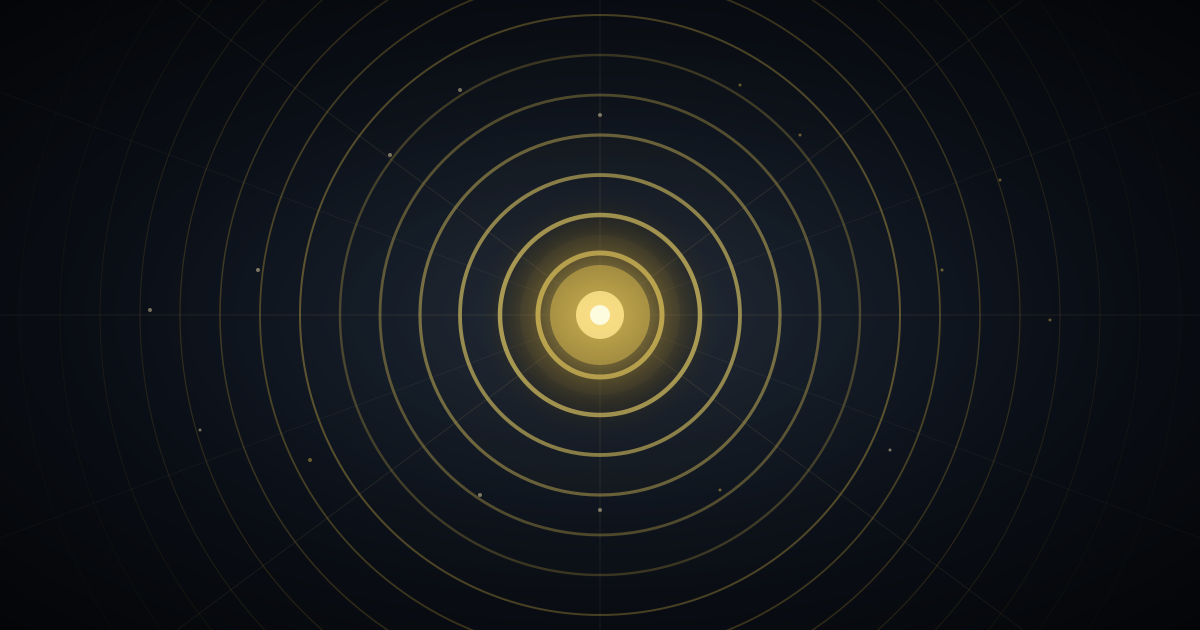
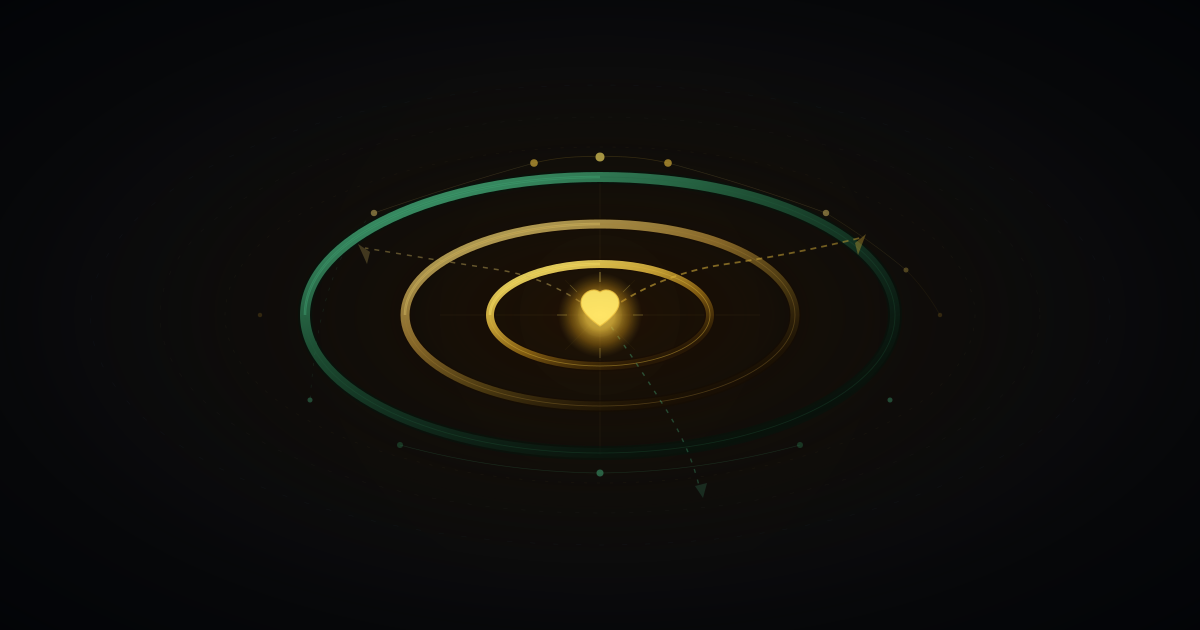
The Four Toroidal Flows. The hourglass is the visible cross-section of a torus — energy flowing inward at the poles, outward at the equator, forming a self-sustaining circulation. The four flows are always simultaneously active, never sequential.
The Four Toroidal Flows: How Energy Moves Through the Hourglass
A torus is a donut-shaped energy field in which energy flows continuously — inward at the poles, outward at the equator — forming a self-sustaining, self-renewing loop. This geometry appears at every scale in nature: the hydrogen atom, the Earth's magnetosphere, the human heart's electromagnetic field, the form of galaxies. The hourglass is the visible cross-section of a torus.
The hourglass generates four simultaneous currents. Two are inner flows — private, developmental, invisible from the outside. Two are outer flows — expressive, social, visible in behavior and relationship. Together they form the toroidal circulation of a human life, always moving, always simultaneously present, never sequential.
The Inner Upward Flow
The Inner Upward Flow is the self-nourishing current of genuine development — the natural ascending movement of energy through the seven dimensions when the mode of perception is what Maslow called B-cognition: seeing the world in its fullness rather than through the filter of deficiency.
This current feels like vitality that does not depend on stimulation, creative abundance that arises without forcing, the particular ease that accompanies right action. Rollin McCraty and his colleagues at the HeartMath Institute have documented its physiological correlate: cardiac coherence, in which the heart's electromagnetic field enters a state measurably more ordered and expansive, supporting clear cognition, emotional stability, and what McCraty describes as system-wide order.
The inner upward flow is not a destination. It is a quality of circulation — and when it is moving, it naturally produces overflow. That overflow is what becomes the outer downward flow: the offering that arises from genuine abundance. This is why the hourglass reveals what the pyramid could not — generosity is not a moral achievement layered on top of self-actualization. It is the natural consequence of inner upward flow reaching its fullness and seeking expression.
The Inner Downward Flow
The Inner Downward Flow is the depleting current of resistance and grasping — what we will explore more fully in the next section as "catching falling knives."
It is energy draining from the upper dimensions downward through the lower ones: meaning fragmenting into anxiety, emotional resilience contracting into numbness, purpose calcifying into role-performance, belonging collapsing into isolation, financial ground narrowing into scarcity panic, safety splintering into survival alarm.
This current is not evil. It is not failure. It is universal. Every human being knows it intimately. Its signal is always the same felt quality: heaviness, reactivity, the sense of moving against the grain of things, the peculiar exhaustion of resisting what is already happening. Each downward-flow pattern is a form of what the reification article identifies at the level of perception — freezing what naturally flows, grasping at what must be allowed to move.
The Outer Upward Flow
The Outer Upward Flow is the compensatory current of seeking and acquiring — the attempt to nourish from outside what has been depleted inside. When the inner upward flow is blocked or diminished, the system reaches outward: for acquisition, status, comparison, consumption, recognition.
Buddhism named this tanha — craving, the second noble truth, the grasping that produces dukkha. The Stoics distinguished between preferred indifferents (externals) and genuine goods (virtue, wisdom). The Sufi poets saw the outer world as a mirror that can only show you your own face — outer seeking is the attempt to find in the reflection what exists only in the original.
The outer upward flow brings temporary relief, never nourishment. And each acquisition raises the threshold for the next — the hedonic treadmill that consumer capitalism has designed into the structure of modern life. This is the economic architecture that the toroidal economy proposes to replace: a system built on inner upward and outer downward flow rather than on the outer upward flow of perpetual acquisition.
The Outer Downward Flow
The Outer Downward Flow is the natural expression of inner fullness — generosity, creativity, service, teaching, care, the offering of what has been gathered inward back into the world. This is the descending expressive pyramid in motion: what was received descending through the dimensions and landing in the world as gift.
It is giving from overflow rather than obligation. The creative act as natural completion. Service as its own reward. Christian mystical theology named one dimension of this kenosis — the self-emptying that does not produce depletion but liberation. The Buddhist tradition called it dana — generosity as the first perfection, the practice from which all others flow. Ubuntu philosophy named its social expression: "I am because we are." The outer downward flow is the hourglass discovering that its own fullness belongs to the world.
This is what the Golden Rule as a fractal law looks like in energetic terms: the recognition that what I offer to you returns to me not because of reciprocity but because the torus is a single circulation. The giving and the receiving are different points on the same flow.
The Electromagnetic Parallel
The electromagnetic parallel here is more than metaphor. The HeartMath Institute's research documents that the human heart generates a toroidal electromagnetic field extending several feet beyond the body in every direction — approximately 60 times greater in amplitude than the brain's electrical field and 5,000 times stronger magnetically.
In a state of cardiac coherence (inner upward flow), this field becomes measurably more ordered and expansive. Cardiac coherence is transmitted to others in proximity: upward inner flow is literally contagious at the electromagnetic level. Two people in close physical proximity whose hearts are in coherence will begin to entrain — their heart rate variability patterns synchronizing without conscious effort. This is not a claim about mystical connection. It is a measurable electromagnetic phenomenon with peer-reviewed documentation. The heart does not stay within the body. Its field extends into the space around it, and that field carries information — about emotional state, about coherence, about the quality of attention. When two people are in the same room and one of them enters cardiac coherence, the other's heart rate variability begins to shift toward coherence as well, even without conversation or physical contact.
This has profound implications for everything from collaboration to healing relationships to community gathering. The Foundation's programs are, in part, designed around this insight: creating conditions where coherent hearts can gather, because coherence is a field effect as much as an individual achievement.
David Bohm's implicate order offers a philosophical frame for this: what appears as separate in the visible, explicit world is actually an unfolding of a deeper unity — and when the observer temporarily dissolves, as in plateau experience or genuine self-transcendence, the two pyramids are revealed as a single torus, the implicate and explicate momentarily unified.
The Hidden Geometry of the Heart: Intelligence at the Pivot
The heart is not primarily a pump. Modern cardiology increasingly recognizes what contemplative traditions have always known: the heart is a sensory and information-processing organ with approximately 40,000 neurons — what cardiologist J. Andrew Armour named, in his 2003 research on neurocardiology, "the little brain in the heart."
The heart sends more information to the brain than the brain sends to the heart. The neural highway from heart to brain carries more traffic upward than downward. In the hourglass, the heart pivot is not metaphorical. It is the literal location of the body's primary intelligence center — the anatomical point where the ascending developmental arc meets the descending expressive arc.
The Heart Across Traditions
Every major wisdom tradition has placed the heart here, at the axis of human knowing.
The Sufi concept of qalb — literally "that which turns" — understands the heart as the organ of spiritual perception: the site of divine disclosure (tajalli), the place where the infinite makes itself known within the finite. The hourglass pivot is the qalb.
Meister Eckhart, the fourteenth-century Christian mystic, described Durchbruch — breakthrough — as the moment in which the soul breaks through its own structures and recognizes its ground in what he called the Godhead. His phenomenology is identical to what Maslow described as plateau experience and what HeartMath documents as cardiac coherence: a state in which the usual self-referential processing falls quiet and something more direct becomes available.
Plotinus named the dynamic itself: at the pivot, the ascending and descending flows recognize each other as one movement — what he called the return to the One, not a spatial return but a recognition that the One was never absent.
Jiddu Krishnamurti, whose work bridges Eastern contemplative insight and Western psychological precision, offered the most direct pointing: "The observer is the observed." When the heart pivot is clear — when the churning of the inner downward flow has stilled — the apparent distance between the one who sees and what is seen collapses. Not as a mystical claim but as a description of a mode of attention: the neurological signature of a mind that has temporarily stopped narrating itself and started inhabiting experience directly. The default mode network — the brain's self-referential processing system, hyperactive in anxiety, depression, and self-criticism — quiets. Direct perceptual processing increases. The heart's coherence ripples outward.
The Pivot That Reveals Itself
The practical paradox is worth naming clearly: the heart pivot is not something to achieve. It is something to recognize. It is always present — not a level to reach but a ground to return to.
In downward inner flow, this recognition is obscured by turbulence, the way the bottom of a lake disappears when the water is churned. In upward inner flow, the water clears — not because something was added, but because the churning ceased.
Krishnamurti's deepest contribution was this: we cannot make the water clear by will. We can only stop throwing stones. The pivot reveals itself.
The five veils describe what obscures the pivot. The five radical realizations describe what the pivot reveals when it is uncovered. And the heart science — the 40,000 neurons, the toroidal field, the coherence transmission — gives us the anatomical confirmation that this is not poetry alone. The heart is, literally, the center of the system. The hourglass merely makes that center visible.
There is a quiet revolution happening in this recognition. For centuries, Western thought has placed intelligence in the head — the brain as sovereign, the body as vehicle. The heart pivot challenges this not with mystical assertion but with empirical evidence: the heart processes information, the heart generates the body's strongest electromagnetic field, the heart communicates to the brain more than the brain communicates to the heart. When we say "follow your heart," we are not speaking metaphorically, or at least not only metaphorically. We are pointing toward a center of intelligence that the hourglass places exactly where it anatomically resides: at the meeting point of the ascending and descending arcs, at the membrane between what we have gathered and what we have to give.
[Contemplative pause: Place one hand over your heart — not as a gesture, but as an act of attention. Feel its rhythm beneath your palm. This is the pivot. Not a concept to understand but a location to return to. The 40,000 neurons in your chest are processing information right now. The field they generate is already extending into the room. You have been here all along. The hourglass has been breathing since before you picked up this article. The pivot was never somewhere you had to go.]
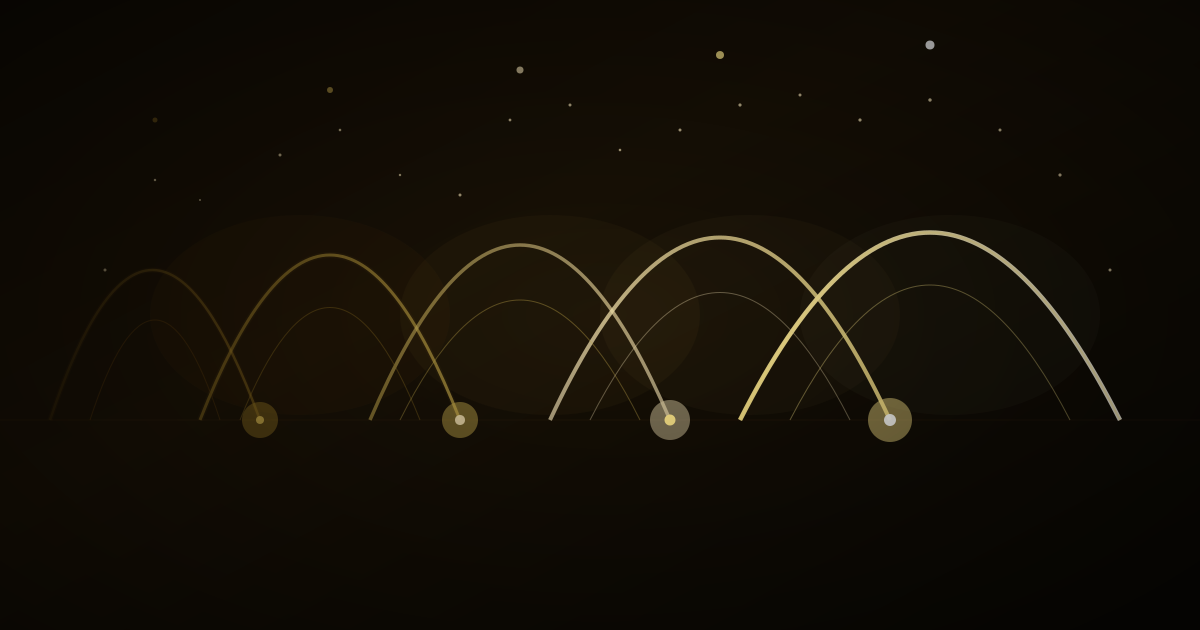
Catching falling knives. The hand is cut not by the falling but by the grasping. The knife is grief, change, impermanence — everything the mind attempts to arrest that gravity has already claimed.
Catching Falling Knives: The Universal Invitation to Let Fall
A knife is thrown into the air. At the moment of maximum height, it pauses — weightless, suspended, the trajectory completed and not yet reversed. Then gravity reasserts itself. The knife is falling. No act of will can prevent the fall. The fall is already happening. It has, in a sense, always been happening — the moment the knife left the hand, the fall was already underway. To reach up and catch the knife by the blade is not heroism. It is the refusal to accept what has already occurred. And the hand is cut not by the falling but by the grasping.
The knife is grief. The knife is change. The knife is the end of a relationship, a career, an identity, a season of life that has completed itself. The knife is the body aging. The knife is the moment when something we built stops being what it was. And the suffering — the real, unnecessary, avoidable layer of suffering on top of the genuine pain of loss — is not in the knife's falling. The knife was always going to fall. The suffering is in the reaching.
Consider the person who has lost a job. The pain is real — financial uncertainty, disrupted routine, the grief of colleagues and purpose suddenly removed. But much of the suffering that follows is not about the job. It is about the identity the job provided. The person who was "the director" or "the expert" or "the one they couldn't do without" is grasping not at the job but at the self-image the job sustained. The knife is the identity. The grasping is the insistence that it not fall. The hand is cut not by unemployment but by the refusal to let the old identity complete its arc.
Or consider the parent whose child has left home. The empty room is real. The silence is real. But the deepest pain is often not about the child's absence — it is about the role that gave the parent their primary sense of purpose for two decades. The knife is the identity of "the one who is needed." The grasping is the attempt to maintain that identity through excessive contact, unsolicited advice, or the quiet resentment of the child's independence. Letting fall would mean allowing the role to complete itself — grieving it fully, honoring what it was, and discovering what wants to emerge in the space it leaves behind. The Purpose dimension (Green) in downward flow is almost always an identity-knife being grasped.
[Contemplative pause: Is there a knife you are currently holding by the blade? Not to fix it — just to name it honestly. A relationship that has already changed shape, a role that no longer fits the person wearing it, a version of yourself you are not yet willing to let complete its arc. The recognition itself is not the solution. It is the first honest step: the hand seen, the blade felt, the awareness that something is ready to fall.]
The Traditions Speak
Every contemplative tradition has named this dynamic from its own angle.
Buddhism calls the reaching tanha — craving — and identifies it as the second noble truth: not the pain of impermanence itself, but the resistance to impermanence that the mind generates. The second arrow: the first arrow is the painful event; the second arrow is the resistance to the painful event, which we shoot into ourselves.
Rumi, in the opening verses of the Masnavi, gives us the reed cut from the reed bed — its cry of longing is not a problem to be solved. It is the music. The sound the reed makes is not despite the wound but through it. The falling knife is the cut. The music is what falls through the cut, if we stop trying to prevent it. Imagine hearing a reed flute for the first time — that low, aching tone — and recognizing something in your own chest. Not a thought. A vibration. The reed knows what it is to have been separated from where it grew, and the music it makes is not the sound of suffering. It is the sound of suffering transformed by honesty into beauty.
Taoism names this as wu wei — not passivity, but the wisdom to move with what is already moving rather than against it.
The Stoics drew the same line with different language: Epictetus, in the Enchiridion, distinguishes between what is "up to us" and what is not. The knife's fall is not up to us. Our response to the falling is.
Meister Eckhart called the practiced art of non-grasping Gelassenheit — releasement, or "letting-be." The willingness to let fall every claim to preservation, status, continuation. Not as defeat but as the form that trust takes in the face of impermanence.
Letting Fall vs. Letting Go
The distinction between "letting go" and "letting fall" is subtle and important.
"Letting go" implies a prior act of holding — "I was gripping the knife; now I release my grip." This framing maintains the quiet illusion that the one holding is in control: first I gripped, now I choose to release.
But "letting fall" begins from honesty. Gravity was always doing the work. The knife was always going to fall. The question is not whether to release it — it is whether to reach up and cut your hand in the attempt to prevent the inevitable.
"Letting fall" does not mean indifference. We can grieve fully, care completely, be shattered by what we have lost, and still not reach for the blade. These are not opposites. Genuine care and non-resistance can coexist. They must, eventually, coexist — because the only alternative is the chronic suffering of the cut hand.
Gravity, the hourglass insists, is not the enemy. What falls, feeds the earth. The fallen leaf becomes soil. The fallen rain becomes river. In the hourglass, the inner downward flow is gravity — it cannot be reversed by will, only accompanied with intelligence and compassion, or grasped at, producing the wound. The inner downward current is not punishment. It is invitation: something is ready to be released. Will you trust what you cannot control?
The Maslow Compass: A Mirror That Breathes
The Maslow Compass is not a personality test. It is not a diagnostic instrument. It does not rank, score, or categorize. It is a mirror — and what we see in a mirror depends entirely on how honestly we are willing to look.
The Compass translates the Hourglass of Being into an interactive reflection: a living visualization of the current direction of energy flow across all seven dimensions simultaneously. Each of the seven rainbow bands glows or dims according to the user's actual responses. Upward-flowing dimensions glow; downward-flowing ones soften. The heart pivot brightens or dims based on the overall coherence of the system. The toroidal field animation — the gentle, pulsing rings surrounding the hourglass — intensifies or softens based on the ratio of upward to downward flow across the whole. The visualization does not produce a fixed chart. It breathes, pulses, and shifts as the reflection deepens.
The Four Compass Points
The four compass points mirror the four toroidal flows:
Ground reveals the current foundation: which dimensions feel nourished and alive, where energy is naturally accumulating without force.
Current maps the direction of movement: which dimensions are in upward flow and which are in downward flow right now, in this season of life.
Turn Toward names the one dimension whose upward activation would most unlock flow across the whole system — the keystone that, when engaged, shifts the entire hourglass.
Let Fall names the specific pattern, habit, or identification currently generating the most inner downward flow — the knife the hand is reaching toward.
The Poetic Title
After completing the reflection, the tool offers each user a unique poetic title for their reading: not a personality type, not a category, but a phrase that names the specific quality of this person's energy in this moment. "The Dawn of the Second Mountain." "Standing at the Reed Bed." "The Knife Held Still."
This naming is not decorative. It is a precision act — giving language to an interior state that may have been nameless, which in itself can create the conditions for a perceptual shift. To name what is moving in you is already to change your relationship to it.
The Mirror as Doorway
The Maslow Compass embodies the article's core claim in interactive form. What matters is not where we are on a hierarchy. What matters is how our energy is moving — and a clear, honest mirror of that movement is itself a doorway. The variable is perception. The tool is the mirror. What we do with the reflection is entirely our own.
Take the Maslow Compass — and see how your energy is moving across all seven dimensions right now.
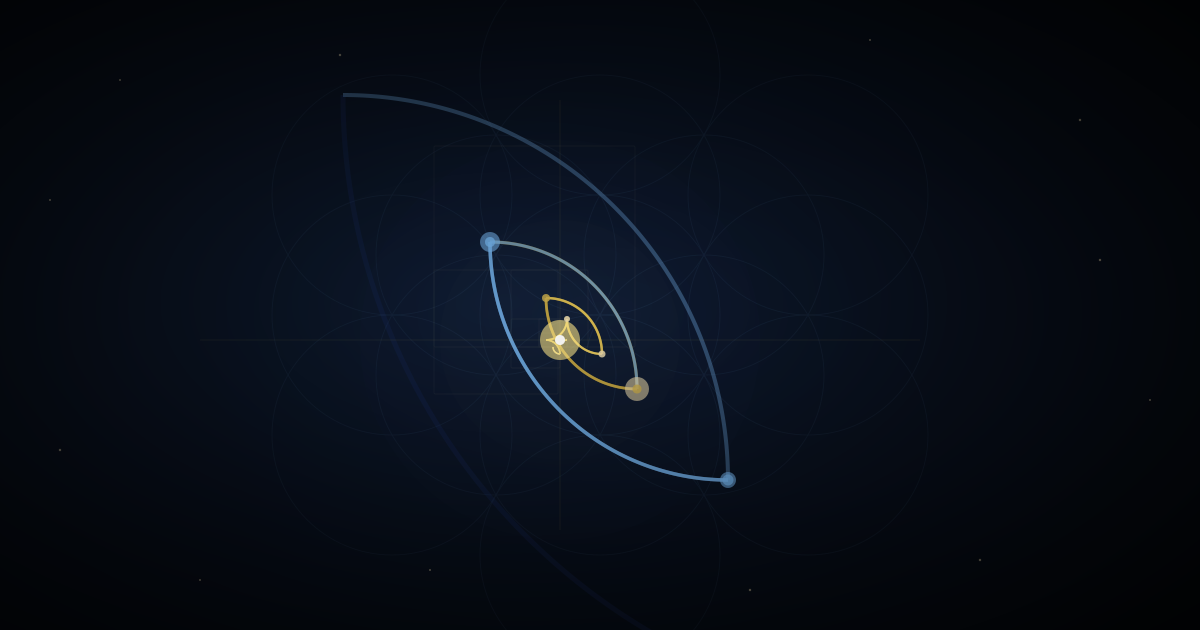
The Hourglass in context. How the seven dimensions connect to the Fractal Life Table, the Technologies of the Heart, and the Foundation's five action areas.
The Hourglass and the Technologies of the Heart
The Hourglass of Being is not one more article in a series. It is the geometric grammar that makes all the other pieces legible simultaneously — the experiential map in which each technology finds its precise location.
The Spectrum of Compassion is the Emotional Resilience dimension (Blue) made precise. Compassion determines whether Blue flows upward (grounded presence) or downward (empathic overwhelm). The spectrum distinguishes empathy from compassion not as a preference but as a directional difference — and direction, in the hourglass, is everything.
The Math of Everything gives the deepest lens for understanding why the hourglass has two directions at all. D-motivation is the One — bounded, separate, seeking from lack. B-motivation is the Zero — unbounded, whole, expressing from fullness. Every point in the hourglass is either a Zero-expression or a One-expression. The framework names what the hourglass shows.
Generosity as Gratitude in Action is the Outer Downward Flow in its purest expression. Generosity is what inner fullness does when it has somewhere to go. The hourglass reveals why genuine generosity never depletes: it flows from overflow, and overflow, when it circulates, replenishes the source.
The Golden Rule as a Fractal Law is the operating principle of B-seeing — the direct recognition that the one across from you is not different in kind from you. It is what the heart pivot looks like in the Belonging dimension when the perception has shifted from I-It to I-Thou.
Paying It Forward is the Outer Downward Flow cascading across time — the gift that does not require a recipient who can return it, because the hourglass is its own return system. Each gift nourishes the giver and the receiver simultaneously, through different arcs of the same circulation.
The Geometry of Collaboration is the Belonging dimension in full upward flow at collective scale — individual hourglasses in coherent relationship, their toroidal fields mutually reinforcing rather than interfering.
Compassion as Inner Clarity is the Emotional Resilience dimension in upward flow — the capacity to be with another's experience without flinching, fixing, or absorbing. It is only sustainably available when one's own inner downward flow is not dominating the field.
Oneness is the Inner Peace dimension in full upward flow — the direct recognition of shared nature that the hourglass's upper apex points toward. It is not a belief. It is a mode of perception available when the heart pivot is clear.
The Toroidal Economy is the hourglass applied to the economic dimension of human civilization — collective Financial Ground in full upward flow at societal scale, resources circulating as gift rather than accumulating as power.
And the Fractal Life Table is the structural architecture that positions all of this within a seven-column framework mapping how each dimension operates across psychology, economics, philosophy, spirituality, and more. The hourglass gives you the felt experience. The Fractal Life Table gives you the structural coordinates. They are designed to read as companion pieces of the same recognition.
Integration: The Hourglass at Community Scale
The Heart of Peace Foundation's mission — to cultivate compassion, generosity, and human flourishing through mindfulness, community nourishment, and spiritual growth — is the hourglass in action at community scale. The Foundation does not deliver transformation. It creates the conditions in which the hourglass's natural circulation can reassert itself: the ground conditions, the relational conditions, the interior conditions that make inner upward flow more available than it would otherwise be.
Each of the Foundation's program areas maps to a dimension of the hourglass. Mindfulness and contemplative practices cultivate the Violet dimension — the recognition of inner peace and shared nature that is the apex of the ascending pyramid. Community nourishment programs engage the Green dimension of Purpose — the joyful contribution that arises when inner fullness has somewhere meaningful to land. Financial literacy and stewardship work supports the Orange dimension, inviting participants into a relationship with resources based on wise generosity rather than scarcity. Grief and loss support honors the inner downward flow in the Blue dimension — not as failure but as the natural movement of metabolization, the completion of what the pressure-cooker model would suppress. Youth mentorship and education kindle the Indigo dimension's wonder and beginner's mind. Community belonging events embody the Yellow dimension's authentic connection. Housing and safety programs address the Red dimension directly — the nervous system regulation that is the ground of everything else.
What makes this approach distinctive is its orientation: not toward fixing, prescribing, or advancing people up a hierarchy, but toward revealing what is already present and supporting what is already moving. The Maslow Compass, and every tool in the Technologies of the Heart suite, functions as a mirror of flow direction — showing users not where they should be but where they actually are and how they are actually moving.
The Sand Has Always Been Moving Both Ways
She is still in the kitchen. The hourglass is still on the shelf. The lamplight is the same. But something has shifted — not in the hourglass, which has been doing exactly what hourglasses do all along, but in the quality of her watching.
She sees now that the sand was never falling only one way. The narrow waist holds both directions simultaneously — the downward grain finding its level, the upward potential of what has already settled, the whole glass a single breath held in amber and glass. The pyramid told us there was a top to reach. The hourglass shows us there is a center to inhabit — the heart pivot, always present, always available, not a destination but a ground. And from that center, all directions are simultaneously possible: the ascending nourishment, the descending offering, the outer seeking that signals a hunger for more inner care, the outer radiating that signals an inner fullness finding its natural expression.
The unnamed incompleteness she felt at 3 a.m. was not a deficiency on the pyramid. It was a signal — one dimension in downward flow, inviting her attention. Not a failure of progress. Not evidence that she had fallen short of some summit. An invitation to attend, to notice, to ask the simplest and most radical question the hourglass poses: Which direction is my energy moving right now, and what does it need?
At the center of the hourglass — in the luminous waist where all grains pause before choosing direction — the pyramid and its mirror were always the same shape, breathing the same breath, held in the same glass. We are not climbing. We are breathing. And the breath has been happening since before we learned to count the rungs.
Invitation
You are not stuck at any level. You are in motion.
The hourglass was never a ladder to climb — it is a field you already inhabit, with currents moving both ways simultaneously.
Your inner nourishment feeds your outer expression. Your outer service deepens your inner ground. The Maslow Compass can show you where the energy is moving now.
You are already whole. The only question is: in which direction are you flowing?
Take the Maslow Compass and see.
People Also Ask
What is the difference between Maslow's original hierarchy and the Hourglass of Being?
Maslow's original 1943 hierarchy described five levels of human needs arranged vertically, with the implication that one level must be fully satisfied before the next becomes motivating. The pyramid diagram that popularized this model — which Maslow himself did not draw — further simplified this into a single upward trajectory. The Hourglass of Being does not contradict Maslow; it completes the arc his own thinking was already tracing in his final years, when he added self-transcendence as a sixth level, articulated Being-motivation as distinct from deficiency motivation, and described plateau experiences as natural expressions of the fully functioning person. The hourglass shows both the ascending developmental arc Maslow described and the descending expressive arc — the offering of inner fullness into the world — which the pyramid diagram omits entirely. For the full structural mapping of these seven dimensions across multiple paradigms, see the Fractal Life Table.
What are the Four Toroidal Flows?
The Four Toroidal Flows are the four simultaneous currents of energy that circulate through the hourglass at all times. The Inner Upward Flow is the self-nourishing current of genuine development — energy rising naturally through the seven dimensions from safety toward transcendence. The Inner Downward Flow is the depleting current of resistance and grasping — the "catching falling knives" current in which the mind attempts to arrest what is already in motion. The Outer Upward Flow is the compensatory current of seeking and acquiring — the attempt to nourish from outside what has been depleted inside. The Outer Downward Flow is the expressive current of offering and radiating — the natural movement of inner fullness into the world as generosity, creativity, and service. These four flows are not sequential; they are always occurring simultaneously, in varying proportions, at every moment of a human life.
What does "catching falling knives" mean in this context?
"Catching falling knives" is the central metaphor for the Inner Downward Flow — the depleting current that arises when the mind attempts to prevent, reverse, or outrun what is already in motion: grief, loss, change, impermanence, and the natural endings of all things. Just as a knife thrown into the air will fall regardless of our will, and grasping it by the blade cuts the hand rather than preventing the fall, the attempt to arrest grief or loss creates additional suffering without preventing the underlying movement. The metaphor invites a distinction between "letting go" — which implies prior holding — and "letting fall," which acknowledges that gravity was always doing the work. Across Buddhist, Sufi, Taoist, Stoic, and Christian mystical traditions, this same dynamic is named under different terms: the second arrow, tanha, wu wei, Gelassenheit — resistance to what is already falling is the source of unnecessary suffering, not the falling itself. Compassion as inner clarity is the quality that allows us to be present to the falling without reaching for the blade.
How does the heart become the pivot point in the hourglass model?
The heart is the pivot of the hourglass for reasons that are simultaneously anatomical, electromagnetic, and contemplative. Anatomically, the heart contains approximately 40,000 neurons and sends more information to the brain than the brain sends to the heart — making it a primary intelligence center, not merely a pump, as cardiologist J. Andrew Armour documented. Electromagnetically, the HeartMath Institute's research demonstrates that the heart generates a toroidal field extending several feet beyond the body — approximately 60 times greater in amplitude than the brain's electrical field. Contemplatively, every major wisdom tradition places the heart as the organ of deepest perception: the Sufi qalb, the Sanskrit hridaya, Dzogchen's recognition of Rigpa. In the hourglass, the heart pivot is where the ascending developmental arc meets the descending expressive arc — the membrane between becoming and offering, between who we are growing into and what we have to give. This is Column 4 (Purpose) in the Fractal Life Table — the column where all paradigms converge.
What is the difference between upward and downward flow in the hourglass?
Upward flow — the inner self-nourishing current — is the natural movement of genuine development: energy arising from within, activating each dimension in its generative mode, producing vitality, creativity, and relational openness. It is associated with what Maslow called Being-cognition: perceiving and acting from fullness rather than deficiency. Downward flow has two forms: the Inner Downward Flow (depletion through resistance and grasping) and the Outer Upward Flow (compensation through seeking and acquiring). These flows are not failures or moral deficiencies — they are universal human experiences that every person knows. The key variable is perception: the same circumstances can activate upward or downward flow depending on whether they are received through D-seeing (deficiency cognition, filtering experience through the lens of lack) or B-seeing (Being cognition, encountering experience in its fullness). Flow direction is not determined by circumstance but by the mode of perception meeting that circumstance — which is why the five veils matter: they are the perceptual filters that determine flow direction.
How does the Maslow Compass use the Hourglass of Being?
The Maslow Compass translates the Hourglass of Being framework into a living, interactive reflection tool. Rather than assigning a level or a score, it maps the current direction of energy flow across all seven dimensions simultaneously, generating a visual hourglass in which each dimension glows or dims based on the user's actual responses. The four compass points — Ground, Current, Turn Toward, and Let Fall — mirror the Four Toroidal Flows, showing users not where they are on a hierarchy but how their energy is moving and what specific pattern is most generating downward flow. The tool also generates a unique poetic reading title for each session — a phrase that names the specific quality of the user's inner state in this moment. The Compass is not diagnostic; it is revelatory — a mirror designed to make visible what was already moving, because the act of honest seeing is itself often the doorway to change.
Is the hourglass model supported by science?
The hourglass model integrates multiple streams of scientific evidence while also drawing on philosophical and contemplative sources that science has not yet fully mapped. The HeartMath Institute's research base, particularly Rollin McCraty's Science of the Heart (2015), directly supports the heart-pivot concept: the cardiac electromagnetic field, the measurability of coherence states, and the transmission of coherence between individuals are empirically documented. Neuroscience of default mode network dynamics supports the D-seeing/B-seeing distinction: the measurable differences in brain activity between self-referential and direct-perceptual modes of processing are well-established. Maslow's own published works (1943, 1962, 1964, 1969, 1971) document his evolution toward transcendence, Being-motivation, and plateau experiences. Viktor Frankl's observations in the concentration camps empirically challenge the pyramid's sequentiality. Scott Barry Kaufman's Transcend (2020) provides the most rigorous contemporary integration of Maslow's full body of work, including the self-transcendence addition the textbooks omit. The toroidal geometry appears at every scale in physics from quantum to galactic — its application to the human heart's electromagnetic field is scientifically grounded rather than merely metaphorical. The contemplative and philosophical dimensions — Plotinus, Dzogchen, Krishnamurti, Sufi wisdom — are experiential maps independently verified across cultures and centuries, which constitutes a different but complementary form of evidence.
References
Armour, J.A. (2003). Neurocardiology: Anatomical and Functional Principles. HeartMath Research Center, Institute of HeartMath.
Bohm, D. (1980). Wholeness and the Implicate Order. Routledge.
Buber, M. (1923/1970). I and Thou (W. Kaufmann, Trans.). Scribner.
Csikszentmihalyi, M. (1990). Flow: The Psychology of Optimal Experience. Harper & Row.
Eckhart, Meister. (c. 1300/2009). The Complete Mystical Works of Meister Eckhart (M.O.C. Walshe, Trans.). Crossroad Publishing.
Epictetus. (c. 108 CE/2008). Discourses and Selected Writings (R. Dobbin, Trans.). Penguin Classics.
Frankl, V.E. (1959). Man's Search for Meaning. Beacon Press.
Graves, C.W. (1970). Levels of existence: An open system theory of values. Journal of Humanistic Psychology, 10(2), 131-155.
Kaufman, S.B. (2020). Transcend: The New Science of Self-Actualization. TarcherPerigee.
Krishnamurti, J. (1969). Freedom from the Known. Harper & Row.
Maslow, A.H. (1943). A theory of human motivation. Psychological Review, 50(4), 370-396.
Maslow, A.H. (1954). Motivation and Personality. Harper & Row.
Maslow, A.H. (1962). Toward a Psychology of Being. D. Van Nostrand.
Maslow, A.H. (1964). Religions, Values, and Peak Experiences. Ohio State University Press.
Maslow, A.H. (1971). The Farther Reaches of Human Nature. Viking Press.
Max-Neef, M. (1991). Human Scale Development: Conception, Application and Further Reflection. Apex Press.
McCraty, R. (2015). Science of the Heart: Exploring the Role of the Heart in Human Performance, Volume 2. HeartMath Institute.
McCraty, R., Atkinson, M., Tomasino, D., & Bradley, R.T. (2009). The coherent heart: Heart-brain interactions, psychophysiological coherence, and the emergence of system-wide order. Integral Review, 5(2), 10-115.
Neff, K. (2011). Self-Compassion: The Proven Power of Being Kind to Yourself. William Morrow.
Plotinus. (c. 270 CE/1991). The Enneads (S. MacKenna, Trans.). Penguin Classics.
Rumi, J. (c. 1258/2004). The Masnavi, Book One (J. Mojaddedi, Trans.). Oxford University Press.
Seligman, M.E.P. (2011). Flourish: A Visionary New Understanding of Happiness and Well-Being. Free Press.
Welwood, J. (2000). Toward a Psychology of Awakening: Buddhism, Psychotherapy, and the Path of Personal and Spiritual Transformation. Shambhala.
Wilber, K. (2000). Integral Psychology: Consciousness, Spirit, Psychology, Therapy. Shambhala.