The candle on the kitchen table is burning down. Someone lit it after dinner, when the plates were already in the sink and the house had gone quiet, and now the flame is the only thing moving in the room.
The wax softens at the rim. A small bead runs down the side of the candle and stops, hardening before it reaches the saucer. The flame leans a little toward the warmer side of the wick, then rights itself. Inside that quiet leaning, the universe is doing two things at once that should not, by any account, be compatible: it is falling apart, and it is holding its shape.
The wax is becoming carbon dioxide and water vapor. The heat is rising into the air. The dark around the candle is being pushed back, just a little, by photons that will never return. By any honest accounting, the room is more disordered now than it was a minute ago — the energy that was locked into solid hydrocarbon is loose, dispersing, slipping toward the equilibrium that all things eventually reach. This is what the second law of thermodynamics describes. It is also, more plainly, what dying is.
And yet the flame keeps its shape. A luminous teardrop, the same teardrop your grandmother saw and her grandmother before her, sustained against the very dissolution it is enacting. The candle is falling apart in an orderly way. It is being undone, and in the being-undone it is briefly, exquisitely organized.
Something similar happens in a person who has begun to love the world after being hurt by it. They keep their shape through the falling-apart. The energy of their living goes outward — into a phone call answered, a meal cooked, a difficult conversation entered without armor — and instead of being depleted by the giving, they hold a coherence the cost should have ruined. They are becoming, in the same quiet way the candle is becoming, a small ordered pocket inside a much larger drift.
That is what compassion does. The body of someone moving toward another's suffering, instead of away from it, behaves the way the flame behaves: it organizes itself by being burned. It does not deny the second law. It rides it.
Key Takeaways
- The three laws of thermodynamics map structurally onto the contemplative coordinates of Zero, One, and Infinity — not as metaphor but as parallel descriptions of the same deep pattern written in different vocabularies.
- The First Law (conservation of energy) corresponds to Zero: nothing is created or destroyed, only transformed — the ground of all existence is complete and sufficient.
- The Second Law (entropy increase) corresponds to One: the cost of being a localized observer is real, but Prigogine showed that order emerges precisely through disequilibrium, not despite it.
- Negentropy — what Schrodinger identified as life "feeding on negative entropy" — corresponds to Compassion: the force that organizes consciousness against the current of dissolution without denying that current.
- Dissipative structures are the physical template for every contemplative insight about growth through suffering: they maintain coherence not by resisting entropy but by processing it continuously.
- The Third Law (absolute zero is unattainable) corresponds to Infinity: the practice never arrives at a fixed terminus, and this inexhaustibility is not a failure but the very structure of the path.
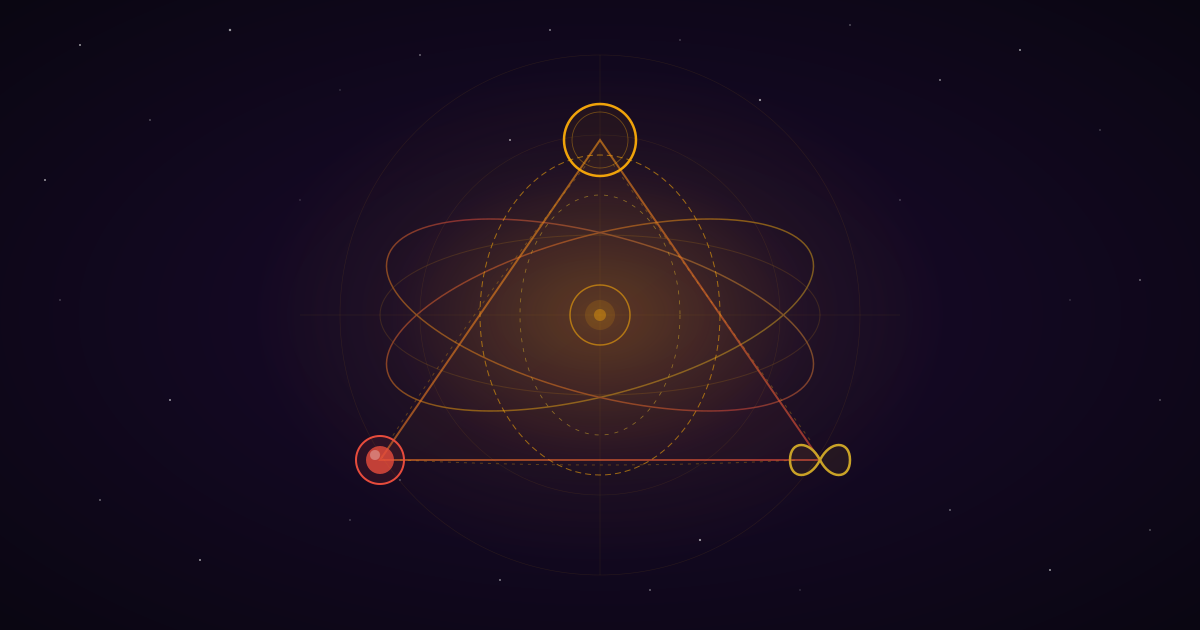
The three laws of thermodynamics rendered as a candle — zero, one, and infinity made visible.
Where attention goes, energy flows.
The First Law: Nothing Is Created or Destroyed
Conservation as Pure Potential
Before there is entropy, before there is order, before there is the drama of dissolution and self-organization that will occupy the rest of this article — there is conservation.
The First Law of Thermodynamics states that energy can be neither created nor destroyed, only transformed from one form to another. The total energy of an isolated system remains constant. This is not a suggestion or a tendency. It is, as far as any physicist has been able to determine, absolute. No experiment has ever violated it. No theoretical framework has found an exception. In every interaction, in every reaction, in every transformation from kinetic to thermal to chemical to radiative energy, the books balance. Nothing appears from nothing. Nothing vanishes into nothing.
Contemplate that for a moment.
Not as a physics fact to be memorized and moved past, but as a statement about the nature of reality. The universe is a closed system in which the total quantity of what is never changes. Forms change. Configurations change. A star collapses and its matter becomes a nebula. A tree absorbs sunlight and converts photons into cellulose. A human body metabolizes food and converts chemical bonds into thought. But the underlying quantity — energy, in its deepest sense — is invariant. It was all there at the beginning. It will all be there at the end. Nothing has been added. Nothing has been lost.
This is what the 108 Framework calls Zero.
Not zero as absence. Not zero as emptiness in the nihilistic sense. Zero as pure potential — the undifferentiated ground from which all differentiation arises and to which all differentiation returns. The Buddhist tradition calls it sunyata. The Vedantic tradition calls it Brahman. The Kabbalistic tradition calls it Ein Sof. The physicist calls it the conservation of energy. They are not saying the same thing in every respect — the contemplative traditions are making claims about consciousness that physics does not address, and physics is making claims about measurability that contemplative traditions do not require. But they share a structural feature: the ground is complete. Nothing needs to be added. Nothing can be subtracted. Every apparent gain is a transformation, not a creation. Every apparent loss is a rearrangement, not a destruction.
This is why the First Law comes first — not just chronologically in the history of thermodynamics (though it does) but structurally in the architecture of reality. Before you can understand entropy, before you can understand negentropy, before you can understand why compassion is the ordering force of consciousness, you need to understand that the game is played with a fixed deck. The cards are only ever shuffled. No card is ever added or removed.
The implications are staggering, and most of us have not sat with them long enough.
If nothing is created or destroyed, then every form you have ever loved still exists — transformed, dispersed, reconfigured, but not gone. The atoms that composed your grandmother's hands are somewhere in the biosphere right now, cycling through soil and water and atmosphere and eventually through other living bodies. The energy that powered your childhood laughter is still propagating through the universe as thermal radiation. Nothing you have lost is truly lost. It has changed shape. It has not changed quantity.
And equally: nothing you have gained is truly gained. Every capacity you develop, every insight you achieve, every moment of beauty you experience — these are not additions to the total. They are reorganizations of what was already there. The potential for your deepest realization was present in the initial conditions of the universe. It did not need to be imported. It needed to be uncovered.
This is not a poetic restatement. It is a structural observation. The First Law says: the ground is sufficient. What changes is not the amount but the arrangement. The contemplative traditions say: the ground is complete. What changes is not the nature of awareness but its configuration. Same structure. Different vocabulary. The recognition, when it lands, is quiet and enormous.
The Thermodynamic Ledger
Rudolf Clausius formalized the First Law in 1850, building on the work of Julius Robert von Mayer and James Prescott Joule. But the intuition predates formalization by millennia. Heraclitus wrote that fire is the fundamental element, transforming into all things and all things transforming back into fire — a prescient metaphor for energy conservation. The Stoics articulated a vision of pneuma, a vital breath that pervades and constitutes all things, never increasing or decreasing, only changing its density and tension. Hindu cosmology describes Brahman as the unchanging substratum of all change.
What Clausius did was translate this ancient intuition into mathematics. He showed that in any thermodynamic process, the internal energy of a system changes by exactly the amount of heat added minus the work done:
dU = δQ − δW
No more, no less. The ledger balances. And from this seemingly simple bookkeeping equation flows the entire edifice of thermodynamics — and, as we shall see, a structural description of the field in which compassion operates.
Because compassion, too, operates in a conserved field. The spectrum of compassion does not create caring from nothing. It reorganizes existing awareness — redirecting attention from contraction toward opening, from self-referential loops toward relational presence. The total "energy" of consciousness does not change when someone becomes more compassionate. What changes is the arrangement. And that, as thermodynamics teaches us, makes all the difference.
The Second Law: The Cost of Being a Self
Entropy as Contraction
If the First Law is the ground — serene, balanced, complete — the Second Law is the drama.
The Second Law of Thermodynamics states that in any spontaneous process, the total entropy of an isolated system increases. Entropy, in Boltzmann's statistical formulation, is a measure of the number of microscopic configurations (microstates) consistent with a system's macroscopic properties (macrostate). The higher the entropy, the more microstates are available, the more "spread out" the energy, the less concentrated the order.
Ludwig Boltzmann carved the equation into the foundation of modern physics:
S = k log W
Where S is entropy, k is Boltzmann's constant, and W is the number of accessible microstates. The equation is engraved on his tombstone in Vienna — a fitting memorial, since the implications of this relationship haunted him for the rest of his life and, according to some historians, contributed to his tragic end.
What Boltzmann's equation tells us is that disorder is overwhelmingly more probable than order. Not slightly more probable. Overwhelmingly. The number of ways to arrange a deck of cards in a random configuration vastly exceeds the number of ways to arrange it in any particular ordered sequence. The number of ways for molecules in a room to be evenly distributed vastly exceeds the number of ways for them all to cluster in one corner. Given enough time, any ordered arrangement will dissolve into the most probable disordered arrangement — not because some force is pushing toward disorder, but simply because there are so many more disordered states to fall into.
This is why heat flows from hot to cold and not the reverse. This is why an egg breaks but does not unbreak. This is why the universe, left to its own devices, tends toward thermal equilibrium — a state of maximum entropy, maximum disorder, minimum concentration of energy, and, from the perspective of organized beings like ourselves, maximum boringness.
Now here is the structural parallel that this article exists to illuminate.
The Second Law describes the cost of localization. The moment energy concentrates — into a star, a molecule, a cell, a self — it creates a gradient against the background. That gradient is inherently unstable. It will, given time and opportunity, dissolve. The star will burn out. The molecule will decompose. The cell will die. The self will lose coherence. This is not punishment. It is mathematics. Localization has a thermodynamic cost, and that cost is measured in entropy — the disorder that the localized system must export to its environment in order to maintain its improbable order.
This is what the 108 Framework calls One.
One is the first contraction — the moment when undifferentiated potential (Zero) takes on a particular form, a particular perspective, a particular boundary. It is the moment when "everything" becomes "this thing." And the Second Law tells us that this contraction, this individuation, this becoming-a-self, carries a thermodynamic price tag. To be a localized observer in a universe that tends toward equilibrium is to be in a state of perpetual thermodynamic tension. You are improbable. Your order is borrowed. Your existence requires continuous work to maintain.
This is not a flaw. It is the engine of all experience. Without the contraction from Zero to One, there would be no perspective, no experience, no one to notice the beauty of the conserved field. But the contraction hurts. The material veil — the felt sense that you are separate, bounded, isolated from the rest of the conserved field — is the experiential correlate of the Second Law. It is the felt entropy cost of being a self.
Every contemplative tradition knows this. Buddhism calls it dukkha — often mistranslated as "suffering" but more accurately rendered as "unsatisfactoriness," the inherent stress of maintaining a conditioned, impermanent structure. Hinduism calls it maya — the veil of separate appearance. Christianity calls it the Fall — the departure from an original wholeness into the multiplicity and friction of embodied existence. These are not explanations of thermodynamics. But they are descriptions of the same structural situation: to be a localized form in a universe that trends toward dissolution is to be in a state of inherent tension. The cost of being a self is entropy. And when that entropy cost is denied rather than processed, the contraction deepens — into the cycle of harm that perpetuates suffering, into the patterns where hurt people hurt people because unprocessed entropy has to go somewhere, into the cult of certainty that mistakes rigidity for order.
Prigogine's Discovery: Order Through Disequilibrium
Hexagonal Bénard cells forming spontaneously in heated fluid — order arising at the edge of disequilibrium.
For more than a century after Boltzmann, the Second Law seemed to tell a single story: things fall apart. The universe runs down. Order dissolves. The end.
And then, in a laboratory in Brussels, something unexpected happened.
Ilya Prigogine was a Russian-born Belgian chemist who spent the 1950s and 1960s studying systems far from thermodynamic equilibrium. The classical thermodynamics he had inherited dealt almost exclusively with systems at or near equilibrium — systems that were, in thermodynamic terms, relaxing, running down, approaching their most probable state. But Prigogine was interested in systems that were being driven away from equilibrium by a continuous flow of energy. Living systems. Chemical oscillators. Weather patterns. Economies.
What he found shattered the conventional interpretation of the Second Law.
He found that when certain systems are driven far enough from equilibrium — pushed far enough from their resting state by a sustained flow of energy — they do not simply dissolve into chaos. Instead, they spontaneously organize into new, more complex structures. He called these dissipative structures: systems that maintain their organization by dissipating energy, by processing a flow from high-grade to low-grade energy and using that flow to sustain their improbable order.
The most famous example is the Benard convection cell. Heat a thin layer of liquid from below. At low heat gradients, the liquid conducts heat smoothly from bottom to top — no drama, no structure. But as you increase the gradient, something remarkable happens. At a critical threshold, the liquid spontaneously organizes into a pattern of hexagonal convection cells — beautiful, regular columns of rising and falling fluid that are far more ordered than the original smooth conduction. Order has emerged not despite the energy flow but because of it. The very disequilibrium that classical thermodynamics would predict should produce disorder has instead produced a new and more complex form of organization.
Prigogine received the Nobel Prize in Chemistry in 1977 for this work. But the implications extend far beyond chemistry.
What Prigogine demonstrated is that the Second Law does not say order always decreases. It says entropy of the total system always increases. A localized subsystem — an open system, one that exchanges energy and matter with its environment — can increase its internal order as long as it exports enough entropy to its surroundings to keep the total books balanced. The localized system becomes more organized. Its environment becomes more disordered. The total entropy still increases. The Second Law is satisfied. And yet — order has emerged from chaos.
This is the candle flame. The flame maintains its structure — a dissipative structure — by continuously processing the energy stored in the wax, converting it to heat and light, exporting entropy to the surrounding air. The flame's order is paid for by the disorder it creates around itself. It is not cheating the Second Law. It is riding it.
And this, Prigogine realized, is what life does.
Schrodinger's Question: What Is Life?
The Organism Feeds on Negative Entropy
In February 1943, Erwin Schrodinger — the Austrian physicist famous for his wave equation and his unfortunate cat — delivered a series of lectures at Trinity College Dublin that would change the course of biology.
Schrodinger was sixty-one years old, a Nobel laureate in exile from Nazi-occupied Austria, living in Ireland under the protection of Eamon de Valera's government. He had spent his career in the abstract heights of quantum mechanics, and now, late in life, he turned to what he called the most fundamental question in science: What is life?
The lectures became a book — What Is Life? — published in 1944. It is one of the most influential scientific works of the twentieth century, credited with inspiring James Watson and Francis Crick to pursue the structure of DNA. But its deepest insight was not about genetics. It was about thermodynamics.
Schrodinger asked: How does a living organism maintain its organization in a universe that tends toward disorder? How does a cell — a fantastically improbable arrangement of molecules — persist, reproduce, and evolve, when the Second Law says that improbable arrangements should dissolve?
His answer was elegant and unsettling.
An organism, Schrodinger wrote, "feeds on negative entropy." It maintains its internal order by importing low-entropy energy (sunlight, food) from its environment and exporting high-entropy waste (heat, carbon dioxide, metabolic byproducts). The organism is not a closed system running down. It is an open system — a dissipative structure, though Prigogine had not yet coined the term — that sustains its improbable order by continuously processing a flow of energy from low to high entropy.
"What an organism feeds upon is negative entropy," Schrodinger wrote. "It continually sucks orderliness from its environment."
The word he chose — negative entropy, or negentropy — would take on a life of its own. It became the term for the ordering force of living systems, the capacity of life to swim upstream against the current of dissolution. Not by violating the Second Law — the total entropy of organism plus environment always increases — but by concentrating order locally while exporting disorder globally.
Think of a forest.
A mature forest is one of the most ordered structures on the planet's surface. Billions of organisms — trees, fungi, bacteria, insects, birds, mammals — arranged in a web of symbiotic relationships so complex that no computer has ever fully modeled it. Every leaf is a solar collector of staggering efficiency. Every root network is a communication system. Every cubic centimeter of forest soil contains more bacterial species than the human gut. The forest is a cathedral of negentropy — an island of improbable order maintained by the continuous flow of solar energy through its dissipative structures.
Now light that forest on fire.
The entropy increase is catastrophic. Centuries of accumulated order — the cellulose, the mycorrhizal networks, the nesting cavities, the seed banks — are converted to ash, carbon dioxide, and heat in a matter of hours. The Second Law, in its most dramatic and destructive expression, has won.
Except it hasn't.
Within weeks, the first pioneer species are germinating in the ash-enriched soil. Within months, a carpet of fireweed and grasses covers the burned ground. Within years, fast-growing trees are colonizing the gaps. Within decades, a new forest stands where the old one burned — often more diverse, more resilient, more complexly ordered than its predecessor. The fire, that catastrophic entropy event, has become a precondition for renewal. The destruction has seeded a higher order.
This is a dissipative structure at the ecosystem scale. The forest does not persist by avoiding entropy. It persists by processing entropy — including the catastrophic entropy of fire — and using the energy flow to reorganize at a higher level of complexity. The Second Law is not violated. It is ridden, the way a surfer rides a wave.
And this is the physical process that, in the domain of consciousness, we call compassion.
Negentropy as Compassion: The Ordering Force
The Central Claim
Here is the heart of this article. Read it slowly.
Negentropy — the thermodynamic ordering force that Schrodinger identified as the defining characteristic of life — is the structural parallel, in the domain of consciousness, of what contemplative traditions call compassion.
Not compassion as sentiment. Not compassion as feeling sorry for someone. Not compassion as the warm fuzzy glow that advertisers put on greeting cards. Compassion as the spectrum of compassion defines it: the fundamental movement from contraction toward opening, from self-referential closure toward relational presence, from the isolated order of the defended self toward the complex order of the interconnected whole.
When a living organism imports low-entropy energy and exports high-entropy waste, maintaining its improbable internal order against the universal tendency toward dissolution — that is negentropy operating in the physical domain.
When a conscious being attends to suffering — their own or another's — and responds not by contracting further into defensiveness but by opening toward connection, reorganizing their psychic structure at a higher level of complexity and coherence — that is the same structural dynamic operating in the domain of awareness.
In both cases, an open system maintains and increases its internal order by processing a flow. In both cases, the processing requires energy — metabolic energy in the physical case, attentional energy in the conscious case. In both cases, the system does not avoid disequilibrium but uses it as fuel for reorganization. In both cases, the local increase in order is paid for by an entropy export to the surrounding environment. In both cases, the result is a more complex, more resilient, more adaptive structure than existed before.
The methodology here matters. The argument is not that compassion is a thermodynamic process — that would require demonstrating that the conservation equations of physics apply directly to subjective experience, which has not been done and may not be possible. The argument is that the structure of what happens when compassion operates in consciousness is isomorphic to the structure of what happens when negentropy operates in physical systems. Same pattern. Different substrate. The recognition of this isomorphism is the meaning of "structural parallel, not identity claim."
And the parallel is not forced. It falls out naturally from the physics.
England's Thermodynamic Inevitability
In 2013, Jeremy England, then a physicist at MIT, published a paper in the Journal of Chemical Physics that sent tremors through both physics and biology. England proposed that self-replication — the defining feature of living systems — is not a cosmic accident but a thermodynamic inevitability. Under certain conditions, collections of molecules that are good at capturing energy and dissipating heat will be favored by the Second Law itself. The universe does not merely tolerate life. It drives toward it.
England's argument, known as dissipation-driven adaptation, works like this: when a group of atoms is bathed in a heat bath (an energy source and a cold reservoir), those atomic configurations that are best at absorbing and dissipating energy will, over time, become more probable than those that are not. And the most efficient way to dissipate energy is to become a self-replicating structure — a structure that makes copies of itself, each copy absorbing and dissipating more energy, in a positive feedback loop that the Second Law actively promotes.
Life, in this framework, is not swimming against the current of thermodynamics. Life is where the current is strongest. The universe does not merely permit pockets of order. It drives toward them — because pockets of order that process energy flows are the most efficient way to increase the total entropy of the universe.
If England is right — and the mathematical framework is sound, though the empirical validation is still in progress — then negentropy is not the exception to the cosmic rule. It is the point of the cosmic rule. The Second Law drives toward disorder globally precisely by driving toward order locally. The universe creates eddies of complexity because complex structures are better at dissipating energy than simple ones. Life is not fighting entropy. Life is entropy's most elegant strategy.
Now translate that into the domain of consciousness.
If compassion — the movement from contraction toward opening — is the negentropic force of awareness, then compassion is not some optional ethical add-on to the human experience. It is the structural direction of consciousness itself. Just as life is thermodynamically favored because self-organizing systems dissipate energy more efficiently, compassionate awareness may be "favored" in the domain of consciousness because open, relational, complexly ordered awareness processes experience more efficiently than contracted, defensive, simplistically ordered awareness.
This is not a proof. It is a structural suggestion. But it aligns with everything the contemplative traditions have reported for millennia: that compassion is not something you have to force, not something unnatural that requires heroic effort to sustain. It is the natural direction of awareness when the contractions of fear and defense are released. It is what consciousness does when it stops fighting itself.
Kauffman and the Edge of Chaos
Stuart Kauffman spent decades at the Santa Fe Institute studying self-organization in complex systems. His 1995 book At Home in the Universe advanced a radical thesis: the spontaneous order observed in biological systems — from the genetic regulatory networks of cells to the ecosystem dynamics of biomes — cannot be explained by natural selection alone. There is, Kauffman argued, a deep tendency toward self-organization in complex systems that precedes and enables selection. Evolution is not random mutation plus selection. It is random mutation plus self-organization plus selection. And the self-organization is not a lucky accident. It is a feature of the mathematics of complex systems.
Kauffman's key insight was that self-organization occurs at the edge of chaos — the narrow zone between rigid order (where a system is frozen and cannot adapt) and full chaos (where a system is so disordered that no structure persists). At the edge of chaos, systems exhibit maximal computational capacity, maximal adaptability, maximal creativity. They are ordered enough to maintain structure and disordered enough to explore new possibilities. They are, in Prigogine's terms, dissipative structures operating at the critical threshold where disequilibrium generates complexity.
The edge of chaos is where life lives. Literally. Biological systems — from cellular metabolism to brain dynamics to ecosystem webs — operate near the critical boundary between order and chaos. Move too far toward order, and the system becomes rigid, brittle, unable to adapt. Move too far toward chaos, and the system loses coherence, cannot maintain its structure, dissolves. The sweet spot — the edge — is where negentropy operates most powerfully.
And here is the parallel that refuses to be merely metaphorical: contemplative practice navigates the same edge.
The meditator sits between rigidity and chaos. Too much control — forcing the breath, suppressing thoughts, gripping the technique — and awareness becomes brittle, effortful, incapable of insight. Too little structure — spacing out, daydreaming, losing the thread — and awareness dissolves into noise. The practice is a continuous, moment-by-moment calibration at the edge of chaos: enough structure to maintain coherence, enough openness to allow emergence.
This is exactly what compassion in its deepest sense does. It does not impose rigid order on experience ("I should feel compassionate"). Nor does it dissolve into chaotic reactivity ("I feel everything and am overwhelmed"). It navigates the edge — attending to suffering with sufficient structure to remain present and sufficient openness to allow the suffering to reorganize into something more complex, more integrated, more alive.
Compassion is consciousness at the edge of chaos. Negentropy is matter at the edge of chaos. Same edge. Same dynamics. Different substrates.
The edge of chaos: the narrow living band where negentropy and compassion find their home.
Dissipative Structures of the Psyche
Growth Through Suffering
If Prigogine's insight is correct — that order emerges through disequilibrium, not despite it — then suffering is not merely something to be endured or eliminated. It is a thermodynamic precondition for reorganization at a higher level of complexity.
This is not a justification of suffering. It is not the cruel optimism that says "everything happens for a reason" to someone whose world has collapsed. It is a structural observation: when a system is driven far from equilibrium, it either collapses or it reorganizes. And when it reorganizes, the new structure is typically more complex, more adaptive, more resilient than the old one.
Psychology has a name for this: post-traumatic growth. The research, pioneered by Richard Tedeschi and Lawrence Calhoun in the mid-1990s, documents a pattern that clinicians had long observed but had not systematically studied. Many people who undergo severe psychological trauma — the loss of a child, a life-threatening illness, exposure to war, the collapse of a fundamental life assumption — do not merely return to their pre-trauma baseline. They reorganize at a higher level. They report greater appreciation for life, deeper relationships, a sense of new possibilities, enhanced personal strength, and spiritual deepening. Not despite the trauma. Through it.
Post-traumatic growth is a dissipative structure of the psyche.
The trauma drives the psychological system far from equilibrium — far from the stable, predictable, ordered state that the person had maintained before. The old structure — the old self, the old assumptions, the old way of organizing experience — cannot accommodate the new information. It shatters. This is the entropy increase. This is the fire in the forest.
And then, if conditions allow — if there is sufficient social support, sufficient internal resources, sufficient time, sufficient willingness to remain in the disequilibrium without forcing a premature return to the old order — a new structure emerges. More complex. More inclusive. More capable of holding paradox, ambiguity, and contradiction. More compassionate — because having been broken open, the person now has a larger container for the suffering of others.
The contemplative traditions describe this process with startling precision. St. John of the Cross called it the Dark Night of the Soul — a period of spiritual desolation in which the old relationship to the divine shatters, leaving the practitioner in what feels like cosmic abandonment, before a new, deeper, less mediated relationship emerges. Zen Buddhism speaks of the Great Doubt — the moment when all conceptual handholds dissolve and the practitioner is left in freefall, before the experience of kensho (insight into true nature) crystallizes from the apparent void. The Sufi tradition describes fana — the annihilation of the ego-self — as the precondition for baqa, the subsistence in the divine.
These are not pre-scientific superstitions. They are phenomenological reports of dissipative structure dynamics operating in the domain of consciousness. The system is driven far from equilibrium. The old order shatters. And from the disequilibrium, a new and more complex order emerges — one that could not have been designed in advance, one that surprises even the one who undergoes it.
This is what reification looks like when it breaks down. Reification — the premature crystallization of fluid experience into rigid concepts — is the psychological equivalent of a frozen system. It is order that has moved too far from the edge of chaos toward rigidity. It cannot adapt. It cannot accommodate new information. It defends its structure by distorting or rejecting experience that does not fit. And when reality pushes hard enough — through loss, through failure, through the simple accumulation of evidence that the rigid structure cannot process — the reified structure shatters.
The shattering feels like destruction. Thermodynamically, it is the precondition for reorganization. This is what distinguishes genuine transformation from the gaslighting and misinformation that mimics it — authentic reorganization requires moving through disequilibrium, not papering over it with false certainty. And it is what the art and science of generosity enacts in social space: giving is an entropy export, a deliberate opening of the self-system that enables reorganization in both giver and receiver.
The Entropy Export of Healing
There is a detail in Prigogine's framework that has profound implications for understanding compassion in action.
A dissipative structure maintains its internal order by exporting entropy to its environment. The structure itself becomes more organized, more complex, more coherent. But the environment absorbs the exported disorder. The total entropy — structure plus environment — increases, as the Second Law requires. Local order, global disorder. The books balance.
Now consider what happens when a person undergoes post-traumatic growth — or, more broadly, when any contemplative practitioner moves through a period of intense psychological reorganization.
The internal reorganization produces order — new insights, new capacities, new patterns of attention and response. But it also produces entropy — tears, confusion, sleeplessness, emotional turbulence, periods of behavioral disorganization that affect the people around the reorganizing person. Anyone who has lived with someone going through a spiritual crisis or a major psychological transformation knows this: the process is messy. It exports disorder. It taxes the relational field.
This is why contemplative traditions universally insist on community. The sangha in Buddhism. The ummah in Islam. The ecclesia in Christianity. The ashram in Hinduism. These are not merely social support systems. They are thermodynamic environments — containers large enough to absorb the entropy exported by individuals undergoing reorganization. The community is the heat sink. The community is the environment into which the reorganizing individual can export the disorder generated by their growth, without the disorder destroying the relational field.
And this is also why compassion as a practice is not merely a private affair. Compassion — the reorganization of consciousness from contraction toward opening — generates entropy. It disrupts old patterns, old relationships, old ways of being in the world. The person becoming more compassionate may, paradoxically, become temporarily more disruptive — more honest, more boundary-setting, less willing to participate in the comfortable fictions that maintained the old order. The entropy has to go somewhere. And if there is no community, no container, no heat sink — the reorganization either stalls (the person retreats to the old order out of social pressure) or the exported entropy destroys the relational field (the person's growth costs them their relationships).
Compassion requires community the way a flame requires air. Not optionally. Thermodynamically. The golden rule as fractal law is, at bottom, a thermodynamic principle: treat others as you would be treated because the open system that processes your entropy is the same relational field that processes theirs. Paying it forward is entropy export converted into social negentropy — the disorder of your own transformation becoming the raw material for someone else's reorganization. And collaboration geometry is the structural pattern by which communities arrange themselves to serve as heat sinks for each other's growth.
The Open System: Interdependent Origination as Thermodynamic Insight
Nothing Exists in Isolation
The Second Law applies to isolated systems — systems that exchange neither energy nor matter with their environment. But here is the thing: there are no isolated systems in nature.
Every actual system in the physical universe is an open system — one that exchanges energy, matter, and information with its surroundings. Stars exchange radiation with interstellar space. Cells exchange molecules with their extracellular environment. Organisms exchange food, waste, heat, and communication with their ecosystems. Economies exchange goods, services, money, and information across porous boundaries. Even the universe itself, in some cosmological models, may not be fully isolated.
This is not a minor qualification. It changes everything.
If you study only isolated systems, the Second Law tells a story of inevitable decline. But the moment you acknowledge that actual systems are open — that they exist in relationship, in exchange, in mutual flow with their environment — the Second Law tells a radically different story. It tells the story of Prigogine's dissipative structures: open systems driven far from equilibrium, generating new forms of order through the very process of energy exchange.
The Buddhist tradition, twenty-five centuries before Prigogine, articulated the same structural insight in philosophical terms. Nagarjuna — the second-century Indian philosopher whose Mulamadhyamakakarika (Fundamental Verses on the Middle Way) is one of the most rigorous philosophical texts ever written — argued that nothing exists in isolation. Every phenomenon arises in dependence upon other phenomena. This is pratityasamutpada — interdependent origination — and it is the foundational principle of Mahayana Buddhism.
Nagarjuna's argument is not about thermodynamics. But its structure maps onto thermodynamics with uncanny precision.
If nothing exists independently — if every phenomenon is constituted by its relationships — then the concept of an "isolated system" is an abstraction that does not correspond to any actual entity. And if there are no actual isolated systems, then the story the Second Law tells about isolated systems (inevitable decline toward equilibrium) does not apply to any actual entity. What applies instead is the story the Second Law tells about open systems: that they can increase their internal order through exchange, through relationship, through the very interdependence that Nagarjuna identified as the fundamental nature of reality.
Fritjof Capra, the physicist and systems theorist, was among the first Western thinkers to make this connection explicit. In The Turning Point (1982), Capra argued that the mechanistic worldview of classical physics — with its emphasis on isolated parts, linear causation, and reductive analysis — was being replaced by a systems view that emphasized relationships, networks, and dynamic patterns of organization. In The Web of Life (1996), he deepened the argument, showing that the principles of self-organization, autopoiesis (self-making), and dissipative structure dynamics constitute a unified framework for understanding living systems. And in The Systems View of Life (2014, co-authored with Pier Luigi Luisi), he provided the most comprehensive synthesis yet of systems thinking across physics, biology, ecology, and social science.
Capra's work, alongside that of Francisco Varela, Humberto Maturana, and Evan Thompson, established what we might call the thermodynamic case for interdependence: the physical sciences, properly understood, do not describe a universe of isolated objects interacting mechanically. They describe a universe of open systems in dynamic relationship, generating complexity through exchange. The Buddhist insight — that nothing exists independently — is not a mystical leap. It is a structural description of how the physical world actually works.
This is what the Gaia Mind Network article explores at the planetary scale: the Earth itself as an open system, a dissipative structure maintained by the flow of solar energy, generating staggering complexity through the interdependent networks of its atmosphere, hydrosphere, lithosphere, and biosphere. The planet is not a collection of parts. It is a single self-organizing system — a thermodynamic whole in which every component exists in relationship to every other.
And the toroidal economy is the same principle applied to human social organization: an economy modeled not on extraction and accumulation (which treats the economy as an isolated system and therefore guarantees entropic decline) but on flow and regeneration (which treats the economy as an open, dissipative structure and therefore enables sustainable self-organization).
The Systems View of Compassion
If interdependent origination is a thermodynamic principle — if the openness of systems to exchange is the precondition for negentropic self-organization — then compassion, understood as the conscious practice of opening to relationship, is the deliberate alignment of consciousness with the thermodynamic structure of reality.
Read that again.
Compassion is not a moral imperative imposed from outside. It is not a duty you owe because some authority said so. It is the conscious alignment of awareness with the way things actually work. The universe organizes through exchange, through relationship, through openness. Consciousness that aligns with this structure — that opens rather than contracts, that relates rather than isolates, that flows rather than hoards — is consciousness that operates in harmony with the thermodynamic grain of reality. It works with the ordering force rather than against it.
And consciousness that contracts — that closes itself off, that treats itself as an isolated system, that refuses exchange — is consciousness that operates against the thermodynamic grain. It is fighting a battle it cannot win. Not because some cosmic morality demands openness, but because the physics does. An isolated system runs down. Only open systems self-organize.
This is why the five veils describe progressive layers of contraction — each veil a further isolation from the relational field, each one increasing the experienced entropy of the psyche. And this is why the contemplative path, across all traditions, involves the progressive dissolution of those veils — not by force, but by recognition. You do not have to make yourself open. You have to notice the contractions that are closing you, and relax them. The openness — the thermodynamic tendency toward relationship — is already there. It is the default. The contractions are the anomaly.
Closed systems contract toward entropy; open systems generate negentropy through relationship and exchange.
The Evolutionary Vision: Omega Point and Involution-Evolution
Teilhard de Chardin: Complexity-Consciousness
Pierre Teilhard de Chardin was a French Jesuit paleontologist who spent his career studying human evolution and his intellectual life constructing a vision of the cosmos that would have gotten him burned at the stake four centuries earlier. His masterwork, The Phenomenon of Man (1955, published posthumously because the Church forbade its publication during his lifetime), proposed that the universe has a direction — not merely a thermodynamic direction (toward entropy) but an evolutionary direction (toward complexity and consciousness).
Teilhard observed that the history of the universe, viewed at sufficient scale, tells a story of increasing complexity. Quarks form protons. Protons form atoms. Atoms form molecules. Molecules form cells. Cells form organisms. Organisms form societies. At each level, the new whole possesses capacities that its parts did not — a phenomenon that systems theorists call emergence and that reductionists call suspicious. And accompanying this increasing complexity, Teilhard argued, is an increasing interiority — an increasing depth of consciousness, culminating (so far) in the self-reflective awareness of Homo sapiens.
Teilhard called this trajectory the law of complexity-consciousness: complexity and consciousness are correlated. As material organization increases in complexity, the interior dimension — consciousness — deepens. This is not a mystical claim, or at least it need not be taken as one. It is an empirical observation: a bacterium exhibits simpler behavior than a flatworm, a flatworm simpler than a fish, a fish simpler than a primate, a primate simpler than a human. Complexity of organization and depth of awareness scale together.
The endpoint of this trajectory — the point toward which the whole cosmic process converges — Teilhard called the Omega Point: a state of maximum complexity and maximum consciousness, in which the evolutionary process reaches its fulfillment. Teilhard identified the Omega Point with the cosmic Christ, which caused predictable controversy. But the structural insight transcends its theological framing: the universe is not merely running down. It is also complexifying. And the complexifying has a thermodynamic basis.
This is where Teilhard meets Prigogine. Dissipative structures increase in complexity as they process energy flows. Life increases in complexity across evolutionary time. Consciousness increases in complexity as brains evolve. The negentropic ordering force does not merely maintain a fixed level of order. It drives toward greater and greater complexity, greater and greater interiority, greater and greater depth.
The Omega Point is the thermodynamic trajectory of negentropy extrapolated to its logical endpoint: maximum order, maximum complexity, maximum consciousness. Whether it is actually achievable — or whether, as the Third Law suggests, it is asymptotically approachable but never reachable — is a question we will address in the final section.
Sri Aurobindo: Involution and Evolution
Half a world away from Teilhard, and decades earlier, an Indian philosopher-mystic was developing a strikingly parallel vision.
Sri Aurobindo Ghose — scholar, political revolutionary, and eventually one of the most systematic spiritual philosophers of the twentieth century — published The Life Divine between 1939 and 1940. In it, he articulated a cosmological framework in which consciousness does not emerge from matter (as Western science assumes) or from nothing (as some interpretations of the Big Bang suggest), but involutes into matter and then evolves back out.
The involution is the First Law and the Second Law combined: pure consciousness (Brahman, the Absolute, what the 108 Framework calls Zero) contracts into material form (One), accepting the entropy cost of localization. Matter is consciousness that has become maximally contracted, maximally localized, maximally "asleep." It is not unconscious — Aurobindo insisted that consciousness is present at every level — but it is consciousness at its lowest degree of self-awareness, the way a deep sleeper is still conscious but not aware of being conscious.
The evolution is the negentropic return. Life is consciousness beginning to wake up within matter. Mind is consciousness recognizing itself through the instrument of the brain. And beyond mind — Aurobindo's unique contribution — lies Supermind, a mode of consciousness that transcends the separative, analytical character of ordinary mind and operates from the direct perception of unity.
Aurobindo's framework is not thermodynamics. But it maps onto thermodynamics with remarkable structural fidelity:
- Involution corresponds to the entropic process: the contraction from undifferentiated wholeness into localized, ordered-but-partial forms.
- Evolution corresponds to the negentropic process: the progressive reorganization of those localized forms into greater complexity, greater integration, greater wholeness.
- Supermind corresponds to the endpoint: maximum negentropy, maximum organizational complexity, maximum reintegration of the localized parts into a conscious whole.
The parallel between Teilhard and Aurobindo is striking and well-documented: two thinkers, working independently in different traditions (Christian mysticism and Vedantic philosophy), arriving at structurally identical visions of a cosmos that is not merely running down but waking up. And both visions, when translated into the language of thermodynamics, describe the same process: the negentropic ordering force — what this article calls compassion — driving complexity and consciousness upward against the current of entropy.
David Bohm's Wholeness and the Implicate Order (1980) adds a crucial piece to this picture. Bohm proposed that the manifest, explicate order of the physical world — the world of separate objects, local interactions, and measurable properties — unfolds from a deeper implicate order in which everything is enfolded within everything else. The implicate order is non-local, holistic, and indivisible. The explicate order is its localized, partial, entropic expression.
In Bohm's framework, the relationship between the implicate and explicate orders is continuous and dynamic: the implicate order is constantly unfolding into the explicate and the explicate is constantly enfolding back into the implicate. This is not a one-time event (like a Big Bang creating a universe that then runs down). It is an ongoing process — a breathing, a pulse, a rhythm of unfoldment and enfoldment that constitutes the moment-by-moment existence of every phenomenon.
The implicate order is Zero. The explicate order is One. The continuous dynamic between them — the unfolding and enfolding, the breathing of reality — is the negentropic process, the compassionate ordering force, the creative pulse that maintains the universe in its improbable, astonishing, unnecessary beauty.
The Three Laws as Contemplative Map
The Unique Synthesis
We have arrived at the article's unique contribution: the mapping of the three laws of thermodynamics onto the contemplative coordinates of Zero, One, and Infinity — not as analogy, not as metaphor, not as a poetic conceit, but as a structural parallel illuminated by two centuries of physics and millennia of contemplative practice.
The First Law: Conservation = Zero
Energy is neither created nor destroyed. The total quantity of what is never changes. Only the form, the arrangement, the configuration shifts. This is the ground — the pure potential from which all manifestation arises. It is the hidden wisdom that nothing needs to be added and nothing can be subtracted. It is the contemplative recognition that you are already complete. The practice is not acquisition. It is uncovering.
The Second Law: Entropy = One
The cost of localization. The price of being a bounded self in a universe that tends toward equilibrium. Every form, every identity, every structure carries the thermodynamic burden of maintaining its improbable order. This is dukkha. This is the cycle of harm that perpetuates itself when contracted selves defend their boundaries against the relational flow. It is not punishment. It is physics. And it is also the engine of all experience: without the contraction, there is no perspective, no witness, no one to know.
Negentropy: Life / Compassion = The Ordering Force
The response to entropy that does not deny it, does not fight it, does not pretend it doesn't exist — but rides it. Life maintains its order by processing entropy, not by avoiding it. Compassion maintains its coherence by processing suffering, not by numbing to it. The dissipative structure — biological or psychological — does not close itself off from the energy flow. It opens to it. It uses the flow to reorganize at a higher level of complexity. This is the spectrum of compassion in action: the movement from contraction toward opening, powered by the very suffering that the contraction was designed to avoid.
The Third Law: Absolute Zero Unattainable = Infinity
And here is the final piece. The Third Law of Thermodynamics states that absolute zero — the temperature at which a system would have exactly zero entropy, perfect order, no thermal motion whatsoever — cannot be reached in a finite number of steps. You can approach it asymptotically. You can get closer and closer, each step requiring more energy than the last. But you can never arrive. The approach is inexhaustible.
This is Infinity. Not infinity as a number. Infinity as a quality of approach. The contemplative path does not have an endpoint. The five radical realizations do not culminate in a final realization after which nothing remains to be realized. The practice deepens endlessly. Each layer of contraction that dissolves reveals another, subtler layer. Each level of reorganization opens the possibility of a still higher level. The approach is asymptotic. And this is not a failure of the path. It is its nature.
The Third Law transforms the spiritual journey from a quest (which implies an arrival and a stopping point) into a practice (which implies a continuous, open-ended engagement with the inexhaustible). It is the physics of the sacred joke: the cosmic humor of a universe that arranges itself into beings who seek completion and then discovers that the seeking is the completion. You are already home. And you will never stop arriving.
The Meditator's Breath
The meditator's breath as thermodynamic cycle — inhale draws in negentropy, exhale exports entropy outward.
Sit with this for a moment. Literally.
If you are reading this in a place where you can close your eyes for thirty seconds, do so. And breathe.
Watch the inhale. Air enters your lungs — twenty-one percent oxygen, a low-entropy gas rich with chemical potential. Your hemoglobin binds the oxygen and carries it to your cells. Your mitochondria use it to oxidize glucose, extracting the energy stored in its chemical bonds, converting it to ATP, the universal currency of biological order. The inhale is negentropy. It is the import of order from the environment.
Watch the exhale. Carbon dioxide leaves your lungs — a high-entropy waste product, the ash of your metabolic fire. Water vapor follows it. Heat radiates from your skin. The exhale is entropy export. It is the disorder your body creates and then gives back to the universe so that your internal order can be maintained.
Inhale: order in. Exhale: disorder out. The breath is a dissipative structure. Your body is a flame.
Now deepen the attention. Notice what happens in the pause between the inhale and the exhale — that still point at the top of the breath where the lungs are full and the body is momentarily quiet. In that pause, the maximum negentropy of the inhale has been captured. The oxygen is being bound. The chemical potential is being stored. Everything is ordered, poised, ready.
And then the exhale begins — not because you decide to exhale but because the system requires it. The entropy must be exported. The waste must be released. The pause cannot be held indefinitely, because holding it would mean closing the system, and a closed system runs down. The exhale is the release, the letting go, the trust that you can give back to the universe and it will give to you again.
This is compassion as inner clarity. Not as a concept you think about while breathing. As the structure of the breathing itself. The inhale receives. The exhale gives. Neither is complete without the other. The cycle is the unit, not the parts. And the whole cycle — receive, hold, release, pause, receive again — is a complete thermodynamic portrait of the compassionate life.
The Fractal Life Table describes this same dynamic at every scale: each column of the table is a thermodynamic gradient, a dimension of experience across which awareness can expand or contract, open or close. The breath is the body's fractal life table: a microcosm of the universal pattern of reception, organization, and release that sustains all dissipative structures, from cells to civilizations.
The Implicate Order and the Unbroken Wholeness
Bohm's Enfolded Universe
David Bohm's contribution to this discussion cannot be overstated. While Prigogine showed how order emerges from disequilibrium, and Schrodinger showed why life feeds on negentropy, and England showed that self-organization is thermodynamically favored — Bohm showed where the order comes from.
In Wholeness and the Implicate Order (1980), Bohm proposed that the deep structure of reality is not the explicate order of separate objects in space and time, but an underlying implicate order in which everything is enfolded within everything else. The explicate order — the world of tables, chairs, stars, and selves — is like the surface of an ocean. It is what we see, what we measure, what we navigate. But beneath the surface is the vast, invisible depth — the implicate order — from which the surface forms constantly emerge and into which they constantly return.
The hologram served as Bohm's primary metaphor: in a hologram, every part contains information about the whole. Cut a holographic plate in half, and each half still produces the complete image, just at lower resolution. The universe, Bohm argued, has this holographic character. Every region of space-time enfolds the whole. Every phenomenon carries within it the signature of every other phenomenon. Separation is an abstraction of the explicate order. The deeper reality is unbroken wholeness.
Alfred North Whitehead, decades earlier, had articulated a complementary vision in Process and Reality (1929). Whitehead's process philosophy replaced the notion of static objects with dynamic "occasions of experience" — each occasion prehending (taking in, feeling) every other occasion, constituting itself through its relationships. Like Bohm, Whitehead saw reality as fundamentally relational, processual, and holistic.
For our purposes, the key insight is this: the negentropy that life extracts from its environment is not merely local order created from local ingredients. It is a manifestation of the implicate order — a particular region of the explicate order "tuning in" to the deeper wholeness and allowing that wholeness to express itself as localized complexity. Life does not create order from nothing. It unfolds order from the implicate depth.
And compassion — the conscious version of this unfolding — does not create connection from nothing. It recognizes the connection that was already enfolded in the implicate order. Oneness is not an achievement. It is a recognition. The separation was never fundamental. The contraction into One — into a bounded, entropic, suffering self — was a localized phenomenon occurring within a wholeness that was never broken.
This is why the karma as attention framework matters: attention is the mechanism by which the implicate order unfolds into explicate experience. What you attend to, you unfold. The grooves of karma are grooves in the unfolding — habitual patterns by which the implicate order manifests through a particular conscious system. Compassionate attention unfolds a different pattern than fearful attention. Not because compassion imports something that fear lacks, but because compassion unfolds more of the implicate wholeness, while fear constricts the unfolding to a narrow, repetitive, self-referential subset.
Varela and the Embodied Mind
Francisco Varela, Evan Thompson, and Eleanor Rosch's The Embodied Mind (1991) bridged cognitive science and contemplative practice in a way that directly supports the structural parallel we are tracing. Drawing on Maturana and Varela's theory of autopoiesis (self-making), they argued that cognition is not a process that happens inside a brain. It is a process that enacts a world through the dynamic coupling of organism and environment.
An autopoietic system — a living cell, an organism, a cognitive agent — is a system that produces itself through its own operations. It is a dissipative structure that generates and maintains its own organization by processing energy and matter from its environment. The boundary between the system and its environment is not a wall. It is a membrane — permeable, dynamic, constitutive. The boundary defines the system by distinguishing it from its environment, but it also connects the system to its environment by enabling exchange.
This is the thermodynamic resolution of the apparent paradox of selfhood. The self is real — it is a genuine structure, a genuine organization, a genuine locus of experience. But it is not isolated. It is a dissipative structure: maintained by flow, defined by relationship, constituted by exchange. The self is neither the illusion that some spiritual traditions claim nor the fortress that Western individualism assumes. It is an eddy in the river — real, coherent, and fundamentally inseparable from the current that sustains it.
Compassion, in this framework, is the recognition of the eddy nature of selfhood — the experiential understanding that your coherence depends on your openness, that your order is maintained by flow, that your existence is constituted by relationship. It is the practice of intention, motivation, and purpose aligned with the open-system nature of the self. Not the dissolution of the self (which would be the collapse of the dissipative structure) but the full functioning of the self as what it actually is: an open, relational, exchange-constituted process.
Information, Entropy, and the Bridge to Consciousness
Shannon's Surprise
In 1948, Claude Shannon published "A Mathematical Theory of Communication" — a paper that, in its quiet, precise way, changed the world as much as Einstein's papers of 1905. Shannon showed that information could be quantified using the same mathematical formalism that Boltzmann had used for thermodynamic entropy:
H = -Σ p(i) log p(i)
Shannon's entropy (H) measures the uncertainty in a message — the average number of bits needed to encode it. And its mathematical form is identical to Boltzmann's entropy. This is not a coincidence. It reflects a deep structural identity: entropy is missing information. A high-entropy state is one about which you have maximum uncertainty regarding its microscopic details. A low-entropy state is one about which you have more information — its microscopic details are more constrained, more predictable, more ordered.
This identity between thermodynamic entropy and information entropy has enormous implications for the science-spirituality bridge. If entropy is missing information, then negentropy is gained information. And if negentropy is the structural parallel of compassion, then compassion is, at its structural root, an information process: the gaining of information about the relational field that restores order to a system that has become informationally impoverished through contraction.
Terrence Deacon, in Incomplete Nature (2012), pushed this insight further. Deacon argued that the most important things in the universe — life, mind, meaning, purpose — are characterized by what he called "absential" features: they are defined by what is absent, by constraints, by what is not the case. A living organism is defined not by what molecules it contains but by the constraints on what molecular configurations it allows. Meaning is defined not by the sounds of a word but by the other words it isn't. Consciousness is defined not by neural firing patterns but by the vast space of patterns that are excluded by the system's organization.
This is a thermodynamic insight: order is constraint. Negentropy is the imposition of constraints on the space of possible microstates. And compassion — the ordering force of consciousness — is the imposition of constraints on the space of possible attentional configurations. The compassionate person does not attend to everything equally. They attend with discernment — opening to suffering while maintaining structure, receiving pain while holding coherence. The constraints of compassionate attention are what create its order.
Richard Davidson and Sharon Begley's The Emotional Life of Your Brain (2012) provides the empirical evidence: sustained compassion practice measurably changes the brain's functional organization, increasing connectivity between regions associated with empathy, executive function, and emotional regulation while decreasing reactivity in regions associated with threat detection and self-referential processing. Compassion literally reorganizes the brain. It is negentropy made visible on a neural scan.
Invitation
We have traveled a long way from the candle in the dark room.
Through Clausius's conservation law and Boltzmann's statistical mechanics. Through Prigogine's Brussels laboratory and Schrodinger's Dublin lectures. Through England's thermodynamic inevitability and Kauffman's edge of chaos. Through Nagarjuna's interdependent origination and Capra's systems view. Through Teilhard's Omega Point and Aurobindo's involution-evolution. Through Bohm's implicate order and Shannon's information entropy. Through post-traumatic growth and the meditator's breath.
And in each domain, the same pattern:
A conserved ground (Zero) contracts into a localized form (One) that carries the thermodynamic cost of its own improbability (entropy). That localized form can either close itself off — isolating, defending, running down — or it can open to the flow (compassion / negentropy), processing disequilibrium into higher-order organization, exporting entropy to its relational field, complexifying endlessly toward a wholeness it can approach but never reach (Infinity).
This is not a metaphor. It is not an analogy. It is a structural parallel — two vocabularies, one territory.
The physicist who reads this may object: "You have taken rigorous mathematics and dressed it in spiritual language." Fair enough. But consider: have the contemplatives perhaps taken rigorous phenomenology and dressed it in physical language? Or — more honestly — have both traditions been mapping the same territory from different entry points, and is it not time to notice the convergence?
The contemplative who reads this may object: "You have reduced the sacred to thermodynamics." But nothing has been reduced. The sacred has been recognized — in the very structure of the physical world, in the mathematics of entropy and negentropy, in the way a flame maintains its shape, in the way a forest regenerates after fire, in the way a broken heart can reorganize into a more spacious heart. If the sacred is real, it should be recognizable everywhere — including in physics. And if physics is accurate, it should be describing the same reality that contemplatives encounter in silence.
The generosity standard reminds us that the deepest knowledge is not hoarded but given. So here is the gift of this article, offered freely:
You are a dissipative structure. Your body maintains its improbable order by processing a continuous flow of energy — inhaling negentropy, exhaling entropy, organizing and reorganizing at every moment. Your consciousness does the same: receiving experience, processing suffering, exporting what it cannot integrate, reorganizing toward greater coherence with each cycle.
Compassion is your natural thermodynamic direction. Not because it is morally required, though it may be. Not because it feels good, though it often does. But because open systems self-organize and closed systems run down. Because negentropy flows through exchange. Because the universe creates order through relationship. Compassion is what you are already doing, at the cellular level, at every moment. The practice is simply to do it consciously.
The practice is inexhaustible. The Third Law promises that absolute zero cannot be reached. The approach is asymptotic. There is always further to go, always another layer of contraction to dissolve, always a more complex order to organize into. This is not a burden. It is the physics of freedom. A path that could be completed would be a prison. A path that is inexhaustible is an invitation.
So here is the invitation:
Breathe. Notice the inhale bringing order. Notice the exhale releasing disorder. Notice the pause between them — the still point where the conserved field rests, complete, before the next cycle begins. This is Zero. This is One. This is the ordering force that connects them. This is you — a candle in the dark room, simultaneously consuming and creating, dissolving and organizing, entropy and negentropy in the same flame.
You do not need to resolve the paradox. You need only to notice that you are the paradox — and that the paradox, far from being a problem, is the most beautiful thing in the universe.
The universe lit you like a candle. You are both the burning and the light.
And the light is compassion, operating at every scale, from the organization of your cells to the evolution of planetary consciousness, from the breath you are taking right now to the asymptotic approach toward a wholeness that has been there all along.
Breathe. And notice what is already happening.
The candle of compassion burns through all three laws — conserving, ordering, and reaching toward infinity.
People Also Ask
What is the thermodynamics of compassion?
The thermodynamics of compassion is a framework that identifies structural parallels between the laws of thermodynamics and the dynamics of compassion as described by contemplative traditions. The First Law (conservation of energy) parallels what contemplatives call the ground of being — the pure potential from which all forms arise. The Second Law (entropy increase) parallels the contraction into a localized self, with its inherent cost and suffering. Negentropy — the ordering force of life identified by Schrodinger — parallels compassion: the movement from contraction toward opening, from isolation toward relationship. This framework claims structural parallel, not identity — the same mathematical relationships appear in both domains, but this is a recognition of shared pattern, not a claim that compassion is literally a physical force.
How does negentropy relate to consciousness?
Negentropy — negative entropy, the ordering force that maintains complex structures against the universal tendency toward dissolution — relates to consciousness through the structural parallel first suggested by Schrodinger in 1944. Living systems maintain their organization by importing low-entropy energy and exporting high-entropy waste. Consciousness, in contemplative and some neuroscientific frameworks, appears to operate similarly: maintaining coherent awareness by processing the flow of experience, integrating information, and releasing what cannot be held. Davidson's research on compassion meditation shows that sustained contemplative practice literally reorganizes the brain's functional architecture — a measurable negentropic process at the neural level.
What are dissipative structures and why do they matter?
Dissipative structures, discovered by Ilya Prigogine (Nobel Prize, 1977), are systems that maintain their organization by continuously dissipating energy — processing a flow from high-grade to low-grade energy while using that flow to sustain internal order. Examples include convection cells, chemical oscillators, living organisms, ecosystems, and potentially conscious minds. They matter because they show that order can emerge through disequilibrium, not despite it — overturning the simplistic interpretation that the Second Law only predicts decline. For the science-spirituality dialogue, dissipative structures provide a physical model for the contemplative insight that growth often occurs through crisis: the system is driven far from equilibrium, the old structure shatters, and a new, more complex structure emerges.
Is compassion a physical force?
This article does not claim that compassion is a physical force in the way that gravity or electromagnetism is a physical force. It claims that the structure of what compassion does in the domain of consciousness — organizing awareness from contraction toward opening, processing suffering into greater coherence, maintaining relational order through exchange — is structurally parallel to what negentropy does in the domain of physics. The methodology is "structural parallel, not identity claim." The parallel is illuminating because it suggests that compassion is not arbitrary or optional but aligns with the deep organizational tendencies of reality. However, demonstrating a direct physical mechanism connecting thermodynamic negentropy to compassionate awareness remains an open question.
What did Schrodinger mean by negative entropy?
In What Is Life? (1944), Erwin Schrodinger asked how living organisms maintain their highly ordered structure in a universe that tends toward disorder. His answer: organisms "feed on negative entropy" — they import low-entropy energy (sunlight, food) from their environment and export high-entropy waste (heat, carbon dioxide), using the energy differential to maintain and replicate their improbable internal order. Schrodinger's insight — that life is fundamentally a thermodynamic phenomenon, an open system sustained by energy flow rather than a closed system running down — anticipated Prigogine's dissipative structures by two decades and remains one of the foundational insights of modern biophysics.
How do the three laws of thermodynamics relate to spiritual practice?
The mapping proposed in this article: The First Law (conservation) corresponds to the contemplative ground — the recognition that nothing fundamental is created or destroyed, that the total "energy" of reality is complete. The Second Law (entropy) corresponds to the cost of individuation — the suffering inherent in being a localized, bounded self. Negentropy (the ordering force) corresponds to compassion — the practice of opening to relationship and processing suffering into greater coherence. The Third Law (absolute zero unattainable) corresponds to the inexhaustibility of practice — the asymptotic approach toward a wholeness that can be endlessly deepened but never "completed." This is not a claim that spiritual practice is physics, but that both describe the same structural territory.
What is Prigogine's theory of dissipative structures?
Ilya Prigogine's theory, developed through the 1960s and 1970s and recognized with the 1977 Nobel Prize in Chemistry, demonstrates that systems driven far from thermodynamic equilibrium by continuous energy flow can spontaneously organize into new, more complex structures. These "dissipative structures" maintain their order by dissipating energy — processing a flow from concentrated to dispersed energy while using the flow to sustain their organization. The key insight is that disequilibrium is not merely destructive; it is the precondition for the emergence of new forms of order. Prigogine's work revolutionized thermodynamics by showing that the Second Law, properly understood, permits and even drives the creation of complexity.
Can science and spirituality be reconciled?
This article argues for neither reconciliation nor separation but recognition. The methodology is "structural parallel, not identity claim": when the same mathematical or structural relationships appear in both physical systems and contemplative descriptions of consciousness, this is worth noting — not as proof that one validates the other, but as evidence that both may be mapping the same deep territory from different entry points. Science addresses the measurable, repeatable, external dimensions of reality. Contemplative practice addresses the qualitative, first-person, interior dimensions. A mature integration honors both without collapsing one into the other.
What is self-organization at the edge of chaos?
Stuart Kauffman's research at the Santa Fe Institute demonstrated that complex systems exhibit maximum creativity, adaptability, and computational capacity at the narrow boundary between rigid order and full chaos — the "edge of chaos." Systems at this edge are ordered enough to maintain structure and disordered enough to explore new possibilities. Biological systems, from cellular metabolism to brain dynamics to ecosystems, characteristically operate near this edge. The parallel with contemplative practice is structural: meditation and compassion practice involve a continuous calibration between too much control (rigidity) and too little structure (dissolution) — navigating the same edge in the domain of awareness.
How does Buddhist interdependent origination relate to physics?
Nagarjuna's principle of pratityasamutpada (interdependent origination) — that nothing exists independently, that every phenomenon arises in dependence upon other phenomena — maps structurally onto the thermodynamic insight that only open systems (systems that exchange energy and matter with their environment) can self-organize. Isolated systems run down; open, interdependent systems complexify. Fritjof Capra, in The Turning Point and The Web of Life, was among the first to make this connection explicit, showing that the mechanistic worldview of isolated parts has been replaced by a systems view of dynamic, interdependent relationships — a view that mirrors what Buddhist philosophy articulated twenty-five centuries ago. The parallel is structural, not doctrinal: both traditions describe a reality in which relationship, not isolation, is the ground of order.
References
-
Prigogine, I., & Stengers, I. (1984). Order Out of Chaos: Man's New Dialogue with Nature. Bantam Books.
-
Schrodinger, E. (1944). What Is Life? The Physical Aspect of the Living Cell. Cambridge University Press.
-
England, J. L. (2013). "Statistical physics of self-replication." Journal of Chemical Physics, 139(12), 121923.
-
Kauffman, S. A. (1995). At Home in the Universe: The Search for the Laws of Self-Organization and Complexity. Oxford University Press.
-
Boltzmann, L. (1896/1964). Lectures on Gas Theory. University of California Press. (Translated by S. G. Brush.)
-
Bohm, D. (1980). Wholeness and the Implicate Order. Routledge & Kegan Paul.
-
Capra, F. (1982). The Turning Point: Science, Society, and the Rising Culture. Simon & Schuster.
-
Capra, F. (1996). The Web of Life: A New Scientific Understanding of Living Systems. Anchor Books.
-
Capra, F., & Luisi, P. L. (2014). The Systems View of Life: A Unifying Vision. Cambridge University Press.
-
Teilhard de Chardin, P. (1955/1959). The Phenomenon of Man. Harper & Brothers. (Translated by B. Wall.)
-
Sri Aurobindo. (1939-1940/2005). The Life Divine. Sri Aurobindo Ashram.
-
Whitehead, A. N. (1929/1978). Process and Reality: An Essay in Cosmology. Corrected edition, Free Press.
-
Nagarjuna. (c. 2nd century CE). Mulamadhyamakakarika (Fundamental Verses on the Middle Way). Various translations, including J. L. Garfield (1995), Oxford University Press.
-
Varela, F. J., Thompson, E., & Rosch, E. (1991). The Embodied Mind: Cognitive Science and Human Experience. MIT Press.
-
Davidson, R. J., & Begley, S. (2012). The Emotional Life of Your Brain: How Its Unique Patterns Affect the Way You Think, Feel, and Live — and How You Can Change Them. Hudson Street Press.
-
Shannon, C. E. (1948). "A Mathematical Theory of Communication." Bell System Technical Journal, 27(3), 379-423.
-
Deacon, T. W. (2012). Incomplete Nature: How Mind Emerged from Matter. W. W. Norton & Company.