What you water, grows.
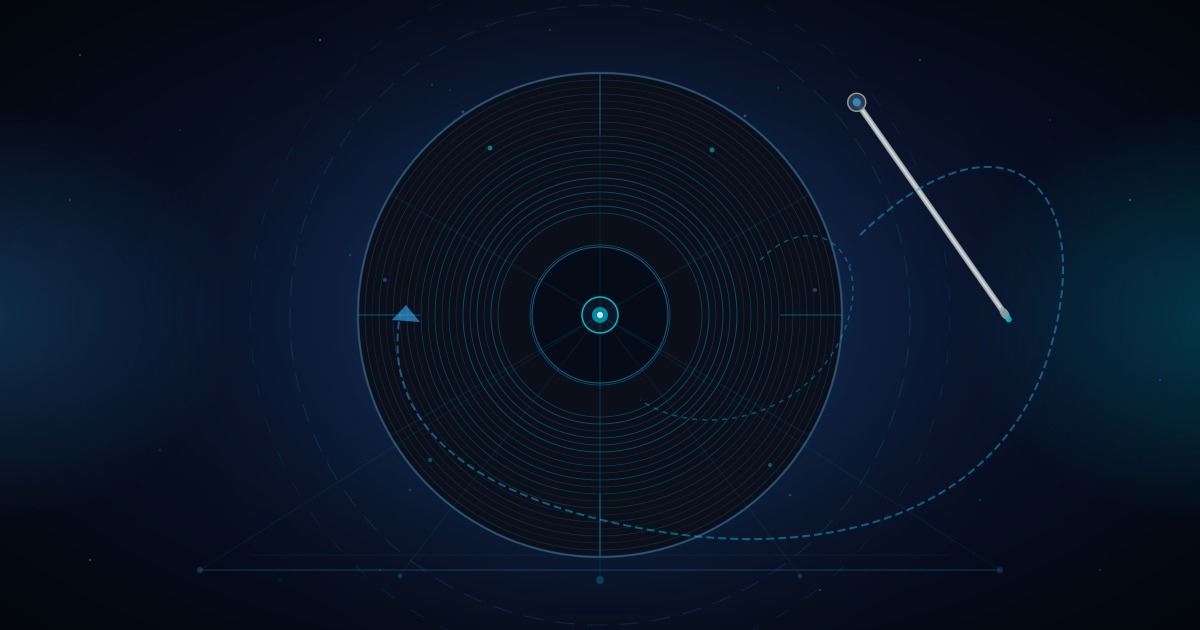
A vinyl record.
The needle follows the groove, and the groove produces the music. But who cut the groove? The musician's attention — what they chose to practice, how they chose to listen, which phrases they repeated ten thousand times until the fingers knew them without the mind's intervention. Years of sustained attention carved a pattern into the wax of ability. And once cut, the groove determines what the needle will play next. The music does not choose itself. The groove chooses it.
Now imagine that you are the record.
Every moment of sustained attention — every belief you rehearsed, every fear you fed, every skill you practiced, every resentment you polished — has carved a groove into the wax of your nervous system, your perceptual habits, your emotional reflexes, the very structure of your brain. These grooves are not abstractions. They are measurable, scannable, physically real. And they determine, with remarkable fidelity, what the needle of your awareness will play next.
This is karma.
Not a cosmic ledger of debts and rewards. Not an invisible accountant tallying sins and virtues across lifetimes. Not the magical thinking that says good things happen to good people and bad things happen to bad people — a claim that five minutes of honest observation can disprove. Karma, in its original formulation and in its most rigorous modern parallels, is something both simpler and more profound than any of those stories.
Karma is the shape attention gives to reality.
What you attend to, you amplify. What you amplify, you encounter. What you encounter, you attend to. The loop is self-reinforcing. The groove deepens with each pass of the needle. And the deeper the groove, the more reliably the needle falls back into it — even when you try to skip to a different track.
Attention is not passive. It is constitutive. The shape of your attention is the shape of your world.
The groove is the karma. The music is your life.
The only question that matters is whether you can become aware of the groove while the needle is still in it. And whether that awareness changes what the next track sounds like.
A vinyl record whose concentric grooves represent karma as accumulated attention patterns, the needle tracing a spiral of conditioned consciousness.
Key Takeaways
- Karma is not a cosmic ledger of punishment and reward — it is the accumulated shape of where attention is placed.
- What attention amplifies, it encounters; what it encounters, it amplifies — the loop is self-reinforcing, and the groove deepens with every pass.
- William James identified attention as the root of judgment, character, and will, establishing it as the mechanism through which consciousness shapes its world.
- Neuroplasticity research demonstrates that sustained attention physically reshapes the brain, making karma measurable at the level of neural architecture.
- The holographic principle and Wheeler's participatory universe suggest that the observer's attention is not incidental to reality but structurally constitutive of it.
- Contemplative practice is not an escape from karma but a recognition of the attention loop — and the opening of genuine choice about where that attention goes.
1. What Karma Actually Is
Stripping the Cosmic Ledger
Most people who have heard of karma understand it through one of two distortions.
The first is the cosmic vending machine version: put in good deeds, get out good fortune. Put in bad deeds, get out suffering. This is karma as celestial accounting, and it has more in common with prosperity gospel than with anything the Buddha actually taught. It implies that the universe keeps a ledger, that there is a cosmic payroll department issuing rewards and punishments, and that the proper response to other people's suffering is the quiet suspicion that they must have done something to deserve it. This version of karma is not just wrong — it is morally corrosive. It turns a profound insight about the nature of mind into a justification for indifference.
The second distortion is the fatalist version: everything that happens to you was predetermined by past actions. Your life is a sentence to be served. Free will is an illusion, and the proper response is resignation. This version transforms karma from a teaching about attention and liberation into a doctrine of helplessness. It is the opposite of what the contemplative traditions intended.
Both distortions share the same structural error: they locate karma outside the mind, in some external mechanism that distributes consequences. The cosmic ledger version puts it in a supernatural accounting system. The fatalist version puts it in an impersonal causal chain. Both miss the point entirely.
Karma, in its original Buddhist formulation, is not out there. It is in here. It is not what happens to you. It is what you do with your attention — and how that doing reshapes the field of what can happen next.
Cetana: The Heart of Karma
The Pali word that the Buddha used for the operative mechanism of karma is cetana — usually translated as "intention" but more accurately rendered as "the directionality of attention." In the Anguttara Nikaya, the Buddha states it with striking clarity: "It is cetana that I call karma. Having willed, one acts through body, speech, and mind."
This is worth pausing over. The Buddha did not say that karma is action. He said karma is cetana — the intentional direction of attention that precedes action. The external act is the consequence, not the cause. The karma is the inner movement of attention — the moment when awareness turns toward something and away from something else. That turning is the seed. Everything that follows is the plant.
This is why the Buddhist teaching on intention places such emphasis on the quality of attention that precedes every act. The IMP framework — Intention, Motivation, Purpose — is, at its deepest level, a framework for conscious karma. It asks: what is the shape of the attention that is about to produce this action? Because that shape will determine not only the action's external consequences but the internal groove it carves — the habit pattern it deepens, the perceptual filter it reinforces, the probability space it creates for the next moment of attention.
The Twelve Links: Karma as Mechanism
The most precise Buddhist description of karma's mechanism is the twelve nidanas — the twelve links of dependent origination (paticca samuppada). This is not a creation myth or a timeline. It is a description of how the attention loop operates in real time, moment by moment:
- Ignorance (avijja) — not seeing the loop clearly
- Formations (sankhara) — habitual patterns of attention (the grooves)
- Consciousness (vinnana) — awareness conditioned by those patterns
- Name-and-form (namarupa) — the experienced world shaped by conditioned awareness
- Six sense bases (salayatana) — the organs of perception
- Contact (phassa) — sense experience arising
- Feeling (vedana) — pleasant, unpleasant, or neutral tone
- Craving (tanha) — the pull toward pleasant, the push from unpleasant
- Clinging (upadana) — grasping at what was pleasant, resisting what was unpleasant
- Becoming (bhava) — the new state of being that craving and clinging produce
- Birth (jati) — the emergence of a new moment of identity
- Aging and death (jaramarana) — the dissolution of that moment
Read this list not as a sequence of separate events but as a single cycle that completes itself dozens of times in a single minute of ordinary consciousness. Ignorance (not seeing the loop) produces habitual formations (the grooves in the record) which condition consciousness (the needle following the groove) which shapes the experienced world (the music that plays). The feeling tone of that experience triggers craving (wanting more of the pleasant, less of the unpleasant), which produces clinging (grasping, resisting), which creates the conditions for the next round. The cycle is karma in motion. Each pass of the needle deepens the groove.
And here is the crucial point — the point that separates the Buddha's teaching from fatalism: the chain can be broken. Not by destroying the links, but by seeing them. The twelfth-century commentator Buddhaghosa identified link number eight — the transition from feeling (vedana) to craving (tanha) — as the critical junction. That is the moment where habitual attention can be interrupted by awareness. The feeling arises — pleasant, unpleasant, neutral — and in the gap before the automatic craving response, there is a choice point. A moment of potential de-automatization. A moment where you can see the groove and choose not to follow it.
This is what the five veils describe from a different angle: the layers of conditioned attention that obscure direct recognition. And it is what reification dissects in its own register — the process by which fluid, arising-and-passing experience gets frozen into fixed categories by habitual attention. Karma, reification, and the veils are different maps of the same territory: the territory of attention creating its own world and then forgetting that it did so.
Sit with this for a moment. Think of a belief you hold about yourself — "I'm not good at..." or "People always..." Feel how automatic it is. Notice how it functions as a groove: your attention falls into it without choosing to. Now notice that you are noticing it. That noticing — that moment of seeing the groove while the needle is in it — is the gap the Buddha identified. It is not the solution. But it is the beginning of every solution.
2. The Self-Fulfilling Prophecy
In 1948, the sociologist Robert K. Merton published a paper in The Antioch Review that would become one of the most cited works in social science. He titled it "The Self-Fulfilling Prophecy," and in it he described a mechanism that the Buddha would have recognized immediately.
Merton's formulation: "The self-fulfilling prophecy is, in the beginning, a false definition of the situation evoking a new behavior which makes the originally false conception come true."
The structure is clean. A person believes something about reality — something that is not (yet) true. The belief changes their behavior. The changed behavior produces consequences that make the belief true. And the now-confirmed belief reinforces itself, deepening the groove for the next cycle.
Merton's original example was a run on a bank. In 1932, the Last National Bank was financially sound. But a rumor spread that it was insolvent. Depositors, believing the rumor, rushed to withdraw their money. The withdrawals — caused by the false belief in insolvency — actually made the bank insolvent. The prophecy fulfilled itself. The belief created the reality it described.
This is the attention → amplification → encounter → attention loop in its starkest social form. And it operates everywhere.
The Trust Erosion Loop
Consider a person who believes, based on early experience, that people cannot be trusted. This belief is their groove — cut by real events, deepened by repetition, now so familiar that it feels like simple realism rather than a perceptual filter.
The belief changes their behavior. They approach relationships guardedly. They scan for signs of betrayal. They interpret ambiguous signals — the unanswered text, the cancelled lunch, the distracted conversation — as confirmation of untrustworthiness. They do not scan for signs of trustworthiness — the kept appointment, the thoughtful gesture, the reliable presence — because those signals do not match the groove.
But the guardedness itself has consequences. People sense it. They feel the wall. Some withdraw, confirming the belief. Some respond with their own guardedness, creating a cycle of mutual distance that looks, from the inside, exactly like evidence that people cannot be trusted. The prophecy fulfills itself. The groove deepens.
This is not a claim about all mistrust being unfounded. Sometimes people genuinely cannot be trusted. The point is structural: even when the original belief has some basis in experience, the self-fulfilling mechanism amplifies it beyond its warranted scope. The belief does not merely describe reality — it participates in creating it. And this participation is invisible to the person inside the loop, because the loop produces evidence that confirms the belief, which makes the belief feel like observation rather than construction.
This is karma. Not cosmic justice. Not supernatural punishment. The natural, empirically validated consequence of the fact that attention is not neutral. It shapes the probability space of what you encounter.
Confirmation Bias: The Cognitive Mechanism
The self-fulfilling prophecy operates through what cognitive psychology calls confirmation bias — the tendency to search for, interpret, and remember information that confirms existing beliefs, while simultaneously ignoring or minimizing information that contradicts them.
Confirmation bias is not a flaw in reasoning. It is a feature of attentional architecture. The brain processes roughly eleven million bits of sensory information per second; conscious awareness handles about fifty. The gap between input and awareness is filled by filtering — and the filters are shaped by prior attention. What you have attended to in the past determines what you are likely to notice in the present. The groove selects the music.
This is why the cycle of harm is so self-reinforcing: hurt people hurt people, partly because the lens of past hurt filters present experience toward threat detection, which produces defensive behaviors that generate new hurt, which deepens the lens. The karma is not in the original wound. The karma is in the attentional loop that the wound set in motion.
And this is why the article on gaslighting and misinformation matters for understanding karma at social scale: when external actors deliberately manipulate the information environment to exploit confirmation bias, they are — in the language of this article — cutting grooves in other people's records. Disinformation is engineered karma.
Think of a judgment you recently made about someone — a coworker, a public figure, a family member. Now ask: did I make this judgment based on the full range of available evidence, or did my attention select the evidence that confirmed what I already believed? The question is not whether the judgment is right or wrong. The question is whether the groove chose the music, or whether you did.
The self-fulfilling prophecy loop: belief shapes behavior, behavior creates evidence, evidence confirms the belief in an enclosed attention cycle.
3. William James and the Blooming Confusion
In 1890, 108 years before neuroscience would begin to confirm his central insight with fMRI scans and cortical mapping studies, William James sat at his desk in Cambridge, Massachusetts, and wrote a sentence that deserves to be carved into the entrance of every psychology department in the world:
"My experience is what I agree to attend to. Only those items which I notice shape my mind — without selective interest, experience is an utter chaos."
James was describing a street scene. The raw sensory input streaming through his window — carriages, pedestrians, vendors, dogs, children, light on cobblestones, the smell of horses, the sound of iron wheels on pavement — constituted what he called "the blooming, buzzing confusion." An undifferentiated field of sensory experience, rich beyond processing, arriving from every direction at once.
But James was not experiencing all of it. He was attending to the woman selling flowers — because she reminded him of a woman he knew in Florence, a connection his memory made before his conscious mind could articulate it. For that moment, she was his reality. Everything else was background noise — present but not experienced, available but not selected.
"The mind," James continued, "chooses to suit itself, and decides which ones shall be special reality for it. In a word, attention is the very root of judgment, character, and will."
Three words: judgment, character, and will. James was saying that attention is not a minor cognitive function — not a spotlight that illuminates a pre-existing stage. Attention is the constructor of the stage. What you attend to is what exists for you. What you ignore is, functionally, not real. And the cumulative pattern of what you attend to and ignore — sustained over a lifetime — is what James called character.
Character. The shape of accumulated attention. The groove in the record.
James saw it, 130 years before the neuroplasticity researchers would show it on a brain scan. He saw that the mind is not a passive receiver of experience but an active selector — and that the selection is not neutral. It has consequences. It creates patterns. The patterns reinforce themselves. And the reinforced patterns become the lens through which all future experience is filtered.
"Each of us literally chooses, by his ways of attending to things, what sort of a universe he shall appear to himself to inhabit."
This is karma stated in the language of pragmatic American psychology — without the Sanskrit, without the cosmology, without any framework that the scientific materialist might find objectionable. And yet the structural identity is complete. What James calls "ways of attending" is what the Buddhist tradition calls cetana. What James calls "character" is what the Buddhist tradition calls karma. What James calls "the universe he shall appear to himself to inhabit" is what the Buddhist tradition calls the experienced world (namarupa) — the world as shaped by conditioned consciousness.
The convergence is not an accident. It is a recognition — arrived at independently across traditions, centuries, and methodologies — that attention is not incidental to experience. It is foundational. It does not merely observe reality. It participates in constituting it.
James added one more observation that completes the picture: "The faculty of voluntarily bringing back a wandering attention, over and over again, is the very root of judgment, character, and will. No one is compos sui if he has it not. An education which should improve this faculty would be the education par excellence."
An education that improves the faculty of bringing back a wandering attention. James was describing, without naming it, what the contemplative traditions have practiced for twenty-five centuries: meditation. The systematic training of attention. The practice of noticing the groove — and returning, again and again, to a chosen object of awareness. Not to escape the blooming confusion, but to discover that you have a choice about which parts of it become your reality.
4. Attention Reshapes the Brain
James could only hypothesize. A century later, the evidence arrived.
Merzenich: You Are What You Attend To
In the 1980s, Michael Merzenich at the University of California, San Francisco, began the experiments that would overturn the neuroscience establishment's conviction that the adult brain is fixed — that its wiring is completed in early childhood and thereafter immutable. Merzenich demonstrated that this conviction was spectacularly wrong.
Working initially with owl monkeys, Merzenich showed that when a monkey's middle finger was surgically removed, the cortical area previously devoted to that finger did not go dark. Instead, the adjacent finger territories expanded to fill the vacated space. The cortical map reorganized itself based on which inputs were still active — based on what the brain was still attending to.
This was not healing. It was rewriting. The brain was literally reallocating neural territory according to the demands of sustained attention.
Merzenich went on to demonstrate that the effect works in both directions. Train a monkey to perform a task that requires sustained attention to specific finger movements, and the cortical area devoted to those fingers expands measurably. Stop the training, and the expansion reverses. The cortical map is not a fixed blueprint — it is a living record of accumulated attention. A topographic autobiography written in neural tissue.
"You are what you attend to," Merzenich later wrote in Soft-Wired. "The brain is continuously remodeled by the details of your experiences and behaviors."
The Pianist's Hands
The most vivid demonstration of Merzenich's principle is visible in every concert hall. A professional pianist's hands move across the keyboard with a fluidity that looks effortless. But those hands carry ten thousand hours of accumulated attention — scales practiced at dawn, passages repeated until the fingers knew them without the mind's intervention, performances where every ounce of awareness was channeled through the fingertips.
Brain imaging studies confirm what the pianist feels: the cortical map for a professional pianist's left hand is measurably larger than a non-musician's. The motor cortex, the somatosensory cortex, the auditory cortex — all show structural differences shaped by years of sustained attention. The grooves are visible on the scan.
This is karma as neuroplasticity. Not metaphor. Not analogy. Direct, measurable, physically real neural restructuring driven by the accumulated shape of attention. The pianist's karma is visible on an fMRI.
Pascual-Leone: When the Eyes Close, the Fingers See
Alvaro Pascual-Leone at Harvard Medical School pushed the finding further. Studying blind Braille readers, he discovered that their visual cortex — the brain region normally devoted to processing visual information — had been repurposed for tactile processing. The neural territory that would have processed light was instead processing touch, because touch was what these individuals' attention was sustained upon.
The brain did not merely compensate for the missing sense. It reallocated neural real estate according to attentional demand. Attention redirected, neural architecture followed. The groove carved by sustained tactile attention was deep enough to recruit brain regions that evolution had spent millions of years optimizing for vision.
This is cross-modal plasticity, and its implications for understanding karma are staggering. The brain is not a fixed machine running fixed programs. It is a self-organizing system that restructures itself according to the sustained direction of attention. What you attend to, over time, literally becomes what your brain is built to process. The architecture follows the attention. The architecture is the karma.
Davidson: Compassion on the Scanner
Perhaps the most directly relevant research for the karma framework comes from Richard Davidson and Antoine Lutz at the University of Wisconsin-Madison. Working with long-term meditators — including Buddhist monks with ten thousand or more hours of compassion meditation practice — Davidson's team demonstrated that meditation produces measurable structural changes in the brain.
The findings were specific. Long-term practitioners of compassion meditation (metta) showed increased gamma-wave activity — the brain wave pattern associated with heightened awareness, integration, and insight. They showed structural changes in the prefrontal cortex (associated with positive emotion and approach behavior) and the anterior insula (associated with empathy and body awareness). And these changes were proportional to the number of hours practiced: more meditation, more structural change.
This is compassion as measurable karma. Ten thousand hours of directing attention toward the wellbeing of all sentient beings — the practice of metta meditation — produces a brain that is structurally different from one that has spent those same hours directing attention toward self-protection, acquisition, or distraction. The groove cut by compassion is visible on the scan, just as the groove cut by fear would be.
Davidson's conclusion: "We can take responsibility for our own brains." What he means, translated into the language of this article: we can take responsibility for our own karma. Not by manipulating an external accounting system, but by choosing — moment by moment, practice by practice, ten thousand hours at a time — the shape of our attention.
Place your attention on your right hand for thirty seconds. Feel the weight of it, the temperature, the subtle pulse in the fingertips. Notice how, within seconds, the hand that was background noise becomes vivid — detailed, present, real. Now consider: this is what your brain does all the time, with everything. What you attend to becomes vivid. What you ignore fades. You are doing this right now, with these words, with this moment. The question is not whether you are shaping your experience with attention. The question is whether you know you are doing it.
Neural plasticity map showing how sustained attention reshapes cortical territory, carving new brain pathways through repeated focus.
5. The Holographic Principle
We have traced the karma loop through Buddhist philosophy, through James's psychology, through Merton's sociology, and through the neuroplasticity laboratory. Each discipline describes the same mechanism from a different vantage point: attention shapes experience, and experience reinforces attention, and the cycle is karma.
Now we enter deeper water. The claim of this section is not that physics proves karma — it does not, and any article that claimed so would be intellectually dishonest. The claim is that contemporary physics has discovered structural features of reality that parallel the karma mechanism in ways that are too precise to dismiss as coincidence and too important to ignore.
These are structural parallels. Maps that share topology even though they were drawn in different centuries, in different languages, for different purposes. The convergence is suggestive, not conclusive. But it is suggestive enough to deserve careful attention.
Bohm's Implicate Order
David Bohm, theoretical physicist at Birkbeck College, London, was one of the twentieth century's most creative and most troubled scientific minds. A protege of Robert Oppenheimer, a colleague of Einstein, a victim of McCarthyism, and a lifelong interlocutor with the philosopher Jiddu Krishnamurti, Bohm spent decades wrestling with a problem that most physicists preferred to ignore: what does quantum mechanics actually mean?
His answer, developed most fully in Wholeness and the Implicate Order (1980), proposed that the universe we observe — the world of separate objects, distinct boundaries, things over here and things over there — is not fundamental. He called this observed world the explicate order: the unfolded, manifest, apparently separate world of everyday experience.
Beneath it (or rather, enfoldled within it), Bohm proposed the implicate order: an undivided wholeness in which every part contains information about the whole. Not a hidden world behind the visible one, but the very same world at a deeper level of description — a level at which the separations that define ordinary experience have not yet arisen.
Bohm's metaphor was the hologram. In a hologram, every fragment of the photographic plate contains information about the entire image. Cut the plate in half, and each half still produces the whole image (at lower resolution). Cut it into quarters, and each quarter still contains the whole. Information about the totality is distributed everywhere. There is no privileged location. There is no fragment that is separate from the whole.
The holomovement — Bohm's term for the dynamic unfolding and enfolding between implicate and explicate — is the process by which the undivided wholeness expresses itself in local, apparently separate forms. The observer and the observed, in Bohm's framework, are not separate entities interacting across a gap. They are enfoldments of the same holomovement — different expressions of the same undivided wholeness.
Now. The parallel to karma.
If the universe is structured holographically — if every part contains information about the whole — then the act of attention (selecting this from the totality, ignoring that) is not a trivial spotlight function. It is the mechanism by which the implicate order becomes explicate for a given observer. What you attend to is what unfolds from the implicate order into your explicate experience. The shape of your attention determines which aspects of the undivided wholeness become manifest in your life.
This is precisely the karma mechanism described in the twelve nidanas: ignorance (not seeing the wholeness) produces formations (habitual patterns of attention) which condition consciousness (the experienced world). Bohm's physics and the Buddha's psychology are describing the same structure from opposite directions — one starting from the mathematics of quantum field theory, the other starting from the phenomenology of meditative observation.
Bohm himself was aware of the parallel. His long correspondence with Karl Pribram, and his extensive dialogues with Krishnamurti and with the Dalai Lama, were motivated by the intuition that physics and contemplative practice were describing the same territory. Not that consciousness is quantum (a claim Bohm never made in the sloppy way it is sometimes attributed to him). But that the structure of quantum reality — wholeness expressing itself through enfoldment — parallels the structure of conscious experience as described by contemplative traditions.
The article on oneness explores Bohm's implicate order from the perspective of non-separation — the recognition that boundaries between self and other are constructed, not given. Here, we approach the same physics from the perspective of karma: the implicate order as the field from which attention's shape unfolds a particular explicate world.
Pribram's Holonomic Brain
Karl Pribram, neuroscientist at Stanford, arrived at a complementary insight from the opposite direction. Working not from physics but from neuroscience, Pribram encountered a puzzle: how does the brain store memories?
The prevailing assumption was that memories are stored in specific locations — that the memory of your grandmother's kitchen is filed in some particular set of neurons, the way a book is filed on a specific shelf. But the experimental evidence didn't support this. Karl Lashley's famous lesion studies had shown that you could remove large portions of a rat's cortex and the rat would still remember its maze, albeit with reduced accuracy. Memory seemed to be distributed — not localized but spread across the whole.
Pribram proposed that the brain stores information holographically: not as localized traces in specific neurons but as distributed interference patterns across the cortex. Like a hologram, any fragment of the brain contains information about the whole of experience. Memory is not here or there — it is everywhere, encoded in patterns of neural oscillation that can be read from any sufficient sample of cortical tissue.
The parallel to the Buddhist understanding of karma is striking. In the Buddhist tradition, karma is not stored in a specific soul-substance or carried in a particular repository. It is distributed across the entirety of a person's experiential field — across habits, perceptions, emotional reflexes, cognitive patterns, physical postures, and relational dynamics. Karma, like Pribram's memory, is not somewhere. It is everywhere in the system.
The Bohm-Pribram connection — sometimes called the holographic paradigm — suggests a universe in which both the external world and the internal brain are structured holographically. If this is so, then karma (the shape of attention creating the shape of experience) is not a local phenomenon. It is a holographic one: the pattern of attention encoded everywhere in the system, readable from any fragment, shaping the whole.
Susskind and the Boundary
The holographic principle received its most rigorous formulation not from Bohm or Pribram but from the next generation of theoretical physicists. In the 1990s, Leonard Susskind and Gerard 't Hooft, working on the black hole information paradox, demonstrated that the information content of a volume of space can be fully described by data encoded on its two-dimensional boundary surface.
Think about what this means. The information that describes everything inside a region of space — every particle, every interaction, every bit of physical reality within that volume — can be represented by a description on the boundary. The three-dimensional interior is, in some precise mathematical sense, encoded on the two-dimensional surface.
Juan Maldacena's AdS/CFT correspondence (1997) provided the most rigorous version of this insight: a complete duality between a theory of gravity in a higher-dimensional space and a quantum field theory on its lower-dimensional boundary. What happens in the bulk is encoded on the surface. What appears to be a three-dimensional reality is described, without loss, by a two-dimensional one.
The structural parallel to karma: the surface of attention — what you look at, what you attend to, the two-dimensional interface between your awareness and the world — encodes the volume of experience. What you live through. The depth and richness and texture of your experienced reality.
This is not a claim that the holographic principle is karma or that AdS/CFT correspondence explains dependent origination. The physics operates at Planck scale; karma operates at the scale of human experience. The claim is structural: in both the physical and the experiential domain, the boundary determines the interior. What is on the surface — the shape of attention, the data on the boundary — encodes what is inside — the experienced world, the information in the volume.
If this parallel holds (and this article claims only that it is suggestive, not that it is proven), then karma is not an add-on to the physics of reality. It is a feature of the same holographic structure that physics describes at its most fundamental level.
Consider this: right now, your visual field is a two-dimensional surface — light arriving at the retina from a three-dimensional world, compressed into a flat image from which your brain constructs depth, distance, and volume. Your entire experienced world is built from a surface. The holographic principle says the universe works the same way. What you see — the surface — is all you need to reconstruct what is. The shape of your looking determines the shape of your world. This is not a metaphor. Or if it is a metaphor, it is one that physics and consciousness happen to share.
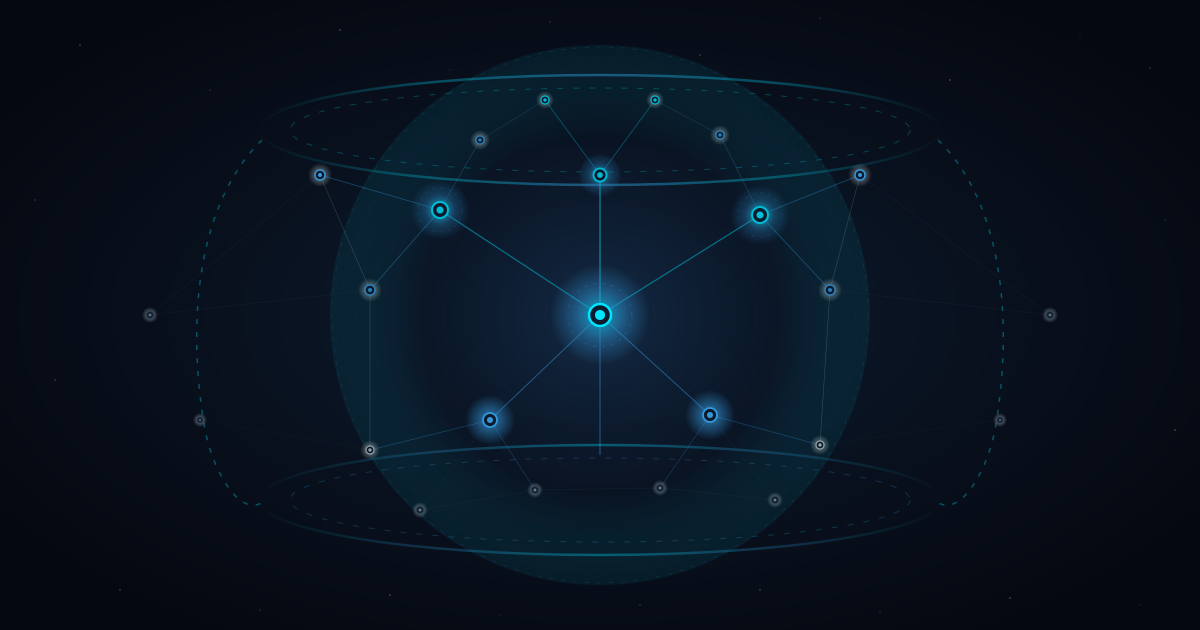
Holographic encoding diagram showing how the two-dimensional surface of attention encodes the full depth of lived experience.
6. The Observer-Participatory Universe
Wheeler's "It from Bit"
John Archibald Wheeler — who gave black holes their name, who supervised more physics PhD theses than any scientist in the twentieth century, who was Richard Feynman's dissertation advisor — spent the last decades of his life wrestling with a question that most physicists avoided: what role does the observer play in quantum mechanics?
His answer was radical. In a series of papers and lectures culminating in his famous 1989 essay "Information, Physics, Quantum: The Search for Links," Wheeler proposed that the universe is not a machine running independently of observation. It is a participatory process in which the act of measurement — the act of attention — plays a constitutive role.
"We are not only observers," Wheeler wrote. "We are participators. In some strange sense this is a participatory universe."
His compressed formulation: "It from bit." Every physical quantity — every particle, every field, every element of spacetime — derives its meaning from observer-participatory acts of measurement. The "it" (the physical world) arises from the "bit" (the information generated by observation). Not that consciousness creates matter in some New Age sense, but that the physical world as we describe it is inseparable from the acts of observation that define it.
Wheeler's most provocative thought experiment was the delayed-choice experiment, first proposed in 1978 and confirmed experimentally decades later. In the standard double-slit experiment, a photon exhibits wave-like behavior (interference pattern) when no detector monitors which slit it passes through, and particle-like behavior (no interference) when a detector is present. Wheeler's twist: what if the choice of whether to detect the path is made after the photon has already passed the slits?
The result, confirmed by experiment, is that the delayed choice appears to retroactively influence the photon's behavior. A photon that "should have" been a wave (because no detector was present at the slits) behaves as a particle if the delayed choice to detect path information is made later — as if the observation reaches backward in time to determine the photon's character.
This does not mean that observation literally changes the past. The correct interpretation is debated. But the structural implication is clear: the act of observation is not a passive recording of a pre-existing reality. It is a participatory act that helps determine the character of what is observed. The observer and the observed are entangled in the same process. Attention does not merely receive reality. It participates in shaping it.
QBism: The Observer at the Center
The most philosophically rigorous version of this insight comes from Quantum Bayesianism — QBism — developed by Christopher Fuchs, Carlton Caves, and Rudiger Schack.
In most interpretations of quantum mechanics, the quantum state (the wave function) is treated as a property of the physical system. The electron has a wave function that describes its state, independent of who is observing it.
QBism disagrees. In QBism, the quantum state is not a property of the object. It is a description of the agent's beliefs about what measurement outcomes they will encounter. The wave function is not out there in the world — it is in the mind of the observer, encoding their expectations, updated by their experiences, and fundamentally tied to their perspective.
This is not solipsism. QBism does not deny the existence of an external world. It asserts that quantum mechanics — our most fundamental physical theory — is a theory about the relationship between an agent and the world, not a theory about the world independent of agents. The observer's attention, beliefs, and prior experience are not incidental to the physics — they are part of the formalism.
The parallel to karma is direct and precise. In QBism, the quantum state is shaped by the observer's history of interactions — their prior measurements, their accumulated experience, their expectations. Change the observer's history, and the quantum state changes. The observer's past attention determines their present quantum state, which determines the probabilities of their future measurement outcomes.
This is the attention → amplification → encounter → attention loop at the level of quantum mechanics. Not a claim that karma is quantum. A recognition that the structure — observer-participation, history-dependent probabilities, the inseparability of attention and outcome — appears at both scales.
Fuchs himself, in his collected essays, uses language that would be at home in a Buddhist text: "The quantum state is a tool for the agent. It encodes the agent's personal expectations. There is no view from nowhere." The view is always from somewhere — from a particular history of attention, a particular set of accumulated experiences, a particular karma.
The physicist says: there is no view from nowhere. The Buddhist says: there is no self that stands outside experience. The psychologist says: attention is the root of character. Three traditions, three vocabularies, one structural insight: you are not a spectator. You are a participant. And the shape of your participation — the grooves in your record — determines the music that plays.
7. Thermodynamics and the Cosmic Accounting
There is a deeper layer still. The holographic principle, the observer-participatory universe, and the karma mechanism all point toward a common root: the physics of information. And information, it turns out, has a thermodynamic cost.
The Second Law and the Arrow of Attention
The second law of thermodynamics states that the total entropy of a closed system tends to increase over time. Entropy, roughly, is a measure of disorder — or more precisely, a measure of the number of microscopic configurations consistent with the macroscopic state. High entropy: many possible configurations, maximum uncertainty, no distinguishing features. Low entropy: few possible configurations, high order, rich in distinctions.
Ludwig Boltzmann, who first connected entropy to probability, showed that the second law is not a mysterious force — it is a statistical inevitability. There are vastly more high-entropy states than low-entropy ones, so any system left to itself will tend to drift toward higher entropy, not because it is pulled there by some force, but because there are simply more disordered configurations than ordered ones.
Now. Consider what happens when attention creates a distinction.
To attend to something is to separate it from everything else — to create an informational distinction where none existed before. The woman selling flowers is distinguished from the street scene. The untrustworthy behavior is distinguished from the full range of evidence. The breath is distinguished from the blooming confusion of sensory input. Every act of attention creates a bit of information: this, not that.
And information, as Rolf Landauer demonstrated in 1961, has a minimum thermodynamic cost. Erasing one bit of information generates at least kT ln 2 joules of heat — a tiny amount, but physically real. Information is not abstract. It is physical. Creating it costs energy. Maintaining it costs energy. And the patterns of information that attention creates — the grooves in the record — are thermodynamic structures that require continuous energy investment to sustain.
Karma, from this angle, is thermodynamic. Every act of attention creates an informational asymmetry (I attend to this, not that), and that asymmetry has consequences that propagate. The grooves in the record are low-entropy structures — ordered patterns maintained against the general drift toward disorder. They persist because energy continues to be invested in them. They deepen when more energy is invested. They fade when the energy is withdrawn.
The Zero/One/Infinity Mapping
The 108 Framework maps the structure of reality onto three fundamental numbers: Zero, One, and Infinity. The thermodynamic angle on karma connects to this mapping with surprising precision.
Zero corresponds to maximum entropy. No distinctions. No self. No observer. No karma. The undifferentiated field before attention creates the first separation. In thermodynamic terms: the heat death of the universe, where all gradients have dissolved and no work is possible. In Buddhist terms: sunyata — emptiness, the ground of being before the first formation arises. In Bohm's terms: the implicate order prior to enfoldment.
One corresponds to the creation of a reference point — the first act of attention. The first distinction. The moment when the undifferentiated field acquires a here and a there, an inside and an outside, an observer and an observed. In thermodynamic terms: the creation of a gradient, a departure from equilibrium, a low-entropy pocket within the high-entropy ocean. In Buddhist terms: the arising of avijja (ignorance of wholeness) and the first link of dependent origination. In Bohm's terms: the first enfoldment — the moment the implicate order unfolds into an explicate distinction.
Infinity corresponds to the cascade of consequences that flows from the first distinction. Once there is a One — once there is a reference point, an observer, a self — the distinctions multiply. This, not that. Here, not there. Me, not you. Good, not bad. Pleasant, not unpleasant. Craving, clinging, becoming, birth, death. The twelve links of dependent origination are the cascade from One to Infinity. The second law of thermodynamics is the physics of the same cascade: once a gradient exists, consequences propagate.
Karma is the shape of this cascade. It is not the cascade itself (that is simply the physics of being a localized observer in a universe governed by the second law). Karma is the particular pattern of distinctions that a particular consciousness has created through its particular history of attention. Your karma is not that you are subject to the cascade — everyone is, by thermodynamic necessity. Your karma is the direction of the cascade — the specific grooves that your specific history of attention has carved.
This is why the fractal life table reveals such precise self-similar patterns across scales: the same 0 → 1 → ∞ structure operates at the level of a single thought, a single life, a single civilization, and a single universe. Karma is the shape of attention at whatever scale you examine.
And here is the thermodynamic kicker: because information creation is irreversible (Landauer's principle), the grooves have real physical consequences that propagate forward in time. You cannot un-create a bit of information without dissipating energy. You cannot un-carve a groove without effort. The past acts of attention leave real thermodynamic traces in the system. Karma is not imaginary. It is entropic.
This is, perhaps, the deepest parallel in this article. Thermodynamics says: every distinction costs energy, and the consequences propagate. Buddhism says: every act of attention creates formations, and the consequences cascade through the twelve links. Both are describing the same structural fact: to be an observer — to create a reference point, a One, a self — is to initiate a process that has consequences. The question is not whether you are creating consequences. You are, with every moment of attention. The question is: what shape are you giving to the cascade?
8. Flow: The Positive Karma Loop
Everything we have discussed so far might suggest that karma is a trap — a self-reinforcing cycle of conditioned attention from which there is no exit. But the same mechanism that creates negative karma (the trust erosion loop, the confirmation bias spiral, the grooves of fear and craving) also creates positive karma. The loop runs in both directions.
The clearest description of positive karma in Western psychology comes from Mihaly Csikszentmihalyi's research on flow — the state of complete attentional absorption in a challenging activity that matches one's level of skill.
The Flow Structure
Csikszentmihalyi identified the flow state through thousands of interviews across cultures, professions, and skill levels. Whether the subject was a rock climber, a surgeon, a chess player, a musician, or a factory worker who had found a way to make the assembly line interesting, the description of the experience was remarkably consistent:
- Complete concentration on the task at hand
- Merging of action and awareness
- Loss of self-consciousness
- Distortion of time experience
- A sense that the activity is intrinsically rewarding
- A feeling of control over the activity
- Immediate feedback from the activity
Notice what is happening attentionally: in flow, the entire bandwidth of attention is absorbed in a single activity. There is no attention left over for the inner commentator — the voice that evaluates, worries, compares, regrets, plans. The self-referential loop that normally consumes a significant portion of cognitive bandwidth simply stops, because there is no attentional surplus to power it.
This is positive karma in action. The mechanism is the same loop — attention → amplification → encounter → attention — but running in a constructive direction:
- Attention is absorbed in a challenging activity
- Amplification: skill develops through sustained engagement
- Encounter: increased skill opens access to more challenging activities
- Attention: the increased challenge absorbs attention more deeply
The loop deepens. The groove gets cut. But the groove leads toward increasing competence, complexity, and meaning rather than toward narrowing, rigidity, and suffering.
Flow as Counter-Evidence to Karmic Fatalism
Flow is important for the karma framework because it refutes the fatalist distortion at the empirical level. If karma were truly fixed — if the grooves were permanent and the record could never be re-cut — then flow would be impossible. You could never enter a state of absorbed, non-habitual attention because your habitual patterns would always dominate. But flow happens. It happens to concert pianists and weekend gardeners, to surgeons and skateboarders, to anyone who has ever been so absorbed in an activity that they forgot to check the time.
Every flow experience is evidence that the grooves do not own you. That habitual attention can be interrupted — not by force of will (which often reinforces the groove it tries to fight) but by absorption in something that demands the whole of attention. The activity provides the structure; attention fills the structure; and for the duration of the flow, the old grooves go quiet. Not erased. But quiet. And in that quietness, new neural pathways form. New grooves begin. The positive karma loop is carving its own record.
This is why paying it forward works at the attentional level — acts of generosity that absorb attention in the wellbeing of another create flow-like states that carve new grooves, interrupting the self-referential loops that produce suffering. The mechanism is not magical. It is neuroplastic.
The Paradox of Self-Forgetting
There is a beautiful paradox at the center of flow that connects directly to the Buddhist understanding of karma. In flow, the self disappears. The rock climber is not thinking "I am climbing." There is just climbing. The pianist is not thinking "I am playing." There is just music flowing through fingers. The surgeon is not thinking "I am performing an operation." There is just the steady, absorbed attention on the tissue beneath the scalpel.
The self-referential loop — "I am doing X, and I am the kind of person who does X, and doing X means Y about me" — goes quiet. And when it goes quiet, the quality of attention changes dramatically. Without the self as intermediary, attention becomes more direct, more responsive, more attuned to the actual demands of the situation rather than to the ego's commentary about the situation.
This is precisely what the Buddhist tradition means by anatta (non-self) in practice — not a metaphysical denial that persons exist, but an experiential discovery that the best moments of human performance, creativity, and connection happen when the self-referential loop is quiet. The five radical realizations touch this territory from the philosophical side; flow touches it from the phenomenological.
Flow is karma running in the direction of liberation. Not liberation from the loop, but liberation within it: the discovery that when attention is fully absorbed, when the grooves are carved by genuine engagement rather than by fear or craving, the music that plays is — well — the music the musician actually wants to play.
Recall a moment of genuine flow in your own life — a time when you were so absorbed in what you were doing that self-consciousness disappeared and time distorted. Notice how that memory feels different from memories of rumination, worry, or boredom. In flow, the karma loop is still running — attention is still shaping experience, which is reinforcing attention. But the quality of the loop has changed. The groove was cut by absorption, not by anxiety. The music is different. Same mechanism. Different karma.
9. The Attention Economy: Civilizational Karma
Now we scale up.
Simon's Diagnosis
In 1971, Herbert Simon — Nobel laureate, one of the founders of artificial intelligence, and one of the sharpest minds of the twentieth century — made an observation that would prove prophetic:
"In an information-rich world, the wealth of information means a dearth of something else: a scarcity of whatever it is that information consumes. What information consumes is rather obvious: it consumes the attention of its recipients. Hence a wealth of information creates a poverty of attention."
A poverty of attention. Simon saw, half a century before the smartphone, that the fundamental scarcity of the information age would not be information (which was becoming effectively infinite) but attention (which remains biologically fixed). The human brain processes fifty bits of conscious experience per second. The information environment was about to deliver millions. The gap would be filled by competition — not for money, not for resources, not for territory, but for the one thing that is genuinely scarce: human attention.
Wu and the Attention Merchants
Tim Wu's The Attention Merchants (2016) traces the history of this competition from the first newspaper advertisements of the nineteenth century through radio, television, and social media. His conclusion: attention has become the primary currency of the modern economy. The business model of the largest companies in human history — Google, Meta, TikTok, X — is the extraction and sale of human attention.
This is karma at civilizational scale.
When attention is commodified — when the economic incentive is to capture attention rather than to inform or educate or enrich — the self-fulfilling prophecy mechanism operates on billions of minds simultaneously. The attention-capturing content that succeeds algorithmically is the content that triggers strong emotional responses: outrage, fear, desire, tribal identification. The algorithms amplify whatever captures attention. What is amplified captures more attention. The loop runs.
The result is a civilizational groove — a collective karma shaped by the fact that the most powerful information-distribution systems in human history are optimized not for truth, wisdom, or wellbeing, but for engagement. And engagement, measured in clicks and watch-time, correlates reliably with emotional arousal. What arouses, gets amplified. What gets amplified, arouses. The groove deepens.
This is what the material veil describes as the systemic layer of obscuration — the structures that make it harder, not easier, for attention to find its way to what matters. The attention economy is not just an economic phenomenon. It is a karmic one: the collective shape of billions of individual attentional loops, steered by algorithmic incentives toward content that deepens grooves of outrage, division, and craving.
And it is what the article on AI as mirror addresses from the technological side: when artificial intelligence is deployed to maximize engagement, it becomes a karma accelerator — deepening whatever grooves already exist in individual and collective attention, feeding back amplified versions of existing biases, fears, and desires. Platform-as-Medicine — the alternative vision described in that article — is the possibility of redirecting the same technology toward karma that heals rather than harms.
The Algorithm as Groove-Cutter
There is a crucial distinction between the attention economy and all previous forms of attentional shaping. A newspaper editor chose what to put on the front page. A television producer chose what to air. These were human decisions, subject to human judgment — sometimes wise, often not, but at least legible. The algorithmic attention economy operates differently. The algorithm does not choose content according to human values. It optimizes for a mathematical function: maximize engagement time. And it discovers, through billions of iterations of machine learning, that the content that maximizes engagement is the content that triggers the brain's threat-detection circuits, tribal-loyalty mechanisms, and novelty-seeking reflexes.
The algorithm is, in the language of this article, an automated groove-cutter. It carves attentional grooves in billions of minds simultaneously, optimized not for truth or wisdom or wellbeing but for continued engagement. Each scroll, each click, each watch-to-completion deepens the groove. The algorithm learns from the deepened groove and serves content that deepens it further. This is the self-fulfilling prophecy operating at a speed and scale that Merton could not have imagined.
The implications for collaboration are severe: when the attentional infrastructure of a civilization is optimized for division, the geometry of collaboration itself deforms. And the implications for the toroidal economy are equally stark: an attention economy that extracts rather than circulates is a karma economy running in the wrong direction — depleting rather than regenerating the collective attentional commons.
The Collective Groove
Consider the structural parallel. An individual with a confirmation bias loop — "people can't be trusted" → selective attention to untrustworthiness → encountering untrustworthiness → deeper belief — is creating individual karma. Now multiply this by three billion people connected to the same algorithmic amplification system, and you have civilizational karma: collective attentional loops, reinforced at industrial scale, creating the collective world that the collective attention describes.
The political polarization, the epidemic of anxiety, the erosion of shared truth, the sense that the world is more dangerous and hostile than it actually is — these are not random. They are the predictable consequences of the attention economy's karmic structure. The algorithm amplifies what captures attention. What captures attention is what activates threat detection, tribal loyalty, and outrage. The amplified content reshapes collective perception. The reshaped perception generates behavior. The behavior creates the reality that confirms the perception.
This is the cycle of harm operating at civilizational scale. And it is why the question of karma is not merely a personal or spiritual one. It is a political, economic, and civilizational question of the first order.
Simon saw it in 1971. Wu documented it in 2016. The Gaia Mind Network describes the infrastructure through which it operates. But the mechanism is the same one the Buddha described twenty-five centuries ago: ignorance → formations → conditioned consciousness → a world shaped by that conditioning. The scale has changed. The mechanism has not.
Notice what you attended to in the last hour on your phone. Not what you intended to look at — what you actually looked at. The gap between intention and actuality is the civilizational karma gap. It is the distance between the groove the algorithm cut and the groove you would cut for yourself. Recognizing that gap is the beginning of reclaiming your attention. It is also the beginning of reclaiming collective karma.
Civilizational karma: the attention economy as an algorithmic groove-cutter amplifying emotional triggers across billions of minds simultaneously.
10. Karma Practice: De-Automatizing the Loop
If karma is the shape of attention, then changing karma requires changing the shape of attention. This sounds simple. It is not. The grooves are deep, the needle falls back into them with extraordinary reliability, and the self-referential loop that would change the grooves is itself running on grooves.
But it is possible. Every contemplative tradition on Earth says so. And the neuroplasticity evidence confirms it: the brain that was shaped by one pattern of attention can be reshaped by a different one. Davidson's monks are proof. The pianist's cortical maps are proof. Merzenich's entire career is proof.
The question is how.
The Meditator's Discovery
A person sits down on a meditation retreat. Day three. They have been instructed to do something that sounds absurdly simple: watch the breath. Notice the inhalation. Notice the exhalation. When attention wanders, notice the wandering, and return to the breath.
By day three, this person has made a discovery that is simultaneously humbling and revelatory: they cannot do it. Not for more than a few seconds at a time. The breath is there, present, reliable, asking nothing — and within moments, attention has drifted to a conversation from last week, a worry about tomorrow, an itch on the knee, a fantasy about lunch. The drift is not a failure of willpower. It is a demonstration of habitual attention — the grooves in the record playing themselves.
Each drift reveals a groove. The conversation from last week: a groove of relational processing, probably connected to unresolved emotion. The worry about tomorrow: a groove of anticipatory anxiety, probably deepened by years of planning and contingency-thinking. The itch: a groove of body-consciousness, the brain's constant monitoring of physical sensation for potential threats.
None of these grooves are wrong. All of them were carved for reasons — survival reasons, social reasons, emotional reasons. The point of watching them is not to judge them. The point is to see them. To discover that what felt like "just thinking" is actually a patterned, habitual, self-reinforcing loop of attention. To recognize that the needle falls into the same grooves again and again — and to notice the falling.
This is the twelve links of dependent origination experienced in microcosm on a cushion. Ignorance (not seeing the groove) → formations (the habitual pattern) → consciousness (conditioned awareness following the pattern) → contact (the experience that arises) → feeling (pleasant, unpleasant, neutral) → craving (wanting more, wanting less) → clinging (grasping, resisting).
And here, in the space between feeling and craving — the gap that Buddhaghosa identified as the critical junction — the meditator discovers the possibility of not following the groove. Not fighting it. Not suppressing it. Simply... not following it. Noticing the feeling arise (pleasant, unpleasant, neutral), noticing the pull toward craving (more! less!), and instead of following the pull, returning to the breath.
Each return is a moment of de-automatization. A moment of interrupting the karma loop. A moment of choosing where attention goes rather than letting the groove choose. One return does nothing measurable. A thousand returns begin to carve a new groove — the groove of returning, the groove of noticing, the groove of choosing. Ten thousand returns produce the structural brain changes that Davidson measured.
This is karma practice. Not escaping the loop. Not transcending it. Seeing it while you are in it, and choosing where attention goes next. The hidden wisdom tradition names this capacity in various ways across cultures; the mechanism is the same everywhere it appears.
The Four Movements of Karma Practice
Drawing from the contemplative traditions and the neuroplasticity evidence, we can identify four movements that constitute karma practice:
1. Recognize. See the groove. Notice that attention has drifted into a habitual pattern. This is the moment of vidya (knowing) replacing avidya (unknowing). You cannot change a groove you cannot see.
2. Release. Let go of judgment about the groove. The inner critic — "I shouldn't be thinking about this" — is itself a groove, and a particularly sticky one. Release means allowing the pattern to be what it is without adding a layer of self-criticism on top of it.
3. Return. Bring attention back to the chosen object — the breath, the body, the present moment, the task at hand. This is the moment of cetana — intentional direction of attention. Each return is a rep in the gym of neuroplasticity.
4. Repeat. The groove was not carved in a day. It will not be re-carved in a day. The practice is the repetition — the ten thousand returns that, over time, create a new groove: the groove of awareness itself.
These four movements are not unique to any single tradition. They appear in Zen (shikantaza: just sitting, just returning), in Vipassana (noting and returning), in Christian contemplative prayer (centering prayer's return to the sacred word), in the Sufi practice of dhikr (remembrance and return), and in the secular mindfulness tradition that Jon Kabat-Zinn adapted from Buddhist practice. The language differs. The mechanism is identical.
And the mechanism is karma. Deliberate karma. Conscious karma. The choice to carve grooves of awareness instead of grooves of automation. As the article on the sacred joke observes from its own angle: the moment you see the groove is the moment the groove no longer fully owns you. The seeing is already the freedom — not freedom from karma, but freedom within it.
11. The Structural Convergence
Let us pause and see where we are.
We have traced the karma mechanism through seven domains:
- Buddhist philosophy: Karma is cetana — the directionality of attention. The twelve nidanas describe the self-reinforcing loop.
- Social psychology: The self-fulfilling prophecy (Merton) is karma's most empirically validated mechanism. Confirmation bias is the cognitive engine.
- Psychology of attention: James identified attention as "the root of judgment, character, and will" — the mechanism by which raw experience becomes organized reality.
- Neuroplasticity: Merzenich, Pascual-Leone, and Davidson demonstrated that sustained attention literally reshapes the brain. Karma is measurable.
- Holographic physics: Bohm's implicate order, Pribram's holonomic brain, and Susskind's holographic principle describe a universe where every part contains information about the whole — and where the surface of observation encodes the volume of experience.
- Quantum foundations: Wheeler's participatory universe and QBism place the observer's attention at the center of physical reality, not as mysticism but as a feature of the formalism.
- Thermodynamics: Information creation has thermodynamic cost. Attention creates information. The grooves are entropic structures with real physical consequences.
These are not seven different topics. They are seven views of one territory — the territory described by the statement: attention is not neutral; it shapes the probability space of future experience.
The convergence is not forced. It was not manufactured by selecting only the evidence that fits. It was discovered — independently, across centuries and disciplines — by people who looked carefully at the relationship between attention and reality and found the same structure.
The Buddhist practitioner who watches the breath and notices habitual attention is observing the same mechanism that Merzenich measures in the laboratory. The social psychologist who studies self-fulfilling prophecies is quantifying the same loop that the twelve nidanas describe. The physicist who formulates the holographic principle is formalizing the same structural relationship between surface and volume that the meditator discovers between the quality of attention and the quality of experience.
This is not a claim of identity. Buddhist meditation is not neuroscience is not quantum physics is not thermodynamics. The methodologies are different, the scales are different, the precision criteria are different. The claim is structural parallel — the same formal relationship appearing across domains, the way the Fibonacci sequence appears in pinecones, sunflowers, and galaxy arms without any of them "being" the others.
The parallel is suggestive. It may ultimately prove superficial. But it earns, at minimum, this recognition: the concept of karma — stripped of its supernatural accretions, returned to its original meaning as the shape of attention — is not a primitive superstition to be replaced by science. It is a description of a structural feature of reality that science is, from its own direction and with its own tools, beginning to formalize.
Notice how many different doorways led to the same room. Physics, psychology, neuroscience, contemplative practice — all arriving at the same structural insight: attention participates in constituting reality. The multiplicity of paths is itself evidence. When many independent investigations converge on the same finding, the finding is probably pointing at something real.
12. Closing: What Shape Is Your Attention Giving to the Field?
Return to the groove in the record.
But now, after everything we have traced — the twelve nidanas, Merton's prophecy, James's blooming confusion, Merzenich's cortical maps, Bohm's holomovement, Wheeler's participatory universe, the thermodynamic cost of information — the metaphor has deepened.
The groove is not just a metaphor for habit. It is a physical structure in the brain, measurable by fMRI. It is a thermodynamic investment, maintained by energy. It is an informational pattern on the boundary surface of your attention, encoding the volume of your experienced world. It is a self-fulfilling loop, creating the evidence that confirms the belief that created the loop. It is a link in the twelve-fold chain of dependent origination, turning endlessly until awareness interrupts it.
And it is also — always — a choice point.
Not a choice in the sense of unlimited freedom. The grooves are real. The needle falls into them with enormous reliability. Decades of accumulated attention have carved patterns that are not erased by a single moment of insight. The pianist did not develop their cortical maps in a weekend. The person who cannot trust did not build that groove overnight. Neither will be reshaped by wishing.
But the neuroplasticity evidence says: the groove can be reshaped. By sustained, deliberate, repeated attention to something other than the habitual pattern. By ten thousand returns to the breath. By ten thousand acts of noticing the drift and choosing where attention goes next. By carving new grooves — grooves of awareness, grooves of compassion, grooves of presence — alongside the old ones.
The thermodynamics says: this will cost energy. Creating new informational patterns requires work. Maintaining them requires ongoing investment. There is no free lunch in the physics of attention, just as there is no free lunch in the physics of anything else. Changing karma is not effortless. It is effortful. The effort is the practice.
The holographic principle says: the surface determines the volume. The boundary of your attention — what you choose to look at, what you choose to engage with, where you direct the fifty bits per second of conscious awareness — encodes the interior of your experienced world. You do not need to reshape the entire universe to reshape your experience. You need to reshape the surface — the shape of your attention. The interior follows.
The 108 Framework says: Zero is the ground. One is the reference point. Infinity is the cascade. You cannot avoid creating a One — you are an observer, a localized consciousness, a reference point in the field. You cannot avoid the cascade — the second law guarantees it. But you can choose the shape of the One. You can choose the quality of the reference point. And the quality of the reference point — the quality of your attention — determines the quality of the cascade.
This is what the Buddha meant by karma. Not cosmic accounting. Not predestination. Not magical thinking. The simple, rigorous, empirically verifiable, structurally paralleled, thermodynamically grounded fact that attention shapes the probability space of future experience. What you attend to, you amplify. What you amplify, you encounter. What you encounter, you attend to.
The groove is the karma. The music is your life.
And in every moment — in this moment, right now, as you read these words and feel your attention resting here or drifting there — the needle is in the groove, and the groove is being cut, and the music is playing.
The question is not whether this is happening. It is.
The question is: what shape is your attention giving to the field?
Sit with this — not as a problem to solve, but as a territory to recognize.
The groove in the record is already playing. You did not choose all of it. Much of it was carved by circumstances, by culture, by early experience, by the attention economy's algorithmic shaping of your perceptual field. You inherited grooves. This is the truth that the fatalist gets right: you did not start from a blank record.
But you are holding the stylus. Right now. In this breath. In this moment of attention.
The neuroplasticity researchers have shown that new grooves can be carved. The contemplative practitioners have demonstrated it for twenty-five centuries. The physics suggests that the surface of attention encodes the volume of experience. And the thermodynamics confirms that the investment is real — it costs energy, it takes time, it requires the ten thousand returns.
What will you attend to in the next hour? The next day? The next ten thousand hours?
Not as a self-improvement project. Not as a burden. As an invitation — toward the grooves you would actually choose if you could see them clearly.
Not as a prescription. Not as a command. As an honest question from one consciousness to another — one groove to another — one stylus to another:
What shape will your attention give to the field?
Invitation
This is not a teaching you can agree with and set aside. It is happening — right now, in the quality of your attention as you read these words, in what you will notice in the next five seconds, and the next, and the next.
There is no moment that is not shaping you. No glance that is not a vote. No distraction that is not a practice.
This could feel like a burden. But feel it again — it is the opposite. It means that every instant is a fresh canvas, and the brush has never left your hand.
References
Bohm, D. (1980). Wholeness and the Implicate Order. Routledge & Kegan Paul.
Csikszentmihalyi, M. (1990). Flow: The Psychology of Optimal Experience. Harper & Row.
Davidson, R. J., & Lutz, A. (2008). Buddha's brain: Neuroplasticity and meditation. IEEE Signal Processing Magazine, 25(1), 176-174.
Davidson, R. J., & Begley, S. (2012). The Emotional Life of Your Brain: How Its Unique Patterns Affect the Way You Think, Feel, and Live — and How You Can Change Them. Hudson Street Press.
Fuchs, C. A. (2010). QBism, the perimeter of quantum Bayesianism. arXiv preprint arXiv:1003.5209.
Fuchs, C. A., Mermin, N. D., & Schack, R. (2014). An introduction to QBism with an application to the locality of quantum mechanics. American Journal of Physics, 82(8), 749-754.
James, W. (1890). The Principles of Psychology (Vols. 1-2). Henry Holt and Company.
Kabat-Zinn, J. (1990). Full Catastrophe Living: Using the Wisdom of Your Body and Mind to Face Stress, Pain, and Illness. Delacorte Press.
Landauer, R. (1961). Irreversibility and heat generation in the computing process. IBM Journal of Research and Development, 5(3), 183-191.
Merzenich, M. M. (2013). Soft-Wired: How the New Science of Brain Plasticity Can Change Your Life. Parnassus Publishing.
Merzenich, M. M., Nelson, R. J., Stryker, M. P., Cynader, M. S., Schoppmann, A., & Zook, J. M. (1984). Somatosensory cortical map changes following digit amputation in adult monkeys. Journal of Comparative Neurology, 224(4), 591-605.
Merton, R. K. (1948). The self-fulfilling prophecy. The Antioch Review, 8(2), 193-210.
Pascual-Leone, A., & Torres, F. (1993). Plasticity of the sensorimotor cortex representation of the reading finger in Braille readers. Brain, 116(1), 39-52.
Pribram, K. H. (1971). Languages of the Brain: Experimental Paradoxes and Principles in Neuropsychology. Prentice-Hall.
Pribram, K. H. (1991). Brain and Perception: Holonomy and Structure in Figural Processing. Lawrence Erlbaum Associates.
Simon, H. A. (1971). Designing organizations for an information-rich world. In M. Greenberger (Ed.), Computers, Communications, and the Public Interest (pp. 37-72). Johns Hopkins Press.
Susskind, L. (1995). The world as a hologram. Journal of Mathematical Physics, 36(11), 6377-6396.
't Hooft, G. (1993). Dimensional reduction in quantum gravity. In A. Ali, J. Ellis, & S. Randjbar-Daemi (Eds.), Salamfestschrift (pp. 284-296). World Scientific.
Wheeler, J. A. (1989). Information, physics, quantum: The search for links. In W. H. Zurek (Ed.), Complexity, Entropy, and the Physics of Information (pp. 3-28). Addison-Wesley.
Wu, T. (2016). The Attention Merchants: The Epic Scramble to Get Inside Our Heads. Alfred A. Knopf.