In 2012, a developmental psychologist at the University of British Columbia placed a small bowl of Goldfish crackers in front of a toddler — just twenty-two months old, barely tall enough to see over the edge of the table. The researcher, Lara Aknin, handed the child a cracker and then asked her to give one to a puppet named Monkey. The child reached into the bowl and gave one over. The researcher asked again. The child gave again. Then again. And again. Treat by treat, the bowl emptied. The child's supply, which had seemed permanent and plentiful in the way all things seem to a toddler, grew smaller with each act of offering. She did not know yet how to count. She did not know the word diminishing. And yet her face, captured by cameras positioned at her eye level, told researchers something that no survey instrument could have obtained from someone so young: she was not reluctant. She was not complying. She was luminously, unmistakably happy.
The team measured emotional responses throughout the session with painstaking care — and what they found quietly disassembled a great deal of conventional wisdom. These children were measurably happier giving than receiving. They were most happy when giving from their own diminishing supply — at personal cost, with nothing held back. No reward system was operating. No moral instruction had been given. These children had not yet lived long enough to learn what they were supposed to feel. They had not been trained by religion, culture, or social expectation to perform generosity. What they were experiencing was something older than any of those systems, something that arrived before language could frame it as virtue: the pleasure of a living system doing precisely what it was designed to do.
Published by Aknin and her colleagues in PLOS ONE, this study did not merely prove that young children can be generous. It suggested something far more radical — that generosity is not a lesson we learn but a capacity we are born expressing, and that the accumulated weight of growing up is, in part, the story of learning to suppress it. The question the study raises is not whether we are built for generosity. The question is what gets in the way — and whether we can, with sufficient clarity and intention, clear the path back.
The toddler did not invent the move. She remembered it. What follows is an honest tracing of that memory — through the body, through the social network, through the long history of how the human animal organizes itself when it is allowed to be at home in its own nature.
Key Takeaways
- Generosity is not a moral virtue but a biological and social technology — a reproducible pattern encoded into human evolution that extends capacity at every scale of human organization.
- The brain rewards giving as richly as receiving: the helper's high is produced by the same mesolimbic circuits that respond to food, love, and recognition, making generosity neurologically self-sustaining.
- A single generous act reaches three degrees of social separation, influencing the behavior of strangers the giver has never met — documented by Christakis and Fowler in large-scale network research.
- Generous communities consistently outperform others in resilience, innovation, and wellbeing; social capital, as measured by Robert Putnam, functions as infrastructure, not sentiment.
- The gift economy preceded the market economy in every documented human culture, establishing generosity as the original social technology rather than a refinement of later economic systems.
- At its deepest register, generosity is not a duty performed at personal cost but the natural expression that arises when the perceived separation between giver and receiver dissolves.
1. Introduction — Generosity as a Technology of Human Evolution
Generosity has long been framed as a virtue — admirable, aspirational, the province of saints and philanthropists. We speak of generous souls as though generosity were a rare quality given to the fortunate few. What the evidence shows from many independent directions is something different: that generosity is a biological, emotional, social, and spiritual technology — built into the architecture of what it means to be human.
The distinction between a virtue and a technology is not semantic. A virtue is a quality we admire and aspire to cultivate — something morally praiseworthy, something we are a little better for having, a little less fully human for lacking. Technologies are different in kind. A technology is a tool that extends our capacities beyond what we could achieve alone. Fire was a technology — it multiplied the nutritional return of every calorie, extended the usable hours of every day, made a species that had evolved for warm climates capable of inhabiting a cold planet. Language was a technology — it allowed intentions, knowledge, and warnings to be stored outside any individual brain and transmitted across generations. Writing amplified language into civilizational memory. The wheel made the body's mechanical advantage portable. Each of these technologies was not an addition to human nature — it was an expression of a latent capacity, a discovered method for extending what was already possible into what had previously been impossible.
Generosity — the voluntary extension of what we have toward others' flourishing — belongs in this category. Not because it lacks moral significance. Because it works in the same way technologies work: it extends capacity, creates emergent effects at scale, and operates through a consistent, reproducible, structurally describable mechanism. Call it the gift. Call it prosocial behavior. Call it the giving pattern. Whatever its name in any given discipline, the mechanism is the same: when one living system gives freely to another, both are transformed. And the transformation does not end with them.
What distinguishes a technology from a feeling is its structure. Technologies have architecture. They are not random. Generosity is not a random eruption of good feeling — it is a pattern, a fractal behavior that replicates itself at every scale of human experience. One act of giving tends to inspire another. One generous community attracts generosity from beyond its borders. One culture that orients itself toward contribution rather than extraction tends, over time, to become more resilient, more creative, more adaptive — more alive in every dimension we know how to measure.
The pattern holds because the underlying mechanism holds. Tracing that mechanism — from the synapse through the social bond to the way whole civilizations rise and fall — is some of the most useful work we can do right now.
There is also an urgency to this understanding that is not hypothetical. The extractive logics organizing much of contemporary civilization — logics built on accumulation, competitive advantage, and the externalization of cost onto those who cannot resist — are showing their structural limits with increasing visibility. The antidote is not idealism. It is a more accurate understanding of how human systems actually work, and what kind of operating system sustains them over time. Generosity is not the romantic alternative to realism. It is the reality that realism has been systematically underweighting.
Seen clearly, generosity is not moral decoration. It is a core operating principle of human biology, human community, and human history. The thesis is simple and far-reaching:
Generosity transforms the giver, the receiver, and the system.
Tracing how — through the body, through emotion, through social structure, through culture, through the deepest spiritual lineages humanity has produced — is some of the most useful work we can do together right now.
2. The Biology of Giving — What the Brain Reveals
The body does not lie about what it values. And the body's response to generosity is clear, measurable, and consistent across cultures, ages, and experimental conditions.
You may have felt it without naming it. The moment you held the door for someone whose hands were full and they looked up surprised and grateful — there was a small warm thing that moved through your chest before you had time to think about it. That was not sentiment. That was the body reporting what was happening to it. When we give — a gift, a compliment, a donation, an act of service to someone who needs it — the brain's reward circuitry activates in ways that closely mirror what happens when we receive. The ventral striatum, a deep brain structure associated with motivation and reward, lights up. Dopamine floods the mesolimbic pathways. Oxytocin rises, deepening the sense of connection. The anterior cingulate cortex — involved in social cognition and the detection of social pain and pleasure — becomes active. What neuroscientists have come to call the "helper's high" is not metaphor or wishful thinking. It is measurable, reproducible, and has now been documented in populations ranging from American university students to subsistence farmers in rural Uganda.
Jorge Moll's neuroimaging research at the National Institutes of Health was among the first to make this visible with precision. In a 2006 study published in PNAS, Moll and his colleagues placed participants inside fMRI scanners and gave them the choice to donate money to a charitable cause or keep it for themselves. When participants chose to donate, the regions associated with pleasure and social bonding activated — the same mesolimbic circuits that fire when we eat a satisfying meal, fall in love, or feel seen and recognized by someone we respect. Giving, at the neural level, is not self-sacrifice. It is its own form of receiving. The reward is not incidental to the act — it is embedded in the act's architecture.
This finding has a deeper evolutionary logic that Moll's work began to illuminate. The neural reward for giving is not a cultural overlay added by millennia of moral instruction. It is a feature of the system's basic design. Our brains reward generosity for the same reason they reward sex and food: because generosity, in the environment where human neural architecture was shaped, was essential to survival.
The anthropological record is clear on this point, even if popular evolutionary narratives have obscured it. Homo sapiens outlasted and outcompeted numerous other hominin species not primarily because of raw intelligence, physical size, or aggressive dominance. We were not the strongest species on the Pleistocene savanna, nor the fastest, nor the most physiologically formidable. What we had, and what our competitor species appear to have lacked in equivalent form, was radical cooperation. We shared food across seasons, storing it communally and distributing it to those who could not contribute in any given period — the elderly, the injured, the very young. We cared for individuals who provided no immediate return on investment, building the extended care networks that allowed children to survive the long developmental dependency period unique to our species. We built shared stories, shared rituals, shared obligations — what anthropologists call the cooperative infrastructure of human society. Cooperation and generosity were not additions to our survival toolkit, polished up once the harder work of survival was done. They were the toolkit. The human niche is the cooperative niche.
Elizabeth Dunn's landmark 2008 study, published in Science, confirmed that this cooperative impulse produces measurable wellbeing even in modern conditions radically different from the ancestral environment. Dunn and her colleagues at UBC gave participants either 20 and instructed half to spend it on themselves, half to spend it on others. Participants who spent money on others reported significantly greater happiness at the end of the day — regardless of the amount. The effect was not a function of wealth: it held across income levels, across educational backgrounds, across cultures. Dunn and her colleagues subsequently replicated the finding in India, Canada, and Uganda — including among Ugandan households living on less than two dollars per day. The happiness benefit of giving was not a luxury of affluence. It was a constant of human nature, operating across conditions of material scarcity that most wealthy-world participants cannot imagine.
Paul Zak, a neuroeconomist at Claremont Graduate University who has spent two decades studying the role of oxytocin in human behavior, offers one of the most elegant pieces of the puzzle. Oxytocin — the neuropeptide involved in bonding, trust, and social connection — is released not only when we receive care and affection, but when we give it. Zak, who dubbed oxytocin "the moral molecule" in his 2012 book of the same name, found that individuals with higher baseline oxytocin levels are measurably more generous, more trusting, and more prosocial across every metric. More strikingly, Zak's cross-national research found a consistent correlation: countries with higher average oxytocin reactivity have higher per-capita charitable giving rates. The "moral molecule" may be less a metaphor than a literal biochemical substrate of social generosity — a chemical messenger that the body uses to say: this person can be trusted; this relationship is safe; it is worth giving here.
The nervous system confirms the picture from another angle. The autonomic nervous system regulates our physiological response to the environment through two primary branches: the sympathetic branch, which mobilizes the stress response — elevating cortisol and adrenaline, accelerating heart rate, shunting blood to the muscles — and the parasympathetic branch, which induces the rest-and-digest state of recovery and connection. Chronic stress — the condition that characterizes an increasing proportion of modern life — keeps the sympathetic branch in a state of low-grade activation, flooding the body with cortisol and setting the stage for the downstream consequences: impaired immune function, cardiovascular stress, difficulty concentrating, emotional dysregulation. Acts of generosity and compassion consistently activate the parasympathetic branch, reducing cortisol levels and inducing what researchers call the "tend-and-befriend" response — the physiological state associated with nurturing, bonding, and cooperative engagement. Regular volunteers, across multiple longitudinal studies, report lower rates of depression and better self-reported physical health than matched non-volunteers — even after controlling for socioeconomic status, initial health levels, and the possibility that healthier people simply volunteer more.
Christian Smith and Hilary Davidson's landmark 2014 study, The Paradox of Generosity, analyzed data from more than 2,000 Americans across five years and found that those who gave more than 10 percent of their income to charitable causes reported 43 percent higher life satisfaction than those who gave less than 2 percent. The relationship held across age, income, religious affiliation, and political orientation. The "paradox" in Smith and Davidson's title is that generosity appears to produce exactly the opposite of what our culture's scarcity logic predicts: instead of diminishing the giver, it amplifies them. The more you give, the more — in the dimensions that demonstrably constitute a good life — you seem to have.
Giving, in the deepest physiological sense, is a form of calming. The body was not designed for pure accumulation. It was designed for exchange. And the nervous system, in ways we are only beginning to understand fully, registers generous exchange as a signal of safety — as evidence that the world is trustworthy, that relationship is possible, that the self is supported rather than alone. Generosity is the technology by which the nervous system learns to feel safe in the world.
The neurochemistry of generosity: one act of giving activates reward circuits, releases bonding molecules, and calms the stress response.
It is more blessed to give than to receive.
— Acts 20:35 (KJV)
3. The Social Technology — How Generosity Builds Communities
Before money, before markets, before the elaborate systems of credit, debt, and contractual obligation that structure modern economies, human societies organized themselves around the gift.
This is not a romantic gloss. It is documented history — traceable across cultures on every inhabited continent, in archaeological records and ethnographic accounts accumulated over more than a century of careful fieldwork. The French sociologist Marcel Mauss, in his landmark 1925 essay The Gift, documented gift economies across dozens of cultures: the potlatch ceremonies of Indigenous Pacific Northwest peoples, in which chiefs gave away — and sometimes destroyed — enormous quantities of accumulated wealth to demonstrate social standing; the kula ring exchanges of the Trobriand Islands, in which ceremonial objects circulated through an elaborate network of islands not as commodities but as relational markers, each object trailing behind it a memory of every hand that had held it. In the cultures Mauss examined, the gift was never simply an object transferred from one person to another. It was a relationship — made tangible, extended through time, and governed by a social logic far more sophisticated and more durable than simple barter.
What Mauss understood — and what subsequent generations of economic anthropologists have confirmed — is that generosity is the original social technology. Before law, before governance, before formal institutions of any kind, communities held themselves together through the webs of obligation, gratitude, memory, and reciprocal care that gifts create. A gift does not merely transfer an object. It transfers a relationship. It creates what anthropologists call "prestations" — the felt obligations that bind giver and receiver into an ongoing social bond. To give is to invite the other into a relationship that extends forward through time. To receive is to accept membership in that relationship — to become, in some meaningful sense, responsible for its continuation.
The economist Lewis Hyde, in his 1983 classic The Gift: Imagination and the Erotic Life of Property, drew the distinction that sharpens Mauss's insight: commodities diminish with use. A barrel of oil, once burned, is gone. A car, once driven, depreciates. But gifts — and Hyde is speaking of gifts in the fullest anthropological sense, including works of art, acts of kindness, and the transmission of knowledge — increase with circulation. The story that is told grows richer each time it is told. The skill that is taught generates new teachers. The kindness that is given opens the recipient to kindness they might not otherwise have passed on. Where the market creates consumers, Hyde observes, the gift economy creates community. And it does so through a logic that markets cannot replicate: the logic of increase through giving, rather than increase through extraction.
Charles Eisenstein, building on Hyde and Mauss in his 2011 work Sacred Economics, argues that the original human economy was not barter — the textbook fantasy of pre-monetary exchange in which two farmers trade specified quantities of grain for specified quantities of wool — but gift. The transition from gift economy to market economy, Eisenstein suggests, was not an improvement on a primitive arrangement. It was a narrowing — a reduction of the rich relational logic of the gift into the thin informational medium of price. Money can communicate value, but it cannot communicate care. It can specify quantity, but it cannot carry memory, history, or obligation. The gift, as Eisenstein argues, retains beneath its surface the traces of the original human economy: the recognition that we are in this together, that what I have becomes more fully mine when I share it, that the measure of wealth is not what I have accumulated but what I have given away.
Robert Putnam's decades of research into the texture of American civic life — most fully synthesized in his landmark 2000 work Bowling Alone — demonstrated in quantitative terms what gift economy theorists had argued philosophically: communities with high social trust, built through mutual generosity and voluntary association, consistently and significantly outperform those without it across every dimension of collective wellbeing that researchers know how to measure.
Communities high in what Putnam calls "social capital" — the dense networks of mutual obligation, civic participation, and generosity that characterize flourishing civic life — show:
- Significantly faster recovery from natural disasters and economic shocks
- Lower rates of violent crime and property crime
- Higher levels of educational achievement
- Greater economic productivity and entrepreneurial activity
- Better public health outcomes, including lower rates of heart disease, stroke, and mental illness
- Higher individual wellbeing across all standard measures
The implication is not merely that generous communities are nicer places to live. It is that generosity is a functional organizing principle — that it produces downstream effects in the practical dimensions of community life that are causally, not merely correlationally, related to the presence of giving. Putnam does not romanticize generosity. He treats it as infrastructure. And like all infrastructure, its absence is most visible not when things are going well but when they are going wrong. When disaster strikes a community with high social capital — with deep habits of mutual aid, of showing up, of giving time and skill and resources to neighbors in need — the community's capacity to absorb and recover from the shock is qualitatively different from what we see in communities where those habits have atrophied.
Nicolas Christakis and James Fowler at Harvard added the final piece of the structural argument in a 2010 paper published in PNAS: acts of generosity ripple through social networks in ways that extend measurably beyond the original transaction. One generous act does not merely affect the person who receives it. It measurably influences their subsequent behavior toward others — who in turn influence their others. Christakis and Fowler documented that this "cascade of cooperation" propagates precisely three degrees of separation: the original giver influences a person who influences a person who influences a person — and then the signal fades. Three degrees. No further. But those three degrees encompass, on average, several hundred people in a typical social network. One act of generosity, fully propagated, touches hundreds of lives.
One act of generosity cascades through three degrees of social connection, touching hundreds of lives the giver has never met.
Belonging, ultimately, is assembled by generosity. Not the performed generosity of public display — not the strategic philanthropic gesture calculated for social return — but the daily, unremarkable, largely invisible practice of caring for people near you. Showing up. Listening fully. Sharing what you have. Celebrating what others make. The architecture of belonging is built one act at a time, and it is built from no other material than this.
4. The Fractal Structure — Generosity at Every Scale
A fractal is a pattern that replicates itself at every scale of magnification. The coastline of Norway contains craggy fjords that contain smaller inlets that contain crevices that contain, if you look closely enough, shapes that recall the whole. A fern's frond mirrors the structure of the plant. A snowflake's six arms each replicate, in miniature, the structure of the snowflake as a whole. Fractals are not merely mathematically beautiful. They are extraordinarily efficient: a single, small rule applied consistently generates elaborate and enduring complexity without requiring a central designer or a separate instruction for every level of the structure.
Generosity is a fractal behavior. This is not metaphor. It is structural description.
The rule is simple: what is given tends to inspire giving in return. Applied consistently, at every scale, this rule generates the entire architecture of human social life. At the scale of two individuals, it produces friendship and trust. At the scale of a family, it produces the mutual care that makes a household a home rather than a residence. At the scale of a neighborhood or community, it produces the social capital that Putnam documented — the capacity to absorb hardship, innovate collectively, and maintain cohesion under pressure. At the scale of an economy, it produces the circulation of resources that prevents the accumulation of wealth at one node from starving the system at all others. At the scale of a civilization, it produces what we call culture — the shared inheritance of stories, art, knowledge, and wisdom that each generation gives to the next.
The fractal holds because the mechanism holds at every level. The brain chemistry that rewards a toddler's act of giving is the same mechanism that makes a society's culture of mutual aid stable over generations. Scale changes; structure does not.
Christakis and Fowler's three-degree finding is the fractal in action at the measurable scale of human social networks. The fact that the cascade decays at the third degree — that my generosity influences your generosity influences their generosity, but by the fourth step the signal has dissipated — tells us something important about the resolution at which this fractal operates. It operates at the scale of direct and indirect personal relationship. It does not require the giver to know the ultimate beneficiaries. The pattern propagates through the web on its own, like a wave on water that continues after the stone that struck it has sunk.
This fractal quality also explains a phenomenon that puzzles people who try to reason about generosity from a purely transactional perspective: why generous behavior is often more stable and more persistent than selfish behavior in social groups. Classical game theory predicted that cooperative strategies should be outcompeted by selfish strategies in most realistic social scenarios. Defection should pay better than cooperation, and therefore defection should spread. But the empirical record of human social behavior does not match this prediction — cooperative cultures are remarkably common, remarkably stable, and remarkably difficult to shift toward defection once established. David Sloan Wilson's multilevel selection theory offers the resolution: selfish individuals may outcompete generous individuals within a group, but generous groups reliably outcompete selfish groups across groups. The fractal structure of generosity — its capacity to propagate upward through scales of social organization — is precisely why it is a stable evolutionary strategy. It wins not at every transaction but at every level of the structure above the transaction.
Robert Trivers, in his landmark 1971 paper in the Quarterly Review of Biology, called this reciprocal altruism — the evolutionary mechanism by which helping others at cost to oneself is stable across generations when parties can recognize one another and interact repeatedly. The condition — recognizability and repeated interaction — is exactly the condition that the structure of social networks creates. We live in networks of repeated interaction with recognizable others. The giving pattern is not a naïve idealism that ignores the reality of self-interest. It is a technology that works precisely within the conditions of social life as it actually operates.
At The Heart of Peace Foundation, this fractal principle is not merely philosophical — it is visual. The heart at the center of our symbol is built from symmetry and self-similarity: each curve echoing the whole, the whole containing every part. The fractal heart is our logo because it is the truth. Generosity, like the heart itself, does not deplete when it beats outward. Each pulse creates the next.
Fractal generosity: the same pattern — giving inspires giving — replicates from the individual to the civilizational.
5. Cross-Cultural Lineages — The Universal Technology
The universality of generosity as a social technology is not a Western or contemporary proposition. It is one of the most consistently documented features of human culture across time and geography — documented not by advocates for a particular moral position, but by anthropologists, historians, and comparative scholars who were often looking for something else entirely.
Marcel Mauss was studying economic anthropology when he noticed that gift exchange was the underlying organizing principle of every pre-market economy he examined. He was not looking for evidence of human goodness. He was tracing the mechanics of social obligation. What he found was that generosity — encoded in ritual, embedded in ceremony, enforced by social expectation — was the mechanism by which human groups held themselves together across the conflicts, resource pressures, and interpersonal frictions that arise in any community over time.
The potlatch ceremony of the Kwakwaka'wakw and other Indigenous peoples of the Pacific Northwest Coast is perhaps the most spectacular documented example: a feast of giving in which the host demonstrated status not by the size of what he had accumulated but by the magnificence of what he gave away. The more lavishly he distributed his wealth — to guests, to rivals, to the community at large — the higher his standing. Colonial governments, alarmed by this inversion of the logic they operated on, actually banned the potlatch in Canada from 1885 to 1951. The ban was not enforced against the ceremony because it was harmful to Indigenous communities. It was enforced because it was incomprehensible — and, to colonial administrators trained in the logic of accumulation, threatening.
Across the Pacific, the kula ring of the Trobriand Islands documented by Bronisław Malinowski in 1922 traced the same logic through a different form. Ceremonial objects — necklaces that circulated clockwise, armbands that circulated counterclockwise — moved through a network of island communities in exchanges that served no economic purpose in the narrow sense. No one accumulated them permanently. No one ate them or built with them. But the exchanges generated the dense web of relationships, obligations, and mutual recognition through which the island communities maintained their social coherence across generations. The gift was the relationship, made tangible and put in motion.
Every major spiritual tradition has developed an articulation of generosity as a central practice — not as peripheral moral teaching but as core to the tradition's understanding of what it means to live well. Dana, in the Buddhist tradition, is the first of the six perfections (paramitas) that the bodhisattva cultivates on the path toward full awakening. It is not merely monetary giving — it encompasses the giving of protection, of fearlessness, of knowledge, of one's own life in service of another's liberation. Zakat in Islam is one of the five pillars — not a voluntary act of goodwill but an obligatory dimension of right relationship to wealth and community, a recognition that a portion of what one possesses always belongs, in justice, to those who need it. Tzedakah in Jewish tradition carries a similar weight: often translated as "charity," the word's root is tzedek — justice — suggesting that giving is not an act of generosity in the sense of voluntary surplus distribution but an act of justice, a correction of a distribution that was always already incomplete.
He who gives quickly gives twice.
— Latin proverb (Bis dat qui cito dat, Publilius Syrus)
The concept of ubuntu, expressed across diverse Bantu language traditions of sub-Saharan Africa, encodes generosity in the very definition of personhood: umuntu ngumuntu ngabantu — a person is a person through other persons. The self is not prior to the community and then embedded in it; the self emerges from, and is constituted by, its relationships of mutual recognition and care. Ubuntu does not merely advocate generosity as a good thing for a self-contained person to do. It understands generosity as the condition under which a person becomes fully themselves.
These are not parallel expressions of the same moral teaching, passed around the globe through cultural contact. They arose independently, in radically different material and cultural conditions, across thousands of years of human history. Their convergence is evidence not of theological influence but of structural truth: human societies that survived and flourished over time were the societies that developed effective technologies for mobilizing generosity at scale. The religious and philosophical traditions that persist are, in part, those that most successfully encoded this technology into forms robust enough to transmit across generations.
This is the deepest sense in which generosity is universal: not that every human being is generous, but that every human culture that lasted long enough to leave a record had a mechanism for making generosity socially legible, morally obligatory, and ceremonially celebrated.
6. Philosophical and Spiritual Depth — The Ground of Generosity
At its deepest register, generosity is not a virtue we cultivate. It is what remains when the illusion of separation dissolves.
The sense that I am fundamentally separate from you — a bounded, self-sufficient self with interests distinct from and often in competition with yours — may be the most consequential misunderstanding available to ordinary human consciousness. Not that the self is unreal. Not that individuality should be dissolved into undifferentiated collectivity. But that the boundary the ego draws around itself is far more porous, more permeable, more dynamically negotiated than the isolated self supposes. The self, as neuroscience and contemplative philosophy converge in recognizing, is a construction — a useful fiction assembled by the nervous system from relational experience, maintained through ongoing relational engagement, and fundamentally constituted by the connections it both depends on and reaches out to make.
When we give freely — when we release our attachment to what we have offered and rest in the simple fact of offering — something in the ego structure loosens. The tight arithmetic of mine and yours relaxes. And in that relaxing, something becomes available that was not available before: a spaciousness, a lightness, a paradoxical sense of more arising where there was previously the anxious accounting of less. This is not mysticism. It is the body's honest report of what happens when the defensive grip of the separate self temporarily eases.
The joy of generosity — the distinctive quality of the helper's high that sets it apart from ordinary pleasure — is not the joy of sacrifice. It is not the grim satisfaction of suffering for a worthy cause. It is something closer to what the Zen tradition calls mushin — "no-mind" — the state in which self-consciousness relaxes its grip and action flows from something deeper and more direct than deliberate intention. When we give from that place, we are not calculating the cost. We are not weighing the return. We are simply in contact with the reality of another's need and the reality of our own capacity, and moving naturally between them.
Thich Nhat Hanh's concept of interbeing — what he called inter-existence, the recognition that nothing arises independently of its conditions, that every phenomenon is constituted by all the phenomena it encounters — provides the philosophical ground from which this quality of giving naturally flows. If I already contain you — if what I am is in part made possible by what you are — then giving is not sacrifice. It is the circulation of what was already shared, recognized and put in motion.
The philosopher Emmanuel Levinas approached the same territory from a different direction. For Levinas, ethics begins not with a rule or a system but with a face — with the encounter with another person's irreducible otherness. The face of the Other, in Levinas's phenomenology, makes a claim that precedes any calculation: a claim of need, of vulnerability, of the simple fact of another life that could be helped. The generous response to that claim is not, for Levinas, a voluntary act of exceptional virtue. It is the recognition of a prior obligation — the recognition that the self is always already implicated in the welfare of others, always already called before any response has been formulated.
This philosophical convergence — across Buddhism, across Western phenomenology, across the ubuntu philosophy of sub-Saharan Africa, across the mystical traditions of every major religion — is not accidental. It points to something that these traditions, emerging from radically different material and cultural conditions, independently discovered: that the deeply generous self is not the self that has stepped past selfishness through heroic moral effort. It is the self that has looked clearly enough at the structure of its own existence to recognize that separation was always a partial truth at best.
Like a river giving its water to the sea: not because it must, but because that is its nature and its direction.
There is a deeper mechanism underneath the dopamine and the oxytocin and the network ripples and the gift-economy histories — and it is the simplest one of all. The looking with which a generous person sees the receiver IS itself the gift. Not the cracker. Not the donation. Not the favor returned. The quality of attention given without grasping IS the technology being demonstrated. Every other generosity is a doorway into that one. The kindness in the eyes when a grandmother looks at the grandchild coming in from outside; the steadiness in a friend's face when you tell them something you have not told anyone yet; the way an old dog looks at the person who has just come home — those lookings are not signs of love arriving. They are love, doing what love does when nothing is interrupting it. We have walked further into this in Looking IS Love. The same teaching lives in the body's chemistry, in the network's geometry, and in the long history of how human beings have organized themselves when they were at home in their own nature.
The humor, the lightness, the surprising ease of open-heartedness — these are among generosity's least discussed and perhaps most important gifts. There is something inherently playful about the open hand, something buoyant in the released grip. The generous heart is not a heavy heart. It is one that has remembered how to breathe.
Commodities diminish with use. Gifts increase with circulation. The gift economy preceded the market economy in every documented culture.
7. Practical Application — Living the Technology
Generosity does not require large reserves of money or heroic reservoirs of virtue. It requires only what every human being already possesses: presence, and the choice of how to direct it.
Attention is generosity. In an age of relentless distraction — of devices designed to fracture focus and platforms engineered to monetize the shortest possible unit of human concentration — the act of looking someone fully in the face, of letting their words actually land, of allowing yourself to be genuinely moved by what moves them, is a rare and quietly powerful gift. We live in a world where people feel deeply unseen. The epidemic of loneliness documented in study after study is not primarily a loneliness of physical isolation. It is a loneliness of being present in a room full of people who are managing their screens, managing their impressions, managing their anxiety — present to everything except each other. To see someone, truly and without agenda, is to offer something rare and deeply restorative. Put the phone down. Hold the gaze an extra moment. Let there be silence when silence is what is needed.
Patience is generosity. It is the willingness to give another person time — to let them arrive at their own pace, to resist the impulse to complete their sentence, to trust that what they are working toward has its own integrity and is worth waiting for. Patience is not passivity. It is an active choice, made in the face of the pressure to accelerate, to optimize, to move on to the next thing before this thing is complete. Patience extended to others tends, mysteriously and reliably, to return as patience with oneself. The generous pauser discovers that there is more available in the unhurried moment than in the rushed one.
Listening is generosity. Not the performance of listening — the strategic nodding, the well-timed affirmations, the half-attention that reserves the other half for formulating the next response — but the genuine suspension of one's own agenda in service of understanding another's experience. To listen well is among the most demanding and most generous things a person can do. It costs something real: the comfort of one's own certainties, the pleasure of one's own voice, the safety of remaining in one's own interpretive framework. And what it gives is irreplaceable: the experience, for the one being listened to, of existing fully in another person's attention — of being, in the deepest sense, received.
Beyond these three primary forms, generosity operates in micro-acts so small they barely register as choices but whose accumulated weight determines, over time, whether a community contracts toward scarcity or expands toward something more generous than any individual within it could produce alone:
- The encouragement offered without expectation of return, to someone who has not yet succeeded but might
- The forgiveness that releases both the forgiven and the forgiver from a past that has already ended
- The word of genuine appreciation that costs nothing to give and sometimes costs someone everything not to receive
- The service done without announcement or record-keeping
- The compassion that meets someone's struggle without rushing to fix it or explain it away
These are not peripheral to the Technology of the Heart. They are its atomic units — the irreducible acts from which everything larger is built.
Try This Today
Pick one of these three practices — attention, patience, or listening — and bring it forward consciously for a single day. Not as discipline. Not as self-improvement. As inquiry: What shifts when I treat every act of attention as an offering? When you meet impatience with its opposite — not because you should, but because you are curious what opens — notice what actually happens. When you listen without preparing your response, what do you hear that you would otherwise have missed? The answer, for most who have genuinely tried it, is: more than expected. The world grows richer at exactly the point where attention deepens.
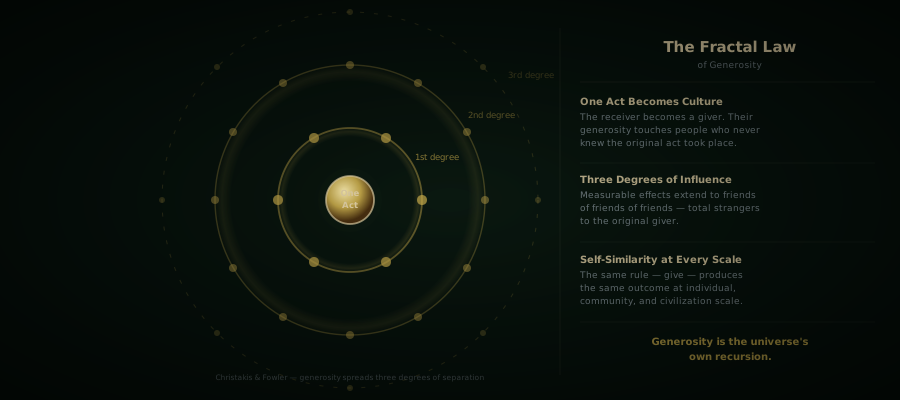 One act ripples to people the giver has never met. Research: Christakis & Fowler, Harvard.
8. The Maslow Compass and Generosity
The Maslow Compass, available at /tools/maslow-compass, is a reflective mapping tool that traces wellbeing across seven dimensions drawn from the Hourglass of Being — the reimagined Maslow framework explored in Chapter 8 of this series. Among the seven dimensions, generosity illuminates what the hourglass framework calls the outer flow: the expressive arc of human development, in which the self that has been nourished through the ascending inner pyramid turns outward, and begins to give from what it has received.
The outer flow is the dimension that many wellbeing frameworks underweight or ignore entirely. Maslow's own pyramid, as popularly understood, describes the ascending journey toward self-actualization without accounting for the descending movement through which the actualized self becomes generative — through which self-transcendence, the final level Maslow added in 1969, expresses itself in the world. Generosity is the primary medium of that expression. When the outer flow is blocked — when a person has developed genuine inner resources but has no channel through which those resources can move outward into the world — the result is a distinctive form of stagnation that does not resemble ordinary unhappiness. It has the quality of fullness with nowhere to go: the reservoir that cannot empty into the river it was built to feed.
The Maslow Compass measures not only where you are on the dimensions of the inner pyramid — safety, belonging, purpose, resilience — but also the quality and direction of the outer flow. Are you giving from abundance or from depletion? The distinction is not merely psychological. It is structural. Generosity that flows from genuine fullness — from the felt sense that you have something real to offer, that the giving will not leave you less than you were — is sustainable indefinitely. It is self-replenishing, because genuine giving in the outer flow restores the inner pyramid in ways that mere self-nourishment cannot. But generosity that flows from depletion — from obligation, from the fear of being seen as ungenerous, from the hope that giving will finally earn the love that was withheld — is exhausting in the short term and corrosive in the long term. It produces what the psychologist Christina Maslach identified in her landmark research on burnout: the slow erosion of the capacity to care, in people who gave more than they had and had no way to restore what the giving took.
The Compass offers a simple and non-judgmental way to identify which mode you are operating in. Three questions orient the inquiry: Are you giving freely or giving to avoid a consequence? Does the giving leave you feeling more yourself or less? And in the space after giving — in the quiet after the act — is there relief, or is there the low anxiety of a ledger that you sense is not balancing in your favor? These are not trick questions. There are periods in every life when giving from depletion is what the situation demands, and doing so with full awareness is itself a form of generosity toward oneself. But sustainable generosity — the kind that builds communities, heals relationships, and advances the inner development it is also meant to express — flows from the outer pyramid's proper source: the fullness that accumulates when the inner journey is not abandoned in service of the outer expression, but allowed to continue, replenishing the giver in the act of giving.
9. Integration with the Technologies of the Heart
Generosity does not stand alone. It is the ground condition — the soil in which every other technology of the heart takes root. The other technologies in this series each open a different facet of the same one technology.
Chapter 1 — The Art & Science of Generosity: Generosity as biological, social, and spiritual technology — the ground-floor operating principle of human flourishing.
Chapter 2 — The Golden Rule as a Fractal Law of Life: Generosity is the living enactment of the Golden Rule. To treat others as you wish to be treated is not merely a moral instruction. It is a description of the generous act: the extension of imagination across the gap of selfhood, the offering of what you would wish to receive. The Golden Rule functions as a fractal law precisely because generosity — its operative mechanism — replicates at every scale.
Chapter 3 — Paying It Forward: The Social Technology of Transformation: Generosity becomes civilizational only when it moves forward rather than backward — when the gift received becomes the inspiration for a new gift extended to someone else entirely. Paying forward is generosity freed from the logic of reciprocal exchange and made available to the full breadth of the social network.
Chapter 4 — Collaboration as the Ultimate Human Technology: Genuine collaboration is impossible without a prior disposition of generosity. Collaboration is not the coordination of self-interested parties toward a shared outcome. It is the mutual offering of capacity, insight, and effort in service of something neither party could produce alone. Without generosity — the willingness to give more than can be contractually required — collaboration degrades into negotiation.
Chapter 5 — Compassion as Inner Clarity and Emotional Freedom: Compassion is the inner face of generosity — the capacity to feel the reality of another's experience without being overwhelmed by it, and to give from that feeling without losing the self that is giving. Where generosity is the outer expression, compassion is the inner orientation that makes sustainable outer expression possible.
Chapter 6 — Oneness: The Technology of Connection: At its deepest, generosity arises from the recognition that giver and receiver are not separate — that what I give to you I give in some sense to myself, and that what I withhold from you I withhold, in some diminished form, from my own experience of being alive. Oneness is not the cause of generosity; it is its deepest expression and its deepest fruit.
Chapter 7 — The Toroidal Economy: When Giving Is the Engine: The toroidal flow of wealth — energy moving outward from a center, circulating through the periphery, and returning to the center enriched — describes the structure of every sustainable economic system. Generosity is the mechanism by which the toroidal flow maintains its circulation: the willingness to release what has returned to the center, so the outward movement can begin again.
Chapter 8 — The Hourglass of Being: Maslow Reimagined: The outer pyramid of the Hourglass — the expressive arc of human development — moves through generosity as its primary medium. Self-transcendence, the apex Maslow identified in the final years of his career, is not an inner state of rarefied consciousness. It is the orientation outward — the giving of the self's gifts to something larger than the self — that constitutes the fullest expression of human development.
Chapter 9 — Intention, Motivation, and Purpose: Intention determines whether generosity is genuine or performative. The quality of motivation shapes the quality of the gift: giving from fear of social judgment produces a different relational outcome than giving from genuine care, even when the material transfer is identical. The inner architecture of motivation is what distinguishes the generous act from its mimicry.
Chapter 10 — The Generosity Standard: Generosity is the ultimate backing of every human exchange — monetary, relational, civilizational. Just as a currency is only as strong as the productive capacity it represents, every human institution is only as strong as the generosity of spirit that sustains it. The Generosity Standard is the proposal that this recognition — already embedded in the gift economies Mauss documented, already expressed in the spiritual traditions every culture has developed — be made explicit, and designed into the systems we build.
These are not a sequence of independent topics. They are facets of one inquiry approached from different angles. Generosity is the angle from which the whole becomes visible.
Why This Matters Now
We are living through a moment of deep collective reckoning.
The extractive systems that have organized much of human civilization — built on the logic of accumulation, competitive advantage, and the off-loading of cost onto people and places without the power to resist — are revealing their structural limits with increasing urgency. The fractures are visible: in hollowed communities where the architecture of belonging has been replaced by the architecture of consumption; in degraded ecosystems where the logic of extraction has been applied without limit; in the epidemic of loneliness, anxiety, and purposelessness that more technology and more speed have, paradoxically, deepened rather than resolved.
What heals systems is not more extraction. It is the restoration of the giving pattern — the recognition that the health of the whole and the health of the part are not in competition but are, at every scale, the same health. Generosity does not heal only individuals. It heals the relational fabric from which individuals are woven. And that is exactly why these technologies of the heart matter right now.
10. The Future — Generosity as Evolutionary Force
Generosity is not merely a personal virtue worth cultivating. It is the engine of social transformation — the force that, when widely distributed through a culture, changes what that culture is capable of seeing, building, and becoming.
David Sloan Wilson's multilevel selection framework gives us the evolutionary language for what history has already demonstrated: the future belongs to groups that can mobilize generosity at scale. Generous societies are not utopias free of conflict. They are societies that have developed the capacity to respond to conflict with something other than escalation — that have practiced, in thousands of small daily moments, the technology of meeting need with care rather than meeting threat with threat. They are societies that have learned, slowly and through collective experience, that the commons can be maintained not only through regulation and enforcement but through the cultivation of the generous disposition that makes people want to maintain it.
The future that remains possible — more peaceful, more transparent, more genuinely collaborative, more capable of meeting the challenges that no individual nation or community can address alone — will not arrive through legislation alone, or through technological innovation alone, or through the restructuring of economic systems alone. It will be built through the slow, steady accumulation of generous choices made by human beings who have recovered the understanding that we are not separate — that what harms you diminishes something in me, that what helps you opens something in me I did not know was closed, that the boundary between self-interest and other-interest is a permeable membrane, not a wall.
This is not optimism in the sense of wishful thinking. It is optimism in the sense of an accurate reading of the evidence: that the human capacity for generosity is not a cultural overlay fragile under pressure, but a biological endowment older than civilization, stronger than any ideological counter-pressure, and — as Aknin's toddlers remind us — native to us before any teaching could either cultivate it or suppress it.
Somewhere in Nairobi right now, a woman is handing a stranger her last bus fare. Somewhere in Charlotte, a teenager is staying late to help a classmate she barely knows, with a patience that surprises even herself. Somewhere a father is choosing presence over distraction, choosing patience over reaction, choosing the harder and more generous response when the easier one was available and nobody would have blamed him for taking it. Somewhere a neighbor is choosing welcome over suspicion. Somewhere a community is choosing repair over resentment, choosing to address a wound rather than to wall it off.
These are not exceptions to human nature. They are expressions of it — the oldest technology we have, still running, still working, still capable of doing what it has always done: holding the web of human relationship together at the precise point where it is most likely to fray.
That toddler who gave away her last Goldfish cracker was not learning to be generous. She was remembering — retrieving something native to her, something written into the nervous system long before the world could teach her otherwise, before the arithmetic of scarcity could complicate the simple mathematics of the open hand.
We were built for this. All of us. And every time we choose it, we build the world that makes it easier to choose again.
Invitation
You are already a source. Not someday. Not once you have enough. Now.
Every act of genuine giving changes the biology of two people — the one who gives, and the one who receives. And science says: both are the better for it.
You are already generous. The question is only whether you see it — and whether you let it grow.
People Also Ask
What is the neuroscience of generosity? When we give to others, the brain's mesolimbic reward system activates — the same dopamine pathways that fire during pleasurable experiences like eating and social bonding. Jorge Moll's 2006 fMRI research at the National Institutes of Health documented this directly: choosing to donate to charity activated the same circuits as receiving a reward. Paul Zak's oxytocin research adds another layer: giving releases the "bonding molecule," which deepens our sense of connection and makes subsequent acts of generosity easier. The neurological message is clear — the brain was designed to reward generosity as richly as it rewards any other essential behavior.
Why does giving make you happier than receiving? Elizabeth Dunn's landmark 2008 study in Science found that spending money on others produced significantly greater happiness than spending the same amount on oneself — across income levels, across cultures, and even among very low-income households in Uganda. The explanation lies partly in the social dimension: giving deepens our connections, and it is connection — not consumption — that the brain's wellbeing systems are calibrated to reward. Christian Smith and Hilary Davidson's five-year study found that Americans who gave more than 10% of their income reported 43% higher life satisfaction. Giving activates the parasympathetic nervous system, reduces cortisol, and creates the physiological state associated with safety and belonging — which is, at the bodily level, what happiness is.
What is the difference between generosity and altruism? Altruism, in both evolutionary biology and moral philosophy, refers to behavior that benefits another at some cost to oneself. It is often framed as a puzzle — why would natural selection favor self-sacrifice? Generosity is a broader and more human term that encompasses acts ranging from small daily kindnesses to large material gifts, and that can operate through many motivational routes: genuine care, social obligation, spiritual practice, or simple pleasure. The key distinction is that generosity does not require that the giver be materially worse off — the neuroscience of the helper's high suggests that in most circumstances, the giver also benefits. What looks like altruism from a purely material accounting may be, from a broader wellbeing perspective, a transaction that enriches both parties.
Is generosity learned or innate? The evidence suggests both — but the innateness is the more surprising finding. Lara Aknin's toddler research showed that children as young as 22 months, before significant moral instruction was possible, were measurably happier giving than receiving. Cross-cultural research confirms that the basic emotional response to giving is consistent across radically different cultural contexts. What is learned is not the capacity for generosity — that appears to be a biological endowment — but the cultural forms through which generosity is expressed, the social norms that either encourage or suppress it, and the philosophical frameworks that give it meaning. The question is less whether generosity is natural and more what specific conditions allow it to flourish rather than contract.
What does Marcel Mauss say about the gift? In his 1925 essay The Gift, Mauss argued that gift exchange — not barter, as the economics textbooks maintained — was the original form of human economic life. Documenting dozens of cultures across multiple continents, Mauss showed that gifts create obligations: to give, to receive, and to reciprocate. These obligations constitute the web of social bonds that hold communities together. Crucially, Mauss showed that the gift is never purely economic — it always carries something of the giver with it, creating a relationship that persists long after the material transfer is complete. The implication is that markets, which strip exchange of its relational content, are a relatively recent and partial representation of what human exchange has always been.
How does generosity build community? Robert Putnam's decades of research on social capital demonstrated that communities with high levels of mutual generosity — expressed through civic participation, voluntary association, and day-to-day acts of mutual aid — consistently outperform those without it in resilience, health, educational achievement, and economic productivity. Nicholas Christakis and James Fowler's network research showed that one generous act cascades through three degrees of social connection, influencing people the original giver has never met. The mechanism is straightforward: generosity creates trust; trust enables cooperation; cooperation produces the collective goods that no individual can produce alone. Community is not a context within which generosity happens. It is what generosity builds, and what it continuously sustains.
Can generosity be practiced without money? Absolutely — and many researchers argue that non-material generosity is both more common and more impactful than financial giving. Attention, listening, patience, forgiveness, encouragement, presence, and service are all forms of generosity that require no financial resources whatsoever. The neuroscience of giving does not discriminate between material and non-material gifts: the helper's high is equally measurable when someone gives time, skill, or genuine attention as when they write a check. In fact, Elizabeth Dunn's research found that the quality of the giving relationship — the sense of connection and care it expressed — mattered more to the wellbeing benefit than the monetary amount. The cheapest and most available form of generosity — showing up fully present in someone's company — may also be among the most transformative.
References
- Lara Aknin et al. — "Giving Leads to Happiness in Young Children" (2012, PLOS ONE) — The landmark toddler study documenting that children as young as 22 months experience more happiness giving than receiving
- Elizabeth Dunn & Michael Norton — Happy Money: The Science of Happier Spending (2013) — Accessible synthesis of cross-cultural research linking generosity with wellbeing, including the Uganda replication
- Jorge Moll et al. — "Human Fronto-Mesolimbic Networks Guide Decisions About Charitable Donation" (2006, PNAS) — The neuroimaging study documenting that giving activates the brain's mesolimbic reward system
- Paul Zak — The Moral Molecule: The Source of Love and Prosperity (2012) — Documents the role of oxytocin in trust, generosity, and social cohesion across cultures and nations
- Christian Smith & Hilary Davidson — The Paradox of Generosity (2014) — Five-year longitudinal study showing that Americans who give more report dramatically higher life satisfaction, better health, and greater purpose
- Marcel Mauss — The Gift (1925) — The anthropological classic establishing gift exchange as the underlying social technology of human culture across dozens of societies
- Robert Putnam — Bowling Alone: The Collapse and Revival of American Community (2000) — The definitive quantitative study of social trust, civic generosity, and their downstream effects on community health
- Nicholas Christakis & James Fowler — Connected: The Surprising Power of Our Social Networks (2009) — Documents how generosity propagates precisely three degrees of separation through social networks
- Lewis Hyde — The Gift: Imagination and the Erotic Life of Property (1983) — The classic literary-anthropological argument that gifts increase through circulation while commodities diminish through use
- David Sloan Wilson — Does Altruism Exist? Culture, Genes, and the Welfare of Others (2015) — The evolutionary biologist's argument for multilevel selection as the explanation of why generosity is stable across generations
Helper's High: The measurable neurological reward — involving dopamine, oxytocin, and the activation of the brain's mesolimbic reward circuitry — experienced when we give to or help others. Named in parallel with "runner's high," it reflects the body's deep evolutionary encoding of generosity as a positive and self-reinforcing behavior. The effect is measurable via fMRI, blood markers, and subjective wellbeing reports across cultures.
Fractal: A pattern that replicates itself at every scale of magnification. In this chapter, generosity is described as fractal because the same structural rule — giving tends to inspire giving — produces the same emergent outcomes whether operating between two individuals, within a community, or across civilizations. The Christakis-Fowler finding that generosity propagates three degrees of separation is an empirical demonstration of the fractal at the scale of human social networks.
Interbeing: A term from Buddhist philosophy, associated with the Vietnamese teacher Thich Nhat Hanh, describing the condition of mutual arising — the recognition that nothing exists independently of its relational conditions. Used in this chapter to name the philosophical ground from which generosity becomes natural rather than effortful: when the boundary between self and other is recognized as permeable, giving is not self-sacrifice but self-expression.
Oxytocin: A neuropeptide involved in bonding, trust, and social connection, sometimes called "the moral molecule" (Paul Zak, Claremont Graduate University). Released during acts of both giving and receiving care, oxytocin deepens our sense of connection and is associated with increased prosocial behavior. Zak's cross-national research found consistent correlations between average oxytocin reactivity and per-capita charitable giving rates.
Social Capital: Robert Putnam's term for the networks of mutual trust, civic participation, and reciprocal care that constitute a community's capacity for collective action. Communities high in social capital — built through sustained practices of generosity, voluntary association, and mutual aid — demonstrate measurably better outcomes across health, safety, education, and economic productivity. Social capital is built by generosity; it is the form that generosity takes at the scale of a community.