On February 20, 1962, astronaut John Glenn became the first American to orbit the Earth. He had prepared for everything: the launch vibrations, the blackout of communication, the mechanical checklists that would occupy every minute of a controlled six-hour mission. He had not prepared for what happened when he looked out the capsule window.
The terminator — the line between day and night — was moving across the African continent below him. The Sahara was a warm ochre crescent. The Atlantic was a dark field stitched with light. And something happened that no amount of astronaut training had described: the distinction between himself and what he was seeing temporarily ceased to make sense. Not in a way that was frightening. In a way that felt more real than any perception he had experienced on the ground.
He later said that he wanted to take that feeling back and put it in a bottle — to hand it to every world leader, every person nursing a grievance, every family torn apart by an argument about a boundary line.
What Glenn experienced was not unique to him. Of the roughly 600 people who have traveled to space, a remarkably consistent percentage — documented by philosopher Frank White in his 1987 study The Overview Effect — describe a variant of the same structural shift: the sudden recognition that the divisions we take to be fundamental — between nations, species, self and world — are features of a particular perceptual scale, not ultimate truths about the structure of reality. The planet, seen whole, is a single living system. And the person looking at it is not outside that system looking in. They are the system looking at itself.
This is not a feeling that comes only from orbit. It arrives in childbirth and in grief, in the first moment of genuine forgiveness, in the forest at dusk, in the seconds after a piece of music resolves in a way that feels inevitable. It arrives, with systematic regularity, in the long practices of every contemplative tradition on Earth — and it has been arriving, quietly, at the edges of physics and neuroscience for the past century.
Key Takeaways
- Oneness is not a belief to adopt but a description to recognize — the most precise account available of what reality is at the level where physics, neuroscience, ecology, and every contemplative tradition converge.
- The felt boundary between self and world is constructed by the brain's posterior parietal cortex for purposes of navigation; neuroimaging research by Andrew Newberg shows its quieting correlates directly with non-dual experience.
- Bell's theorem (1964) and Alain Aspect's experiment (1982) empirically confirmed quantum non-locality: entangled particles remain correlated regardless of distance, showing that at its most fundamental level the universe is not locally separable.
- David Bohm's implicate order is a rigorous physics proposition, not a metaphor — apparent separateness is the real but secondary surface of an undivided wholeness, the way a shadow is real but is not the object that casts it.
- Every major contemplative tradition — Advaita Vedanta, Buddhist dependent origination, Sufi Wahdat al-wujud, Christian mysticism, and Indigenous cosmologies — converges on the same structural recognition from different directions and in different languages.
- When oneness-recognition is present, even partially, the other technologies of the heart — generosity, the Golden Rule, compassion, collaboration — stop feeling like moral achievements and begin to feel like natural expressions of what is already the case.
The Recognition That Changes Everything
Each article in this series has explored a distinct technology of the heart: generosity, the Golden Rule, paying it forward, collaboration, compassion. The Spectrum of Compassion mapped the axis from contraction to opening. The Compassion Lineage showed that every wisdom tradition on Earth converges on the same experiential territory. And Reification revealed the cognitive mechanism that freezes what flows — the mind's habit of turning processes into things, verbs into nouns, relationships into objects.
But there is something underneath all of them. Something they all point toward, and all draw from. And it is the task of this article to name it directly, to trace its threads through physics and neuroscience and ecology and contemplative tradition, and to show how recognizing it does not add another obligation to the list but dissolves the effort that the other technologies require.
That something is the recognition of oneness.
Not oneness as a vague spiritual feeling. Not oneness as a claim that individuals do not exist or that differences do not matter. Not oneness as an argument to be won or a belief to be adopted. Oneness as a description — the most precise available account of what reality actually is at the level at which physics, neuroscience, and contemplative science have been converging for the past century.
This article's thesis, stated plainly:
The boundary between self and other is provisional, porous, constructed by the brain for purposes of navigation, and ultimately not the most important truth about what we are.
Before proceeding, intellectual honesty requires a disclosure about the kind of claim being made — because not all claims here carry the same kind of evidence, and conflating them would weaken rather than strengthen the case. This article operates across two distinct levels. The first is phenomenological: humans can experience states in which the felt boundary between self and world dissolves, and this experience is well-attested across every major contemplative tradition, confirmed in neuroimaging (Newberg), documented in astronauts (White, Yaden), and studied in contexts from deep meditation to awe research (Keltner & Haidt). The evidence here is robust. The second level is ontological: the claim that separation is not merely a felt experience but an actual metaphysical feature of reality — that reality is, at its deepest level, undivided. Here the evidence is suggestive, not conclusive. Physics points in this direction (Bell, Aspect, Bohm). Ecology points in this direction (Margulis, Lovelock, Bateson). But physics does not prove a metaphysical unity, and the contemplative consensus does not constitute empirical proof.
Where the article speaks — as in the outcome of Bell tests, SPECT imaging, or symbiogenesis research — the evidence is peer-reviewed and reproducible. Where it speaks — as in the lived quality of oneness-recognition — it is reporting consistent first-person evidence across cultures and centuries. Where it speaks — as in interpreting quantum non-locality as implying consciousness-is-non-local — it is navigating contested interpretive territory.
Holding all three registers simultaneously, rather than collapsing them into one, is what makes the case stronger, not weaker.
And it is a technology: it changes what is possible. Not by adding a new capacity, but by removing the friction that the illusion of separation creates. When the recognition is present — even partially, even intermittently — the other technologies in this series do not feel like moral achievements. They feel like natural expressions of what is actually the case.
This is the Mind cluster gateway: where the heart-centered understanding developed in Generosity through The Compassion Lineage becomes mind-expanding recognition. After the Compassion Lineage shows that all traditions converge, this article reveals what they converge on.
Understanding why requires a journey through several territories: the physics of wholeness, the neuroscience of self-construction, the ecology of non-separation, the contemplative phenomenology of interbeing, and the practical question of how a recognition this fundamental becomes available in ordinary life.
The journey is not linear. But then, nothing ultimately is.
The Experiment That Changed Everything
The story begins with a disagreement between two of the greatest physicists who ever lived — and the experiment that settled it.
In 1935, Albert Einstein, Boris Podolsky, and Nathan Rosen published a paper arguing that quantum mechanics must be incomplete. Their reasoning: quantum theory predicted that two particles, once entangled, would remain correlated regardless of how far apart they moved. Measuring one would instantly affect the other — what Einstein dismissed as "spooky action at a distance." This, Einstein insisted, was absurd. Separated things cannot influence each other instantaneously. The universe must be local: what happens here, in this region of space, cannot instantaneously determine what happens there.
Einstein was not an unreasonable man. Locality — the principle that effects travel no faster than light, that what happens at one location can only influence what happens at another through a chain of causes propagating through space at finite speed — was a cornerstone of all of physics. Special relativity depended on it. The entire edifice of causal reasoning depended on it. If locality was wrong, something fundamental about the architecture of reality was different from what science had assumed for three centuries.
For nearly three decades, the argument was philosophical — untestable. Physics had no way to distinguish between quantum mechanics' predictions and what Einstein called "local hidden variables" — the possibility that entangled particles carried predetermined values that merely appeared to be instantaneously correlated. Then, in 1964, physicist John Bell derived a mathematical inequality — Bell's theorem — that could distinguish between the two. If Bell's inequality was violated in experiment, the hidden-variable explanation was wrong and the universe was genuinely non-local.
In 1982, at the Institut d'Optique in Paris, Alain Aspect and his team ran the experiment that settled the argument. Two entangled photons were sent to separate locations and measured simultaneously, with the measurement settings changed so rapidly that no signal traveling at the speed of light could communicate between the two stations in time. The correlations held. Bell's inequality was violated. Einstein's intuition about locality — the premise that separated things cannot influence each other instantaneously — was incorrect. The universe is, at the quantum level, non-local: certain events remain correlated regardless of the distance between them.
This is not a minor technical footnote. It is a structural feature of reality at its most fundamental level. The separateness of things — the premise on which classical physics, classical economics, classical psychology, and most of institutional civilization are built — is not a fundamental truth about reality. It is a feature of a particular scale of observation.
A critical disclosure is necessary here, because this finding has been widely misread in popular writing. Bell's theorem and Aspect's experiment prove something precise: particles cannot be locally realistic — they cannot simultaneously have definite pre-existing values AND respect the principle that influences travel no faster than light. What the experiment establishes is exactly this: local realism is false. What it does not prove, on its own, is that consciousness is non-local, that human minds are entangled, or that the universe "knows" itself as a unity. That leap — from quantum non-locality to consciousness-is-non-local — is a interpretation, not an empirical entailment. It is a minority position in physics. Bohm's pilot-wave interpretation, the Penrose-Hameroff Orch-OR proposal, and Stapp's von Neumann–Wigner reading are serious physicists working at this frontier — but their interpretations are minority positions, not the consensus view. The consensus in physics acknowledges non-locality as a physical fact and brackets the implications for consciousness entirely. The framing is what Silvia offered in her peer review: "Quantum physics has shown that locality is wrong at the foundation of matter; contemplative traditions independently arrived at non-separation through phenomenological investigation; the convergence is suggestive, not proof." This article holds both: the physics is real and significant; its implications for consciousness are compelling and philosophically serious, without being demonstrated.
Tell a physicist that the universe is non-local and they will nod — it is now textbook physics, confirmed by ever more stringent experiments including the 2015 "loophole-free" Bell tests. Tell most people and they will look at you blankly. The most consequential experimental finding of the twentieth century has not yet reorganized how most human beings understand what they are.
This article is an attempt to help.
Two entangled photons remain correlated across any distance, confirming that separation is not the deepest truth.
The Implicate Order: Bohm's Map of Wholeness
David Bohm (1917-1992) was one of the most original and philosophically courageous physicists of the twentieth century. A student of Robert Oppenheimer, a colleague of Einstein's at Princeton, exiled from the United States during McCarthyism, and later a long-term dialogue partner of the philosopher Jiddu Krishnamurti, Bohm spent his career pressing on the questions that most physicists preferred to set aside: not just how the quantum formalism works, but what it means — what it tells us about the actual structure of reality.
His answer, developed in his 1980 masterwork Wholeness and the Implicate Order, is one of the most rigorous philosophical engagements with oneness available from within physics — though it is important to say clearly that it is a minority position. The dominant framework in physics remains the Copenhagen interpretation (Bohr, Heisenberg: focus on what can be measured, bracket what cannot), with serious competition from Many-Worlds (Everett) and decoherence-based accounts (Zurek, Wallace). Bohm's pilot-wave / implicate-order interpretation, while supported by rigorous philosophical work — developed by a physicist who co-authored a landmark quantum mechanics textbook before turning to foundational questions — is not the standard view. It is, in short, what a physicist produces when they refuse to stop asking "but what does it mean?" What it offers is not a replacement for standard QM but a different ontological reading of the same formalism — one with profound implications if you follow it seriously.
Bohm began with quantum entanglement and asked the obvious but largely ignored question: what does non-locality tell us about what particles actually are? The standard answer — that particles are separate objects that happen to be correlated — struck Bohm as an evasion. The correlations, he argued, were not features of the relationship between two separate things. They were features of an underlying wholeness in which what appears as "two separate things" is actually a particular unfolding of a single, undivided process.
Bohm called this deeper level the implicate order — the "enfolded" order, in which everything is folded into everything else. The level of ordinary experience — in which things appear as separate, locatable, distinct objects interacting across space and time — he called the explicate order: the "unfolded" order, real and important for practical purposes, but not the most fundamental description of what exists.
He offered an analogy that makes this tangible. Imagine you are watching two screens, each showing what appears to be a separate fish swimming independently. One turns left; a moment later, the other turns left. They seem to communicate, but there is no visible connection between them. Then you discover that both screens are video feeds from two different cameras pointed at the same aquarium, at the same single fish. The apparent correlation between two separate objects is actually the expression of a single underlying reality viewed from two different angles. The fish were never separate. They looked separate because of the observational apparatus.
Bohm was not saying that the apparent separateness of things is false or unreal. He was saying it is incomplete — that it is the real but secondary appearance of something deeper, in the way that a shadow is real but is not the object casting it.
The chairs in the room are genuinely distinct from each other. You are genuinely distinct from me. But beneath that distinction is a deeper continuity — what Bohm called the holomovement — that neither of us can claim as "outside" ourselves.
This is where Bohm's physics meets the holographic principle that appears across scales. Karl Pribram's model of distributed memory in the brain demonstrated that memories are not stored in specific locations but distributed holographically across neural tissue — damage to one area does not erase a specific memory but slightly degrades all memories, exactly as cutting a holographic plate in half produces two complete but slightly less sharp images. The ecological observation that every organism encodes its ecosystem's history in its adaptations, its immune responses, its behavioral repertoire. The Fractal Life Table's architecture, in which every column contains the whole table viewed from a particular center of gravity. These are not metaphors borrowing from each other. They are independent observations arriving at the same structural insight: that the wholeness precedes the parts, and the parts never fully separate from the wholeness that produced them.
Fritjof Capra, whose 1975 The Tao of Physics documented the structural parallels between quantum physics and Eastern mystical traditions, went on in The Web of Life (1996) to develop what he called a new scientific understanding of life — a systems theory in which the key insight is that life, at every scale, is characterized not by the properties of its components but by the relationships between them. A cell is not explained by listing its chemical constituents. It is explained by the dynamic network of relationships through which those constituents are continuously being organized, maintained, and renewed. The same is true of an organism, an ecosystem, a society, a civilization. Capra's systems theory and Bohm's implicate order point in the same direction from different angles: the separateness of things, at every scale from the subatomic to the civilizational, is a secondary feature of an underlying relational wholeness.
Bohm spent the last decade of his life in dialogue with Krishnamurti, exploring the implications of the implicate order for consciousness and perception. Their conversations, collected in The Ending of Time (1985), repeatedly circled the same conclusion: the fragmentation of consciousness — the tendency to treat parts of the world, and parts of the self, as separate from each other — is not a natural feature of reality but a learned habit of perception. And habits of perception can be unlearned.
This is not mysticism. It is physics. But it arrives at the same place.
The Brain That Builds the Boundary
If the universe is non-local at the quantum level and undivided at the level of Bohm's implicate order, why does separation feel so absolutely real?
Because the brain builds it. Continuously. Automatically. From a dedicated piece of neural hardware.
Andrew Newberg at Thomas Jefferson University has spent three decades imaging the brains of meditators, contemplatives in deep prayer, and individuals at peak moments of mystical experience. What he consistently finds illuminates both what oneness is and how it works.
The key region is the posterior parietal cortex — specifically the superior parietal lobule — which Newberg calls the "orientation association area" (OAA). This is the brain region responsible for constructing the spatial self-model: the sense of where the body ends and the world begins, the felt boundary between self and other, the orientation of the body in space. Under ordinary conditions, the OAA is continuously active, continuously refreshing the boundary between you and not-you. It takes sensory data from the body and from the environment and constructs, moment by moment, the model that says "this is me" and "that is not me."
This construction is not trivial. It requires significant neural resources, and its output is remarkably stable — stable enough that you experience it not as a model but as reality itself. The boundary between self and world feels like a fact. It does not feel like a construction. And that is precisely the feature that makes it so effective for navigation and so misleading for understanding.
During peak experiences of oneness — whether induced by deep meditation, intensive prayer, certain entheogenic substances, the overview effect, or spontaneous mystical experience — activity in the OAA decreases dramatically, sometimes nearly to zero. What the SPECT imaging shows is that the felt dissolution of the boundary between self and world is not a hallucination or a malfunction. It is the quieting of a specific neural mechanism — one whose normal function is to construct a boundary that, at the phenomenological level, temporarily ceases to be constructed.
This finding changes the terms of the conversation — but it must be read carefully, because it is easy to misread in two opposite directions. The accurate framing requires holding three things simultaneously.
First: the ordinary sense of being a bounded, separate self is not a direct perception of reality but a construction — a model, generated by a specific neural mechanism, that is useful for navigating the physical and social environment. The brain constructs color, time, continuous narrative self, the felt location of pain — none of these constructions are illusions, but none of them are raw reality either. They are useful simplifications of a vastly more complex underlying signal. The self-other boundary is in this category: a powerful and reliable construction that does not represent the final truth of what we are.
Second: the fact that the boundary is constructed does not mean it is arbitrary. A cell membrane is a biological construction — but it is a non-arbitrary construction that tracks real causal and functional structure. The boundary between organism and environment is constructed by evolution, the nervous system, and the cognitive architecture we were born into — and it tracks something real. You are not literally the same as the chair you are sitting on, even though both you and the chair are made of atoms exchanging with the environment. Constructed does not mean fictitious. The boundary is real and useful at the scale for which it evolved. What the neuroscience is saying is not that the boundary is false, but that it is incomplete — that it is not the most fundamental level of description available.
Third: under specific conditions — deep meditation, intensive prayer, certain contemplative practices, certain entheogenic states, the overview effect — the boundary-construction process can temporarily suspend. What is reported, across traditions, cultures, and centuries, is not hallucination or malfunction. It is the quieting of a specific neural mechanism, revealing what the mechanism was filtering. This is the contemplative report, and it is remarkably consistent: what remains when the OAA quiets is not chaos or void, but a field of awareness that feels, paradoxically, more real and more complete than the ordinary bounded state. Importantly, David Yaden's research on the overview effect (Yaden et al., 2016) notes that even this dissolution-experience is itself culturally inflected — Glenn's recognition arrived through the lens of American astronaut, Cold War context, Christian cultural background, and technologically mediated observation. The experience is reproducible AND culturally shaped. That does not make it less real; it makes it more interesting. The brain constructs the dissolution-recognition too, in the same way it constructs color. The difference is that this particular construction, when it occurs, accurately maps a feature of reality that the ordinary construction was filtering out.
Holding all three layers: boundaries are constructed; they are non-arbitrary and track real causal structure; and they are dissolvable under specific conditions, revealing what construction was filtering. This is not a contradiction. It is a complete account.
William James, who collected and analyzed hundreds of mystical experience reports in his 1902 Varieties of Religious Experience, identified four structural features that appear consistently across traditions, cultures, and centuries: noetic quality (the experience has the felt character of insight — it delivers a recognition, not just a feeling), ineffability (it resists ordinary language, not because it is vague but because language is built for the world of separate things), transiency (it does not last, though its effects do), and passivity (it arrives; it cannot be forced, though conditions can be cultivated that make it more available). To these four, contemporary researchers add a fifth: noetic aftereffects — people who have had genuine experiences of oneness consistently report not just a temporary change in feeling but a sustained change in how they perceive and relate to the world. Values shift. Behavior changes. The motivation to compete and accumulate tends to decrease. The motivation to connect, contribute, and care tends to increase.
Francisco Varela, Evan Thompson, and Eleanor Rosch, in their landmark 1991 work The Embodied Mind, provided the cognitive science framework for understanding what happens when the OAA quiets. Their enactivist account proposed that the mind does not represent a pre-given world from inside the sealed container of a skull. It enacts a world through embodied action — through the ongoing, dynamic, mutually specifying relationship between organism and environment. The self and its world arise together, through each other, in a continuous process that has no fixed interior and exterior. The boundary between self and world is not a fact of nature; it is a practical stance — a useful simplification that collapses when examined closely enough.
Enactivism is oneness articulated in the language of cognitive science. And it converges with what Reification reveals from the opposite direction: that the mind's habit of freezing what flows — turning the living process of self-and-world into two frozen things called "self" and "world" — is the master instance of the very mechanism that Reification maps. The self-other boundary is the ultimate reification. And oneness is what happens when that reification is seen through. Reification owns the cognitive mechanism; this article owns what happens when that mechanism is illuminated. The self is the "master freeze" that oneness thaws.
Evolution does not maintain dedicated neural machinery for experiences that have no functional significance. The machinery for oneness exists because oneness is adaptive — perhaps the most adaptive recognition available to a species whose survival has always depended on cooperation, interdependence, and the recognition of shared fate. The brain has hardware for oneness. That hardware has been doing its work since before we had words for it.
The posterior parietal cortex constructs the self-other boundary — and quiets when oneness is recognized.
The Master and the Emissary
Newberg's SPECT imaging locates the neural mechanism that constructs the boundary. It answers the question: which region goes quiet when oneness arises? But a different question remains — one that matters enormously for understanding why the felt sense of separation is so thoroughgoing in modern Western life in particular. What is the character of attention that builds the construction in the first place — and what character of attention is recovered when the construction dissolves?
The psychiatrist and Oxford scholar Iain McGilchrist spent two decades answering that question. His conclusion, argued at exhaustive length in The Master and His Emissary: The Divided Brain and the Making of the Western World (Yale University Press, 2009) and the two-volume The Matter With Things (Perspectiva Press, 2021), is both neurologically grounded and civilizationally consequential: the two cerebral hemispheres do not divide function so much as they divide mode of attending. And Western modernity has, over roughly two and a half millennia, progressively installed one mode as its default — with consequences that look, from the inside of lived experience, like exactly the crisis of separation this article has been naming.
Two Ways of Attending, Not Two Departments
The popular neuroscience account — left brain is logical and analytical, right brain is creative and emotional — is a simplification that points at something real while getting the underlying structure wrong. Both hemispheres handle language. Both handle mathematics. Both handle emotion. The difference McGilchrist identifies is not a division of what the brain processes but how it attends to anything it processes.
The left hemisphere operates in a mode that is narrow, focused, decontextualized, and instrumental. It takes the flow of experience and parses it into discrete, manageable units — objects with fixed identities, categories with sharp edges, parts whose relationships to each other can be manipulated. This mode of attention is extraordinarily powerful for tool use, for analysis, for building models that can be acted upon. It is the mode that allows a surgeon to focus on a millimeter of tissue, a programmer to trace a logical chain, a mathematician to follow a proof. Without it, human civilization in its technical sense would not exist.
The right hemisphere operates in a mode that is broad, vigilant, contextual, and relational. It holds the whole field within which parts are located. It attends to what is living and moving, to the relationships between things rather than the fixed identities of things, to the background against which foreground figures emerge. It is the mode of knowing that recognizes a face rather than cataloguing features, that hears music as music rather than as a sequence of frequencies, that receives another person as a whole presence rather than as a profile of attributes. Where the left hemisphere gives you a map with clear edges, the right hemisphere gives you the territory — ambiguous, alive, inexhaustible.
Both modes are necessary. Neither hemisphere is the "good" one. The pathology McGilchrist identifies is not in either hemisphere but in their relationship — specifically in the progressive dominance of the left-hemispheric mode over the right-hemispheric ground from which it must ultimately be authorized. The title of his 2009 work makes the argument precisely: the right hemisphere is the Master, the left hemisphere is the Emissary. An emissary who forgets he is an emissary — who takes his operational map for the territory itself — is the structural mistake that generates what McGilchrist calls "the world the left hemisphere made."
The left-brain/right-brain dichotomy of popular culture — logical vs. creative — was never pure invention. It was an early cartographic attempt at a real landscape, derived from genuine experimental findings: the Nobel Prize-winning split-brain research of Roger Sperry and the extended laboratory work of Michael Gazzaniga. What the popular account misread was not that there are differences, but the nature of those differences: not a division of content (verbal here, visual there) but a division of stance — of mode, of the quality of engagement with whatever content is present. The landscape is real; the early maps were imprecise. McGilchrist's contribution is a far more detailed cartography of the same terrain.
The Empirical Substrate
Sperry's split-brain research, conducted at Caltech through the 1960s and 1970s with patients who had undergone surgical severing of the corpus callosum, produced findings that are easier to feel than to summarize. Consider one of the most reproduced: the left hand reaches for an object — an apple, a hammer — that only the right hemisphere was shown. The left hemisphere, which controls language and saw nothing, is then asked why the hand moved. It does not say I don't know. It says: I picked up the hammer because I needed it for a task. The explanation is confident, plausible, and entirely invented. Gazzaniga, extending Sperry's work over four decades, named this the left hemisphere's "interpreter" — the narrative-generating system that explains what happened whether or not the explanation is accurate. The interpreter does not lie deliberately; it simply cannot tolerate a gap in the story it tells about itself. It is constitutively in the business of coherence.
Contemporary neuroimaging has complicated the split-brain picture: intact-brain hemispheres communicate constantly across the corpus callosum, and dramatic lateralization of split-brain patients does not generalize directly to ordinary cognition. But the processing asymmetries revealed by split-brain research are robustly supported by lesion studies and fMRI activation patterns. Right-hemisphere damage consistently produces deficits in contextual apprehension, holistic perception, and the sense of being embedded in a world larger than oneself — precisely McGilchrist's right-hemispheric signature. Left-hemisphere damage disrupts the parsing, labelling, and sequential manipulation of discrete elements — the emissary functions.
McGilchrist's broader civilizational thesis — that Western modernity has institutionally over-developed left-hemispheric attending and suppressed right-hemispheric ground — is more speculative. It is a compelling and carefully argued hypothesis, not a proven neurological fact. What is empirically grounded is the asymmetry of modes; what is philosophical is the civilizational diagnosis.
The Connection to Separation — and to Oneness
Here is where McGilchrist's frame becomes directly load-bearing for this article's argument.
The felt sense of separation — the experience of being a discrete, bounded self moving through a world of other discrete, bounded objects — is, in McGilchrist's account, the signature phenomenology of left-hemispheric dominance. Left-hemispheric attending produces a world of fixed objects with sharp edges, a self with a clear interior boundary, relationships as instrumental connections between independent entities. This is the mode in which most of modern Western daily life is spent: categorical, focused, extractive, instrumental.
The felt sense of oneness — the dissolution of sharp edges, the recognition of self as embedded in a field rather than contained in a boundary, the quality of aliveness and mutual implication that contemplative traditions have reported for millennia — is the phenomenology of what McGilchrist calls right-hemispheric primacy restored. Not the elimination of the left-hemispheric mode, but the restoration of the right hemisphere as the ground from which the left-hemisphere emissary operates and to which it returns.
This convergence is striking. Newberg's SPECT imaging shows the OAA quieting during mystical dissolution-states. McGilchrist's framework names the mode of attending that the OAA's quieting makes possible: the broad, relational, contextual, living apprehension that the right hemisphere has always been offering, and that left-hemispheric dominance has been drowning out. Andrew Newberg's work and David Yaden's psychometrics of self-transcendent experience describe the phenomenology; McGilchrist's hemispheric framework offers a candidate mechanism for why that phenomenology is mode-dependent — why it is recoverable through practices that deliberately interrupt the left-hemispheric grasping mode: breath-focused meditation, contemplative prayer, deep listening, the sustained encounter with beauty or with another person's full presence.
What contemplative traditions have called the "ego dissolution" of deep practice is, on this reading, not the destruction of a useful cognitive function but the temporary demotion of the left-hemisphere emissary from his usurped throne — the restoration of the right-hemisphere master to his proper function as ground. The experience is not a hallucination. It is what the whole of experience feels like when the narrowing, categorizing, extracting mode is no longer running unopposed.
The Trap to Avoid
The goal is not to rehabilitate the right hemisphere at the expense of the left. That inversion would be its own pathology — romanticism as compensation, the abandonment of analysis in favor of feeling, the refusal of precision in favor of vagueness. McGilchrist himself is emphatic on this point: the emissary is not an enemy. The left-hemispheric mode is what allows surgery, science, engineering, law, and every other achievement that requires the disciplined manipulation of precisely defined elements. The error is not the emissary's existence but the emissary's forgetting — the moment the map mistakes itself for the territory, when the model of discrete objects becomes the final word on reality, when the extraction mode has no right-hemispheric context to return to and be corrected by.
Holding McGilchrist's frame alongside Section 4's three-layer analysis: boundaries are constructed — this is left-hemispheric work, and necessary work; they are non-arbitrary — the emissary's map is not pure fiction; and they are dissolvable under specific conditions — the master's ground is recoverable, the right-hemispheric mode has never gone away, it has only been consistently interrupted. The contemplative recognition does not unmake the left hemisphere's work. It restores the right hemisphere's wider view in which that work can be seen, evaluated, and rightly used.
The left hemisphere narrows and categorizes; the right hemisphere opens to the living field of relations.
The Bridge to the Cloud
When Thich Nhat Hanh holds up a sheet of paper and asks whether the cloud can be seen in it, the capacity he is invoking — the capacity to perceive the entire web of conditions that produced this object, right here, right now — is not primarily a cognitive skill. It is a quality of attention. It is what right-hemispheric attending, restored to primacy, naturally does: perceive wholes in their relations, perceive backgrounds as well as foregrounds, perceive the living field within which this particular form has temporarily cohered. The left hemisphere, meeting the paper, sees paper. The right hemisphere, meeting the paper, sees cloud, sun, logger, mill, river, soil, deep time.
That quality of whole-field attending is not merely a cognitive preference or an aesthetic virtue. It points at a deeper puzzle — one that no description of hemispheric mode, however precise, can fully dissolve. Even with every neural mechanism mapped and every attentional asymmetry named, a question remains that honest philosophy has not yet answered: not how the brain generates experience, but why there is experience at all. The next section holds that question open — not to destabilize what has been built, but because holding it honestly is what integrity requires.
The Hard Problem and the Hard Honesty
There is a moment that arrives, sometimes, when someone has been sitting quietly long enough — when the usual noise has dropped below a threshold — and something happens that is almost impossible to describe afterward. The room does not change. The body does not change. And yet the quality of being present to it all shifts in a way that feels more real, not less, more intimate with whatever is actually happening. The person who has sat is reluctant, afterward, to call it an illusion. It felt, if anything, more true than ordinary waking.
Philosophy of mind calls what is happening in that moment subjective experience — or, more technically, phenomenal consciousness: the felt quality of what it is like to be somewhere, to see red, to hear music, to sense the warmth of sunlight on skin. There is a word for this quality — qualia — and there is a problem, named with unusual precision, that surrounds it.
Chalmers Names the Gap
In a 1995 paper that has not lost its force in three decades, philosopher David Chalmers drew a distinction between what he called the "easy problems" and "the hard problem" of consciousness (Chalmers, 1995; see also The Conscious Mind, Oxford University Press, 1996).
The easy problems are not easy in any ordinary sense. They include explaining how the brain integrates information, directs attention, controls behavior, and generates verbal reports about its own states. They are "easy" only in the sense that they are, in principle, tractable: given sufficient science, we can in principle give a functional, mechanistic account of each of them. We can say what the brain does.
The hard problem is different in kind. Even after every functional, mechanistic, information-processing question has been answered — even after neuroscience has mapped every synapse and every feedback loop with perfect fidelity — a question remains that none of those answers touch: Why is there something it is like to be a brain in that state? Why does the integration of information produce an inner felt quality, rather than happening, as it in principle could, entirely in the dark?
Chalmers is not claiming that consciousness is supernatural or that the brain is not its substrate. He is noting that there is an explanatory gap between even the most complete third-person, functional account of a physical system and the first-person fact of experience. That gap is real. It does not close by adding more neuroscience.
Nagel's Bat
A philosopher had made the same point two decades earlier, in a thought experiment that has become canonical (Nagel, 1974).
Imagine you have complete neurological knowledge of a bat — its auditory cortex, its echolocation system, every circuit and pathway that processes the sonar signals it uses to navigate. You have an exhaustive third-person scientific account. Now ask: what is it like to be a bat, experiencing its own echolocation? What is the felt quality of navigating by sound-echo in the dark?
Thomas Nagel's argument is not that the bat's experience is exotic or hard to imagine, though it is both of those things. It is that no accumulation of third-person neurological facts, however complete, tells you what the bat's experience is like from the inside. The bat's subjectivity is genuinely irreducible to the description of its mechanisms. And what is true of the bat's echolocation is true of any experience: the felt quality of red, of hunger, of the recognition of a friend's face. Third-person description, however exhaustive, leaves the first-person dimension untouched.
The Hard Honesty
Here the article pauses to name something that is too often papered over.
The hard problem is not solved. It is not solved by materialism — the most parsimonious and scientifically productive framework — which, in its most rigorous forms, acknowledges the explanatory gap rather than dismissing it. It is not solved by idealism, which reverses the polarity but faces its own parallel difficulties. It is not solved by dualism, which names the gap as a permanent feature of reality but offers no account of how two fundamentally different substances interact. And it is not solved by contemplative traditions, which report with remarkable consistency that the felt dissolution of the subject-object boundary is real and significant — but whose authority is phenomenological, not ontological.
Honesty at this juncture means saying: we do not know how consciousness arises from matter, or whether it does, or whether framing the question that way is even the right framing. What we know is that experience is undeniable — to deny it is to use experience to deny experience — and that explaining it in third-person terms has not yet succeeded and may face structural limits.
This is not a council of despair. It is an invitation to take the question seriously without the anxiety of needing to close it.
One Adjacent Framework: Panpsychism
Among the philosophical positions that take the hard problem seriously as a genuine structural puzzle rather than a temporary gap in neuroscience, one has attracted sustained attention from analytic philosophers who are not easily dismissed: panpsychism — broadly, the thesis that some form of experiential or proto-experiential character is a fundamental feature of nature, not an emergent product of sufficiently complex physical organization.
The most technically rigorous recent case for this view is Galen Strawson's 2006 paper "Realistic Monism: Why Physicalism Entails Panpsychism" (Journal of Consciousness Studies 13(10–11): 3–31). Strawson's argument is not New Age mysticism; it proceeds entirely within analytic philosophy. His claim is that if you take materialism seriously — if you insist that consciousness is genuinely physical — then you are committed to the conclusion that experience is a feature of the physical all the way down, because the emergence of experience from wholly non-experiential matter is, on close inspection, not less mysterious than consciousness itself.
Philip Goff's 2019 book Galileo's Error (Pantheon Books, ISBN 9781524747961) makes the case in more accessible terms. Goff argues that Galileo's decision to define matter purely in terms of quantitative, third-person properties — to exclude from science's domain anything qualitative and experiential — was a methodological choice that bought enormous predictive power at the cost of permanently exiling consciousness from the scientific picture. The hard problem, on Goff's reading, is not a puzzle internal to physics but a consequence of the way physics was constitutively set up.
Neither Strawson nor Goff is claiming that rocks have rich inner lives or that the universe is populated by sentient beings at every scale. The thesis is more modest and more careful: that whatever consciousness is, its building blocks may be intrinsic to nature rather than conjured from pure mechanism, and that the explanatory gap may reflect not a gap in our knowledge but a gap in our conceptual framework.
The Connection to Oneness
This is where the philosophy and the phenomenology converge — not as proof but as structural resonance.
If consciousness is fundamental rather than emergent — if experience, or something continuous with experience, runs through the fabric of what exists rather than arising only in certain complex physical arrangements — then the hard boundary between "minds" becomes conceptually harder to draw. Not impossible to draw for practical purposes; not dissolved in a way that confuses the neurological individual with some oceanic unity. But harder to draw ultimately — harder to maintain as the last word on what exists.
The contemplative reports of oneness — the dissolution of the felt boundary between self and world, the recognition of the field as a whole, the sense of mutual implication that Thich Nhat Hanh was naming with interbeing — are phenomenological claims. They describe what experience is like under certain conditions. Panpsychism is an ontological hypothesis. The two operate at different levels and neither entails the other.
What can be said, carefully, is this: panpsychism is one among several serious philosophical frameworks at which careful thinkers have arrived when they take seriously both the reality of experience and the genuine difficulty of the hard problem. And it is a framework structurally compatible with what contemplatives describe — not as proof of oneness, but as one philosophical avenue by which the boundaries between experiencing subjects become, in principle, less absolute than the default materialist picture suggests.
The article does not commit to panpsychism. Neither does it need to, for the broader argument to stand. The phenomenological claim — that oneness is a real experiential possibility, repeatedly reported, neurologically correlated, and transformatively significant — rests on its own ground. The philosophical landscape surveyed here simply names the honest context in which that claim exists: a landscape where the nature of consciousness remains genuinely open, where serious thinkers have followed the question into territory structurally consonant with what the meditators have been describing, and where intellectual honesty requires holding that openness rather than papering it over.
Bridge to the Next Frame
The next section turns to a third philosophical framework that has arrived, by yet another route, at a structurally similar territory: cognitive scientist Donald Hoffman's argument that what we perceive is not reality itself but an interface — a species-specific rendering optimized for fitness, not for truth. Where Chalmers names the gap between mechanism and experience, and where Strawson and Goff ask whether experience might be fundamental, Hoffman asks what follows for our understanding of reality if our perceptual systems were never designed to show it to us at all.
The Interface and the Field
Something happens when the sun is low and the light catches the edge of a face you know — a moment of recognition so vivid it feels like contact, not construction. The room you have lived in for years, seen thousands of times, appears one afternoon with an odd freshness, as though you are seeing it for the first time. There is an intuition, deep and seemingly obvious, that what you perceive is what is there. That seeing is arriving. That the world presses its actual shape through the window of the senses and deposits itself, more or less faithfully, inside.
That intuition is the thing cognitive scientist Donald Hoffman asks us to examine.
The Desktop Analogy
A file on a computer's hard drive has no color, no shape, no spatial location that corresponds to the blue rectangle labeled "Document" on the screen. The icon is not a picture of the physical bits stored on the disk. It is an interface — a simplified, action-relevant representation optimized not for accuracy but for usefulness. The icon's purpose is not to show you what the file is; it is to allow you to interact with it.
Hoffman's argument, developed in The Case Against Reality (Hoffman, 2019), is that perception works the same way. The evolved sensory systems of any organism do not function as cameras delivering an image of what is actually out there. They function as interfaces, generating a species-specific, action-relevant rendering — one shaped entirely by what aided survival, not by what maps faithfully to underlying structure.
The apple appears red, round, edible. Those qualities are real in the sense that they reliably guide behavior. They are not real in the sense that "redness" or "roundness" are properties that exist in the apple's structure independently of a perceiving nervous system tuned by millions of years of selection.
The Empirical Leg
This is not merely philosophical provocation. Hoffman and colleagues built it as a testable claim.
In peer-reviewed evolutionary game-theory simulations, Hoffman, Singh, and Prakash ran competitions between virtual agents across a range of environments (Hoffman, Singh, & Prakash, 2015; building on earlier formal work in Mark, Marion, & Hoffman, 2010). Some agents were tuned to perceive their environments as they actually were — that is, tuned to maximize accuracy. Others were tuned purely to fitness-relevant signals, seeing only what they needed to see to survive and reproduce, with no pressure toward veridical representation.
The fitness-tuned agents consistently outcompeted the accuracy-tuned agents. In the logic of natural selection, spending metabolic resources on perceiving what is actually there — rather than what is useful to respond to — is a competitive liability. An organism that sees the world as it is gets eaten by an organism that sees only what it needs to act on.
The stronger interpretive claim — that what we call "physical objects" are therefore tokens in a fitness interface rather than mind-independent realities disclosed by perception — carries a different weight. That step moves from simulation results to a claim about the nature of the physical world, and that step is contested. But the evolutionary logic is rigorous, and the peer-reviewed evidence for the Fitness Beats Truth result is real.
Conscious Realism
Hoffman extends this into a full metaphysical position he calls "conscious realism": the hypothesis that consciousness is the fundamental substrate, and that the objects of physics — particles, fields, spacetime — are tokens in a network of interacting conscious agents rather than the bedrock from which minds emerge.
This is a serious philosophical proposal from a cognitive scientist who spent decades studying visual perception. It is also a minority and contested position, resisted by most physicists and many philosophers of mind. The article salutes the careful argument and declines to commit to it. Conscious realism is one philosophical avenue; panpsychism, which arrived in the preceding section from within analytic philosophy, is another. That two independent research programs — one rooted in evolutionary biology and cognitive science, one in analytic philosophy of mind — arrive at structurally consonant conclusions about the primacy of experience is worth noting.
Three Frameworks, One Territory
Step back from the details and look at the shape of the argument the article has traced across three consecutive sections.
McGilchrist, working in cognitive neuroscience, showed that the kind of attention the modern mind defaults to — analytical, sequential, boundaries-forward — actively constructs the experience of separation. Chalmers, Nagel, Strawson, and Goff, working within analytic philosophy, showed that the hardest question in the field — why there is experience at all — remains genuinely open in ways that are structurally compatible with the claim that consciousness is not a late arrival to an otherwise non-experiential universe. Hoffman, working in cognitive science and evolutionary biology, showed that the sensory systems through which the experienced world is rendered were shaped by selection for fitness, not for accuracy — meaning the boundary between "self" and "world" that perception draws so convincingly is a boundary drawn by evolution, not disclosed by reality.
Three independent research traditions, three different methodological homes, three different starting questions — and each arrives at a boundary-loosening conclusion. The convergence is not proof of anything. But in intellectual inquiry, the improbability of convergence carries its own evidentiary weight.
Bridge to the Skill
None of this makes the boundary illusory in the practical sense. The interface is real. The skill of navigating it — the capacity to maintain the self-other distinction, to act on behalf of the individual organism, to function in the world as it is rendered — is genuine and necessary. The question the next section turns to is not whether the interface should be discarded. It is whether mistaking the interface for ultimate reality generates consequences that can be named and addressed.
The Skill and the Fact
Here is the pivot that makes everything else in this article personal.
Separation — the felt experience of being a bounded, independent self — is not wrong. It is a skill — one that the human nervous system learned over millions of years of evolution because it was adaptive. The ability to distinguish self from other, to maintain the boundary of the individual organism, to act on behalf of oneself and one's immediate kin — these are real and necessary capacities. Without them, you could not eat, avoid predators, recognize your children, or navigate a crowded room.
But a skill, however useful, is not a fact. The ability to see objects as separate from each other does not mean that they are, at the deepest available level of description, separate. The ability to treat oneself as separate from one's environment does not mean that the self and the environment are, ultimately, different kinds of thing.
The skill of separation is a way of interacting with the world that is appropriate in some contexts and dangerously misleading in others — specifically, in contexts where the health of the whole is being damaged by agents who mistake their separation for ultimate truth rather than useful approximation.
We are living in such a context. The ecological crisis is precisely the result of treating the separation of human civilization from the living systems on which it depends as if it were an ultimate fact rather than a pragmatic stance — civilization organized on the premise that human beings can extract indefinitely without harming themselves, because the damage happens "over there." The political crisis is a crisis of separation: democracies organized around ever-more-rigid tribal identities treating fellow citizens as adversaries rather than collaborators. The psychological crisis is a crisis of separation: an epidemic of loneliness persisting amid digital hyper-connection, because human beings have organized their lives around individual achievement and individual survival — and are discovering, over and over, that this diet does not nourish.
The Cycle of Harm is what happens when the separation between self and other becomes rigid enough that the other's pain registers as irrelevant. The Material Veil is what happens when the separation between human economy and living ecology becomes so complete that extraction seems rational. When Frozen Thinking Turns Cruel is what happens when the skill of separation is weaponized at civilizational scale — when entire populations are reified into categories, and the categories are used to justify violence.
The antidote to all three is not a political program or a new technology. It is a different recognition — the oldest one available, the one that every contemplative tradition and now several scientific disciplines have been arriving at independently: you are not as separate as you have been led to believe. From that recognition, everything else in this series becomes not just possible but natural.
Alfred North Whitehead called this the fallacy of misplaced concreteness — treating abstractions as if they were concrete things. "Self" and "world" are abstractions from a continuous process. Useful abstractions. But when you forget they are abstractions and start treating them as the final furniture of reality, you have committed the error that generates every form of ecological destruction, every form of social fragmentation, every form of the loneliness epidemic that persists amid digital hyper-connection. Reification introduced Whitehead in the context of the freezing mechanism. Here, the same insight arrives from the other direction: oneness is what process philosophy looks like when the fallacy of misplaced concreteness is corrected. Not the elimination of parts but their re-integration into the flow from which they were prematurely extracted.
Six convergent disciplines arrive at the same recognition: the appearance of separation is not the final word.
The Cloud in the Paper
Thich Nhat Hanh picks up a sheet of paper.
"Can you see the cloud in it?"
The cloud watered the forest. The sun grew the tree. The logger felled it. The mill processed it. The truck carried it. Looking at the paper, you are looking at the sun, the rain, the logger's breakfast, the road the truck drove on, the history of the wheel. Nothing exists without the entire web of conditions that produced it.
This is pratityasamutpada — dependent origination — the Buddha's teaching that nothing arises except in dependence on conditions. Everything that exists is what it is only because of everything else that exists. There are no independently existing things — only networks of mutually conditioning processes. The implications are radical. If nothing exists independently, then the sense of a permanently existing, independently self-sufficient individual self is exactly what the Buddha called anatta — not-self. Not "there is no self" in the sense that you do not exist, but "what you have been taking to be a fixed, bounded, separate self is actually a dynamic, relational, process-like event that has no fixed boundaries."
Thich Nhat Hanh's contribution was to render this abstract philosophical teaching as a phenomenological practice he called interbeing (tuong tuc in Vietnamese). Not a doctrine to be believed but a quality of attention to be cultivated: the practice of looking at anything until you can see in it all the conditions that produced it.
Try it now. Pick up whatever is nearest to you — a cup, a pen, your phone. Trace its conditions. The materials mined from the earth. The engineers who designed it. The factory workers who assembled it. The supply chains that carried it. The civilization that produced the supply chains. The agriculture that fed the civilization. The soil that fed the agriculture. The ancient stars whose explosions produced the elements in the soil.
You are holding a piece of the universe's history. And the hand that holds it is made of the same history.
This is not an intellectual exercise. It is a shift in perception — and anyone who practices it for more than a few minutes discovers that the felt quality of the object in their hand changes. It becomes more real, not less. More connected, more alive, more implicated in the web of everything that has happened to produce this moment. The isolation of things is revealed as an artifact of inattention. When attention deepens, interbeing becomes visible everywhere.
In the Mahayana tradition, this recognition gives rise to the figure of the Bodhisattva — the being who, having recognized the non-separation of self and other, vows to remain present in the world until all beings are free. The Bodhisattva's motivation is not self-sacrifice; it is the recognition that there is no "other" to sacrifice for. The suffering of any being is, in the most fundamental sense, one's own suffering — and its alleviation is simply what love does when it recognizes itself.
Jesper Hoffmeyer's biosemiotics offers a scientific parallel to interbeing that is striking in its precision. Life, in Hoffmeyer's framework, is fundamentally semiotic — every organism participates in a web of sign-exchange, a conversation with its environment that never stops. A bacterium reading a chemical gradient. A tree releasing volatile compounds to warn neighboring trees of insect attack. A human immune system recognizing a virus it has never encountered, because it shares structural features with one the species encountered ten thousand years ago. Meaning is not a human invention layered on top of a meaningless material world. It is a feature of living systems at every scale — a feature that makes the boundary between "organism" and "environment" dissolve into a continuous field of communication.
This is the contemplative heart of oneness: not a grand cosmic theory but a quality of attention available to anyone willing to look carefully enough at the nearest thing.
The Net of Jewels
There is a sutra in the Buddhist canon — the Avatamsaka Sutra, sometimes called the Flower Garland Sutra — that contains what may be the most elaborate pre-scientific articulation of the holographic principle ever produced.
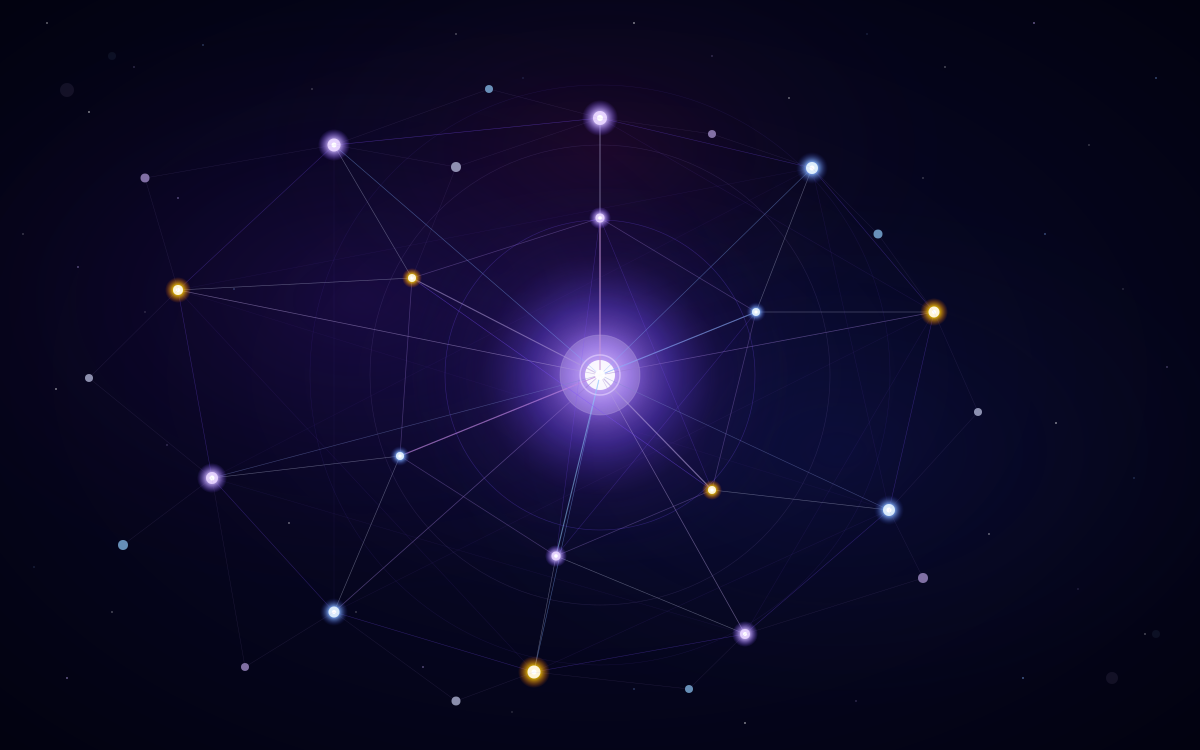
The text describes the Net of Indra: an infinite net extending in all directions, with a luminous jewel at every node. Each jewel is perfectly clear. Each reflects every other jewel in the net. And in each reflection, you can see all the other reflections — jewels reflecting jewels reflecting jewels, infinitely, without limit. Change any single jewel and every reflection in the entire net changes.
Sit with this image for a moment. Let it work on you. It is not meant to be grasped quickly.
This image is not just poetry. It is structurally identical to Bohm's implicate order described in scientific terms.
Bohm says: every point of the implicate order contains information about the whole. The Avatamsaka Sutra says: every jewel reflects every other jewel. Bohm says: the explicate order (the world of separate things) is a local unfolding of a deeper undivided wholeness. The Avatamsaka Sutra says: each jewel appears distinct, yet is constituted entirely by its reflections of all the others. Bohm says: the holomovement is continuous — the enfolding and unfolding never stops. The Avatamsaka Sutra says: the reflections are infinite — there is no level at which they bottom out into separate things.
The convergence is not because one tradition borrowed from the other. They had no contact. Bohm was a 20th-century American-Brazilian-British physicist; the Avatamsaka Sutra was composed in Central Asia sometime between the 1st and 4th centuries CE. They were separated by two millennia and completely different epistemological frameworks. Yet they arrived at the same structural description of reality — because they were both describing, from different observational positions, the same structural feature of reality.
This is where the reader should feel something shift. Not because the argument is clever, but because the mounting improbability of the convergence is doing the work. Different disciplines, no coordination, same finding. Physics, contemplative practice, ecological science, Indigenous cosmology, process philosophy — each arriving independently at the same conclusion. The improbability of coincidence is itself a form of evidence.
The holographic principle connects Bohm's implicate order, the Net of Indra, Thich Nhat Hanh's interbeing, Karl Pribram's holographic brain model, and the Fractal Life Table's architecture — Column 2 (Unity/Oneness) and Column 7 (Emptiness) both mapping the oneness territory from different directions — into a single structural insight: the wholeness is not something that needs to be achieved. It is what is already the case. The task is not creation but recognition.
Each jewel in Indra's Net reflects every other — change one, and all reflections change.
I am because we are.
— Nguni proverb (Ubuntu philosophy)
One Eye, One Seeing
Meister Eckhart, 13th-century Dominican friar, later investigated for heresy for saying this:
"The eye through which I see God is the same eye through which God sees me: my eye and God's eye are one eye, one seeing, one knowing, one love."
He was not being metaphorical. He was reporting an experience — the same structural recognition that in the Upanishads is called Tat Tvam Asi ("That thou art"), that in Sufism is called Wahdat al-wujud (the oneness of being), that the Buddha pointed to with dependent origination, and that Advaita Vedanta's method of neti, neti ("not this, not this") is designed to reveal.
One seeing, not two. And the recognition of this identity is not an achievement that adds something new to what you are. It is the removal of the misunderstanding that made you think you were less than you are.
The Compassion Lineage surveyed these traditions through the lens of compassion — how each arrives at the capacity to remain present to suffering. This article revisits them through the lens of what they converge on. Not syncretism — the traditions differ genuinely and importantly in their practices, their cosmologies, and their social forms. But resonance: different languages, different centuries, different continents, same structural recognition at the center.
Consider the convergence:
Advaita Vedanta — Adi Shankaracharya, 8th century: The individual self (jiva) and the universal Self (Atman) are not two things in relationship; they are one reality seen from two perspectives. The philosophical method, called viveka (discrimination), proceeds by neti, neti ("not this, not this") — progressively identifying everything that changes, everything that can be observed, as "not the self" — until what remains is the unchanging, unobservable, ever-present awareness in which all content appears. This is the sakshi, the witness — pure awareness, identical to Brahman, already and always whole. Liberation (moksha) is not gaining something new but removing the ignorance (avidya) that obscured what was always present. Ramana Maharshi, teaching at Arunachala in the 20th century, transmitted the entire tradition through a single question: Who am I? — designed to turn attention back toward the source of attention itself.
Sufism — Ibn ʿArabi, 12th–13th century: There is only one being. The universe is the self-disclosure of God — not God creating something separate from Himself, but the single reality differentiating itself into infinite forms of experience in order to know itself. Each created being is a mirror in which the one Being sees itself from a unique perspective. The mystic path is the progressive dissolution of the belief that the mirror is separate from what it reflects. Ibn ʿArabi named this doctrine wahdat al-wujud — the oneness of being, or unity of existence — arguing in the Fusus al-Hikam (c. 1229) that being is singular and undivided; what appear as separate things are modes of its self-disclosure, not independent entities (trans. Austin 1980; Chittick 1989). This is an ontological claim: it is not merely that things look unified from a certain vantage, but that the underlying fabric of existence is, in fact, one.
That claim generated one of the tradition's own great internal debates. A later Naqshbandi line of Sufi thought, associated with Aḥmad Sirhindī (1564–1624), proposed the corrective doctrine of wahdat al-shuhud — unity of witnessing, or phenomenological oneness. On this reading, the mystic's experience of undivided reality is a feature of the state of witnessing, not a metaphysical fact about existence-in-itself; when the vision clears, multiplicity remains real at its own level (Schimmel 1975; Weismann 2007). This internal disagreement — wahdat al-wujud (oneness of being) versus wahdat al-shuhud (oneness of witnessing) — is the Sufi tradition's own version of the phenomenological-versus-ontological debate that frames Section 1 of this article. The tradition did not import this tension from Western philosophy; it generated it from within, which makes the parallel all the more striking.
Rumi's Mathnawī and Divan-e Shams inhabit both sides of the tension without resolving it — which may be exactly the point. The opening of the Mathnawī (Book I, lines 1–18, Nicholson translation) — the reed cut from the reed bed, crying out in the song that is its lament for the home it remembers — is the individual soul crying for the ground of being it has forgotten. The rest of the poem is the account of its journey back. Rumi's technical vocabulary for that journey is precise: hal (a transient ecstatic state, not chosen or held) is distinguished from maqam (a stable station of the soul, the enduring fruit of practice); fanāʾ (annihilation — the dissolution of the illusory separate self in the divine) is distinguished from baqāʾ (subsistence — the quality of presence that remains after fanāʾ, consciousness continuing without the fiction of isolation) (Chittick 1983). These are not poetic terms of mood; they are technical descriptions of verifiable states in a disciplined phenomenology refined over centuries. The recognition, when it arrives — and in Rumi, it arrives in the form of maḥabbat, divine love — is experienced not as loss but as homecoming. The separation was the exile. The recognition is the return.
This phenomenological cartography is also embodied in practice. The Mevlevi semāʿ — the ceremony of the whirling dervishes — is not a performance. It is an enactment of cosmic rotation: every celestial body turns; every atom turns; the dervish turns with them, surrendering the fixed point of the separate self into the universal motion (Schimmel 1975). The body enacts what the intellect is being asked to recognize. Oneness is not a conclusion arrived at by argument but a recognition rehearsed in the moving body until it becomes indistinguishable from ordinary experience.
Buddhism — The Heart Sutra: "Form is emptiness, emptiness is form." Not two. Not "form leads to emptiness" but "form is emptiness" — the apparent separateness and the underlying emptiness of independent existence are not two different things requiring reconciliation. They are one reality described from two angles. The Bodhisattva's vow flows directly from this: when self and other are recognized as non-separate, remaining present until all beings are free is not self-sacrifice but self-recognition.
Indigenous cosmologies — The Lakota Mitakuye Oyasin ("all my relations"), used as both prayer and greeting, expresses the recognition that the speaker is in relationship with all things: every creature, every element, every ancestor, every descendant, the land itself. Not metaphor. The cosmological ground of ethics, medicine, governance, and daily practice. This is not a "primitive" precursor to scientific understanding — it is a parallel arrival at the same structural insight through a different methodology: sustained attention to living systems over millennia, encoded in language, ritual, and practice.
Christian mysticism — Eckhart's Gelassenheit (letting go, releasement), the progressive dissolution of the will to maintain a separate self in the presence of the divine. What remains after Gelassenheit is not nothing. It is the Seelenfunklein, the spark of the soul — the innermost ground of the self, which Eckhart identifies with the Gottheit, the Godhead: the ground of being that underlies even the personal God (Eckhart, Colledge & McGinn trans. 1981). This strain runs even deeper in an anonymous 14th-century English text, The Cloud of Unknowing, composed perhaps two or three generations after Eckhart by an unknown contemplative in the English mystical tradition. Its teaching is stark: between the soul and God there is a "cloud of unknowing" that cannot be pierced by any human faculty — not intellect, not imagination, not theological argument. The only instrument that reaches through is naked love, stripped of every concept. The companion text, The Book of Privy Counselling, makes the method even more direct: let go of all awareness of particular things, all awareness of self-as-something, until bare awareness itself is what remains (Hodgson, ed., 1944/1958). In this, the anonymous author and Eckhart arrive at the same location from different approaches — and both arrive at the same location that Advaita Vedanta reaches by neti, neti: stripped of every attribute, what remains is the undivided ground.
The tradition was not carried only by men. The Apophthegmata Patrum — the Sayings of the Desert Fathers and Mothers, collected in the 4th–5th centuries and transmitted in the alphabetical collection edited by Benedicta Ward — preserves direct statements by women teachers that match their male contemporaries in sharpness and precision (Ward, trans. 1975). Amma Syncletica, one of the most frequently cited figures, taught that the outward life and the inward life must converge: the movement toward God is not an ascent away from ordinary existence but a deepening into its root, which is already unified. Amma Theodora described the contemplative life as a progressive stripping of the self-story — not to arrive at emptiness in the sense of absence, but to arrive at the only thing that was never absent. What the desert tradition — in its full witness, including its women — demonstrates is that the nondual recognition is not the property of any one philosophical school, gender, or cultural formation. It emerges wherever sustained practice of honest attention is undertaken, regardless of the form.
Thomas Merton, the American Trappist monk, traced a direct lineage from the desert tradition through his own writing and practice. In New Seeds of Contemplation (1961) he describes the contemplative life not as withdrawal from the world but as a form of presence so complete that the boundary between the contemplative and everything else becomes permeable — the same structural recognition that Section 7 of this article calls the overview effect translated into enclosed monastic life. In the final days of his life, on a 1968 Asian pilgrimage, Merton stood before the great Polonnaruwa rock sculptures of the reclining Buddha in Sri Lanka and described — in what became one of the most cited passages of his Asian Journal — a sudden recognition that everything was emptiness and everything was compassion, that these were not two things, and that this had been the content of the previous twenty years of seeking without his being able to name it directly until that moment (Merton 1973). The recognition is structurally identical to the astronauts' overview reports: not argument, not conclusion, but direct perception of oneness that arrives faster than any logical step. Merton spent the last decade of his life in active dialogue with Zen Buddhist, Hindu, and Sufi teachers — convinced that the underlying recognition was not the property of Christian contemplative tradition alone, but a shared discovery visible across the boundaries of tradition precisely because it is a fact about the nature of things, not a confessional position.
Howard Thurman, the African American theologian, mystic, and mentor to the architects of the civil rights movement, arrived at the same recognition by a different path. In Jesus and the Disinherited (1949) and The Inward Journey (1961), Thurman argued that the mystical-experiential encounter with the unity of life was not an escape from historical suffering but its ground: the recognition that one's own life is not separate from the life of the universe dissolves the internal scaffolding of fear that makes the oppressed vulnerable to the psychic violence of oppression. The unity is not consolation. It is the ontological fact that makes courage possible. Thurman taught that when the individual touches the ground of life that is common to all things, the isolating terror of the separate self — which is what social domination most deeply exploits — loses its grip. Oneness, here, is not a luxury of the already-comfortable but a resource most urgently needed by those who have been systematically told they are less than whole.
The wonder of the convergence should intensify here, not diminish. The more traditions you examine, the more improbable it becomes that this is coincidence — and the more the recognition begins to feel not like a philosophical position but like a fact of experience that keeps being rediscovered because it keeps being true.
The Grammar of Kinship
Robin Wall Kimmerer, trained botanist and Potawatomi citizen, notices something about her Indigenous language that changes how she sees everything.
In Potawatomi, there is no word for "it" when referring to living beings. A river is not "it" — it is a subject, a relative. A bay is not a thing but a being. English forces you to make the river an object; Potawatomi makes you acknowledge it as kin. The grammar itself encodes a cosmology of relationship.
This is not a quaint linguistic curiosity. It is a design feature of a language evolved over millennia by people who understood — not as theory but as survival practice — that the living systems they were embedded in were not resources to be extracted but relatives to be tended. When you call the river "it," you have already done the cognitive work that makes damming it, polluting it, or draining it seem reasonable. When you call the river a relative, the same actions become something closer to assault on family.
Kimmerer's great contribution in Braiding Sweetgrass is showing that the recovery of relational grammar is ecological healing: we cannot protect what our language has turned into a thing. Her work bridges Indigenous wisdom with the science of oneness — different methods, different timelines, same recognition. And it does so with a sensitivity that honors both — never reducing Indigenous knowledge to a data point for a scientific argument, never dismissing scientific method as inferior to traditional knowing. Both are parallel discoveries of equal dignity, and the convergence between them is the evidence.
This is also where Reification becomes visible at the civilizational scale. The grammar of objectification is reification embedded in language. Every time English forces a speaker to say "it" about a river, a tree, a mountain, the language is performing the freeze that Reification describes: turning a living process into a dead noun. Oneness, at the linguistic level, is the thawing of that freeze — the recovery of a grammar in which the living world is addressed as subject, not catalogued as object.
Arne Naess, the Norwegian philosopher who founded the deep ecology movement, arrived at the same place from Western philosophy. In his 1973 paper "The Shallow and the Deep," Naess distinguished between shallow ecology — which treats nature as a resource for human use — and deep ecology, which recognizes that the self extends into the environment. The "ecological self" is identity that includes the living systems one is embedded in. When the self expands to include the forest, defending the forest is not altruism. It is self-defense. Naess developed this in full in Ecology, Community and Lifestyle (1989) — the ecological self as the ground of environmental ethics. Oneness is not just a spiritual recognition. It is a political and ecological imperative.
And Naess's ecological self is grounded in the same biological reality that Lynn Margulis demonstrated at the cellular level with her theory of symbiogenesis: life evolves through cooperation, not just competition. Mitochondria — the organelles that power every cell in your body — are captured bacteria, incorporated into a host cell billions of years ago in a merger so successful that neither partner could survive without the other. Every eukaryotic cell on Earth is already a community. What we call "an organism" is a collaboration. Oneness at the cellular level.
James Lovelock's Gaia hypothesis, developed in the 1970s, extends this insight to the planetary scale: the Earth's biosphere functions as a single self-regulating living system. The atmosphere's oxygen content, the ocean's salinity, the planet's surface temperature — these are not accidental features of a passive environment but the products of active biological regulation. The environment is not a backdrop for life. It is a participant in life, shaped by organisms as much as it shapes them. When you zoom out far enough, the distinction between "organism" and "environment" loses its meaning. There is just one system, maintaining the conditions for its own continuation. The Gaia Mind Network explores what this means for human consciousness — the planet's intentional infrastructure becoming visible as a living cognitive system.
Gregory Bateson — whose Steps to an Ecology of Mind (1972) remains one of the great unread books of the twentieth century — put it most precisely: the unit of survival is not the organism but the organism-plus-environment. Any analysis that treats the two as separate is missing the most important level of what is actually happening.
The convergence continues to mount. Physics, neuroscience, cognitive science, ecology, linguistics, Indigenous cosmology, process philosophy — each arriving independently at the same structural insight: separation is useful, constructed, and incomplete.
What the preceding pages of this article have named — Buddhism, Advaita Vedanta, Sufism, Christian apophatic mysticism, Lakota cosmology, deep ecology, symbiogenesis — are not the totality of the discovery. They are slices through a sphere. Any sufficiently deep investigation of experience, anywhere on Earth, conducted with enough patience and honesty, has arrived at some structural version of the same recognition: the boundaries between self and world are functional, not ultimate. The sphere is far larger than any single tradition can make visible alone. Six more slices follow.
Twelve contemplative traditions circle the same recognition, each arriving from a different direction.
Daoism — The Tao Te Ching, attributed to Laozi (c. 6th century BCE, though the dating remains contested by scholars), opens with a recognition of its own limitation: "The Dao that can be spoken is not the eternal Dao" (Lau trans. 1963, ch. 1). This is not evasion. It is precision. The Dao — the undifferentiated source from which all things emerge and to which all things return — cannot be named without instantly becoming a named thing, distinct from other named things, which is precisely the opposite of what it is. The naming creates the illusion of a boundary where there is none. The Tao Te Ching spends its eighty-one short chapters pointing past every concept that would make the Dao into an object, the same negative approach that Advaita Vedanta accomplishes through neti, neti.
Zhuangzi (c. 4th–3rd century BCE) extends this with a famous image: waking from a dream of being a butterfly, he cannot determine whether he is now a man who dreamed he was a butterfly, or a butterfly currently dreaming he is a man (Watson trans. 2013, ch. 2). The question is not idle philosophical play. It is a precise dismantling of the assumption that a fixed boundary separates what you are from what you are not. The transition between states — the moment of waking, the moment of dying, the moment of deep attention — reveals that the apparently solid boundary is a convention, not a wall. Zhuangzi's technical term for the fluid aliveness on the other side of the convention is ziran ("self-so" or "natural spontaneity") and the practical consequence is wu wei — effortless action that moves with the relational fabric of things rather than against it. Not passivity: wu wei in Zhuangzi is the skill of a master artisan whose hands know the grain of the wood before his mind has formulated a plan (Watson trans. 2013, ch. 3). The Daoist path, like the Sufi and Vedantic paths, is not toward a separate mystical realm. It is toward closer attunement with what is already here.
Ubuntu — Umuntu ngumuntu ngabantu: a person is a person through other persons. The Nguni Bantu formulation, examined by philosophers John Mbiti, Mogobe Ramose, and Desmond Tutu, encodes a relational ontology — not a mere ethics of kindness toward others, but a claim about what a self fundamentally is. Mbiti's rendering is direct: "I am because we are, and since we are, therefore I am" (African Religions and Philosophy, 1969/1990). The individual self, on this account, is not a finished interior object that then enters into relationships. It is constituted by relationships: take away the web of connections, and the "person" does not exist in a diminished form — it does not exist at all. This is not cultural sentiment. Ramose develops it as a rigorous metaphysical argument in African Philosophy through Ubuntu (1999): Ubuntu describes the ontological ground of being-human, prior to any ethical or political superstructure built upon it. Selfhood, on the Ubuntu account, is inherently relational in the same way that symbiogenesis describes selfhood at the cellular level — every organism is already a collaboration — and that Bateson describes selfhood at the systemic level: the unit is never the individual but the individual-in-relation.
Desmond Tutu brought Ubuntu from philosophy into world-historical practice when it became the animating principle of the South African Truth and Reconciliation Commission in the 1990s. The TRC's premise — that even the perpetrators of apartheid's violence remained persons-through-other-persons, that their humanity was entangled with the humanity of those they had harmed, that restoration rather than pure retribution was therefore both possible and necessary — is Ubuntu translated into institutional design (No Future Without Forgiveness, 1999). The argument is that you cannot permanently excise another from the web of mutual constitution without diminishing the web itself. Oneness, here, is not a state achieved by rare mystics. It is the prior condition that makes political reconciliation intelligible at all.
Kabbalah — Lurianic Kabbalah, developed by Rabbi Isaac Luria in 16th-century Safed and systematized in the Kabbalistic tradition, offers one of the most structurally precise accounts of why multiplicity exists within oneness, and how oneness is recovered. Before creation, there was only Ein Sof — the Infinite, boundless, undifferentiated. For anything to exist other than the Infinite, the Infinite had to make room for it. This divine self-contraction is tzimtzum: the withdrawal of the Infinite to allow a primordial space in which finite things might emerge (Idel 1988). Into that space, divine light was channeled through vessels meant to hold and differentiate it. But the vessels could not contain the intensity of the light: shevirat ha-kelim, the shattering of the vessels — the fragments scattered into every corner of existence, carrying within them sparks of the original divine light, buried under husks of limitation and concealment (klipot). This is the Lurianic account of why the world looks broken: it is broken, in the precise sense that the original unity of light has been dispersed into myriad particulars, each carrying an ember of what it came from but unable, alone, to recognize it.
Tikkun olam — the repair of the world — is the name for the human (and cosmic) work of gathering the scattered sparks back: restoring the hidden unity latent in every fragment of creation. This is not a passive mysticism of inward withdrawal. It is an active, relational imperative: every ethical act, every kindness, every moment of genuine attention that sees the divine spark in another being, participates in the restoration. Moshe Idel's scholarship (Kabbalah: New Perspectives, 1988) recovers the technical precision of this metaphysics, disentangling it from popular reductions. The structural logic is remarkably exact: oneness → self-contraction → shattering → dispersal into multiplicity → gradual gathering of sparks → restored unity. This is not a myth of return to a static past. It is a dynamic account of why the universe is both multiple and one, and why those two descriptions are not contradictory. The sphere from which all things fell is also the sphere toward which all things move.
Jainism — The Jain tradition, among the oldest continuous philosophical and contemplative traditions on Earth, contributes a recognition that approaches the same sphere from the epistemological side. Anekāntavāda — the doctrine of non-one-sidedness or many-sidedness — holds that reality is inherently multiple in its aspects: no single perspective, no matter how carefully developed, can capture all of what is true about any given thing simultaneously (Jaini 1979). This is not relativism. It is the recognition that reality exceeds any single frame of reference, not because reality is confused or indeterminate, but because the instrument of knowing — a finite perspective situated in a particular point of time and space — is by nature partial. The Jain philosophical discipline of syādvāda (conditional predication) trains the reasoner to qualify every claim with the recognition that it is true from a particular standpoint, without dissolving the claim's validity within that standpoint.
This epistemological humility finds its ethical complement in the Jain teaching on jīva — the living soul present in all beings. The foundational ethical commitment is ahimsa (non-harm), grounded not in sentiment but in the recognition that every living being contains a soul oriented toward liberation, and that to harm it is to obstruct that journey. The Tattvārtha Sūtra (attributed to Umasvati, c. 2nd–5th century CE), the foundational Jain philosophical text accepted across the tradition's sects, includes a principle that functions as a relational ontology in five words: parasparopagraho jīvānām — "souls are bound to one another by mutual support" (TS 5.21; Jaini 1979). The universe is not a collection of isolated souls seeking individual liberation. It is a fabric of mutually sustaining lives. Oneness, here, is not absorption into a featureless unity — Jainism is careful to preserve the irreducible particularity of each jīva — but the recognition that the particular lives are constitutively related to one another in a way that makes the web prior to any single node.
Sikh — The Guru Granth Sahib, the scripture of the Sikh tradition compiled by Guru Arjan Dev Ji and completed in its final form under Guru Gobind Singh Ji, opens with the Mūl Mantar — the root syllables of the entire tradition. Its first two words are Ik Onkar: There is One. One becomes, one pervades, one sustains. The Sikh framing of oneness differs from Advaita Vedanta's in a philosophically significant way: where Advaita holds that the apparent multiplicity of the world is māyā (illusion or misperception), the Sikh teaching holds that multiplicity is real and that the One pervades and sustains it without dissolving it (Singh & Fenech 2014). God (Waheguru) is not behind multiplicity, waiting to be revealed when multiplicity is seen through. God is present within multiplicity, as its source and sustaining ground. The many do not need to become one to be in the One — they already are, exactly as they are. This is a subtler and in some respects a more generous account of relation: the beloved is not a projection to be seen through but a real other in whom the One is genuinely present.
The practical form of this recognition in Sikh life is sangat — the congregation, the community of practitioners gathered in the presence of the Guru Granth Sahib. Sangat is not merely social gathering for logistical or emotional reasons. It is the relational form of the One made visible: the recognition of the divine in one another is itself a spiritual practice, enacted structurally every time the community assembles. Langar — the free communal kitchen that every Gurdwara provides to anyone regardless of caste, religion, or background — is the ethical and economic consequence: when you see the One in every person, the hierarchy of deserving collapses, and the feeding of the hungry becomes simply what kinship does.
Sumak Kawsay — The Andean Indigenous philosophy known in Quechua as sumak kawsay — "full life," "good living," or more precisely, "life in plenitude in relationship" — offers a formulation that directly contests the dominant modern assumption about what the good life is. In Western liberal political philosophy, the good life is typically theorized as individual flourishing: the realization of individual capacities, the satisfaction of individual preferences, the protection of individual rights. Sumak kawsay describes a different ontological structure: the good life is not an individual achievement extracted from a relational web but a quality that arises in the web itself, and can only be experienced from within it (Gudynas 2011; Acosta 2013). Sumak kawsay is not the sum of individual wellbeings any more than a mycelium network is the sum of its individual threads — the quality emerges from the relational structure, not from the nodes taken separately.
The Pachamama — often translated as "Mother Earth" but more precisely denoting the living cosmological whole of which all beings are participants — is the relational ground within which sumak kawsay becomes possible. Human beings are not the managers of Pachamama or its stewards in the sense of an outside authority with custody of a resource. They are participants in a living system with its own inherent value and rights. This was recognized not only as a philosophical position but as a constitutional fact: Ecuador's 2008 constitution and Bolivia's 2009 Ley de Derechos de la Madre Tierra became the first legal documents in modern history to recognize the rights of nature itself as a subject rather than an object — a legal formalization of what the relational ontology of sumak kawsay had always implied (Gudynas 2011). The grammar of kinship, which Kimmerer traces in the Potawatomi language, is here written into the architecture of a state. Oneness is not a private mystical achievement. It is a public claim about what exists and what is owed.
These six traditions — Daoism, Ubuntu, Kabbalah, Jainism, Sikh, and Sumak Kawsay — do not share a language, a founding text, a historical connection, a methodology, or a set of practices. They emerged on different continents, across different millennia, in response to different challenges. What they share is this: each, when followed to its most rigorous expression, arrives at the same structural recognition that the boundaries between self and world, self and other, self and cosmos, are functional descriptions of a relational fabric, not metaphysical walls dividing ultimately separate things. The sphere continues to reveal more of itself. There is no tradition on record that, when examined with sufficient depth and patience, arrived at the conclusion that permanent, ultimate, irreducible isolation is the nature of what is. The argument of this article is not that all traditions say exactly the same thing — they do not, and honoring that distinctness matters. The argument is that the convergence at this one structural point, across this much diversity, is itself evidence.
Mycelium, neurons, and galaxies wear the same pattern — organism and environment are one continuous system.
Let brothers be united, that is the first law.
— José Hernández, Martín Fierro (1872, translated)
The Sangha That Includes the Land
The preceding pages of Section 9 moved across continents and centuries — from Potawatomi grammar to Andean constitutional law — and arrived at the same structural recognition through each: the boundaries between self and other are functional, not ultimate, and the traditions that have investigated this most patiently have built their practice and their politics on that recognition. But there is a further axis, one that all of those traditions touch but none of them exhaust. It is the question of ground, literally. Not the philosophical "ground of being" but the actual ground — the soil underfoot, the air moving through the window, the water that arrived here from a cloud that formed over a sea that no one in the room has ever visited. What does oneness mean when the inquiry leaves the library and enters the body, the field, the watershed? What is the sangha when it includes, as it must, the land on which every contemplative sits?
Three thinkers have pressed this question with unusual rigor and clarity. They are not making the same argument. They approach from phenomenology, from Buddhist practice, and from cosmological theology. But they converge on a recognition that is at once deeply simple and almost entirely absent from the modern West's dominant account of what it means to be alive.
The Reciprocity of Perception (David Abram)
David Abram's The Spell of the Sensuous (1996) begins with a philosopher's question and ends somewhere far more unsettling. The question is Merleau-Ponty's: what is perception, really, before we theorize it? Maurice Merleau-Ponty had spent a career demonstrating that perception is not a passive recording of the world by a mind inside a body. It is a reciprocal engagement between body and world — the hand that touches is simultaneously touched, the eye that perceives is perceived by what it sees, in the precise sense that the world presses back against the senses with its own textures, rhythms, and presence (Merleau-Ponty called this the "flesh of the world," a single reversible fabric in which perceiver and perceived are folds).
Abram takes this phenomenological inheritance outdoors. He asks: if perception is genuinely reciprocal, if the body is always already in responsive relation with what it encounters — then what does it mean that most of what the body encounters, for most of human history, has been other-than-human? The animist cultures that treated every element of the living landscape as a subject, as an entity with its own expressive interiority, were not committing a cognitive error, projecting human qualities onto inert matter. They were reading accurately a reciprocity that is actually there. The wind, the river, the old oak — each has its own way of pressing back against the senses, of altering the texture of the perceptual field, of calling attention toward it. To name this exchange "relationship" is not metaphor. It is phenomenological description (Abram 1996, 9–28).
The implication is radical: literacy, in Abram's analysis, is partly a flattening of this sensory entanglement. Alphabetic writing redirects attention from the expressive landscape toward a self-referential human symbol system. The letters on a page call out to be read; the birds outside the window compete for attention. In predominantly oral and pre-literate cultures, the entire living environment functioned as a kind of script — a surface of meanings to be attended to, not a background to be tuned out while reading. The cost of what literacy enables — and the cost is real — is a certain narrowing of the perceptual commons, a gradual withdrawal of attention from what Abram calls the "more-than-human world."
That phrase — the more-than-human world — is Abram's careful replacement for "nature." The word "nature" still implies a human/non-human binary, a zone beyond the fence where the truly wild begins. The more-than-human world is not beyond the fence. It is what a human being already is and always is: a mammal with a liver that runs on the same biochemical logic as a fern's, breathing air that passed through the lungs of creatures long dead, made of minerals that were once seafloor and will be again. The "more-than-human" is not out there. It is what is happening right now in the chest, in the gut, in the perpetual osmotic exchange between skin and atmosphere (Abram 1996, 22). The sangha always already includes the land. The question is whether it knows this.
Becoming Animal (2010) extends these themes into a more sustained bodily phenomenology — not the body as object of inquiry but the body as the very instrument of inquiry, the animal intelligence that orients in darkness, that reads weather in a shift of wind, that knows the path without the map. Abram's second book is, in a sense, an instruction in the attention that the first book describes as endangered: how to inhabit the creaturely intelligence that modern life systematically ignores (Abram 2010).
The bridge to the article's preceding sections is direct: what Bohm calls the implicate order, what Buddhism calls pratītya-samutpāda, what Kimmerer finds encoded in Potawatomi grammar — Abram finds in the pre-reflective structure of bodily perception. Before thought, before language, before any tradition's formulation of oneness, the body is already doing it: exchanging with the world in a continuous reciprocal fold that cannot be located entirely inside the skin.
The Practice of Grief and the Ecological Self (Joanna Macy)
Joanna Macy brings a different instrument to the same terrain. Where Abram comes from philosophy, Macy comes from practice. Trained as a Buddhist scholar and deeply influenced by systems theory, she spent decades asking why people whose survival depends on the living world — which is everyone — can watch that world deteriorate without feeling much. Her answer is not cognitive but emotional: modern culture specifically trains the nervous system not to feel the pain of ecological loss, because to feel it fully would be to feel a grief so large it seems unbearable. So the feeling is blocked. And the blocking is what allows the destruction to continue (Macy 1991).
The conceptual move that makes Macy's work philosophically load-bearing — not just therapeutically important — is her translation of Buddhist dependent co-arising into ecological identity. Pratītya-samutpāda, the insight that all phenomena arise only in dependence on conditions, means that there is no independently existing self prior to the web of relations that constitutes it. Macy's question is: if this is true, then what exactly is the entity that grieves when a forest burns? The grief, she argues, is evidence. You cannot grieve for something you are not in some meaningful sense connected to. The pain of watching a river die is the river in you responding to itself — the relational self registering a wound in the web it participates in. Far from being pathology, the capacity for what Macy calls "pain for the world" is intelligence: it is the ecological self becoming legible to itself, the way physical pain is the body's intelligence registering damage (Macy 1991).
This reframing has practical stakes. "The Work That Reconnects" — the group practice Macy developed over decades — is built on the premise that the primary task is not persuasion or information delivery but the recovery of felt connection: to other beings, to the living systems one depends on, to the suffering those systems are currently undergoing, and to the deep time in which they have their meaning. Groups move through a cycle: gratitude (reconnecting to what is loved), grief and honoring pain (allowing the blocked feeling to move), seeing with new eyes (perceiving the world as kin rather than resource), and going forth (returning to action from a grounded rather than panicked place). The sequence is not therapeutic in the ordinary sense — it is contemplative. The sangha gathers not to fix the world from outside but to recognize itself as part of what the world is doing (Macy 1991).
The echo with Section 8's apophatic mysticism is audible: Macy's insistence on allowing grief rather than managing it around recalls the via negativa's refusal to protect the self from what is actually present. And the echo with Ubuntu is audible too: the ecological self that includes the river is the relational ontology of umuntu ngumuntu ngabantu extended to every being, not only human ones. The sangha that includes the land is not a poetic expansion of the concept of community. It is the conceptual consequence of taking any of the preceding traditions seriously.
The New Story (Thomas Berry)
Thomas Berry arrived at the same recognition from a direction neither of the others traveled: Catholic theology, cultural history, and geology. A Passionist priest who spent decades studying the developmental history of cultures and the geophysical history of the planet he called himself a "geologian" — one who reads the earth as scripture — his major statement is The Dream of the Earth (1988), a work that is equal parts lament and cosmological brief.
Berry's diagnosis of the present moment is precise: the ecological crisis is not, at its root, a technical or economic problem. It is a cosmological problem. The industrial civilization that is burning the biosphere runs on an assumption so deep it is almost invisible: that the earth is dead matter, a collection of resources to be processed, a container for human projects. This assumption is not argued for — it is inherited, built into the grammar of economic rationality, encoded in property law, expressed in every accounting system that treats the destruction of a forest as a gain and its flourishing as nothing. Berry's term for this assumption is that the earth is a collection of objects rather than a community of subjects. And his claim is that no amount of technical fix will address the crisis so long as the underlying cosmological assumption remains operative. The crisis requires, at its root, a different story about what the earth is (Berry 1988, 32).
The story Berry calls for is neither a return to pre-modern animism nor a rejection of scientific understanding. It is what he calls trans-modern: a narration of the human that is scientifically grounded, that takes seriously the 13.8 billion years of cosmic development that led to this moment, and that treats the universe's self-organization — from quarks to galaxies to cells to consciousness — not as a mechanical accident but as a development that is, in some meaningful sense, alive and oriented. "The universe is a communion of subjects, not a collection of objects" is Berry's most quoted formulation (Berry 1988). Every component of the universe has its own interiority, its own spontaneity, its own manner of being present. The human being is not an alien observer of this process. The human being is the universe at the stage where it becomes capable of reflecting on itself — the cosmos grown curious about its own nature.
Berry's name for the transition required is the "Great Work": the multi-generational project of moving from the period of human devastation of the earth to a period of mutually enhancing human-earth relationship. This is not a project of restoration in the sense of returning to some earlier equilibrium. The prior equilibrium is gone. What is possible is something genuinely new: a human culture that builds itself with full awareness of what it is embedded in, that designs its cities, its economics, its education, and its spiritual life in accordance with the pattern of the living systems it depends on. The sangha that includes the land is, in Berry's framing, not optional for those serious about contemplation. It is the scale at which the contemplative work must eventually operate — not just individual clarity but civilizational re-narration (Berry 1988).
Where the Three Converge
Abram, Macy, and Berry are not saying the same thing, but they are pointing at the same recognition from three different heights of abstraction. Abram shows it in the body — in the pre-reflective reciprocity of perception that is always already happening, before any philosophy or practice. Macy shows it in the heart — in the grief that is also intelligence, in the felt connection that contemplative practice either honors or bypasses. Berry shows it in the cosmos — in the story that situates the human not as master of the earth but as the earth's own capacity for self-awareness, with responsibilities proportional to that position.
The convergence matters for any contemplative project that takes seriously where it happens. Peace Houses — the community-rooted spaces where THOPF's programs find their form — sit on land. They are built from earth-derived materials: timber that was once a forest, concrete that was once limestone, glass that was once sand. They are nourished by water that arrived through a watershed no human engineer designed, air that has been around the planet many times before this breath. The soil in the yard has been soil for ten thousand years and will be soil long after the building is gone. The land is not the setting for the contemplative practice. It is a participant in it — present, contributing, carrying its own history of what has grown and decayed and grown again in that place.
This is not ornamentation. If the traditions surveyed across Sections 7–9 are correct — if the boundary between self and world is functional rather than ultimate — then the inclusion of the more-than-human in the sangha is not a generous expansion of the concept but its necessary completion. You cannot stop at the edge of the human and call the investigation finished. The Gaia Mind Network traces what this means at planetary scale — the living cognitive web of which every human mind and every non-human intelligence is already a node. But the ground truth is more local than that: it is in this soil, under these roots, breathed by these lungs. The sangha has always included the land. What is new is the possibility of knowing it.
And from this recognition, the arc of the article clarifies. Einstein's "optical delusion of consciousness" — the sense of being a separate fragment — dissolves not only when the human web of relationship becomes visible, not only when the traditions of all cultures are seen to converge, but also when the body itself is recognized as something the earth has been doing for four billion years. The "I" that wakes each morning is not a self that lives in a world. It is a world, momentarily organizing itself into the shape of a life.
What Oneness Holds That Cannot Be Held
There is a version of oneness that costs nothing to believe. It arrives in a quiet moment — a forest, a meditation cushion, a sudden dissolving of the usual static — and it offers the feel of homecoming without the weight of what home actually contains. This is the version most often sold, and most often abandoned when the news arrives: when the photographs of the gas chambers surface, when the satellite images of the charred Amazon appear, when the report lands that somewhere in the hour you are reading these words, a child is being harmed by someone who knows them.
If oneness means anything — if the convergence of neuroscience, contemplative tradition, ecology, and phenomenology surveyed across this article is describing something real — then it must hold all of that. The boundary-builder brain that Section 4 identified as the instrument of perception is the same brain that architects genocide. The cortical maps that parse "self" from "world" with elegant efficiency are the same maps that parse "us" from "them" — the cognitive preprocessing that makes Auschwitz and Hiroshima and the burning of the Amazon not aberrations but productions of the same faculty that writes poetry and nurses the sick. The emissary brain that McGilchrist identifies as the hemisphere of narrow focus and abstract representation (McGilchrist 2009) is the bureaucrat at the death camp: efficient, categorizing, untroubled by what the categories do when they reach their conclusions.
To engage this is not to abandon the recognition of oneness. It is to take that recognition seriously enough that it cannot be used as an escape from what the boundary-builder brain has done and continues to do. Three voices — across different centuries, different cultures, and different traditions — have refused this escape. Their refusal is worth hearing carefully.
The Void That Teaches
Simone Weil, the French philosopher and mystic who died in 1943 at thirty-four after refusing to eat more than the rations available to occupied France, built her entire spiritual thought around a single distinction most religious consolation refuses to make: the difference between suffering and malheur (affliction).
Suffering, in Weil's analysis, is painful but navigable — it can be endured, transcended, converted into growth or meaning. Malheur is different in kind. It is the crushing that happens when a human being is struck by impersonal force — the force of history, of institutional violence, of the indifferent grinding of circumstances — and the result is not pain that strengthens but a flattening of the soul, a grinding of the personality into something that can no longer assert its own dignity (Weil 1947). The slave, the prisoner, the person whose life has been entirely at the disposal of others for long enough — they know malheur not as an experience that can be metabolized but as a condition that redefines what is possible. Weil had little patience for any spiritual framework that did not take this seriously. She was contemptuous of theodicy that resolved affliction into meaning, contemptuous of religious consolation that arrived too quickly, contemptuous of any spirituality that did not first pass through what she called the void.
The void, in Weil's account, is what remains when every false consolation has been stripped away — when the soul refuses to fill the emptiness of affliction with premature meaning, premature hope, premature arrival. In Gravity and Grace (La Pesanteur et la Grâce, 1947), she writes that the grace which is actually transformative arrives only in the void — not as consolation but as presence precisely because the consolation has been refused (Weil 1947). Attention, for Weil, is the root of both love and prayer: the discipline of staying with what is before you without distorting it toward what would comfort you. In Waiting for God (Attente de Dieu, 1950), she extends this: the cross is not a symbol of redemption so much as the precise location where God meets the afflicted — not by lifting the affliction but by being present in it, in the void, at the point where impersonal force and human spirit meet without resolution (Weil 1950). The universe, in Weil's account, contains a void at its center — and the person who refuses to fill that void with anything false is the one who can be reached by what is real.
This is demanding. It does not offer closure. But its demand is what makes it honest: a spirituality that has not looked at the gas chambers and remained is a spirituality that has not earned the claim of universality.
The Witness That Must Answer
Howard Thurman's Jesus and the Disinherited (1949) — already met in Section 9 of this article in its account of the unity of life as the ground of courage — carries a more specific burden in this section.
Thurman wrote it for a particular reader: the person with their back against the wall, living under systemic domination, who hears the Christian gospel preached by or on behalf of the powerful and must decide whether there is anything in it that addresses their condition. His answer depends on returning the historical Jesus to his actual context: a poor Jew living under Roman military occupation, a member of a colonized people under the heel of an empire with the legal authority to execute him — and eventually doing so. This is not the imperial Christ of Constantinian Christianity, Thurman insists. This is a man who knows from the inside what it is to live at the mercy of a system that has classified you as less than fully human. That Jesus, Thurman argues, has something to say to the disinherited that the imperial Christ cannot say — because that Jesus knows malheur not as theology but as biography.
Martin Luther King Jr., who carried a copy of Jesus and the Disinherited with him during the Montgomery bus boycott of 1955–56, described it in Stride Toward Freedom (1958) as one of the most important books he had read — a book that gave his nonviolent activism its contemplative ground (King 1958). This is documented, not extrapolated: the book's influence on King's formation is part of the public record of the civil rights movement.
But Thurman's most relevant contribution for this section is his analysis of the three "hounds of hell" that stalk those living under domination: fear, deception, and hate. Each is a survival mechanism that becomes a trap. Fear, rightly generated by genuine danger, curdles into a chronic internal weather that prevents clear seeing. Deception — the management of self-presentation under conditions where honesty is too costly — corrodes the self even as it protects it. Hate, the understandable response to being hated, ultimately destroys the person who carries it more than the object of it. Thurman's insistence is that contemplative practice — the practice of touching the unity of life that underlies the self — must answer all three, or it is not practice but luxury. A spirituality that produces peace only for the already comfortable has failed its most important test (Thurman 1949).
The convergence with Weil is not accidental. Both are saying that the contemplative encounter with oneness is not an escape from affliction but a resource for remaining present within it — for not flinching, for not filling the void with consolation that has not earned its consolation, for continuing to see clearly when clarity is the last thing the conditions are designed to produce.
The Vow That Refuses Separation
The Bodhicaryāvatāra — roughly, The Guide to the Bodhisattva's Way of Life — composed by the Indian Buddhist philosopher Śāntideva around 700 CE, opens with a dedication that is worth sitting with: the merit of writing the text is offered for the relief of all beings who suffer.
This is not courtesy. It is the structural logic of the bodhisattva vow — the vow not to enter nirvāṇa (liberation from the cycle of suffering) while a single being remains in that cycle. The bodhisattva, in the Mahāyāna Buddhist understanding, has recognized the nature of things fully enough to be free — and chooses, on the basis of that recognition, to remain. The vow is the recognition in action: if all beings are already Buddha, already possessed of the nature that would end suffering, then the work is not to achieve something for oneself but to help everyone recognize what they already are. Separation is the illusion; the vow is the refusal to act as though the illusion were real (Śāntideva, trans. Crosby & Skilton 1995).
The dedication of merit at the close of the Bodhicaryāvatāra — "as long as space endures, as long as living beings remain, until then may I too abide to dispel the misery of the world" — is not sentiment. It is a formal commitment to not being saved alone. Whatever the individual has understood, whatever peace has opened, the bodhisattva turns it outward rather than in. The vow is I refuse to be free while others are not free. Not as penance. As the logical consequence of having understood that there are no others.
The three voices now resolve into the same posture: Weil's refusal to fill the void with premature consolation, Thurman's insistence that contemplation must answer the hounds of hell or it is luxury, and the bodhisattva's refusal to enter liberation alone. Different vocabularies, one discipline: do not turn away from what cannot be held. Attention — Weil's root of prayer. Witness — Thurman's contemplative ground for courage. Dedication — Śāntideva's structural commitment to everyone's freedom as the expression of one's own.
The Fracture That Instructs
Any serious account of oneness must also hold the following public record.
Jean Vanier, the Canadian philosopher and theologian who founded L'Arche in 1964 — the international network of communities where people with and without intellectual disabilities live together as a contemplative practice of mutual presence — was, across four decades, sexually abusing women who came to him for spiritual guidance. The investigation commissioned by L'Arche International and conducted by the independent consulting firm GCPS found, in its February 2020 report, that six women were abused, that the abuse was systematic and extended over decades, that Vanier used theological language and his spiritual authority as instruments of the grooming, and that those closest to him in the community either did not know or did not intervene (L'Arche International / GCPS Consulting 2020). Vanier died in 2019. The investigation was published posthumously.
L'Arche itself is still alive. The communities continue. But the founder of a network whose explicit stated purpose was contemplative presence — a network grounded in the recognition that the person with disabilities is a teacher of presence, that vulnerability is not a deficit but a form of wisdom, that oneness is practiced in the sharing of meals and daily life across difference — used that framework to harm the people it was supposed to protect.
The lesson this history teaches is precise. The boundary-builder brain, identified in Section 4 as the faculty that produces the sense of separation, does not automatically dissolve in the presence of contemplative practice. It can dress itself in the language of oneness while continuing to operate by the logic of domination. Spiritual authority, contemplative vocabulary, community structure, reputation for holiness — none of these are immune. McGilchrist's emissary — the narrowing, categorizing, self-serving hemisphere — is quite capable of learning the language of the master while remaining in charge (McGilchrist 2009). The fracture at L'Arche is not evidence that contemplation fails. It is evidence that contemplation without radical honesty about the boundary-builder brain can re-arm it under new cover.
This is why the Cycle of Harm — the recognition that harm propagates through the same human systems that are capable of healing — is not peripheral to the contemplative project but central to it. No practice that ignores the mechanism of harm can protect those in its care.
The Discipline of Not Looking Away
The question this section has been circling is whether a genuine recognition of oneness can survive contact with what the boundary-builder brain has produced. The answer, after Weil, Thurman, Śāntideva, and the L'Arche record, is: yes — but only if it stops trying to protect itself from that contact.
Oneness is not a consolation. It is a discipline of attention — the willingness to remain present with what cannot be resolved, what has not been healed, what is burning right now, what was done to those six women, what was done at Auschwitz and Hiroshima and in the Mississippi Delta and in the Amazon — and still to recognize what is true about the nature of things. Not because the recognition makes the harm acceptable. Because only within the recognition is there any ground from which to refuse the harm, to refuse the logic of separation that produces it, and to refuse the inner move toward despair that would make sustained response impossible.
The Maslow Hourglass of Being traces what happens when the ground of needs is unmet at scale — how panic propagates through a human system, how the boundary-builder brain in scarcity mode becomes the instrument of collective violence. The recognition of oneness does not bypass that analysis. It sits beneath it: the ground from which something other than panic becomes possible, not by denying the reality of scarcity and harm, but by refusing to let scarcity and harm define the whole.
The bodhisattva does not enter nirvāṇa while a single being suffers. Weil sat in the void and refused to fill it. Thurman named the hounds of hell and insisted that contemplative practice must be their match. These are not three versions of the same comfort. They are three forms of the same refusal. The recognition of oneness, carried far enough, is not peaceful in the comfortable sense. It is demanding in the way that all genuine commitments are demanding: it does not let you stop.
The next question — the one Section 10 will address immediately — arrives out of this room, not around it: if everything is one, what happens to the individual? The answer must be given here, where affliction is real, where the boundary-builder brain's productions are on the table, where the bodhisattva's vow means something because the suffering it refuses to abandon is not abstract.
Oneness does not dissolve the wound — it dissolves the loneliness that lives inside the wound.
No man is an island.
— John Donne, Devotions Upon Emergent Occasions (1624)
The Wave That Knows
Every serious engagement with oneness must answer the same question: if everything is one, what happens to the individual? Do I disappear? Does my particular life, my specific loves, my irreplaceable perspective — do they dissolve into some formless cosmic soup?
The answer, across every tradition that has engaged this question honestly, is: no. But the reason matters.
The individual does not disappear in the recognition of oneness. The wave does not disappear when it recognizes it is ocean. It becomes a wave that knows what it is.
And its waveness is, if anything, more fully itself when it is no longer maintaining an anxious fiction of independence. The self that knows it is an expression of a larger whole can do something the isolated self cannot: it can give from abundance rather than scarcity, collaborate rather than compete, receive without shame and offer without calculation, because its sense of being enough is not dependent on what it can hold.
This distinction — between the self as isolated container and the self as particular expression of a larger whole — is not merely philosophical. It has direct practical consequences that the Spectrum of Compassion maps with precision. The spectrum's axis from contraction to opening describes exactly this shift: the contracted self defends, accumulates, competes. The opening self contributes, collaborates, receives. Oneness is what is recognized when the opening reaches its furthest extent: there was never a boundary to begin with.
The lived experience of people in whom the recognition of oneness is stable and embodied — contemplatives, certain long-term meditators, people who have passed through profound grief or near-death experiences and emerged changed — shows precisely this shift. Their behavior, systematically documented in hundreds of studies, moves from self-protective accumulation toward open-handed contribution; from fear-based caution toward trust-based engagement; from competitive orientation toward collaborative one. They do not lose their individuality. They gain context for it.
Martin Buber, the Jewish philosopher whose 1923 work I and Thou is perhaps the most careful phenomenological study of encounter ever written, clarified what oneness looks like in relationship — not cosmic dissolution but intimate meeting. Buber distinguished the I-It relationship (treating the other as object, means, category) from the I-Thou relationship (genuine encounter where the other's reality becomes as vivid as one's own). In the I-Thou moment, the boundary between self and other thins to transparency. Not absence of self — presence of self so complete that the usual defenses become unnecessary.
The I-Thou encounter is available in any relationship — with a person, a tree, a piece of music, a moment of silence. It requires only full presence and the willingness to let the other be real. Buber is the phenomenologist of oneness in relationship — not cosmic dissolution but the most intimate possible meeting. And this is where the Golden Rule finds its deepest ground: treating the other as you would wish to be treated becomes not moral effort but the natural consequence of an I-Thou encounter in which the other's reality has become as vivid as your own.
Teilhard de Chardin, the Jesuit paleontologist, offered another angle: oneness not as a static truth already achieved but as a direction evolution is heading. His concept of the noosphere — a thinking layer of consciousness forming around the Earth, evolving toward what he called the "Omega Point" of maximum complexity and unity — suggests that the recognition of oneness is not just a spiritual achievement but a developmental milestone that the human species is, however fitfully, moving toward. The Gaia Mind Network explores what this might look like in practice: the planet's intentional infrastructure becoming visible as a living cognitive system.
The practical import is this: you do not need to annihilate yourself to recognize oneness. You need to stop defending yourself against it. The wave that relaxes its anxious insistence on being separate from the ocean does not lose its shape. It gains context. And from that context, every act of generosity, every extension of the Golden Rule, every moment of compassion becomes not a moral achievement wrung from a reluctant self but the natural expression of a self that knows what it is.
Zero, One, and the Liberation of the Self
There is a structural connection between oneness and the 108 Framework that goes deeper than analogy.
In the 0/1/infinity architecture that the 108 Framework maps, One is the reference point — the contracted awareness, the "I" that draws a boundary and says "this is me, that is not me." One is not wrong. It is necessary. Without One, there is no perspective, no agency, no capacity to act in a world of distinct things. One is the origin of the self, and the origin of separation.
But One, taken as the final truth, becomes a prison. Einstein's "optical delusion of consciousness" is precisely the experience of being trapped in One — experiencing oneself as a part limited in time and space, separated from the rest, restricted to personal desires and affection for a few persons nearest. The Cycle of Harm is what One does when it forgets it was always something more. The Material Veil is what civilizations build when they organize around One's fiction of isolation. When Frozen Thinking Turns Cruel is what happens when One hardens into categories and the categories are used to deny the humanity of those on the other side of the boundary.
The recognition of oneness is the moment One recognizes it was always Zero — awareness without a fixed reference point. Not the annihilation of the self but its liberation from the fiction that it was ever separate from what it surveys. Zero is not nothing. It is the open, boundless awareness in which all content (including the content called "self") arises and passes. The Fractal Life Table maps this from yet another angle: Column 2 (Unity/Oneness) says "everything is one"; Column 7 (Emptiness) says "nothing has independent existence." Both arrive at the same place. This article is where the reader feels that convergence — not as intellectual argument but as lived recognition.
This is why the traditions that have most deeply engaged oneness — Advaita, Madhyamaka Buddhism, Christian apophatic theology, Sufi metaphysics — all insist that the ultimate realization is not the addition of something new but the removal of something unnecessary. You do not become one with the universe. You stop maintaining the fiction that you were ever separate from it.
Erwin Schrödinger, the Austrian Nobel laureate who gave quantum mechanics its most enduring image, wrote in My View of the World (1964) — and in passages whose exact original-letter provenance has not been fully resolved by archival scholarship, though the sentiment appears consistently across his writings — the following:
"This life of yours which you are living is not merely a piece of the entire existence, but is in a certain sense the whole. Thus you can throw yourself flat on the ground, stretched out upon Mother Earth, with the certain conviction that you are one with her and she with you. You are as firmly established, as invulnerable, as she."
This was not mysticism from a confused mind. It was the considered conclusion of a physicist who had spent his career studying the mathematical structure of reality — and who had arrived, through that rigorous path, at the same recognition that Shankaracharya and Rumi and Meister Eckhart and Thich Nhat Hanh and Black Elk had been articulating for centuries.
Schrodinger, in My View of the World (1964), went further: he explicitly acknowledged Vedanta as the framework most consistent with quantum mechanics, and wrote that "the number of minds in the universe is one." Not as religious belief. As the conclusion most compatible with the physics.
The wave does not disappear when it recognizes it is ocean — it becomes more fully what it always was.
Five Minutes of Oneness
Pause here.
Find five minutes of uninterrupted quiet. Sit comfortably. Close your eyes. And begin simply with this: breathe.
Notice that the air you are breathing right now has been breathed by billions of other human beings. It has circulated through ancient forests and oceanic plankton and volcanic eruptions and the lungs of ancestors you will never know. It is not arriving from outside you into an enclosed self. It is the world moving through you, as you move through the world.
Stay with this for five minutes. Not as an idea to hold, but as an experience to inhabit.
Then notice what, if anything, is different about the quality of your presence when you return to your day. Notice whether the stranger you pass on the street, the colleague who annoys you, the news story that frightens you — whether any of them looks slightly different from the vantage point of something you cannot quite name but that feels, oddly, like recognition.
This is not a technique. It is an invitation. The recognition being invited is already present — it does not need to be created. It only needs the noise of ordinary self-preoccupation to quiet enough for it to be audible.
This is also where the Spectrum of Compassion becomes practical. The spectrum's contraction-opening axis is not abstract theory — it describes what you just did in those five minutes. You moved, however slightly, from contraction (the defended, bounded, separate self) toward opening (the self that includes what it breathes, what it touches, what it notices). The recognition of oneness lives in the opening direction of that spectrum. It does not require going all the way. Even a few degrees of opening changes what is possible.
The major contemplative traditions have spent millennia developing practices that make this shift more stable and more available. Whether called zazen in Zen, vipassana in Theravada, lectio divina in Christian monasticism, muraqaba in Sufism, or contemplative prayer in any tradition, the structural move is the same: withdraw outward-going attention from its objects and return it to the subject that is doing the attending. What is found, when this is done carefully and persistently, is not a small individual self attending to its own interior. It is an open, boundless awareness that was always already present but overlooked in the rush of ordinary attention.
Nature offers the same invitation. Extended time in forests, on coastlines, under open sky consistently induces shifts toward the phenomenology of oneness. The scientific literature on what researchers call "awe" — reviewed comprehensively by Dacher Keltner and Jonathan Haidt — shows that awe reliably decreases self-referential thought, increases the felt sense of connection, and generates prosocial behavior. It is, neurologically and phenomenologically, a mild and accessible form of the overview effect. You do not need a spaceship. You need a forest. Or a clear night. Or five minutes of careful breathing.
And there is genuine service — the experience of wholehearted action for the benefit of another without expectation of return, in a context where the service is genuinely needed. The Bhagavad Gita calls this karma yoga — the yoga of action offered without attachment to fruits. The Christian tradition calls it agape — love that gives because it is love, not because it expects return. The recognition available in this experience is that the giver and the receiver are not, at the level of what is actually happening, as separate as the ego's accounting would suggest. This is why generosity is not just the first technology in this series but also one of the most reliable entry points into the recognition this article describes.
Why Every Technology Becomes Effortless
Here is the practical payoff — the reason this article sits where it sits in the series.
Every technology of the heart described in this series involves some degree of the self extending beyond its default boundary. Generosity extends resources. The Golden Rule extends consideration. Paying it forward extends trust to strangers. Collaboration extends intelligence. Compassion extends presence. Each one asks the separate self to do something that, from the vantage point of separation, costs something.
The recognition of oneness does not add another extension to the list. It removes the friction that makes all the extensions feel like effort.
Generosity becomes a different act when the recognition is present. Without it, generosity is a moral achievement: a disciplining of the self-protective impulse. With it, generosity is simply the hand caring for itself. If the self and the other are not ultimately separate — if the other's flourishing and my own flourishing are not independent variables — then giving is not sacrifice. It is investment in the only portfolio that actually exists: the health of the whole of which both giver and receiver are expressions. The neuroscience of generosity documents the felt experience of this recognition: the "warm glow" of giving is not a reward for virtue. It is the felt recognition of connection — the brief dissolution of the boundary that genuine giving makes available.
The Golden Rule becomes effortless not because it is easy but because the friction it was designed to overcome — the felt difference between self-interest and other-interest — has been dissolved by the recognition of what self actually includes. When the other's experience is, at the level of mirror neurons and interbeing and the implicate order, already partially your experience, treating them well is not moral achievement. It is recognition.
Compassion — the capacity to remain present to suffering — turns out to be what naturally happens when the self-other boundary thins enough that the other's suffering is felt as one's own. Not as vicarious overwhelm but as the field feeling its own pain and responding with care. This is why genuine compassion, as distinct from pity, always has a quality of recognition: not "I feel sorry for you" but "I feel, with you, what you are carrying."
Collaboration reaches its deepest possibility when the participants experience what Bohm called "dialogue" — a quality of thinking together in which individual positions are held lightly enough for something genuinely new to emerge from the space between them. The "third thing" that genuine collaboration generates is the local appearance of oneness: the moment participants experience themselves as part of something larger that generates through them.
The Generosity Standard rests, in its deepest form, on the willingness to extend oneself without certainty of return. That willingness is what oneness provides — not as philosophical conviction but as felt recognition that the giver and the receiver inhabit the same system. The Hourglass of Being describes the living geometry of a fully functioning human — self-transcendence at the apex of both pyramids. That self-transcendence is precisely the recognition described here: the point at which the upward developmental current (becoming more fully oneself) and the downward expressive current (offering that self to the world) reveal themselves as the same continuous movement.
And Intention, Motivation, and Purpose — the IMP triad — finds its deepest resolution here. Purpose, by definition, orients toward something beyond the individual agent. When the self one identifies with includes the relationships, communities, and living systems of which one is part, then acting for their benefit is not altruism. It is self-care, understood at the right scale.
This is also the bridge to what comes next. The Five Veils maps the five obstacles that prevent oneness-recognition from becoming stable — the five ways the separate self reconstitutes itself even after glimpses of the whole. This article establishes what is recognized. The Five Veils maps what blocks the recognition. And The Math of Everything formalizes the experiential content of this article into ontological architecture. Oneness says "feel this." The Math of Everything says "here is the structure of what you just felt."
Memories You Must Recover
You have traveled through this article. Each section has described a different angle on the same recognition: from orbit, from the physics laboratory, from the contemplative cushion, from the Indigenous language, from the brain scanner, from the ecological field, from the philosopher's study, from the mystic's cell.
The angles were different. The recognition was the same.
These are not lessons you must learn. They are memories you must recover.
The generosity was already in you before you were taught to be cautious. The capacity for the Golden Rule was already in the mirror neurons firing before you had language to describe it. The impulse to pay it forward was already in the gratitude you felt when someone helped you in a way they didn't have to. The capacity for collaboration was already in the third thing that emerged the first time two people thought together and discovered something neither had known alone. The compassion was already in the flinch you felt watching another person's pain. And the oneness was already in every moment of wonder, every genuine encounter, every instant in which the boundary between self and world became transparent to something larger.
At the end of his life, the physicist David Bohm was asked what he most wanted people to understand about his work. He said: the essential thing is not any specific finding, but the general attitude — the willingness to see the whole before the parts, to hold the possibility that what appears to be separate may not be, fundamentally, separate at all.
Albert Einstein, writing in 1950:
"A human being is part of the whole called by us 'universe,' a part limited in time and space. He experiences himself, his thoughts and feelings as something separated from the rest — a kind of optical delusion of his consciousness. This delusion is a kind of prison for us, restricting us to our personal desires and to affection for a few persons nearest to us. Our task must be to free ourselves from this prison by widening our circle of compassion to embrace all living creatures and the whole of nature in its beauty."
Notice what you are experiencing right now, at the end of this chapter. The aliveness. The recognition. The sense that something you already knew has been named more clearly. That is not a response to an argument. That is the technology working.
Now: live it.
Invitation
You have always been this. The separation was never real — only necessary, for a while, like the skin of a seed.
The boundaries that divide you from others are real enough to navigate, and thin enough to love through.
You are not alone in the universe. You never were. You never could be.
Welcome home.
People Also Ask
What does oneness mean — is it a spiritual belief or a scientific finding?
Neither exclusively. Oneness, as used in this article, is a description — the most precise available account of what reality actually is when examined at the level where physics (quantum non-locality, Bell's theorem, Bohm's implicate order), neuroscience (Newberg's OAA research, Varela's enactivism), ecology (Lovelock's Gaia hypothesis, Margulis's symbiogenesis, Naess's deep ecology), and every major contemplative tradition converge. It is not a faith claim, not a New Age assertion. It is what these independent disciplines arrive at when pursued without prior commitment to the separateness of things. The reader should feel the difference between "believing in oneness" and "recognizing oneness" — the first is ideology, the second is perception.
Is there scientific evidence that we are all connected?
Yes, from multiple independent disciplines. Quantum physics established through Bell's theorem (1964) and Aspect's experiment (1982) that particles can remain correlated regardless of distance — quantum non-locality, contradicting the classical assumption of separateness. David Bohm interpreted this as evidence for an underlying wholeness (the implicate order). In neuroscience, Andrew Newberg's SPECT imaging shows the brain region that constructs the self-other boundary (posterior parietal cortex) quiets during experiences of oneness — meaning the ordinary sense of separation is a constructed model. In ecology, Lovelock's Gaia hypothesis and Margulis's symbiogenesis demonstrate that living systems are fundamentally cooperative and interconnected at every scale. In cognitive science, Varela's enactivism shows that organism and environment co-arise. Gregory Bateson argued the unit of survival is the organism-plus-environment, not the organism alone. The convergence of these independent findings is itself significant evidence.
What is Bohm's implicate order theory?
David Bohm's implicate order, developed in Wholeness and the Implicate Order (1980), proposes two levels of reality. The explicate order is the level of ordinary experience: separate, locatable objects interacting across space and time. The implicate order is the deeper level where everything is "enfolded" in everything else — where separation is a particular unfolding of an underlying wholeness Bohm called the holomovement. His aquarium analogy makes it tangible: two camera feeds of the same fish appear to show two separate fish that mysteriously correlate — until you realize there was always only one fish, viewed from two angles. Grounded in quantum entanglement and non-locality, this is not a mystical concept but a rigorous physical interpretation with implications for how we understand consciousness, cognition, and the relationship between self and world.
What is interbeing according to Thich Nhat Hanh?
Interbeing (tuong tuc) is Thich Nhat Hanh's rendering of the Buddhist teaching of dependent origination as contemplative practice. "The cloud is in the paper." Looking at any phenomenon until you can see the entire web of conditions that produced it — the sun, the rain, the logger, the mill, the road, the civilization, the stars that forged the elements. Not a metaphor but a description of causality taken seriously. The practice gradually dissolves the felt sense of isolation and replaces it with a lived sense of belonging to the web of relations that constitutes reality. It is available to anyone as a daily practice: pick up any object and trace its conditions until the isolation of things dissolves into the connectedness of everything.
How do you experience oneness in daily life?
Through genuine attention. In listening — the moment you set aside your own agenda and let another person's reality actually land, you have crossed into the territory oneness describes. In forgiveness — the moment you release the debt that maintained a separation. In wonder — the moment a landscape, a piece of music, or a child laughing dissolves your ordinary sense of being a separate self. In nature — the felt sense of belonging that reliably arrives in forests, on coastlines, under open sky. In the breathing exercise described in this article — five minutes noticing that the air you breathe has been breathed by billions, circulated through ancient ecosystems and the lungs of ancestors. In genuine service — wholehearted action for another without expectation of return. These are not exotic states. They are available in any moment met with full presence.
What is the overview effect?
The overview effect, documented by philosopher Frank White (1987), is the cognitive shift reported by a remarkably consistent percentage of the roughly 600 people who have seen Earth from space. It involves the sudden recognition that the divisions we take to be fundamental — between nations, between species, between self and world — are features of a particular perceptual scale, not ultimate truths. Astronauts consistently describe it as one of the most significant experiences of their lives — a recognition that the planet is a single living system and that the person observing it is part of, not separate from, what they see. John Glenn wanted to bottle it and hand it to every world leader.
Does recognizing oneness mean losing your individuality?
No. The wave does not disappear when it recognizes it is ocean. It becomes a wave that knows what it is. Every serious tradition that engages oneness makes this distinction clearly: the individual does not dissolve into formless cosmic soup. What dissolves is the anxious fiction of independence — the defensive posture of a self that believes it must compete, accumulate, and defend in order to exist. What remains is a self that can give from abundance, collaborate naturally, and receive without shame — because its sense of being enough is no longer dependent on what it can hold. Martin Buber's I-Thou encounter clarifies this: oneness in relationship is not cosmic dissolution but the most intimate meeting — full presence of self so complete that the usual defenses become unnecessary.
What is the connection between oneness and the Golden Rule?
The Golden Rule — treat others as you would wish to be treated — becomes effortless when the recognition of oneness is present. Without that recognition, the Rule requires moral effort: overcoming the felt difference between self-interest and other-interest. With it, the distinction thins to transparency. When the other's experience is, at the level of mirror neurons and interbeing and the implicate order, already partially your experience, treating them well is not moral achievement but recognition. Oneness dissolves the friction that makes the Golden Rule feel like discipline rather than description.
How does deep ecology relate to oneness?
Arne Naess founded deep ecology on the distinction between shallow ecology (treating nature as resource for humans) and deep ecology (recognizing that the self extends into the living environment). His concept of the "ecological self" — identity that includes the forests, rivers, and ecosystems one is embedded in — is oneness made political. When the self expands to include the forest, defending the forest is self-defense, not altruism. This is supported by Margulis's symbiogenesis (every cell is already a community), Lovelock's Gaia hypothesis (the biosphere as a single self-regulating system), and Bateson's ecology of mind (the unit of survival is organism-plus-environment).
What is the relationship between separation and suffering?
The Cycle of Harm describes what happens when separation calcifies: pain that has no place to go gets redirected onto others, perpetuating cycles of harm. The Material Veil describes what happens when civilizations organize around the fiction of isolation: extraction, exploitation, ecological destruction. Reification describes the cognitive mechanism: the mind's habit of freezing fluid processes into fixed things, including freezing the fluid self-and-world into two separate objects. When Frozen Thinking Turns Cruel shows what happens when this mechanism is weaponized at civilizational scale. Suffering, at its root, is the friction generated by treating the skill of separation as an ultimate fact. Oneness-recognition does not eliminate all suffering — but it dissolves the unnecessary suffering generated by the illusion that we are fundamentally alone.
Does the hard problem of consciousness undermine the case for oneness?
The hard problem of consciousness — why any physical process gives rise to subjective experience at all — was articulated by David Chalmers in his 1995 paper "Facing Up to the Problem of Consciousness" (Journal of Consciousness Studies) and developed further in The Conscious Mind (Oxford University Press, 1996). Chalmers argued that no third-person description of brain activity can, in principle, explain why there is something it is like to be that brain — the explanatory gap is structural, not merely a matter of incomplete science. This might seem to challenge oneness: if consciousness cannot be explained in terms of physical parts, does that leave us with an irreducible dualism of matter and mind?
Philip Goff (Galileo's Error, Pantheon, 2019) and Galen Strawson ("Realistic Monism: Why Physicalism Entails Panpsychism," Journal of Consciousness Studies, 2006) each argue that the hard problem actually points in the opposite direction. If you accept that consciousness cannot be derived from matter treated as purely non-experiential, the most parsimonious resolution is not dualism but panpsychism — the view that experience is a fundamental feature of reality at every level, not a product of sufficiently complex physical organization. On this reading, the hard problem does not split reality into mind-stuff and matter-stuff; it reveals that the separation was always the category error. Consciousness is not something that matter generates. It is what reality is — or, at minimum, what reality has always already included. Oneness is not undermined by the hard problem. It is the space in which the hard problem begins to dissolve.
What does Iain McGilchrist say about oneness?
Iain McGilchrist's two major works — The Master and His Emissary: The Divided Brain and the Making of the Western World (Yale University Press, 2009) and The Matter with Things: Our Brains, Our Delusions, and the Unmaking of the World (Perspectiva Press, 2021) — offer one of the most comprehensive accounts of why modern culture experiences reality as fragmented, and why that fragmentation is, in part, a function of how we pay attention.
McGilchrist argues from neurological evidence that the two cerebral hemispheres do not divide tasks so much as they embody two fundamentally different ways of encountering the world. The right hemisphere apprehends reality as flowing, relational, implicit, and whole — it holds context, sustains ambiguity, and maintains connection between things. The left hemisphere apprehends reality as discrete, mappable, and manipulable — useful for tools and categories, but constitutively unable to hold what lies between. He argues that Western modernity has progressively privileged the left hemisphere's mode, producing a civilizational worldview built from objects in empty space, divorced from relationship, stripped of the living quality of the whole.
What this means for oneness: it is not a primitive or pre-rational worldview that science has superseded. It is what reality looks like when the right hemisphere's mode of attention is allowed full operation — a mode that is, in many respects, more accurate to the actual structure of the world than the left hemisphere's analytic carve-outs. The problem of the Western mind is not too much reason; it is the habitual suppression of the mode of attention in which oneness is simply visible.
What is Donald Hoffman's Interface Theory of Perception?
Donald Hoffman's Interface Theory of Perception, developed in The Case Against Reality: Why Evolution Hid the Truth from Our Eyes (W.W. Norton, 2019) and grounded formally in the Fitness-Beats-Truth theorem published with Manish Singh and Chetan Prakash (Psychonomic Bulletin & Review, 2015), proposes that perception evolved not to show us what reality is but to show us what is fitness-relevant. The key mathematical result: in any population of agents competing for survival, those whose perception tracks fitness (what helps the organism survive and reproduce) will systematically outcompete those whose perception tracks truth (what reality actually is). This means natural selection actively selects against accurate perception of deep structure.
The analogy Hoffman uses is a desktop graphical user interface. The blue folder icon on a screen is not what a file is at the level of transistors, magnetic fields, and quantum states. It is a simplified, task-oriented representation that allows the user to function without needing to understand the underlying hardware. Our perceptual experience of a world of separate, locatable objects in three-dimensional space is, on this model, an interface of this kind — accurate enough for survival, radically incomplete as a picture of what reality is.
Hoffman's conclusion is that space, time, and separate objects are properties of the interface, not the territory. This converges, from the direction of evolutionary cognitive science, with Bohm's implicate order (where separation is the explicate unfolding of an underlying whole) and with quantum non-locality (where separation at the interface coexists with correlations that violate classical boundaries). It is worth noting that Hoffman's interface thesis remains contested within mainstream cognitive science — his mathematical theorem is rigorous, but his metaphysical conclusions from it are actively debated. What is not contested is the core FBT result: perception is not a transparent window onto reality's deep structure.
If reality is one, why does suffering exist?
This is the theodicy question — the oldest one, and the one no tradition has fully resolved. The honest answer is that oneness, as articulated in this article, does not promise the absence of pain. It offers something different: a change in the relationship to pain.
Simone Weil's theology of malheur — affliction — in Gravity and Grace (Routledge, 2002) and Waiting for God (Harper Perennial, 2009) addresses this directly. Weil argued that affliction is the condition in which the false self — the self that believes it is the center and measure of things — can be unmade. Décréation, her term for this unmaking, is not destruction but a return: the self dissolved back into the love that underlies it. Suffering, for Weil, is not evidence against oneness; it is, at the limit, the void in which oneness can finally be received, when there is nothing left to resist it.
Śāntideva's Bodhicaryāvatāra (Oxford World's Classics, 1995) approaches from the Buddhist direction: the bodhisattva vow is a commitment to remain present to suffering — one's own and all beings' — until the conditions of suffering dissolve for everyone. Suffering is not an anomaly to be explained away; it is the ground in which compassion becomes real, the field in which the recognition that suffering belongs to no one exclusively becomes a living practice rather than an idea.
Howard Thurman, writing from the African American Christian contemplative tradition in Jesus and the Disinherited (Beacon Press, 1949) and The Inward Journey (Harper & Row, 1961), offers a third angle: suffering becomes bearable, and ultimately transformative, when the person suffering knows — at depth, not as consolation but as lived recognition — that they are not alone in it. Not that someone else is suffering equally, but that there is a ground of being that holds them through it. This is not the same as explaining suffering. It is the difference between suffering alone and suffering connected.
Oneness does not dissolve the wound. It dissolves the loneliness inside the wound. That distinction is worth holding carefully.
Is oneness a metaphysical claim or a description of experience?
Both — but the article's load-bearing claim is phenomenological, not metaphysical, and that distinction matters for how a reader can honestly engage it.
The metaphysical claim would be: reality is one substance, and the apparent multiplicity of things is ultimately illusory. This is a serious position — Advaita Vedānta holds a version of it, as does certain readings of Madhyamaka Buddhism and Ibn Arabi's waḥdat al-wujūd. But it requires metaphysical commitments that a reader trained in analytical philosophy might reasonably resist, and this article does not require them.
The phenomenological claim is more modest and more empirically traceable: when the ordinary sense of being a bounded self-among-objects quiets — whether through contemplative practice, through genuine encounter with another person, through the overview effect, through grief, through awe — what the attention finds in that quieting is not emptiness or dissolution but connection, recognition, belonging. This is what Andrew Newberg's SPECT imaging shows: the posterior parietal cortex, the brain region that constructs the self-other boundary, shows markedly reduced activity during experiences reported as oneness across traditions and individuals. The boundary is a construction. What remains when the construction quiets is reported, across thousands of years and every major tradition, as whole rather than empty.
William James documented this convergent phenomenology across traditions with scrupulous care in The Varieties of Religious Experience (1902), noting the "sense of objective presence" and the dissolution of the subject-object divide as the most consistent features across mystical accounts regardless of doctrinal context. Evan Thompson, working in the enactivist tradition developed with Francisco Varela and Eleanor Rosch in The Embodied Mind (MIT Press, 1991), grounds the phenomenology in a science of experience that takes first-person data seriously without reducing it to third-person brain states.
What physics, ecology, and cognitive science add is convergent confirmation from the outside: the interfaces through which we normally experience reality as populated by separate objects are not transparent. Donald Hoffman's FBT theorem (Psychonomic Bulletin & Review, 2015) formalizes why evolutionary selection would produce precisely this kind of simplified, separation-emphasizing interface rather than accurate perception of deep structure. None of this proves the metaphysical monist claim. It does establish that the ordinary experience of separation is a constructed representation, and that when that representation is seen through — by scientific analysis as much as by contemplative attention — what the evidence describes is a reality more deeply interconnected than the interface shows.
The reader can hold oneness as an accurate description of what attention reveals and what science discloses, without committing to a metaphysical thesis they cannot verify. That is this article's actual epistemic posture. The phenomenology is load-bearing. The metaphysics is optional.
References
-
Abram, David. The Spell of the Sensuous: Perception and Language in a More-Than-Human World. New York: Pantheon Books, 1996. ISBN 9780679438199.
-
Abram, David. Becoming Animal: An Earthly Cosmology. New York: Pantheon Books, 2010. ISBN 9780375421709.
-
Acosta, Alberto. El Buen Vivir: Sumak Kawsay, una oportunidad para imaginar otros mundos. Icaria Editorial, 2013. ISBN 9788498884197.
-
Aspect, Alain, Jean Dalibard & Gérard Roger. "Experimental Test of Bell's Inequalities Using Time-Varying Analyzers." Physical Review Letters 49.25 (1982): 1804–1807. DOI: 10.1103/PhysRevLett.49.1804
-
Bateson, Gregory. Steps to an Ecology of Mind. University of Chicago Press, 1972. ISBN 9780226039053.
-
Bell, John S. "On the Einstein Podolsky Rosen Paradox." Physics Physique Fizika 1.3 (1964): 195–200. DOI: 10.1103/PhysicsPhysiqueFizika.1.195
-
Berry, Thomas. The Dream of the Earth. San Francisco: Sierra Club Books, 1988. ISBN 9780871566225.
-
Bohm, David. Wholeness and the Implicate Order. Routledge, 1980. ISBN 9780710003669.
-
Bohm, David & Jiddu Krishnamurti. The Ending of Time. Harper & Row, 1985. ISBN 9780060647964.
-
Buber, Martin. I and Thou. Trans. Walter Kaufmann. Scribner, 1970 (orig. 1923). ISBN 9780684717258.
-
Capra, Fritjof. The Tao of Physics. Shambhala, 1975. ISBN 9780877730774.
-
Capra, Fritjof. The Web of Life: A New Scientific Understanding of Living Systems. Anchor Books, 1996. ISBN 9780385476768.
-
Chalmers, David J. "Facing Up to the Problem of Consciousness." Journal of Consciousness Studies 2.3 (1995): 200–219. Archived: https://consc.net/papers/facing.pdf.
-
Chalmers, David J. The Conscious Mind: In Search of a Fundamental Theory. Oxford University Press, 1996. ISBN 9780195117899.
-
Chittick, William C. The Sufi Path of Love: The Spiritual Teachings of Rumi. SUNY Press, 1983. ISBN 9780873957243.
-
Chittick, William C. The Sufi Path of Knowledge: Ibn al-ʿArabi's Metaphysics of Imagination. SUNY Press, 1989. ISBN 9780887068850.
-
Eckhart, Meister. The Essential Sermons, Commentaries, Treatises, and Defense. Trans. Edmund Colledge & Bernard McGinn. Paulist Press, 1981. ISBN 9780809123391.
-
Einstein, Albert, Boris Podolsky & Nathan Rosen. "Can Quantum-Mechanical Description of Physical Reality Be Considered Complete?" Physical Review 47.10 (1935): 777-780. DOI: 10.1103/PhysRev.47.777.
-
Gazzaniga, Michael S. The Social Brain: Discovering the Networks of the Mind. Basic Books, 1985. ISBN 9780465078509. (For the "left-hemisphere interpreter" thesis and split-brain research program established with Roger Sperry at Caltech.)
-
Goff, Philip. Galileo's Error: Foundations for a New Science of Consciousness. Pantheon Books, 2019. ISBN 9781524747961.
-
Gudynas, Eduardo. "Buen Vivir: Today's Tomorrow." Development 54, no. 4 (2011): 441–447. DOI: 10.1057/dev.2011.86.
-
Hodgson, Phyllis (ed.). The Cloud of Unknowing and the Book of Privy Counselling. Early English Text Society, Original Series 218. Oxford University Press, 1944; rev. 1958.
-
Hoffman, Donald D. The Case Against Reality: Why Evolution Hid the Truth from Our Eyes. W.W. Norton & Company, 2019. ISBN 9780393254693.
-
Hoffman, Donald D., Manish Singh & Chetan Prakash. "The Interface Theory of Perception." Psychonomic Bulletin & Review 22.6 (2015): 1480–1506. DOI: 10.3758/s13423-015-0890-8.
-
Hoffmeyer, Jesper. Biosemiotics: An Examination into the Signs of Life and the Life of Signs. University of Scranton Press, 2008. ISBN 9781589661844.
-
Ibn Arabi, Muhyiddin. The Bezels of Wisdom (Fusus al-Hikam). Trans. R.W.J. Austin. Paulist Press, 1980 (orig. c. 1229).
-
Idel, Moshe. Kabbalah: New Perspectives. Yale University Press, 1988. ISBN 9780300046991.
-
Jaini, Padmanabh S. The Jaina Path of Purification. University of California Press, 1979. ISBN 9780520029262.
-
James, William. The Varieties of Religious Experience. Harvard University Press, 1902 (critical edition 1985). ISBN 9780674932258.
-
Keltner, Dacher & Jonathan Haidt. "Approaching Awe, a Moral, Spiritual, and Aesthetic Emotion." Cognition and Emotion 17.2 (2003): 297–314. DOI: 10.1080/02699930302287.
-
Kimmerer, Robin Wall. Braiding Sweetgrass: Indigenous Wisdom, Scientific Knowledge, and the Teachings of Plants. Milkweed Editions, 2013. ISBN 9781571313355.
-
King, Martin Luther, Jr. Stride Toward Freedom: The Montgomery Story. Harper & Row, 1958. ISBN 9780807000694.
-
L'Arche International / GCPS Consulting. Summary Report from L'Arche International on the Inquiry into Jean Vanier. L'Arche Internationale, February 2020. Available via L'Arche International press archive: https://www.larche.org/news/-/asset_publisher/uxylJEcYLYLR/content/follow-up-on-the-revelations-of-the-summary-report-of-the-inquiry-into-jean-vanier
-
Laozi. Tao Te Ching. Trans. D. C. Lau. Penguin Classics, 1963. ISBN 9780140441314.
-
Lovelock, James. Gaia: A New Look at Life on Earth. Oxford University Press, 1979. ISBN 9780192176653.
-
Macy, Joanna. World as Lover, World as Self. Berkeley: Parallax Press, 1991. ISBN 9780938077275.
-
Margulis, Lynn. Symbiotic Planet: A New Look at Evolution. Basic Books, 1998. ISBN 9780465072712.
-
Mark, Justin T., Brian B. Marion & Donald D. Hoffman. "Natural selection and veridical perceptions." Journal of Theoretical Biology 266, no. 4 (2010): 504–515. DOI: 10.1016/j.jtbi.2010.07.020.
-
Mbiti, John S. African Religions and Philosophy. Heinemann, 1969 (rev. 1990). ISBN 9780435895914.
-
McGilchrist, Iain. The Master and His Emissary: The Divided Brain and the Making of the Western World. Yale University Press, 2009. ISBN 9780300148787.
-
McGilchrist, Iain. The Matter With Things: Our Brains, Our Delusions, and the Unmaking of the World. 2 vols. Perspectiva Press, 2021. ISBN 9781914568060.
-
Merton, Thomas. The Asian Journal of Thomas Merton. Eds. Naomi Burton Stone, Brother Patrick Hart & James Laughlin. New Directions, 1973. ISBN 9780811205702.
-
Merton, Thomas. New Seeds of Contemplation. New Directions, 1961. ISBN 9780811200998.
-
Naess, Arne. "The Shallow and the Deep, Long-Range Ecology Movement: A Summary." Inquiry 16 (1973): 95-100. DOI: 10.1080/00201747308601682.
-
Naess, Arne. Ecology, Community and Lifestyle. Trans. David Rothenberg. Cambridge University Press, 1989. ISBN 9780521344067.
-
Nagel, Thomas. "What Is It Like to Be a Bat?" The Philosophical Review 83.4 (1974): 435–450. DOI: 10.2307/2183914.
-
Newberg, Andrew & Mark Waldman. How God Changes Your Brain. Ballantine Books, 2009. ISBN 9780345503411.
-
Pribram, Karl. Brain and Perception: Holonomy and Structure in Figural Processing. Lawrence Erlbaum, 1991. ISBN 9780898599954.
-
Ramose, Mogobe B. African Philosophy through Ubuntu. Mond Books, 1999. ISBN 9780797415294.
-
Rumi, Jalal ad-Din. The Mathnawí of Jalálu'ddín Rúmí. Edited from the Oldest Manuscripts Available, with Critical Notes, Translation, and Commentary by Reynold A. Nicholson. 8 vols. E. J. W. Gibb Memorial Series, 1925–1940. OCLC 1444113. (Reed flute prologue: Book I, lines 1–18.)
-
Śāntideva. The Bodhicaryāvatāra. Trans. Kate Crosby & Andrew Skilton. Oxford World's Classics. Oxford University Press, 1995. ISBN 9780192837202.
-
Schimmel, Annemarie. Mystical Dimensions of Islam. University of North Carolina Press, 1975. ISBN 9780807812716.
-
Schrödinger, Erwin. What Is Life? with Mind and Matter. Cambridge University Press, 1944/1958. Canto Classics edition: ISBN 9781107604667.
-
Schrödinger, Erwin. My View of the World. Cambridge University Press, 1964. OCLC 644448574.
-
Shankaracharya, Adi. Vivekachudamani (The Crest-Jewel of Discrimination). Trans. Swami Madhavananda. Advaita Ashrama, 8th century CE (modern edition).
-
Singh, Pashaura, and Louis E. Fenech, eds. The Oxford Handbook of Sikh Studies. Oxford University Press, 2014. ISBN 9780199699308.
-
Sperry, Roger W. "Cerebral Organization and Behavior." Science 133.3466 (1961): 1749–1757. DOI: 10.1126/science.133.3466.1749. (Nobel Prize in Physiology or Medicine, 1981, for split-brain research.)
-
Strawson, Galen. "Realistic Monism: Why Physicalism Entails Panpsychism." Journal of Consciousness Studies 13.10–11 (2006): 3–31. Archived: https://philarchive.org/rec/STRRM-2.
-
Teilhard de Chardin, Pierre. The Phenomenon of Man. Trans. Bernard Wall. Harper & Brothers, 1959. OCLC 285906. (French original: Le Phénomène humain. Éditions du Seuil, 1955.)
-
Thich Nhat Hanh. Interbeing: Fourteen Guidelines for Engaged Buddhism. Parallax Press, 1987 (rev. 2020). 4th edition ISBN 9781946764201.
-
Thurman, Howard. Jesus and the Disinherited. Beacon Press, 1949. ISBN 9780807010297.
-
Thurman, Howard. The Inward Journey. Harper & Row, 1961. Reissued: Friends United Press. ISBN 9780913408476.
-
Tutu, Desmond. No Future Without Forgiveness. Doubleday, 1999. ISBN 9780385496896.
-
Varela, Francisco, Evan Thompson & Eleanor Rosch. The Embodied Mind: Cognitive Science and Human Experience. MIT Press, 1991. ISBN 9780262720212.
-
Ward, Benedicta (trans.). The Sayings of the Desert Fathers: The Alphabetical Collection. Cistercian Studies Series 59. Cistercian Publications, 1975; rev. 1984. ISBN 9780879079598.
-
Weil, Simone. Gravity and Grace (La Pesanteur et la Grâce). Trans. Emma Crawford & Mario von der Ruhr. Routledge, 2002 (orig. posth. 1947). ISBN 9780415290005.
-
Weil, Simone. Waiting for God (Attente de Dieu). Trans. Emma Craufurd. Harper Perennial, 2009 (orig. posth. 1950). ISBN 9780061718960.
-
Weismann, Itzchak. The Naqshbandiyya: Orthodoxy and Activism in a Worldwide Sufi Tradition. Routledge, 2007. ISBN 9780415431880.
-
White, Frank. The Overview Effect: Space Exploration and Human Evolution. Houghton Mifflin, 1987. ISBN 9780395430842.
-
Whitehead, Alfred North. Process and Reality. Free Press, 1929 (corrected edition 1978, eds. Griffin & Sherburne). ISBN 9780029345801.
-
Yaden, David B., Jonathan Iwry, Kelley J. Slack, et al. "The Overview Effect: Awe and Self-Transcendent Experience in Space Flight." Psychology of Consciousness: Theory, Research, and Practice 3.1 (2016): 1–11. DOI: 10.1037/cns0000086
-
Zhuangzi. The Complete Works of Zhuangzi. Trans. Burton Watson. Columbia University Press, 2013. ISBN 9780231164740.
Further reading (self-published; presented as adjacent reading, not as scholarly support for claims in this article): Thomas Campbell, My Big TOE: A Trilogy (2003), Lightning Strike Books, ISBN 9780972509404. Self-published; NDE/OBE-derived; fringe position not peer-reviewed.