There are five doors in the hall.
You discover this on the morning you arrive for retreat — not the first retreat, not even the tenth, but the one you almost did not attend because you were tired of retreats, tired of trying, tired of the particular kind of hope that keeps you purchasing plane tickets to remote locations where someone will tell you, again, that you are already whole. You are tired of being told you are already whole. You would like, just once, to feel it.
The teacher is a small woman in her seventies. She speaks without notes, without urgency, as if she has all the time in the world and suspects you do too. "There are five doors in this hall," she says. "Each one opens differently."
She points to the first. "This one opens when you stop pushing."
She points to the second. "This one opens when you release the handle."
She points to the third. "This one opens when you notice it was already open."
She points to the fourth. "This one is not a door at all. It is a mirror."
She points to the fifth. "This one opens when you see that the person standing on the other side is you."
Some students rush to the first door and push harder. Some try to pick the lock on the fourth. A few stand in the middle of the hall looking confused. One woman walks to the fifth door, puts her hand flat against it, and starts to cry.
The teacher watches all of this without comment. She has seen it before. Every retreat, the same hall, the same five doors, the same confusion, the same eventual softening. After a while — sometimes hours, sometimes years — each student discovers the thing that the teacher has been waiting for them to discover:
All five doors open into the same room.
The room was never locked.
But you have to find that out for yourself. No one can tell you. That is why they are called realizations, not lessons. A lesson is given. A realization is arrived at. And the arriving is the opening.
Key Takeaways
- The word radical means root-level, not extreme — Acceptance, Forgiveness, Gratefulness, Humor, and Family are recognitions of what is already present, not achievements to acquire.
- Radical Acceptance is the foundation: facing what is, without adding or subtracting, dissolves the rigid boundary between self and situation and makes every subsequent realization possible.
- Radical Forgiveness releases the grip of the past not by excusing harm but by refusing to let harm define the present — restorative justice traditions confirm this as the basis of genuine repair.
- Radical Gratefulness arises naturally from acceptance and forgiveness; it is not a practice to force but a perception that unlocks when the veil of scarcity softens into care.
- Radical Humor is the recognition that the cosmic arrangement is genuinely, tenderly absurd — laughter becomes a spiritual act when it cracks open solemnity without dismissing grief.
- Radical Family — ubuntu, the African recognition that a person is a person through other persons — is the culmination: the other is not separate, and this kinship feeds back into a deeper Acceptance, opening the spiral again.
The Arc That Brought You Here
If you have been walking the path traced by this series — from the Golden Rule as a fractal law through the cycle of harm, through the material veil and the freezing process of reification, down into the darkest places where reification goes wrong, back up through generosity as gratitude in action, along the spectrum of compassion, through the great lineage that carries this teaching, into the direct recognition of oneness, and then into the five habitual patterns that veil that recognition — you have covered extraordinary ground.
You have learned that the five veils — Separation, Scarcity, Self-Fixation, Comparison, and Uncertainty — are not moral failures. They are evolutionary adaptations, neurological shortcuts, defense mechanisms that once served survival and now obscure something deeper.
And then, in the most recent turn of this journey, you learned the twist: the veils are not merely obstacles. They are wisdoms in disguise. Each veil, when its energy is liberated rather than contracted, reveals itself as a genuine capacity of awakened awareness. Separation becomes Discernment. Scarcity becomes Care. Self-Fixation becomes Self-Awareness. Comparison becomes Appreciation. Uncertainty becomes Openness.
That was the door swinging open.
This article is what you find on the other side.
Not five more concepts to learn. Not five more spiritual techniques to master. Five recognitions — already underway in your life, if you are willing to see them. The 108 Framework calls this One remembering it was always Zero. The contemplative traditions call it waking up. The research psychologists call it flourishing. This article calls them by their simplest names: Radical Acceptance. Radical Forgiveness. Radical Gratefulness. Radical Humor. Radical Family.
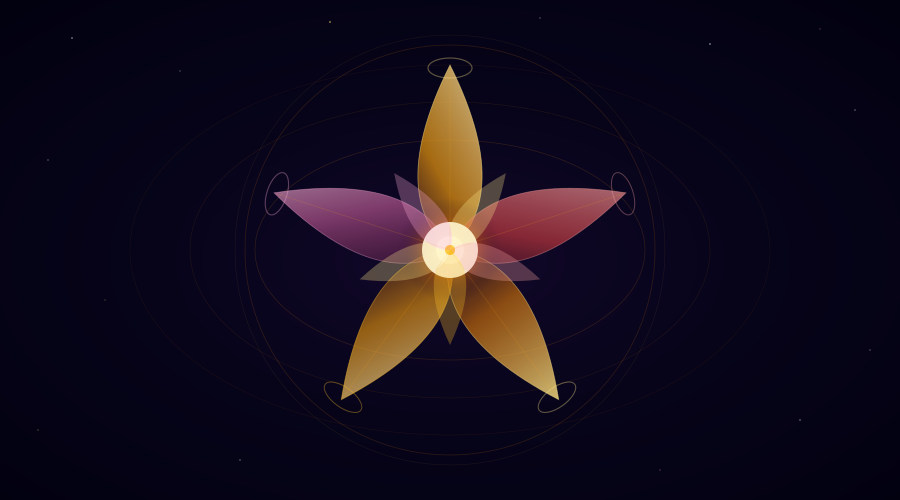
The word radical matters. Not radical as in extreme or dramatic or counter-cultural. Radical as in radix — the Latin word for root. These are root-level recognitions. They touch the base of who you are, not the surface of what you do. They are not behaviors to perform but grounds to stand on. And they follow a natural sequence — not a hierarchy to climb but a flower opening, petal by petal, each one making room for the next.
You cannot forgive what you have not first accepted.
You cannot be grateful for what you still resent.
You cannot laugh at the cosmic absurdity if you are still keeping score.
You cannot recognize the other as self if you are still defending a separate self.
Acceptance opens into Forgiveness. Forgiveness opens into Gratefulness. Gratefulness opens into Humor. Humor opens into Family. And Family, fully felt, feeds back into a deeper Acceptance, and the spiral begins again.
Five doors. One room. Already open.
Let us walk through them.
Five arched doorways in distinct warm hues converging on a single golden room — the many entry points of human experience meeting one shared light.
Facing What Is: The Ground of Radical Acceptance
It is two in the morning. A mother sits at the kitchen table. Her teenager has come home drunk — again. The third time this month. Every instinct in her body fires at once: fix it, punish it, deny it, rage at it, collapse under it. She can feel the five reactions competing for control — denial (this is not happening), blame (where did I go wrong), panic (this is going to end badly), control (I will take away the car, the phone, the freedom), despair (I am failing as a parent).
She does none of these things. Not because she is enlightened or particularly evolved. Because she is exhausted. She has tried all five reactions before, and none of them worked. Denial did not make the drinking stop. Blame did not produce insight. Panic did not generate clarity. Control did not build trust. Despair did not help anyone.
So she sits. She breathes. She allows the situation to be exactly what it is, without adding a single story to it. A teenager, struggling. A mother, afraid. The kitchen table between them, solid and real. The hum of the refrigerator. The smell of cheap beer. The clock ticking.
This is Radical Acceptance.
Not passive resignation — she will act, she will seek help, she will set boundaries. But not yet. First, she clears the field. She lets reality arrive without filtering it through five competing reactions. And in that clearing, something unexpected happens: she can see. Not through the fog of her fear or the lens of her preferred version of events, but directly. A child in pain. A mother who loves them. The next right thing to do.
Steven Hayes, the founder of Acceptance and Commitment Therapy, spent decades studying what he calls experiential avoidance — the refusal to remain in contact with difficult internal experiences. His research, now replicated across hundreds of studies, points to a startling conclusion: the root mechanism of most psychological suffering is not the painful experience itself. It is the attempt to avoid the painful experience. The pushing away. The bargaining. The five competing reactions at the kitchen table.
ACT — the therapeutic framework Hayes developed — does not ask you to feel better. It asks you to get better at feeling. The distinction is everything. Feeling better implies that the painful experience should change. Getting better at feeling implies that your relationship to the experience can change, even when the experience itself does not.
Tara Brach bridges this clinical insight into contemplative language. Her phrase "Radical Acceptance" — which gives this first realization its name — describes "the willingness to experience ourselves and our lives as they are." Not as we wish they were. Not as we fear they might be. As they are. Brach's RAIN framework — Recognize, Allow, Investigate, Nurture — is one practical pathway into this willingness. But the framework is a finger pointing at the moon. The moon is the moment when you stop pushing against reality and discover, as with the door in the meditation hall, that reality opens when you stop pushing.
Here is where Radical Acceptance connects to everything you have already learned. The Veil of Separation — the first of the five habitual patterns — creates a rigid boundary between self and world, between what is happening and what you think should be happening, between the present moment and your preferred version of it. When you accept what is, that rigid boundary softens. Not dissolves — you still perceive the difference between yourself and your teenager, between fear and calm, between 2 AM and the morning that will eventually come. But the boundary becomes permeable. Fluid. Functional rather than defensive.
This is exactly the transformation that hidden wisdom described: the Veil of Separation, when its energy is liberated, becomes the Wisdom of Discernment. You perceive boundaries without being imprisoned by them. You see what is what, clearly, without needing to defend your side of every line.
The mother at the kitchen table has not transcended anything. She has not achieved a higher state of consciousness. She has simply stopped adding her reactions to the situation — and in that stopping, the situation became clear enough to respond to wisely. Pema Chödrön calls this "the fundamental ambiguity of being human" — the capacity to remain present with what is without needing it to be different. Chödrön's great teaching is that this ambiguity is not a problem to solve but a ground to stand on. Groundlessness, she insists, is the ground.
Radical Acceptance is the first realization because it is the ground for everything that follows. You cannot forgive what you have not accepted. You cannot be grateful for what you refuse to see. You cannot laugh at what you are still denying. You cannot recognize family in the faces you will not look at. Every subsequent door opens from this one — this willingness to face what IS, without adding, subtracting, or rearranging.
And the deepest acceptance — the one that takes the longest and costs the most — is the acceptance of yourself. Kristin Neff's research on self-compassion demonstrates what contemplatives have known for millennia: you cannot offer others what you have not first offered yourself. Radical Acceptance is not only the acceptance of your teenager, your situation, your fear. It is the acceptance of the version of yourself that sits at the table at 2 AM, terrified and out of answers. That version is not a failure. That version is a human being, doing the hardest thing a human being can do: facing what is.
Take a breath here. Let the ground settle before we move to the next door.
Dark contracted rings dissolving outward as rigid boundaries soften into permeability — clarity emerging at the luminous center.
Facing What Was: The Weight and Release of Radical Forgiveness
There is a man in South Africa who has been carrying something for thirty years. He carries it the way you carry a stone in your pocket — always there, always weighing on one side, pulling your gait slightly off-center so that eventually you stop noticing the unevenness and begin to think that is just how you walk. The stone is a killing. His brother, shot during the struggle against apartheid. The man who pulled the trigger was never charged. The new South Africa arrived, and with it the Truth and Reconciliation Commission, and with it the invitation to tell the truth and hear the truth and, somehow, to continue.
The man decides to write a letter. It takes him four months. He does not begin with forgiveness — that word is not available to him yet, and he does not trust anyone who says it should be easy. He begins with the truth. This is what you took from me. This is what the absence of my brother cost my mother, who never recovered. This is what it cost my children, who know their uncle only from photographs. This is what it cost me — the rage that became a companion, the bitterness that replaced the sweetness, the thirty years of walking off-center with a stone in my pocket.
He writes all of it. He does not spare the reader. He does not spare himself.
And then, after the truth has been told in its fullness — not softened, not curated, not made palatable — something unexpected happens. The telling itself creates a space. The stone, described in precise detail, begins to feel less like a permanent fixture and more like something he is holding. And what you are holding, you can set down.
He writes the last section of the letter: I release this. Not for your sake — I do not know you well enough to do this for your sake. For mine. For the future. For the children who should not inherit this weight. He mails the letter. The reply takes a year. It is two sentences: "I am sorry. I did not know you were a person."
This is Radical Forgiveness.
Desmond Tutu and his daughter Mpho Tutu, in The Book of Forgiving, laid out the fourfold path that this man walked without knowing its name: Tell the Story. Name the Hurt. Grant Forgiveness. Renew or Release the Relationship. The path is not soft. It is not a shortcut around pain. It is a way through pain that does not require you to carry the pain forever. Tutu, who chaired the Truth and Reconciliation Commission, watched thousands of South Africans walk this path — perpetrators and victims alike, seated in the same room, telling the same truth from opposite sides. His conclusion was not optimistic in the shallow sense. It was something deeper: there is no future without forgiveness. Not because forgiveness is nice but because without it, the past owns the future.
The connection to the cycle of harm is direct and structural. Hurt People, Hurt People described how harm perpetuates itself — how the harmed become the harming, how pain passed down becomes pain passed on, how the wheel turns and turns and no one can remember who pushed it first. Radical Forgiveness is where the wheel stops. Not because you pretend it was never turning. Not because you excuse the person who pushed it. Because you refuse to push it one more revolution. You take your hands off the wheel.
Ho'oponopono — the Hawaiian practice of reconciliation — distills the entire arc into four phrases: I'm sorry. Please forgive me. Thank you. I love you. The practice is radical because it is directed inward as much as outward. You forgive yourself for having been hurt. You forgive yourself for having caused hurt. You forgive yourself for having carried the weight. The four phrases trace the same journey as the Tutus' fourfold path: truth (I'm sorry), release (please forgive me), gratitude (thank you), and love (I love you). Four phrases that contain the entire movement from Radical Acceptance through Radical Family.
Here is what Radical Forgiveness is NOT, because the misunderstandings are as dangerous as the unforgiveness itself:
It is not condoning. Forgiveness does not mean what happened was acceptable. The man's brother is still dead. The apartheid regime was still evil. Naming the hurt — the second step of the fourfold path — makes this explicit: you do not skip the truth to get to the release. The truth comes first. Always.
It is not forgetting. Robert Enright's forgiveness research program has demonstrated what Tutu intuited: forgiveness that requires amnesia is not forgiveness but denial. You remember. You remember clearly. But the memory no longer owns you.
It is not reconciliation — not necessarily. The fourth step of the Tutus' path offers a choice: renew or release the relationship. Sometimes the wisest, most loving thing to do is to release. Forgiveness does not require you to invite the person back into your life. It requires you to stop carrying them in your body.
The Veil of Self-Fixation — the third of the five habitual patterns — is what makes unforgiveness so sticky. Self-Fixation freezes the self into a fixed image: "I am the one who was wronged." Or: "I am the one who did wrong." Either way, the self becomes a monument to the past — a statue that can neither move nor be moved. Radical Forgiveness is the warming of that statue back into a living, breathing, evolving self. It is the Wisdom of Self-Awareness — described in hidden wisdom — in motion. You know yourself. You know your history. But you are not imprisoned by the narrative of who you have been.
Howard Zehr's The Little Book of Restorative Justice shows what Radical Forgiveness looks like at the institutional scale. Instead of retributive justice — which asks "What law was broken? Who broke it? What punishment do they deserve?" — restorative justice asks: "What was the harm? What needs to happen to repair it? How do we reintegrate the person who caused it back into the community?" The South African TRC was restorative justice at the scale of a nation. The mechanism is precisely the one this article describes: facing what WAS (telling the truth about apartheid), releasing the narrative that binds you to it (choosing not to prosecute), and renewing relationship (building a shared future).
Restorative justice proves something essential: Radical Forgiveness scales. It is not only a personal practice, performed in the quiet of your heart. It is a political technology, capable of transforming entire nations. When the spectrum of compassion describes the movement from contraction to opening, restorative justice is what that movement looks like at the level of policy — the moment a society chooses opening over retribution, future over past, repair over punishment.
Brené Brown's research on vulnerability illuminates the cost of this door. Forgiveness requires an extraordinary vulnerability — the willingness to set down the armor you built from the hurt, to stop using the wound as a shield, to stand in the open air without the protection of your grievance. Brown identifies this as one of the most courageous acts a human being can perform: not the courage of confrontation but the courage of release. Not daring to fight but daring to stop fighting.
The man in South Africa did not become a different person when he mailed that letter. He became a lighter version of the same person. The stone was still in his memory. It was no longer in his pocket.
Pause here. This door is the heaviest. Let it settle.
A heavy stone descending on one side, a luminous form rising on the other — the weight of unforgiveness released, spaciousness opening where contraction once lived.
Facing What Is Given: The Quiet Revolution of Radical Gratefulness
A woman who lost her sight at forty describes the rain differently than anyone who can see.
"Before I went blind," she says, "rain was weather. Inconvenient. Something to avoid or endure. I would check the forecast and grumble. I would run from the car to the door and shake the water from my coat with mild resentment.
"Now rain is a symphony. I can hear each drop separately — the fat ones on the roof, the thin ones on the leaves, the scattered percussion on the window. I can feel the temperature shift as the cloud passes over, the air cooling first on my face and then on my arms. I can smell the earth opening — that petrichor, that ancient green scent that I never noticed when my eyes were doing all the work.
"I lost my eyes and gained a world."
This is Radical Gratefulness. Not the thin, performative gratitude of listing three things before bed — though that practice has its uses. Something deeper. Something that rewires perception itself. The recognition, arrived at through loss and attention and the willingness to face what is given rather than what is missing, that existence itself exceeds our capacity to receive it. That the world is not scarce. That we are.
Robert Emmons spent two decades studying gratitude with the rigor of a research scientist, and his findings are remarkably consistent: people who keep gratitude journals sleep better, visit the doctor less frequently, exercise more, and report higher levels of positive affect. The study he conducted with Michael McCullough — gratitude journals versus hassle journals versus neutral logs — showed significant improvements in wellbeing for the gratitude group across almost every measure. The research is robust. The evidence is in.
But the research, Emmons himself acknowledges, captures the effects of gratefulness without fully capturing its nature. For that, you need Brother David Steindl-Rast, the Benedictine monk who has spent sixty years teaching gratefulness as the root of all prayer — and, by extension, the root of all genuine spiritual practice. Steindl-Rast's insight is ontological, not psychological: gratefulness is not a response to specific good things. It is the fundamental amazement that anything exists at all. "It is not happiness that makes us grateful," he writes in Gratefulness, the Heart of Prayer. "It is gratefulness that makes us happy."
Read that again. Let the inversion settle. Gratefulness does not follow from pleasant circumstances. Pleasant circumstances follow from gratefulness — or more precisely, the same circumstances reveal their depth when perceived through grateful eyes. The blind woman did not receive better rain. She received the same rain through a wider door.
Here is where generosity as gratitude in action completes its arc. Generosity is Gratitude in Action described generosity as the turning point of the entire journey ��� the moment the contracted self begins to open outward. But that article described the outward expression: the giving. Radical Gratefulness reveals the inward ground: the receiving. You give because you have recognized that everything was always given. The breath in your lungs — given. The body that holds it — given. The capacity to perceive — given. The person sitting across the table from you — given. None of this was earned. None of this was purchased. The universe, it turns out, is fundamentally generous. Scarcity was never the structure of reality. It was the structure of a particular way of looking at reality.
This connects directly to the Veil of Scarcity — the second of the five habitual patterns. Scarcity perceives the world through the lens of insufficiency: there is not enough time, not enough money, not enough love, not enough safety. The veil is powerful because it often matches the surface evidence. There really is a finite amount of money in your account. There really are only twenty-four hours in the day. But the veil operates by generalizing from specific scarcities to a universal scarcity — by turning "I don't have enough of X" into "there is never enough of anything." The Wisdom of Care, described in hidden wisdom, is what the Veil of Scarcity becomes when liberated: the attentiveness to what matters, freed from the panic that there is not enough of it. Radical Gratefulness is that wisdom lived. You pay attention — deep, specific, loving attention — to what is given. And what is given, when attended to with that quality of attention, turns out to be staggering.
Martin Seligman's PERMA model — Positive Emotion, Engagement, Relationships, Meaning, Accomplishment — maps the territory of human flourishing. Gratitude is implicated in every dimension. Positive emotion: gratitude is one of the most consistently positive emotional states, correlated with lower rates of depression and anxiety. Engagement: grateful attention deepens presence and flow. Relationships: gratitude is the strongest predictor of relationship satisfaction in the research literature. Meaning: the capacity to see existence as given — as fundamentally meaningful rather than randomly occurring — is the substrate of all meaning-making. Accomplishment: grateful people persist longer and recover faster from setbacks. Radical Gratefulness is not one PERMA pillar. It is the soil in which all five grow.
But here is where the article must push beyond positive psychology, because the realizations are not self-improvement techniques. They are recognitions of what is already the case. Seligman maps the territory. The Fractal Life Table maps the territory. The research literature maps the territory. Radical Gratefulness reveals that the territory was always there, covered by the Veil of Scarcity — and that uncovering it does not require adding anything new. It requires removing the filter that was blocking the perception.
The blind woman did not add anything to the rain. She removed the visual dominance that had been drowning out everything else. In the same way, Radical Gratefulness does not add pleasant experiences to your life. It removes the scarcity filter that prevents you from perceiving the experiences already arriving.
There is a moment — and if you have felt it, you will recognize this immediately — when gratitude becomes involuntary. Not something you practice or generate or remind yourself to feel, but something that floods through you, unbidden, in response to something so ordinary it should not be remarkable: sunlight on a kitchen counter, the smell of coffee, the weight of a sleeping child on your chest, the sound of rain. Brown calls this "foreboding joy" — the fear that arises when gratitude arrives unbidden, because the thing you are grateful for might be taken away. Foreboding joy is the Veil of Scarcity making its last stand: even in the moment of fullness, the veil whispers this cannot last, this will be taken, do not open too far.
Radical Gratefulness faces the foreboding and remains open anyway. Not because the fear is wrong — things will be taken, nothing lasts in its current form — but because closing against the joy does not prevent the loss. It only prevents the joy. And the joy was always the point. Not the joy of getting but the joy of receiving. Of being the kind of creature that can stand in the rain and hear a symphony.
As above, so below; as within, so without.
— Hermetic axiom (Tabula Smaragdina)
The Spiral Deepens: Five Facings in the Same Mirror
Before we open the fourth door, step back. See the pattern.
Each of the first three realizations shares a common structure: each is a form of facing. Acceptance faces what IS. Forgiveness faces what WAS. Gratefulness faces what is GIVEN. In each case, the turning toward — the willingness to look directly at something instead of away from it — is itself the transformative act. The mother faces the reality of her teenager at the table. The man in South Africa faces the truth of what was taken. The blind woman faces the full spectrum of what is given when the eyes are not filtering it.
This is the 108 Framework's mirror metaphor made personal. In that framework, the mirror does not add anything — it reveals what is already there. The five realizations are five angles on the same mirror. Acceptance is the mirror held up to present reality. Forgiveness is the mirror held up to the past. Gratefulness is the mirror held up to the given. Humor — which we are about to enter — is the mirror turned on itself, the moment when the mirror recognizes that it is both the observer and the observed. And Family — the fifth — is the mirror recognizing itself in every other face.
Each "facing" is an act of what the 108 Framework calls One remembering it was always Zero. In the ontological language of that framework: Zero — Unfathomable Compassion — collapsed into One, the individuated self. The veils are One's defense mechanisms, the patterns that keep One from remembering where it came from. The wisdoms are Zero shining through. And the Five Radical Realizations are what happens when One stops defending and starts remembering.
Radical Acceptance: One accepts that it is Zero wearing a costume.
Radical Forgiveness: One forgives itself for having forgotten.
Radical Gratefulness: One recognizes that everything — including the forgetting — was always Zero's gift.
Radical Humor: One laughs at the absurdity of having taken the costume so seriously.
Radical Family: One sees every other One as Zero in a different costume.
The sequence is not a spiritual ladder. It is the natural unfolding of a single recognition across five domains of experience. And that recognition, mapped onto the spectrum of compassion, traces the full arc from contraction to opening. Acceptance is the first loosening — the moment contraction gives way. Forgiveness is the opening of the past. Gratefulness is the opening of perception. Humor is the opening of meaning. Family is the opening of identity itself — the self expanding to include everything it once held at arm's length.
But here is the spiral: the spectrum is not a line. It is the torus that The Math of Everything described — the shape that flows outward and returns to itself. Family, the most open of the five, feeds back into Acceptance, the most fundamental. And the cycle begins again, deeper each time. You accept more. You forgive more. You receive more. You laugh more freely. You recognize more faces as your own. Each pass through the five brings wider acceptance, deeper forgiveness, more radical gratefulness, wilder humor, larger family.
This is why the five realizations are not a hierarchy to climb but a garden to tend. You do not master one and move on. You circle through them, each time from a deeper place, each time with more willingness to face, each time with less distance between yourself and what you face.
The mirror is the same. The angles multiply.
A torus-spiral of five petals cycling inward and outward — the five realizations as a living garden revisited with ever-wider understanding, not a ladder climbed once.
Facing the Absurd: Radical Humor and the Crack in Everything
At a funeral in County Cork, the priest reads the eulogy with the solemnity the occasion demands. The words are carefully chosen. The theology is sound. The grief is honored. Everything is exactly as it should be.
Then the dead man's best friend stands up.
She is a stout woman in her sixties with the kind of face that looks like it has laughed too much and cried too much and done both at the same time. She does not look at her notes. She does not have notes.
"He would have hated this," she says.
And she tells the story. The barbecue. The lighter fluid. The spectacular miscalculation of how much lighter fluid is "enough." The trousers catching fire — not dramatically, not cinematically, but in that slow, bewildered way where you look down and think "surely that is not actually happening" for a full three seconds before your nervous system catches up. The run down the street. The boxers — and they were the ridiculous ones, the ones with the cartoon dogs, because of course they were. The neighbor's dog, who saw a running man and concluded that running men must be chased. The pond. The splash. The man standing waist-deep in green water, holding the barbecue tongs he had somehow not dropped, looking at the dog, who was looking at him, and both of them equally confused about how they had arrived at this moment.
The church shakes.
Not with disrespectful laughter — no one has forgotten why they are here. The grief has not evaporated. But something has cracked open. The solemnity, which was correct but incomplete, has been supplemented by something the solemnity could not contain: the truth that this man — this absurd, flammable, pond-sitting, tong-clutching, ridiculous, beloved man — was funny. And that the funniness was not separate from the love. It was part of the love. It was the love's favorite outfit.
This is Radical Humor.
Not comedy. Not coping mechanism. Not the brittle laugh that deflects pain or the cruel laugh that inflicts it. Something else entirely — the moment of recognition when the structure of reality becomes visible and laughter is the only adequate response.
Peter McGraw's Benign Violation Theory provides the mechanism. Humor arises, McGraw demonstrated through years of research across cultures, when something is simultaneously perceived as wrong (a violation) and OK (benign). A man running down the street with his trousers on fire is wrong — fire is dangerous, dignity is compromised, the social order has been disrupted. But the man is also OK — he is not seriously hurt, the pond is available, and the story will be told at his funeral forty years later by a woman who loved him. The violation and the benign perception happen at the same time, and the brain's response to holding both simultaneously is laughter.
Now apply that to everything you have learned in this series.
The five veils are exactly this: each one is a genuine distortion — a violation of clear seeing — that is also, as hidden wisdom revealed, a distorted wisdom — benign in its origin and recoverable in its nature. When you see both at once — the contraction and the wisdom it contains, the veil and the light shining through it — you laugh. Not because suffering is funny. Because the setup is so elaborate. Because Zero went to such extraordinary lengths to forget itself, constructed such intricate defenses against its own nature, and has been running this absurd, magnificent, heartbreaking, hilarious program for billions of years — and the entire time, the door was unlocked.
Viktor Frankl discovered this in Auschwitz. In the most extreme conditions imaginable — conditions that should have destroyed every capacity for lightness — Frankl observed that humor survived. "Humor was another of the soul's weapons in the fight for self-preservation," he wrote in Man's Search for Meaning. He and a friend made a pact to invent at least one amusing story every day. Not jokes about their captors, not bitter gallows humor, but the strange, human, involuntary humor that arises when the gap between what is happening and what should be happening becomes so vast that the only response is a kind of bewildered amazement.
Radical Humor dissolves the Veil of Comparison — the fourth of the five habitual patterns. Comparison ranks everything: better, worse, above, below, winning, losing. Radical Humor sees the ranking and laughs — not because ranking has no function (it does) but because the seriousness with which we defend our rankings is cosmically disproportionate to their importance. The Wisdom of Appreciation, which hidden wisdom described as the liberated form of Comparison, is Radical Humor's quieter cousin: the ability to perceive quality without needing to rank it. Radical Humor is Appreciation in its freest, wildest form — appreciating the cosmic comedy without needing anyone to win or lose, including yourself.
Here is the connection to the 108 Framework that makes Radical Humor more than a pleasant emotion: laughter is the sound One makes when it catches itself taking the costume seriously. Every spiritual tradition that has reached a certain depth has a tradition of holy fools, divine jesters, teachers who use absurdity as a technology of liberation. Zen koans. Sufi trickster tales. The Heyoka tradition of the Lakota. The crazy wisdom teachers of Tibet. They all point to the same recognition: the final defense of the ego — the last thing One holds onto before remembering it was always Zero — is seriousness. Not the seriousness of caring, which is the Wisdom of Care and entirely compatible with laughter. The seriousness of self-importance — the conviction that my suffering, my journey, my realization is uniquely significant in a universe of eight billion simultaneous dramas.
Radical Humor cracks that seriousness open. Not by dismissing the suffering — Frankl would never dismiss suffering — but by placing it inside a larger frame. Your suffering is real. Your journey is genuine. And you are also a character in the most elaborate comedy ever staged — a comedy in which the main character spends the entire play searching for something that is in their pocket, and the audience — who can see the pocket — keeps laughing, and the character keeps searching, and the beauty of the whole thing is that the searching is the play. Without the searching, there is no comedy. Without the forgetting, there is no remembering. Without the tragedy, there is no humor.
The funeral in County Cork was not a denial of grief. It was grief's completion — the moment when love, which had been wearing its solemn face, was allowed to wear its ridiculous face too. The two faces are the same face. The tears and the laughter come from the same place. Anyone who has been to a real funeral — the kind where the dead person was truly known and truly loved — has felt this: the moment when grief and humor become indistinguishable, when crying and laughing happen in the same breath, when the heart breaks open wide enough to hold both the loss and the absurdity and the love, all at once.
This is where the door opens but we do not walk through it. The full treatment of Radical Humor — the deep dive into the cosmic joke, the sacred laughter, the technologies of divine comedy — awaits in The Sacred Joke. This article cracks the door. The Sacred Joke throws it wide. The laughter of recognition has not yet told its full joke. But you can hear it beginning — a low rumble, somewhere in the chest, the kind of laugh that starts before you know what is funny and only gets louder as you realize.
Facing the Other as Self: Radical Family and the Thinning of Every Wall
A man sits at an airport gate, exhausted. Nineteen hours of travel. Two layovers. A missed connection. A lost bag. He has not slept properly, has not eaten properly, has consumed too much bad coffee and not enough water. He is, in the precise language of his body, running on fumes.
He looks around.
A baby is crying — the piercing, inconsolable cry of a very small human for whom every discomfort is total. A businessman three rows down is on the phone, performing competence, his voice a half-octave lower than it needs to be, his vocabulary a quarter-turn more corporate than the situation requires. An elderly couple shares a sandwich from a paper bag, tearing pieces off for each other with the practiced efficiency of people who have been sharing food for fifty years. A teenager has disappeared into a screen, her face lit blue and blank, her body a parenthesis of avoidance.
The man has no reason to feel anything for these people. They are strangers. They share nothing except a gate number and a departure time. In the economy of attention, they are background noise — furniture in the waiting area of his life.
And then — he cannot explain it, will never be able to explain it, will remember it for the rest of his life — something shifts.
He sees them.
Not as strangers. Not as obstacles or inconveniences or categories (baby, businessman, couple, teenager). As family. Not people who happen to share his gate. People who share his awareness, his ground, his being. The baby is crying because she is uncomfortable — he knows that discomfort. It lives in his body right now. The businessman is performing competence — he knows that performance. He does it every Monday morning. The couple is sharing food as an act of love — he knows that love. It is the same love that makes him call his mother on Sundays. The teenager is hiding in a screen because the world is too much — he knows that hiding. He is hiding right now behind his exhaustion and his irritability.
Everyone at this gate is him. In a different body. In a different costume. But him.
This is Radical Family.
Desmond Tutu gave it a name long before this man had his moment at the gate: Ubuntu. "Umuntu ngumuntu ngabantu" — a person is a person through other persons. "My humanity is caught up, is inextricably bound up, in yours," Tutu wrote. "I am human because I belong. I participate. I share." Ubuntu is not a warm feeling about humanity. It is an ontological claim — a statement about the structure of reality. There is no such thing as a separate self. There is only the self-in-relation, the self-through-others, the self that is not a noun but a verb conjugated in the plural.
Thich Nhat Hanh called it interbeing. "We inter-are," he said. "If you are a poet, you will see clearly that there is a cloud floating in this sheet of paper." The paper requires rain, which requires clouds, which requires ocean, which requires sun, which requires nuclear fusion, which requires the fundamental forces of physics, which requires the conditions of the Big Bang — and so the sheet of paper contains the entire universe, and you, holding it, are holding the universe, and the universe, being held by you, is holding itself. Nothing exists independently. Everything "inter-is."
If you have followed the arc from the Golden Rule to this moment, you can feel the arrival. The series began with a simple instruction: "Do unto others as you would have them do unto you." Every wisdom tradition on Earth has some version of this rule. It sounds like a moral instruction — a should. You should treat others as you wish to be treated. Radical Family reveals that it is not an instruction at all. It is a description. A description of the way things actually are. The others are you. Treating them well is not a sacrifice or a discipline or a moral achievement. It is a recognition — and once the recognition arrives, the instruction is no longer necessary. You do not need to be told to care for your own hand. You do not need a moral code governing how you treat your own breath.
The Veil of Uncertainty — the fifth and final of the habitual patterns — is what keeps the other strange. Uncertainty fears what it does not know. The stranger is dangerous precisely because they are unknown — their intentions opaque, their loyalty unproven, their difference threatening. The Veil of Uncertainty generalizes from "I do not know this person" to "the unknown is unsafe" to "protect yourself from what you cannot predict." This is how reification works at the social level: the flowing, contextual, moment-to-moment process of encountering someone new gets frozen into a fixed category — stranger, foreigner, outsider, threat.
Radical Family thaws this. The Wisdom of Openness, described in hidden wisdom, is the liberated form of the Veil of Uncertainty: the capacity to stand in the unknown without making it an enemy. Radical Family is that wisdom embodied in the particular — not the abstract recognition of non-separation that oneness described but the lived, immediate, this-person-right-here experience of kinship. The man at the airport gate did not think "all is one." He looked at a crying baby and thought "I know that cry." He looked at a teenager hiding in a screen and thought "I know that hiding." The recognition was not philosophical. It was somatic. Body to body. Breath to breath. Costume to costume.
Chosen family traditions — the queer community, the recovery community, intentional communities of every kind — demonstrate Radical Family in its most practical form. These are traditions that have discovered, often through the pain of being excluded from biological family, that kinship is not blood. It is recognition. It is the moment you look at another human being and see — not decide, not believe, not theorize, but see — that you are made of the same substance. That their joy is available to you and your suffering is legible to them and the wall between you, while useful for navigating the world, is thinner than a sheet of paper.
Daniel Siegel's interpersonal neurobiology provides the clinical framework: the brain is wired for integration — the linking of differentiated parts into a functional whole. When the integration is internal (linking different brain regions), you get the capacities described by the first four realizations: acceptance (prefrontal regulation), forgiveness (narrative coherence), gratefulness (state integration), humor (temporal integration). When the integration is interpersonal — linking different nervous systems through attunement, resonance, and presence — you get Radical Family. The mirror neurons fire. The resonance circuits activate. The brain literally perceives the other as self — not metaphorically but neurologically, at the level of circuits and synapses.
And here is the deepest implication, the one that the man at the airport gate felt but could not articulate: Radical Family is not a state you achieve. It is a state you notice. The interconnection is already there. The interbeing is already the case. The neurons are already firing. The only thing that changes is whether you are perceiving it or whether the Veil of Uncertainty has filtered it out of your awareness. The man did not become connected to the people at the gate. He noticed that he had always been connected. And the noticing changed everything — not the fact, but the experience of the fact.
He did not hug anyone. He did not announce his realization. He did not post about it on social media. He just sat there, at the gate, seeing family everywhere he looked. And for the rest of the flight, something was different. The wall between self and other had thinned. And through the thinning, love — not the dramatic love of movies and songs but the quiet, structural, built-into-the-fabric love that holds the universe together — began to flow.
Pause here. Let the recognition land. You have met the fifth door.
A constellation of human figures as luminous nodes connected by golden threads — each recognizing itself in every other, Ubuntu as a living web of mutual recognition.
Vulnerability: The Thread Through Every Door
There is a thread that runs through all five doors, so fine you might miss it if you are watching for something grander. Brené Brown named it vulnerability.
Radical Acceptance requires the vulnerability to see reality without your preferred filters — to be seen, even by yourself, as someone who does not have the answers. The mother at the kitchen table is vulnerable not because she is weak but because she has stopped pretending she is strong enough to fix everything. Her vulnerability is her clarity.
Radical Forgiveness requires the vulnerability to release the protective narrative — to set down the armor built from injury and stand in the open air without the shield of grievance. The man writing his letter is vulnerable not because forgiveness makes him soft but because it requires him to stop using his rage as a wall. His vulnerability is his freedom.
Radical Gratefulness requires the vulnerability to receive — and this is the one Brown identified most precisely. "Foreboding joy," she calls it: the fear that arises in the moment of genuine gratitude because what you are grateful for might be taken away. The blind woman in the rain is vulnerable not because she is unprotected but because she has opened herself to the full symphony of a world she could lose — and is choosing to hear it anyway. Her vulnerability is her perception.
Radical Humor requires the vulnerability to be seen laughing at what once seemed solemn — to let your self-importance be punctured, to be the person at the funeral who tells the story about the burning trousers. The woman in County Cork is vulnerable not because she is irreverent but because she is willing to be the one who cracks the solemnity open. Her vulnerability is her honesty.
Radical Family requires the vulnerability to recognize yourself in a stranger — to admit that the crying baby and the corporate-voiced businessman and the blue-lit teenager are all you, wearing different faces. The man at the airport gate is vulnerable not because he has lowered his defenses but because he has allowed the wall between self and other to thin. His vulnerability is his love.
Brown's central insight — "Vulnerability is the birthplace of love, belonging, joy, courage, empathy, and creativity" — is the psychological correlate of what the contemplative traditions have been saying for millennia. The realizations are not achievements of strength. They are surrenders into openness. Each one requires you to give up something you thought was protecting you: your filters (Acceptance), your narrative (Forgiveness), your scarcity lens (Gratefulness), your seriousness (Humor), your separateness (Family). And what you discover, every time, is that the thing you were protecting was not really there — it was a costume, worn by Zero, taken too seriously by One.
This is why the five realizations cannot be forced, earned, or achieved through willpower. They can only be surrendered into. You do not build acceptance — you stop building resistance. You do not construct forgiveness — you stop constructing the monument to your grievance. You do not generate gratefulness — you stop generating the scarcity filter that blocks it. You do not manufacture humor — you stop manufacturing seriousness. You do not create family — you stop creating walls.
In every case, the realization is a subtraction, not an addition. Which is why they feel like remembering rather than learning. You are not gaining something new. You are losing something old. And the loss is the opening.
The Veil, the Wisdom, and the Realization: A Map in Three Layers
Now let us see the complete map — the three-layer arc that runs from contraction through recognition to embodiment.
Separation → Discernment → Radical Acceptance. The veil contracts around a rigid self-other boundary. The wisdom perceives differences clearly without imprisoning you in them. The realization lives that wisdom by facing what IS — seeing reality without the defensive boundary, responding to it with clarity instead of reactivity. This is One accepting that it is Zero wearing a costume.
Self-Fixation → Self-Awareness → Radical Forgiveness. The veil freezes the self into a monument — to past hurts, past achievements, past identities. The wisdom knows itself fluidly, without clinging to a fixed narrative. The realization lives that wisdom by facing what WAS — releasing the story that binds you to who you used to be, freeing yourself to become who you are becoming. This is One forgiving itself for having forgotten.
Scarcity → Care → Radical Gratefulness. The veil perceives insufficiency everywhere — not enough time, money, love, safety. The wisdom attends to what matters without the panic that there is not enough of it. The realization lives that wisdom by facing what is GIVEN — seeing the staggering abundance that is always arriving, always exceeding our capacity to receive it. This is One recognizing that everything was always Zero's gift.
Comparison → Appreciation → Radical Humor. The veil ranks everything — better, worse, winning, losing, above, below. The wisdom perceives quality without needing to rank it. The realization lives that wisdom by facing the ABSURD — laughing at the cosmic comedy in which Zero forgot itself and then spent billions of years building elaborate ranking systems to decide which costume was best. This is One laughing at the absurdity of having taken the costume so seriously.
Uncertainty → Openness → Radical Family. The veil fears the unknown — the stranger, the unpredictable, the Other. The wisdom stands in the unknown without making it an enemy. The realization lives that wisdom by facing the OTHER AS SELF — recognizing, in the faces of strangers and loved ones alike, the same awareness looking out from a different pair of eyes. This is One seeing every other One as Zero in a different costume.
The map is not a hierarchy. It is not a to-do list. It is a description of what is already happening in your life, if you are willing to see it. Every time you face a difficult reality without flinching — that is Radical Acceptance. Every time you release a grudge — that is Radical Forgiveness. Every time gratitude floods you without warning — that is Radical Gratefulness. Every time laughter breaks through solemnity — that is Radical Humor. Every time you recognize yourself in a stranger — that is Radical Family.
The realizations are not rare. They are common. They are as ordinary as breathing — which is to say, as extraordinary as breathing, once you notice it.
Practice makes perfect.
— Folk wisdom (English)
After the Ecstasy, the Laundry
Jack Kornfield wrote a book with the best title in the contemplative literature: After the Ecstasy, the Laundry. His thesis, drawn from decades of practice and decades of interviewing meditators, monks, teachers, and seekers, is simple and devastating: awakening does not exempt you from the dishes.
This is the grounding principle for everything in this article. The Five Radical Realizations are not peak experiences. They are not the fireworks display at the end of the spiritual journey. They are the kitchen counter at six in the morning. They are the laundry basket. They are the moment you accept your partner's irritating habit (Acceptance), forgive yourself for the sharp thing you said last Tuesday (Forgiveness), notice the impossible beauty of light on a glass of water (Gratefulness), laugh at your own self-importance when the dog chews your meditation cushion (Humor), and see your own face looking back at you from the eyes of the grocery store clerk (Family).
If these realizations sound too grand, you are hearing them wrong.
They are as ordinary as breathing. And as extraordinary as breathing, once you notice that you have been doing it your entire life without ever deciding to begin.
Kornfield's teaching is the necessary counterweight to the elevated language of this series. The Math of Everything speaks of Zero and One and Infinity. The spectrum of compassion traces the arc from contraction to opening. The Fractal Life Table maps the patterns of human development across every scale. These are real, these are useful, these are maps of genuine territory. But the territory itself is not a mountain peak. It is the ground you are standing on. It is the chair you are sitting in. It is the screen you are reading from. It is this breath.
The great contemplative teachers — Kornfield, Chödrön, Thich Nhat Hanh, Steindl-Rast — all converge on the same point: the realization that matters is the one you can live at breakfast. Not the one you experience on the seventh day of a silent retreat, but the one that survives the drive home. Not the one that fills you with cosmic love in the meditation hall, but the one that remains when your teenager comes home drunk, when the letter from South Africa arrives, when the rain falls on a woman who cannot see, when the friend tells the story about the burning trousers, when the stranger at the airport gate turns out to be you.
If the Five Radical Realizations feel like five more things to add to your spiritual to-do list, the writing has failed. If they feel like five things you have already been doing — five doorways you have already been walking through, most days, without knowing their names — then the writing has done its work. Because that is the truth. You have been accepting. You have been forgiving. You have been grateful. You have been laughing. You have been recognizing family in the faces of strangers. Not perfectly. Not consistently. Not with a framework or a practice schedule or a five-step program. But genuinely. Naturally. In the way a river finds the sea — not because it has a map but because water moves toward openness.
The doors are not locked. They were never locked. You have been walking through them your entire life. The only change — the only thing the teacher in the hall is really offering — is the naming. Once the five openings have names, you begin to notice them. Once you notice them, they deepen. Once they deepen, the distinctions between them begin to blur. Acceptance becomes forgiveness becomes gratefulness becomes humor becomes family becomes acceptance again, and the spiral continues, wider each time, deeper each time, more ordinary each time.
After the ecstasy, the laundry. After the realizations, the kitchen table. After all five doors, the room — which is just this room, the one you are in right now, with its particular light and its particular sounds and its particular version of you, reading these words, already whole, already home.
The Room Beyond All Five Doors
There is a story — possibly apocryphal, possibly too perfect to need to be true — about a student who spent twelve years meditating on the five doors.
First she worked on Acceptance. She sat with everything she had been avoiding — the body sensations she did not want, the emotions she had been suppressing, the realities she had been denying. It took three years. One morning, the first door opened, and what she found on the other side was not peace but clarity: a clear perception of what is, without the distortions of avoidance. The clarity was not comfortable. It was useful.
Then she worked on Forgiveness. She went through every resentment, every grudge, every frozen narrative of self-as-victim and self-as-perpetrator. She wrote letters. She burned letters. She told the truth to people who did not want to hear it and received the truth from people she did not want to listen to. It took four years. One evening, the second door opened, and what she found on the other side was not lightness but freedom: the freedom of a self that is no longer defined by its wounds. The freedom was not pleasant. It was spacious.
Then she worked on Gratefulness. She trained her attention to see what is given rather than what is missing. She practiced in the easy places — sunsets, food, friendship — and then in the hard places — loss, illness, the dissolving of things she loved. It took two years. One afternoon, the third door opened, and what she found on the other side was not happiness but fullness: the recognition that existence itself exceeds the capacity to receive it. The fullness was not comfortable. It was true.
Then she worked on Humor. She learned to laugh at herself — at her own seriousness, her own solemnity, her own twelve years of door-opening as if the universe had been waiting for her to figure it out. The fourth door, she realized with a start, was not a door at all. It was a mirror. And the face in the mirror was laughing. It took two years. One night, sitting alone, she laughed so hard she wept — not at anything in particular, but at everything, at the sheer elaborate absurdity of a universe that forgets itself and then builds meditation retreats to remember. The humor was not light. It was profound.
Then she came to the fifth door. She placed her hand on it. She expected it to be the hardest — the final boss, the ultimate door. But when she touched it, she felt a hand on the other side. The same shape. The same warmth. The same pulse. She pushed, gently, and the hand on the other side pushed back, gently. She laughed. The hand on the other side laughed. She realized she was not pushing against a door. She was pressing her hand against the hand of another person — another being, another costume, another One — and the wall between them was so thin it was almost transparent.
The fifth door opened when she stopped trying to open it and simply stood there, palm to palm, breathing with whoever was on the other side.
And then she noticed something that made her sit down in the middle of the hall: all five doors opened into the same room. The clarity of Acceptance, the spaciousness of Forgiveness, the fullness of Gratefulness, the laughter of Humor, and the hand-to-hand recognition of Family were not five different states. They were five different descriptions of the same state. Five angles on the same room. Five words for the same wordless thing.
The room was not a destination she had arrived at. It was where she had always been — sitting, standing, breathing, living. The twelve years had not moved her from one place to another. They had opened her eyes in the place where she already was.
She went to the teacher and said, "I found the room."
The teacher said, "I know. You are standing in it. You have always been standing in it."
"Then what were the twelve years for?"
"The twelve years were for you to believe that. Knowing it was not enough. You had to discover it. That is the difference between a lesson and a realization."
"Could you not have told me that twelve years ago?"
The teacher smiled — the particular smile of someone who has had this conversation before and will have it again and finds it, each time, genuinely funny.
"I did," she said. "On the first day. You were not yet able to hear it. Now you can. That is not my achievement or yours. It is what the five doors are for."
Invitation
You have never been without these. Acceptance was there in every breath you didn't refuse. Forgiveness was there in every morning you began again. Gratefulness was there in the pause before you named what you saw. Humor was there in every moment you caught yourself taking the story too seriously. Family was there — in the stranger whose eyes you held a beat too long.
You are not climbing toward these realizations. They are the ground you have been standing on every time you forgot to perform something other than what you are.
People Also Ask
What are the five radical realizations? The Five Radical Realizations are Radical Acceptance (facing what IS), Radical Forgiveness (facing what WAS), Radical Gratefulness (facing what is GIVEN), Radical Humor (facing the ABSURD), and Radical Family (facing the OTHER AS SELF). They form a natural sequence — not a hierarchy to climb but a progression of deepening openness, where each realization creates the conditions for the next. The word "radical" comes from the Latin radix, meaning root — these are root-level recognitions that touch the base of who you are.
What is radical acceptance and how is it different from giving up? Radical Acceptance is the active, clear-eyed willingness to experience reality as it actually is — before the stories, the defenses, the preferred version. It is the opposite of giving up. Giving up abandons agency. Radical Acceptance clears the ground so that wise action becomes possible. Steven Hayes's Acceptance and Commitment Therapy distinguishes between experiential avoidance (pushing away difficult experiences, which increases suffering) and acceptance (remaining in contact with difficult experiences, which paradoxically reduces their power). The mother who sits at the kitchen table at 2 AM accepting her teenager's struggle is not passive — she is clearing the field of competing reactions so that clarity can speak.
How does radical forgiveness break the cycle of harm? The cycle of harm perpetuates itself because unprocessed pain gets passed forward — the harmed become the harming. Radical Forgiveness interrupts this cycle by refusing to push the wheel one more revolution. Desmond and Mpho Tutu's fourfold path — Tell the Story, Name the Hurt, Grant Forgiveness, Renew or Release the Relationship — provides the mechanism. You face the truth of what happened, you name the cost, and then you release the narrative that binds you to the past. This is not amnesia or condoning — it is the deliberate decision to stop letting the past own the future.
What is the connection between gratefulness and generosity? Gratefulness is the inner recognition that existence itself is given, not earned. Generosity is that recognition expressed outward in action. You give because you have recognized that everything was always given — the breath, the body, the capacity to perceive, the people around you. Brother David Steindl-Rast's insight captures it precisely: gratefulness is not a response to specific good things but amazement at the givenness of existence itself. When that amazement becomes natural, generosity flows from it as naturally as water flows downhill.
Can humor be a spiritual practice? Yes — and virtually every contemplative tradition that has reached a certain depth includes a tradition of sacred humor. Zen koans, Sufi trickster tales, the Heyoka tradition of the Lakota, the crazy wisdom teachers of Tibet. Radical Humor is not comedy or coping mechanism but the moment of recognition when the gap between what is and what the ego insists should be becomes visible, and laughter is the only adequate response. Viktor Frankl discovered this in Auschwitz: humor was "another of the soul's weapons in the fight for self-preservation." The sacred traditions suggest that the final defense of the ego is seriousness — and laughter, genuine laughter, dissolves it.
What does ubuntu mean and why does it matter? Ubuntu is a Nguni Bantu term often translated as "I am because we are." Desmond Tutu described it as the recognition that "my humanity is caught up, is inextricably bound up, in yours." Ubuntu is not a sentiment but an ontological claim: there is no such thing as a separate self. Personhood is constituted through relationship. This philosophy grounded the South African Truth and Reconciliation Commission and provides the philosophical foundation for Radical Family — the recognition that all beings are kin, not by blood but by shared awareness.
How do the five realizations relate to the five veils? Each realization transforms a corresponding veil into its liberated wisdom. Radical Acceptance transforms Separation into Discernment. Radical Forgiveness transforms Self-Fixation into Self-Awareness. Radical Gratefulness transforms Scarcity into Care. Radical Humor transforms Comparison into Appreciation. Radical Family transforms Uncertainty into Openness. The three-layer progression — veil, wisdom, realization — represents the movement from contraction (the pattern that blocks) through recognition (seeing the wisdom inside the pattern) to embodiment (living from that wisdom stably).
What is restorative justice and how does it connect to forgiveness? Restorative justice is an approach to harm that asks not "what law was broken and who should be punished?" but "what was the harm, what needs to happen to repair it, and how do we reintegrate the person who caused it?" Howard Zehr's framework and the South African Truth and Reconciliation Commission are the most prominent examples. Restorative justice is Radical Forgiveness at the institutional scale — it proves that the capacity to face the past, tell the truth, and choose the future over retribution is not only a personal practice but a political technology capable of transforming entire nations.
Why are the five realizations called radical? "Radical" comes from the Latin radix, meaning root. The five realizations are called radical because they touch the root of human experience — the fundamental relationships with reality (what IS), the past (what WAS), the given (what is received), the absurd (the gap between reality and expectation), and the other (who else is here). They are not surface-level behavior changes or cognitive reframes. They are shifts in the ground you stand on — changes not in what you do but in where you do it from.
How do you practice radical acceptance in everyday life? The most common entry point is Tara Brach's RAIN practice: Recognize what is happening, Allow it to be there without fighting it, Investigate with kindness, and Nurture with self-compassion. But Radical Acceptance is less about a formal practice than about a stance: the willingness, in any moment, to stop adding your reactions to the situation and simply perceive what is actually happening. At the kitchen table at 2 AM, in the traffic jam, in the difficult meeting, in the mirror — the practice is always the same: stop pushing, feel which way the door wants to move, and let reality arrive without your preferred version standing in the way.
References
-
Hayes, Steven C. Get Out of Your Mind and Into Your Life: The New Acceptance and Commitment Therapy. New Harbinger, 2005.
-
Hayes, Steven C., Kirk D. Strosahl, and Kelly G. Wilson. Acceptance and Commitment Therapy: The Process and Practice of Mindful Change. 2nd ed. Guilford Press, 2012.
-
Brach, Tara. Radical Acceptance: Embracing Your Life with the Heart of a Buddha. Bantam, 2003.
-
Chödrön, Pema. When Things Fall Apart: Heart Advice for Difficult Times. Shambhala, 1997.
-
Tutu, Desmond, and Mpho Tutu. The Book of Forgiving: The Fourfold Path for Healing Ourselves and Our World. HarperOne, 2014.
-
Tutu, Desmond. No Future Without Forgiveness. Doubleday, 1999.
-
Zehr, Howard. The Little Book of Restorative Justice. Good Books, 2002.
-
Enright, Robert D. Forgiveness Is a Choice: A Step-by-Step Process for Resolving Anger and Restoring Hope. APA, 2001.
-
Emmons, Robert A. Thanks!: How Practicing Gratitude Can Make You Happier. Houghton Mifflin, 2007.
-
Steindl-Rast, Brother David. Gratefulness, the Heart of Prayer: An Approach to Life in Fullness. Paulist Press, 1984.
-
Emmons, Robert A., and Michael E. McCullough. "Counting Blessings versus Burdens: An Experimental Investigation of Gratitude and Subjective Well-Being in Daily Life." Journal of Personality and Social Psychology 84.2 (2003): 377–389.
-
McGraw, Peter, and Joel Warner. The Humor Code: A Global Search for What Makes Things Funny. Simon & Schuster, 2014.
-
Frankl, Viktor. Man's Search for Meaning. Beacon Press, 1946/2006.
-
Seligman, Martin. Flourish: A Visionary New Understanding of Happiness and Well-being. Free Press, 2011.
-
Tutu, Desmond. "Ubuntu." In God Has a Dream: A Vision of Hope for Our Time. Doubleday, 2004.
-
Thich Nhat Hanh. Interbeing: Fourteen Guidelines for Engaged Buddhism. 3rd rev. ed. Parallax Press, 1998.
-
Kornfield, Jack. After the Ecstasy, the Laundry: How the Heart Grows Wise on the Spiritual Path. Bantam, 2000.
-
Brown, Brené. Daring Greatly: How the Courage to Be Vulnerable Transforms the Way We Live, Love, Parent, and Lead. Avery, 2012.
-
Brown, Brené. The Gifts of Imperfection: Let Go of Who You Think You're Supposed to Be and Embrace Who You Are. Hazelden, 2010.
-
Kornfield, Jack. A Path with Heart: A Guide Through the Perils and Promises of Spiritual Life. Bantam, 1993.
-
Siegel, Daniel. Mindsight: The New Science of Personal Transformation. Bantam, 2010.
-
Neff, Kristin. Self-Compassion: The Proven Power of Being Kind to Yourself. William Morrow, 2011.
-
Vitale, Joe, and Ihaleakala Hew Len. Zero Limits: The Secret Hawaiian System for Wealth, Health, Peace, and More. Wiley, 2007.