The Golden Rule as a Fractal Law of Life
Technologies of the Heart — Volume I, Chapter 2
Part of the Technologies of the Heart series | The Heart of Peace Foundation
← Chapter 1 — The Art & Science of Generosity | Next: Chapter 3 — Paying It Forward →
In 519 BCE, in the city of Jerusalem, a man named Hillel was approached by a skeptic who offered to convert to Judaism on one eccentric condition: Hillel must teach him the entire Torah while standing on one foot. The request was almost certainly intended as mockery. The Torah was an enormously complex body of law, history, poetry, and prophecy — the accumulated spiritual inheritance of a people. To summarize it on one foot was, presumably, to expose its impossibility.
Hillel stood on one foot.
"What is hateful to you, do not do to your neighbor. That is the whole Torah. All the rest is commentary — go and learn it."
The skeptic, according to the Talmud, converted.
What Hillel understood — and what the skeptic apparently recognized in the moment of hearing it — was that the complexity of an entire moral tradition could be generated from a single seed principle. Not because the Torah was simple, but because the Golden Rule was, in a precise sense, generative: it was the pattern from which the whole could be derived.
Twenty-five years later and a thousand miles to the west, a teacher named Jesus offered his followers a positive formulation of the same principle: "Do unto others as you would have them do unto you." (Matthew 7:12) Neither man knew the other existed. Neither was working from the other's teaching. They were, as Karen Armstrong's extraordinary scholarship has demonstrated, co-discoverers — two people in different cities, different traditions, different centuries, who had arrived at the same underlying law.
But the convergence was not limited to Jerusalem and Galilee. Confucius had taught a nearly identical principle in China three centuries before Hillel stood on his foot: "Is it not shu — reciprocity? What you do not want done to yourself, do not do to others." (Analects 15:24, c. 500 BCE). When a student once asked Confucius for a single word that could guide a person's entire life, Confucius gave him shu. The question was asked in the same spirit as the skeptic's challenge to Hillel. And Confucius's answer was the same principle from a different cardinal direction.
The Buddha articulated it in the Dhammapada: "Hurt not others in ways that you yourself would find hurtful." Muhammad would later anchor it at the heart of Islam: "None of you has faith until he loves for his brother what he loves for himself." The Mahabharata states it without equivocation: "This is the sum of duty: do not do to others what would cause pain if done to you." Zoroastrianism: "That nature alone is good which refrains from doing to another whatsoever is not good for itself."
The convergence is not coincidence. It is not the product of cultural diffusion. And the principle itself is not merely advice.
It is a discovery.
What this article reveals:
- The Golden Rule is not a moral commandment but a fractal law — a governing pattern that replicates itself at every scale of human existence, from the individual relationship to the structure of civilizations, producing the same structural outcome at every level of application
- The simultaneous, independent emergence of the Golden Rule across at least five unconnected civilizations during the Axial Age (800–200 BCE) is not cultural coincidence but evidence of separate discoverers encountering the same underlying law — as different observers discovering gravity would each describe the same force
- Robert Axelrod's computer tournaments (University of Michigan, 1984) proved mathematically that Tit-for-Tat — a direct formalization of the Golden Rule — outperforms every known alternative strategy in iterated cooperation scenarios; the most ethical strategy is also the computationally optimal one
- Mirror neurons, discovered by Giacomo Rizzolatti and colleagues at the University of Parma, reveal that the brain literally enacts what it observes in others — the Golden Rule is not moral aspiration grafted onto a selfish biology but the articulation of a neurological reality already built into the structure of the human nervous system
- Jonathan Haidt's cross-cultural research identifies fairness/reciprocity as one of six universal moral foundations present across all studied cultures — it is not a Western ethical invention but an evolutionary constant, a feature of moral cognition that precedes any specific cultural or religious tradition
- Communities that practice the Golden Rule at scale demonstrate measurably superior outcomes across economic resilience, health, educational achievement, democratic participation, and innovation — Robert Putnam's thirty-year research project documents what happens to societies when this web of reciprocal trust becomes thin enough to tear
- The deepest traditions that discovered the Golden Rule were pointing past mere behavior toward a metaphysical claim: that the boundary between self and other is less fixed than it appears, and that the Rule functions not as external constraint but as the natural expression of a more accurate perception of what we are
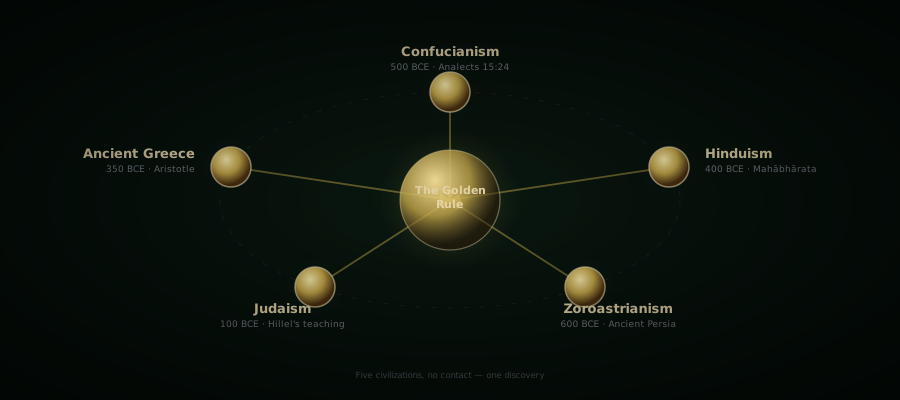 Five traditions, no contact — one discovery. The same underlying law, articulated independently across the full span of human civilization.
I. Introduction — The Golden Rule as a Fractal Law
The Golden Rule is the most widely shared ethical principle in human history. It appears, in some formulation, in every major world religion and philosophical tradition ever studied. It has been rediscovered independently across cultures separated by oceans, centuries, and mutually unintelligible languages. It predates recorded law. It is older than any nation, any scripture, any civilization of which we have detailed knowledge.
This universality is itself a finding — and a deeply significant one. When principles recur this reliably across unconnected human cultures, it suggests something deeper than shared moral preference. It suggests the independent discovery of something structurally true about the nature of human community.
But the Golden Rule's claim on our attention is not merely historical. It is architectural. In the decades since its multiple discoveries were first systematically documented, an extraordinary convergence has emerged from fields as different as evolutionary biology, cognitive neuroscience, game theory, developmental psychology, and behavioral economics — all pointing toward the same conclusion that Confucius, Hillel, and the Buddha reached by a different road: reciprocal regard is not one ethical option among many. It is the foundational operating principle of any cooperative human system that succeeds.
A technology is a tool that produces reliable outcomes when applied. The Golden Rule produces reliable outcomes — at every scale at which it is applied — not because it is a nice idea but because it is a description of how cooperative human systems actually function. It is a technology in the most precise sense: a reproducible process for generating a specific result.
The word fractal, introduced by the mathematician Benoit Mandelbrot in 1975 to describe geometric patterns that repeat at every level of magnification, gives us the most precise available language for what the Golden Rule actually is. A fractal is not merely a repeating pattern. It is a pattern generated by a simple rule applied recursively — a pattern that produces the same structural output regardless of the scale at which you examine it. The coastline of Britain is irregular at the scale of a satellite image and equally irregular under a microscope, because the same generative process — the interaction of water and rock — produces structural self-similarity at every level. The Mandelbrot set is generated by the recursive application of the simplest possible rule (z → z² + c), yet produces infinite structural complexity at every scale of magnification, a complexity that is not imposed from outside but emerges from the rule itself.
The Golden Rule is fractal in exactly this sense. The principle — treat others as you would want to be treated — is a simple rule. But applied recursively, at every scale of human social organization, it generates the same structural output: more cooperation, more trust, more resilience, more capacity for joint flourishing. And its violation, at any scale, generates the same structural failure: erosion of trust, defection from cooperation, collapse of the systems that depend on reciprocal obligation.
This chapter's central thesis is simple and far-reaching:
The Golden Rule is not merely an ethical ideal. It is a fractal governing law — a principle that, when applied consistently at any scale, produces the same outcome: a system capable of sustaining itself and flourishing.
What we will trace through this chapter is not the moral case for the Golden Rule — that case has been made by every major tradition in human history. We will trace the structural case: the evidence that this principle is not a preference but a law, not advice but architecture, not aspiration but description.
II. Historical Context — The Axial Age Discovery
Karen Armstrong's The Great Transformation (2006) is one of the most important works of comparative intellectual history written in the last half-century, and its central argument deserves careful attention. Armstrong documented what the philosopher Karl Jaspers had named in 1949 the "Axial Age" — a period roughly spanning 800 to 200 BCE during which transformations of extraordinary depth occurred simultaneously in at least four distinct civilizational centers: China, India, the Middle East, and Greece. During this same period, without any evidence of significant cross-cultural contact, thinkers working in radical isolation from one another arrived at strikingly convergent conclusions about the nature of the human moral situation — including, in virtually every case, some formulation of the Golden Rule.
The convergence is remarkable not because these thinkers agreed on theology, or metaphysics, or cosmology. They disagreed profoundly on all of these. What they agreed on — what emerged independently from each tradition — was the principle of reciprocal regard as the foundation of ethical life.
To appreciate the significance of this convergence, we need to understand the historical moment in which it occurred. The Axial Age was not a period of peace and stability. It was a period of intense urban disruption, political fragmentation, violent conflict, and the collapse of older social orders. In China, the Zhou dynasty was fracturing into a mosaic of warring states. In India, the old Vedic tribal order was giving way to urban commercial society. In the Middle East, the Assyrian and Babylonian empires were destroying ancient kingdoms; the Israelite state was eliminated and its people exiled. In Greece, the collapse of Mycenaean palace culture had given way to centuries of relative poverty before the emergence of the polis in the seventh and sixth centuries.
It was precisely in this context of fragmentation and suffering, Armstrong argues, that the Axial Age teachers emerged — and the principle they consistently arrived at was one that could serve as a foundation for community when older sources of social cohesion had failed. The Golden Rule was not a luxury of prosperous, settled civilizations. It was, over and over again, the discovery of people trying to understand how human beings could live together after the structures that had organized them had collapsed.
Confucius's life spanned the period 551–479 BCE, a time when the Zhou feudal order was fragmenting into chaos. His project was explicitly restorative: he was searching for the principles that could rebuild a coherent human community. When he identified shu — reciprocity — as the single principle that could guide a whole life, he was not offering moral decoration. He was identifying what he took to be the structural foundation of social order. His disciple Tsang asked: "Is there one word that can serve as a guide for one's entire life?" Confucius replied: "Is it not shu — reciprocity? What you do not want done to yourself, do not do to others." (Analects 15:24). And in the Analects 4:15, he offered a related formulation: the Master's way is zhong shu — conscientiousness and reciprocity — and nothing more. The Golden Rule as the entire curriculum.
In India, the tradition of the Jains offers one of the earliest formulations anywhere: the Acaranga Sutra (c. 500 BCE) states: "A man should wander about treating all creatures as he himself would be treated." The Mahabharata, the vast Hindu epic that reached something like its current form between 400 BCE and 400 CE, contains the formulation already cited — "This is the sum of duty" — and returns to the same principle in multiple different passages across the text, suggesting that its authors understood it not as one teaching among many but as a root principle capable of generating the whole.
Hillel the Elder (~110 BCE – 10 CE), working in Jerusalem during the period of Roman occupation, gave what is arguably the most compact and radical formulation in any tradition: "What is hateful to you, do not do to your neighbor. That is the whole Torah; the rest is commentary — go and learn it." (Talmud, Shabbat 31a). The move is extraordinary: Hillel does not merely identify the Golden Rule as an important principle. He identifies it as the generative seed of an entire moral tradition — the principle from which the whole can be derived, the rest being elaboration.
In Greece, Socrates's ethical project was anchored in a version of the same principle articulated through the concept of justice. Aristotle's formulation in the Nicomachean Ethics approaches it from the direction of distributive justice: what is just is what you would want applied to yourself if you were in the position of the other. The Stoics made it foundational to their cosmopolitanism — the recognition that all rational beings belong to a single community whose law is reciprocal regard.
It is worth noting what this convergence is and is not. It is not evidence of a single primordial tradition from which all these derivations spring. The genetic evidence does not support a common ancestral moral teaching. What the convergence does suggest — what Armstrong argues and what the historical record bears out — is that these were genuinely independent discoveries. Different people, in different contexts, working in different conceptual frameworks, reached the same structural conclusion through their own rigorous engagement with the question of how human beings can live together. Just as Leibniz and Newton independently discovered calculus because they were both engaging seriously with the same mathematical problem, the Axial Age teachers independently discovered the Golden Rule because they were all engaging seriously with the same social problem.
This kind of independent convergence, in the history of science, is considered strong evidence that what is being described is real. When multiple observers, without contact with each other, describe the same phenomenon, we treat this as confirmation that something actual is being observed. The Axial Age convergence on the Golden Rule is, by this logic, evidence that these thinkers were not constructing cultural preferences but discovering something structurally true about the conditions under which human community can sustain itself.
Armstrong's argument — refined across multiple works including The Case for God (2009) and Sacred Nature (2022) — is that the Axial Age teachers were responding to a specific historical challenge: how do we maintain moral seriousness in conditions of fragmentation, violence, and the collapse of traditional authority? Their answer, reached from five different starting points, was the same: the only foundation that does not require the authority of a stable external structure is the authority of the principle itself — and that principle, at its most fundamental, is reciprocal regard.
We are, in 2026, living through a period that bears more than a passing structural resemblance to the conditions of the Axial Age. Political fragmentation. The collapse of shared epistemic authority. The erosion of the civic structures that once organized collective life. Urban disruption. The fracturing of the inherited social order. The question the Axial Age teachers were answering is not a historical question. It is the question of our own moment.
III. The Science of Reciprocity — Why It Works
The contemporary science of reciprocity begins, in the most satisfying way, with a computer tournament.
In 1980, the political scientist Robert Axelrod at the University of Michigan sent invitations to game theorists around the world: submit a computer program that will compete in an iterated Prisoner's Dilemma tournament, and we will find out which strategy for managing cooperation and defection is most successful over time.
The Prisoner's Dilemma is a game structure familiar to anyone who has taken an introductory course in economics or political science, but its implications bear careful elaboration here because they are directly relevant to everything that follows. Two players simultaneously choose to cooperate or defect. If both cooperate, both receive a moderate payoff. If both defect, both receive a small loss. If one cooperates and the other defects, the defector receives a large gain and the cooperating player receives a large loss. The structure creates a genuine dilemma: the individually rational choice is to defect (since defection is always better than cooperation regardless of what the other player does), but mutual defection produces worse outcomes for everyone than mutual cooperation. The Prisoner's Dilemma is the mathematical formalization of the social situations in which we most need to decide whether we are going to treat others as we would want to be treated.
Axelrod received fourteen entries. The tournament ran each program against every other in iterated rounds, giving each pair of programs the opportunity to interact repeatedly. What matters, in the iterated version, is not just what you do on any single round but what pattern of behavior you establish over time — because your partner can respond to your history.
The winner was the simplest program submitted: Tit-for-Tat, submitted by the game theorist Anatol Rapoport of the University of Toronto. Its complete logic fits in one sentence: cooperate on the first move, then on every subsequent move do whatever your partner did on the last move.
Axelrod ran a second tournament with sixty-two entries, this time publishing the results of the first tournament so that participants could design their strategies knowing that Tit-for-Tat had won. More complex strategies were submitted. Tit-for-Tat won again.
Axelrod's analysis of what made Tit-for-Tat so consistently dominant — published as The Evolution of Cooperation in 1984 — is one of the most elegant pieces of applied moral philosophy in the scientific literature. He identified four properties that accounted for Tit-for-Tat's success:
It is nice: it never defects first. This means it never initiates exploitation and consistently presents itself as a cooperative partner.
It is retaliatory: it responds to defection immediately and proportionally, making exploitation unprofitable. It cannot be taken advantage of.
It is forgiving: it returns to cooperation as soon as the other player does, ending cycles of mutual defection that benefit neither party.
It is clear: its behavior is simple enough for other players to model accurately and respond to. This transparency is not weakness — it is what makes the cooperative equilibrium stable.
What Axelrod demonstrated was not just that reciprocity is ethically appealing. He demonstrated that reciprocity is computationally optimal for sustained cooperation. The Golden Rule, in its essence, is Tit-for-Tat: offer what you would want returned. Respond proportionally to what you receive. Forgive and resume cooperation when the other party is ready to resume. And be legible enough that others can understand what you are offering.
Martin Nowak of Harvard University, writing in Science in 2006, extended Axelrod's insight by identifying five distinct mechanisms through which cooperation can evolve in biological and social systems: direct reciprocity (Tit-for-Tat), indirect reciprocity (reputation), network reciprocity (the clustering of cooperators), kin selection, and group selection. What is striking about this taxonomy is that every single mechanism is, at its core, a variant of the Golden Rule operating at a different scale of social organization. Direct reciprocity is the Golden Rule between two individuals. Indirect reciprocity is the Golden Rule extended through reputation — I treat you well because it increases the probability that others will treat me well. Network reciprocity is the Golden Rule embedded in the structure of relationships. Kin selection is the Golden Rule applied to genetic relatives. Group selection is the Golden Rule operating at the level of competing communities. Nowak's research reveals that the Golden Rule is not one cooperation mechanism among many — it is the master pattern that all cooperation mechanisms instantiate at different scales.
The evolutionary foundation for this was laid by Robert Trivers of Harvard (subsequently Rutgers), in his landmark 1971 paper "The Evolution of Reciprocal Altruism" in the Quarterly Review of Biology. Trivers showed that behavior that benefits another organism at cost to the actor — what looks, superficially, like altruism — can evolve through natural selection under precisely the conditions that characterize human social life: when individuals interact repeatedly, when they have the capacity to recognize and remember one another, and when the benefits of mutual cooperation exceed the costs of individual sacrifice. Reciprocal altruism is not a moral ideal grafted onto selfish biology. It is an evolved survival technology, optimized by millions of years of social living in small, persistent groups.
The Golden Rule, then, is not invented moral philosophy. It is the moral articulation of what evolution built first. Confucius and Hillel were not creating something new. They were, as Armstrong says, discovering something that was already there — and giving it a form that could be transmitted, practiced, and refined.
Jonathan Haidt's research program at the University of Virginia and subsequently NYU, synthesized in The Righteous Mind (2012), adds a crucial cross-cultural dimension. Haidt and his colleagues surveyed moral intuitions across dozens of cultures worldwide, analyzing the structure of moral concern across radically different social contexts. They identified six universal moral foundations — care/harm, fairness/reciprocity, loyalty/betrayal, authority/subversion, sanctity/degradation, and liberty/oppression — that appear, in varying proportions, in every studied culture. Fairness and reciprocity is not the only universal moral foundation, but it is among the most consistent. Haidt's research confirms what the Axial Age record suggests: reciprocal regard is not a Western ethical invention, not the invention of any tradition. It is a feature of moral cognition that appears wherever human beings live together in social groups — which is to say, everywhere.
The neuroscience of this universality received a stunning illumination in 1996, when Giacomo Rizzolatti and his colleagues at the University of Parma published their discovery of what they called mirror neurons — a class of neurons in the premotor cortex of macaques that fire identically whether the monkey performs an action or observes the same action performed by another. The discovery was initially serendipitous: a macaque was observed activating the same neurons when it reached for a peanut as when it watched a researcher reach for a peanut. Subsequent research confirmed the existence of analogous mirror neuron systems in humans, as documented by Rizzolatti's broader program and extended by researchers including Vittorio Gallese and Jean Decety.
Jean Decety, working at the University of Chicago using functional MRI studies, found that moral reasoning and empathy share neural circuitry with self-referential processing — the brain's capacity to model the other as a version of the self. When we observe another person's experience, the same neural regions activate as when we undergo that experience ourselves. The distinction between first-person and third-person, between self and other, is a construction — and it is a construction that the brain can partially dissolve in the act of genuine attention.
The Golden Rule, in neuroscientific terms, is not an instruction to override selfishness. It is an invitation to activate the neural architecture that already exists for accurately perceiving another person's experience — and to let that perception inform action. When we do unto others as we would have them do unto us, we are engaging a neurological capacity that evolution built into us precisely because it makes us more effective social agents.
IV. The Fractal Structure — The Rule at Every Scale
The term fractal was coined by Benoit Mandelbrot of IBM in 1975 to describe geometric patterns that reproduce their own structure at every scale of magnification. The Mandelbrot set — generated by iterating the function z → z² + c — produces, at every level of zoom, the same characteristic shapes and spirals, not because they are imposed from outside but because they emerge from the recursive application of a single simple rule. Georg Cantor's foundational work on set theory in the late nineteenth century had laid the mathematical groundwork for understanding such self-similar infinite structures within finite systems. What Mandelbrot gave us was the vocabulary for recognizing fractal structure everywhere we look — in the branching of trees, the distribution of galaxies, the structure of coastlines, the patterns of turbulence.
The Golden Rule is fractal in precisely this sense. It is a simple rule — treat others as you would want to be treated — that, applied recursively at every level of social organization, produces the same structural output: a system capable of sustaining itself and flourishing. And its violation produces the same structural failure at every level: erosion of trust, proliferation of defection, collapse of the cooperative structures that depend on reciprocal obligation.
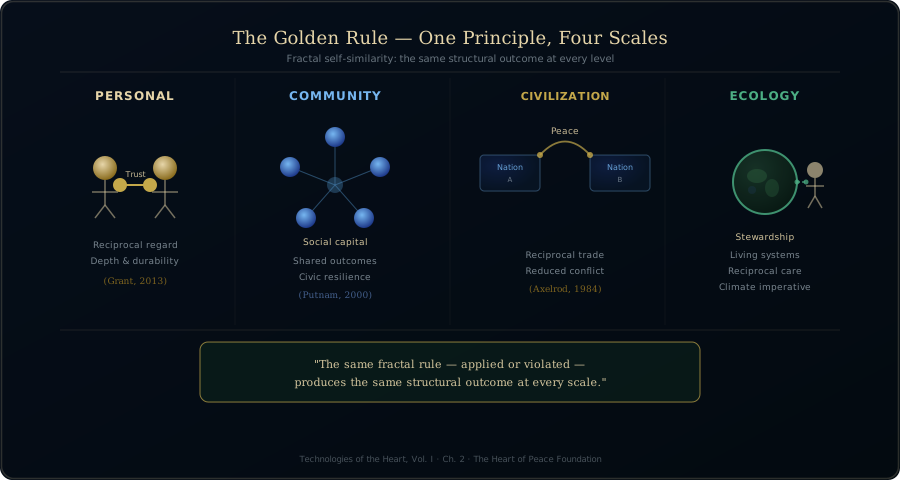
At the scale of two people: A relationship organized around treating each other as one would want to be treated generates the trust that makes depth and durability possible. This is not merely a description of friendship — it is the description of friendship's structural condition. Without reciprocal regard, what looks like relationship is actually a temporary alignment of interests, vulnerable to dissolution the moment those interests diverge. With reciprocal regard, the relationship can survive divergence because the parties have committed to something that transcends the immediate transaction.
At the scale of an organization: Adam Grant's research at the Wharton School, detailed in Give and Take (2013), documents the organizational scale of the fractal with empirical precision. In virtually every field he studied — medicine, engineering, sales, law — the highest long-term performers were what he calls "Givers": people whose default orientation is to offer more than they take. Givers initially appear to sacrifice short-term advantage. But over time — and this is the fractal insight — the pattern of reciprocal regard they establish attracts collaboration, generates trust, builds reputation, and creates conditions in which others invest in their success. The Golden Rule, at organizational scale, is not merely ethically preferable. It is operationally superior over any time horizon long enough to matter.
At the scale of communities: Robert Putnam's thirty-year research project into civic life, culminating in Bowling Alone (2000) and Better Together (2003), documented what he called "social capital" — the networks of trust, reciprocity, and mutual obligation that determine a community's capacity for collective action. Societies where what Putnam calls "generalized reciprocity" is strong — the willingness to extend the Golden Rule not just to people we know but to strangers, to the community as a whole — show measurably superior outcomes across every significant dimension: faster economic recovery from shocks, longer individual lifespans, higher educational achievement across all socioeconomic brackets, more effective democratic governance, and greater innovative output. The Golden Rule at community scale is not a moral luxury. It is what determines whether a community can hold itself together under pressure.
At the scale of nations: International trade relationships built on the principle of reciprocal benefit — what the economist David Ricardo called comparative advantage — have produced longer periods of peace between their participants than any alternative arrangement. The postwar international order was an imperfect attempt to institutionalize this principle: countries that commit to reciprocal trade rules, mutual legal obligation, and the norm of treating other nations' interests as real (not merely instrumental) have, in general, fought one another less. The Golden Rule at civilizational scale is the foundation of peace — not because nations are altruistic, but because reciprocal cooperation is computationally optimal, as Axelrod showed, and because the costs of sustained mutual defection exceed the costs of genuine reciprocal investment.
At the ecological scale: The relationship between humanity and the living systems on which we depend is, at its deepest level, a reciprocity problem. We have been extracting from those systems without returning; treating them as resources without interests or integrity of their own; doing unto the living world what we would not want done to ourselves. The consequences — now visible across multiple dimensions of the planetary system simultaneously — are precisely what always follows when the Golden Rule is violated at sufficient scale: a system begins to fail. The ecological crisis is, among other things, the fractal consequence of the Golden Rule's violation at civilizational scale. What we do at the level of the individual relationship reproduces itself, with the same structural logic, at the level of civilization's relationship with the world.
The pattern of the Golden Rule's application and the pattern of its violation are both fractal. What is true between two people is true between two organizations, between two nations, between humanity and the living world. The same simple rule, applied or violated at any level of scale, produces the same structural outcome.
V. Cross-Cultural Lineages — East, West, Indigenous, and Beyond
The survey of the Golden Rule across traditions risks becoming a list of quotations without context — and lists of quotations are the least interesting way to encounter what these traditions were actually doing. What is more interesting, and more revealing, is to notice the differences between the formulations: where they place the emphasis, what conceptual architecture surrounds the principle in each tradition, and what each tradition understood to be at stake.
In the Confucian tradition, the Golden Rule is embedded in an elaborate understanding of social relationships. Confucius was not primarily a metaphysician. He was a social architect — someone trying to understand what structures of relationship could sustain a coherent human community in conditions of political fragmentation. The concept of shu (reciprocity) is inseparable from the concept of ren (benevolence, humaneness, the fully realized human quality). For Confucius, ren is not an inner feeling but a relational achievement — something that exists between persons, in the quality of their interactions, not inside any individual. Shu is the practice that cultivates ren: by consistently treating others as you would want to be treated, you participate in the emergence of humaneness in the space between people. The Golden Rule, in the Confucian tradition, is not merely individual ethics. It is the practice by which the social fabric is woven.
The Buddhist tradition approaches the Golden Rule through a distinctive metaphysical lens. The First Precept — non-harming, ahimsa — is the foundational ethical principle, and the Golden Rule is its operational method: how do you know what causes harm? You imagine what would cause harm to you and extend that knowledge to all beings. But the Buddhist framework adds a layer that the purely social analysis does not include: the recognition that the self whose interests are being extended is itself a construction. The Buddhist teaching of anatta (non-self) does not mean that there is no experience — it means that the seemingly solid, separate self that experiences is a process, not a substance, and that the sense of fundamental separation from others is, at some level, a misperception. The Golden Rule, in this context, is not just good social policy. It is the ethical expression of a more accurate perception of what we actually are.
The Hindu tradition offers perhaps the most explicit statement of the Golden Rule as cosmic principle. The Mahabharata's Anushasan Parva contains the verse: "Treat others as you treat yourself." But this is embedded in a cosmological framework in which dharma — the right order of things — operates at every scale simultaneously: the right order of the cosmos, the right order of society, the right order of the individual life. The Golden Rule, in this context, is not merely interpersonal ethics. It is the individual's participation in cosmic order — the way in which the right action of the individual both expresses and sustains the right order of the whole.
In the Abrahamic traditions, the Golden Rule functions differently in each case. In the Hebrew tradition, as Hillel's formulation makes clear, it is understood as the generative root of law: the principle from which the entire edifice of Torah can be derived, the reason why the law takes the form it does. The prophetic tradition — Isaiah, Amos, Micah — consistently returns to reciprocal regard as the criterion of righteousness: "What does the Lord require of you but to do justice, love kindness, and walk humbly" (Micah 6:8). In the Christian tradition, Jesus's positive formulation — "Do unto others as you would have them do unto you" — is explicitly identified as the sum of the Law and the Prophets (Matthew 7:12), echoing Hillel's claim. And in Islam, the hadith of Muslim ibn al-Hajjaj records the Prophet Muhammad: "None of you has faith until he loves for his brother what he loves for himself." The word translated as "brother" (akhihu) in classical Islamic jurisprudence encompasses all human beings, not merely fellow Muslims — a scope that makes the principle universal rather than communal.
Indigenous traditions across multiple continents contain formulations of the Golden Rule that predate contact with any of the Axial Age traditions. The Sioux concept of Mitákuye Oyásʼiŋ — "all my relations" — is both a cosmological statement and an ethical principle: to recognize that all living beings are related is to recognize that the treatment of others is not separable from the treatment of oneself. The Ubuntu philosophy of Southern African cultures — umuntu ngumuntu ngabantu, "a person is a person through other persons" — contains an even more radical version of the same insight: the self is not prior to relationship but constituted by it. In this framework, the Golden Rule is not a constraint on a pre-social individual. It is a description of how the individual actually comes into being.
What is striking, surveying these traditions, is not merely that they all contain the Golden Rule but that each tradition's formulation illuminates something the others leave implicit. The Confucian tradition makes explicit the social architecture that reciprocity builds. The Buddhist tradition makes explicit the perceptual shift that makes reciprocity natural rather than effortful. The Hindu tradition makes explicit the cosmic scale at which the principle operates. The Abrahamic traditions make explicit the generative power of the principle — its capacity to ground and organize an entire moral order. The indigenous traditions make explicit the relational ontology that the principle presupposes — the understanding that the self is not separate from but constituted by its relations.
Together, they do not contradict each other. They describe the same phenomenon from different angles, and the overlapping testimony is among the strongest available evidence that what these traditions were pointing at was real.
VI. Philosophical and Spiritual Depth — The Metaphysics of Reciprocity
The deepest question about the Golden Rule is not why it works — Axelrod has answered that with mathematical precision — but why it was discovered so consistently, so urgently, by so many different contemplative and philosophical traditions working in conditions of historical crisis.
The traditions themselves suggest an answer: the Golden Rule is not arbitrary moral advice. It is a description of reality. It reflects the actual structure of what we are.
Immanuel Kant's Categorical Imperative — act only according to maxims you could will to be universal laws — is a philosophical re-derivation of the Golden Rule from pure reason rather than empirical observation. Kant's argument is not that we should be nice to each other. It is that any maxim of action that cannot survive universalization (the test of whether you would want it applied to yourself) contains a self-contradiction. The Golden Rule, in this analysis, is not an external moral requirement but the logical consequence of consistent rational agency. To act against the Golden Rule is not just to be unkind. It is to be incoherent.
John Rawls, in A Theory of Justice (1971), reconstructed the Golden Rule at the level of political philosophy through the concept of the "veil of ignorance": design social institutions as though you did not know what position in that society you would occupy. Rawls was not making a sentimental argument. He was making a rational one: the only way to design institutions that are genuinely just is to apply the Golden Rule at systemic scale — to ask, for every institutional arrangement, whether you would endorse it if you did not know whether you would be its beneficiary or its victim.
Martin Buber's philosophy of encounter, developed in I and Thou (1923), approaches the metaphysical dimension from a different direction. Buber distinguished between "I-It" relationships, in which the other is encountered as an object or instrument, and "I-Thou" relationships, in which the other is encountered as a genuine subject — as another center of experience, worthy of recognition in its own right. The Golden Rule, in Buber's framework, is the practical expression of the I-Thou orientation: to treat the other as I would want to be treated is to recognize the other as a Thou, not an It. Buber's contribution is to make explicit what the Golden Rule presupposes: a specific quality of perception — what he calls "inclusion," the genuine imaginative inhabiting of the other's experience — without which the principle becomes merely formal.
At the deepest level, the philosophical traditions that have engaged most seriously with the Golden Rule have consistently found themselves pointing past ethics into ontology — past the question of how we should act into the question of what we actually are.
The Buddhist tradition's analysis of anatta (non-self) suggests that the sense of being a separate, autonomous individual — with interests fundamentally independent of and potentially opposed to those of others — is a perceptual construction rather than an accurate description of reality. The Advaita Vedanta tradition in Hinduism makes this claim in its most radical form: Atman (the individual self) and Brahman (the ground of all being) are not-two. The apparent separation between self and other is the fundamental misperception that the tradition's practices are designed to dissolve. The mystical traditions of the Abrahamic religions — Kabbalah, Sufism, Christian mysticism — arrive at structurally similar claims through different conceptual vocabularies.
What these traditions converge on is a claim that the neuroscience of mirror neurons is now, in a more modest way, confirming: the boundary between self and other is not as fixed as ordinary experience suggests. The neural enactment of another's experience that Rizzolatti's research documents is not a metaphor for connection — it is a literal description of what the nervous system does. We do not merely observe others from behind a window of separateness. We resonate with them at the level of neural firing.
When we do unto others as we would have them do unto us, we are — at this deeper level — doing unto a being who is not as separate from us as our ordinary perception suggests. The Golden Rule is not a guideline for the management of our separateness. It is an invitation to perceive more accurately — to discover that the separateness which makes the Rule feel like sacrifice is less complete than we imagined. And in the traditions that have practiced this most deeply, the insight is consistent: when the perception of separation dissolves even partially, the Rule ceases to feel like constraint and begins to feel like description. Not I should treat others as I would want to be treated, but of course I treat others as I would want to be treated, because what happens to them is not separate from what happens to me.
VII. Practical Application — The Daily Practice of the Rule
The Golden Rule does not require philosophical enlightenment to practice. It requires only a moment of genuine imagination — what Martin Buber called "inclusion," the act of genuinely inhabiting the full reality of another person's experience from within, not merely observing it from without.
This is not complicated. What makes it difficult is not its complexity but the pervasive bias of self-referential attention — the tendency, reinforced by every ambient cultural message, to treat our own experience as primary and others' experience as secondary. The practice of the Golden Rule is, fundamentally, a practice of attention: turning the same quality of attention we normally give to our own experience toward the experience of another.
The practical technologies of reciprocal regard:
The Three-Second Pause. Before speaking, before sending the email, before making the decision — pause long enough to ask: how would I experience this if I were on the receiving end? Not abstractly or defensively, but with genuine imaginative effort. In this person's position, with their history, their sensitivities, their hopes, their fears — how does this land? Three seconds. It changes everything.
The Bilateral Interest Map. In conflict, the Golden Rule does not mean giving the other person what they want. It means treating the other person's interests as though they were as real and as legitimate as your own — because they are. This requires identifying, as specifically as possible, what each party actually needs: not their stated position, but the interest behind the position. The resolution that treats both sets of interests as real is almost always available; the resolution that treats only one set as real is almost always unstable.
The Rawlsian Leadership Test. In leadership — whether of an organization, a family, a community, or a civic institution — the Golden Rule asks: would I endorse these practices if I did not know whether I would be the leader or the led? What transparency would I want? What respect? What genuine consideration of my perspective and welfare? Leadership organized around this question consistently outperforms leadership organized around hierarchy and control, for reasons that Axelrod's analysis makes precise: people cooperate more fully with leaders they trust, and trust is generated by the consistent practice of reciprocal regard.
The Veil of Ignorance in Policy. In civic life and policy design, the Golden Rule takes Rawls's form: advocate for systems you would want to be born into, not knowing what position in those systems you would occupy. This is not utopianism. It is the practical test for whether a proposed arrangement is genuinely just or merely advantageous to those with the power to design it.
The Forgiveness Protocol. Tit-for-Tat's most counterintuitive property — and perhaps its most important — is its forgiving quality. It does not carry grudges beyond the next move. When the other party returns to cooperative behavior, Tit-for-Tat immediately resumes cooperation. Applied in human relationships, this translates to what every contemplative tradition recommends: the willingness to return to reciprocal regard after violation, not because the violation didn't happen, but because sustained mutual defection serves neither party and closes the possibility of repair.
Try This Today
Choose one relationship — professional, personal, or civic — in which you are currently navigating a tension. Write down, in as much detail as you can, how the situation looks and feels from the other person's position. Not your interpretation of how it looks to them. Their experience, as close as you can honestly imagine it. What do they fear? What are they trying to protect? What do they most need to hear? What would it mean for them for this to go well?
Then ask: what would I offer them, knowing this? The answer, in most cases, will be both clearer and more generous than what you were offering before.
This is not weakness. It is the most effective move available, and Axelrod's research makes that precise: the strategy that begins with generosity, responds proportionally, forgives readily, and continues — consistently outperforms every alternative over any time horizon long enough to matter.
VIII. The Maslow Compass and the Golden Rule
The Maslow Compass maps the seven dimensions of being described in Chapter 8 of this series — a living hourglass of human flourishing from physical safety through self-transcendence, with Purpose as the heart pivot. Among those dimensions, the relational dimension — the capacity for genuine connection, for treating others as full subjects rather than objects, for inhabiting shared experience — is, in a precise sense, where the Golden Rule lives. And the Maslow Compass illuminates something about the Golden Rule that the ethical analysis alone cannot reach: the distinction between practicing the Rule from fullness and practicing it from fear.
The Maslow Compass works with what the hourglass framework calls "directionality" — whether a person's energy in any given dimension is moving upward (generative, nourishing, alive) or downward (depleting, reactive, contracted). In the relational dimension, the distinction maps directly onto a fundamental question about the quality of one's reciprocity: is it being offered from genuine regard, or is it being performed from social calculation? Both look like the Golden Rule from the outside. A person who treats others well because they genuinely care about others' experience, and a person who treats others well because they are managing their reputation, can produce identical observable behavior. But the internal orientation is different — and over time, the difference in outcome is dramatic.
What the Compass reveals is that genuine reciprocity — the Golden Rule practiced from what the hourglass calls upward flow — is approach-motivated. It is energized by genuine interest in the other, by real curiosity about their experience, by the pleasure of mutual regard. It generates rather than depletes. Transactional reciprocity — the Golden Rule practiced from downward flow — is avoidance-motivated. It is driven by fear of social consequences, by the need to maintain a reputation, by anxiety about what happens if the Rule is violated. It depletes because it is organized around managing threat rather than engaging possibility. The Maslow Compass, used as a daily check-in, creates the conditions for noticing which orientation is active — not as a judgment, but as information. Because the most important move, when transactional reciprocity is operating, is not to redouble the effort but to ask what is actually needed: what is the relational dimension contracted around, and what would nourish it toward genuine engagement rather than managed performance?
When this inquiry is practiced consistently — when the Compass's daily check-in shifts the question from how am I performing the Rule? to what am I actually bringing to my encounters with others? — something subtle and consequential happens to the texture of one's experience. The field of relationship begins to feel less like a surface to be carefully managed and more like a living medium that responds to the quality of attention brought to it. The Axial Age teachers understood this not as moral achievement but as perceptual shift: when we stop performing reciprocal regard and begin actually inhabiting the perspective of the other, the Rule ceases to be an imposition on the self and becomes, instead, its natural expression. The Compass does not enforce this shift. It creates the conditions — through honest reflection, through the gentle discipline of daily attention — in which it can occur organically, over time, in the ordinary texture of lived relationship.
IX. Integration with the Technologies of the Heart
The Golden Rule does not stand alone in this series. It is the architectural center — the structural principle around which the other nine technologies organize themselves. Understanding how the Rule relates to each chapter reveals something important: not that each chapter is about reciprocity, but that the Golden Rule is the underlying pattern that each chapter's specific technology expresses at a different scale or dimension.
Chapter 1 — The Art and Science of Generosity: Generosity is the Golden Rule in action — the act by which we choose to treat another's need as we would want our own treated. Chapter 1 explores the biological and social mechanics of generosity: why it evolved, how it works in the brain, what it builds in communities. The Golden Rule is the ethical articulation of what Chapter 1 describes mechanically: the first move is always an offer, not a demand.
Chapter 3 — Paying It Forward: Paying it forward is the Golden Rule extended through time — treating strangers as we would want future strangers to treat us. The temporal extension of reciprocity breaks the transactional logic entirely: you cannot "pay back" the person who helped you, but you can participate in the same field of generosity by extending it forward. Chapter 3 explores how this temporal extension builds social infrastructure across generations — the invisible web of reciprocal obligation that makes civilizations possible.
Chapter 4 — Collaboration: Collaboration is the Golden Rule operating within a shared creative space. When two or more people work toward a convergent purpose, the quality of their collaboration — whether it is characterized by mutual respect, genuine curiosity about each other's perspective, and the willingness to treat each other's contributions as real — is determined by the degree to which each party practices reciprocal regard. The geometry of flourishing in Chapter 4 is built on the structural foundation of the Rule.
Chapter 5 — Compassion: Compassion is the felt experience of the Golden Rule — the moment we stop merely modeling the other's experience and begin inhabiting it. Chapter 5 explores the neurological and relational mechanics of compassion: how it is cultivated, how it differs from sympathy, how it changes what is possible in encounter. The Rule prescribes the behavior; compassion is what happens when the behavior becomes genuine rather than performed, when the imaginative act of inhabiting the other's experience becomes something more than imagination.
Chapter 6 — Oneness: The Golden Rule points toward the recognition that makes it effortless. Chapter 6 explores what the contemplative traditions call oneness — the direct recognition that the boundary between self and other is less fixed than ordinary experience suggests. When this recognition is stable, the Rule is not a command but a description: of course I treat others as I would want to be treated, because what happens to them is, in some sense, happening to me. Oneness is not the prerequisite for practicing the Rule. It is what consistent practice of the Rule, in the deepest traditions, reveals.
Chapter 7 — The Toroidal Economy: The toroidal circulation of wealth — the economic model explored in Chapter 7 — is sustained by the Golden Rule applied at economic scale. What you give into the field eventually returns; what you extract without returning eventually collapses the field. The toroidal economy is not just a model of economic justice. It is the Golden Rule rendered as the operating principle of a self-sustaining economic system.
Chapter 8 — The Hourglass of Being: The Golden Rule is the relational expression of the heart pivot in the hourglass — the moment where inner development and outer expression meet in reciprocal regard. As Chapter 8 explores, the movement from inner development (ascending the lower pyramid) to outer expression (descending the upper pyramid) requires a pivot that is, in its essence, the Golden Rule: a willingness to let what has been gathered in solitude become gift in community. The quality of that pivot — whether it is performed out of obligation or offered from genuine fullness — determines the quality of what flows.
Chapter 9 — Intention, Motivation, and Purpose (IMP): The quality of how we practice the Golden Rule — the intention behind the reciprocity — determines whether it is a technology of liberation or a system of social calculation. Chapter 9 explores the inner architecture of motivation: why we do what we do, and how the difference between approach motivation and avoidance motivation transforms the same behavior. The Golden Rule practiced from approach motivation — genuine care, curiosity, and delight in the other's flourishing — is qualitatively different from the Golden Rule practiced from avoidance motivation, even when the observable behavior is identical.
Chapter 10 — The Generosity Standard: The Generosity Standard — explored in the final chapter of this series — is the monetary expression of the Golden Rule: every currency rests on the willingness to extend value before receiving it, to trust that the field will return what is given into it. The Generosity Standard is the Golden Rule scaled to the architecture of an economic system — and its viability depends on exactly the same conditions that make Tit-for-Tat viable: enough participants, over a long enough time horizon, practicing reciprocal regard consistently enough that the cooperative equilibrium becomes self-sustaining.
Why This Matters Now
We live in an era of increasing fragmentation — of political polarization, of digital tribalism, of the erosion of the shared civic spaces where the habit of reciprocal regard was once cultivated. The costs of this fragmentation are visible at every scale: in institutions that cannot hold, in communities that cannot cooperate, in international systems buckling under the weight of their own contradictions.
The Golden Rule is not a retreat into sentimentality. It is the most practically sophisticated organizing principle available to human systems that want to survive their own complexity. Axelrod's tournaments showed that the most successful long-term strategy is also, at its core, the most ethical one. This is not a paradox. It is what the Axial Age teachers understood and what the science is now confirming.
Civilizations do not fail because of a shortage of intelligence or resources. They fail when the web of reciprocal obligation that holds them together becomes thin enough to tear. And they flourish when enough of their members, enough of their institutions, enough of their habits of relation are organized around the oldest and most reliable principle available: Treat others as you would want to be treated.
X. Conclusion — Shu
One spring morning in ancient China — the exact date lost to history, but the context preserved in the Analects — a student named Tsang approached Confucius and asked for a single word that could guide a person's entire life. It was not a casual question. It was the kind of question that a student asks when they have grasped that the complexity of moral learning is threatening to overwhelm the coherence of practice — when the accumulation of principle is in danger of becoming confusion.
Confucius replied: "Is it not shu — reciprocity? What you do not want done to yourself, do not do to others."
The student went away with one word. Two and a half thousand years later, in a computer laboratory at the University of Michigan, Robert Axelrod ran a tournament that would involve game theorists from around the world, sixty-two competing strategies, millions of iterations of the Prisoner's Dilemma, and the full analytical apparatus of modern social science — and the winner was the simplest strategy submitted: a program that cooperated first, responded proportionally, forgave readily, and continued. A program, in other words, that formalized exactly the principle Confucius had given to the student with a single word.
Shu survived two and a half millennia not because it was protected by authority or preserved by tradition alone, but because it kept working. Every community that applied it consistently found that it worked. Every leader who organized their governance around it found that it produced more stable and more flourishing outcomes than the alternatives. Every relationship in which it was practiced found that it generated the trust without which depth is impossible. The principle outlasted every civilization that discovered it because it is not the product of any civilization. It is a description of how human cooperative systems actually function.
What Confucius gave the student was not comfort. He gave him a tool — a precise, deployable, testable technology for navigating the full complexity of human social life. The student who received it was in the same position as the student who receives any powerful tool: he had to practice it, test it, fail with it, refine his understanding, and practice again. He would, in applying it imperfectly and persistently, discover for himself what Axelrod would later demonstrate mathematically: that this approach, over time, outperforms every alternative, not because the world is fair but because cooperation, consistently offered and consistently maintained, generates the conditions under which the world can become more fair.
We return, at the end, to Hillel on one foot. The skeptic's challenge was that the Torah — the entire accumulated moral inheritance of a civilization — was too complex to be summarized. Hillel's answer was that it was not too complex but too simple: the whole of it was generated by a single seed principle, and what looked like complexity was elaboration on a theme so fundamental that you could stand on one foot and say it. The rest — all of it — was commentary. Go and learn it.
Shu. Reciprocity. Treat others as you would be treated. It is the shortest distance between where we are and the world we are trying to build — and it is open, always, at the next step you take.
Next Steps
Continue reading: Chapter 3 — Paying It Forward →
Discover how generosity moves through time — how a single act of giving, passed forward rather than back, builds the social infrastructure that sustains civilizations. The Golden Rule extended through time is the technology by which communities invest in strangers they will never meet — and it is the foundation of every civilization that has ever lasted.
Return to the series overview: Technologies of the Heart
Related Articles
- Chapter 1: The Art and Science of Generosity — The biological, social, and spiritual technology from which the Golden Rule emerges as the natural operating principle
- Chapter 3: Paying It Forward — The Social Technology of Transformation — How the Golden Rule moves forward through time and builds the invisible infrastructure of civilization
- Chapter 4: Collaboration — The Geometry of Flourishing — When the Golden Rule operates within a shared creative purpose
- Chapter 6: The Technology of Oneness — The recognition that makes the Golden Rule effortless rather than effortful
- Chapter 7: The Toroidal Economy — The Golden Rule scaled to the architecture of economic circulation
- Chapter 8: The Hourglass of Being — The structural model in which the Golden Rule is the relational pivot
- Technologies of the Heart — Series Overview — All ten chapters in context
- Our Programs — How THOPF Practices the Golden Rule — Community programs built on reciprocal care
FAQ
What is the Golden Rule and where does it come from?
The Golden Rule — "treat others as you would want to be treated" — is the most widely shared ethical principle in human history, appearing in every major world religion and philosophical tradition. Its origins are not singular: it was discovered independently in at least five major civilizations during the period historians call the Axial Age (roughly 800–200 BCE), including China (Confucius, c. 500 BCE), India (the Jain and Hindu traditions), the Middle East (Hillel the Elder, c. 30 BCE; the Hebrew prophets), and Greece (Socrates, Aristotle). The historian Karen Armstrong has documented this simultaneous independent emergence in her landmark work The Great Transformation (2006), concluding that these were not separate inventions but separate discoveries of the same underlying moral law.
Is the Golden Rule found in all religions and cultures?
Remarkably, yes. Every major world religion contains a formulation of the Golden Rule: Judaism (Hillel: "What is hateful to you, do not do to your neighbor"), Christianity (Jesus: "Do unto others as you would have them do unto you"), Islam (Muhammad: "None of you has faith until he loves for his brother what he loves for himself"), Hinduism (the Mahabharata: "This is the sum of duty: do not do to others what would cause pain if done to you"), Buddhism (Udanavarga: "Hurt not others in ways that you yourself would find hurtful"), and Zoroastrianism, Confucianism, Jainism, and Taoism among others. Indigenous traditions across multiple continents contain equivalent principles — the Sioux concept of Mitákuye Oyásʼiŋ (all my relations) and the Ubuntu philosophy of Southern Africa (a person is a person through other persons) are among the most notable. Jonathan Haidt's cross-cultural moral psychology research confirms that fairness and reciprocity is one of the universal moral foundations found across all studied human cultures.
What does science say about the Golden Rule?
Three distinct scientific traditions converge on the same conclusion. Evolutionary biology (Robert Trivers, 1971) demonstrates that reciprocal altruism is an evolved survival strategy that operates wherever social animals interact repeatedly and can recognize one another. Game theory (Robert Axelrod, 1984) proves mathematically that Tit-for-Tat — a direct formalization of the Golden Rule — outperforms every known alternative strategy in iterated cooperation scenarios. And neuroscience (Giacomo Rizzolatti, Vittorio Gallese, Jean Decety) has discovered mirror neuron systems that cause the brain to literally enact observed experiences, providing a neural substrate for the empathy on which the Golden Rule depends. Martin Nowak's 2006 synthesis in Science identified five mechanisms through which cooperation evolves — and all five are variants of the Golden Rule operating at different scales.
Why does treating others as you want to be treated actually work?
It works for reasons that are structural, not merely moral. Axelrod's analysis identifies four properties of Tit-for-Tat — the mathematical formalization of the Golden Rule — that account for its consistent success: it is "nice" (never defects first, so it never initiates exploitation), "retaliatory" (responds proportionally to defection, making exploitation unprofitable), "forgiving" (returns to cooperation immediately when the other party does, ending costly cycles of mutual defection), and "clear" (legible enough for others to model and respond to, which stabilizes the cooperative equilibrium). Communities that consistently practice the Golden Rule — what Robert Putnam calls "generalized reciprocity" — show measurably superior outcomes across economic resilience, health, education, governance, and innovation. The Rule works because it is the description of how cooperative human systems actually function, not a moral ideal imposed on a non-cooperative reality.
What are the limits of the Golden Rule?
The most serious limitation is the assumption of shared preferences: "treat others as you would want to be treated" presupposes that what you want is what others want, which is not always true. The philosopher Milton Bennett called this the "Platinum Rule" problem — in multicultural contexts, it may be more accurate to treat others as they want to be treated rather than as you would want to be treated. A deeper limitation is that the Rule says nothing about how to act when one party is consistently unreciprocating — Tit-for-Tat handles this by responding proportionally, but in practice, knowing when to continue offering and when to protect oneself from systematic exploitation requires judgment that the Rule alone cannot supply. Finally, the Rule's application to non-human systems — ecosystems, future generations, beings incapable of reciprocating — requires extensions beyond the original principle that the ecological and inter-generational thinkers in this series address.
What is Axelrod's Tit-for-Tat and why did it win?
Tit-for-Tat is a strategy for the iterated Prisoner's Dilemma — a game that formalizes the structure of real-world cooperation dilemmas — submitted by the game theorist Anatol Rapoport to Robert Axelrod's 1980 computer tournament. Its complete logic: cooperate on the first move, then on every subsequent move do whatever your partner did on the last move. It won Axelrod's first tournament, and then won a second tournament run with sixty-two strategies after participants had been informed that Tit-for-Tat had won the first. It won not despite its simplicity but because of four specific properties Axelrod identified: it was the "nicest" strategy (never defected first), it was consistently retaliatory (making exploitation unprofitable), it was maximally forgiving (returning immediately to cooperation), and it was transparent (easily modeled by others). These properties together make it the computationally optimal strategy for any social environment in which interactions repeat and parties can recognize each other — which is the structure of virtually all significant human relationships.
How is the Golden Rule different from reciprocity?
Reciprocity is the broader category; the Golden Rule is its most specific and powerful expression. Reciprocity simply means exchanging — giving and receiving in roughly equal measure. The Golden Rule adds a direction and a quality to this exchange: begin with what you would want returned, rather than waiting to be treated well before you treat others well. The critical difference is the first move. Reciprocity can operate reactively — I respond to what I receive. The Golden Rule operates proactively — I offer what I would want to receive, without waiting to see whether it will be returned. This first-move generosity is precisely what makes Tit-for-Tat so effective: it establishes the cooperative norm rather than waiting for the other party to establish it. Adam Grant's research in Give and Take (2013) documents this distinction empirically: "Givers" — those who default to offering before receiving — produce dramatically better long-term outcomes than "Matchers" (strict reciprocators) or "Takers" (those who take before they give).
Further Reading
- Karen Armstrong — The Great Transformation (2006) — The definitive historical account of the Axial Age and the simultaneous independent discovery of the Golden Rule across five civilizations; Armstrong's most sustained engagement with the principle that she has called "the most important moral discovery in human history"
- Robert Axelrod — The Evolution of Cooperation (1984) — The landmark work documenting why Tit-for-Tat — the formalization of the Golden Rule — outperforms all known alternatives in iterated cooperation games; the mathematical proof of what the Axial Age teachers understood by other means
- Robert Trivers — "The Evolution of Reciprocal Altruism" (1971, Quarterly Review of Biology) — The foundational evolutionary biology paper explaining why behavior that benefits others at cost to the actor can evolve through natural selection, providing the biological basis for the Golden Rule's universality
- Robert Putnam — Bowling Alone: The Collapse and Revival of American Community (2000) — The authoritative thirty-year study of what happens to communities when the norm of reciprocal trust erodes; the data on what the Golden Rule's absence costs at community scale
- Adam Grant — Give and Take: Why Helping Others Drives Our Success (2013, Wharton School) — Empirical documentation that the Golden Rule is the most effective long-term professional strategy; the organizational-scale data supporting what evolutionary biology predicts
- Martin Nowak — "Five Rules for the Evolution of Cooperation" (2006, Science) — The synthesis paper identifying five mechanisms through which cooperation evolves, all of which are variants of the Golden Rule at different scales; the most comprehensive overview of the science of reciprocity
- Jonathan Haidt — The Righteous Mind: Why Good People Are Divided by Politics and Religion (2012) — Documents fairness/reciprocity as a universal moral foundation present across all studied cultures; the cross-cultural psychology evidence for the Golden Rule's universality
- Martin Buber — I and Thou (1923, translated Walter Kaufmann, 1970) — The philosophical foundation for understanding what genuine reciprocal regard requires at the level of perception; Buber's concept of "inclusion" as the act of genuinely inhabiting another's experience
Glossary
Axial Age: The period roughly 800–200 BCE during which foundational ethical principles — including the Golden Rule — emerged independently in multiple civilizations: China (Confucius, Laozi), India (the Buddha, Jain teachers, authors of the Upanishads), the Middle East (the Hebrew prophets, Zoroastrian teachers), and Greece (Socrates, Plato, Aristotle). The philosopher Karl Jaspers coined the term in 1949; Karen Armstrong's The Great Transformation (2006) provides the definitive account. The convergence of these traditions on the Golden Rule, without evidence of cross-cultural contact, is among the strongest available evidence that the principle describes something structurally true rather than culturally invented.
Tit-for-Tat: The game-theoretic strategy submitted by Anatol Rapoport to Robert Axelrod's 1980 iterated Prisoner's Dilemma tournament: cooperate first, then mirror the other party's previous move. Proven by Axelrod to outperform every alternative in iterated cooperation scenarios across two successive tournaments. Its four key properties — niceness (never defects first), retaliation (responds proportionally to defection), forgiveness (returns to cooperation immediately), and clarity (simple enough for others to model) — constitute the formal mathematical expression of the Golden Rule's operating logic.
Reciprocal Altruism: The evolutionary mechanism described by Robert Trivers in his landmark 1971 paper in the Quarterly Review of Biology, explaining how apparently altruistic behavior — helping others at cost to oneself — can evolve through natural selection when parties interact repeatedly and can recognize one another. Reciprocal altruism is the biological foundation on which the Golden Rule's effectiveness is built: the mechanism explains not only why it is ethically appealing but why evolution selected for the neural and behavioral capacities that make it possible.
Mirror Neurons: A class of neurons discovered by Giacomo Rizzolatti and colleagues at the University of Parma in 1996 that fire identically when an action is performed and when the same action is observed in another. Subsequently confirmed in humans and extensively studied by researchers including Vittorio Gallese and Jean Decety. Mirror neurons provide the neural substrate for empathy — the capacity to resonate with another's experience rather than merely observe it — and constitute the biological basis for the Golden Rule's claim that the boundary between self and other is more permeable than ordinary experience suggests.
Fractal Law: A principle, derived from Benoit Mandelbrot's 1975 mathematical framework for self-similar structures, that produces the same structural output at every scale of application. The term is used in this article to describe the Golden Rule's property of generating the same structural outcomes — cooperative surplus, trust, resilience — at every scale of human social organization, from the dyadic relationship to civilizational systems. The violation of a fractal law produces correspondingly self-similar failures at every scale where the violation occurs.
Shu (恕): The Chinese concept of reciprocity, central to Confucian ethics. When asked by a student for a single word that could guide an entire life, Confucius answered: shu. The character combines the radicals for "like" (如) and "heart" (心) — "like-hearted," the capacity to align one's heart with the heart of another. In the Confucian framework, shu is not merely a rule of behavior but a relational practice through which ren (humaneness, the fully realized human quality) is cultivated and expressed.
The Heart of Peace Foundation cultivates compassion, generosity, and human flourishing through mindfulness, community nourishment, and spiritual growth. Explore our programs or get involved to bring these technologies into your community.