Paying It Forward
Technologies of the Heart — Volume I, Chapter 3
Part of the Technologies of the Heart series | The Heart of Peace Foundation
← Chapter 2 — The Golden Rule as a Fractal Law | Next: Chapter 4 — Collaboration: The Geometry of Flourishing →
In 1989, a woman named Ann Herbert scrawled three words on a placemat in a California diner: "Practice random kindness and senseless acts of beauty." She was not addressing anyone in particular. She had no platform, no theory, no system for tracking what she was releasing into the world. A stranger saw it, wrote it down, passed it to someone else. It appeared in a local paper, then in a column in Reader's Digest, then on bumper stickers and refrigerator magnets and motivational posters in schools and hospitals and prison chaplains' offices. Within five years, it had circled the globe.
Ann Herbert did not know any of the people whose lives were touched by those words. She asked for no credit. She built no mechanism for tracing the gift's path. She simply released something into the world — a phrase, a permission, an invitation — and trusted the world to carry it forward.
The words themselves describe what they enacted. They moved forward through strangers. They never returned to their source. They became someone else's gift to someone else entirely, and then again and again, in variations Ann Herbert never imagined, in languages she perhaps never spoke, into rooms she would never enter. By the time those words reached the diner in Wyoming or the schoolroom in São Paulo or the recovery group meeting in Dublin, they were no longer Ann Herbert's words. They belonged to the chain.
This is the essential structure of paying it forward — and it is older, stranger, more powerful, and more necessary than the familiar phrase suggests. To understand why, we need to go further back than 1989. We need to go to the origin of the human tendency to extend generosity forward rather than returning it to its source — back through the sociological literature that formalized what communities already knew, back through anthropological fieldwork in the Pacific and the Arctic and the Northwest Coast of North America, back through the philosophical traditions that saw in gift-giving a cosmological principle rather than merely a social custom. And then we need to come forward again into the laboratories and field studies of contemporary social science, where researchers have begun to measure what the gift-givers of every previous century already understood: that the forward direction of generosity is not just a moral preference. It is an engineering principle. It is, in the deepest sense, how civilizations are built.
What this article reveals:
- Paying it forward — generalized reciprocity — is structurally different from direct reciprocity and produces stronger communities, more resilient networks, and greater long-term wellbeing; the difference is not one of degree but of kind
- A single act of forward generosity propagates through at least three degrees of social separation — reaching, according to research by Nicholas Christakis and James Fowler at Harvard, up to 1,000 people per act — not as metaphor but as measured social network effect
- Adam Grant's research at Wharton, surveying over 30,000 professionals, found that those who give to the system rather than to individuals in direct exchange consistently produce the greatest long-term value — while the givers who burn out are those giving from depletion rather than abundance
- Marcel Mauss documented in 1925 that gift economies preceded market economies by tens of thousands of years and still perform a social function the market structurally cannot: creating the felt sense of being genuinely held by something larger than the self
- Elinor Ostrom, Nobel laureate in Economics, found that communities managing shared resources sustainably for centuries without privatization or government control share a single critical mechanism: reciprocal obligation extended forward to the community as a whole
- Paying it forward is not a soft add-on to economic life — it is the foundational layer of social trust on which all other economic activity depends; Robert Putnam's research links generalized social trust directly to economic performance, health outcomes, educational attainment, and civic engagement across US states
- The Maslow Compass reveals whether our giving flows from abundance — B-motivation, the natural overflow of a full vessel — or from obligation — D-motivation, the performance of virtue from an empty one; only the first sustains both giver and receiver over time
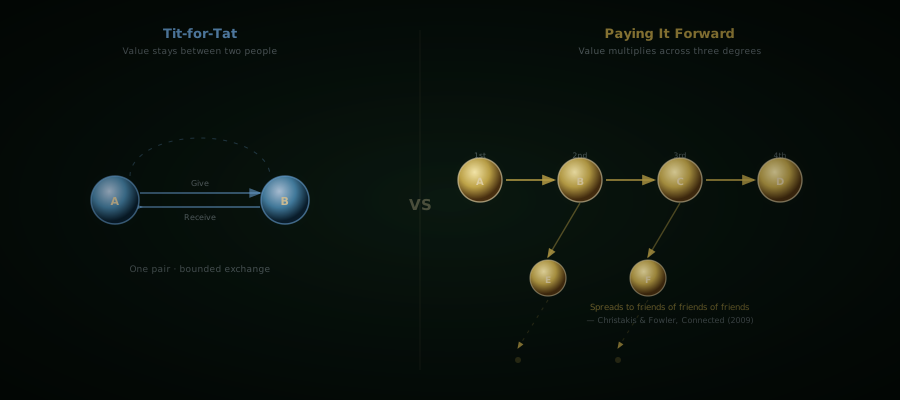 Left: value stays between two people. Right: one act multiplies across degrees of connection — reaching people the original giver will never meet.
I. Introduction — The Direction of Generosity
There are two directions in which gratitude can travel.
The first is backward: you receive a benefit and return it to the person who gave it. You repay the debt. The relationship is closed, the ledger balanced, the obligation discharged. This is the logic of the market — clean, traceable, efficient, and fundamentally static. It creates no new value. It merely circulates existing value between parties who already know one another. Bilateral reciprocity is the grammar of exchange: I give, you give back, the sentence ends. It is functional, and up to a certain scale of community, it is sufficient.
The second is forward: you receive a benefit and pass something — not necessarily the same benefit, not necessarily to the same person — to someone else. The ledger is never closed. The obligation is never discharged. Instead, it extends — outward, forward, through networks of connection that the original giver could never have mapped, touching people the original giver will never meet, creating a social current that does not diminish as it travels but can, under the right conditions, grow.
This is not a minor distinction. It is the difference between a society organized around debt and a society organized around gift. And the consequences of that organizational choice, when it plays out at scale over time, are civilizational.
To understand why, it helps to pause and examine what exactly is passing through these two structures. In direct reciprocity, what passes between people is equivalent value — this for that, approximately matched, within an approximately known timeframe. The transaction may be warm; it may occur between people who love each other deeply. But its logic is additive: the parties end where they began, with the same amount of value, just redistributed. The relationship is maintained but not deepened by the transaction itself.
In generalized reciprocity, something structurally different is passing: trust extended into the unknown. When you give forward — to someone who did not give to you, to someone who may never give back to you, to someone you may never meet again — you are not making an investment with a calculable return. You are placing trust in the system. You are saying, implicitly, I believe this community will hold me when I need to be held, so I will hold it now. This is a fundamentally different act from making a fair exchange. And its cumulative effect, as every serious researcher who has studied it has found, is the production of something for which the market has no mechanism: genuine social trust — the invisible load-bearing structure on which everything else rests.
This chapter's thesis:
The forward direction of generosity — paying it forward rather than paying it back — is the social technology that builds durable human communities, sustains civilizations through crisis, and creates the conditions under which human beings become capable of their greatest achievements. It is not a supplement to the economic system. It is its invisible foundation.
II. Historical Context — Generalized Reciprocity Through Human History
Gouldner's Foundational Discovery
The sociologist Alvin Gouldner published "The Norm of Reciprocity: A Preliminary Statement" in the American Sociological Review in 1960, and in doing so gave a name to something human communities had been practicing for far longer than the academy had been studying them. Gouldner's argument, built on a synthesis of anthropological data spanning dozens of cultures on every inhabited continent, was deceptively simple: there is embedded in virtually every human society ever studied a deep moral obligation not merely to return benefits received but to circulate them — to ensure that what enters the social system does not merely loop back to its origin but moves forward, sustaining the system as a whole.
Gouldner distinguished two dimensions of this norm. The first is the more familiar: the obligation to help those who have helped you — direct, bilateral reciprocity, the foundation of stable interpersonal relationships and the grammar of most economic exchange. The second, and the one that interested him most, is what he called generalized reciprocity: the obligation to help others in general — not the specific person who helped you, but the system of which you are a part — on the understanding that the system will, in its own time and in its own way, provide when you need it.
Gouldner's insight was that this expectation is not merely moral instruction or sentimental aspiration. It is a hardened social technology, tested over hundreds of thousands of years of human community life, and its presence or absence is one of the most reliable predictors of whether a given community will remain coherent under pressure. Communities without generalized reciprocity — communities in which every transaction is immediately and bilaterally reciprocated but nothing is passed forward into the wider social fabric — are rigid, brittle, and incapable of the distributed generosity that allows communities to absorb shocks and recover from them. When catastrophe strikes, the bilateral-exchange community finds that it has no reserves — no accumulated social trust to draw upon, no web of obligation that extends to strangers. The generalized-reciprocity community finds that it has invisible infrastructure everywhere.
Gouldner was careful to note that this norm is not equally strong in all communities, nor does it operate independently of social structure. It can be exploited by free-riders; it requires cultural maintenance through norms, stories, rituals, and social sanctions. But where it operates, it creates something no other social mechanism produces as efficiently: the capacity for strangers to help each other. And the capacity for strangers to help each other is, in the deepest sense, the capacity for a civilization to exist at all.
The Gift Before the Market — Marcel Mauss and the Deeper Economy
Marcel Mauss, the French anthropologist and nephew of Émile Durkheim, published Essai sur le don — translated into English as The Gift — in 1925, and it remains, a century later, one of the most carefully studied texts in the anthropological literature. Mauss had been puzzling over a question that seemed, on the surface, to be merely about exotic customs in distant places: why do gift-giving practices in non-market societies involve such elaborate systems of obligation, protocol, and expectation? Why is the Polynesian ceremonial gift not simply a gift — a voluntary, uncomplicated transfer of goods from one party to another? Why does it carry such elaborate social weight?
His answer changed how anthropologists and economists think about exchange itself. The gift in traditional societies, Mauss argued, is never merely the transfer of a thing. It is the creation of a relationship — and specifically, a relationship that carries obligation forward in time. The gift creates what Mauss, borrowing from Māori informants, called hau — the spirit of the gift — a kind of relational charge that clings to the gifted object and compels its circulation forward. To receive a gift is to receive an obligation. But the obligation is not to repay the giver. It is to pass the gift onward. The gift has a destination that the giver cannot specify and the recipient can only partially determine.
Mauss documented this structure across an extraordinary range of cultural contexts: the potlatch ceremonies of the Pacific Northwest Coast, where elaborate feasts served as occasions for the competitive redistribution of wealth; the kula ring of Melanesia, where valuables circulated continuously through an archipelagic network of hundreds of islands; the legal and religious gift-giving customs of ancient Rome, India, and Germanic tribal societies. In every case, he found the same underlying structure: the gift economy is not a primitive precursor to the market economy. It is a fundamentally different social technology that performs functions the market structurally cannot.
What functions? Most critically: the creation of the sense of mutual obligation, shared membership, and genuine care that makes a collection of individuals into a community. The market produces exchange partners. The gift produces members. The market creates transactional relationships. The gift creates the kind of bonds that cause people to show up for one another in difficulty, to sacrifice for one another without calculating return, to feel themselves part of something that extends beyond their individual interests. Mauss's most striking claim — and the one that has proven most durable in subsequent scholarship — is that gift economies do not disappear when market economies arrive. They retreat underground, into families, neighborhoods, voluntary associations, religious communities, and the informal networks through which most actual human care is distributed. But where they persist in a market society, they perform the same function they always have: they make people feel genuinely held. And that felt sense of being held — the subjective experience that Putnam and others have tried to measure as "social trust" — turns out to be one of the most powerful predictors of human wellbeing and collective performance that social science has found.
The Kula Ring — Gift as Infrastructure
The most elaborate single illustration of Mauss's thesis came from the fieldwork of another great early-twentieth-century anthropologist: Bronisław Malinowski, whose 1922 Argonauts of the Western Pacific documented the kula ring system of exchange across the Trobriand Islands and neighboring Melanesian archipelagos. The kula ring is, by any measure, one of the most remarkable social institutions in the ethnographic record — and one of the most instructive illustrations of what paying it forward looks like when it is elevated to the level of explicit cultural design.
The kula system operates across a ring of islands spanning hundreds of miles of open Pacific. Two types of valuables circulate through this ring in opposite directions: shell necklaces (mwali) travel clockwise from island to island; shell armbands (soulava) travel counterclockwise. The valuables have, by Western market standards, essentially zero utility. They cannot be eaten, used as tools, or converted to productive capital. They are ceremonially exchanged between trading partners across the ring, held for a time, and then passed forward again. No individual owns them permanently. No individual accumulates them as wealth in the conventional sense. The entire purpose of the kula objects is to move.
What keeps them moving? The elaborate web of relationship, obligation, reputation, and trust that their circulation creates and maintains. A kula partner who receives a valuable and holds it too long, failing to pass it forward, damages his reputation throughout the ring — not just with his immediate trading partner, but with the entire network. The ring functions because every participant understands that their role is not to accumulate but to circulate; not to be a destination but a node through which the gift passes; not to end the chain but to extend it. The kula ring is generalized reciprocity formalized as cultural institution, elevated to the level of explicit community design.
Malinowski was struck by something even more fundamental: the kula partners across the ring often traveled enormous distances through genuinely dangerous open-ocean conditions to maintain their gift relationships. The material exchange itself — the objects being passed — was not sufficient explanation for this risk. What motivated the journey was the relationship, the mutual recognition, the web of trust and obligation that the kula system maintained across hundreds of miles and dozens of communities. The kula ring was infrastructure — not material infrastructure, but social infrastructure, maintaining the web of connection and mutual regard that allowed the communities of the ring to function as a coherent civilization rather than a collection of isolated islands.
The Potlatch — Status Through Generosity
Among the Indigenous peoples of the Pacific Northwest Coast — the Haida, Tlingit, Chinook, Kwakwaka'wakw, and others — the potlatch ceremony performed a structurally similar function through a different mechanism. The potlatch was a ceremonial feast at which the hosting clan or family not only provided extraordinary food and entertainment for all guests but gave away a significant portion of its accumulated wealth — blankets, copper shields, canoes, fish oil, preserved food — to the assembled guests. The host family's status was determined not by what they accumulated but by what they gave away. The one who gave the most was the most honored. Accumulation was socially sanctioned; hoarding was not. The logic of the potlatch was the inversion of the market: wealth moved from the center to the periphery, from the powerful to the less powerful, from the present to the future, precisely because the community's shared understanding was that wealth, properly understood, is most valuable when it is in circulation.
The colonial governments of Canada and the United States, deeply uncomfortable with an economic institution that contradicted the logic of capitalist accumulation, banned the potlatch in 1885 in Canada and attempted to suppress it in the United States. Anthropologists and legal scholars have argued persuasively since then that this suppression was a form of cultural violence aimed at eliminating not just a ceremony but an entire alternative economic logic — one that had sustained sophisticated, complex civilizations for thousands of years through exactly the mechanism Mauss had identified: the forward circulation of wealth as the foundation of community cohesion.
III. The Social Science — What Adam Grant and Others Found
Givers, Takers, and the Architecture of Success
Adam Grant is a psychologist at the Wharton School of Business at the University of Pennsylvania, and his 2013 book Give and Take is perhaps the most carefully researched contemporary study of what happens to people who default to forward generosity in their professional and social lives. Grant spent years surveying and tracking more than 30,000 people across a range of industries — engineering firms, medical schools, sales organizations, financial institutions — and what he found continues to confound people when they encounter it for the first time.
Grant sorted people into three categories based on what he calls their "reciprocity styles." Takers are people who, in their professional and social interactions, tend to receive more than they give. They are often skilled at self-presentation and the extraction of value from relationships and institutions; in the short term, they frequently appear highly successful. Matchers operate on a strict norm of direct reciprocity — they give when given to and withhold when not, keeping careful mental ledgers of give-and-take. Matchers are the dominant style; most people, most of the time, in most contexts, operate as Matchers. Givers tend to contribute more than they take, often without keeping close track of whether their contributions are being returned. They ask what they can offer before asking what they can receive.
The finding that initially seems paradoxical but on reflection reveals exactly the pattern Gouldner and Mauss described: when Grant looked at the bottom performers in virtually every field he studied, they were disproportionately Givers. When they burned out, when they were exploited, when their generosity was systematically taken advantage of, the Givers who failed did so not because generosity was a losing strategy, but because they gave indiscriminately — depleting themselves without boundaries, giving from an empty vessel in the hope that emptying themselves further would eventually produce reciprocity. These are the Givers who gave backward, driven by what Maslow's later work would identify as D-motivation: the need to be needed, the performance of virtue as a response to felt inadequacy, giving from depletion rather than abundance.
But when Grant looked at the top performers in every field, they were also disproportionately Givers. Not the depleted Givers at the bottom, but what Grant calls "otherish" Givers — people who give generously and strategically, not because they are calculating returns to themselves, but because they are giving to the system. The distinction Grant draws is subtle but critical: the failing Givers give reactively, to individuals, in response to specific requests, without regard for their own sustainability. The thriving Givers give proactively, to the community, in ways that create expanding networks of reciprocity — that pay forward, in other words, into a system that will eventually support everyone including themselves.
What the top Givers are building, Grant argues, is not a personal savings account of social capital. They are building infrastructure. Every act of forward generosity they make — every time they offer help to someone who can't immediately reciprocate, every time they share information to the room rather than hoarding it, every time they spend an hour with someone who is earlier in their journey than they are — becomes part of a web of trust and obligation that eventually extends further than any individual ledger could track. This is generalized reciprocity operating in the contemporary professional context. It is the kula ring in the research university. It is the potlatch at the conference.
Grant's key meta-finding, derived from this data: generalized reciprocity to the community consistently outperforms direct reciprocity to individuals as a long-term strategy for network value creation. The person who gives back to those who gave to them is maintaining relationships. The person who gives forward to those who haven't yet is building civilization.
Robert Putnam and the Architecture of Social Capital
Robert Putnam's 2000 book Bowling Alone: The Collapse and Revival of American Community brought the concept of social capital — the network of relationships, norms, and trust that make collective action possible — into mainstream public discourse with a precision and urgency that made it impossible to ignore. Putnam and his colleagues at Harvard spent years measuring social trust and civic engagement across all fifty US states and dozens of countries, correlating these measures with economic and social outcomes. What they found was stark and, in retrospect, obvious: states and nations with higher levels of what Putnam called "generalized social trust" — the willingness to trust not just known individuals but strangers in general — showed significantly better outcomes across virtually every metric of human flourishing that the researchers could measure.
Economic performance: higher generalized trust correlates with higher GDP growth, greater innovation, and more efficient markets. Health outcomes: higher generalized trust correlates with lower mortality rates, better self-reported health, and greater healthcare access. Educational attainment: higher generalized trust correlates with better school performance at every income level. Civic engagement: higher generalized trust correlates with higher voter participation, more voluntary association membership, and more philanthropic giving.
Putnam distinguished between two types of social capital. "Bonding" capital is the trust and solidarity that operates within a specific group — family, ethnic community, religious congregation, club. Bonding capital is important and valuable; it provides the close, high-trust relationships that sustain people through personal difficulty. But bonding capital is, structurally, a form of direct reciprocity: I care for you because you are like me, because you are ours, because you belong to the network I belong to. "Bridging" capital is the trust that extends across groups — the willingness to cooperate with and for strangers, to extend the norms of fair dealing beyond the circle of the known. Bridging capital is, structurally, generalized reciprocity: I contribute to the system because I believe the system is good and because the system's flourishing will eventually include mine.
Putnam's central argument is that the health of a democracy — and, more broadly, the health of any complex human community — depends not just on bonding capital (which it tends to have in abundance) but on bridging capital (which it tends to erode over time under the pressures of market individualism, residential segregation, and the technological disaggregation of community life). The civic organizations, local institutions, and informal community norms that once maintained bridging capital — the bowling leagues whose decline gave Putnam his title — were not luxuries. They were the infrastructure of generalized trust. Their erosion was the erosion of the civilizational foundation.
The practical upshot: paying it forward is not merely a personal virtue. It is an act of civic infrastructure maintenance. Every forward act of generosity — every extension of help to a stranger, every mentorship offered, every door opened for someone who cannot yet open it themselves — is a small act of rebuilding exactly the bridging capital that Putnam identified as the load-bearing foundation of functioning democratic societies.
Elinor Ostrom and the Commons
In 2009, Elinor Ostrom became the first woman to win the Nobel Prize in Economic Sciences, for work that directly challenged one of the foundational assumptions of twentieth-century economic theory. The "tragedy of the commons" — the idea, popularized by ecologist Garrett Hardin in 1968 and widely adopted in economic theory, that any shared resource will inevitably be depleted by self-interested individuals — had been used to justify both privatization and state control as the only available solutions to the management of collective resources. Ostrom's response, documented in Governing the Commons (1990) and hundreds of subsequent papers, was to go look at what actually happened in the world rather than what economic theory predicted.
What she found in the field was extraordinary: hundreds of communities around the world had managed shared resources — forests, fisheries, irrigation systems, grazing lands — sustainably, without privatization or government control, for periods ranging from decades to centuries. Alpine communities in Switzerland had maintained shared meadows productively for 500 years. Japanese villages had managed common forests sustainably for generations. Farmers in Spain and the Philippines had maintained complex irrigation systems through collective governance for centuries. The tragedy of the commons was not universal. It was conditional.
What condition distinguished the communities that maintained their commons from those that depleted them? Ostrom identified eight design principles common to durable commons institutions, and at the core of virtually every one of them was some version of the same mechanism: reciprocal obligation extended forward to the community as a whole. The members of sustainable commons communities do not just reciprocate with individuals they personally know. They contribute to the system — the common pool, the shared resource, the collective institution — in the understanding that the system will provide for them and for others who need it. They pay it forward, institutionally and repeatedly, to a community that includes people they do not know personally and will not personally benefit from helping. This is generalized reciprocity operating at the level of collective resource management. It is the mechanism that makes the commons not a tragedy but a possibility.
Ostrom's work has implications that extend far beyond environmental resource management. Every common pool resource — and the list extends to include language, knowledge, public health, democratic institutions, social trust itself — is maintained by the same mechanism. The communities that recognize themselves as stewards of a shared inheritance, obligated to pass it forward in better condition than they received it, are the communities that sustain those resources. The communities that treat common resources as opportunities for individual extraction deplete them. This is not a moral observation. It is an empirical finding, replicated hundreds of times across dozens of resource types and cultural contexts.
IV. The Mechanism — How Forward Generosity Propagates
Three Degrees of Separation
Nicholas Christakis and James Fowler at Harvard have spent years studying how behaviors, emotions, and social norms propagate through human social networks — not as metaphor but as measurable phenomenon. Their research, collected in Connected: The Surprising Power of Our Social Networks (2009) and in a series of papers in Proceedings of the National Academy of Sciences and BMJ, reveals a consistent and remarkable finding: nearly every significant human behavior they studied propagated through social networks to precisely three degrees of separation — to the friends of the friends of the friends of the original actor.
Generosity, cooperativeness, and gift-giving behaviors follow the same pattern. In experimental studies where one participant in a social network was primed to behave generously with a stranger, that stranger subsequently behaved more generously in their next interaction — with someone they had never met the original generous actor. And the people in the third degree of separation — the friends of friends of friends — were measurably more cooperative even with people entirely outside the original network. The effect decays predictably at each degree of separation, but it does not disappear at the first degree. A single generous act can, through the mechanism of network propagation, influence the behavior of individuals across multiple social connections — reaching, by Christakis and Fowler's calculations, up to 1,000 people from a single act.
This is not a soft claim about mood or atmosphere. It was measured in controlled conditions. And its implications for understanding paying it forward are profound. When Ann Herbert wrote her phrase on that placemat, she was not just sending a nice message into the world. She was triggering a network propagation cascade that, by the logic of Christakis and Fowler's research, had measurable effects on the behavior of people she would never meet — not just through the transmission of the words, but through the direct behavioral contagion of the generous acts those words inspired. The act did not end when the recipient received it. The act continued propagating, in a way that no individual could track, through the invisible social network that connects every person to thousands of others through chains of acquaintance.
The research also confirms what Gouldner predicted: the inverse pattern holds equally. Non-cooperative, suspicious, extractive behavior propagates through the same networks to the same three degrees of separation. Communities do not become generous or stingy through collective moral decisions. They drift, incrementally, carried by the accumulated weight of thousands of small acts, each of which becomes the invisible behavioral context for the next. What this means is that every act of paying it forward is not just an isolated moral choice. It is an input to a social network whose outputs extend far beyond the immediate interaction, in both space and time.
The Gift and the Commodity — Lewis Hyde's Distinction
Lewis Hyde's 1983 book The Gift: Imagination and the Erotic Life of Property is one of the most philosophically precise examinations of what distinguishes gift logic from market logic — and why the distinction matters for understanding what paying it forward actually does. Hyde's central observation is deceptively simple: commodities are diminished through sharing, while gifts are increased. A commodity I give to you is one I no longer have. A joke I tell you is one we both now possess. A skill I teach you does not diminish my skill. A song sung for a hundred people does not give each of them a hundredth of a song. The logic of gift and the logic of commodity operate under fundamentally different rules.
This distinction, Hyde argues, is not merely economic. It is cosmological. Where commodity logic applies — where the primary question is how much can I extract from this transaction — community erodes. Where gift logic applies — where the primary question is what can I contribute to what we share — community cohesens. The market creates exchange partners. The gift creates members of a community. And the key mechanism of the gift is precisely the forward movement that Mauss described: the gift that is received and passed forward becomes more valuable at each step, because it leaves behind it a trail of relationship, obligation, and mutual recognition. The gift that is received and kept — hoarded, monetized, converted to commodity — dies. It loses its hau. It stops generating the social energy that was its real content.
Hyde applied this framework to understanding why certain works of art, certain forms of knowledge, certain communities of practice feel alive — and others, by contrast, feel transactional and dead. The difference, in every case he examined, was whether the gift logic of forward circulation was operating or had been replaced by commodity logic of individual accumulation. The sciences flourish when knowledge is shared freely forward into the community of researchers. They stagnate when knowledge is hoarded for competitive advantage. Art communities flourish when artists teach, share, inspire forward into the next generation of artists. They contract when artists treat their techniques as proprietary secrets. Hyde's analysis is, at bottom, an extended meditation on Mauss's thesis applied to creative and intellectual communities — and its conclusion is the same: what we are when we pay it forward is the living medium through which gifts become more than themselves.
Robin Dunbar, the Cognitive Limit, and the Scale Problem
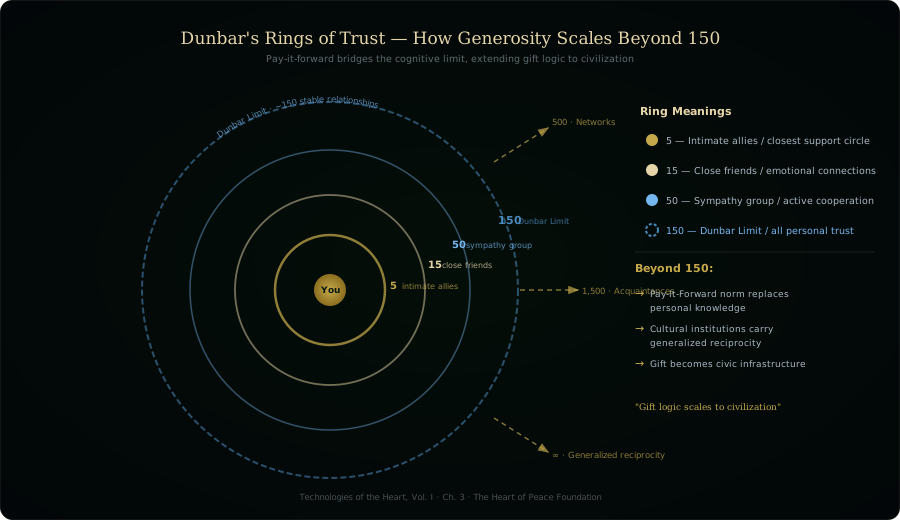
Robin Dunbar, the British anthropologist and evolutionary psychologist at the University of Oxford, identified in his research in the 1990s and subsequent decades a constraint on human social cognition that has come to be known as Dunbar's Number: the human brain can actively maintain approximately 150 stable social relationships simultaneously. This is not a cultural preference or an artifact of modern conditions. It appears to be a neurological ceiling — a function of the ratio of neocortex size to total brain volume — that constrained the social groups of our ancestors and still constrains ours.
Dunbar's Number creates what might seem like an insurmountable problem for any theory of paying it forward. If we can only maintain genuine, stable social relationships with about 150 people, how can generalized reciprocity — the obligation to the system, to strangers, to people outside our immediate circle — operate at all? How can it scale to the hundreds, thousands, millions of people who make up modern societies and civilizations?
Dunbar's own work suggests the answer: beyond 150, communities need formal institutions, shared symbols, and cultural norms to maintain reciprocity norms among members who cannot know each other personally. Paying it forward, in this framework, is the mechanism by which gift economics scales beyond the Dunbar limit. When I give forward not to a specific person I know but to the system — when I contribute to the commons, when I mentor the stranger, when I extend the professional network, when I pay for the coffee of the next customer in line — I am extending my cooperative behavior beyond my 150 into the wider social field, guided by a norm of generalized reciprocity rather than a personal relationship. This is the function of cultural institutions that encode and maintain the paying-forward norm: they make generalized reciprocity cognitively tractable for organisms whose natural social cognition tops out at 150. They allow gift logic to scale to civilization.
David Sloan Wilson and Multilevel Selection
David Sloan Wilson, the evolutionary biologist at Binghamton University, has spent his career applying multilevel selection theory to the study of human cooperation — and his findings provide an evolutionary grounding for why paying it forward is not just morally admirable but biologically stable. The standard model of evolutionary biology, derived from selfish-gene theory, predicts that altruistic behaviors — contributing to others at cost to oneself — will be selected against over time, because individuals who defect (take without contributing) will out-reproduce those who cooperate. This prediction, if correct, would make generalized reciprocity an evolutionary puzzle.
Multilevel selection theory offers a resolution. The key insight is that natural selection operates not just at the level of the individual but at the level of the group. In an environment where groups compete — as human groups have throughout evolutionary history, through warfare, through resource competition, through the challenges of surviving extreme environments — groups with stronger norms of generalized reciprocity consistently outcompete groups with weaker norms. The generosity that reduces an individual's fitness advantage over other members of their own group increases the group's fitness advantage over competing groups. Over evolutionary timescales, this creates selection pressure not just for bilateral reciprocity (which is easily explained by kin selection and direct reciprocity models) but for exactly the kind of generalized, forward-oriented cooperative behavior that pays forward to strangers and the commons.
Wilson argues that human beings are, in this sense, "conditionally cooperative" — predisposed toward generalized reciprocity when cultural and institutional conditions support it, predisposed toward defection when those conditions erode. The paying-it-forward norm is not a recent cultural invention layered atop a fundamentally selfish evolutionary heritage. It is, Wilson's research suggests, as old as the species — an evolved tendency that requires cultivation and institutional support, but that is genuinely part of what we are.
V. Cross-Cultural Lineages — The Universal Pattern of Giving Forward
The paying-forward pattern, under different names and in different forms, appears across every major civilizational tradition. This universality is itself evidence for Wilson's evolutionary claim: if the pattern were merely a cultural invention of one tradition, we might expect it to be absent in others. Instead, we find it everywhere — which suggests we are encountering not a contingent cultural preference but something structural about human communities that have survived and flourished.
The Haudenosaunee Seventh Generation Principle
The Haudenosaunee Confederacy — the alliance of Six Nations also known as the Iroquois — developed a governance philosophy that encodes temporal forward generosity at the constitutional level. The Great Law of Peace, the foundational document of the Confederacy, contains the principle that every decision made by the Grand Council should be evaluated not only for its effects on the present generation but for its effects on seven generations into the future — approximately 175 years. The seventh generation principle is not mystical or sentimental. It is a hardened governance technology, tested over centuries of collective decision-making about land use, warfare, resource management, and political structure, specifically designed to prevent the short-term extraction logic that Ostrom documented as the cause of commons collapse.
The seventh generation principle is paying it forward applied to governance — the formal institutionalization of the obligation to give to people who cannot yet give back, and who may not yet exist. It is the temporal dimension of Gouldner's generalized reciprocity elevated to constitutional principle.
Ubuntu and African Gift Philosophy
The Nguni Bantu concept of ubuntu — usually translated as "I am because we are" or "a person is a person through other persons" — expresses the foundational ontological premise of many southern and central African philosophical traditions: that personhood itself is constituted through relationship, not prior to it. The isolated, self-sufficient individual who gives and receives in bilateral transactions is, from the ubuntu perspective, not the baseline from which community is constructed. Community is the baseline from which persons emerge.
Ubuntu ethics generates an economics of generalized reciprocity directly: if personhood is constituted through relationship, and relationship is constituted through mutual obligation and care, then withholding from the community is not just unkind — it is a kind of self-destruction. Contributing to the community is not sacrifice — it is self-constitution. The paying-forward norm in ubuntu philosophy is not a supplement to individual interest; it is the condition of the possibility of having individual interests worth pursuing.
Indigenous Reciprocity with the Living World
Robin Wall Kimmerer, the Potawatomi botanist and author of Braiding Sweetgrass (2013), offers a version of the forward-giving principle that extends beyond human communities to encompass the entire living world. In the Potawatomi gift economy as Kimmerer describes it, the relationship between human beings and the plants, animals, and ecosystems they depend upon is itself governed by gift logic. The forest gives — oxygen, food, medicine, beauty, shelter, the substrates of everything human culture has ever produced. The appropriate human response is not market exchange (you cannot buy oxygen) but forward generosity: care, stewardship, reciprocal obligation, the willingness to give to the living world in ways that the living world cannot reciprocate directly but that sustain the conditions of the living world's continued giving.
Kimmerer's analysis is, in one sense, an extension of Ostrom's governance research to the ecological commons — and it reaches the same conclusion by a different path: the communities that survive and flourish are the communities that extend their generalized reciprocity beyond the human social circle to include the ecological systems on which they depend. Paying it forward to the living world is not optional. It is the condition of the living world's ability to continue paying it forward to human beings.
VI. Philosophical and Spiritual Depth — Gift as Cosmological Principle
The Circle and the Spiral
Across spiritual traditions that have thought deeply about the nature of generosity, a consistent image appears: the circle. Not the closed circle of bilateral exchange, where value travels from A to B and back to A, but the expanding spiral of forward circulation, where value moves from A to B to C to D to E — never returning to its origin, but moving always outward, always forward, always creating new connections, new nodes of relationship, new points of entry for the gift into the wider social fabric.
The Stoics spoke of oikeiōsis — the natural expansion of care from the self outward through family, community, city, humanity, and ultimately the cosmos. The Stoic sage is not someone who has transcended care for the near and particular; they have learned to extend that same care, in appropriate measure, to ever-wider circles. Marcus Aurelius, writing his private meditations in the second century CE, returned again and again to the same theme: we are parts of a whole, and the health of the whole depends on each part contributing to it more than it extracts. This is not political theory. It is a description of the cosmological structure of reality as the Stoics understood it — a living organism whose health is maintained by the forward circulation of care.
Jewish thought's concept of tikkun olam — "repair of the world" — encodes a similar cosmological paying-forward: the world as we find it is broken, and the vocation of human beings is to repair it, not for themselves, not for those who will personally repay them, but for the world as it will be long after any of us are gone. The great Hasidic teachers were explicit about the temporal structure of this obligation: you work on the repair not because you will live to see it completed, but because the work of repair is itself the fullest expression of what a human being can be.
In the Christian tradition, the concept of grace — charis, the gift that is not earned and cannot be repaid — carries a similar structural logic: the gift received from God is not paid back to God but paid forward to the neighbor. The parable of the Talents (Matthew 25) turns precisely on this point: the right response to what has been given is not to preserve it safely (to pay it back to the original giver in unchanged form) but to invest it — to put it into circulation, to make it productive in the world, to pass it forward into a form that will eventually benefit others. The servant who buries his talent, trying to preserve it for safe return, is condemned. The servants who invest it — who put it into the world in trust that the world will receive it and multiply it — are praised.
Gift as Cosmological Principle in the Perennial Tradition
Plotinus, the third-century Neoplatonic philosopher, described the structure of reality in terms that map with surprising precision onto Mauss's description of the gift economy. The One — the source of all being — does not give because it has been asked, or because it expects return, or because giving is a duty imposed from outside. It gives because giving is its nature: the One overflows, as a spring overflows, not because the spring has calculated that overflow will produce a good return, but because a spring that is full flows. Being is the original gift — given forward to all existence, without condition, without tracking, without expectation of return.
Plotinus called the outward movement proodos — the emanation of being from the One into multiplicity, the great forward giving by which the universe exists. The return movement — epistrophe, the soul's recognition of its origin and its turning back toward the source — is not a withdrawal from the world but a deepening of presence in it: the soul that recognizes itself as gift can give more freely, because it is no longer giving from depletion. It is giving from the recognition that it is itself a forward-flowing expression of an inexhaustible source.
This is the spiritual depth-structure of what Maslow, seventeen centuries later, would call B-motivation: giving not from deficiency but from abundance, not from the need to be needed but from the natural overflow of a life in contact with what is deepest in it. The Neoplatonic giving-forward and the Maslowian B-motivation describe the same inner movement from different vocabularies. And both point toward the same practical conclusion: the quality of forward giving — its capacity to sustain both giver and receiver over time — depends on whether it flows from this deepest source, or whether it is a performance of virtue driven by the need to compensate for felt inadequacy.
VII. Practical Application — The Technology of Forward-Giving
The great risk of any essay on paying it forward is that it becomes too abstract to use. The research and the philosophical depth are valuable — they help us understand why the practice matters, which is often what gives us the energy to sustain it. But the practice itself is available in every ordinary interaction, at no cost, with no special equipment or preparation. The following are not metaphors. They are specific technologies of forward generosity, available today.
Mentorship as Paying Forward
Every competent person carries knowledge, experience, and relational capital that was given to them by others — by teachers, colleagues, mentors, and the accumulated work of everyone who built the field before them. The natural direction for that inheritance is forward: to the next generation, to the person coming up behind, to the community member who could benefit from what has been accumulated. Mentorship is not charity. It is not a favor granted from a position of surplus. It is the forward movement of accumulated wisdom — the natural expression of Mauss's hau, the obligation carried by the gift to continue its own circulation.
The specific technology: identify one person in your professional or community life who is at the stage you were at five or ten years ago. Not a random person — the person who most needs the specific thing you now have. Offer them, concretely and without conditions, the single most useful piece of what you have — a specific connection, a specific piece of knowledge, an hour of genuine attention and honest feedback. Not a performance of mentorship. An act of it. Not general encouragement, but specific, targeted transfer of what was given to you into the hands of someone who will carry it forward.
Advocacy as Paying Forward
When you use your voice, your platform, your access, or your institutional position to open doors for people who don't have them, you are paying forward the doors that were opened for you — and the doors that could not be opened for others who deserved entry. This is the structural logic of allyship, stripped of its political freight: not guilt about what you have, but recognition that what you have was in part given to you, and that its natural direction is forward. The most specific form of this: identify one systemic barrier that you can see clearly from your position that someone else cannot see from theirs, and use whatever you have to lower it. Not as self-congratulation. As the straightforward forward movement of access that was, in some form, given to you.
Presence as Paying Forward
The simplest and most universally available form of forward generosity is the quality of presence you bring to every interaction. This is not about performing attentiveness. It is about the genuine decision to bring the full weight of your attention, care, and humanity to the person in front of you — without agenda, without calculation of return, without the constant partial attention of a mind already half-elsewhere. Simply bringing your whole self to a conversation, a gathering, a community — is an act of forward generosity. You are placing into the social fabric the quality of your genuine engagement. This costs almost nothing. Its effects accumulate invisibly and over time become the difference between a community that feels alive and one that does not.
Temporal Generosity — Paying Forward in Time
The most demanding form of paying it forward extends not just across social space but across time — to people who do not yet exist, whose lives you will shape without ever meeting them. The medieval cathedral builders of Europe worked on timescales that guaranteed most of them would never see the finished structure. They were working for grandchildren and great-grandchildren they would never meet, for strangers born centuries after their own deaths. The artisan who spent a working life carving a stone capital for a column that would not be placed for decades after his death was practicing temporal generosity — contributing to a project that would outlast him because he believed in what it was building.
We are the inheritors of this kind of giving. Every library, school, legal institution, scientific discovery, and democratic norm we benefit from was paid forward to us by people who are now dead — who paid at great personal cost to a future they could not see. The only honorable response to that inheritance is to pay it forward ourselves: to invest in the institutions, the commons, the ecological systems, the social trust that the people who come after us will need, even when we will not live to see the return on that investment.
Try This Today
Think of someone who invested in you — a teacher, a mentor, a parent, a colleague, a stranger who offered something at a moment you needed it. You probably cannot repay them directly. But you can pay it forward.
Identify one person in your life right now who is where you were when that person invested in you. What is the one thing you could offer them — specific knowledge, a connection, an hour of genuine attention — that would change something for them the way something changed for you? Reach out today. Not with fanfare. Just with the simple directness of one human being passing something forward.
VIII. The Maslow Compass and Paying It Forward
Among the tools offered through the Technologies of the Heart, the Maslow Compass is designed to do something that is rarely attempted in wellness or self-development contexts: to reveal not just what you are doing in your relationships and contributions, but why — specifically, whether your giving is flowing from the energized, abundant dimension of Being-motivation (what Maslow called B-motivation) or from the anxious, depleted dimension of Deficiency-motivation (D-motivation). This distinction is, as we have seen throughout this chapter, the single variable that most determines whether forward generosity is sustainable over time.
When we give from D-motivation — from the felt need to be needed, from guilt about what we have, from the performance of virtue as a compensation for inner inadequacy — our giving has the structure of exchange even when its apparent form is gift. We are giving backward — back toward the person who will be grateful to us, back toward the image of ourselves as generous, back toward the relief of having discharged an obligation we didn't consciously recognize we were carrying. This kind of giving is not sustainable. It depletes the giver without creating the forward-flowing social energy that genuine gift-giving generates. The recipient receives something, but it arrives with a weight — an implicit demand for recognition, reciprocation, or at least acknowledgment — that the receiver can often sense even when neither party can name it. The gift of D-motivated giving is real, but it is a gift given backward toward the giver's need.
When we give from B-motivation — from genuine abundance, from the overflow of a life that has found its ground, from the recognition that what we have was itself given and its natural direction is forward — the quality of the giving is structurally different. It does not need to be recognized. It does not carry an implicit ledger. It lands in the receiver as pure gift, without the weight of implicit demand, and it creates in them the same overflow that will lead them, in their own time, to pay it forward. This is what Plotinus described as the spring that overflows not because it has calculated the benefit of overflow, but because a full spring flows. The Maslow Compass, used as a daily orientation practice, helps identify which source we are drawing from in any given moment of giving.
The practical application is specific: when you notice yourself giving — offering help, making a contribution, extending yourself for someone else — take one moment to locate the felt sense of that giving in your body. Is there a quality of fullness, of genuine generosity flowing outward? Or is there a quality of tightness, of giving-in-order-to, of releasing something that feels more like discharging a debt than making a gift? Neither answer is grounds for judgment. Both are information. The tightness, when it appears, is a signal not to stop giving but to turn first toward the inner spring — to access, through whatever practice sustains it for you, the deeper abundance from which forward giving flows naturally. The compass does not judge our motivation. It illuminates it — so we can choose the direction of our giving with greater clarity and greater freedom.
IX. Integration with the Technologies of the Heart
The Technologies of the Heart is a ten-chapter investigation of the inner capacities that build human communities capable of genuine flourishing. Paying it forward is not one isolated practice within this framework. It is the temporal dimension of nearly every other practice — the specific mechanism by which inner cultivation becomes civilizational consequence. Here is how paying it forward intersects each chapter.
Chapter 1 — The Art and Science of Generosity: Generosity is the inner disposition — the orientation toward open-handed offering rather than defensive accumulation. Paying it forward is generosity's structural expression in time. Generosity can remain a personal quality, a warmth of character that enriches individual relationships. Paying it forward is what happens when generosity is extended not just toward those we love and know but forward into the social field — to strangers, to the commons, to the future. It gives generosity its civilizational power.
Chapter 2 — The Golden Rule as a Fractal Law: The Golden Rule answers the question of how to treat others: as you yourself wish to be treated. Paying it forward answers the question of when — and to whom: to those who cannot yet repay you, to those you may never meet, to the strangers whose flourishing you will not personally witness. The Golden Rule in its bilateral form ("treat this person as you wish to be treated") is a norm of direct reciprocity. Paying it forward is the Golden Rule extended forward into generalized reciprocity — treat strangers as you would be treated, because they are not strangers but the extended community you belong to.
Chapter 4 — Collaboration: The Geometry of Flourishing: Collaboration is paying it forward through shared creative work — giving not just goods or services but your full creative and relational capacity to a shared project whose results benefit others. The unique feature of paying it forward as temporal generosity is that the "collaborator" is often not present: you give to someone you may never meet, work on a project whose results you may never see, contribute to an arc of development that extends beyond your own life. Temporal generosity is collaboration without the collaborator present — the ultimate test of whether the practice is genuinely forward-oriented or still dependent on the warm feedback loop of mutual acknowledgment.
Chapter 5 — Compassion: Sustainable compassion requires the capacity to give forward without tracking return — to care for others not because they are "our" people (bonding capital), not because they can reciprocate (direct reciprocity), but because their suffering is suffering and their flourishing is flourishing, full stop. Compassion that keeps a ledger — that extends care only as far as it is returned, that burns out when the giving is not acknowledged — is not compassion. It is social exchange with compassion's vocabulary. The specific inner capacity that distinguishes sustainable compassion from burnout-prone charity is the ability to give from a source that is not depleted by giving: the B-motivation that Chapter VIII describes, the spring that fills itself even as it flows.
Chapter 6 — Oneness: When the deep recognition of shared being — the non-separation of self and other that is the experiential content of what traditions call oneness or non-duality — becomes not just an intellectual position but a felt reality, the distinction between giving back (to the known, to the reciprocating) and giving forward (to the unknown, to those who cannot repay) begins to dissolve. Paying it forward is the practical expression of oneness in the social and temporal field. It is what oneness looks like when it moves through a human life in relationship with other human lives. Where oneness is merely cognitive, paying it forward remains an effortful practice. Where oneness is genuinely felt, paying it forward becomes as natural as breathing: the out-breath that follows the in-breath, the offering that follows the receiving, the forward movement that is inseparable from the nature of a life lived in recognition of its deep connectedness.
Chapter 7 — The Toroidal Economy: The toroidal economy — the economic model derived from the torus-shaped circulation pattern found in electromagnetic fields, living systems, and cosmological structures — describes an economy in which value circulates continuously, flowing inward through contribution and outward through distribution, without the pooling and stagnation that characterize extractive economic systems. Paying it forward is the micro-level mechanism by which this toroidal circulation remains alive. Every act of forward generosity keeps wealth — material, social, informational, relational — in motion rather than allowing it to pool. The toroidal economy cannot exist without a culture of paying it forward. It is not a structural innovation that produces generosity automatically; it is the institutional form that forward-generosity takes when it is built into the design of economic relationships.
Chapter 8 — The Hourglass of Being: The Hourglass of Being describes the expressive arc of human development as a downward flow — from the summit of self-transcendence recognition through the dimensions of contribution, relational offering, material generosity, and embodied presence in the world. Paying it forward is the primary movement of this outer arc: the natural outward expression of a human being who has done enough inner work to have something real to give. The hourglass architecture reveals why the inner work described in chapters 1 through 7 is not separable from the outer action of paying it forward: development without expression is incomplete, and expression without development is unsustainable.
Chapter 9 — Intention, Motivation, and Purpose: The intention behind a forward gift — whether it arises from genuine abundance (B-motivation) or the performance of virtue driven by inadequacy (D-motivation) — is not visible on the surface of the act. The same material gift can be given from two entirely different sources, and the receiver can often feel the difference even when neither party can name it. Chapter 9's investigation of intention and motivation is, in this context, a guide to the quality of paying it forward: what distinguishes the gift that sustains both giver and receiver from the gift that depletes the giver and creates in the receiver a subtle debt. The answer, in every tradition that has thought carefully about this, is the same: the quality flows from the source.
Chapter 10 — The Generosity Standard: Every monetary system ultimately depends on a form of forward-extending trust — the willingness of participants to give value now in exchange for claims whose redemption depends on the future behavior of people they may never meet. This is generalized reciprocity embedded in the structure of money itself. The Generosity Standard, as explored in Chapter 10, is the project of making this hidden foundation explicit and designing monetary systems that consciously cultivate and maintain it. The Generosity Standard is paying it forward made systemic: an economic architecture that rewards forward contribution rather than backward accumulation, that embeds Gouldner's norm of generalized reciprocity into the design of the exchange system itself.
Why This Matters Now
The dominant economic and social organizing principle of the past several centuries has been market exchange: direct, bilateral, traceable, organized around individual accumulation and the externalization of costs onto those without the power to resist them. This model has produced extraordinary material abundance — and extraordinary deficits in exactly the capacities it structurally cannot produce: trust, belonging, the felt sense of being held by something larger than the self, the security of knowing that the community will be there when the individual cannot manage alone.
The crises of our moment — the epidemic of loneliness documented in public health research across the industrialized world, the erosion of civic life that Putnam measured, the fractures in political community, the degradation of the ecological commons that Ostrom's successors are now tracking — are, at their root, deficits in the paying-forward pattern. We have been paying it back (to shareholders, to quarterly metrics, to the immediate return on investment) when the system needed us to be paying it forward. The good news is that the infrastructure for paying it forward is not gone. It is dormant. It reactivates the moment enough people begin practicing it — not as ideology or political position, but as the simplest possible response to the recognition that what we have was given to us, and the most natural thing to do with a gift is pass it on.
X. Conclusion — The Thread That Reaches Us
Somewhere in this city, a library is open. Someone long dead paid for it — paid in taxes, in time, in political effort, in the willingness to make a public argument about the value of a building that would serve people they would never meet. You may never use a library. But someone who shaped who you are probably did. And the person who will shape the person who will shape your grandchildren probably will.
The act of building a library, or a school, or a park, or a movement, or a habit of care — any act aimed at the flourishing of people who will come after you — is an act of radical temporal generosity. It is paying it forward to the most distant recipients possible: the unborn, the yet-to-arrive, the children of children you will never hold. It is exactly what allows civilizations to be more than the sum of the lives currently passing through them. It is the mechanism by which a community accumulates wisdom, care, and capacity across time — paying each generation's inheritance forward to the next, so that what the next generation inherits is always a little more than what the previous one received.
Ann Herbert wrote her three words on a placemat in 1989. She did not know — could not have known — that those words would circle the globe. She did not know that decades later, a researcher named Christakis would identify the precise mechanism by which a single generous act propagates through three degrees of social separation to reach a thousand people. She did not know that a Nobel laureate named Ostrom would spend her career documenting communities that had been living her insight for centuries, in the governance of their commons, in the management of their shared resources, in the deep structure of their social contracts with one another and with the living world.
She just wrote the words. She paid them forward. And they are still moving.
This is what we are describing, in all its complexity and depth, when we use the simple phrase paying it forward. Not a transaction. Not a sentiment. Not a moral instruction for well-intentioned people who want to be nice. A technology — the oldest and most durable social technology our species has developed — for building communities that survive, for sustaining civilizations through crisis, for creating the conditions under which human beings become capable of their greatest achievements, and for transmitting those achievements forward through time to people who will receive them without knowing who gave.
The gift moves forward. It has always moved forward. And every time we choose to move it again — in a diner, in a board meeting, in a mentoring conversation, in the slow work of rebuilding a commons, in the radical patience of temporal generosity — we become part of the longest and most important chain there is.
We did not start it. We will not end it. Our part is to receive what was given, and to pass it forward, to someone who needs it, without conditions, without tracking, without waiting for the circle to close.
The circle doesn't close. It spirals outward. That is the whole point.
Next Steps
Continue reading: Chapter 4 — Collaboration: The Geometry of Flourishing →
Discover why the deepest collaboration is not compromise but convergence — and how shared purpose creates outcomes no individual can achieve alone.
Return to the series overview: Technologies of the Heart
Related Articles
- Chapter 1: The Art & Science of Generosity — The biological and social foundations from which paying forward emerges
- Chapter 2: The Golden Rule as a Fractal Law of Life — The governing principle that makes generalized reciprocity rational
- Chapter 4: Collaboration — The Geometry of Flourishing — What happens when paying it forward becomes a shared creative act
- Chapter 7: The Toroidal Economy — When Giving Is the Engine — The economic architecture that embedding paying-forward into the design of exchange
- Chapter 8: The Hourglass of Being — Maslow Reimagined — The developmental geometry from which forward generosity naturally flows
- Technologies of the Heart — Series Overview — All ten chapters in context
- Get Involved — Join the Circle — Add your own act to the chain
FAQ
What does "paying it forward" actually mean?
Paying it forward refers to the practice of responding to a benefit received not by returning it to the original giver, but by extending a benefit — not necessarily the same one — to someone new. The phrase was popularized in the modern era by a 2000 film and Catherine Ryan Hyde's novel, but the underlying social practice is ancient: it appears in virtually every human culture as the foundational mechanism for sustaining community beyond the limits of bilateral exchange. To pay it forward is to treat the benefit as a gift whose natural direction is forward through the social fabric, rather than a debt whose obligation is to the original creditor.
What is the difference between generalized and direct reciprocity?
Direct reciprocity is bilateral: I help you, you help me, the exchange closes. It creates stable two-person relationships and is the foundation of most market transactions and many personal friendships. Generalized reciprocity is multilateral: I help you because someone helped me, you help someone else because I helped you, and the result is a social web in which help circulates freely through the community rather than remaining locked in bilateral bonds. Alvin Gouldner, who formalized this distinction in 1960, argued that generalized reciprocity is a structural feature of all communities that survive crisis — because bilateral exchange, while efficient, creates no reserves of social trust to draw upon when the system is stressed.
What did Adam Grant find about givers and takers?
Adam Grant's research at the Wharton School, surveying over 30,000 professionals, found that "Givers" — people who default to contributing more than they receive — appear disproportionately at both the bottom and the top of professional performance metrics. The Givers at the bottom give indiscriminately, depleting themselves without sustainable boundaries. The Givers at the top give "otherish" — strategically, to the community rather than to individuals in transactional exchange, building expanding networks of reciprocity that eventually create more value for everyone including themselves. Grant's meta-finding: generalized reciprocity to the system consistently outperforms direct reciprocity to individuals as a long-term strategy for organizational and social value creation.
What is Marcel Mauss's theory of the gift?
Marcel Mauss's 1925 essay The Gift argued that gift-giving in traditional societies is not a voluntary, sentimental act but a sophisticated social technology governed by obligation, expectation, and social consequence. The gift creates what Mauss (borrowing from Māori informants) called hau — a relational charge that obligates the recipient not to repay the giver but to pass the gift forward. Mauss documented this structure across dozens of cultures — the potlatch of the Pacific Northwest, the kula ring of Melanesia, the gift customs of ancient Rome and India — and concluded that gift economies are not primitive precursors to market economies but alternative social technologies that perform a function the market structurally cannot: creating the felt sense of genuine community membership, mutual obligation, and being held by something larger than oneself.
How does paying it forward build social capital?
Robert Putnam's research identified two types of social capital: bonding capital (trust within groups of people who know each other) and bridging capital (trust extended to strangers and across group boundaries). Direct reciprocity primarily builds bonding capital. Paying it forward builds bridging capital — the willingness to extend cooperative behavior to those outside your immediate circle. Putnam found that states and nations with higher levels of generalized social trust (the subjective product of bridging capital) show significantly better economic performance, health outcomes, educational attainment, and civic engagement. Paying it forward is, in this framework, the micro-level practice that aggregates into the bridging social capital that sustains functioning democratic societies.
Can paying it forward scale in large societies?
This is exactly the problem that Robin Dunbar's research on the cognitive limit of human social networks — approximately 150 stable relationships — raises. The answer, supported by both evolutionary theory (David Sloan Wilson's multilevel selection research) and institutional economics (Elinor Ostrom's commons research), is yes — but only when cultural institutions encode and maintain the paying-forward norm beyond the limits of personal relationship. When communities develop formal institutions, shared symbols, and cultural norms that extend the obligation of generalized reciprocity beyond the circle of the personally known, the paying-forward pattern can scale to hundreds, thousands, and millions of people. Every functioning large-scale human institution — language, law, public health infrastructure, democratic governance — is generalized reciprocity made institutional.
What is the Kula Ring and what does it teach about gift economies?
The kula ring, documented by Bronisław Malinowski in his 1922 Argonauts of the Western Pacific, is a system of ceremonial gift exchange across a ring of Melanesian islands spanning hundreds of miles of open Pacific. Two types of shell valuables — necklaces and armbands — circulate continuously through the ring in opposite directions: received by one community, held briefly, and passed forward to the next. The objects have zero commodity value but infinite relational value: they maintain the web of trust, obligation, and mutual recognition that allows the dozens of communities of the ring to function as a coherent civilization rather than isolated islands. The kula ring teaches that paying it forward can be made the explicit structural principle of an entire economic system — that the forward movement of gifts need not be left to individual virtue but can be designed into the architecture of economic relationships, with the result that the community sustains itself across centuries through the continuous forward circulation of what it values most.
Further Reading
- Alvin Gouldner — "The Norm of Reciprocity: A Preliminary Statement" (1960, American Sociological Review) — The foundational sociological analysis of why paying it forward is a structural feature of functional communities
- Marcel Mauss — The Gift (Essai sur le don, 1925) — The anthropological classic on gift economies as the original and most durable social technology, still the essential starting point for any serious engagement with the theory of forward generosity
- Adam Grant — Give and Take: Why Helping Others Drives Our Success (2013, Viking) — Empirical research surveying 30,000+ professionals, documenting why "otherish" Givers — those who give to the community rather than in bilateral exchange — consistently outperform over time
- Robert Putnam — Bowling Alone: The Collapse and Revival of American Community (2000, Simon & Schuster) — The definitive account of how generalized social trust (the social-capital product of paying it forward) underlies economic performance, health, education, and civic life
- Nicholas Christakis & James Fowler — Connected: The Surprising Power of Our Social Networks (2009, Little, Brown) — How generous behaviors propagate through social networks to three degrees of separation, reaching up to 1,000 people per act
- Lewis Hyde — The Gift: Imagination and the Erotic Life of Property (1983, Random House) — The philosophical analysis of why gifts increase through sharing while commodities diminish, and why communities depend on the forward circulation of gifts to remain alive
- Elinor Ostrom — Governing the Commons: The Evolution of Institutions for Collective Action (1990, Cambridge University Press) — Nobel laureate's documentation of communities that have maintained shared resources sustainably for centuries through generalized reciprocity extended to the community as a whole
- Robin Wall Kimmerer — Braiding Sweetgrass (2013, Milkweed Editions) — A botanist's exploration of Indigenous gift economies and temporal generosity across generations, extending the paying-forward principle to encompass the entire living world
- Bronisław Malinowski — Argonauts of the Western Pacific (1922, Routledge) — The original fieldwork documentation of the kula ring, the most elaborate gift-economy institution in the ethnographic record
- David Sloan Wilson — This View of Life: Completing the Darwinian Revolution (2019, Pantheon) — Multilevel selection theory and the evolutionary basis for why communities with stronger generalized reciprocity norms consistently outcompete those with weaker norms
Glossary
Generalized Reciprocity: A form of social exchange in which the return of a benefit is made not to the original giver but to the broader community or to a third party, forward in the social chain. Unlike direct reciprocity, generalized reciprocity creates expanding networks of mutual obligation rather than closed bilateral bonds. Alvin Gouldner identified it in 1960 as a structural feature of all known functional human communities — the mechanism that allows communities to sustain collective capacity through crisis, when bilateral exchange fails because there is no immediate partner to reciprocate with.
Norm of Reciprocity: The universal human moral obligation, documented by Alvin Gouldner (1960) across dozens of cultural contexts, to help those who have helped you — and, more broadly, to contribute to the social system that sustains you. The norm has two dimensions: direct (return benefits to those who gave them) and generalized (pass benefits forward to the community as a whole). Communities without the generalized dimension of the norm are rigid, fragile, and incapable of the distributed care that survival requires.
Gift Economy: A system of exchange organized around the forward transfer of goods, services, and relationships without immediate or explicit quid pro quo, governed instead by obligation, trust, and the expectation of future reciprocity. Marcel Mauss documented gift economies across dozens of human cultures in 1925 and argued that they are not primitive precursors to market economies but alternative social technologies performing functions — community cohesion, mutual obligation, the felt sense of being held — that market economies structurally cannot replicate. Gift economies remain operative in families, communities of practice, and the informal networks through which most actual human care is distributed, even within market societies.
Temporal Generosity: The practice of extending generosity forward in time — to future generations, to the unborn, to people one will never meet — through acts of investment, creation, stewardship, and institution-building. Temporal generosity is the highest and most demanding expression of the paying-forward pattern, and the mechanism by which civilizations accumulate capacity beyond the limits of any individual lifetime. The seventh-generation principle of the Haudenosaunee Confederacy is its oldest explicitly institutionalized form.
Hau: The Māori concept documented by Marcel Mauss in The Gift (1925), referring to the spirit or relational charge that clings to a gifted object and compels its forward circulation through the community. The hau of a gift is the obligation it carries — not to repay the giver but to pass the gift onward, so that what enters the social system does not return to its source but continues moving forward. Mauss found structural equivalents to the hau concept across dozens of non-market cultures, and argued that it represents the deepest logic of gift exchange: the gift is not a transfer of ownership but an entry point for a relationship that is designed to keep moving.
The Heart of Peace Foundation cultivates compassion, generosity, and human flourishing through mindfulness, community nourishment, and spiritual growth. Explore our programs or get involved to bring these technologies into your community.