The Toroidal Economy — Reimagining Wealth as a Living Flow
Technologies of the Heart — Volume III, Chapter 7
Part of the Technologies of the Heart series | The Heart of Peace Foundation
In the old-growth forests of the Pacific Northwest, something extraordinary happens beneath the soil that no economist has ever modeled on a spreadsheet.
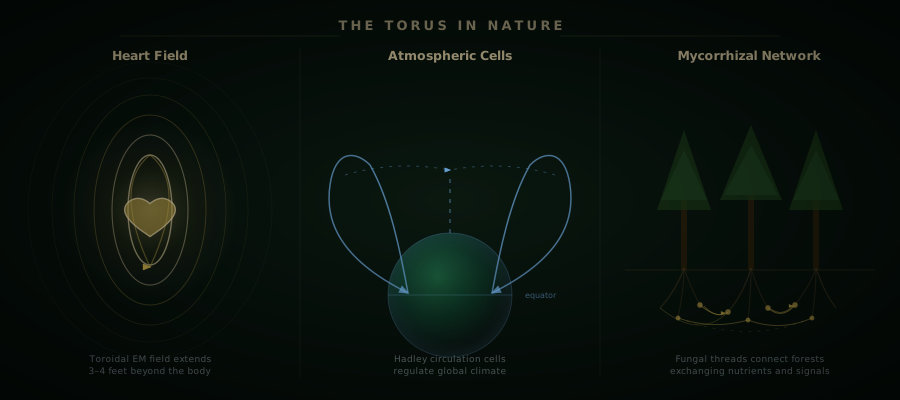
The Douglas firs and the western red cedars do not compete for nutrients in the way a textbook would predict. Instead, they share. Through an underground web of mycorrhizal fungi — what forest ecologist Suzanne Simard calls the Wood Wide Web — sugars and nitrogen and water flow from thriving trees to struggling ones, from the old to the young, from the shaded understory to the sun-drenched canopy edge. When a mother tree senses that a seedling nearby is in distress, it sends carbon along the fungal threads. Not because it calculates a return on investment. Not because it fears punishment for withholding. But because this is simply what a living system does: it circulates.
The flow is not linear. It does not pool at the strongest node and stop. It moves, turns, returns, nourishes, and moves again — describing, in the dark and patient language of roots and fungi, the shape that physicists call a torus.
This is the pattern we have forgotten. And it is the pattern we are being invited — by crisis, by science, and by something older than both — to remember.
I. Introduction — Wealth as Flow
Each chapter in this series has explored a technology of the heart: generosity as biological architecture, the Golden Rule as fractal law, paying it forward as civilizational infrastructure, collaboration as sacred geometry, compassion as the ground of sustained action, oneness as the deepest recognition available to us.
This chapter addresses the structure in which those technologies must operate: the economy. Not the economy as it currently exists — extractive, concentrating, accelerating toward its own limits — but the economy as it could exist, and as isolated communities across the world have already demonstrated it can.
The argument is simple, and its implications are vast:
Wealth behaves like a living system when it circulates. And a living system's most elegant geometry is the torus.
A torus is the shape of a donut, a magnetic field, a hurricane viewed from above, the electromagnetic field generated by a beating heart. It is a geometry in which flow moves outward, curves back, pours inward, spirals through the center, and emerges again — sustaining itself through continuous circulation rather than accumulation.
What follows is neither utopia nor academic exercise. It is a map — drawn from the science of living systems, the records of working cooperatives, the wisdom of indigenous economies, and the emerging frameworks of solidarity economics — pointing toward an economy that works the way forests do.
Key Takeaways
- Wealth is not a noun; it is a verb. When it circulates — through communities, across generations, between the thriving and the struggling — it sustains life. When it pools, it stagnates.
- The torus is nature's blueprint for self-sustaining flow: electromagnetic fields, weather systems, mycorrhizal networks, and the human heart all operate on toroidal geometry.
- The extractive economy is not inevitable. It is a recent design choice — and it can be redesigned. Elinor Ostrom, Kate Raworth, Mariana Mazzucato, and Bernard Lietaer have each mapped dimensions of the alternative.
- Proof of concept exists. Mondragon, the Preston Model, Evergreen Cooperatives, the Kerala Model, and the global Fair Trade network demonstrate that economics organized around circulation rather than extraction produce measurably better outcomes.
- Indigenous reciprocity is not quaint. It is millennia-tested wisdom about how wealth must move to remain alive — and it predates, and outlasts, every extractive system imposed upon it.
- The Heart of Peace Foundation's five pillars — mindfulness, nourishment, community, generosity, and collaboration — are not programs. They are the five currents that keep the toroidal economy flowing at the human scale.
II. The Problem — The Geometry of Extraction
Every economy is, at its root, a geometry: a description of how resources flow between people, places, and time.
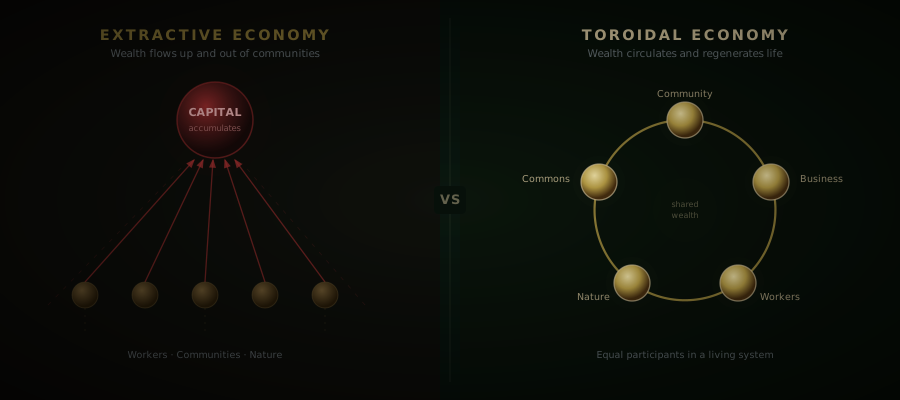
The dominant global economy describes a geometry of extraction: resources flow upward and outward, from the periphery toward the center, from the many toward the few, from the future toward the present. Labor produces value; capital captures it. Communities generate wealth; corporations export it. One generation consumes; the next inherits the debt.
This is not a law of nature. It is a design. And like all designs, it was made by human beings — which means it can be unmade by human beings.
E.F. Schumacher, writing in 1973 in what would become one of the most prophetic economic texts of the twentieth century, put it plainly:
"The modern economy is propelled by a frenzy of greediness and indulges in an orgy of envy, and these are not accidental features but the very causes of its expansionist success."
Schumacher saw — decades before ecological collapse became a dinner-table conversation — that an economy premised on infinite growth within a finite system was not merely unstable. It was a category error. You cannot grow forever in a bounded world. And you cannot extract without eventually reaching the bottom.
Buckminster Fuller, that restless architect of possibility, named the alternative with characteristic bluntness: he called it doing more with less — the design principle he called ephemeralization. Fuller understood that resource constraints were not a problem to be solved through more extraction, but an invitation to more elegant design.
"You never change things by fighting the existing reality. To change something, build a new model that makes the existing model obsolete."
This is precisely what a growing community of economists, architects, cooperative builders, and indigenous wisdom keepers is doing. They are not arguing against the old economy. They are building — quietly, persistently, at scales ranging from village credit unions to the world's largest worker-owned corporation — a new one.
III. The Pattern — Toroidal Geometry in Nature
The torus is not a human invention. It is a recurring solution that nature has arrived at, independently, across every scale of physical reality.
Consider the electromagnetic field generated by the human heart. Measured by the HeartMath Institute over three decades of rigorous research, this field extends several feet from the body in every direction — not as a simple sphere, but as a toroidal shape, curving outward from the heart at the front, arcing up and around, and flowing back through the body from behind. The heart does not simply pump. It circulates — and the field it generates reflects that circulation in its geometry.
Consider the atmosphere of Earth itself. Weather systems are not random. They organize into toroidal cells — Hadley cells, Ferrel cells, polar cells — each one circulating energy from equator to poles and back, sustaining the climate that sustains life. Disrupt the circulation and the system destabilizes. Maintain it and life flourishes.
Consider Nikola Tesla's intuition about electromagnetic resonance — that energy, properly directed, does not diminish but amplifies through circulation, feeding back into itself. Tesla understood that the universe's most efficient geometry is not the straight line but the loop — and not a closed loop that merely returns to its starting point, but a torus: a loop that passes through something, nourishing the center as it circulates.
The ancient Vedic concept of Indra's Net offers a contemplative analog. Indra's Net is an infinite lattice of jewels, each jewel reflecting every other — a universe in which nothing exists in isolation and everything participates in everything else's reality. It is, in the language of metaphor, a toroidal system: the flow of mutual reflection sustaining the whole.
Thich Nhat Hanh's term interbeing — the recognition that nothing exists independently of everything else — points to the same structural reality from within the Buddhist tradition. A cloud does not disappear when it becomes rain. It changes form and flows into the river, the river into the ocean, the ocean into the cloud. There is no extraction from this system; there is only transformation and circulation. As we explored in Oneness — The Ultimate Technology, this recognition is not merely philosophical. It is a description of how living systems actually work.
What the torus offers economics is a shape for flow — a geometry that describes how wealth might move if we designed it to behave like a living system rather than like a machine.
IV. The Precedents — Economic Models That Already Work
The toroidal economy is not purely theoretical. It already exists, in fragments, in dozens of proven models across the world. What is missing is not proof of concept. What is missing is integration — the recognition that these fragments are describing the same larger pattern.
Doughnut Economics: The Outer Boundary
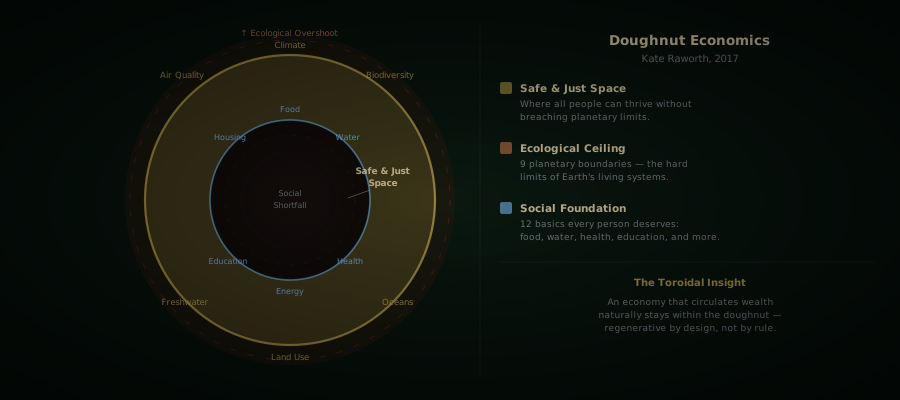
Kate Raworth, in her 2017 work Doughnut Economics, gave this emerging pattern its most accessible contemporary geometry. The doughnut describes an economy bounded on the inside by a social foundation — the minimum conditions for human dignity — and on the outside by an ecological ceiling — the limits beyond which Earth's systems destabilize.
"We need to move from seeing the economy as a growth machine to seeing it as a living system — one that can thrive, but within the boundaries that make life possible."
The doughnut is not yet a torus — it does not yet describe how wealth should flow within its boundaries — but it establishes the crucial insight that an economy must be bounded by living reality on both ends. Neither poverty below nor destruction above.
The Commons: Ostrom's Third Way
Elinor Ostrom spent her career demonstrating that the classic economic narrative of the "tragedy of the commons" — the assumption that shared resources inevitably get destroyed — was empirically false. In 2009, she became the first woman to win the Nobel Prize in Economics, specifically for proving that communities are capable of governing shared resources sustainably over long periods of time.
"We need to get away from the idea that there is one solution. There are many solutions. We need to understand how communities can develop their own rules."
Ostrom's commons governance is toroidal in structure: resources flow through a community, rules govern the rate of extraction and the obligations of return, and the commons sustains itself through collective stewardship rather than private ownership. This is not primitive. It is sophisticated design — and it has been practiced by indigenous communities for thousands of years.
Mondragon: The Cooperative Model at Scale
In the Basque country of Spain, a priest named José María Arizmendiarrieta launched a small technical school in 1943. From that school grew what is now the Mondragon Corporation — a federation of worker cooperatives with 80,000 employee-owners, revenues exceeding €12 billion annually, and a commitment to democratic governance, profit-sharing, and community investment that has never wavered.
Mondragon is a torus in organizational form. Profits do not leave the community; they circulate back into wages, education, health services, and the creation of new cooperatives. When one cooperative fails, the others absorb its workers rather than discard them. The flow is maintained because the design requires it.
The Preston Model: Anchor Institutions
In Preston, a post-industrial city in Lancashire, England, the local council devised what has become an internationally celebrated approach to economic regeneration: instead of chasing inward investment from multinational corporations, they identified five large "anchor institutions" — the hospital, the university, the college, the city council itself — and persuaded them to redirect their procurement spending toward local suppliers.
The result: hundreds of millions of pounds that had previously flowed out of the regional economy began flowing through it instead. New cooperatives were created to meet local procurement needs. The local economy began to circulate again. Wealth, redirected inward, became generative.
Evergreen Cooperatives: Cleveland's Model
Inspired by Mondragon, the Evergreen Cooperatives in Cleveland, Ohio, were incubated by anchor institutions — including the Cleveland Clinic and University Hospitals — to provide employment and ownership opportunities in the city's most economically distressed neighborhoods. Evergreen Laundry, Evergreen Energy Solutions, and Green City Growers together provide worker-owned jobs in sectors — industrial laundry, solar installation, urban farming — anchored in local contracts.
The flow is deliberately circular: anchor institutions spend locally, cooperatives earn, workers own, communities invest, anchor institutions spend locally again.
Kerala: Human Development Without Extraction
The southern Indian state of Kerala has one of the highest Human Development Index scores in the developing world despite relatively modest GDP. Life expectancy, literacy, gender equity, and political participation all rank far above states with higher economic output. Kerala achieved this not through extraction but through redistribution, public investment, and the unusual strength of its cooperative sector.
The Kerala Model demonstrates what Manfred Max-Neef articulated theoretically in his Human Scale Development framework: that the goal of economics is not GDP but the satisfaction of genuine human needs — and that those needs can be met through circulation and public investment rather than private accumulation.
"Development is about people, not objects."
Social Business and Microfinance
Muhammad Yunus, founder of Grameen Bank and Nobel Peace laureate, demonstrated that capital itself can be designed to circulate toward those most in need rather than accumulating at the top. Grameen's model — small loans to groups of women in Bangladesh, with collective accountability and zero profit extraction — has been replicated in 100 countries.
"Poverty is not created by poor people. It is created by the system we have built. And the system can be rebuilt."
Mariana Mazzucato's Mission Economy reframes the role of the state in this rebuilding: not as a passive facilitator of market activity, but as an active investor and co-creator of value, deploying public capital in circular patterns that generate shared returns.
And Bernard Lietaer, who helped design the European Monetary System and spent the later decades of his career studying complementary currencies, demonstrated that money itself is not neutral. Its design determines whether it circulates or concentrates. Local currencies — the Bristol Pound, the BerkShares of Massachusetts — are deliberate design interventions that increase the velocity of local circulation.
V. The Framework — Architecture of the Toroidal Economy
Drawing these threads together, the Toroidal Economy can be described by five structural principles:
1. Circulation Over Accumulation
Wealth that circulates is wealth that works. Wealth that accumulates is wealth that withdraws from the system. The Toroidal Economy taxes, designs, and incentivizes circulation — through progressive wealth redistribution, mandatory reinvestment provisions for anchor institutions, cooperative ownership structures, and the explicit recognition that hoarding is not neutral but actively harmful to the health of the whole.
Lewis Hyde, in The Gift, drew the contrast with anthropological precision: in gift economies — documented across dozens of traditional cultures by Marcel Mauss — gifts that are not passed on lose their power. A gift that stops moving becomes property. The moral architecture of the gift economy is the moral architecture of the torus: flow or stagnate.
2. Regeneration Over Extraction
Janine Benyus, pioneer of biomimicry, observed that nature runs entirely on current income — solar energy arriving each day — rather than drawing down capital accumulated over millions of years. Every organism in a living ecosystem takes only what it needs and returns what it no longer needs in forms useful to others. The soil eats the leaf. The fungus feeds the tree.
An extractive economy draws down accumulated capital — fossil fuels, aquifers, topsoil, biodiversity, community trust — and calls the drawdown "growth." A regenerative economy designs every economic process to return more than it takes.
3. Democratic Governance at Every Scale
Ostrom's commons research demonstrated that sustainable resource governance requires the participation of those most affected. This is not simply a value claim; it is an empirical finding. Communities that govern their own resources outperform both state bureaucracies and private markets in sustaining those resources over time.
The Toroidal Economy extends democratic governance from political to economic life: workers co-own enterprises, communities co-govern local infrastructure, citizens co-design public investment priorities. The collaboration technologies explored in Collaboration: The Geometry of Flourishing are not soft skills. They are governance infrastructure.
4. Need-Based Provisioning, Not Want-Based Growth
Max-Neef identified nine fundamental human needs: subsistence, protection, affection, understanding, participation, leisure, creation, identity, and freedom. These needs are finite and satisfiable. Economic growth, by contrast, is premised on the infinite expansion of wants — a category explicitly distinguished from needs, and deliberately inflated by the advertising industry.
Hernando de Soto's work on The Mystery of Capital revealed that the world's poor are not without assets — they hold an estimated $9.3 trillion in informal property. What they lack is access to the legal and financial systems that would allow those assets to circulate. The Toroidal Economy solves not by expanding wants but by expanding access: ensuring that the assets already present in communities can participate in the economy's flow.
5. Long-Term Reciprocity
Indigenous economies — the Potlatch ceremonies of Pacific Northwest nations, the Ubuntu philosophy of Southern Africa, the communal land practices of the Zapatistas, the Andean concept of ayni (reciprocal exchange) — share a structural feature: they are explicitly designed to sustain circulation across generations, not to maximize return in a single season.
Hernando de Soto observed that Western capital systems are premised on short-term individual return. Indigenous capital systems are premised on long-term communal reciprocity. The Toroidal Economy does not romanticize indigenous practice. It learns from it — and it asks: what would it mean to design an economy that your grandchildren's grandchildren could still live within?
VI. The Practice — The Heart of Peace Foundation's Five Pillars
The Toroidal Economy is not an abstraction from which to derive policies. It is a living practice that must be embodied at every scale — beginning with the individual, extending through the family, the neighborhood, the city, and outward.
The Heart of Peace Foundation's five pillars are five currents of flow within the toroidal economy of daily life.
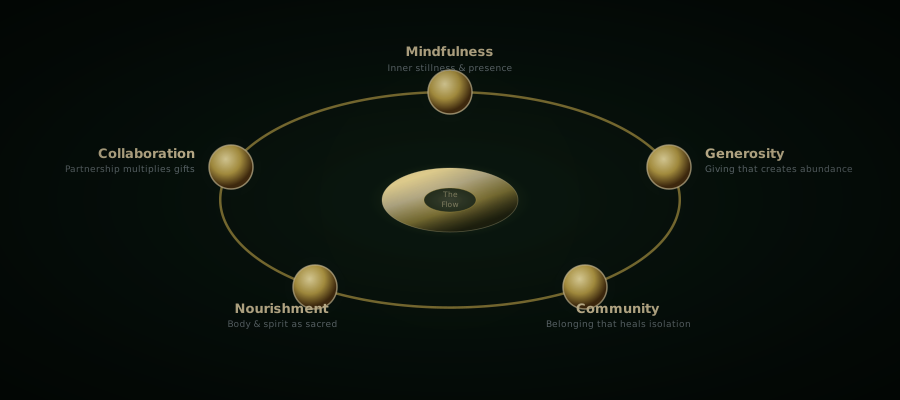
Mindfulness — the practice of awareness — is the inward current of the torus. Before anything can circulate, something must become conscious. Mindfulness practices cultivate the capacity to notice: where am I consuming beyond need? Where am I hoarding through fear? Where could I release, circulate, contribute? The research of the HeartMath Institute demonstrates that heart coherence — the state cultivated by mindfulness practice — literally changes the electromagnetic field a person broadcasts into their community. Consciousness circulates. As explored in Compassion as Inner Clarity, awareness is not passive. It is the energetic source from which all other action flows.
Nourishment — the provision of what sustains life — is the fundamental economic act. Every culture's gift economy begins with food: shared meals, communal harvests, the breaking of bread. The Foundation's programs in community nourishment are not charitable provisioning. They are the reactivation of a toroidal pattern that every traditional culture understood: when food circulates freely through a community, the community coheres.
Community — the web of relationships that makes circulation possible — is the medium of the toroidal economy. Communities are not aggregates of individuals. They are systems of mutual obligation, shared memory, and recursive care. Bernard Lietaer observed that communities with high levels of social capital — dense webs of obligation, favor, and mutual recognition — function as natural complementary currency systems. Every act of neighborly reciprocity is an economic transaction that leaves no trace in GDP but leaves a deep imprint in collective resilience.
Generosity — the voluntary release of what one has toward others' flourishing — is the outward current of the torus. As we explored in The Art & Science of Generosity, generosity is not merely virtue. It is a biological, social, and economic technology. The experiments of behavioral economics consistently show that communities with higher levels of trust and generosity produce more value — measurably — than communities organized around competition and individual maximization.
Collaboration — the creation of value through shared intention — is the geometry of the toroidal organization. The Mondragon Corporation works not because its workers are unusually selfless but because its structure makes collaboration the path of least resistance. The geometry of flourishing is not accidental. It is designed.
Together, these five currents describe an economy that does not require heroes or saints. It requires design — the deliberate choice to build systems in which the natural human impulses toward generosity, reciprocity, and community are supported rather than suppressed.
VII. The Invitation — The Maslow Compass
Abraham Maslow's famous hierarchy of needs — physiological, safety, love, esteem, self-actualization — is often cited to justify prioritizing basic material needs above all else. The poor need bread before they need poetry. This is true as far as it goes.
But Maslow himself spent the final years of his life articulating a level beyond self-actualization: self-transcendence — the orientation of one's capacities not toward personal fulfillment but toward service to something larger than oneself. The hierarchy does not end in individual flourishing. It opens, at the top, into contribution.
The Toroidal Economy is the economic structure that corresponds to Maslow's full vision. It does not force anyone to be altruistic before their needs are met. It creates conditions in which, as needs are met through circulation and cooperation, the natural human movement toward self-transcendence — toward generosity, toward contribution, toward oneness — becomes possible for more and more people.
The invitation is not to sacrifice. It is to participate in a living system that sustains you as it sustains others. To be the mycorrhizal fungus, not despite your own flourishing, but through it.
"A small body of determined spirits, fired by an unquenchable faith in their mission, can alter the course of history." — Mahatma Gandhi
We do not need to replace the global economy tomorrow. We need to build the nodes of the new network — the cooperatives, the local currencies, the community land trusts, the anchor institution partnerships, the gift economies within neighborhoods — until those nodes form connections, until those connections form a web, until that web becomes, for more and more people, the primary reality of economic life.
This is how forests grow. Not from the top down, but from the soil up: one fungal thread at a time, one root connection at a time, one act of circulation at a time.
The torus is already present in every act of genuine giving, every cooperative decision, every local purchase, every community meal. We are not building something new. We are remembering a pattern as old as life itself.
Begin where you are. Circulate what you have. Return more than you take.
This is the Toroidal Economy. And it is already under construction.
Frequently Asked Questions
What exactly is a toroidal economy, and how is it different from a circular economy?
A circular economy — popularized by the Ellen MacArthur Foundation — focuses primarily on redesigning material flows: eliminating waste, recycling materials, closing industrial loops. The Toroidal Economy is a broader philosophical framework. It describes an economy in which all forms of wealth — financial, social, ecological, intellectual, spiritual — flow in sustaining patterns. The circular economy asks: how do we reuse resources? The Toroidal Economy asks: how do we design an entire civilization to function like a living system?
Isn't this just socialism?
No. The Toroidal Economy is not defined by who owns the means of production, but by how value flows. Cooperative ownership, commons governance, social enterprise, community investment, and complementary currencies can all coexist with private enterprise. The question is not ownership alone but circulation: does the design of this economic activity generate flow that sustains the community, or does it generate extraction that depletes it?
Are there examples of toroidal economics in mainstream institutions?
Yes. B Corporations — certified businesses committed to meeting rigorous standards of social and environmental performance — represent the formal business sector's turn toward circulation. Fair Trade networks redesign supply chains to ensure more value reaches producers. The Preston Model adapts public procurement policy. These are not fringe experiments; they represent a coherent pattern emerging across sectors.
How does the Social and Solidarity Economy (SSE) relate to this framework?
The Social and Solidarity Economy — a global movement encompassing cooperatives, mutuals, associations, and social enterprises — is perhaps the closest existing institutional expression of the Toroidal Economy. The SSE explicitly prioritizes social purpose over profit maximization, democratic governance over hierarchical control, and local circulation over global extraction. The United Nations estimates that the SSE accounts for over 10% of global employment.
Can individual people participate, or is this only about large-scale policy?
The Toroidal Economy begins at the individual scale and scales outward. Every local purchase is a vote for circulation over extraction. Every hour exchanged in a time bank is toroidal economics in action. Every community garden, every mutual aid network, every buy-local decision, every cooperative membership is a node in the emerging web. Policy matters enormously — but the pattern starts in practice, and it starts where you are.
What about the Global South? Doesn't this framework ignore the need for economic growth in developing countries?
Manfred Max-Neef explicitly developed Human Scale Development in response to Latin American economic conditions — so this is not a framework developed in Northern comfort and exported. The Kerala Model demonstrates that the Global South can achieve extraordinary human development through circulation and public investment. What the Toroidal Economy resists is not economic activity in the Global South but the extractive pattern — the export of value from local communities to distant shareholders — that has characterized colonial and post-colonial economic relationships.
How does the Heart of Peace Foundation's work connect to the broader Toroidal Economy?
The Foundation's programs are not charity. They are the reactivation of toroidal patterns at the neighborhood scale: nourishment that circulates, generosity that teaches generosity, community that generates social capital, mindfulness that creates the awareness from which genuine collaboration becomes possible. Each program is a thread in the local network. The invitation is to understand that participating in community — really participating, not as consumer but as co-creator — is a revolutionary economic act.
Sources and Further Reading
Primary Works Referenced
- Raworth, Kate. Doughnut Economics: Seven Ways to Think Like a 21st-Century Economist. Chelsea Green Publishing, 2017. Kate Raworth's official site
- Ostrom, Elinor. Governing the Commons: The Evolution of Institutions for Collective Action. Cambridge University Press, 1990.
- Schumacher, E.F. Small Is Beautiful: Economics as if People Mattered. Harper & Row, 1973.
- Fuller, Buckminster. Operating Manual for Spaceship Earth. Southern Illinois University Press, 1969.
- Max-Neef, Manfred. Human Scale Development: Conception, Application and Further Reflections. Apex Press, 1991.
- Lietaer, Bernard. The Future of Money: Creating New Wealth, Work and a Wiser World. Century, 2001.
- Mazzucato, Mariana. The Entrepreneurial State. Anthem Press, 2013. UCL Institute for Innovation and Public Purpose
- Yunus, Muhammad. Building Social Business: The New Kind of Capitalism that Serves Humanity's Most Pressing Needs. PublicAffairs, 2010.
- de Soto, Hernando. The Mystery of Capital. Basic Books, 2000.
- Hyde, Lewis. The Gift: Imagination and the Erotic Life of Property. Vintage, 1983.
- Mauss, Marcel. The Gift: The Form and Reason for Exchange in Archaic Societies. W.W. Norton, 1990.
- Benyus, Janine. Biomimicry: Innovation Inspired by Nature. Harper Perennial, 1997.
- Simard, Suzanne. Finding the Mother Tree. Knopf, 2021.
Proof-of-Concept Models
- Mondragon Corporation — the world's largest worker cooperative federation
- The Preston Model — community wealth building through anchor institutions
- Evergreen Cooperatives — worker-owned cooperatives in Cleveland, Ohio
- Kerala Human Development — UNDP Kerala Human Development Report
- B Lab Global — the B Corporation certification ecosystem
- Fairtrade International — global fair trade standards and network
- RIPESS — Social and Solidarity Economy Network — global SSE alliance
- Grameen Bank — Muhammad Yunus's microfinance institution
Scientific and Philosophical Foundations
- HeartMath Institute Research Library — peer-reviewed research on heart coherence and electromagnetic fields
- Ellen MacArthur Foundation — circular economy frameworks and case studies
- Gift Economy resources — Nipun Mehta's ServiceSpace — gift economy in practice
- Post-Growth Economics Network — degrowth and steady-state economics research
- Community Wealth Building — Democracy Collaborative — anchor institution strategies and cooperative development
- New Economics Foundation — economics as if people and planet mattered
Related Articles in This Series
- The Art & Science of Generosity — the biological foundations of giving
- The Golden Rule as Fractal Law — reciprocity as organizing principle
- Paying It Forward — how generosity moves through time
- Collaboration: The Geometry of Flourishing — shared purpose as value creation
- Compassion as Inner Clarity — the inner ground of sustained action
- Oneness — The Ultimate Technology — the recognition beneath all economies
© The Heart of Peace Foundation. This article may be shared freely for non-commercial educational purposes with attribution.