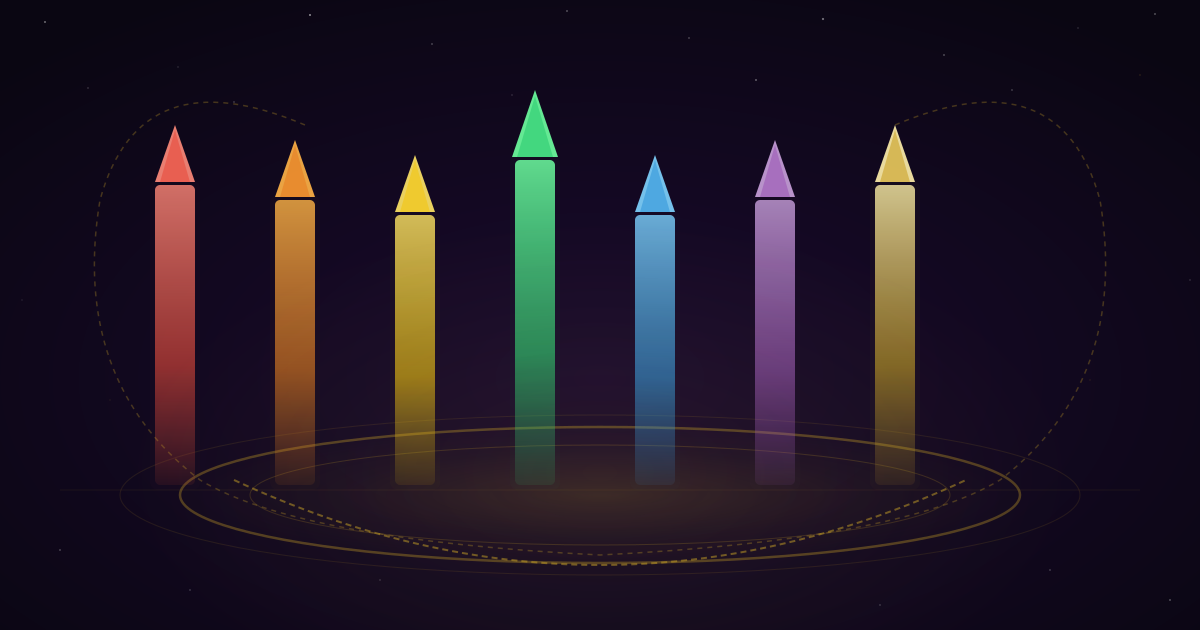
Seven luminous pillars arranged on a toroidal base, each column marking a distinct stage of life's unfolding.
The Color-Coded Printout
What if the fractal life you are already living — the one encoded in your body, your breath, your seven energy centers — could be laid out on a single table? Not a theory. A map drawn by the body itself, for the body itself, of everything the body has ever known.
A man sits at a kitchen table surrounded by printouts. The table is not visible anymore — it disappeared weeks ago under layers of paper, highlighters, coffee rings, and the particular kind of disorder that happens when someone is trying to see a pattern that no one else has confirmed exists. He has been at this for years. Not continuously — there were stretches of months where he walked away, convinced the project was impossible. But it kept pulling him back. The way a melody you cannot name keeps returning: not because you are looking for it, but because it is looking for you.
What he is building is a chart. A massive, color-coded chart that attempts something either deeply foolish or deeply obvious: laying every major religion, every school of philosophy, every political system, every healing modality, every civilization, and every contemplative tradition side by side — not to rank them, not to prove any of them right, but because he keeps noticing the same thing. They are all touching the same elephant. From different angles, with different vocabularies, insisting on different names for the trunk and the tail — but touching. Always touching.
He has tried laying them out alphabetically. By geography. By century. By doctrine. Nothing works. The chart always collapses into a mess of exceptions and special cases. Then one night, staring at a chakra diagram pinned to a studio wall — seven colored circles running up a human spine — something clicks. Not a new idea. An old recognition finally arriving in language: the map is the body. The seven energy centers that every human being carries are not a metaphysical import from the East. They are an observation about the architecture of experiencing itself. And every paradigm in the history of human thought maps onto this architecture — because it was built by the same architecture.
He starts again. This time, the columns are the chakras. And the chart holds.
But the real moment comes later. Much later. He is filling in Column 7 — Emptiness, Pure Potential, the crown — when he notices that its description sounds identical to the conditions from which Column 1 arises. Duality comes from Emptiness. Emptiness is rediscovered through the journey across all columns. It is not a line. It is a ring. A circle. A torus. The fruit contains the seed. The end feeds the beginning. The table has just shown him its own shape — and that shape is the shape of a living thing.
He puts down his pen and stares. Not because the table is finished. Because it never will be.
This article is what that man saw.
Key Takeaways
- Every religion, science, philosophy, and political system is touching the same underlying reality from a different angle — none of them wrong, all of them partial.
- The Ergonomic Table of Periodic Paradigms organizes every major paradigm by the body's own seven energy centers, making the map literally native to the instrument that reads it.
- "Ergonomic" means the table fits human experience because it is built from the architecture of experiencing itself — it is recognized, not learned.
- "Periodic" means paradigms follow predictable patterns, spiraling upward as trust increases and collapsing downward as trust contracts, just as elements fill predictable positions in the periodic table.
- The table forms a torus, not a ladder: Column 7 (Emptiness) is the ground from which Column 1 (Duality) continuously arises, so no column is superior and none is final.
- Each column carries both a luminous and a shadow expression, and the determining axis is the degree of selflessness operating within it — not the column's position on the map.
The Parable and the Promise
There is an old story — ancient enough to belong to no one and therefore to everyone. A group of blind men encounter an elephant for the first time. One touches the trunk and declares: "An elephant is like a snake." Another grasps the leg: "No, like a pillar." A third feels the ear: "You are both wrong — like a fan." The tusk, the belly, the tail — each man is certain, each man is partial, and each man is correct about exactly the part he is touching.
The parable survives across millennia because it is not really about an elephant. It is about what happens when we mistake our angle of contact for the whole. Every paradigm — every religion, every science, every political philosophy, every school of psychology — is a hand touching a different surface of the same living reality. And the moment any of them insists it is holding the whole animal, it becomes the blind man: absolutely certain, absolutely partial.
What if you could lay the entire elephant bare?
Not by claiming to see what the blind men cannot — that would just make you another blind man with a bigger vocabulary. But by mapping where each hand is touching and showing that the surfaces form a coherent shape. Not a shape you invented. A shape you discovered by listening to all the reports and noticing they fit together.
This is what the table attempts.
But before the table is unrolled, there is an insight that needs to land first — the one that makes the rest possible. Imagine every spiritual tradition, every philosophical framework, every self-help methodology as a flavor of Kool-Aid. Cherry, grape, lemon, tropical punch — the flavors are real, the differences are genuine, and your preference matters. But they are all mixed in the same simple water. The water is awareness itself — empty, luminous, tasteless, always already there. Every flavor is a doorway into the water. But you can only drink it if you bring an empty cup. The cup is the practice. The water was always already here.
This is what we are calling the Kool-Aid Insight, and it is the emotional on-ramp for everything that follows: you do not have to switch flavors. The table is not asking anyone to abandon their tradition, their science, or their worldview. It is asking them to notice the water. To marvel that the same element carries every taste. To recognize that the arguments between flavors — which have produced centuries of war, sectarianism, and intellectual contempt — are arguments between hands on the same elephant, flavors in the same water.
In the 108 Framework, we saw the skeleton: Zero, One, and Infinity — three ontological positions through which all of reality can be understood. That skeleton was abstract. Beautiful, but abstract. What the Fractal Life Table does is give that skeleton a body. The same body you already have. Seven vertebrae of meaning running up the spine of consciousness — and every paradigm in history finding its home somewhere along that spine.
The promise is simple: when you see the map, you stop fighting over angles. Not because the differences disappear — they don't, and they shouldn't. But because you can finally see what they are differences of. And that seeing? That is the beginning of the end of every unnecessary war.
The Body IS the Map
Why "ergonomic"?
The word comes from the Greek ergon (work) and nomos (law): the study of how things fit the body that uses them. An ergonomic chair fits the spine. An ergonomic keyboard fits the hands. The Ergonomic Table of Periodic Paradigms fits the body that does the experiencing.
This is not a metaphor. The table is structured according to seven energy centers — the chakras — that map the architecture of every human body. Not as New Age imports or exotic belief. As observation. The same observation that led the Hindu sages to describe muladhara at the base of the spine, the Chinese physicians to map meridians, the Kabbalists to diagram the Tree of Life, and modern neuroscience to document the vagus nerve running from brainstem to gut, passing through every major organ cluster in exactly the order the chakra system describes (Feuerstein, 2001; Motoyama, 1981; Leadbeater, 1927; Judith, 1987).
Seven centers. Seven modes of experiencing reality. Seven rooms in the house of the body.
There is a story that makes this concrete.
A seven-year-old is standing in a yoga studio, staring at a poster of the chakras. She has never heard the word "chakra." She does not know Sanskrit. She does not know what a paradigm is. But she points at each colored circle and says:
"That red one is when I'm scared. That orange one is when I want something. That yellow one is when I'm mad. That green one is when I love my dog. That blue one is when I sing. That purple one is when I know something but I don't know how. And that white one is when I'm asleep and everything is okay."
She has just read the table without ever seeing it. She did it by consulting the only instrument available to her — the one every human being carries. The body already knows. The table is ergonomic because the body is the map, and the map was never missing. It was just waiting for us to stop looking outside and start looking down — at the instrument that has been navigating all seven columns since before we had language to name them.
This is what distinguishes this framework from other integral maps. Spiral Dynamics (Beck & Cowan, 1996), which builds on Clare Graves' research (Graves, 1970), assigns color codes — Beige, Purple, Red, Blue, Orange, Green, Yellow, Turquoise — to levels of development. Ken Wilber's integral theory (Wilber, 1996) maps quadrants, levels, lines, states, and types. Jean Gebser's structures of consciousness (Gebser, 1949/1985) move from archaic through integral. These are all serious, rigorous, illuminating frameworks, and this table shares their impulse toward comprehensive mapping.
But the distinction matters: this table does not assign its architecture from outside. It does not create a classification system and then apply it to human experience. It recognizes the classification system that human experience already is. The somatic ground — the chakras, the body's own architecture — is not a metaphor grafted onto the data. It is the data. Every column is a place in the body. Every paradigm has a somatic address. You can feel Column 1 in the base of your spine when fear grips you. You can feel Column 4 in your chest when love opens. You can feel Column 7 at the crown of your head in those moments of absolute stillness when the thinker disappears and only awareness remains.
The other key distinction is in the shape. Spiral Dynamics and its kin are fundamentally ladders: development moves up through stages, from less complex to more complex. There is always a higher rung. The Fractal Life Table is fundamentally a ring. Column 7 feeds Column 1, the crown feeds the root, emptiness gives birth to duality and duality returns to emptiness in every breath — the way exhale feeds inhale, the way winter feeds spring. The table has no top. It has no bottom. Every point on the ring is equidistant from the center.
The third distinction is methodological. Spiral Dynamics asks one question — what value system is this? — and maps the answer along a single developmental axis. The Fractal Life Table asks three: How does this paradigm touch reality? What does it hunger for? And what does it take the world to be? When at least two of those answers point to the same column, placement stops being a matter of taste. It becomes triangulation — the same technique a navigator uses when two stars and a horizon line are enough to fix a position.
And the fourth: the table keeps growing. It is not a fixed set of types that you memorize and apply. It is a living structure that any domain can walk into — healing, politics, physics, music, cooking, parenting, economics, contemplative practice — and find its own row waiting. A musician can map rhythm to silence and discover the seven columns. A chef already has. The columns hold because they reflect the instrument doing the observing, not the particular field being observed. New domains generate new rows. The architecture remains.
[Contemplative pause: Place your attention at the base of your spine. Notice what lives there — perhaps tension, or solidity, or the simple fact of sitting. Now let attention rise, slowly, through belly, solar plexus, chest, throat, forehead, crown. You just traveled the table. Every column, in seconds, without leaving your chair.]
A chip off the old block.
— Folk wisdom (English)
The Seven Rooms
Imagine a house with seven rooms. Not stacked on top of each other — that would make it a tower, a hierarchy, a thing to climb. Arranged in a circle, so that the seventh room opens back into the first. You can enter from any room. You can live in any room. Each room has its own light, its own texture, its own way of seeing the world. And every room contains, in miniature, the pattern of the whole house.
Room 1 — Duality (Root / Muladhara / The Number 2)
The root. Survival. The fundamental experience of self and other, inside and outside, this and not-this. This is not a mistake and not a punishment — it is a necessary beginning. The taproot that must go down before anything can grow up. Without the experience of separateness, there is no journey to oneness. Without the fear of the unknown, there is no discovery of what is already known.
You know this room. You were born into it. The cry of the infant torn from the womb is Column 1's sound. The clutch of anxiety before a job interview, the scanning of a parking lot at night, the primal calculation of is this safe? — that is Column 1 doing its work. And that work is sacred, even when it does not feel sacred. It is awareness at maximum density, contracted into the smallest possible point so it can protect what it loves.
Feel it in the body. The base of the spine, the pelvic floor, the legs — anything that roots you to the ground. When danger appears, this is where the body responds first: the legs tense to run, the gut clenches, the jaw tightens. The material veil — the contraction that mistakes the physical for the whole of reality — operates from this column. Not because the physical is unreal, but because mistaking it for all there is produces a particular kind of suffering: the suffering of being trapped in a world that appears to be nothing but matter, nothing but threat, nothing but scarcity.
"Time is Money" lives here (Arguelles, 1987). Capitalism in its primitive form lives here. Every zero-sum game lives here. The number 2 lives here — because duality is the first act of division: one reality, split into subject and object.
The shadow of this room is not evil. It is fear that has forgotten it is temporary. Materialism that has forgotten matter came from somewhere. Separateness that has forgotten it is a perspective, not a prison. And the light of this room — the parent who protects, the firefighter who runs into the burning building, the body that keeps breathing while you sleep — is one of the most selfless forces in existence.
Room 2 — Unity (Sacral / Svadhishthana / The Number 1)
The first exhale. The recognition: I am not alone. Where duality sees two, unity sees one. Where Column 1 experiences the world as threat or resource, Column 2 begins to experience it as partner, as beloved, as the other half of a relationship that was always already whole.
This is the column of faith, devotion, belonging, connection. Every love story begins here. Every religion that says "God is One" — Judaism's Shema, Islam's Tawhid, Hinduism's Brahman — has planted its flag here. The oscillation between Column 1 and Column 2 is the fundamental rhythm of all social life. Every war is Column 1 winning; every peace treaty is Column 2 trying to hold.
Feel it in the body. The lower belly, the sacral center — the place where relationship lives in its most primal form. The warmth that rises when you are held by someone you trust. The softening that happens when the scanning stops and the animal body says: safe. Mahayana Buddhism lives here — the great vehicle, the vow to liberate not just oneself but all beings. Zen sits here with its emphasis on sangha, on communal practice, on the bowl held out to receive. This is where the motivation shifts from "I need to be free from suffering" to "I want others to be free from suffering" (Sri Aurobindo, 1939-40).
The number 1 lives here — not the lonely one of solitude, but the one of union. The one that says: despite all appearances of separation, there is a single fabric underneath.
Room 3 — Multiplicity (Solar Plexus / Manipura / The Number Infinity)
The paradox that resolves the tension between duality and unity: reality is neither one nor many — it is infinitely diverse and fundamentally whole simultaneously. This is the room of power, will, personal agency, achievement, and the recognition that difference itself is a kind of abundance. Identity becomes strong enough here to hold complexity without collapsing it.
The number infinity lives here — because once you see that reality is neither purely dual nor purely one, the possibilities become limitless. Every science that maps complexity, every philosophy of pluralism, every political system based on individual rights draws its energy from this room.
You know this room too. It is the feeling of "I can." The surge of competence. The moment you realize your voice matters, your choices matter, your will is a force in the world. The golden rule begins to operate here at the personal scale — the recognition that what you do to the world, you do to yourself, because the multiplicity includes you.
Room 4 — Energy (Heart / Anahata / The Number Lambda)
The heart. Not the sentimental heart of greeting cards, but the electromagnetic heart — the organ that generates the largest electromagnetic field of any organ in the body, measurable several feet beyond the skin. This is the column of reciprocity: giving and receiving as a single gesture. Love not as emotion but as force — the organizing principle that makes connection possible (Kropotkin, 1902).
Here is where the table's deepest shift happens. Columns 1 through 3 are, in different ways, oriented around the self — survival, belonging, power. Column 4 is where the orientation begins to reverse. Not because selfhood disappears, but because the self discovers it is larger than it thought. "I want to help others" stops being an aspiration and becomes a lived reality. Generosity ceases to be a virtue performed at cost and becomes the natural expression of a heart that has recognized itself in the other.
Feel it in the body. The chest — warmth, openness, the literal feeling of space behind the sternum when compassion arises. Or the opposite: the tightness, the closing, the protective armor that goes up when the heart has been hurt. Both are Column 4. Both are the heart doing its work — in one case, flowing; in the other, guarding. The compassion lineage lives here — the historical carriers of the teaching that love is not just an emotion but the organizing principle of reality.
The number lambda (wavelength = intensity times pattern) lives here — because the heart's intelligence operates through resonance, not logic. It knows not by thinking but by feeling the frequency of what it encounters.
Room 5 — Fractality (Throat / Vishuddha / The Number Phi)
Expression. Sound. Creative voice. Each part contains the pattern of the whole — phi, the golden ratio, where each number is the sum of the two before it (Mandelbrot, 1982; Lawlor, 1982). The throat is where inner reality becomes outer expression — where knowing becomes language, where feeling becomes art, where the inner world offers itself to the outer and, in the offering, discovers itself.
"Time is Art" lives here (Arguelles, 2002). This is Arguelles' great insight: time is not a commodity to be spent (Column 1) but a creative medium to be expressed. Each moment echoes all other moments. The artist does not extract value from a moment — they offer the moment back to itself in a form it can recognize.
This room is self-referential not because it is narcissistic but because what it expresses reveals the speaker to themselves. The writer who discovers what they think only by writing it. The musician who finds out what they feel only by playing it. The mirror that built the mirror — consciousness looking at itself through its own creative expression and recognizing what it sees.
The number phi lives here — the golden ratio, the Fibonacci spiral, the mathematical signature of self-similar growth (Critchlow, 1976; Lawlor, 1982). Each moment is the sum of all previous moments. The fractal is the voice of the universe speaking itself into form. Bateson called it "the pattern which connects" (Bateson, 1979) — mind not inside the skull but in the relationships between organisms and environment, self-referential patterns all the way down.
Feel it in the body. The throat — the place where what was private becomes public, where the interior offers itself to the exterior. The vibration of sound in the vocal cords. The catch in the voice when truth is being spoken for the first time. Hidden wisdom operates here: the veils that once contracted awareness now become windows, and what they reveal is the fractal pattern — each contraction echoing every other, each release echoing every other, the whole mirrored in every part.
Room 6 — Luminosity (Third Eye / Ajna / The Number i)
Beyond expression into direct seeing. The third eye is not a metaphor — it is the faculty that sees what is seeing. Not thoughts about awareness, but awareness recognizing itself (Dudjom Rinpoche, 1991; Longchenpa, 2001). Where Column 5 asks "what am I expressing?", Column 6 asks "what is seeing this?"
This is the column of gnosis — vidya in Sanskrit, rigpa in Tibetan — the direct, unmediated recognition that makes all knowledge meaningful. The imaginary number i lives here: you cannot locate it on the real number line, but it makes mathematics complete. You cannot locate Column 6 on the spectrum of ordinary experience, but without it, the spectrum makes no sense.
Arguelles' "Time is Art" becomes possible in Column 5. But here, in Column 6, a further recognition: beauty is not something we create. Beauty is what reality looks like when nothing is added or subtracted. Beauty is organic — the self-recognition of the universe (Huxley, 1945; Bohm, 1980). This is the Gaia mind waking up to itself — not as metaphor, but as the direct recognition that awareness is not inside the skull but in the relationships between all things (Bateson, 1979).
Room 7 — Emptiness (Crown / Sahasrara / The Number 0)
The ground state. Not nothingness — potential-ness. The zero that contains all numbers. The silence that makes music possible. The empty cup before any flavor is added. This is the column the entire table is aimed at — not as a destination, but as a recognition. It was always already here. Every other column is emptiness wearing different clothes, with different degrees of awareness that it is empty.
The number 0 lives here — and as the 108 Framework showed us, 0 is not absence but fullness. The mirror surface that reflects all images without being any of them. The space in which the torus turns.
Here the descent sequence completes itself — the poem that is the table's spine:
When Nothing descends, there is One. When One descends, there is Duality. When Duality descends, there is Multiplicity. When Multiplicity descends, there is Energy. When Energy descends, there is Form. When Form descends, there is I. When I descends, there is You. When You descends, there is Love. When Love descends, there is Light. When Light descends, there is No-thing.
The descent from emptiness through all seven columns and back again — this is the living architecture. Every column is a stop on the emanation from pure potential into maximum form, and the return from maximum form to pure potential. Not a one-time cosmic event, but happening in every breath, every perception, every moment of attention.
The 8th Position — The Container
There is an eighth position. It is not a column. It is the container of the entire table — the empty space in which the torus turns, the cup before any Kool-Aid is poured. Inexpressible Awareness. Pure potential beyond all description. It has no content because it IS the capacity for content. It is referenced but not represented. Column 7 is the highest expression within the table. The 8th position is the space in which the table itself exists.
The table's built-in humility: the map acknowledges it cannot map the territory that holds the map.
[Contemplative pause: After reading these seven rooms, which one did you recognize first? Not which one sounds best — which one did you feel in your body as familiar? That is your current center of gravity. Not your ceiling. Not your assignment. Just where your feet happen to be standing right now. Notice it without judgment.]
How to Read the Map
The table would be a Rorschach test — a pretty arrangement reflecting the mapmaker's preferences — without principled placement criteria. If someone says "capitalism belongs in Column 1" and someone else says "capitalism belongs in Column 3," we need more than opinion. We need convergent triangulation.
Think of it this way. You meet someone at a party. Before they say a word, three things tell you who they are: how they pay attention (are they scanning the room for threats, or gazing at a painting?), what they are hungry for (safety? connection? the chance to speak?), and what they take the room to be (a competition? a family gathering? a work of art?). These three reads are the same three the table uses to place any paradigm. When at least two of the three agree, placement becomes cartographic, not opinionated. When all three diverge, the motivational criterion takes precedence — because the table maps lived gravity, not stated doctrine.
How does it know? — the first read.
Each column has a characteristic way of touching reality. Column 1 knows through the senses — the weight of evidence in the hand, what can be measured and tested. Column 2 knows through revelation, faith, the transmission that arrives when the heart is open. Column 3 knows through logic and rational inference — the mind building from premises to proofs. Column 4 knows through felt-sense — the body's own intelligence, the gut that tightens before the thought arrives. Column 5 knows through creative expression and symbolic analogy — truth that appears in the act of making. Column 6 knows through gnosis — direct seeing, without inference, the way you know you are awake right now. Column 7 is beyond all epistemic categories — non-conceptual, non-referential, the knowing that contains all knowing.
What does it hunger for? — the second read.
Column 1 hungers for security — the ground under the feet. Column 2 hungers for belonging — the hand that holds. Column 3 hungers for power and mastery — the voice that matters. Column 4 hungers for love — not romantic love, but the force that makes connection real. Column 5 hungers for expression — the truth that can only be sung. Column 6 hungers for wisdom — liberation from every conceptual overlay. Column 7 hungers for nothing — it is the recognition that seeking itself has ended.
What does it take reality to be? — the third read.
Column 1 says reality is material and separate. Column 2 says reality is unified and relational. Column 3 says reality is complex, plural, and self-organizing. Column 4 says reality is energetic and processual — always becoming (Whitehead, 1929). Column 5 says reality is fractal and holographic — each part contains the whole (Pribram, 1971). Column 6 says reality is luminous and awareness-based. Column 7 says reality is empty — beyond all categories, neither one nor many.
Three convergent criteria — epistemic, motivational, and ontological — meeting at the center of placement.
A Worked Example
Take capitalism. Run it through all three criteria.
Epistemic: Capitalism knows through empirical measurement — GDP, stock prices, market data. Sensory-material evidence. That places it at Column 1.
Motivational: Capitalism seeks growth, profit, accumulation, competitive advantage. That is the power-achievement drive of Column 3.
Ontological: Capitalism takes reality to be material, separate, and fundamentally competitive — a world of scarce resources distributed by market forces. That is Column 1.
Two of three criteria point to Column 1. One points to Column 3. The table places capitalism at Column 1 with a Column 3 motivational sub-signature. And the periodicity principle predicts something the table confirms: the shadow expression of capitalism (exploitation, extraction, zero-sum) is Column 1 shadow, while its light expression (entrepreneurial creativity, honest exchange, productive problem-solving) reaches toward Column 3 and even Column 4.
Now try Buddhism. Specifically, Theravada Buddhism.
Epistemic: Theravada knows through direct observation of mental and bodily phenomena — mindfulness, vipassana, empirical attention. Column 1 (sensory-material) with a Column 4 (phenomenological) sub-signature.
Motivational: Theravada seeks liberation from suffering — freedom from the cycle of birth and death. That is Column 1's primary drive: freedom from suffering.
Ontological: Theravada takes reality to be impermanent, interdependent, and ultimately characterized by no-self. That is a more nuanced view, reaching toward Column 5 (self-referential impermanence) or even Column 7 (emptiness).
Two of three criteria anchor in the Column 1 neighborhood. The table places Theravada at Column 1 — not as an insult (Column 1 is the root, the foundation, the most honest starting point) but as a recognition of its epistemic and motivational center of gravity. And the periodicity principle predicts what practitioners confirm: a dedicated Theravada practitioner can access Column 7 realization from a Column 1 starting point, because the column is an entry point, not a ceiling.
Now try permaculture.
Epistemic: Permaculture knows through observation of natural systems — cycles, patterns, feedback loops. Column 5 (pattern recognition, fractal thinking).
Motivational: Permaculture seeks regeneration — the creation of self-sustaining systems that give more than they take. Column 4 (reciprocity) reaching toward Column 5 (creative self-referencing).
Ontological: Permaculture takes reality to be a self-organizing network of interdependent relationships — each part reflecting and sustaining the whole. Column 5 (fractal).
Three of three criteria converge on the Column 5 neighborhood. The table places permaculture at Column 5 with high confidence. And the toroidal economy is what permaculture looks like when it is applied to economics — Column 7's prediction for what emerges when Column 5's regenerative principles are taken to their logical conclusion.
The apple doesn't fall far from the tree.
— Folk wisdom (English)
The Table at Work
The table's power is not in its architecture alone — it is in what happens when you apply the seven-column structure across radically different domains and discover that the same spectrum holds. Every domain generates a new row. The columns hold because they reflect the instrument doing the observing, not the particular field being observed.
Here are five domains, fully walked.
Four life domains mapped across seven columns, showing how each column's character shapes every area of human experience.
Healing: From Surgery to Self-Liberation
What does healing look like when practiced from each column's center of gravity?
At Column 1, healing is physical and surgical — the body as mechanism to be repaired. Emergency medicine, antibiotics, pharmacology, physiotherapy. The healer is a physician. The medium is the body as material object. This is profoundly necessary and profoundly incomplete. It saves lives. It cannot explain why some patients recover and others don't when the pathology is identical.
At Column 2, healing is emotional and relational — healing through connection. Psychotherapy, support groups, prayer, pastoral care, 12-step programs. The healer is a therapist, a priest, a sponsor, a community. The medium is relationship itself. If you have ever felt something shift in a conversation with someone who simply listened — not fixed, not advised, just listened — you have experienced Column 2 healing.
At Column 3, healing is behavioral and cognitive — healing through mastery and discipline. CBT, willpower programs, coaching, nutritional science. The healer is a coach, a behaviorist. The medium is the mind and its habits. Column 3 healing says: change your patterns, change your reality.
At Column 4, healing is integrative and somatic — healing through felt-sense reconnection. Yoga, acupuncture, herbal medicine, somatic therapy, heart coherence training, Traditional Chinese Medicine. The medium is energy and sensation. Here the body is no longer a machine to be fixed but a field of intelligence to be listened to. The IMP framework — intention, motivation, purpose — begins to operate naturally here, because healing at this column requires knowing why you want to heal, not just what to fix.
At Column 5, healing is creative and expressive — healing through authentic expression. Art therapy, music therapy, breathwork, dance, shamanic ceremony, narrative medicine, psychedelic-assisted therapy in therapeutic context. The medium is expression and story. Here the healer is an artist, a shaman, a ceremonialist — and the act of creation itself is the medicine. The wound is not treated. It is given a voice. And in speaking, it transforms.
At Column 6, healing is transmission and recognition — healing through direct recognition of one's original nature. Pointing-out instruction, spontaneous insight, the teacher's presence as medicine. There is no medium here — or rather, the medium is direct awareness itself. Certain non-dual retreat formats operate here. The healer does not do anything to the patient. They create the conditions in which the patient recognizes what was never broken.
At Column 7, healing dissolves — the recognition that what was seeking to be healed was never damaged. Self-liberation. The distinction between healer and healed collapses. This is the ground state of healing — and it is not a technique. It is what remains when all techniques have done their work and fallen away.
This row alone demonstrates why the table matters. Not because it ranks healing modalities — Column 1 surgery saves lives that Column 7 dissolution cannot — but because it shows every healer where they stand, what they are offering, and what else exists. A physician who understands that their Column 1 medicine operates within a larger spectrum becomes a better physician. A shaman who knows their Column 5 ceremony has a Column 1 complement becomes a more honest practitioner. The spectrum of compassion operates in each of these columns — the selflessness axis runs through every healing encounter.
Civilization Ages: From the Campfire to the Emerging Integral
Each civilization era represents a dominant center of gravity — not the elimination of prior columns but the emergence of a new primary organizing principle. All previous columns persist; a new one becomes the zeitgeist. You can feel each era in your own week — the moments of animal vigilance, the warmth of belonging, the surge of ambition — because the body carries all of them simultaneously.
Column 1 — The Nomadic / Paleolithic (roughly 300,000 to 10,000 BCE). A woman crouches at the edge of a firelight circle, scanning the darkness for the shape that does not belong. Hunter-gatherer. Tribal survival. Animism as navigation, not belief — the world as alive, dangerous, and responsive to right relationship. The fundamental question — felt in the legs before it becomes a thought: will we eat tomorrow?
Column 2 — The Agricultural / Neolithic (roughly 10,000 to 3,000 BCE). The first child born beside a planted field, growing up knowing the river would return. River valley civilizations. The Nile, the Tigris-Euphrates, the Indus, the Yellow River. Temples as centers of community cohesion. The invention of writing — not for literature, but for grain accounting. The fundamental question, murmured in temple courtyards: do the gods favor us?
Column 3 — The Classical / Imperial (roughly 3,000 BCE to 1,400 CE). A student in Athens stands up in the agora and says: "But what if the teacher is wrong?" Greek city-states, the Roman Empire, Han China, medieval kingdoms. The emergence of philosophy, formal logic, organized religion as state apparatus. The individual as agent, as citizen, as thinker. The fundamental question: who has the right to rule?
Column 4 — The Renaissance / Humanist (roughly 1,400 to 1,800 CE). A painter in Florence steps back from a canvas and realizes the face staring out is not a saint but a man — a particular, irreplaceable, sacred man. Humanism. The Reformation. The Enlightenment. Science and spirituality in uneasy coexistence, each claiming a different piece of truth. The fundamental question: what is the human being capable of?
Column 5 — The Industrial / Modern (roughly 1,800 to 2,000 CE). The factory whistle blows and a million bodies move in unison toward machines. Steam engine. Printing press. Mass communication. Global trade. "Time is Money" as operating system — and colonialism as Column 1 shadow projected at civilizational scale, dark reification in its most destructive expression. The fundamental question: how much can we produce?
Column 6 — The Information / Digital (2,000 to present). Internet. AI. Decentralized networks. Systems thinking. Teilhard de Chardin's noosphere (Teilhard de Chardin, 1959) materializing in code. The fundamental question: what emerges when everything is connected? This is where we stand — and the vertigo of this column is that it contains all previous columns simultaneously. Column 1 capitalism still operates. Column 2 religious tribalism still operates. Column 3 nation-state competition still operates. But underneath, a new center of gravity is forming: connection, emergence, the recognition that separate systems are expressions of one network.
Column 7 — The Post-Information / Integral (emerging). Not yet widely realized. Regenerative civilization. Consciousness as explicit organizing principle. The toroidal economy where output becomes input. Platform-as-Medicine where the medium is organized around recognition rather than production. The fundamental question: what wants to emerge through us? Sri Aurobindo (1939-40) called it the Supramental. Teilhard called it the Omega Point. Fuller called it comprehensive design science — the recognition that nature is trying to make us succeed, and that structural integrity emerges from the pattern, not the parts (Fuller, 1975). The table says: it is Column 7 becoming self-aware, and it is happening now.
Time: From Money to Art to Beauty
One of the most precise demonstrations of the table at work is the domain row of time phenomenology — how each column experiences the nature of time itself (Arguelles, 1987; Arguelles, 2002).
Column 1 — Chronos. Clock time. Time as scarce resource, as commodity, as the raw material of transaction. Under this paradigm, a moment unmonetized is a moment wasted. Life becomes a ledger. This is "Time is Money" — the operating system of industrial capitalism.
Column 2 — Kairos. Relational time. The right moment — not measured by the clock but felt in the heart. When a mother knows it is time to speak to her child, she is not consulting a schedule. She is reading kairos — sacred timing, devotional timing, the kind of time that cannot be bought.
Column 3 — Achievement time. Earned interval. Milestone. Deadline. Time as the metric of self-mastery. The marathon runner's personal best. The quarterly sales target. Time measured not in minutes but in accomplishments.
Column 4 — Duree. Henri Bergson's duree — lived time, felt becoming, time as inner flux rather than external container. The hour that vanishes when you are with someone you love. The afternoon that stretches forever when you are grieving. Column 4 time is experienced, not measured.
Column 5 — Spiral / Mayan time. Fractal recurrence. Each moment echoing all other moments. Time as pattern. This is Arguelles' "Time is Art" — each moment is a creative expression that contains the signature of all moments before it and all moments after it. The Fibonacci sequence operates here: each moment is the sum of the two that came before.
Column 6 — The Eternal Now. The present that contains all time. In direct awareness, past and future have no independent existence. The meditator who sits for an hour and experiences no duration has not lost time — they have found the time that contains all time (Davidson & Lutz, 2008).
Column 7 — Timelessness. The Kalachakra — time as mere appearance arising in and dissolving back into primordial ground. Time and no-time inseparable. Not the absence of time but the ground from which time and timelessness both arise. Beauty is organic — what reality looks like when time itself is recognized as a display of awareness.
Notice what this single domain row reveals: the progression from "Time is Money" (Column 1) through "Time is Art" (Column 5) to "Beauty is Organic" (Column 7) is not theoretical. It is the lived trajectory of anyone who has ever moved from deadline-driven exhaustion to creative flow to the kind of stillness where time simply stops mattering. The row is autobiographical for anyone who has ever watched a sunset and forgotten what time it was. That forgetting is not laziness. It is Column 5 or 6 operating for a moment in the midst of a Column 1 day.
The thermodynamics of compassion offers the physics bridge for this insight: time and energy are related at every column, and what changes as you move across the spectrum is not the physics but the relationship to the physics — from time as entropy (Column 1) to time as creative pattern (Column 5) to time as the display of timeless awareness (Column 7).
Contemplative Traditions: The Nine Vehicles
The Buddhist Nine Yanas (vehicles) map onto the seven columns with extraordinary precision, revealing that the Buddha's own tradition recognized the same spectrum (Dudjom Rinpoche, 1991):
Columns 1-2 — Theravada (Yanas 1-2). The basic vehicle. Path of renunciation. Mindfulness, moral discipline, direct observation of mental and physical phenomena. Motivation: liberation from suffering for oneself.
Column 2 — Mahayana (Yana 3). The great vehicle. Path of purification. Emptiness as not nihilism or eternalism. Motivation: liberation for the sake of all beings. The bodhisattva vow.
Columns 3-4 — Outer Tantra (Yanas 4-6). Kriya, Charya, and Yoga Tantra. Path of transmutation — impurity transformed into purity through ritual, practice, and yogic discipline. The deity is first external, then friend, then merged with.
Column 5 — Mahayoga (Yana 7). Inner Tantra. Generation and completion stages. The practitioner becomes the deity — not as metaphor but as recognition. Buddha nature is primordially existing wisdom and compassion.
Column 6 — Anuyoga (Yana 8). Completion stage. Emptiness of all dharmas. The ground recognized as Buddha-nature. Approaching direct recognition.
Column 7 — Dzogchen / Atiyoga (Yana 9). The Great Perfection. Path of self-liberation. "Mind is Luminosity." The three kayas are inseparable in naturally arising wisdom. The fruit: rainbow body of great transference (Longchenpa, 2001). No effort. No technique. Recognition of what was never not the case.
This mapping does not flatten the traditions. It reveals why a practitioner can enter at any yana and, through dedicated practice, access the realization of any other. The column is the entry point. The destination has always been the same room.
Politics and Economy: From Extraction to the Torus
Column 1 — the clenched fist. Capitalism, socialism, communism — systems built on the premise of scarce resources distributed by power. Marx's historical materialism, mercantilism, zero-sum geopolitics. You feel this column in your gut during a layoff announcement: there is not enough, and the question is who gets it.
Column 2 — the handshake. Populism, pluralism, the tragedy of the commons — systems that organize multiplicity through belonging rather than force. Adam Smith's invisible hand (which is a Column 2 faith-claim, not a Column 3 rational one). The warmth you feel at a town hall where neighbors who disagree still show up.
Column 3 — the ballot box. Professionalization, craft guilds, the meritocratic ideal: the best ideas should win. Column 3 politics produces democracy — and also bureaucracy. The pride of casting a vote. The frustration of the form that requires a form to fill out the form.
Column 4 — the outstretched hand. Public utilities, NGOs, the United Nations, human rights frameworks. Systems organized around care — not yet around recognition, but around the lived commitment to others' flourishing. Paying it forward as institutional design. The relief worker who has not slept in forty hours and keeps going — not from duty, but from love.
Column 5 — the network. Renewable energy, universal basic income, permaculture, decentralized finance, the common heritage of humanity (Sheldrake, 1981; Briggs, 1992). Systems that recognize the fractal pattern underlying exchange — markets and ecosystems as self-similar structures at every scale.
Column 6 — the open palm. The Gift Economy (Eisenstein, 2011), Gross National Happiness (Bhutan), commons-based peer production (Benkler, 2006), mutual aid (Kropotkin, 1902). These systems do not engineer generosity — they recognize it as the natural state. The neighbor who leaves tomatoes on your porch without a note.
Column 7 — the circle. The toroidal economy — the economy as a living torus where output becomes input, generosity is the currency, and giving and receiving are the same gesture. Not yet widely named or practiced. A paradigm being born. This is the gap in the table that functions as prediction — the way Mendeleev's empty squares predicted Gallium (Mendeleev, 1869; Scerri, 2007).
Children see, children do.
The Shadow Is Not the Enemy
Each column's luminous and shadow expressions, showing how selflessness or self-contraction shapes the same energy differently.
Every column has two faces. Not good and evil — light and shadow. And the difference between them is not the column itself but something operating within it: the degree of selflessness.
Light expression = selfless intention — giving, opening, releasing, serving. The infinite space of the spectrum of compassion operating freely.
Shadow expression = self-centered intention — grasping, contracting, taking, protecting the self-image.
This is not a moral judgment. Both arise from the same awareness. The shadow is selflessness temporarily forgotten. The light is selflessness recognized. Every column has both expressions available simultaneously, because the axis of compassion is infinite and present at every level.
A Column 1 action can be profoundly selfless — a parent throwing themselves in front of a car to protect their child. That is survival instinct operating in perfect selflessness. A Column 7 spiritual claim can be profoundly self-centered — "I have achieved the highest realization; everyone else is still asleep." That is emptiness language weaponized by the ego.
The column does not determine the heart. But the heart, operating freely, tends toward the light expression of whatever column it inhabits.
Here is what this looks like in practice:
Column 1 light: Grounded, stable, secure, practical, focused on solutions. Capable self-preservation. Realistic outlook rooted in genuine care for survival — your own and others'.
Column 1 shadow: Fearful, anxious, insecure, overly attached to material possessions. Every unfamiliar thing is a threat. Every difference is a danger. The cycle of harm operates here — hurt people hurting people, not from malice but from the contraction of unmetabolized fear.
Column 4 light: Loving, compassionate, empathetic, forgiving. The ability to give and receive love as a single gesture. Connected to others not from need but from recognition.
Column 4 shadow: Jealous, resentful, bitter, closed off. Unable to trust. The heart that wanted to love but was wounded, and now protects itself by refusing to feel. Not a failure of the heart — a contraction of it.
Column 7 light: Connected to all beings, unconditional love, oneness with the universe. The ground state recognized and lived. Peace that does not depend on circumstances.
Column 7 shadow: Egotistical, arrogant, disconnected from reality, using spiritual language to maintain a superior self-image. Spiritual bypassing at its most refined — the five veils operating at the subtlest level, where the veil is made of emptiness-talk rather than material attachment.
This last point deserves emphasis, because it is the shadow most invisible to the person casting it. Column 7 shadow sounds like wisdom. It uses the right vocabulary. It says "everything is emptiness" — and uses that truth to avoid feeling grief. It says "there is no self" — and uses that truth to sidestep accountability. Reification at Column 7 is the most paradoxical form: freezing the unfreezing itself, making a fixed identity out of the teaching of no-fixed-identity. The Column 7 shadow is the spiritual teacher who has mistaken their map for the territory, their realization for the relationship, their emptiness for their ego wearing the emptiest possible mask.
The selflessness axis — the axis the spectrum of compassion maps in full — is the true organizing principle beneath every column. It is not a column of its own. It is the weather system operating in all seven rooms simultaneously. And the crucial teaching embedded in this axis is that the direction of movement matters more than the position. A person moving from Column 1 shadow toward Column 1 light — from paranoid self-protection toward grounded, courageous care — is making a more real spiritual journey than a person sitting comfortably in Column 6 light who has never been tested. The five radical realizations name the destinations this movement points toward, and each of them can be reached from any column.
[Contemplative pause: Think of a moment when you acted from your very best — not from obligation, but from genuine care. Which column were you standing in? Now think of a moment when you contracted — not from evil intent, but from fear, or pride, or the need to protect something. Which column were you standing in? Was it the same column both times?]
Any Door, Same Room
Here is where the table could become dangerous. Without this section, the table is a spiritual ranking system — a new ladder to climb, a new way to feel superior about where you stand and inferior about where you don't. The table must disarm this reading completely, or it fails.
The disarmament is the State vs. Stage distinction.
Column placement describes a system's structural center of gravity — not the realization level of any practitioner within it.
A dedicated Theravada practitioner (Column 1) who has spent forty years in silent retreat may be vastly more awake — more compassionate, more present, more free — than a weekend Dzogchen enthusiast (Column 7) who has read about emptiness but never sat with their own pain. The column describes the method, not the attainment. The entry point, not the ceiling.
Peak experiences can arise at any column. You can be completely consumed by grief (Column 1 territory — raw survival, overwhelm) and in the very depths of that grief, touch something so vast and still that it can only be called Column 7. You can be painting a picture (Column 5) and the boundary between you and the painting dissolves in a way that mystics would call Column 6. You can be running for your life (Column 1) and experience a clarity so total that time stops. Maslow (1962) documented this in his study of peak experiences — moments of self-actualization that appear spontaneously across all levels of his hierarchy. His later addition of transcendence beyond self-actualization (Maslow, 1969) was precisely this recognition: the peak is available from any base camp.
The grandmother in Oaxaca who arranges her spices by bodily resonance has likely never meditated in a formal sense. But the attention she brings to her craft — the quality of presence, the love encoded in the arrangement — may produce states of awareness that a formal meditator would recognize. The column is the doorway. The quality of attention at that doorway determines what opens.
States are always available. Stages develop over time. The table maps structural affinities, not personal attainments.
This means the table is not a ladder. It is a spectrum of doorways, and any door can open into the same room. The room is the 8th position — the container of the table. The awareness in which all columns arise. You do not get there by climbing from Column 1 to Column 7. You discover it by going fully, completely, unreservedly through whichever door you are standing in front of right now.
Kuhn's insight about paradigm shifts (Kuhn, 1962) applies here: the shift from one column's center of gravity to another is not a gradual climb but a discontinuous leap — a gestalt switch, a moment when the old frame suddenly looks like a subset of a larger frame. And the largest frame — the one that contains all others — is not Column 7. It is the 8th position. The space. The silence. The cup.
Karma as the shape of attention becomes relevant here: wherever your attention habitually rests — whichever column draws you most consistently — that is where your karma is operating. Not as punishment, but as pattern. And patterns can shift, in an instant, when the attention is freed.
The Torus Turns
Toroidal architecture showing Column 7 curving back to Column 1, where emptiness flows into renewed duality.
Now for the shape itself.
The table is not a line. It is not a ladder. It is not a pyramid. It is a torus — a donut-shaped surface where the outer edge curves back to meet the inner edge, where the top flows into the bottom, where what appears to be the end is the beginning wearing different clothes.
Column 7 (Emptiness, Pure Potential, 0) is the ground from which Column 1 (Duality, Separateness, 2) continuously arises. The fruit contains the dormant seeds. The crown contains the root. The rainbow body contains the screaming infant. The sacred joke — which the next article in this series explores — is the moment awareness recognizes the setup: it went through all that drama, all those columns, all those paradigms, only to arrive back where it started. And it laughs, because the starting point was the destination all along.
A grandmother in Oaxaca has never heard of paradigm theory. But her spice cabinet is the table. She arranges spices not alphabetically, not by color, but by what they do to the body: warming spices at the bottom — root spices, survival spices, the ones that heat the blood and ground the belly. Sweet spices in the middle — heart spices, nourishment spices, the ones that connect and comfort. Cooling herbs at the top — crown spices, release spices, the ones that calm and dissolve. When her granddaughter asks why, she says: "Because the body is a house, mija, and every room needs its own medicine." She has been reading the ergonomic table her whole life. She just calls it cooking.
And notice: when she runs out of a cooling herb, where does she go? Back to the warming roots. Back to the bottom shelf. Because the body that needs release first needs grounding. The top of the cabinet feeds the bottom. The torus turns in her kitchen.
This toroidal architecture has a practical consequence that changes how you relate to your own most contracted experiences. If Column 7 feeds Column 1, then the most contracted, fearful, materialistic, survival-driven experience you have ever had — the one you are perhaps most ashamed of, the one that feels most distant from "spiritual" — is emptiness at maximum density. It is not a failure of awareness. It is awareness wearing its heaviest coat. And the coat is not the enemy. It is the same fabric as the crown — just folded very, very tight.
We do not escape Column 1. We discover that it was always Column 7 in disguise.
The CEO who realizes her organization is stuck in Column 3 — power, achievement, metrics — and wants to move toward Column 4 does not do it by denouncing Column 3. She does it by asking one question at the next board meeting: "What if our output became our input? What if everything we give came back — not as revenue, but as relationship?" The board stares at her. She has just described the torus. Not as theory. As budget proposal.
This is how the torus turns in organizational life: not by abandoning the column you are in, but by recognizing that every column contains the seed of every other column. The path from 3 to 4 is not a leap across a chasm. It is the natural flowering of a seed that was always present in 3 — the seed of care hiding inside the husk of achievement.
The Math of Everything described the abstract torus: 0 → 1 → ∞ → 0. The Fractal Life Table embodies that torus in seven living stops: Emptiness → Luminosity → Fractality → Energy → Multiplicity → Unity → Duality → (and Duality, pushed to its absolute limit, discovers it was Emptiness all along). The abstract becomes somatic. The cosmic becomes personal. The framework becomes something you can feel in your body as you fall asleep and as you wake up — because the torus turns in every transition from sleep to waking, from fear to love, from contraction to release.
What the Gaps Predict
Dmitri Mendeleev had a dream. In the dream, chemical elements arranged themselves by atomic weight into rows and columns — a periodic table — with gaps where elements should exist but had not yet been found (Mendeleev, 1869). When he woke up, he wrote it down. And the gaps turned out to be real: Gallium, Scandium, Germanium — each appeared within fifteen years, exactly where the dream said they should be (Scerri, 2007). The periodic table was not just a map of what existed. It was a prediction engine for what was coming.
This is the Periodic Table Moment, and the Fractal Life Table makes the same claim: if you map paradigms honestly — by how they touch reality, what they hunger for, and what they take the world to be — gaps appear. Empty squares where something should exist but does not yet have a name. And the gaps are predictions.
Where is the political system organized around Column 6 — direct recognition of shared abundance, rather than engineered distribution? Bhutan's Gross National Happiness index (Benkler, 2006) hints at it. The commons-based peer production movement sketches it. But no nation-state has yet organized its entire governance around the principle that abundance is the natural state and scarcity is the distortion. The gap is a prediction.
Where is the healing modality at Column 7 — the one that recognizes healer and healed as the same awareness? Certain non-dual retreat formats approach it. Thukdam — the phenomenon documented by the Tibetan Board of Health and University of Minnesota researchers, in which advanced meditators maintain measurable brainwave activity after clinical death (Lutz et al., 2004) — suggests it. But no formal healing modality has yet been named and practiced at this level. The gap is a prediction.
Where is the civilization organized around Column 7's center of gravity — regenerative, toroidal, with consciousness as its explicit organizing principle? We are living in the first stirrings of it. The internet gave us Column 6 infrastructure (global connection, systems thinking, decentralized networks). What Column 7 requires is not more connection but a different relationship to connection itself — one where the medium serves recognition rather than content. Platform-as-Medicine: not yet a named category in the world's vocabulary. Being born now. A platform organized around the recognition of shared awareness rather than the delivery of content. If the 108 Framework showed us that Zero is the fullest position, and if the Fractal Life Table shows us that the table itself rests in an 8th position of pure potential, then Platform-as-Medicine is the practical consequence: build the platform as if the ground state were already present. Because it is.
Seven columns aligned with seven chakras, tracing the spectrum from material duality at the root to pure awareness at the crown.
The table extends beyond the five domains narrated here into every field of human experience — and that is the point. Plant a seed in the ground and watch: taproot (Column 1), stem reaching toward light (Column 2), branching canopy (Column 3), flower opening to the sun (Column 4), fruit ripening (Column 5), the fruit falling and releasing seeds (Column 6), the seed dormant in winter soil (Column 7) — and then the torus turns, and the seed becomes root again. The body of a plant is the table in slow motion.
Physics tells the same story at different scales: classical mechanics and gravity (Column 1) through quantum field theory and vacuum states (Columns 6-7) — not as a hierarchy but as the same reality described at different resolutions (Capra, 1975; Bohm, 1980). Neuroscience maps brainwave states from delta sleep (Column 1) through gamma oscillations in peak insight (Column 6) to the mysterious states documented in advanced meditators during thukdam (Lutz et al., 2004; Davidson & Lutz, 2008). Each domain, when mapped honestly, reveals the same seven-columned shape — not because the mapmaker imposed it, but because the instrument doing the mapping has this shape.
And the table's extensibility means any reader can generate new rows from their own field. A musician could map the spectrum from rhythm (Column 1) through harmony (Column 2) through improvisation (Column 5) to the silence between notes (Column 7). A chef — like the grandmother in Oaxaca — already has. The Hourglass of Being reimagines the Maslow row as a living torus rather than a static pyramid. The table keeps growing because reality keeps revealing the same architecture through every new lens.
The table's invitation is not to study these gaps from a distance. It is to participate in filling them. Every person reading this article is a body with seven energy centers, a consciousness that moves through all seven columns every day, and a life that — whether they know it or not — is already contributing to the shape of whatever wants to emerge. You are not a spectator of the map. You are a cell in the elephant.
The interfaith council that spent three years arguing found this out by accident. A rabbi, an imam, a Buddhist monk, a Catholic priest, a Quaker, and a Lakota elder — each defending their tradition, each insisting on its uniqueness. Then someone laid the table on the conference table. Not as argument. As mirror. "Find yourself," they said. The rabbi placed Judaism at Column 2 — "Hear, O Israel, the Lord our God, the Lord is One." The imam placed Islam at Column 2 as well — Tawhid, the oneness of God. The Buddhist monk placed Theravada at Column 1 and Dzogchen at Column 7. The Quaker found herself at Column 6 — the Inner Light, direct recognition without intermediary. The Lakota elder placed the Sacred Hoop at Column 5 — "everything the Power of the World does is done in a circle" (Capra, 1975; Critchlow, 1976).
No one surrendered their tradition. No one was asked to. But something shifted: they could see the elephant. They stopped defending their angle and started marveling at its size. The arguments did not end — but they changed character. They became collaborative arguments, the kind where each perspective enriches the others rather than competing with them. They became the argument the table itself is making: that the differences are real, the flavors are genuine, and the water is one.
And the water is what you are made of. Not the flavor. Not the column. Not the paradigm. The water. The awareness in which all of it arises. The body through which all seven rooms are rooms. The cup that was empty before any Kool-Aid was poured and will be empty again when the last flavor has been tasted.
The man at the kitchen table is still working on his chart. He will always be working on it. Because the table is not the kind of thing that gets finished — it is the kind of thing that gets lived. Every new domain row he adds reveals the same seven-column structure. Every new tradition he maps finds its place without forcing. And every time the torus turns — every time Column 7 feeds Column 1, every time the fruit becomes the seed — the table shows him something he already knew but keeps needing to be reminded of:
The map is the body he already has.
Invitation
You did not need this map. Your body drew it before you were born — root to crown, hunger to silence, seven rooms you have been living in your whole life without reading the signs on the doors.
Now the signs are legible. Not because someone translated them for you, but because you stopped walking so fast and noticed the architecture was yours all along.
Sit anywhere in the house. Every room opens onto every other.
People Also Ask
What is the Ergonomic Table of Periodic Paradigms? Imagine laying every religion, every science, every political system, and every healing tradition side by side — not to rank them, but to see how they fit together. The Ergonomic Table does exactly that, using a spectrum structured by the human body's own seven energy centers. It is called "ergonomic" because the map fits the body that is doing the experiencing — you do not learn it so much as recognize it. And "periodic" because paradigms repeat in predictable patterns, the way chemical elements fill predictable positions in Mendeleev's table. The shape is not a ladder but a torus: Column 7 (Emptiness) curves back to become Column 1 (Duality), the way a fruit contains the seed of the next tree.
How is the Fractal Life Table different from Spiral Dynamics? Both frameworks share the impulse to map how consciousness develops — but they differ in where the map comes from and what shape it takes. Spiral Dynamics assigns color-coded stages from outside and arranges them as a ladder: you climb from less complex to more complex. The Fractal Life Table starts from inside — from the body's own architecture, the seven energy centers you can feel right now — and arranges paradigms in a circle, not a staircase. No column is higher than any other. And where Spiral Dynamics asks one question (what value system is operating?), this table asks three: how does a paradigm touch reality, what does it hunger for, and what does it take the world to be? That triangulation is what lifts placement from preference into something closer to cartography. Finally, the table grows: any domain — healing, politics, cooking, music — can generate a new row. The seven columns hold because they reflect the shape of the observer, not the field being observed.
What are the seven columns of the Fractal Life Table? Each column is a room in the house of the body — a distinct way of experiencing reality. (1) Duality lives in the root: the primal experience of self and other, the scanning for safety, the clutch of survival. (2) Unity lives in the sacral center: the exhale of belonging, the felt recognition that you are not alone. (3) Multiplicity lives in the solar plexus: the surge of "I can," the paradox that reality is infinitely diverse and fundamentally whole at once. (4) Energy lives in the heart: love not as sentiment but as force — the organizing principle that makes connection real. (5) Fractality lives in the throat: creative expression where each part carries the pattern of the whole, where truth is discovered in the act of speaking it. (6) Luminosity lives in the third eye: direct seeing — awareness recognizing itself without inference. (7) Emptiness lives at the crown: the ground state, pure potential, the silence that makes music possible.
What does "ergonomic" mean in the Fractal Life Table? An ergonomic chair fits the spine. An ergonomic keyboard fits the hands. This table fits the body that does the experiencing. "Ergonomic" means the map was not designed from outside and applied to human life — it was recognized as the shape human life already has. A seven-year-old who has never heard the word "paradigm" can point to a chakra poster and say, "That red one is when I'm scared, that green one is when I love my dog." She is reading the table without ever seeing it, because the body already knows. You can feel Column 1 at the base of your spine when fear grips you. You can feel Column 4 in your chest when love opens. The map is not something you learn. It is something you recognize.
What does "periodic" mean in the Fractal Life Table? Think of how elements in the periodic table fill predictable positions — you can tell where Gallium will sit before you have ever seen Gallium. Paradigms behave the same way. They repeat in predictable patterns: spiraling upward as trust rises, contracting downward as trust collapses. Every column has a predictable light expression (what it looks like when selflessness is operating) and a predictable shadow expression (what it looks like when fear takes the wheel). This periodicity is not decorative — it is what gives the table its power to predict emerging paradigms, the same way Mendeleev's empty squares predicted elements that had not yet been discovered.
What is the toroidal architecture of the table? Picture a donut — not a ladder, not a pyramid, but a surface that curves back on itself so the end becomes the beginning. That is the shape of the table. Column 7 (Emptiness) is the ground from which Column 1 (Duality) continuously arises, the way winter soil holds the seed of the next spring. The fruit contains the dormant seeds. No column is higher or more advanced — the journey across all seven is how emptiness rediscovers itself, over and over, in every breath. The practical implication is startling: we do not escape our most contracted, fearful experiences. We discover they were always emptiness wearing its heaviest coat.
What is the state vs. stage distinction in the Fractal Life Table? This is the distinction that keeps the table honest. A monk who has spent forty years in silent Theravada practice (Column 1) may be vastly more awake — more compassionate, more free — than someone who read about Dzogchen (Column 7) last weekend. The column describes the method, not the attainment. The doorway, not the room behind it. Peak experiences can arise at any column: you can be painting a picture (Column 5) and feel the boundary between you and the canvas dissolve in a way mystics would recognize. You can be gripped by grief (Column 1) and, in the depths of it, touch something so vast it can only be called Column 7. The table is not a staircase of achievement. It is a spectrum of doorways, and any door can open into the same room.
What are the three placement criteria for the Fractal Life Table? Each paradigm earns its column through three tests — the same three things you intuitively read when you meet someone at a party. First: how does it touch reality? Some paradigms know through measurement, others through faith, others through direct seeing. Second: what does it hunger for? Survival? Belonging? Power? Love? Liberation? The end of seeking itself? Third: what does it take the world to be? A collection of separate things? A unified field? Empty potential? When at least two of these answers point to the same column, placement becomes reliable. When all three diverge, the motivational read takes precedence — because the table maps what a system actually lives toward, not what it claims on paper.
What is Platform-as-Medicine? Most platforms are organized around delivering content — they assume you are missing something, and they supply it. Platform-as-Medicine turns that assumption inside out. It is a platform organized around recognition — the recognition that what you are looking for was already here before you opened the app. It arises from a natural progression: "Time is Money" (Column 1) gives way to "Time is Art" (Column 5), which opens into "Beauty is Organic" (Column 7) — the recognition that beauty is what reality looks like when nothing is added or subtracted. If that is true, then the highest technology is one that creates conditions for you to see what was never missing. The Heart of Peace Foundation is building a living prototype of this paradigm.
Can the Fractal Life Table be applied to any domain? Yes — and that is part of how you know it is real. A musician can map the spectrum from rhythm (Column 1) through improvisation (Column 5) to the silence between notes (Column 7). A grandmother in Oaxaca already has: she arranges her spices by what they do to the body — warming roots at the bottom, cooling herbs at the top — and when she runs out of a cooling herb, she reaches back to the warming shelf. The torus turns in her kitchen. Healing, politics, physics, parenting, cooking, contemplative practice — each new domain generates a new row, and the seven columns hold every time. They hold because they reflect the shape of the instrument doing the observing — the human body — not the particular field being observed.
References
Arguelles, J. (1987). The Mayan Factor: Path Beyond Technology. Bear & Company.
Arguelles, J. (2002). Time and the Technosphere: The Law of Time in Human Affairs. Bear & Company.
Bateson, G. (1979). Mind and Nature: A Necessary Unity. E. P. Dutton.
Beck, D. E., & Cowan, C. C. (1996). Spiral Dynamics: Mastering Values, Leadership, and Change. Blackwell Publishing.
Benkler, Y. (2006). The Wealth of Networks: How Social Production Transforms Markets and Freedom. Yale University Press.
Briggs, J. (1992). Fractals: The Patterns of Chaos. Simon & Schuster.
Capra, F. (1975). The Tao of Physics: An Exploration of the Parallels Between Modern Physics and Eastern Mysticism. Shambhala Publications.
Critchlow, K. (1976). Islamic Patterns: An Analytical and Cosmological Approach. Thames & Hudson.
Eisenstein, C. (2011). Sacred Economics: Money, Gift, and Society in the Age of Transition. Evolver Editions.
Gebser, J. (1985). The Ever-Present Origin (N. Barstad & A. Mickunas, Trans.). Ohio University Press. (Original work published 1949)
Graves, C. W. (1970). Levels of existence: An open system theory of values. Journal of Humanistic Psychology, 10(2), 131-155.
Kohlberg, L. (1981). Essays on Moral Development, Vol. 1: The Philosophy of Moral Development. Harper & Row.
Kropotkin, P. (1902). Mutual Aid: A Factor of Evolution. William Heinemann.
Kuhn, T. S. (1962). The Structure of Scientific Revolutions. University of Chicago Press.
Lawlor, R. (1982). Sacred Geometry: Philosophy and Practice. Thames & Hudson.
Longchenpa. (2001). A Treasure Trove of Scriptural Transmission (R. Barron, Trans.). Padma Publishing.
Mandelbrot, B. B. (1982). The Fractal Geometry of Nature. W. H. Freeman.
Maslow, A. H. (1943). A theory of human motivation. Psychological Review, 50(4), 370-396.
Maslow, A. H. (1971). The Farther Reaches of Human Nature. Viking Press.
Mendeleev, D. I. (1869). On the relationship of the properties of the elements to their atomic weights. Zeitschrift fur Chemie, 12, 405-406.
Piaget, J. (1952). The Origins of Intelligence in Children (M. Cook, Trans.). International Universities Press.
Pribram, K. H. (1971). Languages of the Brain: Experimental Paradoxes and Principles in Neuropsychology. Prentice-Hall.
Scerri, E. R. (2007). The Periodic Table: Its Story and Its Significance. Oxford University Press.
Sheldrake, R. (1981). A New Science of Life: The Hypothesis of Formative Causation. Blond & Briggs.
Whitehead, A. N. (1929). Process and Reality: An Essay in Cosmology. Macmillan.
Wilber, K. (1996). A Brief History of Everything. Shambhala Publications.