He sat across from me in a restaurant where entrees cost more than some families spend on groceries in a week. Sixty-two years old. CEO of a midsized logistics company. Two homes, one boat, three grown children who called on holidays. A body kept lean by a personal trainer who arrived at his door at 5:30 every morning. A wife who had stayed — loyally, distantly — through the decades of sixteen-hour days. By every metric the culture had offered him, he had climbed the entire pyramid. Safety: secured. Belonging: technically present. Esteem: externally abundant. Self-actualization: he had built something from nothing, shaped an industry corner, earned the admiration of peers.
And he was hollow.
Not depressed — he had been screened for that, twice. Not ungrateful — he donated generously, attended charity galas, mentored young professionals. Not lacking in self-awareness — he could articulate exactly what was wrong. "I did everything the map said to do," he told me, turning his wine glass slowly in his fingers. "I climbed the whole thing. And at the top there's just — more air."
The map he was referring to, of course, was the pyramid. The one you have seen a hundred times: five colored bands stacked on a triangle, from physiological needs at the base to self-actualization at the peak. Abraham Maslow's hierarchy of needs — or rather, the version of it that textbooks, TED talks, and corporate training decks have been reproducing since the 1960s.
What this man did not know — what almost nobody knows — is that Maslow himself grew dissatisfied with the pyramid before he died. In his final years, working in a journal that would be published posthumously as The Farther Reaches of Human Nature (1971), he added a sixth level above self-actualization: self-transcendence — the capacity to move beyond the individual self entirely, to serve something larger, to dissolve the boundary between giver and gift. He never finished the revision. The textbooks never updated. And the pyramid — rigid, linear, falsely hierarchical — became one of the most influential and most incomplete maps in the history of psychology.
The executive at the summit had climbed the wrong map. Not because the needs were wrong — they were real. But because the geometry was wrong. A pyramid says: you cannot access the top until you have secured the bottom. A pyramid says: the direction is always up. A pyramid says: the goal is a peak, and once you reach it, you are done.
None of that is true.
What if there were a different geometry? Not a ladder, but a landscape. Not a hierarchy, but a compass — with four cardinal directions, each available at every moment, and a center that is not the top but the deepest point of stillness from which all movement begins?
This is the Maslow Compass.
Key Takeaways
- Maslow's pyramid is incomplete. Maslow himself added self-transcendence as a sixth level before his death, but textbooks never updated. The rigid hierarchy was never the full map.
- The Maslow Compass replaces the pyramid with four directions. Grounding (survival, safety, embodiment), Connection (belonging, relationship, community), Expression (esteem, creativity, purpose), and Transcendence (self-actualization, self-transcendence, surrender) — all available at every moment.
- Self-transcendence is the center, not the peak. In the compass, what Maslow called his "highest" level becomes the still point from which all four directions radiate — because transcendence is not somewhere you climb to but something you rest into.
- The four compass directions correspond to the Fractal Life Table's seven dimensions — compressed into navigable quadrants that any person can assess in minutes.
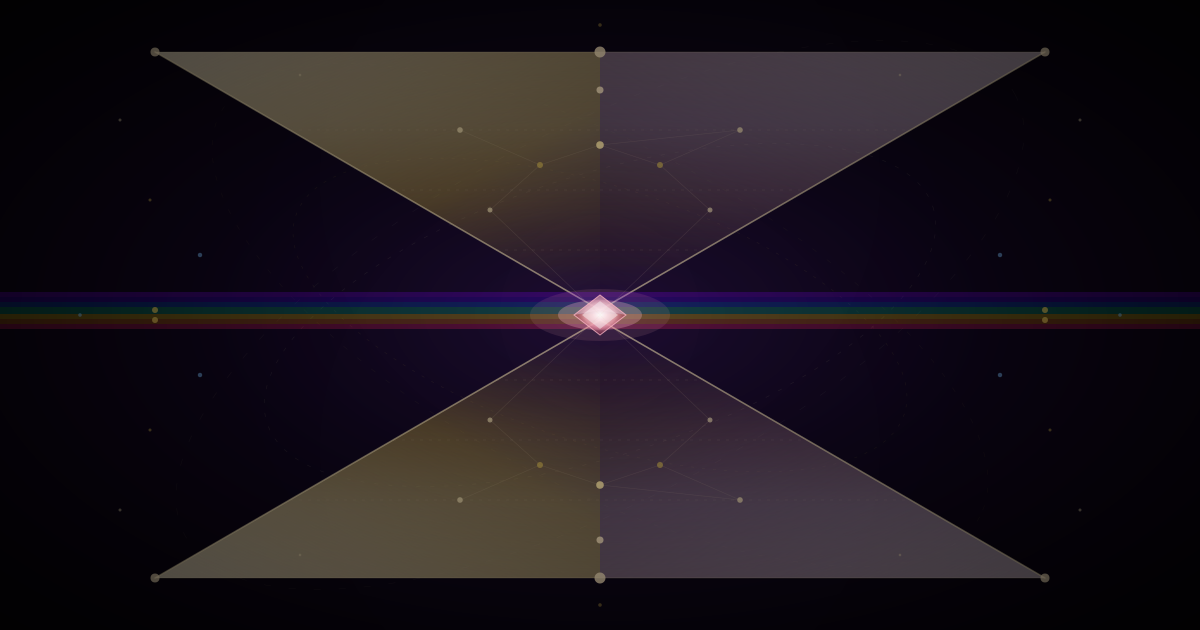
- The Hourglass of Being provides the architecture. The compass is the horizontal cross-section of the Hourglass — both halves always active, four toroidal flows always circulating.
- Common compass profiles are orientations, not types. The Striver, Nurturer, Monk, Survivor, and Balanced profiles describe temporary energetic leanings, not fixed identities.
- The IMP engine fuels all compass movement. Intention, Motivation, and Purpose determine not which direction you move but the quality of that movement.
- The Maslow Compass tool mirrors your current compass position — not to score or rank, but to help you see where your energy is flowing and where it might want to flow next.
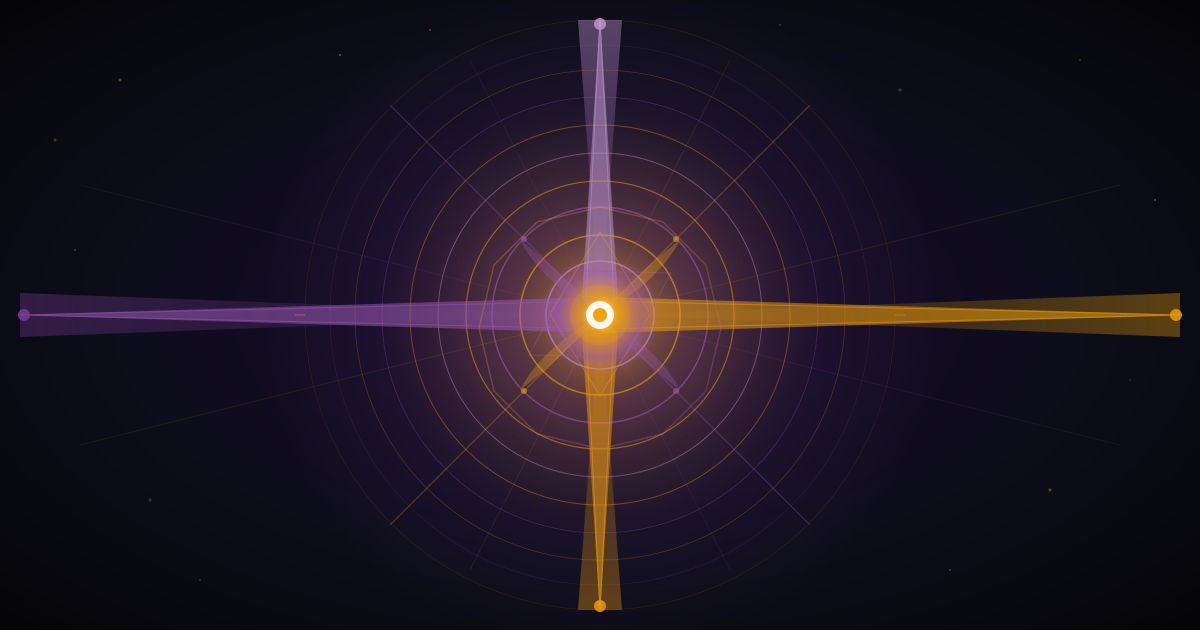
The Maslow Compass. Four directions of human need radiating from a still center — Grounding (south), Connection (west), Expression (east), Transcendence (north). Self-transcendence is not the top of the pyramid but the point from which all directions become possible. Every direction is available at every moment.
Key Takeaways
- Abraham Maslow never drew a pyramid — the familiar triangle was created by a management consultant in 1960 and popularized by textbooks that froze a far more fluid original model.
- In his final writings, Maslow added a sixth level — self-transcendence — above self-actualization, describing a quality of being available to anyone regardless of whether lower needs have been met.
- The Maslow Compass replaces the pyramid's linear climb with four navigable directions — Grounding, Connection, Expression, and Transcendence — each available at any moment.
- Overemphasis on any single direction produces predictable distortions: an overdeveloped Grounding hoards safety, an overdeveloped Transcendence produces spiritual bypassing, and a neglected Expression creates existential vacuum.
- The compass reveals why some people cannot access meditation or transcendent states — neglected Grounding leaves the nervous system without the stable south it needs before turning north.
- Because the four directions operate simultaneously rather than sequentially, genuine development means cultivating inner mobility — the capacity to turn toward whichever direction is calling — rather than ascending a fixed ladder.
1. Beyond the Pyramid
The Most Famous Map That Maslow Never Drew
Here is something that should be better known: Abraham Maslow never drew a pyramid. Not once, in any of his published works. The triangle diagram that bears his name — with its neat colored bands ascending from "physiological needs" to "self-actualization" — was created by a management consultant named Charles McDermid in 1960, five years after Maslow's original paper, and popularized by textbook authors who found the image irresistibly tidy (Kaufman, 2020). Maslow's actual model, as described in Motivation and Personality (1954) and Toward a Psychology of Being (1962), was far more fluid, more recursive, more alive with the complexity of real human experience.
Maslow himself noted, repeatedly, that his hierarchy was not rigid. "We have spoken so far as if this hierarchy were a fixed order," he wrote, "but actually it is not nearly so rigid as we may have implied" (Maslow, 1954, p. 386). He documented cases of people who reversed the order entirely — artists who starved for their craft, putting creation above safety; activists who sacrificed belonging for justice; monks who surrendered esteem in service of something they could not name. He saw these not as exceptions to the theory but as evidence that the "hierarchy" was better understood as a set of prepotent tendencies — general patterns that could be rearranged by individual circumstance, cultural context, and the mysterious gravity of personal calling.
And then, in the last years of his life, he went further.
The Missing Sixth Level
In The Farther Reaches of Human Nature (1971), published posthumously, Maslow began to describe something beyond self-actualization. He called it self-transcendence — the experience of moving beyond the personal self, of identifying with something larger than one's own growth, one's own fulfillment, one's own becoming. Peak experiences, he noted, shared a common feature: they dissolved the boundary between self and world. The musician became the music. The scientist became the inquiry. The caregiver became the care. This was not an achievement stacked on top of previous achievements. It was a qualitative shift in the nature of identity itself.
Scott Barry Kaufman, in his remarkable book Transcend: The New Science of Self-Actualization (2020), documents Maslow's late-life evolution in detail. Kaufman shows that Maslow moved from a "deficiency" model — where lower needs had to be satisfied before higher needs could emerge — toward what he called "Being-motivation" (B-motivation): a kind of motivation that arises not from lack but from fullness, not from what is missing but from what is overflowing. B-motivated action does not seek to fill a hole. It seeks to give from a source that is already whole.
This is the crack in the pyramid that changes everything.
If self-transcendence is real — and Maslow believed it was the most important discovery of his career — then the pyramid's geometry is fundamentally wrong. You cannot place transcendence at the top of a hierarchy and also claim it is available to the monk who has renounced material security, the grieving parent who discovers bottomless compassion in the midst of loss, the child who spontaneously experiences oneness while watching snow fall. Self-transcendence does not require that all other needs be met. It operates on a different axis entirely. It is not the summit. It is the ground.
Why the Pyramid Persists
If the pyramid is this incomplete, why does it dominate? Three reasons.
First, it flatters the narrative of progress. The pyramid tells a comforting story: life is a climb, and if you just keep going, you will reach the top. This maps neatly onto the cultural myth of upward mobility — work hard, satisfy each level in turn, and fulfillment awaits. For a postwar American culture obsessed with achievement and advancement, the pyramid was irresistible. It took the messy, recursive, often paradoxical nature of human development and turned it into a staircase.
Second, it is visually memorable. A triangle with colored bands is easy to reproduce on a PowerPoint slide. A toroidal field of interpenetrating needs with bidirectional flows and a paradoxical center is not. Simplicity won.
Third, it serves institutional power. If needs are hierarchical, then those who control access to lower needs — employers who provide safety, governments that regulate belonging, economies that distribute esteem — hold structural authority over the full range of human motivation. The pyramid says: you cannot access your higher nature until the institution has provisioned your lower nature. A compass says: every direction is available to you right now, regardless of institutional permission. The compass is politically inconvenient.
This is the terrain that Manfred Max-Neef mapped in Human Scale Development (1991) — a taxonomy of human needs that refuses hierarchy altogether, insisting that needs are simultaneous, irreducible, and interactive. It is the terrain that Clare Graves explored in his "Levels of Existence" paper (1970), showing that human consciousness moves not in a straight line but in a spiral, revisiting earlier themes at deeper levels of integration. It is the terrain that Ken Wilber synthesized in Integral Psychology (2000), mapping dozens of developmental models onto a common framework that honors both hierarchy and holarchy — both levels and waves.
The Maslow Compass draws from all of these. But its geometry is simpler and, we believe, more immediately useful. Four directions. One center. Every direction available at every moment.
First live, then philosophize.
— Spanish proverb (after the Latin primum vivere, deinde philosophari)
2. The Four Directions
A Compass, Not a Ladder
Imagine you are standing in an open field. Not climbing. Not ascending. Just standing, with the wind coming from all directions at once. To the south, the earth beneath your feet — solid, heavy, real. To the west, the sound of voices — laughter, argument, song, the hum of others being alive nearby. To the east, a project half-finished, a song half-written, a calling that pulls you toward expression. To the north, a vast sky — open, luminous, stretching beyond what you can name.
This is the compass. Not a hierarchy to climb but a landscape to navigate.
A sailor does not say that north is "better" than south. A navigator does not believe east is "higher" than west. Each direction is necessary. Each direction serves. The question is never which direction is best but which direction is calling right now — and whether you have the inner mobility to turn toward it.
The four cardinal directions of the Maslow Compass are:
Grounding (South) — survival, safety, embodiment, material stability, the relationship with the physical body and the earth. This is Maslow's "physiological" and "safety" needs, but the compass adds something the pyramid missed: the body itself as a field of intelligence, not merely a vehicle for the mind. Grounding includes proprioceptive awareness, nervous system regulation, the capacity to feel safe in the body, not just safe from external threat. As the Hourglass of Being maps it, this is the base of the developmental arc — Safety and Financial Ground — the first two dimensions that form the foundation of all other movement.
Connection (West) — belonging, relationship, community, the capacity to give and receive love. This is Maslow's "belonging" needs expanded into the full ecology of human attachment: not just "do I belong to a group?" but "can I be seen? Can I see others? Can I hold difference without requiring sameness? Can I receive care without performing worthiness?" Connection is the dimension where the spectrum of compassion lives — the full range from self-compassion through interpersonal warmth to universal care. It maps to the Hourglass's Belonging dimension and draws its deepest fuel from the compassion lineage that runs through every wisdom tradition.
Expression (East) — esteem, creativity, purpose, contribution, the drive to bring forth what is uniquely yours. This is Maslow's "esteem" and "self-actualization" collapsed into a single directional energy: the impulse to create, to build, to offer, to shape. Expression includes both the recognition-seeking that Maslow called "lower esteem" (the need to be seen as competent) and the self-sourced creativity he called "upper esteem" and "self-actualization." What the compass reveals is that these are not separate levels but a single direction experienced at different depths. In the Fractal Life Table, Expression maps to Growth and Emotional Resilience — the upper dimensions of the Hourglass's expressive arc.
Transcendence (North) — self-actualization becoming self-transcendence, the capacity to dissolve the boundary between self and other, to experience reality directly without the filter of ego-maintenance. This is Maslow's sixth level — the one the textbooks forgot. In the compass, north is the direction you face when the question shifts from "what do I need?" to "what needs me?" From "what can I get?" to "what can I give?" From "who am I?" to "what am I part of?" Transcendence maps to the Hourglass's Inner Peace dimension and draws from the recognition explored in the 108 Framework: that the center of the compass is Zero — not emptiness as absence but emptiness as infinite potential.
The Four Directions of the Maslow Compass. Each direction contains three layers of depth. All four are available at every moment. The center is not the destination — it is the ground from which all movement arises.
Healthy, Overdeveloped, and Neglected
Each compass direction can be healthy, overdeveloped, or neglected. This is crucial: the compass is not a scoring system where more is always better. A compass needle stuck pointing north is as disoriented as one that never finds north at all.
Grounding — Healthy: You feel safe in your body. Your material life is stable enough that it does not consume your attention. You can sense the earth beneath your feet — literally and metaphorically. You can regulate your nervous system. You eat, sleep, and move in ways that sustain rather than deplete you.
Grounding — Overdeveloped: All energy flows toward security. You hoard resources, over-plan, avoid any risk. The body becomes armor rather than instrument. You are so focused on not falling that you cannot dance. Financial security becomes Financial obsession. The lower dimensions of the Hourglass trap energy in the developmental arc, preventing it from reaching the expressive arc.
Grounding — Neglected: The body is treated as a vehicle to be ignored until it breaks. Sleep is sacrificed for productivity. Nutrition is an afterthought. Safety is assumed until crisis arrives. This is the pattern of the spiritual bypasser who reaches for Transcendence while their nervous system is screaming for attention — and it is the pattern we will meet in the student who could not meditate.
Connection — Healthy: You can give and receive love without performance. Relationships are nourishing rather than draining. You can hold conflict without dissolving. You can be alone without being lonely. You participate in community not from obligation but from genuine warmth. The golden rule operates naturally — you treat others as extensions of yourself because you experience them that way.
Connection — Overdeveloped: Codependency. People-pleasing. Identity dissolved into others. You cannot locate your own needs because you are perpetually attuned to everyone else's. Boundaries collapse. Generosity becomes compulsive rather than free — a pattern the generosity exploration distinguishes carefully from authentic giving. You give not from fullness but from fear of disconnection. And when Connection is so overdeveloped that the self disappears, the harm that arises is rarely intentional — which is precisely why hurt people hurt people: the wound in the giver becomes the wound passed on.
Connection — Neglected: Isolation disguised as independence. "I don't need anyone." Relationships are transactional — useful for networking, dispensable when inconvenient. Emotional intimacy feels dangerous. Community is something other people do. The executive at the summit was here — surrounded by people, connected to none.
Expression — Healthy: You create from inner necessity, not external validation. Your work feels like a contribution rather than a performance. You can receive recognition without depending on it. Purpose is felt as a current moving through you, not a destination you must reach. The IMP engine is aligned — your intention matches your motivation, and both serve a purpose larger than self-advancement.
Expression — Overdeveloped: Workaholism. Identity fused with productivity. Rest feels like failure. Creativity becomes compulsive output rather than organic unfolding. You are the executive at the summit — driven, accomplished, empty. What Martin Seligman described in Flourish (2011) as the trap of "achievement" divorced from meaning — accomplishing without mattering.
Expression — Neglected: Your gifts remain unexpressed. Creativity is suppressed or deferred — "someday, when conditions are right." You consume culture rather than contributing to it. Viktor Frankl's "existential vacuum" (Man's Search for Meaning, 1946) — the suffering that comes not from deprivation but from unexpressed potential. The capacity to create is present but unfed.
Transcendence — Healthy: You experience moments of self-forgetting — in nature, in music, in service, in stillness. The boundary between self and world becomes permeable. You can hold paradox. You serve without keeping score. The five radical realizations are not concepts you believe but territories you have visited. You are not trying to transcend; transcendence happens to you when you stop trying.
Transcendence — Overdeveloped: Spiritual bypassing. Dissociation disguised as enlightenment. You float above your life, chronically ungrounded, using transcendence to avoid the pain of embodiment. As John Welwood described in Toward a Psychology of Awakening (2000), this pattern uses spiritual language to bypass psychological wounds — reaching for the sky while refusing to touch the earth. A. H. Almaas in The Inner Journey Home (2004) maps this precisely: true transcendence includes and integrates all prior dimensions; false transcendence floats above them. The hidden wisdom that the traditions preserve is precisely the antidote: genuine transcendence requires a body willing to be inhabited, not abandoned.
Transcendence — Neglected: Life is flat. Efficient, perhaps. Productive, perhaps. But absent of wonder, absent of the experience Csikszentmihalyi called "flow" (Flow, 1990) — that state where challenge and skill meet so precisely that self-consciousness dissolves and time bends. Without access to the north, everything is task-completion. There is no mystery. No surrender. No sense that you are part of something larger than your own autobiography. The contemplative toolkit exists precisely for this moment — when the north is neglected and the practices to re-open it are needed.
The Student Who Could Not Meditate
She was twenty-three, a graduate student in environmental science, and she had been trying to meditate for three years. Every tradition — Vipassana, Zen, centering prayer, guided visualization. She had read the books, attended the retreats, downloaded the apps. And every time she sat down, closed her eyes, and tried to be still, she felt terror.
Not garden-variety restlessness. Terror. A rising tide of panic that tightened her chest, shortened her breath, and sent her thoughts spiraling into catastrophe. She had been told by one teacher that this was "resistance" and she should push through it. By another that she needed a different technique. By a third that she simply was not trying hard enough.
What nobody had asked her — and what the compass would have revealed immediately — was about her Grounding.
She had grown up in a household where safety was conditional. A volatile parent. Unpredictable evenings. She had learned, very early, that stillness was dangerous — that when things got quiet, something terrible was about to happen. Her nervous system had been calibrated to equate silence with threat.
When she tried to meditate, she was reaching for Transcendence — the north of the compass — without any stable Grounding to support the journey. It was as if she were trying to fly without first being sure the earth would catch her if she fell. The silence she sought was the same silence that, in childhood, had preceded storms.
The compass does not say: meditate harder. The compass says: go south first. Tend your Grounding. Let your nervous system learn, through embodied practice — movement, breath, touch, rhythm — that stillness can be safe. Let the body discover that the ground is reliable. Then, and only then, turn north. Not because north is "higher" and south is "lower" — but because you cannot navigate open sky if you are not sure your feet will hold.
This is what the Hourglass of Being teaches: both halves are always active. The developmental arc (south, the body, the ascending energy of safety and belonging) and the expressive arc (north, the spirit, the descending energy of growth and inner peace) are not sequential but simultaneous. But they can be out of balance. And when Grounding is neglected, reaching for Transcendence does not produce liberation — it produces dissociation. The student was not "failing" at meditation. Her compass was telling her, precisely and compassionately, where her energy needed to go first.
She started walking. Long walks in the woods, slow enough to feel her feet on the ground. She started cooking — not from recipes but by touch and taste, letting her hands find the rhythm. She started a somatic therapy practice where the focus was not on insight but on felt safety in the body. Six months later, she sat down to meditate and the terror did not come. Not because she had conquered it, but because the south of her compass was now populated enough to hold the openness that the north requires.
The compass knows. The question is whether we will listen.
An empty stomach has no ears.
— French proverb (Jean de La Fontaine, after Plutarch)
3. Mapping Your Compass
The Self-Assessment
The compass is not a test. It does not produce a score, a type, a category, or a diagnosis. It produces a mirror. And the value of a mirror is not in the glass but in the willingness to look.
What follows is a guided self-assessment — a set of reflective questions for each compass direction. These are not items on a scale. They are invitations to notice. Read them slowly. Notice which ones produce a physical response — a tightening, a softening, a quickening of attention. The body knows before the mind does.
Grounding (South) — The Body, Safety, Material Life
- When was the last time you felt genuinely safe — not just the absence of threat, but the positive presence of ground?
- How is your relationship with sleep? Do you use it or do you trust it?
- When you sit still, what does your body report? Ease? Tension? Numbness? Vigilance?
- Is your financial life a source of stability or a source of chronic anxiety? Not the amount — the relationship.
- Do you inhabit your body, or do you ride it like a vehicle you are planning to trade in?
Connection (West) — Belonging, Intimacy, Community
- Who, in your life right now, truly sees you? Not your role. Not your function. You.
- Can you ask for help without shame?
- Is there a community — any community — where you feel you belong rather than perform?
- When was the last time you allowed yourself to be fully held — by a person, a group, a landscape?
- Do your relationships nourish you, or do they operate primarily as obligations?
Expression (East) — Creativity, Purpose, Contribution
- What is the thing you would create if no one were watching and no one were paying?
- Does your work feel like contribution or performance?
- When you imagine your life without your title, your role, your accomplishments — what remains?
- Is there a creative impulse you have been deferring? What is it waiting for?
- Do you express your gifts, or do you market your skills?
Transcendence (North) — Surrender, Wonder, Self-Transcendence
- When was the last time you forgot yourself entirely — in nature, in music, in service, in love?
- Can you hold a question without needing to answer it?
- Do you experience moments of awe — genuine awe, the kind that makes the self feel small and the world feel vast?
- Is there a spiritual or contemplative practice in your life? If not, is there a longing for one?
- Can you serve without keeping score?
Sit with these for a while. Not to analyze, but to feel. The compass does not tell you where you should be. It shows you where you are.
Try this now: read through the four sets of questions above. Notice which direction produced the most energy — either the most resonance ("yes, that is alive for me") or the most avoidance ("I don't want to look there"). Both signals are information. The compass direction that pulls you most strongly, and the one you most want to avoid — these are the two edges of your current navigation.
The Fractal Life Table as Compass Refinement
The four compass directions are a simplification — a useful, navigable simplification — of a deeper map. That deeper map is the Fractal Life Table, which lays out seven dimensions of human experience (mapped to the seven energy centers of the body) across multiple columns: Dimension, Shadow Expression, Balanced Expression, Wisdom Tradition, Developmental Stage, and more.
The compass compresses the Fractal Life Table into four navigable quadrants:
| Compass Direction | Fractal Life Table Dimensions | Hourglass Position | |---|---|---| | Grounding (South) | Safety (D1), Financial Ground (D2) | Lower developmental arc | | Connection (West) | Belonging (D3), lower Purpose (D4) | Heart pivot — relational face | | Expression (East) | upper Purpose (D4), Emotional Resilience (D5), Growth (D6) | Upper expressive arc | | Transcendence (North) | Inner Peace (D7) | Crown of the expressive arc | | Center | The Zero point of the 108 Framework | Heart pivot — transcendent face |
Notice: Purpose (D4) appears in both Connection and Expression. This is not an error. Purpose is the heart pivot of the Hourglass of Being — the waist where the two pyramids meet. It has two faces: the relational face (purpose as belonging, purpose as service to the web of life) and the expressive face (purpose as creation, purpose as unique contribution). When your purpose is primarily about relationships, you are navigating Connection. When it is primarily about creation, you are navigating Expression. When both are active simultaneously, you are at the center of the compass.
The Fractal Life Table adds granularity that the compass alone does not provide. If you assess yourself as "weak in Grounding," the Table helps you distinguish whether the issue is primarily Safety (D1 — physical security, nervous system regulation) or Financial Ground (D2 — material stability, relationship with resources). If you assess yourself as "strong in Expression," the Table shows whether that strength is concentrated in Emotional Resilience (D5 — the ability to process and integrate difficult experience) or Growth (D6 — the active expansion of capability and understanding). The compass tells you the direction. The Table tells you the terrain within that direction.
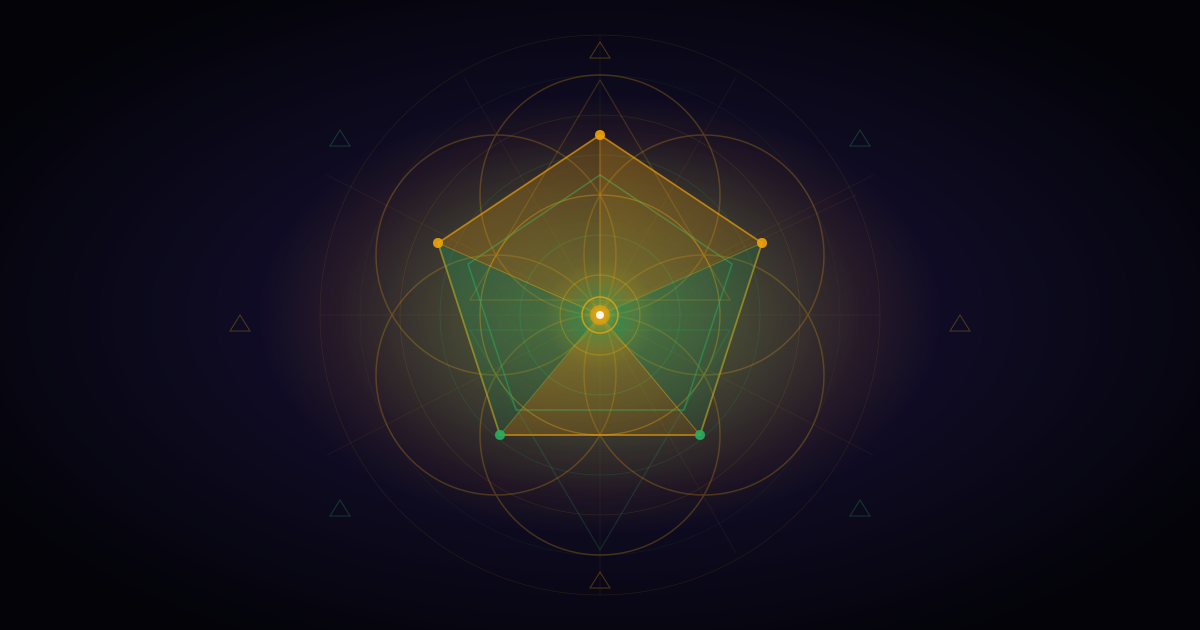
The Compass and the Table. Each compass direction contains specific Fractal Life Table dimensions. Purpose (D4, green) bridges Connection and Expression — the heart pivot where the relational and creative faces of meaning meet.
Common Compass Profiles
A compass profile is a snapshot — a description of where your energy tends to concentrate at a given point in your life. It is not a personality type. It is not fixed. It is not a box. It is more like a weather report: this is what the wind is doing today. Tomorrow it may shift.
We offer five common profiles not as categories but as mirrors — recognizable patterns that many people encounter at various stages of their lives. If one resonates, let it illuminate rather than define.
The Striver — Dominant direction: East (Expression). Secondary: South (Grounding). The Striver's energy flows primarily toward creation, achievement, and contribution. Grounding is maintained instrumentally — the body is kept functional so it can serve the work. Connection and Transcendence are often underdeveloped. The Striver builds impressive things and sometimes wonders, in the quiet moments, for whom. The executive at the summit was a Striver. The IMP analysis for this profile often reveals that intention is clear but purpose has drifted toward self-advancement without the person noticing.
The Nurturer — Dominant direction: West (Connection). Secondary: South (Grounding). The Nurturer's energy flows toward relationship, community, and care. They are often extraordinarily attuned to others' needs and remarkably blind to their own. Expression is frequently deferred — "I'll write that book after the kids are grown." Transcendence may be accessed through relationship rather than solitude. The risk is codependency, burnout, and the slow erosion of self that comes from chronic other-orientation without reciprocity. The paying-it-forward pattern, when healthy, is this profile at its best — generosity as overflow, not as depletion.
The Monk — Dominant direction: North (Transcendence). Secondary: East (Expression). The Monk's energy flows toward inner experience, contemplation, and the direct encounter with mystery. Expression may be strong — many Monks are artists, writers, or musicians — but the fuel is interior. Grounding and Connection are the risk areas. The student who could not meditate had Monk aspirations with insufficient Grounding. When this profile works beautifully, it produces the kind of presence that changes a room simply by entering it. When it is unbalanced, it produces the spiritual bypasser — detached, floating, unable to meet the world on its own terms.
The Survivor — Dominant direction: South (Grounding). Secondary: West (Connection). The Survivor's energy is consumed by safety and stability — often for good reason. When the nervous system is in survival mode, resources flow downward automatically. Expression and Transcendence feel like luxuries. The five veils are thickest here — not because the person is less conscious but because the veil of material urgency makes it genuinely difficult to attend to anything beyond the immediate. The compass does not judge the Survivor. It says: this is where your energy is, and it is there for a reason. Tend it. And know that the other directions are waiting when safety becomes stable enough to release some energy upward.
The Balanced — No single dominant direction. Energy circulates. This is not a permanent state but a temporary equilibrium — a moment when all four directions are receiving adequate attention and the center is accessible. Nobody lives here permanently. But everyone visits. The Balanced profile is what Seligman (2011) calls "flourishing" — not the maximization of any single dimension but the harmonious interplay of all of them. The Hourglass calls this the state where all four toroidal flows are circulating freely.
A necessary warning: These profiles are heuristic, not diagnostic. They are compasses, not cages. The moment you say "I am a Striver" and stop there, you have turned a mirror into a mask. The compass asks not "what are you?" but "where is your energy moving?" — and that question must be asked freshly, repeatedly, with the genuine curiosity of someone who does not already know the answer.
4. The Compass in Motion
The Four Toroidal Flows
A compass that only shows static positions would be useful but incomplete. Human beings are not static. Energy moves. The question is: in what patterns?
The Hourglass of Being introduces four toroidal flows — four directions of energy circulation that are always active, always interpenetrating, always in dynamic relationship. The compass is the horizontal cross-section of the torus; the flows are what moves through it.
Inner Upward Flow — Energy moves from Grounding toward Transcendence through the interior of the self. This is the developmental arc: the child learning to walk, the adult building competence, the elder discovering wisdom. It is the movement from survival to safety to belonging to purpose to growth to inner peace. The Hourglass maps this as the ascending energy within the lower pyramid — the journey from base to heart pivot and beyond. When this flow is healthy, it feels like building, growing, becoming. When it is blocked, it feels like stagnation — the sense that no matter what you do, you are not developing.
Inner Downward Flow — Energy moves from Transcendence toward Grounding through the interior of the self. This is what the Hourglass calls "catching falling knives" — the experience of insight, inspiration, or spiritual opening descending into the body and meeting resistance: old wounds, unprocessed grief, stored trauma. The inner downward flow is the reality check. It is what happens when the meditator, in a moment of genuine opening, suddenly encounters a childhood memory that brings tears. It is integration — the most difficult and most necessary of all the flows. Without it, transcendent experiences remain disembodied. The cycle of harm often activates when this downward flow is resisted.
Outer Upward Flow — Energy moves from the self outward and upward through service, creation, and offering. This is Expression flowing toward Transcendence — the artist who loses herself in the work, the teacher who gives so fully that the boundary between teacher and student dissolves, the caregiver whose care becomes prayer. The outer upward flow is generosity in action — the movement from personal gift to universal offering. The toroidal economy is this flow applied to the collective.
Outer Downward Flow — Energy moves from the world inward and downward, grounding the self through received love, community support, and the simple grace of being held. This is Connection nourishing Grounding — the friend who brings soup when you are ill, the community that gathers around a family in crisis, the landscape that holds you when no human can. The outer downward flow is the one our individualist culture most neglects, because it requires the willingness to receive. It is the counterflow to the collaboration geometry — not the giving side of interdependence but the receiving side.
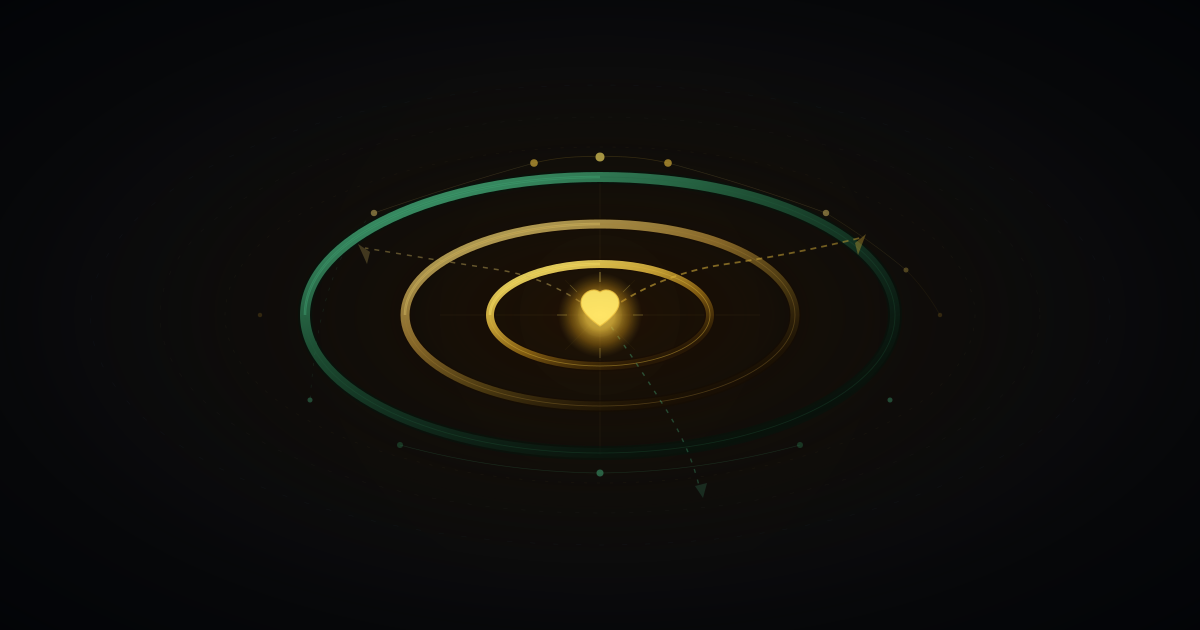
All four flows operate simultaneously. They form a torus — a donut-shaped field where energy circulates continuously from inner to outer, from upward to downward, never stopping, never arriving, always in motion. The compass shows you where the energy is concentrated at any given moment. The flows show you how it is moving.
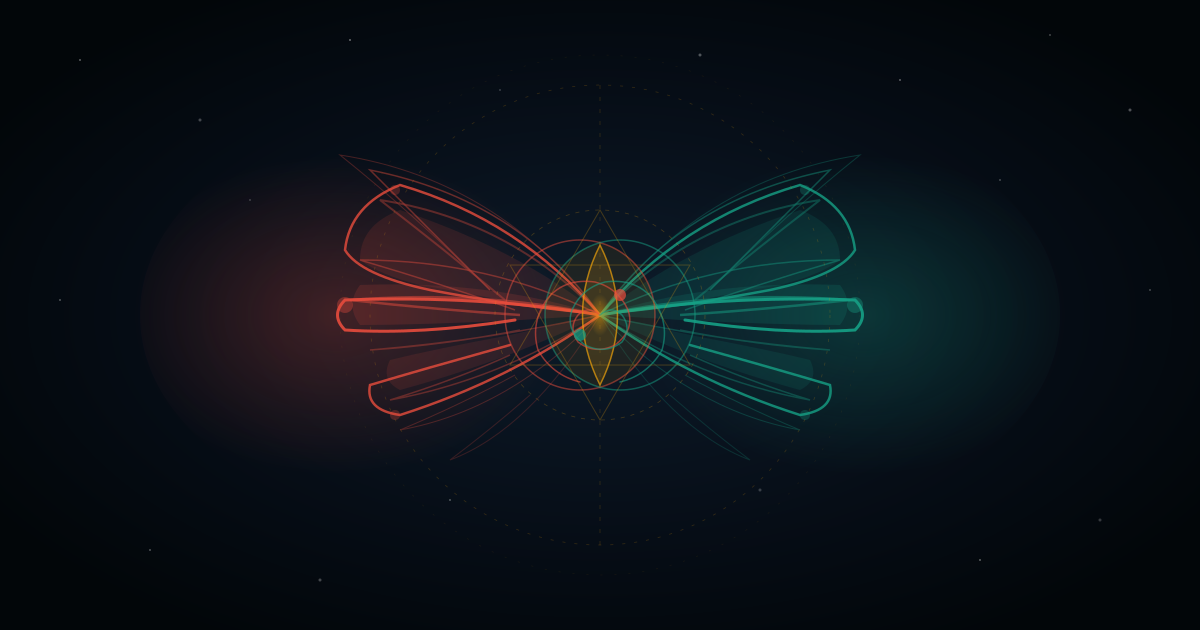
The Four Toroidal Flows. Energy circulates continuously — inner upward (developmental), inner downward (integration), outer upward (offering), outer downward (receiving). The compass is the cross-section; the torus is the full field.
The IMP Engine
The flows move energy through the compass. But what determines the quality of that movement? What makes the difference between a Striver whose Expression is fueled by genuine calling and a Striver whose Expression is fueled by existential terror?
The answer is IMP: Intention, Motivation, and Purpose.
IMP is the compass fuel. It does not change which direction you move — circumstances, temperament, and life stage do that. But it changes how you move in that direction. It changes the texture, the sustainability, and the ultimate impact of the movement.
Consider Grounding fueled by different IMP patterns:
- Intention: "I want to be safe" vs. "I want to build a foundation from which I can serve."
- Motivation: Fear-driven (deficiency motivation) vs. Care-driven (Being-motivation).
- Purpose: Self-preservation vs. Creating stability that supports not only myself but those I love.
Same direction. Same compass point. Completely different inner experience. The first pattern produces hoarding, rigidity, and the paradox of security that never feels secure enough. The second produces the kind of grounded presence that others instinctively trust — not because it is performing strength, but because it genuinely has roots.
IMP operates in every direction:
- Connection fueled by fear: People-pleasing, approval-seeking, relationships as insurance policies against loneliness.
- Connection fueled by love: The willingness to be truly seen, to offer presence without agenda, to stay in the room when the conversation gets difficult.
- Expression fueled by deficiency: Proving, performing, achievement as identity repair.
- Expression fueled by Being-motivation: Creating because the creation wants to exist — because the offering is its own reward, as the generosity standard explores.
- Transcendence fueled by avoidance: Spiritual bypassing, dissociation, using the sky to flee the ground.
- Transcendence fueled by fullness: Surrender that arises not from depletion but from overflow — the natural movement of a cup that is already full.
The IMP analysis transforms the compass from a map of where you are into a mirror of how you are. It is the difference between knowing you are traveling east and knowing whether you are running toward something or running away from something. Both look the same from the outside. Only IMP tells you what is actually happening on the inside.
Life Circumstances Shift the Compass
The compass is dynamic. It moves. A job loss shifts energy toward Grounding. A new relationship shifts energy toward Connection. A creative breakthrough shifts energy toward Expression. A loss, a birth, an encounter with mortality shifts energy toward Transcendence.
This is not failure. This is navigation.
The pyramid tells you that if life pushes you "back down" to safety concerns, you have regressed. The compass says: you have turned south. The wind changed. Adjust your sails. You are still on the sea. You are still moving. The five radical realizations map directly onto compass movements — each realization shifts which direction becomes most alive, most necessary, most urgent.
Some life events rotate the compass entirely. Parenthood often swings energy from Expression toward Connection and Grounding simultaneously. Retirement often releases energy from Expression toward Transcendence — or, if the person's identity was fused with their work, toward crisis. Grief can move all energy toward the center — toward the still point where categories dissolve and the only honest response is presence. The thermodynamics of compassion shows why: emotional energy is not destroyed by loss — it is transformed, redistributed, redirected through the whole system.
The compass does not tell you what to do with these shifts. It mirrors them. And in the mirroring, something becomes possible that the pyramid never allowed: the recognition that there is no wrong direction. There are only neglected directions, overdeveloped directions, and the wisdom to tell the difference.
5. Using the Tool
The Maslow Compass at heartofpeace.org
The Maslow Compass tool at heartofpeace.org takes the self-assessment you just practiced and translates it into a visual compass reading. Here is what to expect when you use it.
Step 1: Reflective Questions. The tool presents a set of questions — drawn from the same territory we explored above, but refined into a format you can respond to with felt-sense rather than analytical thought. For each question, you indicate not "how much" but "how alive" — how present this dimension is in your current experience. The tool does not use numerical scales. It uses warmth — a visual spectrum from cool to warm, mirroring the felt quality of attention rather than the quantity.
Step 2: The Compass Reading. Based on your responses, the tool generates a four-directional compass visualization. Each direction extends outward from the center in proportion to how alive that dimension is in your life right now. The shape that emerges is your compass profile — not a score, not a grade, but a shape. Some shapes are elongated (energy concentrated in one or two directions). Some are roughly circular (energy distributed across all four). Some are surprisingly asymmetric (revealing a neglected direction you may not have noticed).
Step 3: The Compass Narrative. Below the visualization, the tool offers a brief narrative — not a diagnosis, but a reflection. "Your energy appears concentrated in Expression and Grounding, with Connection and Transcendence less activated. This is a common pattern for people in periods of intensive creative work. The invitation is not to change the pattern but to notice it — and to ask whether the less-activated directions are waiting to be tended."
Step 4: The Compass Practices. Based on your reading, the tool suggests specific practices for each direction — drawn from the micro-practices collection and the broader Technologies of the Heart practice library. A neglected Grounding direction might receive a suggestion for embodied movement or somatic breathing. A neglected Connection direction might receive a suggestion for intentional eye contact or a community meal. A neglected Transcendence direction might receive a suggestion for a contemplative walk or a session with the compassion assessment.
The Maslow Compass tool. Your responses generate a four-directional compass profile — a shape, not a score. Suggested practices flow from the compass reading, bridging assessment into action.
From Compass to Practice
The compass is a mirror. But a mirror, by itself, changes nothing. The change happens in what you do after looking.
Three bridges connect the Maslow Compass to lived practice:
Bridge 1: The Compassion Assessment. The compassion assessment is a complementary tool that measures a different axis — not the direction of your needs but the depth of your compassion response. Together, the two tools create a more complete picture: where your energy flows (compass) and what quality of awareness flows with it (compassion). A person with strong Expression and weak compassion may be a brilliant builder who unconsciously harms. A person with strong compassion and weak Expression may be deeply caring but unable to bring their gifts into the world. The two assessments illuminate each other.
Bridge 2: The Micro-Practices Morning Protocol. The micro-practices article offers a menu of small, daily practices organized by compass direction. A compass-based morning practice might look like this: check your compass reading from the tool (or simply sense into the four directions intuitively). Identify the direction that feels most neglected today. Choose one micro-practice from that direction and commit to it — not as a should, but as an experiment. Five minutes. One direction. One practice. Let the compass rotate your attention across the week so that no direction stays neglected for long.
Bridge 3: The Dual Challenge. The dual challenge offers a weekly structure — a compass-themed focus area that pairs an inner practice with an outer action. Week one: Grounding (inner: somatic check-in; outer: tend one material need). Week two: Connection (inner: forgiveness meditation; outer: reach out to one person you have neglected). Week three: Expression (inner: free-write; outer: offer one gift to the world). Week four: Transcendence (inner: stillness practice; outer: one act of anonymous service). The compass gives the direction. The dual challenge gives the structure.
Together, these bridges turn the compass from a moment of self-reflection into an ongoing practice of self-navigation — a way of tending all four directions across time, so that no dimension of your being withers from inattention.
The Center of the Compass
We have explored the four directions. We have mapped them to the Fractal Life Table and the Hourglass of Being. We have watched the four toroidal flows circulate through them. We have seen how IMP determines the quality of movement. We have met the executive who overdeveloped Expression and the student who reached for Transcendence without sufficient Grounding.
But we have not yet spoken about the center.
In the 108 Framework, the center is Zero — not emptiness as absence but emptiness as the ground of all possibility. In the Hourglass, the center is the heart pivot — the membrane where the developmental arc and the expressive arc meet, where ascending and descending energy cross, where the inner becomes the outer and the outer becomes the inner.
In the Maslow Compass, the center is self-transcendence.
Not as a direction you travel toward. Not as an achievement you earn by developing all four directions equally. Not as the "highest" point in a disguised hierarchy. But as the still point from which all movement begins and to which all movement returns. The compass rose has a center. The sailor does not navigate to the center. The sailor navigates from it.
Self-transcendence, as Maslow glimpsed in his final years, is not a level. It is a quality of presence that can infuse any level. The parent who transcends self-concern while changing a diaper at 3 a.m. The artist who disappears into the work. The grieving person who discovers, in the depths of loss, a compassion so vast it includes the whole world. The person in survival mode who, against all logic, shares their last meal. These are not people who have "reached" transcendence after climbing through the lower levels. They are people who, in that moment, are standing at the center of the compass — the place where direction dissolves and only presence remains.
The center of the compass is the Zero of the 108 Framework. It is the heart pivot of the Hourglass. It is the place where oneness is not a concept but an experience. It is not somewhere you go. It is where you already are when you stop going.
The Maslow Compass does not promise you will find the center. It promises that the center is always there — the point from which your compass needle hangs, the gravity that makes direction possible, the stillness at the axis of every turn.
Invitation
You have always had a compass. It was never a pyramid. It was never a ladder. It was never a sequence of boxes to check on the way to some imaginary summit where fulfillment waits with a gold medal and a glass of champagne.
It was always this: four directions, each sacred, each necessary, each available right now. South — the body, the ground, the earth that holds you. West — the others, the community, the warmth of being seen and seeing. East — the gift, the creation, the offering that only you can make. North — the sky, the mystery, the dissolution of the small self into something immeasurably vast.
And at the center, the stillness. Not the absence of movement but the presence from which all movement arises.
You do not need to be balanced to use the compass. You do not need to have all four directions equally developed. You do not need to be whole — whatever that means. You only need to be willing to look. To ask: where is my energy flowing? Where has it been stuck? Where is it longing to go?
The compass does not judge your answer. It mirrors it. And in the mirroring, something becomes possible that judgment never allows: honest navigation.
The Maslow Compass tool is available now, free, at heartofpeace.org. Use it. Return to it. Let it show you something you did not expect. And then — turn toward whatever direction is calling you, with whatever IMP is most authentically yours.
You are not climbing. You are navigating. And the sea is wide, and the directions are many, and the compass is already in your hands.
People Also Ask
What is the Maslow Compass? The Maslow Compass is a reimagination of Maslow's hierarchy of needs as four navigable directions — Grounding (survival, safety, embodiment), Connection (belonging, relationship, community), Expression (esteem, creativity, purpose), and Transcendence (self-actualization, self-transcendence, surrender) — all available at every moment, with self-transcendence at the center rather than the peak. It draws on Maslow's own late-life revisions, Kaufman's Transcend (2020), the Fractal Life Table, and the Hourglass of Being.
Why is Maslow's pyramid wrong? The pyramid is not entirely wrong — it correctly identifies real human needs. But its geometry is misleading. Maslow never drew a pyramid; it was created by others. The rigid hierarchy implies you cannot access "higher" needs without securing "lower" ones, which contradicts abundant evidence: artists create while hungry, caregivers serve while grieving, monks transcend while materially destitute. Maslow himself acknowledged these exceptions and, late in life, added self-transcendence — a level the pyramid cannot accommodate.
What is self-transcendence in Maslow's hierarchy? Self-transcendence is the sixth level Maslow proposed in The Farther Reaches of Human Nature (1971), beyond self-actualization. It describes the experience of moving beyond personal self-concern to identify with something larger — humanity, nature, the sacred, the whole. In the Maslow Compass, self-transcendence is not placed at the top (which would reinforce the hierarchy) but at the center — the still point from which all four directions radiate. See also the oneness article for a deeper exploration.
How do I assess my needs without a hierarchy? The Maslow Compass self-assessment asks not "which level are you on?" but "which direction is most alive in your life right now?" For each compass direction (Grounding, Connection, Expression, Transcendence), you reflect on a set of questions about how present and nourished that dimension feels. The Maslow Compass tool translates your reflections into a visual compass profile — a shape, not a score.
What are the four directions of human development? Grounding (South) encompasses survival, safety, and embodiment. Connection (West) encompasses belonging, relationship, and community. Expression (East) encompasses esteem, creativity, and purpose. Transcendence (North) encompasses self-actualization, self-transcendence, and surrender. These four directions map to the seven dimensions of the Fractal Life Table and the two arcs of the Hourglass of Being.
What is the Hourglass of Being? The Hourglass of Being is the three-dimensional architecture from which the Maslow Compass is derived. It reimagines Maslow's pyramid as two pyramids joined at a heart pivot — one ascending (developmental) and one descending (expressive) — with four toroidal flows circulating energy continuously. The compass is the horizontal cross-section of this hourglass, showing the four directions at any given moment.
How does the Fractal Life Table relate to Maslow? The Fractal Life Table maps seven dimensions of human experience (Safety, Financial Ground, Belonging, Purpose, Emotional Resilience, Growth, Inner Peace) across multiple columns drawn from dozens of developmental frameworks. The Maslow Compass compresses these seven dimensions into four navigable directions, making the Table's depth accessible for everyday self-assessment while preserving its essential structure.
Can you experience self-actualization while struggling with basic needs? Yes — and this is precisely why the pyramid fails. Maslow himself documented cases of people who reversed the hierarchical order. The compass explains this naturally: all four directions are always available. A person in survival mode (strong Grounding needs) can still experience moments of Transcendence, Connection, or creative Expression. The direction of energy at any moment depends on context, temperament, and what the IMP engine is fueling — not on whether "lower" needs have been formally satisfied.
References
Almaas, A. H. (2004). The Inner Journey Home: The Soul's Realization of the Unity of Reality. Shambhala Publications.
Csikszentmihalyi, M. (1990). Flow: The Psychology of Optimal Experience. Harper & Row.
Frankl, V. E. (1946/2006). Man's Search for Meaning. Beacon Press.
Graves, C. W. (1970). Levels of existence: An open system theory of values. Journal of Humanistic Psychology, 10(2), 131-155.
Kaufman, S. B. (2020). Transcend: The New Science of Self-Actualization. TarcherPerigee.
Maslow, A. H. (1954). Motivation and Personality. Harper & Row.
Maslow, A. H. (1962). Toward a Psychology of Being. Van Nostrand.
Maslow, A. H. (1971). The Farther Reaches of Human Nature. Viking Press.
Max-Neef, M. A. (1991). Human Scale Development: Conception, Application and Further Reflections. Apex Press.
McCraty, R., Atkinson, M., Tomasino, D., & Bradley, R. T. (2009). The coherent heart: Heart-brain interactions, psychophysiological coherence, and the emergence of system-wide order. Integral Review, 5(2), 10-115.
Seligman, M. E. P. (2011). Flourish: A Visionary New Understanding of Happiness and Well-Being. Free Press.
Welwood, J. (2000). Toward a Psychology of Awakening: Buddhism, Psychotherapy, and the Path of Personal and Spiritual Transformation. Shambhala Publications.
Wilber, K. (2000). Integral Psychology: Consciousness, Spirit, Psychology, Therapy. Shambhala Publications.
The Heart of Peace Foundation builds technologies of the heart — tools and practices for the inner life of individuals and communities. The Maslow Compass, Compassion Assessment, and all our interactive tools are free and always will be. Visit heartofpeace.org to explore.